
A lot of advisory firms are in the same spot right now. Referrals still matter, but pipeline consistency is uneven, organic traffic takes time, and the prospects showing the strongest intent are already searching for an advisor on Google. The problem isn't whether demand exists. The problem is launching paid search without creating compliance risk, wasting budget on low-fit clicks, or filling the CRM with junk submissions.
That's why Google Ads for financial advisors has to start with governance, not keyword volume. A compliant campaign isn't a watered-down campaign. It's a tighter one. It uses approved language, service-specific targeting, disciplined landing pages, and conversion tracking tied to qualified opportunities instead of raw form fills. That structure protects the firm and usually produces cleaner lead flow.
Table of Contents
- Navigating the Google Ads Opportunity with Compliance in Mind
- The Foundation for Compliant Campaign Planning
- A Keyword Strategy for High Intent and Low Waste
- Crafting Ad Copy That Converts and Complies
- Designing High Conversion and Compliant Landing Pages
- Managing Bids Budgets and Measuring True ROI
- Optimizing and Scaling Campaigns for Long Term Growth
Navigating the Google Ads Opportunity with Compliance in Mind
A prospect searching for retirement planning help isn't browsing casually. That person usually has a live problem, a deadline, or dissatisfaction with a current relationship. Search traffic matters because it captures demand that already exists.
The demand is increasingly mobile and increasingly immediate. Mobile searches for the term "financial advisor" have surged by 75% over the last two years, over 60% of all Google Ads clicks now come from mobile devices, and 46% of people making these searches are actively planning to change providers or add a new advisory relationship within the next two years, according to Altruist's analysis of Google Ads for financial advisors. That changes how campaigns need to be built. Speed, clarity, and trust have to show up on a small screen, fast.
Search also works differently from most outbound channels. The audience is self-identifying through the query. Someone searching "401k rollover help" or "financial advisor near me" has already narrowed the problem. The campaign doesn't need to manufacture intent. It needs to meet intent with compliant relevance.
Why compliance improves targeting
Many advisors treat paid search as a trade-off between growth and regulatory exposure. That's the wrong frame. In a regulated category, compliance acts like a filter. It forces the firm to define exactly which services it offers, who it can legitimately help, and what claims can be supported.
Practical rule: The safest campaign is usually the one with the clearest service scope, the narrowest message, and the least room for interpretation.
That discipline improves performance. Broad promises attract the wrong click. Vague positioning creates low-confidence visits. A compliance-first approach strips out both.
For firms investing in digital marketing in financial services, Google Ads works best when every step answers one question: would compliance, operations, and the advisor all be comfortable standing behind this claim, keyword, and call to action?
What the right campaign is built to do
A strong campaign doesn't try to be all things to all searchers. It should:
- Match a real service need such as retirement planning, rollover guidance, or tax-aware planning
- Use language the firm can substantiate without implied guarantees
- Set expectations early so lower-fit clicks self-select out
- Create a clean handoff from ad click to approved landing page to qualified lead review
That's the playbook. Not more traffic at any cost. Better intent, cleaner compliance posture, and lead data that can be trusted.
The Foundation for Compliant Campaign Planning
Most failed campaigns are flawed before the first impression is served. The account structure is messy, the targeting is too broad, the services are lumped together, and the compliance review happens after copy is already written. That order creates rework and weakens the campaign.
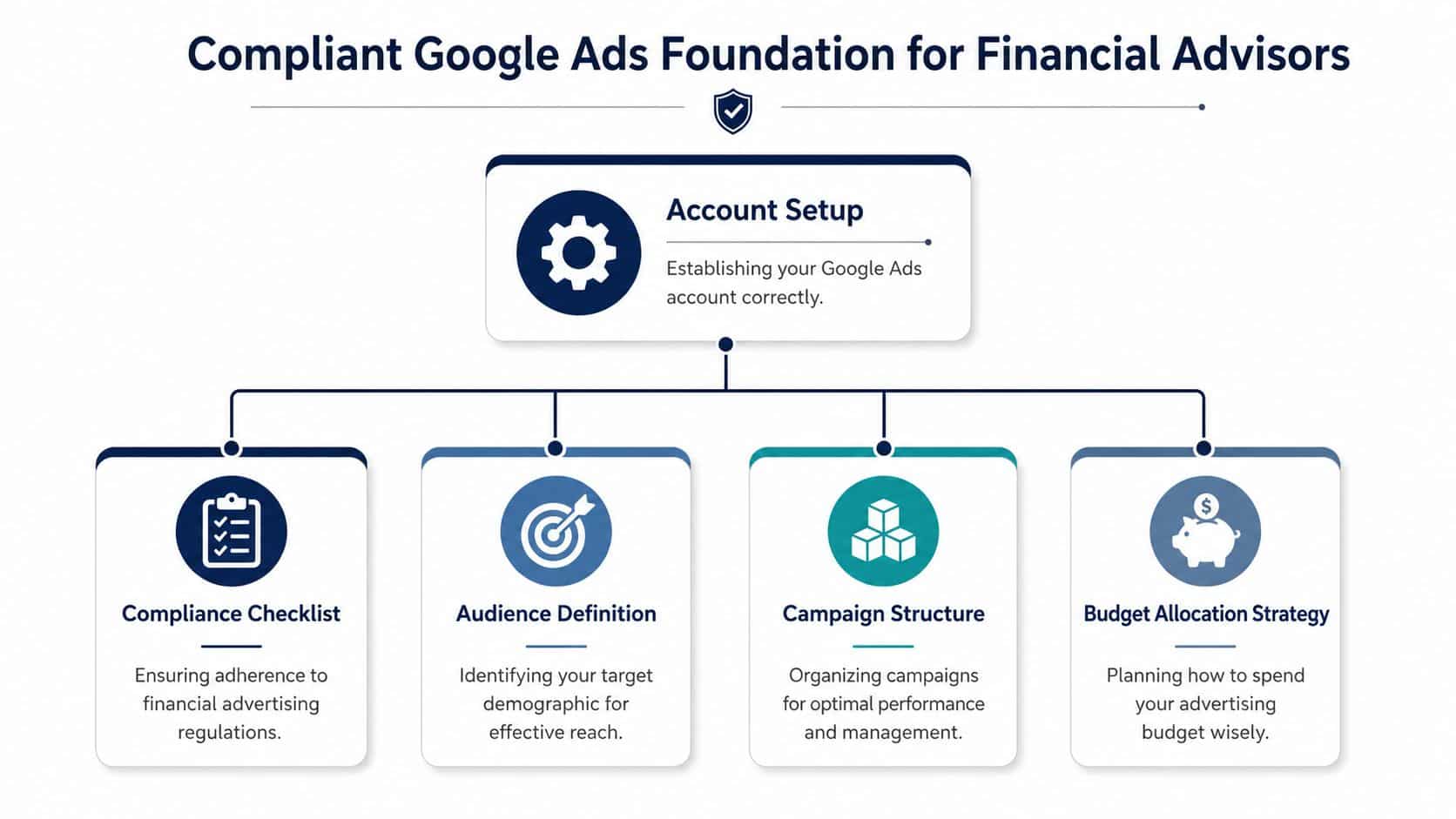
The better approach is to structure the account around approved services and controllable review points.
Build campaigns around services, not personas
Start with the firm's actual revenue lines and approved messaging. Separate campaigns by service category such as retirement planning, investment management, rollover help, or tax strategy if those offerings are clearly defined and supported by the firm's compliance framework.
This matters for two reasons. First, it keeps ad copy aligned with a specific landing page. Second, it simplifies internal review because each campaign has one intent, one claim set, and one conversion path.
A practical structure often looks like this:
- One campaign per core service
- One ad group per close keyword theme
- One landing page per service promise
- One approval trail for each ad and page variation
That layout is easier to audit. It's also easier to pause, revise, or expand without disrupting unrelated campaigns.
Use compliant targeting inputs
Google's policy changes narrowed what financial marketers can do with audience targeting. Google updated its advertising policy in late February 2024 to prohibit targeting based on "sensitive interest categories," which means financial marketing teams need to avoid granular demographic filters such as age, gender, and specific zip codes that were previously used to target affluent audiences, as outlined in Mindgruve's summary of updated Google Ads rules for finance companies.
That shifts the planning model. Instead of relying on demographic assumptions, the campaign should lean on:
- Search intent through tightly grouped keywords
- Geographic relevance based on actual service area
- Service specificity through direct offer alignment
- Device experience so the page works cleanly on mobile and desktop
The query is now the strongest targeting signal in many advisor campaigns. That's a good thing. Search intent is usually more useful than assumed demographic fit.
Set approval checkpoints before launch
Compliance-first execution needs approval gates, not just approval at the end. Before launch, the firm should define who signs off on each of these items:
| Review Area | What needs approval |
|---|---|
| Campaign naming | Service labels that accurately reflect the offer |
| Keyword themes | Terms that match approved business activities |
| Ad copy | Headlines, descriptions, calls to action |
| Landing pages | Page copy, disclosures, form fields, linked documents |
| Conversion definitions | Which actions count as meaningful outcomes |
This is also the right stage to decide who owns changes after launch. If marketing can edit headlines but not offer language, that boundary should be documented before campaigns go live.
A firm can manage this internally, through an agency, or through a specialized provider such as Advisor Momentum when outside execution support is needed for compliant paid search. The model matters less than the workflow. What matters is that nobody is improvising claims, targeting, or conversion logic after spend starts.
A Keyword Strategy for High Intent and Low Waste
Keyword selection decides who gets invited into the funnel. If the list is loose, the campaign buys curiosity clicks, student traffic, job seekers, and people looking for free answers. If the list is tight, it buys commercial intent.
For Google Ads for financial advisors, keyword strategy should start with service intent, not keyword volume. The question isn't which terms get the most searches. The question is which terms reveal a person who may hire an advisor.

Separate decision intent from research intent
Not all relevant keywords deserve budget. Some belong in paid search. Others belong in content.
High-intent commercial searches often include direct service language such as:
- Advisor plus location like "financial advisor near me"
- A planning need like "retirement planning help"
- A transactional event like "401k rollover advice"
- Time-sensitive planning such as Q4 tax strategy queries
By contrast, broad educational searches can be useful for content strategy but often create weaker paid traffic. Someone looking for general investment education may not be ready to speak with an advisor. That click can still have value, but it shouldn't consume the same budget as a rollover or local-advisor query.
Match types should protect budget
Campaigns in regulated categories need tighter control, especially early. Exact and phrase match usually make more sense than broad matching because they reduce ambiguity. That gives the team a cleaner search term report and a smaller review burden.
The account should also separate branded and non-branded intent if both are being used. Mixing them hides performance differences and distorts lead quality analysis.
A keyword isn't good because it sounds related. It's good when the underlying search behavior matches the firm's service, geography, and intake standards.
Negative keywords are not optional
Negative keywords are one of the fastest ways to reduce waste. In advisor campaigns, irrelevant searches often cluster around free information, education, training, hiring, and career exploration.
The most common early exclusions include:
- Free because free-advice searches rarely align with paid advisory relationships
- Jobs to block employment traffic
- Training to exclude certification and coursework queries
- Salary to avoid career research
- DIY terms if the firm isn't trying to attract self-directed investors
A practitioner discussion in the PPC community noted that failing to use negative keywords to block irrelevant searches such as "free advice," "jobs," or "training" can improve campaign efficiency by 20% to 40%, and tracking every form fill as a conversion can inflate reported success by up to 90% because of rubbish leads or bot submissions, based on this Reddit PPC thread on Google Ads for a financial advisor.
A simple qualification lens
Before adding a keyword, run it through three filters:
| Filter | Question |
|---|---|
| Service fit | Does the search clearly relate to an approved advisory service? |
| Buyer intent | Is the user likely seeking help, not just information? |
| Landing page match | Can the click be sent to a page that directly answers the query? |
If a keyword fails any one of those tests, it probably doesn't belong in the campaign.
Crafting Ad Copy That Converts and Complies
Ad copy is where many advisor campaigns break. The offer sounds sharper in the writer's head than it does in compliance review, so the copy drifts into implication. Returns are hinted at. Risk is minimized. Superiority is asserted without support. Then the ad gets rejected internally, flagged externally, or approved with language so diluted that it stops earning clicks.
The fix isn't bland copy. The fix is precise copy.
The approval standard is clear
Under SEC Marketing Rules and FINRA Rule 2210, retail communications including paid search ads must be approved by a registered principal before first use, and ad copy must avoid promissory language such as "guaranteed returns" or "risk-free" while ensuring performance claims are sourced and verifiable, as explained in Wolf Financial's overview of ad compliance review for financial marketing.
That standard should shape the writing from the first draft. Paid search ads are short. Every phrase has to do one job. That means the best compliant ads usually focus on service clarity, audience relevance, and process confidence rather than outcome promises.
What compliant copy sounds like
A good advisor ad can still be persuasive. It just needs to persuade through fit and professionalism.
That usually means emphasizing:
- Who the firm serves
- What planning area is addressed
- What the next step is
- How the relationship is framed, such as consultation, review, or planning discussion
It should avoid unsupported claims of superiority, certainty, or performance.
Copy test: If the ad would be difficult to defend in a compliance file six months from now, it shouldn't run today.
Compliant vs. Non-Compliant Ad Copy Examples
| Service | Non-Compliant Example (Avoid) | Compliant Alternative (Use) |
|---|---|---|
| Retirement Planning | Guaranteed income planning for retirement | Retirement planning tailored to your goals |
| Investment Management | Risk-free wealth growth strategies | Disciplined investment management approach |
| 401(k) Rollovers | Maximize rollover returns today | Guidance for evaluating 401(k) rollover options |
| Tax Strategy | Cut your tax bill fast | Tax-aware planning for year-end decisions |
| General Advisory | Best financial advisor in your area | Fiduciary guidance for individuals and families |
A workable internal review process
The smoothest review workflows are simple and documented. The team should route every ad through the same sequence:
- Draft against approved service language
- Check for prohibited phrasing
- Confirm any factual claim can be verified
- Submit for principal review before use
- Archive approved versions with dates
That archive matters. Search ads change often. Without version control, firms lose track of what was approved and what ran.
What usually performs better anyway
In practice, the strongest search ads for advisors rarely rely on hype. They tend to win with directness. "Retirement Planning for Business Owners" is stronger than a vague promise about financial freedom. "Talk With a Fiduciary Advisor" is stronger than chest-thumping about market-beating results.
Short ads reward clarity. Compliance rewards specificity. In this channel, those two things usually point in the same direction.
Designing High Conversion and Compliant Landing Pages
A paid click should never land on a generic homepage if the campaign is built around a specific service. Homepages force visitors to sort through navigation, broad messaging, and competing calls to action. That friction costs leads.
A campaign landing page should feel like the natural continuation of the ad. If the ad offers retirement planning help, the page should open with that exact need. If the ad speaks to rollover guidance, the page should stay on that topic and remove anything unrelated.
The page elements that matter most
A strong advisor landing page usually includes a small set of focused components:
- A headline that mirrors the ad so the visitor knows they're in the right place
- A short explanation of the service using compliant, plain language
- One primary call to action such as scheduling a consultation or requesting a conversation
- A brief form that asks only for necessary information
- Trust elements such as professional credentials, privacy access, and a link to Form ADV where appropriate
Each element should reinforce the same promise. Mixed messages lower confidence fast.
Mobile-first and trust-first
Because search behavior is increasingly mobile, the page has to load cleanly, read easily, and make the form usable on a phone. Long paragraphs, stacked menus, and cluttered sidebars are all conversion killers.
The page also needs to look governed. That doesn't mean overloaded with legal text. It means clear labels, accurate claims, visible privacy information, and an intake experience that feels professional. Financial services prospects are evaluating credibility as much as convenience.
A landing page should answer three questions within seconds: what this is, who it's for, and what happens next.
Testing without breaking compliance
Landing pages should be tested, but changes should stay inside the approved framework. That means testing presentation, order, and emphasis more often than testing risky new claims. Teams looking for a practical primer on A/B testing for conversions can use that resource to refine forms, headlines, and layout without turning every experiment into a compliance rewrite.
Some of the safest variables to test include:
| Safer test area | Example |
|---|---|
| Headline framing | Service-first headline versus audience-first headline |
| Form placement | Above the fold versus lower on the page |
| CTA wording | "Schedule a Consultation" versus "Request a Call" |
| Section order | Trust indicators before form versus after form |
The best landing pages don't look clever. They look credible, relevant, and easy to act on.
Managing Bids Budgets and Measuring True ROI
Paid search for advisors is expensive enough that weak measurement becomes dangerous fast. The budget gets spent whether the leads are usable or not. That's why bid strategy and conversion tracking have to be handled together.
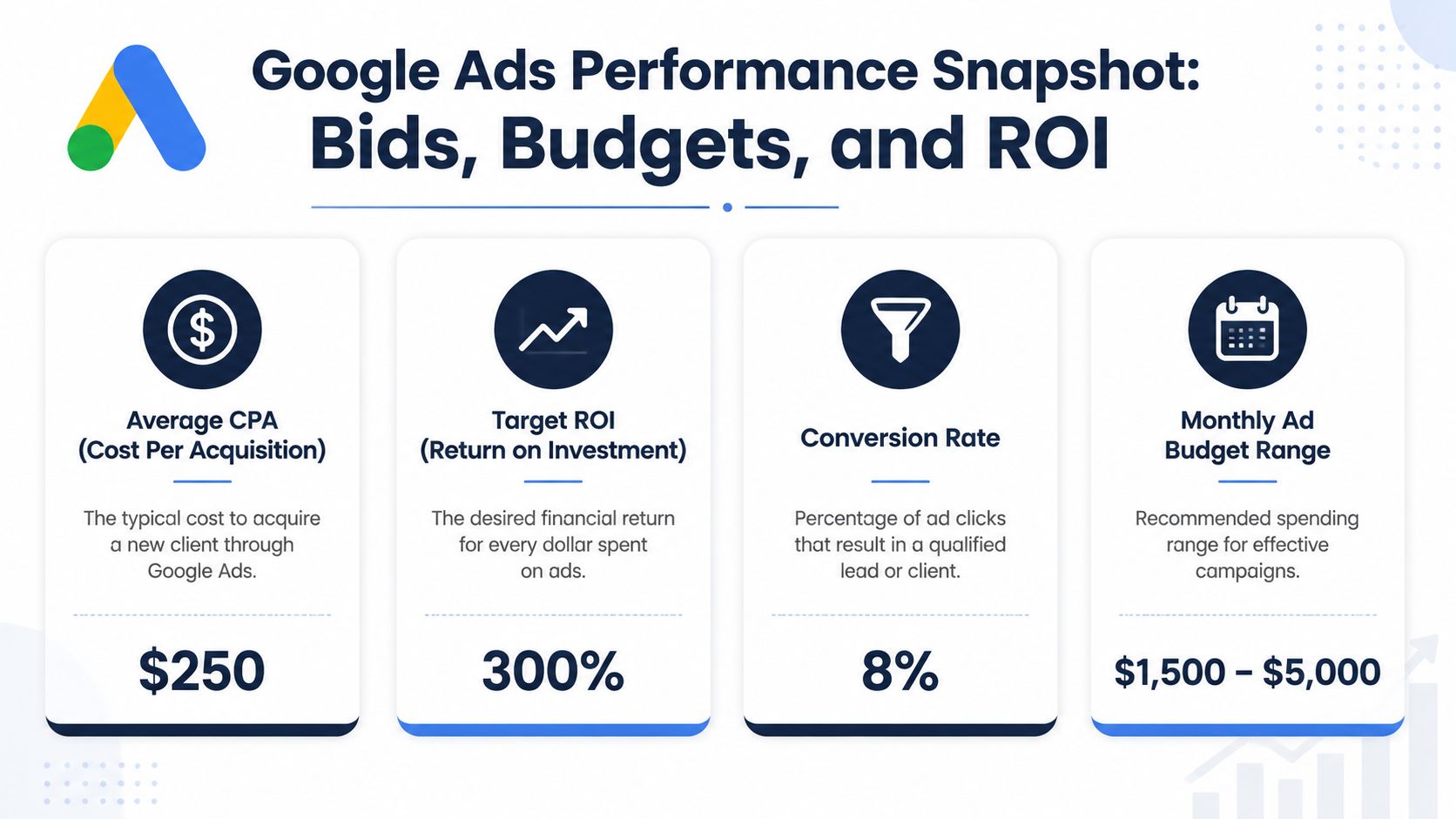
At the cost level, this category requires realistic expectations. Financial advisors running Google Ads usually face cost-per-click ranges from $5 to $50, with high-intent keywords such as "financial advisor near me" or "retirement planning help" often averaging $15 to $35 per click, qualified leads often costing $50 to $200 each, and successful firms generally allocating a minimum monthly ad spend of $2,000 to $5,000 because budgets below $1,500 often fail to produce enough data for optimization in competitive metro areas, according to Wolf Financial's analysis of Google Ads lead generation strategy and costs.
Another industry source places advisor CPCs in a similar premium band, noting that financial advisors in the United States often see cost-per-click figures between $6 and $30, with high-volume keywords like "financial advisor" reaching above $25 per click, based on AltaStreet's overview of Google Ads campaigns, costs, and landing pages for financial advisors.
Budget discipline matters more than bid tricks
The right monthly spend depends on geography, service focus, and sales capacity. But there's a practical threshold. A campaign needs enough volume to generate learnings. If spend is too low, every decision is based on noise.
Budget planning should account for four realities:
- Higher CPCs on core advisor terms
- A testing period before stable optimization
- The need for service-specific landing pages
- Lead qualification time after the click
For teams refining bidding logic, HireMediaBuyers.com's guide is a useful reference for understanding how bid strategy choices affect control, learning, and efficiency.
Raw submissions are not ROI
This is the most common reporting failure in advisor PPC. Every form fill gets counted as a conversion, so the dashboard looks healthy while the intake team complains that the leads are weak, irrelevant, or fake.
A more accurate setup uses Offline Conversion Tracking so only qualified leads are sent back into the ad platform as meaningful outcomes. That keeps the campaign from optimizing toward junk. It also gives the firm a better read on real acquisition economics.
The tracking setup should separate at least these stages:
| Stage | What it means |
|---|---|
| Inquiry | A raw form submission or initial contact |
| Qualified lead | A submission that meets basic fit criteria |
| Sales opportunity | A lead that progresses into a real advisory conversation |
As noted earlier, negative keywords can improve efficiency, but measurement determines whether that efficiency translates into business value. Teams that need cleaner reporting foundations can use this guide on how to add a site to Google Analytics to tighten visibility from click through conversion.
What to watch every week
A good review rhythm focuses on business quality, not vanity metrics. The key questions are simple:
- Are high-cost keywords producing qualified conversations?
- Which search terms are wasting spend?
- Is the landing page attracting the right type of lead?
- Are qualified leads being passed back into optimization?
When those answers are clear, budget decisions get easier. When they aren't, the campaign usually scales the wrong behavior.
Optimizing and Scaling Campaigns for Long Term Growth
A Google Ads campaign doesn't mature because it's left alone. It matures because someone reviews the search terms, cuts waste, tests copy, refines pages, and tightens the definition of a good lead. Launch is the starting line.
The firms that get durable results treat optimization like operating discipline. Not constant random change. Controlled iteration.
Read search term reports like intake notes
Search term reports show how the market is describing its need. That's where waste appears early, and it's where new opportunities show up too. If the campaign begins attracting low-intent education queries, job searches, or unrelated planning topics, those terms should be excluded quickly.
The same report can reveal profitable patterns. Sometimes a narrow phrase starts converting into real conversations while a broader keyword burns budget. That's a signal to break the stronger theme into its own ad group or campaign and give it dedicated messaging.
Good optimization isn't about chasing more traffic. It's about increasing the percentage of traffic that deserves advisor time.
Test the message, not the guardrails
Scaling doesn't require rewriting the compliance framework every month. The guardrails should stay stable. Testing should happen inside them.
Useful optimization areas include:
- Headline emphasis such as service-led wording versus audience-led wording
- CTA phrasing that changes the tone of the invitation
- Landing page sequence to improve clarity before the form
- Geographic prioritization if certain markets produce cleaner leads
Remarketing can also play a role if it's executed carefully and within policy boundaries. Visitors who reached a service page but didn't convert may still need more time, especially for higher-consideration advisory decisions. The messaging should stay factual, restrained, and consistent with the original offer.
Scale only what survives scrutiny
Before increasing spend, the firm should be able to answer yes to three questions:
- Are qualified leads being measured accurately?
- Does the sales team want more of this exact lead type?
- Can compliance review the next round of assets without slowing the whole program down?
If the answer to any one is no, scale should wait.
Growth in this channel comes from repetition done well. Review the query data. Expand what fits. Exclude what doesn't. Tighten the handoff between ad, page, and intake. Then raise budgets on proven themes instead of on hope.
Advisor Momentum helps financial advisors, planners, and banking teams build compliance-ready marketing systems, including paid search campaigns designed for regulated financial services. Firms that need support with strategy, landing pages, analytics, or compliant execution can learn more at Advisor Momentum.
