

Organic search now drives 44.1% of total traffic for wealth management websites, and the average landing page conversion rate is only 3.4%, while top performers reach 11.5% according to CuFinder's 2026 benchmarks cited by Webtonic (wealth management SEO statistics). For advisory firms, that changes the budget conversation fast. Wealth Management SEO is not a side project, it's the primary discovery channel for prospects who begin with a search engine instead of a referral.
The practical takeaway is simple. A firm that ranks well can compound visibility, credibility, and lead flow over time, while a firm that ignores search keeps paying for attention it doesn't own. The hard part is doing that without tripping compliance rules, which is where most generic advice falls apart.
Table of Contents
- Why Organic Search Dominates Wealth Management Client Acquisition
- Technical Performance Benchmarks Your Advisory Site Must Meet
- Keyword Research and Intent Mapping for Financial Services
- Building Compliance-Ready Content That Ranks and Converts
- Local Search Optimization and Google Business Profile Strategy
- Internal Execution Versus Outsourcing to a Compliance-Aware Agency
- Measuring SEO Performance and Attribution in Regulated Funnels
Why Organic Search Dominates Wealth Management Client Acquisition
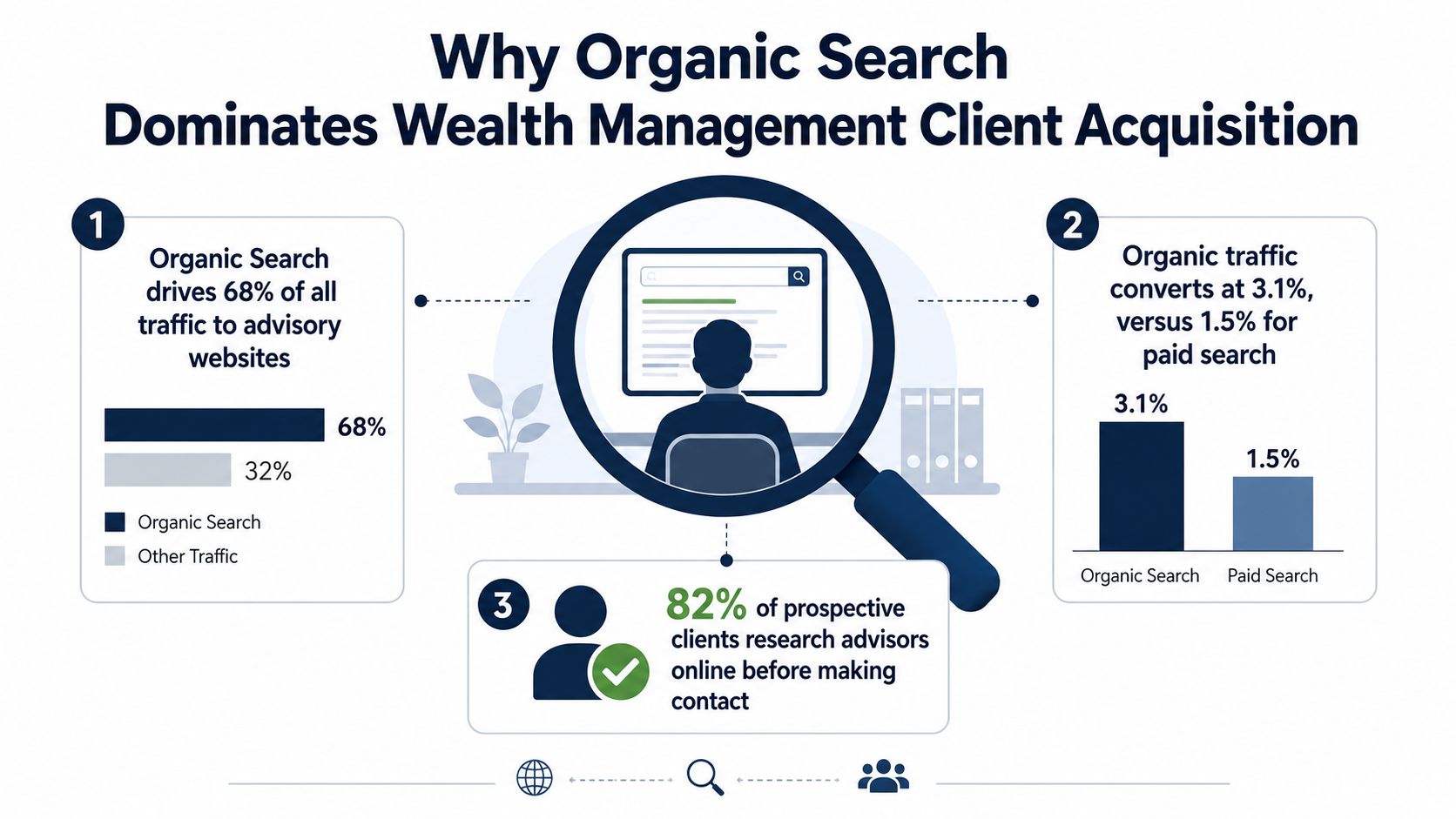
Organic search sits at the center of advisory discovery because it matches how prospects behave. CuFinder's 2026 benchmark set, cited by Webtonic, says 73% of prospective clients research financial advisors online before booking a consultation and that organic search drives 44.1% of total traffic to wealth management websites (wealth management SEO statistics). That combination matters more than any single campaign metric because it shows prospects are already self-qualifying through search.
Why search wins before a salesperson ever speaks
Search traffic works because it captures intent at the moment prospects are comparing firms, services, and credentials. A referral can open the door, but a search result often decides whether the door stays open. In regulated financial services, that matters because search lets a firm answer questions before a prospect ever speaks with an advisor, while keeping claims visible, reviewable, and tied to approved content.
A firm also gets a clearer read on whether its message is resonating. The same benchmark set reports an average landing page conversion rate of 3.4%, with top performers reaching 11.5% (wealth management SEO statistics). Those numbers do not guarantee outcomes, but they do show that search traffic can become a meaningful lead engine when the site is structured to convert and the compliance review process does not slow every page into irrelevance.
Practical rule: if a firm can't explain which pages answer which client questions, it probably isn't ready to turn search visibility into consultations.
The time horizon is part of the value
Meaningful SEO gains usually take 4 to 6 months to emerge, while local Google Business Profile improvements can appear in 6 to 10 weeks (wealth management SEO statistics). That timeline can feel slow next to paid media, but SEO behaves more like a compounding asset than a rented audience. Once rankings stabilize, the same pages can keep earning visibility without paying for every click, which matters in a market where compliance review already adds friction to rapid campaign changes.
That long horizon also explains why organic search keeps working in crowded financial markets. Paid campaigns can buy traffic quickly, but they do not create durable authority, and they often get more expensive as competition intensifies. A disciplined organic strategy gives a firm a place in the search market that competitors cannot easily outbid away, while still leaving room to align each page with SEC and FINRA review standards.
For teams trying to justify the investment internally, a measurement-minded article that helps improve SEO with organic search insights through analytics review and traffic interpretation is the best supporting resource, because the decision usually starts with proof of what search already delivers. The core issue is not whether organic works. It is whether the firm will build the site, content, and compliance process needed to make it work consistently, and whether the design supports that effort, which is where a solid wealth management website design approach becomes part of the growth plan.
Technical Performance Benchmarks Your Advisory Site Must Meet
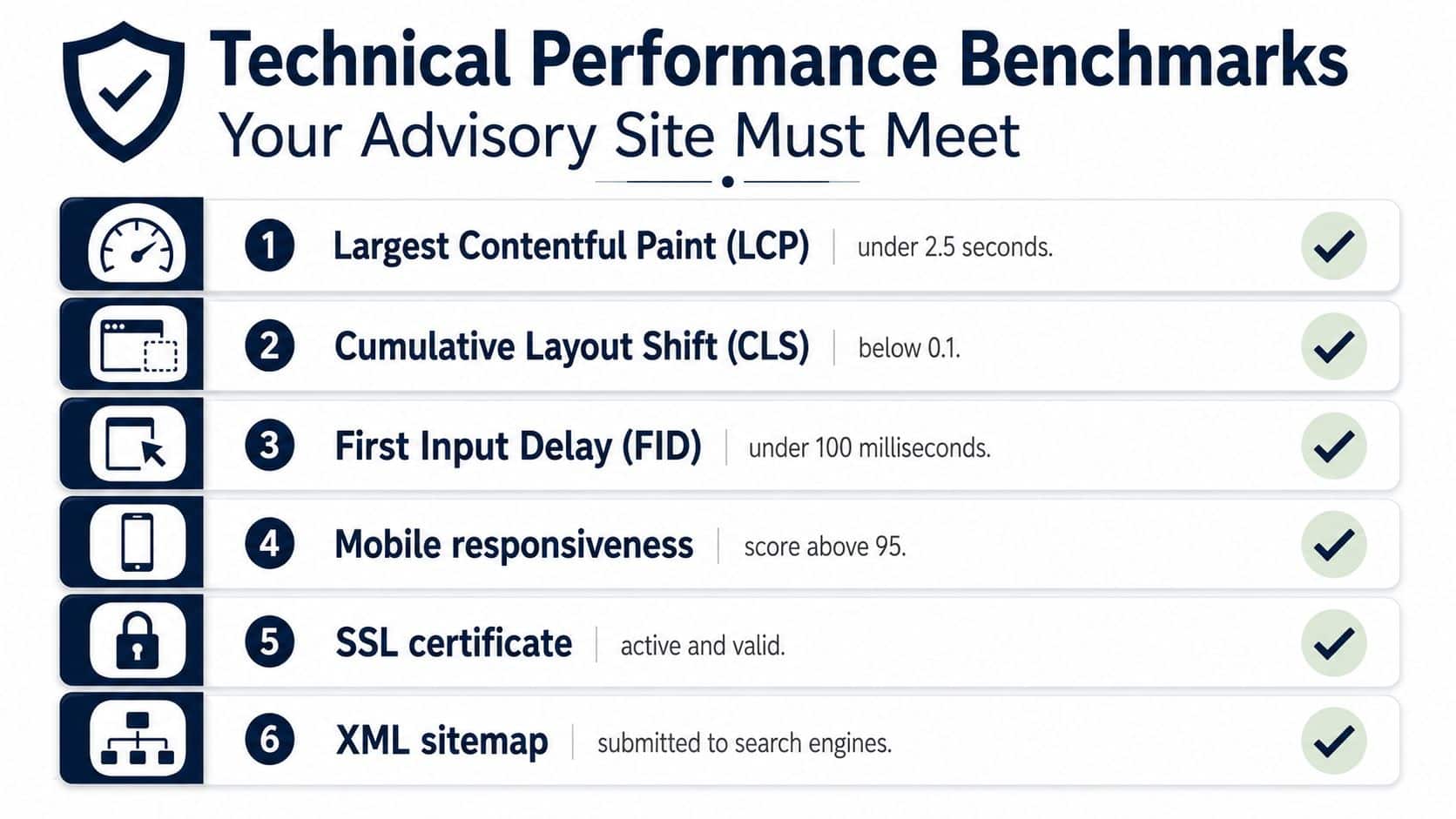
Slow advisory sites lose trust fast. In a benchmark study of 254 U.S. financial advisor sites, the average Largest Contentful Paint was 10.7 seconds, which is more than 4× slower than Google's 2.5-second passing threshold, and the average performance score was 59/100 (financial advisory technical SEO statistics). That performance gap is a ranking problem, and it is also a credibility problem, because affluent prospects often read speed as a proxy for operational discipline.
What to audit first
The first pass should focus on measurable thresholds. Financial services SEO guidance points to LCP under 2.5 seconds, INP under 200 ms, and CLS under 0.1 as core performance targets, while advisor site guidance also calls for HTTPS, mobile optimization, schema markup, and site speed under 3 seconds (SEO for financial services). Those standards are not decorative. They are the minimum conditions for a site that needs to be both findable and believable in a regulated market.
A sensible audit starts with page speed, then moves to crawlability, then checks mobile behavior, forms, and indexation. Google Search Console can surface indexing gaps and crawl errors. A site crawl can reveal broken links, duplicate templates, and missing metadata. Lighthouse helps isolate rendering and performance issues before they start hurting conversions.
Slow or insecure forms do more than reduce lead capture. They also make the firm look less careful than the competitors ranking beside it.
What developers should fix in order
The sequence matters because technical debt spreads across the site. Fix the issues that block discovery before you spend time on polish that only improves appearance. A developer or agency partner should work through the following order:
- Remove crawl barriers: Make sure important pages are reachable and indexable.
- Stabilize mobile rendering: Validate layouts on smaller screens before expanding content volume.
- Secure every form path: Test SSL validity and submission flow so prospects do not hit warnings.
- Trim load time on key templates: Focus first on home, service, and location pages.
- Add structured data where it fits the business model: Keep markup aligned with the actual service structure.
- Verify that the XML sitemap is current: Search engines should not have to guess what matters.
The internal review process should stay boring, in the useful sense. One person checks technical issues, another confirms the page logic, and a third verifies that the proposed changes will not break the regulatory review trail. For firms building the website at the same time, the page structure guidance in this advisor website design framework helps keep speed, conversion paths, and compliance review aligned around the same client journey.
Keyword Research and Intent Mapping for Financial Services
Keyword research in wealth management works only when it separates curiosity from intent. Broad informational searches help a firm earn visibility, but high-intent local searches are the ones that usually signal a prospect is closer to contact. Wealth managers serving high-net-worth and ultra-high-net-worth audiences also need to remember that trust-first search behavior often matters more than volume-first chasing, especially when the visitor is comparing credentials, service depth, and suitability rather than shopping for the cheapest option.
Start with search intent, not keyword lists
A useful keyword map begins with three groups. One group captures educational intent, another captures service intent, and a third captures local intent. The pages should be built differently for each group, because the searcher isn't looking for the same thing at each stage.
Educational queries belong on articles, resource hubs, and FAQ pages. Service queries belong on core offering pages that explain who the firm serves, what the service includes, and how the process works. Local queries belong on location-specific pages or profile assets that reinforce geographic relevance without stuffing the page with awkward city names.
A good test is whether the page would still read naturally if the location term were removed. If the answer is no, the keyword placement is probably too aggressive. That creates review friction, weakens trust, and makes the content feel written for search engines instead of clients.
Map long-tail phrases to the right page type
High-intent search terms often contain service qualifiers, planning situations, or geographic markers. Those phrases should point to a single page with a clear purpose, not be scattered across the site in thin fragments. A firm that serves business owners, retirees, or executives should build distinct content paths for each audience rather than assuming one generic wealth management page can cover everything.
Compliance-safe keywording means precision, not repetition. Put the phrase where it supports the answer, then stop.
That approach matters because affluent prospects usually want proof of expertise before they want a sales pitch. Guidance for asset managers argues that firms should emphasize educational whitepapers, regulatory updates, detailed FAQ pages, and proof of expertise instead of promotional copy (asset manager SEO strategies). Independent advice for financial-advisor SEO also stresses high-intent local search, long-tail phrases, Google Business Profile optimization, and directory consistency, while cautioning that keyword placement should stay selective and natural (financial-advisor high-intent local search).
The firms that do this well build a keyword portfolio around client problems, not vanity terms. That keeps the pages useful, keeps review cycles shorter, and gives the search team a cleaner map between queries and conversion paths.
Building Compliance-Ready Content That Ranks and Converts
Wealth management content can't be judged on ranking alone. It has to survive review under FINRA Rule 2210 and the SEC advertising regime, because financial marketing is regulated and every public-facing page can create exposure if it overpromises, implies guarantees, or blurs disclosures. One source is explicit that wealth management SEO must prioritize compliance with FINRA Rule 2210 and SEC advertising guidelines throughout all content and optimization work.
Structure the page for humans, search engines, and reviewers
The cleanest pages use one H1, then H2s and H3s with related keyword variations, because that hierarchy is easy for readers and auditors to scan. Question-based headings work especially well because answer engines and AI systems can extract direct responses from them. That same structure also keeps editorial review sharper, since each section is answering one defined question instead of drifting into a sales brochure.
Schema markup should match the service category and business type, not force generic templates onto a regulated firm. Citation-rich writing helps as well, because documented sources and regulatory references build the E-E-A-T signals that affluent readers often expect. The result is a page that reads like a useful client education asset instead of marketing copy trying too hard.
Build the workflow before the content calendar
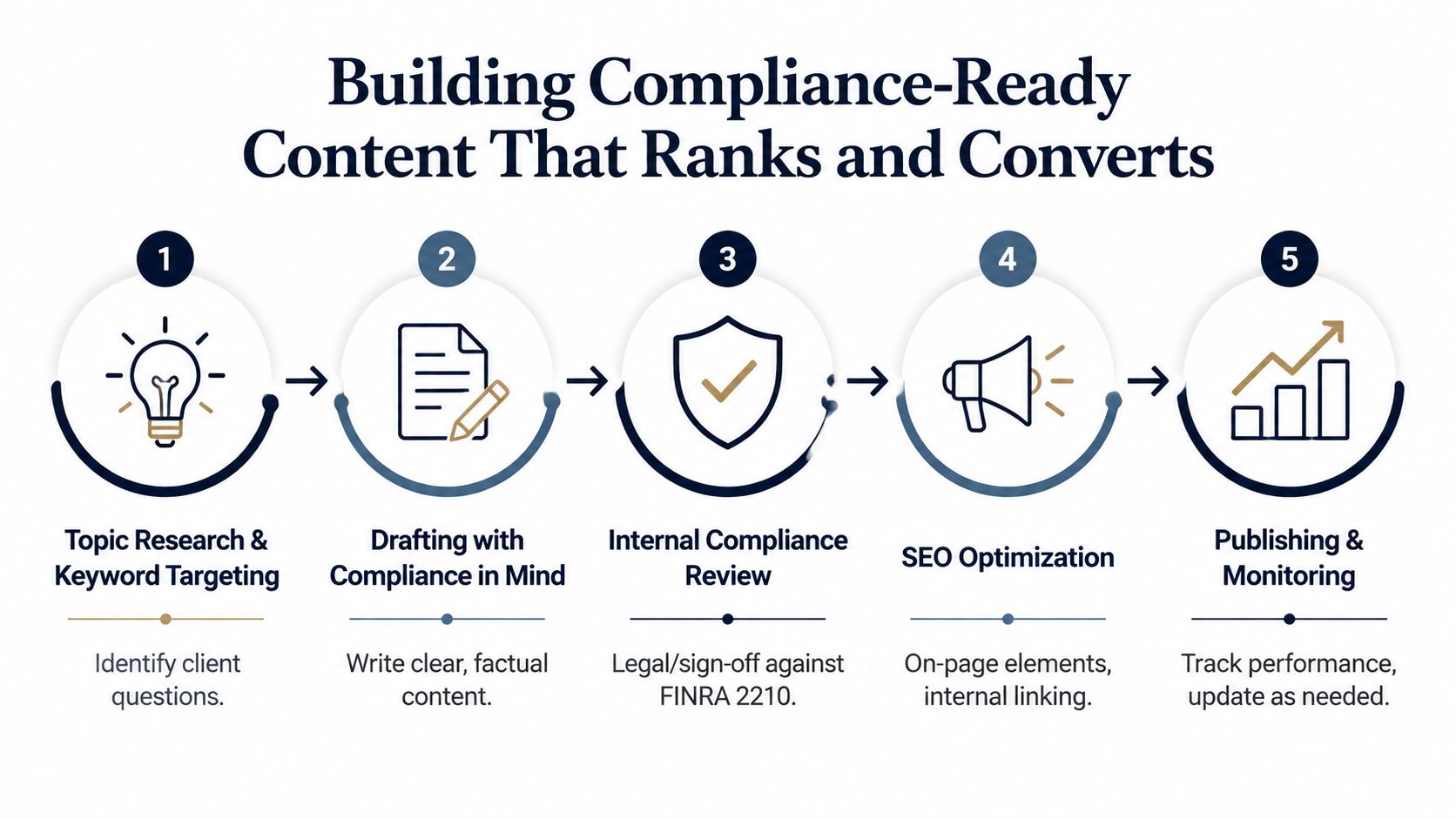
The actual process should be predictable. First, identify the client questions and the service pages they belong to. Then draft the content in plain language with compliant claims only. After that, run internal review, apply SEO refinements, and publish with a monitoring loop that flags changes in performance or search behavior.
A governance-backed workflow also reduces bottlenecks. When compliance, marketing, and the website team agree on the page structure up front, they spend less time rewriting the same paragraph three times. That matters for FAQ pages, whitepapers, market commentaries, and service pages, which tend to perform better when they are educational and specific rather than promotional.
For teams looking for a workflow reference, Flexwork Podcast Studios SEO content is a useful example of how content planning and optimization can be organized around repeatable editorial production. Advisor Momentum also provides an SEO and content program for financial firms, which fits this same compliance-first model when a firm needs an external execution layer rather than ad hoc publishing.
Local Search Optimization and Google Business Profile Strategy
Local visibility still decides a lot of advisory discovery because many prospects want a nearby firm they can verify quickly. Firms that appear in Google's Map Pack tend to get more traffic and more calls than firms buried below the top results, and Google Business Profile signals and reviews remain part of how local rankings are shaped. The point is straightforward. If local visibility is weak, the firm is handing calls to competitors that have invested in trust signals and profile hygiene.
Build the profile before chasing the map pack
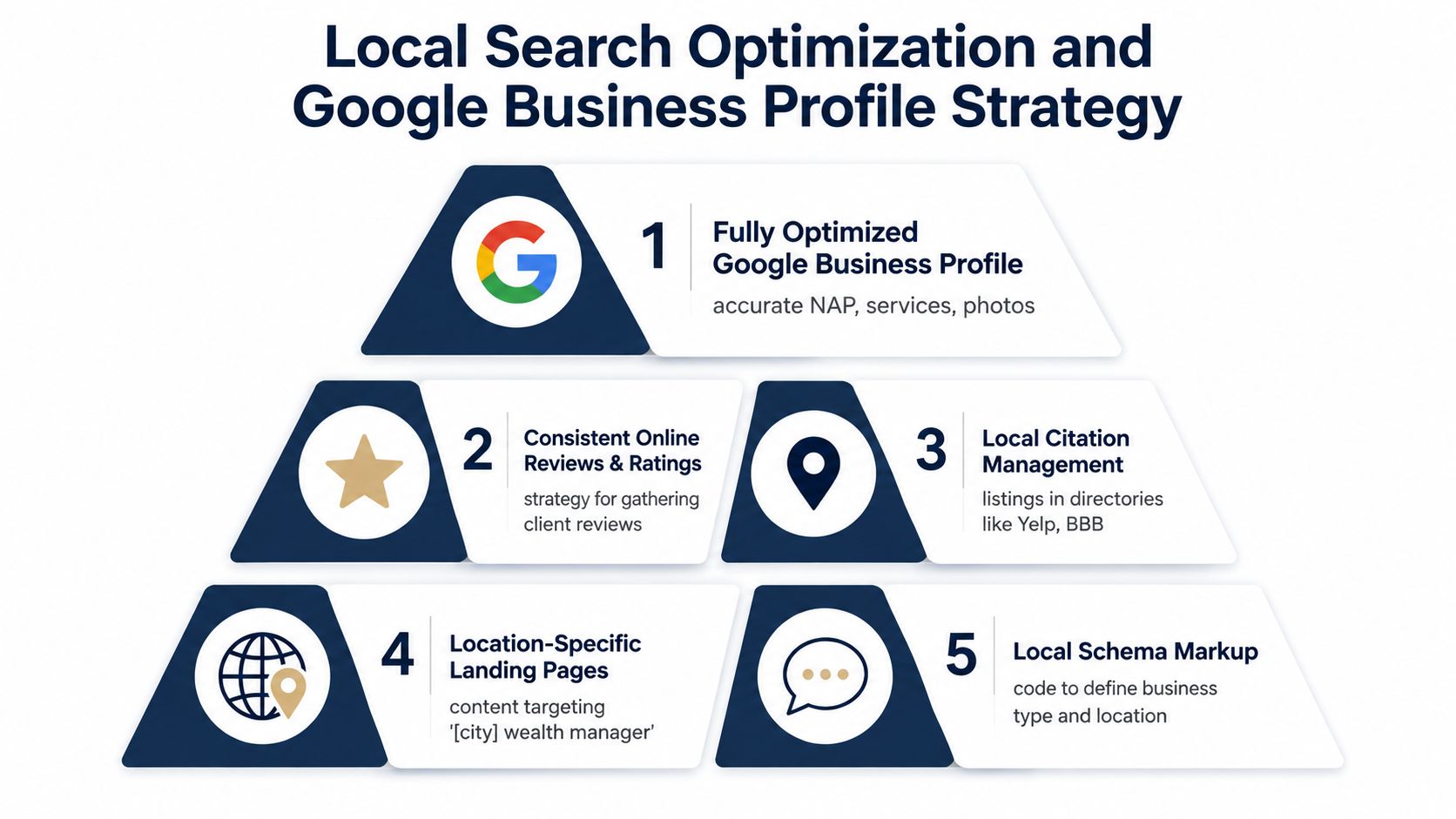
The Google Business Profile should be claimed, fully filled out, and checked against every other public reference to the firm. NAP consistency matters because the firm name, address, and phone number need to match across the website and directories, not drift from one listing to another. That consistency is a trust signal for search engines and a credibility signal for prospects.
Review management has to be handled carefully in financial services. Firms can encourage feedback on Google and other relevant platforms, but the process needs to respect testimonial rules and internal approval standards. The safer approach is to invite general experience feedback, avoid scripting praise, and keep the request focused on the client relationship rather than performance promises.
The same local strategy should support location pages for each market the firm serves. A page targeting a city should describe the local service context, the office or service area, and the team's relevance to that market. Schema markup can reinforce those details by helping search engines understand the business type and location.
Treat citations and reviews as operating assets
The local search stack is not complicated, but it is easy to neglect. Claim the profile, keep hours and services current, align directory data, and create a review intake process that does not force staff to improvise every time a satisfied client is ready to respond. That kind of repetition protects both compliance and visibility.
For firms tightening the listing side, the practical guidance in this Google Business Profile optimization guide is directly relevant because local search often rises or falls on profile completeness and NAP accuracy. Multi-office practices should also audit each branch separately, since one inconsistent location can drag down the whole local footprint.
Local search rewards firms that make verification easy. The cleaner the public record, the less work the prospect has to do to trust the firm.
Internal Execution Versus Outsourcing to a Compliance-Aware Agency
A firm can build SEO in house, but the trade-offs are real. Internal execution gives more control over tone and approval timing, yet it also demands staff who understand search strategy, web performance, and regulated content review at the same time. Outsourcing can move faster, especially when the agency already knows how SEC and FINRA review cycles affect publishing, but the firm still needs strong oversight.
Internal SEO vs Agency Partnership Comparison
| Factor | Internal Execution | Agency Partnership |
|---|---|---|
| Speed to launch | Depends on staff availability and cross-functional coordination | Usually faster when the partner already has a process |
| Compliance familiarity | Varies widely by team member | Stronger when the partner has regulated-industry experience |
| Control over messaging | Very high | High, but requires clear approval workflows |
| Technical depth | Often limited unless dedicated specialists are hired | Broader if the partner handles audits, content, and measurement |
| Scalability | Can stall when priorities shift | Easier to scale across pages, locations, and campaigns |
| Review burden | Usually falls on the firm's internal team | Shared, if the partner builds compliance-first drafts |
The right choice depends on workload and risk tolerance. Smaller firms with one or two priority pages may keep SEO in house if they have a disciplined editor and a compliance reviewer. Larger advisory teams, multi-office practices, and firms in competitive metros usually need dedicated help because the volume of technical, content, and local tasks grows faster than internal bandwidth.
What matters most is whether the partner understands regulated financial marketing, not whether they can promise shortcuts. A compliance-aware agency should be able to explain its page review workflow, how it handles source documentation, and how it avoids overclaiming in public content. If those answers are vague, the agency isn't reducing risk, it's moving it around.
Measuring SEO Performance and Attribution in Regulated Funnels
Traffic alone does not prove SEO is working. In wealth management, the better measure is whether organic visitors become qualified conversations, and that means tracking traffic quality, conversion rate, lead value, and attribution across a longer buying cycle. The benchmark context matters here, since landing page conversion performance varies widely across firms, and that spread shows why reporting only visits can hide weak page performance.
Build the tracking stack around the conversion funnel
A practical measurement setup should include Search Console for query visibility, CRM integration for lead quality, and server-side tagging when attribution needs to survive a more regulated environment. The advisor-focused workflow recommended in the brief also uses Screaming Frog, Lighthouse, GA4, CRM integration, and server-side tagging to preserve attribution quality in regulated-firm funnels. That combination gives the team a better read on what the site is doing.
Last-click attribution usually fails in this category because prospects often read, compare, pause, and return before they book. A person may land on a service page, come back through a thought-leadership article, then visit the contact page days later. A clean measurement model credits the pages that moved the prospect forward, not just the final click before the form submission.
Report outcomes in language partners understand
Partners and compliance leaders usually respond better to lead quality than to traffic volume. The report should show which topics drove consultations, which pages pulled in unqualified visitors, and where the site lost prospects before contact. That makes SEO a business discipline instead of a vanity metric exercise.
A simple 90-day roadmap works well. Establish baselines, validate the analytics stack, align content tags with the CRM, and then review which pages drive conversations rather than visits. Once the firm sees that pattern, SEO decisions become easier because the conversation shifts from “How much traffic?” to “Which pages produce the right clients?”
Advisor Momentum helps financial advisors, RIAs, and banking teams build compliance-ready SEO and conversion-focused websites that fit regulated marketing realities. For firms that want search visibility without creating review bottlenecks, Advisor Momentum offers a practical place to start with strategy, execution, and compliance-aware content support.
