
A lot of RIA and bank websites are busy doing the right things and still missing the outcome that matters. Ads are running, thought-leadership is being published, prospects are landing on polished pages, and yet the calendar stays thin because visitors keep slipping away before they raise a hand.
That gap is where conversion rate optimization matters. For regulated financial firms, CRO is less about cosmetic page testing and more about turning qualified attention into a compliant next step, without making the site feel pushy or hard to trust.
Table of Contents
- Why Financial Advisors Are Losing Visitors They Already Paid For
- What Conversion Rate Optimization Actually Means
- Why the Average Conversion Rate Should Worry Every Advisor
- The CRO Process From Research to Scaled Winner
- The Economics of CRO for Advisory and Banking Firms
- High-Leverage CRO Tactics Advisors Can Test This Quarter
- Adding Compliance to the CRO Loop Without Killing Velocity
- A 90-Day Plan to Launch CRO at an RIA or Bank
Why Financial Advisors Are Losing Visitors They Already Paid For
An RIA can spend months building a clean website, publishing market commentary, and running paid traffic, then watch the same pattern repeat. The traffic arrives. People skim the homepage, open a service page, and disappear before booking a discovery call or filling out the short form.
That's not a brand problem. It's a funnel problem. The firm paid to earn the visit, but the page didn't do enough to move the visitor into a compliant action that signals real intent.
For advisors and banks, the leak hurts more than it does in many other industries. Traffic is expensive to acquire in regulated niches, trust takes time to build, and a lost visitor often represents a missed household, not just a missed click. The economics get harsher when the site asks too much too early, or when the page is too vague for a careful prospect to know what happens next.
The best advisory sites aren't just attractive. They make the next step obvious, reduce hesitation, and answer the questions a cautious visitor is already asking. That's why wealth management website design can't be judged only on visual polish. The test is whether the page moves the right person toward a meeting, a call, or another qualified action.
A beautiful site that doesn't convert is still a leaky asset.
CRO exists to find those leaks and close them with evidence. For a bank marketing team, that may mean improving a branch appointment flow. For an RIA, it may mean getting more prospects to request a consultation without forcing them through a long form that feels like an application.
What Conversion Rate Optimization Actually Means
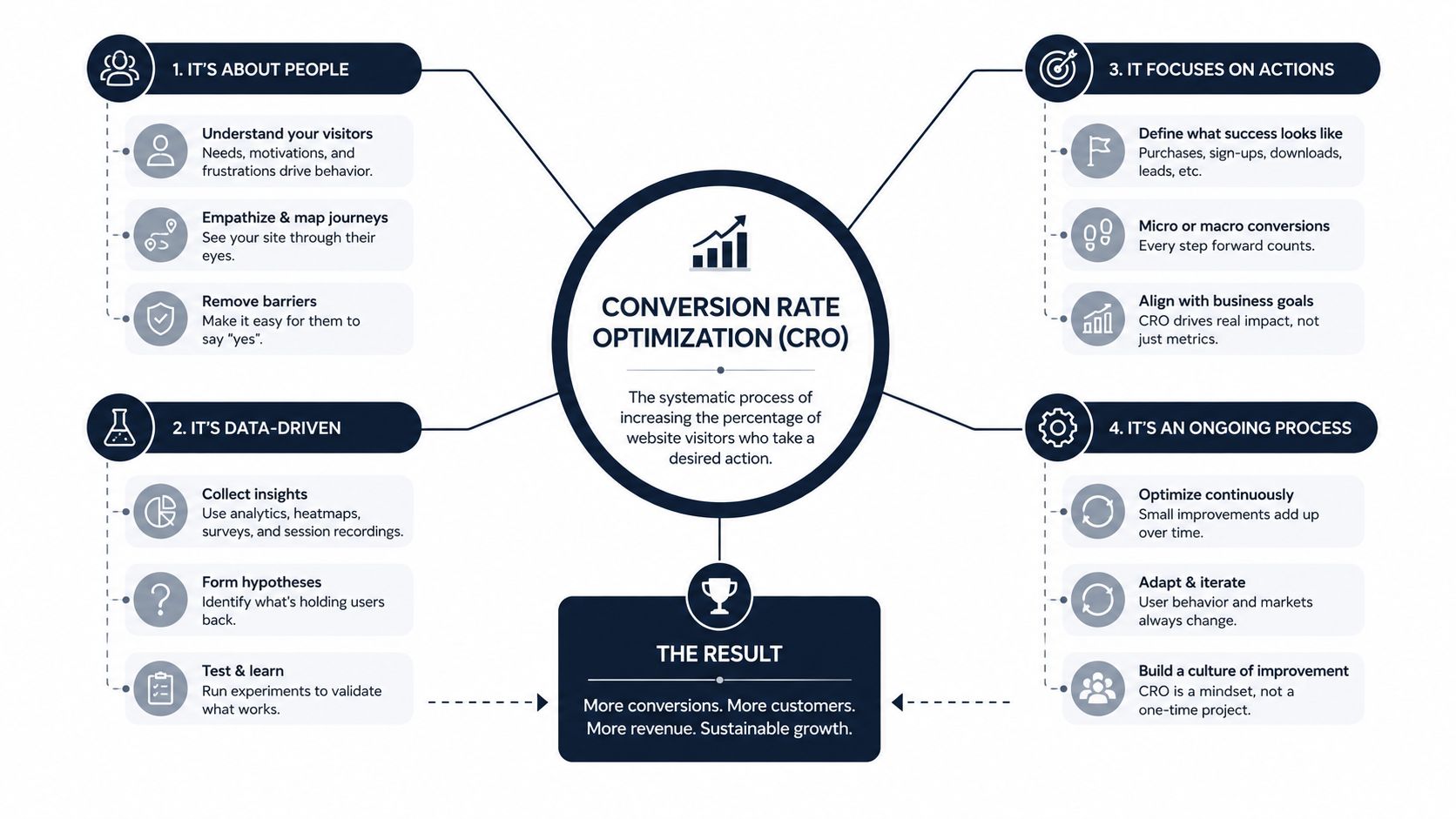
Conversion rate optimization is the process of improving the percentage of visitors who complete a desired action. The basic formula is conversions divided by total visitors, multiplied by 100. That's the part many can recite. The more useful part is what that formula turns into in practice.
For regulated firms, a conversion is not always a sale
In advisor and banking environments, a conversion usually isn't an instant transaction. It's often a compliant micro-action that signals qualified interest, like an appointment request, a click-to-call event, a newsletter signup, a form completion, or a document download that triggers follow-up. Those actions matter because they fit the way regulated sales happen. People rarely go from anonymous visitor to client in one step.
That's also why CRO is not the same thing as lead generation, SEO, or a design refresh. SEO brings people in. Design shapes how they feel. Lead generation creates demand. CRO sits in the middle and asks whether the traffic is being guided toward the right action once it lands.
The discipline is research, testing, and learning
A real CRO program starts with a baseline, then moves through research, hypothesis formation, testing, and analysis. The point isn't to guess what might work. It's to identify friction, test a change, and measure whether more qualified visitors move forward.
For a regulated funnel, that often means tracing a specific page or form step instead of studying the website as one giant whole. If prospects are abandoning an advisor inquiry form halfway through, the issue may be copy, layout, trust signals, or too much friction. CRO makes that visible.
For a concise overview of how practitioners define and structure the discipline, optimizing Divi conversions is a useful reference point. The logic is the same across industries, but the conversion goals change when trust, disclosures, and compliance matter.
Why the Average Conversion Rate Should Worry Every Advisor
A visitor lands on an RIA or bank site, reads the service page, and leaves without taking the next step. That usually means the funnel is doing too much asking, too little clarifying, or both. Across industries, the average website conversion rate sits at 2.35% (Matomo). Many references also place typical websites and landing pages in the 2% to 5% range. The same source cites top landing pages at 11.45% conversion or higher, which is nearly 5x the 2.35% average.
That spread is why average performance should worry every advisor. Conversion is not fixed. It changes when a page better matches intent, reduces friction, and gives the visitor a clearer reason to act.
Benchmarks matter because advisory traffic is expensive
A bank or RIA does not need to chase the abstract idea of elite conversion. It needs to know what happens when a page moves from average to above average. If traffic stays flat, a modest lift can produce more booked meetings, more inquiry forms, and more qualified conversations from the same audience.
That matters because traffic acquisition is expensive relative to optimization work. One industry-cited analysis says companies spend about $92 on traffic acquisition for every $1 spent on conversion optimization (Shno). That imbalance is why CRO keeps showing up as one of the highest-return moves in mature marketing programs.
Device mix makes the benchmark even more important
Behavior also shifts by device. One cited dataset shows paid search averaging about 2.9%, desktop ecommerce at roughly 2.1%, tablet at 3.32%, and mobile at 2.01%. Another benchmark notes 4.14% conversion on desktop versus 1.53% on mobile in 2022. Those gaps are a reminder that blended reporting can hide where the problem lives.
On regulated sites, mobile often carries more research traffic while desktop picks up more action-oriented behavior. If the same page serves both, it rarely deserves the same treatment on both devices.
Practical rule: If the same page serves mobile researchers and desktop schedulers, it probably needs different treatment on each device.
If you want a clean baseline before you judge these gaps, start with your analytics setup and how to add a site to Google Analytics. Without reliable measurement, the rest of the work is just confident guessing. For regression monitoring while changes roll out, use PageSpeed Plus for regression monitoring so a “better” page does not get slower and lose the gain.
| Conversion Rate Benchmarks That Matter for Advisor Funnels | Number | What It Means for an Advisor Site |
|---|---|---|
| Average across industries | 2.35% | Average performance is common, not acceptable |
| Typical website and landing page range | 2% to 5% | A realistic band for baseline planning |
| Top 10% of landing pages | 11.45% or higher | Strong pages can far outperform the average |
| Traffic acquisition versus CRO spend | $92 to $1 | Fixing the funnel is often cheaper than buying more traffic |
| Desktop versus mobile benchmark | 4.14% vs 1.53% | Mobile needs its own review, not a desktop copy-paste |
The CRO Process From Research to Scaled Winner
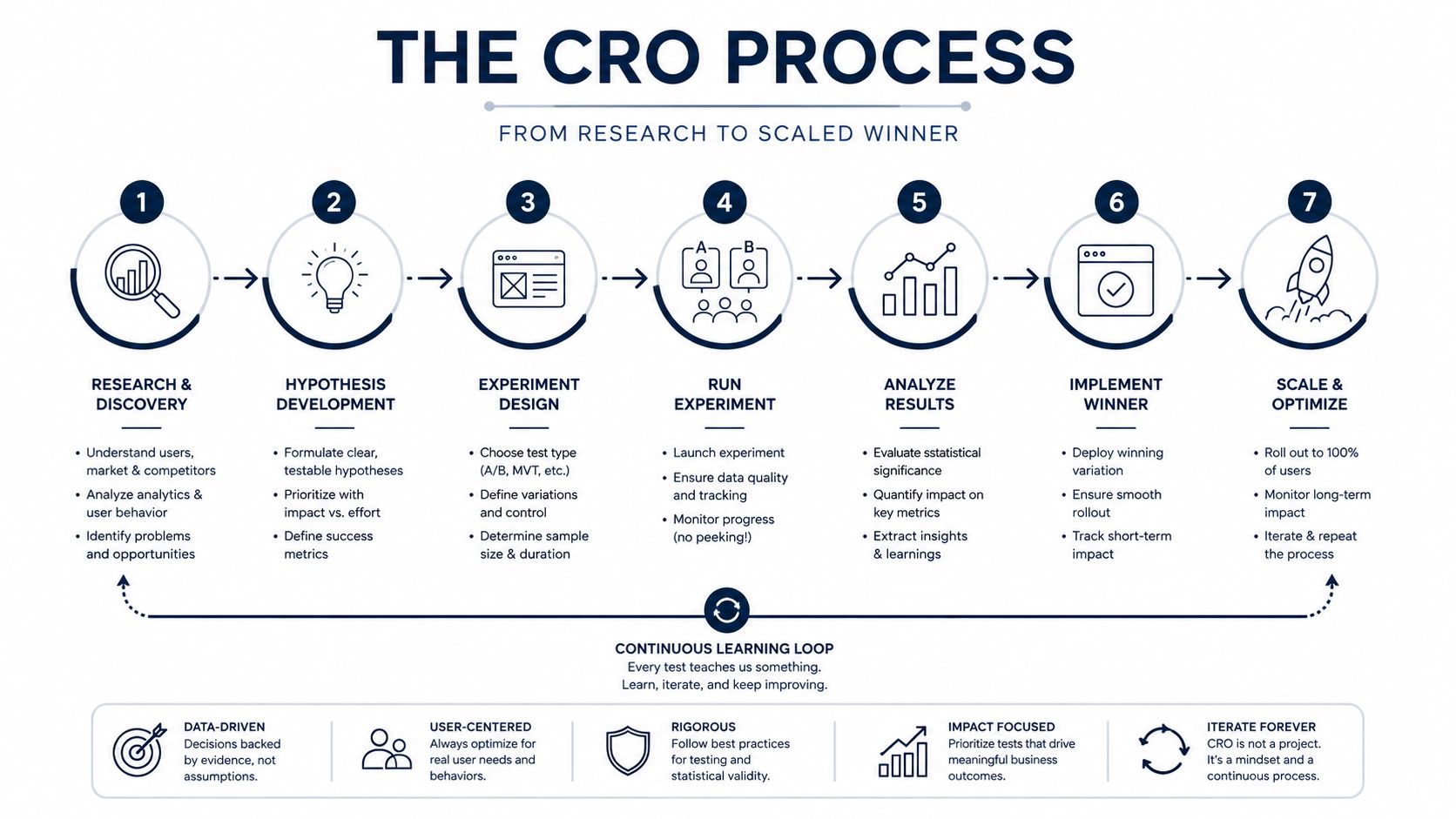
CRO works best when it behaves like an operating system, not a one-time redesign. The sequence is simple enough to describe, but disciplined enough to matter: research, hypothesize, test, implement, document, and repeat.
Start with evidence, not opinion
Research comes first. That usually includes analytics review, heatmaps, session recordings, user feedback, and a look at competitors' positioning. On an advisor site, session recordings can reveal exactly where people stall on a discovery-call form, and heatmaps can show whether a CTA is being seen or ignored.
A useful internal starting point is a clean analytics setup. A practical walkthrough for that is how to add a site to Google Analytics. Without reliable measurement, the rest of the process is just confident guessing.
Turn observations into testable hypotheses
Once the problem is visible, the next step is to write a hypothesis tied to a single funnel step. For example, if prospects abandon after seeing a long form, the hypothesis might be that shortening the form will increase completions. If the service page gets clicks but no inquiries, the issue might be message mismatch rather than layout.
That distinction matters in regulated services. A multivariate test on a service-overview page may need compliance review before launch, especially if the copy contains claims, testimonials, or performance references. The test plan should anticipate that instead of treating compliance like a last-minute obstacle.
Test, measure, and keep the learning
A/B or multivariate testing validates the idea before it gets scaled. Winning variants move forward. Weak ones get retired. Inconclusive tests still matter because they teach the team what didn't move the metric and where the next hypothesis should go.
After a test ends, the outcome should be documented with the variant copy, measurement window, and reviewer notes. That archive becomes the memory of the program. Without it, teams repeat old mistakes and lose momentum every time the marketing calendar gets busy.
For teams that want to track speed and performance regressions while the funnel changes, a practical resource is to use PageSpeed Plus for regression monitoring. In CRO, faster isn't a vanity metric. It's part of keeping the test environment trustworthy.
The Economics of CRO for Advisory and Banking Firms
CRO changes the economics of a funnel because it improves the return on traffic that's already been paid for. The traffic-versus-optimization spend gap is already large, and that makes the case easy: before buying more clicks, make the existing ones work harder.
For advisory firms, that logic translates into cost per booked meeting, cost per qualified inquiry, and the payback period on client acquisition. If a site attracts the right audience but converts poorly, the firm ends up paying more for every meaningful lead than it needs to.
Small lifts compound inside real advisory funnels
A move from 2% to 3% conversion doesn't sound dramatic until it's applied to actual campaign traffic. On a steady stream of visitors, that kind of lift creates more appointments and more follow-up opportunities without changing media spend. In a regulated market where each new relationship can be valuable, that difference compounds quickly.
The deeper point is trust. A site that loads quickly, explains the offer clearly, and previews the onboarding process feels more competent. Prospects often read that as a signal about how the firm operates.
Better conversion also protects brand equity
A poor-converting page can make a strong brand look messy. Too many options, unclear CTAs, and a vague value proposition create friction that feels unprofessional. The reverse is also true. A focused page can make a small firm look more organized than a larger competitor.
That's why CRO is a revenue conversation and a brand conversation at the same time. For banks and RIAs, those two things aren't separable. A page that converts usually does a better job of showing how the firm thinks, how it serves, and what happens after the click.
The cheapest lead is the one the site was already close to winning.
High-Leverage CRO Tactics Advisors Can Test This Quarter
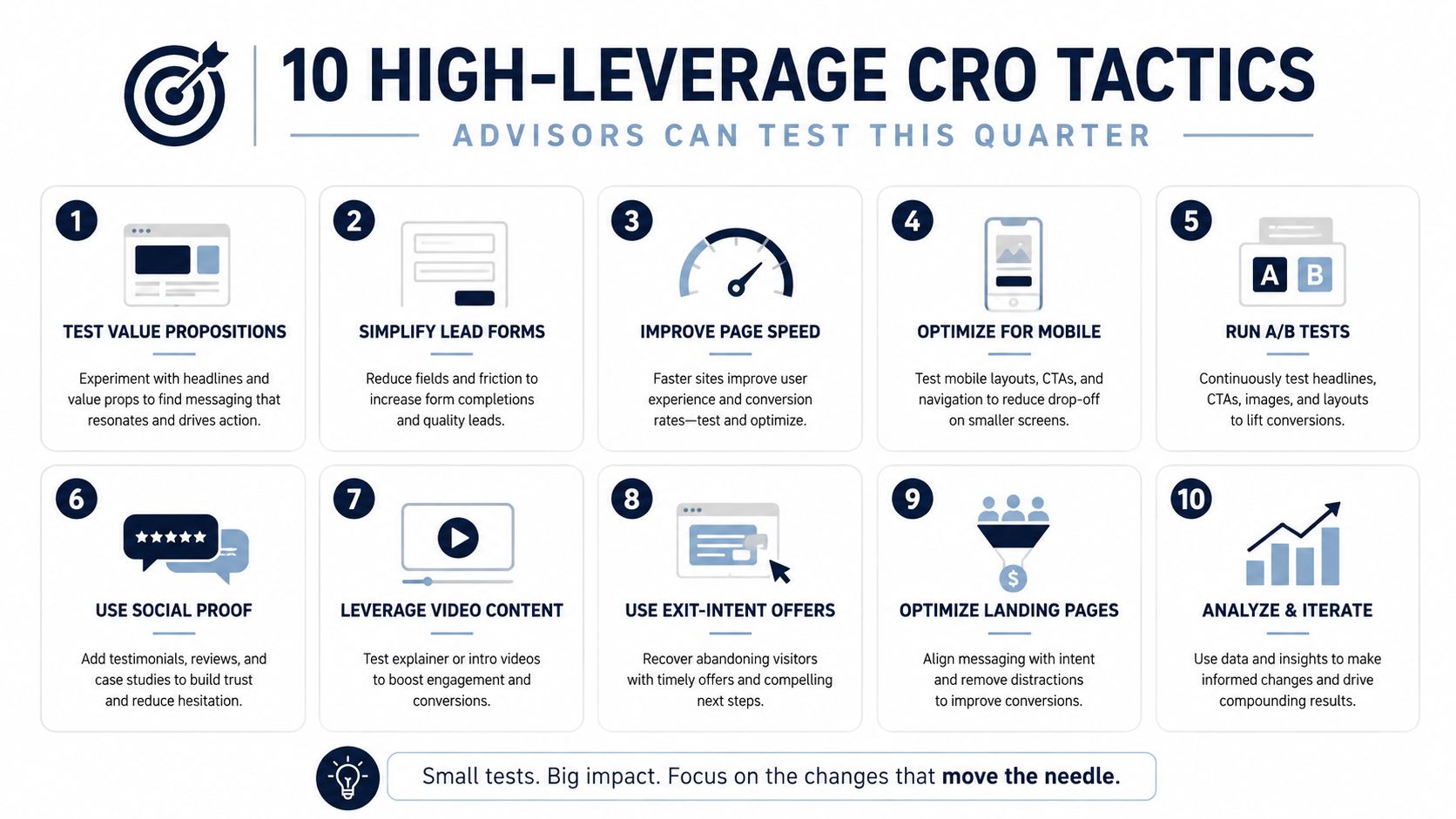
The best test ideas usually fall into three buckets, friction, clarity, and trust. That framing keeps the work practical. It also prevents teams from throwing random design changes at a page and hoping the metric moves.
Friction deserves the first look
Forms are usually where the damage shows up. Long forms, awkward mobile layouts, and unnecessary fields all create exits. Multi-step forms can help when the ask is complex, but they can also make a simple inquiry feel heavier than it needs to be.
Calendar scheduling embeds are another obvious place to test. If a prospect is ready to talk, adding extra steps before the booking flow can suppress action. Page speed matters here too, especially on mobile, where the tolerance for delay is lower.
Clarity should remove ambiguity
A page should have one dominant CTA. Mixed calls to action split attention and create hesitation, especially on landing pages tied to paid search. The hero area should say who the page is for, what problem it solves, and what happens next.
Message match is just as important. If an ad targets physicians nearing retirement, the landing page should sound like it was written for that exact audience, not for “all investors.” Headline tests can be very effective when the audience segment is precise and the promise is specific.
Trust closes the loop
Advisor bios, credentials, and disclosures should be visible and easy to understand. Hiding them usually backfires because prospects notice what the page avoids. Video explainers, testimonials, and case studies can help, but only when they fit the compliance framework and don't overwhelm the action path.
Security and privacy signals belong near the form, not buried in the footer. For regulated firms, that detail matters because the visitor is not just asking whether the service works. They're asking whether the firm looks careful enough to handle personal information.
For teams trying to structure follow-up after a form or booking, it can help to find advisor automation tools that support routing, reminders, and workflow consistency. The tool doesn't create conversion by itself. The page still has to earn the action.
A sensible starting slate is two or three tests, not ten. One around friction, one around clarity, and one around trust is enough to create signal without overwhelming a small marketing team.
Adding Compliance to the CRO Loop Without Killing Velocity
Compliance doesn't have to slow CRO to a crawl, but it does have to be built into the process. If every change waits until the end for review, experiments stall and the team learns nothing. If compliance is involved too early, the program becomes easier to run and easier to defend.
Build the workflow around risk, not just ideas
A shared backlog helps. Each test idea can carry a simple risk flag, such as low, medium, or high. Button placement and layout changes usually belong in the low-risk lane. Claims, testimonial use, and performance language belong in the review lane.
Pre-approved copy modules are useful too. If compliance already signed off on certain phrases, the team can reuse them across variants without reopening the entire review cycle. That speeds up testing while keeping language consistent.
Test events should be compliance-friendly
The cleanest conversion events are often the ones that are easiest to explain to a reviewer. Click-to-call, calendar loads, appointment requests, and form completions are straightforward. They're also meaningful signals inside a regulated funnel because they show intent without forcing the site into a risky promise.
Documentation matters just as much as approval. The team should retain the hypothesis, the exact copy that shipped, the reviewer notes, and the result. If a regulator ever asks why a change was made, the answer should already exist in the program record.
That discipline creates room for speed. The team can move faster on low-risk changes because the guardrails are already in place, and compliance can spend time where the actual exposure lives.
A 90-Day Plan to Launch CRO at an RIA or Bank
The first 30 days should be about visibility. Analytics need to be instrumented, the primary conversion event should be defined, and supporting micro-conversions should be mapped. The team should also document the current funnel and collect friction notes from analytics, session recordings, and internal feedback.
Days 31 to 60 should focus on quick wins
Once the baseline is clear, the team can launch two or three tests that target obvious drop-offs. Form length, above-the-fold clarity, and mobile layout are usually the fastest places to start. This is also when the compliance review workflow should go live, so new variants don't get trapped in email threads.
Days 61 to 90 should turn wins into a system
Winning variants should be expanded across related pages. If a clearer CTA improves one service page, the pattern may belong on other pages with similar intent. At the same time, the team should formalize the test cadence and put a quarterly CRO review on the marketing calendar.
A lean team doesn't need a giant stack to start. It needs analytics, behavioral insight, testing capability, and a clear owner for the program. That owner keeps the work alive when client work, campaigns, and compliance requests all compete for attention.
When those pieces are in place, CRO stops being a side project and starts acting like a repeatable growth process for the whole firm.
Advisor Momentum helps RIAs, wealth managers, and banking teams improve websites, content, and lead flow with a compliance-first approach. If the current site is getting traffic but not enough booked conversations, visit Advisor Momentum to see how regulated-funnel strategy, website content, and conversion-focused execution can work together.
