

The first sign that a bank has outgrown a generalist agency is rarely a failed campaign. It's the pile of revisions, the delayed launch dates, and the uncomfortable moment when a polished ad gets stopped because someone missed a disclosure issue or a state-specific restriction. In regulated banking, that friction isn't a nuisance, it's a cost, and it usually shows up right when budgets are getting bigger and expectations are getting tighter.
Banks have been leaning harder into digital media for years, and the scale is now impossible to ignore. The American Bankers Association reported that U.S. banks' digital ad spend reached over $13 billion in 2022, rising more than 20% from 2021, while worldwide digital advertising spending was $521.02 billion in 2021 and was projected to reach $876 billion by 2026, a 68% increase (ABA banking journal report). That kind of spend creates room for mistakes, but it also creates room for specialist agencies that know how to protect margin, speed up approval, and build campaigns that convert.
Table of Contents
- Why Banks Need a Specialized Advertising Agency
- Evaluating Bank Advertising Agency Capabilities
- Service Alignment and Pricing Models to Consider
- RFP Process and Interview Questions That Reveal Real Capability
- KPIs, Attribution, and Compliance Checkpoints for Ongoing Success
- Onboarding Timeline and Early-Warning Indicators
- Making Your Final Agency Selection Decision
Why Banks Need a Specialized Advertising Agency
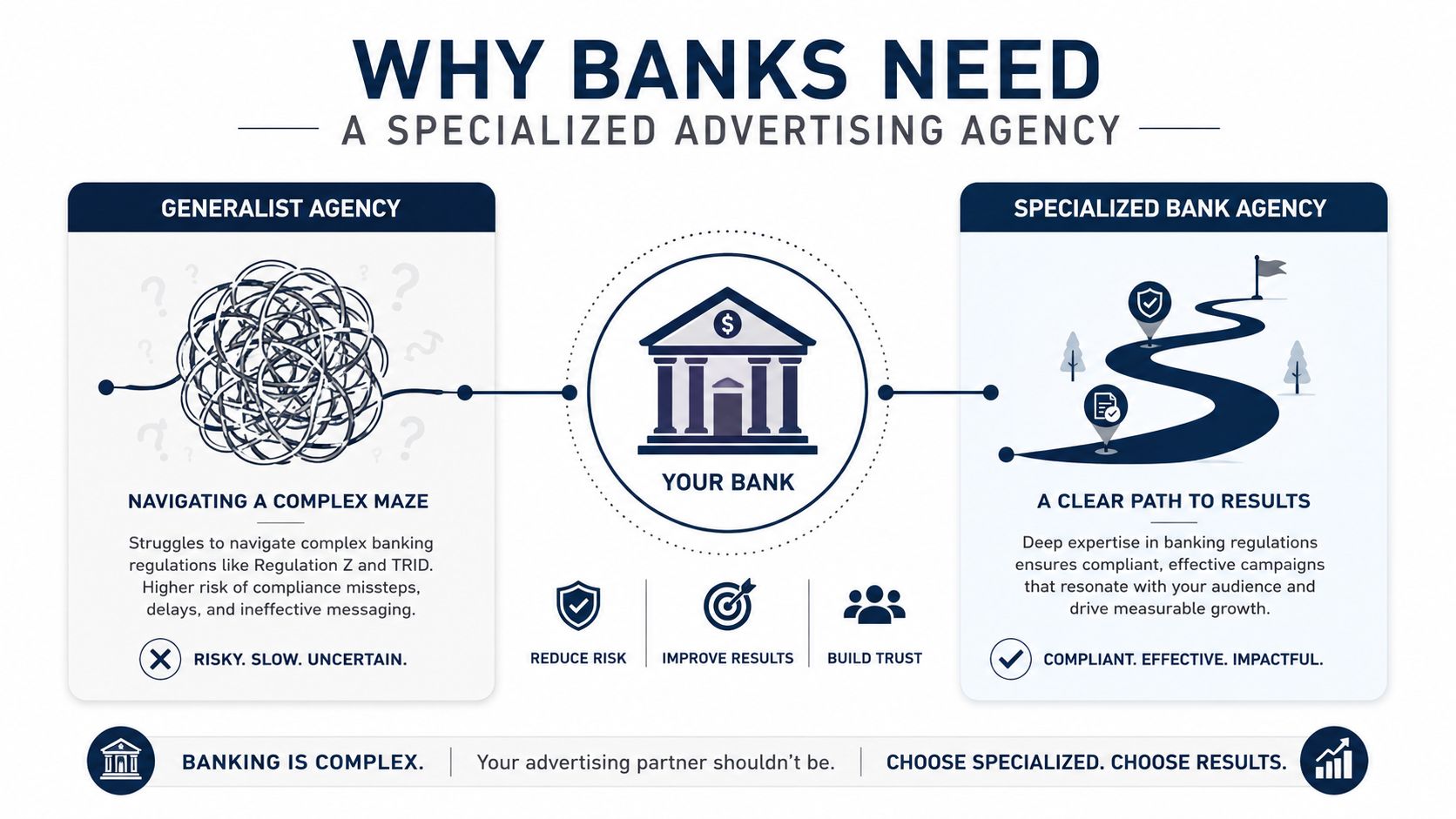
A regional bank can hire a capable-looking agency and still lose weeks in review because the copywriter doesn't understand how a promotion has to be framed. A well-designed ad can still fail if the team that built it didn't think through disclosures, channel-specific benchmarks, or the difference between awareness creative and conversion copy. That's why a bank advertising agency is not just a nicer version of a generalist agency, it's a different operating model.
The core issue is speed under constraint. Banks are spending real money, but the financial sector's average search-ad click-through rate was only 3.58%, and overall ad CTR averaged 0.50% (ABA digital media guidance). Those numbers make it obvious why compliant-by-accident creative is a dead end. If the agency can't work within the regulatory frame, the team ends up paying for rework instead of performance.
What generalist agencies miss
Generalists usually know how to make ads look strong. They're weaker when the work has to survive a compliance review cycle, coordinate with legal, and still hit the launch window. In banking, those are not edge cases, they're the job.
Practical rule: if an agency cannot describe how it shortens compliance back-and-forth, it's probably adding hidden delay.
The growth in bank spending makes this specialization more important, not less. Bank of America disclosed worldwide marketing spending of $1.927 billion in 2023, up from $1.825 billion in 2022 (Ad Age bank marketing coverage), and a survey-based industry analysis found that 30 leading U.S. banks increased marketing spend by 8% in 2024 to more than $22.5 billion, after rebounds of 26% in 2021 and 22% in 2022 following an 18% drop in 2020 (Ad Age bank marketing coverage). Those figures tell a simple story. Banks are investing at scale, and scale punishes undisciplined execution.
Why specialization changes outcomes
A specialist knows that banking campaigns are measured twice, once by the market and once by the compliance team. That changes how briefs are written, how claims are phrased, and how tests are structured. It also changes what gets prioritized, because the right agency understands that performance marketing in banking is about lead quality, approval rate, and operational durability, not just attention.
The FDIC reported that the U.S. banking industry held about $24.1 trillion in assets at year-end 2024 (FDIC asset figure summary). That scale is why advertising decisions in banking carry real operational weight. The wrong agency doesn't just waste media dollars, it creates review bottlenecks, compliance exposure, and a weak feedback loop between spend and revenue.
Evaluating Bank Advertising Agency Capabilities
The cleanest way to evaluate a bank advertising agency is to stop asking whether it “does digital” and start asking whether it can run a regulated growth system. That means looking at three dimensions at once, compliance fluency, measurement sophistication, and operational readiness. Most agencies can talk about creative. Far fewer can explain how that creative gets approved, launched, measured, and optimized without creating audit headaches.
Compliance fluency and measurement depth
A serious banking partner should be able to explain how it handles disclosures, review cycles, and offer language before the first draft is approved. For promotions that mention credit terms, Regulation Z requires the ad to include the actual APR, repayment terms, and whether the offer is available to everyone or only select borrowers (Regulation Z overview). That's not a legal footnote. It's a writing requirement that affects layout, timing, and channel choice.
Measurement matters just as much. A technically sound workflow should use third-party ad servers, media-mix modeling, and algorithmic attribution together, so the team can move beyond clicks and toward incremental revenue contribution (ABA Bank Advertising 101 guidance). Agencies that can't describe that stack in plain language usually rely on shallow reporting. That's a problem in banking, where low CTRs make it easy to mistake noise for success.
For broader financial-marketing context, the internal guide on digital marketing in financial services is useful because it reinforces a basic truth, channel expertise is only valuable when it connects to business outcomes.
A practical scorecard for agency selection
A bank's scorecard should focus on execution under constraint. The easiest way to separate skilled operators from polished sellers is to compare them across a few categories:
- Compliance readiness, can the team show how it works with legal review, disclosures, and offer restrictions.
- Measurement depth, does it talk about cost-per-acquisition, attribution, and conversion quality rather than only impressions.
- Operational fit, can it work within existing CRM rules, suppression lists, and internal sign-off processes.
The right question isn't whether the agency has bank clients. It's whether it can defend a campaign when compliance, analytics, and branch-level realities all collide.
A practical way to pressure-test that answer is to ask for the exact handoff between creative, media, and legal review. Agencies that stall on that question usually haven't built the internal plumbing needed for banking. Agencies that answer clearly are more likely to be useful when campaign volume increases and the review queue gets crowded.
If a team needs a reference point for how this kind of specialization should feel in practice, a solution like AI sales agent for SMBs can be instructive only as a workflow example, not as a banking substitute. The point is the process, not the product. The agency should make the path from targeting to lead handoff cleaner, not more chaotic.
Service Alignment and Pricing Models to Consider
The right pricing model depends on what the bank needs. A community bank trying to build digital discipline from the ground up doesn't need the same arrangement as a national institution managing multiple product lines, branch markets, and compliance layers. If the pricing model doesn't match the operating reality, the partnership starts under strain.
Matching scope to bank stage
Retainers work best when the bank needs ongoing management, campaign optimization, and steady compliance coordination. Project-based pricing makes more sense when the scope is narrow, like a product launch, a site redesign, or a short campaign window. Hybrid arrangements often fit banks best because they separate strategic support from execution bursts.
A full-service agency can be useful when a bank needs branding, paid media, content, and web support under one roof. A specialist makes more sense when the bank already has internal strengths and only needs one gap filled, such as paid search or compliance-aware content. The decision is less about prestige and more about control. A single provider can simplify approvals, but a coordinated multi-vendor approach can outperform it when internal governance is strong.
The publisher's own work on bank website design fits this logic because website experience, lead capture, and compliance all affect whether media spend converts. A strong agency knows that the website is part of the ad system, not a separate asset.
What pricing signals really mean
Pricing often reveals how much compliance overhead the agency expects to absorb. If the scope includes claims review, state-level sensitivity, and measurement setup, higher fees may reflect real labor rather than padding. On the other hand, pricing that looks unusually light can signal that the agency plans to push review burden back onto the bank.
Banks should also watch for service menus that don't match stage. A mature institution with stable branding may not need a big identity overhaul, but it may need help with paid advertising, content programs, and video production. A younger or growing institution may need brand strategy, website design, and campaign structure before spend scales. The best fit isn't the broadest menu, it's the cleanest alignment between current capability and business need.
A simple fit check
- If the bank is building awareness, the agency should prove it can shape messaging and launch structure.
- If the bank is scaling acquisition, the agency should show conversion discipline and attribution habits.
- If the bank is managing multiple product lines, the agency should demonstrate segmentation and review coordination.
That's the actual pricing conversation. Not whether an agency looks expensive or cheap, but whether its model matches the burden of banking work.
RFP Process and Interview Questions That Reveal Real Capability
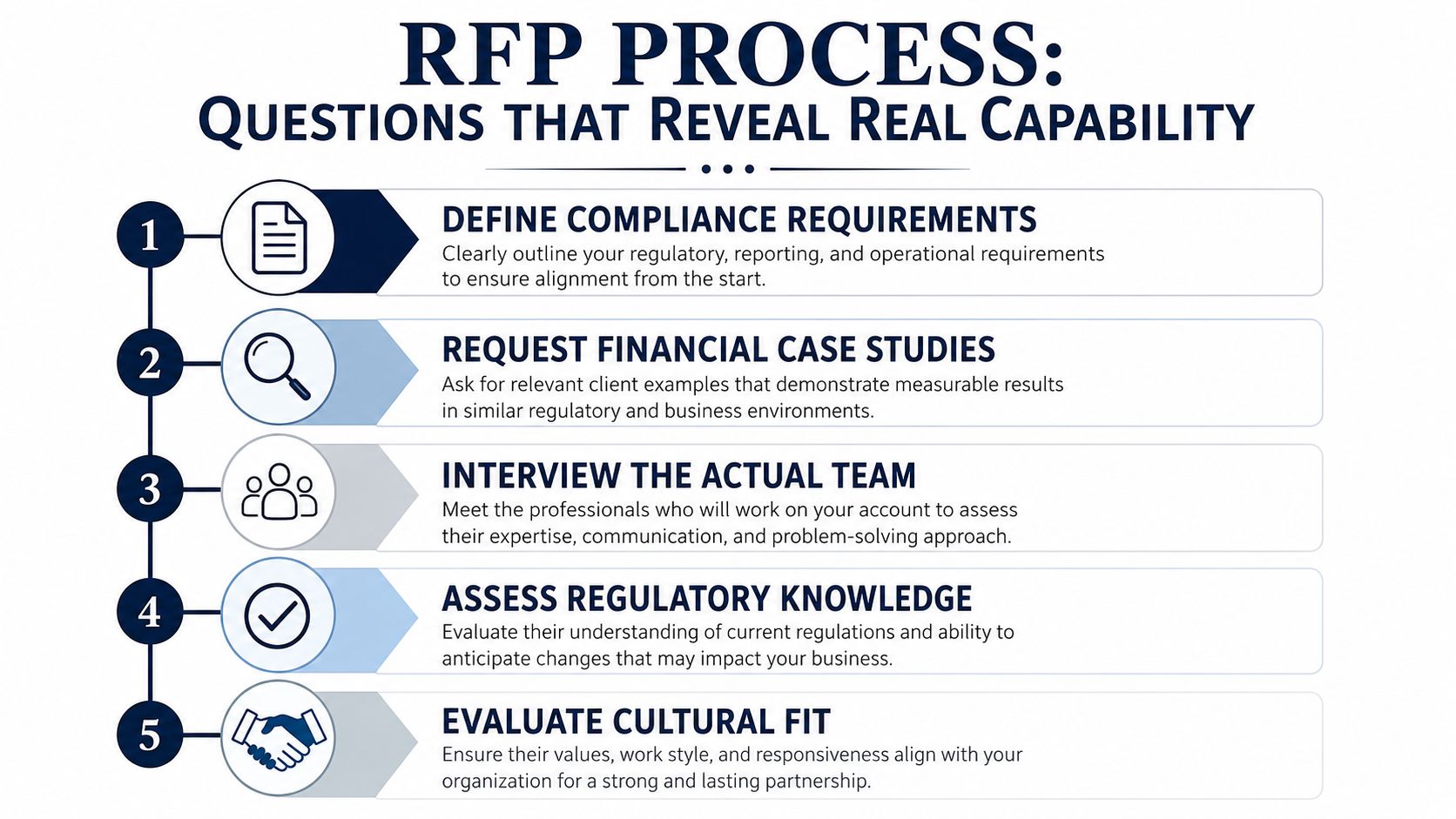
Generic RFPs invite generic answers, and generic answers are dangerous in banking. A bank advertising agency should be forced to show how it works, not just what it sells. The RFP has to surface the mechanics of compliance, attribution, and onboarding, or the selection process becomes little more than a beauty contest.
Questions that expose operational maturity
The cleanest RFP structure asks for evidence, not adjectives. It should require the agency to explain how it handles compliance-aware content, what it does before launch to reduce rework, and how it measures channel performance after go-live. If the response feels like a recycled pitch deck, the process has already gone off track.
A strong interview sequence usually covers four areas:
- Compliance experience, how does the team handle review cycles, offer language, and regulatory constraints.
- Measurement approach, what attribution method does it use, and how does it define a qualified lead.
- Creative process, how are claims tested before they reach legal review.
- Onboarding readiness, what happens in the first month, and who owns each handoff.
Direct filter: if an agency won't discuss suppression lists, review timing, or campaign governance, that's usually a sign it's not ready for banking work.
The most revealing questions are the ones that force specificity. Ask how the agency integrates CRM suppression lists before launch. Ask how it handles geography-based click patterns. Ask who on the team writes, reviews, and revises regulated copy. The answers should sound operational, not theatrical.
Red flags are easy to spot once the questions are right. Vague attribution language, reluctance to describe review timelines, and no clear plan for state-level awareness are all reasons to pause. The same applies if the agency talks about “optimization” but can't explain what it optimizes toward. In banking, impressions aren't the point. Conversion quality is.
One practical way to tighten the process is to require a response format that maps each deliverable to the team member responsible, the review checkpoint, and the expected turnaround. That makes it hard for agencies to hide behind vague capability statements. It also gives the bank a clearer picture of how much internal lift the partnership will demand.
KPIs, Attribution, and Compliance Checkpoints for Ongoing Success
The work starts after the agency is hired. Banks that treat agency selection as the finish line usually end up disappointed, because performance in regulated advertising depends on the feedback loop after launch. The wrong KPIs push teams toward vanity metrics. The right ones keep the partnership tied to revenue, compliance, and operational discipline.
What to measure after launch
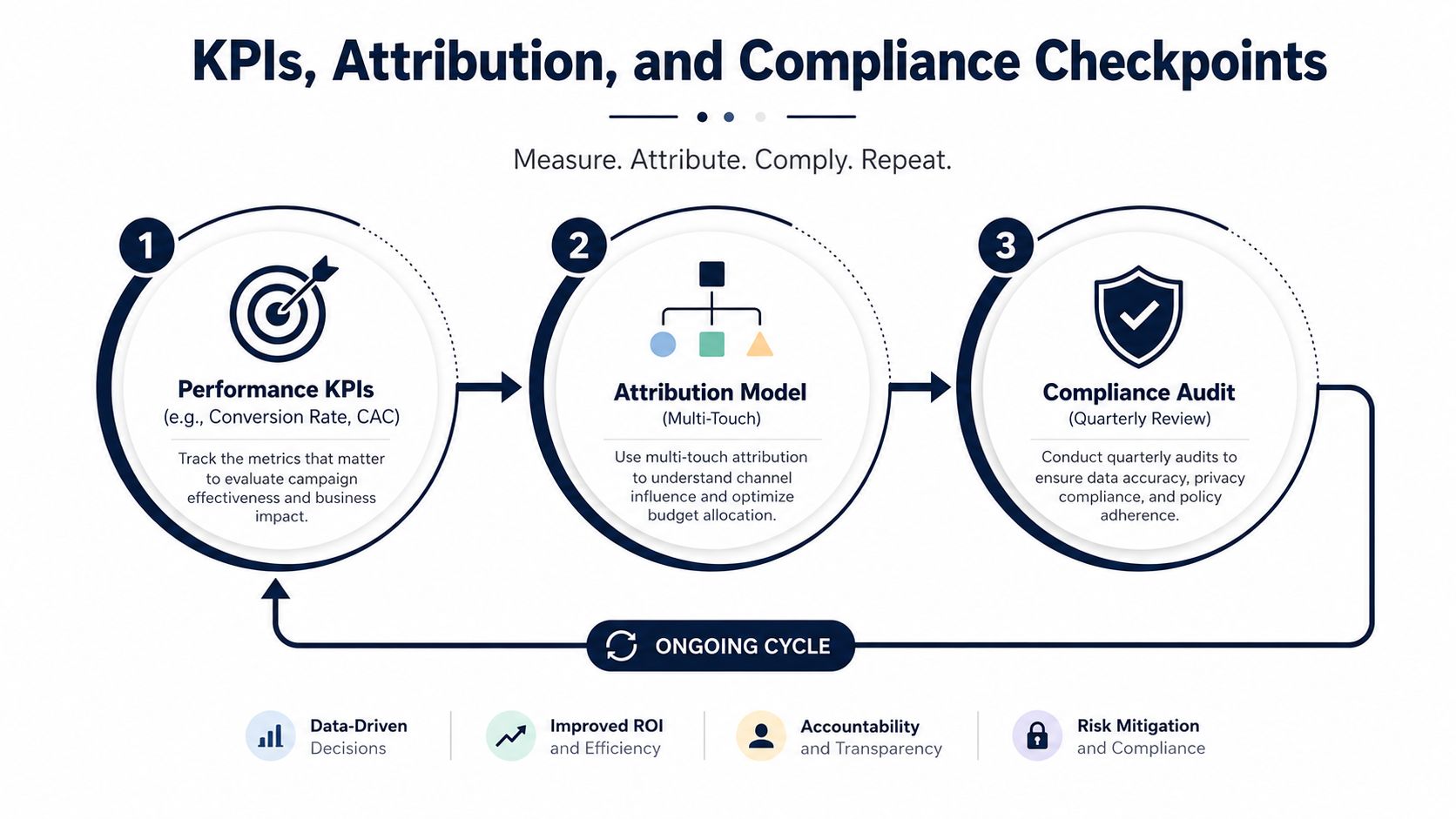
Industry guidance is clear that banks should track cost-per-acquisition, click-to-lead rate, and engagement depth rather than impressions alone. That matters because some channels produce attention without producing account-ready demand. Others look quiet in reporting but drive stronger lead quality.
Channel benchmarks also vary enough that a single standard is misleading. The same source notes that financial services search-ad CTR is 3.58% while overall ad CTR is 0.50%, and email averages 27.1% open rate with 2.4% click-through. Those differences show why one creative concept won't behave the same way across every channel. The agency should be building channel-specific expectations, not pretending every platform follows the same physics.
The internal guide on bank website design matters here because the post-click experience shapes whether paid media turns into a usable lead. If the landing path is weak, good media reporting can still mask poor conversion economics.
AI doesn't fix bad governance
Recent commentary on AI-driven banking ads warns that banks may waste a large share of budget unless they audit strategy versus execution, measure cost per acquisition by platform, review where clicks originate geographically, and connect CRM suppression lists before launch. That's a useful corrective to the usual hype. The problem in banking ad tech is rarely the existence of automation. It's whether governance keeps pace with the automation.
A practical compliance scorecard should be reviewed quarterly, with attention to whether the campaign still matches approved copy, whether the suppression logic is intact, and whether any geographic anomalies need investigation. That kind of review turns the agency relationship into a managed operating system instead of a passive vendor arrangement.
If the agency can't connect media performance to compliance readiness, the team is only seeing half the picture. In banking, that missing half is usually where the expensive surprises live.
Onboarding Timeline and Early-Warning Indicators
The first 90 days tell the truth about an agency. If onboarding is sloppy, the rest of the relationship usually follows the same pattern. A bank advertising agency that knows its craft should move through setup with discipline, because the early workflow shapes how much correction the bank will need later.
The first 90 days
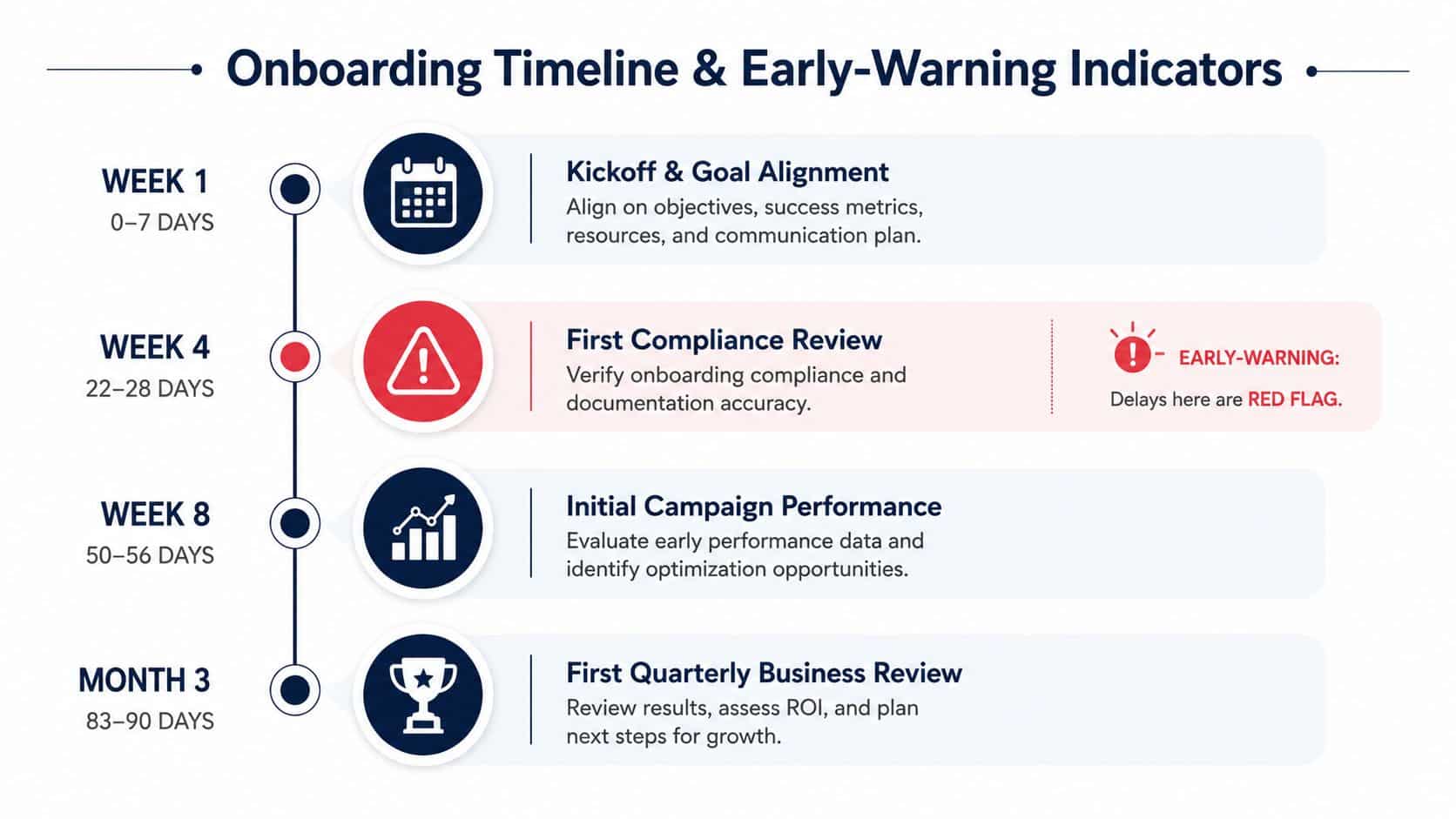
The first month should be about alignment, not volume. Brand assets, compliance rules, campaign goals, audience definitions, and approval paths need to be documented before anything goes live. If the first compliance review keeps getting delayed, that's not a scheduling issue, it's a structural warning sign.
By week four, the agency should already know how its drafts move through review, what internal approvals are required, and which claims need extra scrutiny. By week eight, a campaign should have a baseline, even if the numbers are modest. By month three, the bank should be able to hold a quarterly business review and speak clearly about what's working, what's stalled, and what needs adjustment.
Early-warning indicators that matter
- Missed review windows, the agency is not respecting the bank's approval tempo.
- Unexplained attribution gaps, the reporting setup is probably incomplete or too shallow.
- Repeated creative rework, the briefing process is weak or the team doesn't understand the regulatory frame.
If the same ad needs a third round of compliance fixes, the problem is usually upstream.
Good onboarding should feel structured, not improvised. The team should know who owns launch readiness, how issues get escalated, and what a clean handoff looks like when the first campaign ships. If those roles stay fuzzy, the bank will pay for it in delays and internal frustration.
A useful success check at the end of the first 90 days is simple. The agency should have a documented process, a working baseline, and a clear explanation for every major revision. If it can't show those three things, the partnership is still in the trial phase, no matter what the contract says.
Making Your Final Agency Selection Decision
The final decision should weigh compliance readiness as heavily as creative quality. A strong portfolio can hide weak process, and weak process is what causes the costly surprises in banking. The right choice is the agency that can move quickly without forcing the bank to become the primary operator of its own marketing program.
A clean way to decide is to score each candidate on four questions. Can it work through regulated copy without constant rescue. Can it explain attribution in a way the bank can use. Can it onboard with structure. Can it support the bank's actual stage of growth. If the answer to any of those is shaky, the lower price is usually an illusion.
For banks that want a broader view of agency selection across regulated marketing, the MyMentions guide to top tech PR agencies Australia is a reminder that specialty usually beats generality when the work is high-stakes. Banking marketing follows the same logic. The vendor should match the constraints, not just the category.
The final matrix should not reward flash. It should reward the agency that reduces rework, shortens approval cycles, and ties media work to usable business outcomes. That's what a real bank advertising agency does. It becomes an operating advantage, not another layer of coordination.
Advisor Momentum works with regulated financial teams on compliance-ready website design, advertising, and content programs that are built to support lead generation without ignoring review requirements. For banks that need a partner who understands both performance and compliance, visit Advisor Momentum to see how its services fit this kind of work.
