
A bank can have a polished brand, a good branch network, and a capable product team, yet still lose momentum because the marketing work never gets past compliance review or never turns into qualified conversations. That's the tension most regulated institutions live with right now, since growth pressure keeps rising while every claim, creative choice, and follow-up sequence has to survive scrutiny from legal and compliance stakeholders. Banking marketing services exist to solve that exact problem, bringing together digital execution, trust-building, and audit-friendly process so growth doesn't create unnecessary regulatory exposure.
Table of Contents
- Why Banking Marketing Requires a Different Playbook
- Core Service Categories for Financial Institutions
- How to Evaluate Banking Marketing Vendors
- Measuring What Matters in Financial Marketing
- Understanding Pricing and Budget Allocation
- Building Your Implementation Roadmap
- Common Mistakes and How to Avoid Them
Why Banking Marketing Requires a Different Playbook
A compliance team can approve a campaign that would pass in a general consumer setting and still reject it for a bank, RIA, or wealth management firm because the risk profile is different. A single phrase that sounds like a promise, a testimonial without enough context, or a landing page that skips required disclosures can turn a normal launch into a legal review cycle that slows the entire program. Specialized banking marketing services are built around that reality, and they treat compliance as part of the work from the start.
Practical rule: in regulated financial marketing, creative work is never finished until compliance can live with it.
General agencies often start with reach, impressions, and visual appeal. That approach can work in less regulated categories, but banks and advisory firms need messaging that can survive internal review, support documentation, and still motivate a prospect to act. The same campaign has to persuade a potential client, reassure a cautious executive, and avoid language that creates examination risk. Specialized teams build approval-friendly workflows because the approval path shapes the campaign as much as the copy does.
The execution gap shows up fast. A generalist shop may write broad copy about trust, security, or better service, then hand it over as if the message is finished. A financial-services-focused team instead builds content around reviewable claims, documented offers, and consistent disclosures, then keeps the website, social, advertising, and intake process aligned so one channel does not contradict another. That matters because banks already commit significant budgets to digital channels, and internal teams are often expected to show how those dollars support acquisition, retention, and compliance at the same time.
The wrong partner can create hidden costs that rarely appear on an invoice. Time lost in legal review, rework after noncompliant drafts, and reputational damage after an avoidable claim all consume more than media spend alone. In a regulated setting, the value of a marketing partner lies in producing usable content that can move through the institution safely and repeatedly.
Core Service Categories for Financial Institutions
The strongest banking marketing services stack is rarely a single tactic. It usually combines infrastructure, messaging, acquisition, and conversion support so the whole system can perform under review.
Compliance-ready websites and brand systems
A bank website has to do more than look credible. It needs clear navigation, compliant language, and conversion paths that don't create false expectations. In practice, that means strong page hierarchy, accurate product descriptions, clean disclosure placement, and forms that make the next step obvious without overpromising. A generic website can look beautiful and still fail because it doesn't support the institution's approval process or client intake flow. For a practical example of what a compliance-conscious website approach can look like, the internal bank website design guide is a useful reference point.
Branding services matter for the same reason. Financial institutions don't need louder promises, they need clearer positioning, consistent language, and visual identity that feels stable enough for cautious decision-makers. That includes naming systems, brand guides, and presentation standards that keep every branch, advisor, and campaign from drifting off-message.
Content, video, and advertising
Content programs for regulated firms should be editorially disciplined. That means articles, web pages, and social posts that explain products, reduce confusion, and support compliance review without sounding like legal memos. Video works when it simplifies complex topics, such as account setup, lending steps, or service differences, and it works best when the script is written with review in mind from the start.
Advertising should connect to search intent and audience fit, not just broad awareness. Search, paid social, and SEO all play different roles, but each one needs the same disciplined message architecture. A bank that wants qualified traffic can't rely on generic slogans. It needs landing pages, headlines, and calls to action that match what a prospect is trying to solve.
The best financial marketing programs connect awareness to intake, then intake to follow-up, instead of treating each step as a separate department.
Coaching and recruiting support
Coaching is often underestimated because it sits between marketing and operations. But if a bank or advisory firm generates leads and the front office doesn't know how to qualify or nurture them, the campaign loses value fast. Coaching helps with onboarding flows, response scripts, and client service habits that turn interest into conversations.
Recruiting support belongs in the same conversation because growth depends on people, not only campaigns. When a firm is expanding, marketing has to help attract talent that can uphold the same standard of service promised in public-facing channels. That's why these services work best as a coordinated system rather than isolated line items. One agency can write the message, another can manage the ads, but if the intake team and brand standards are disconnected, the entire process becomes more fragile than it needs to be.
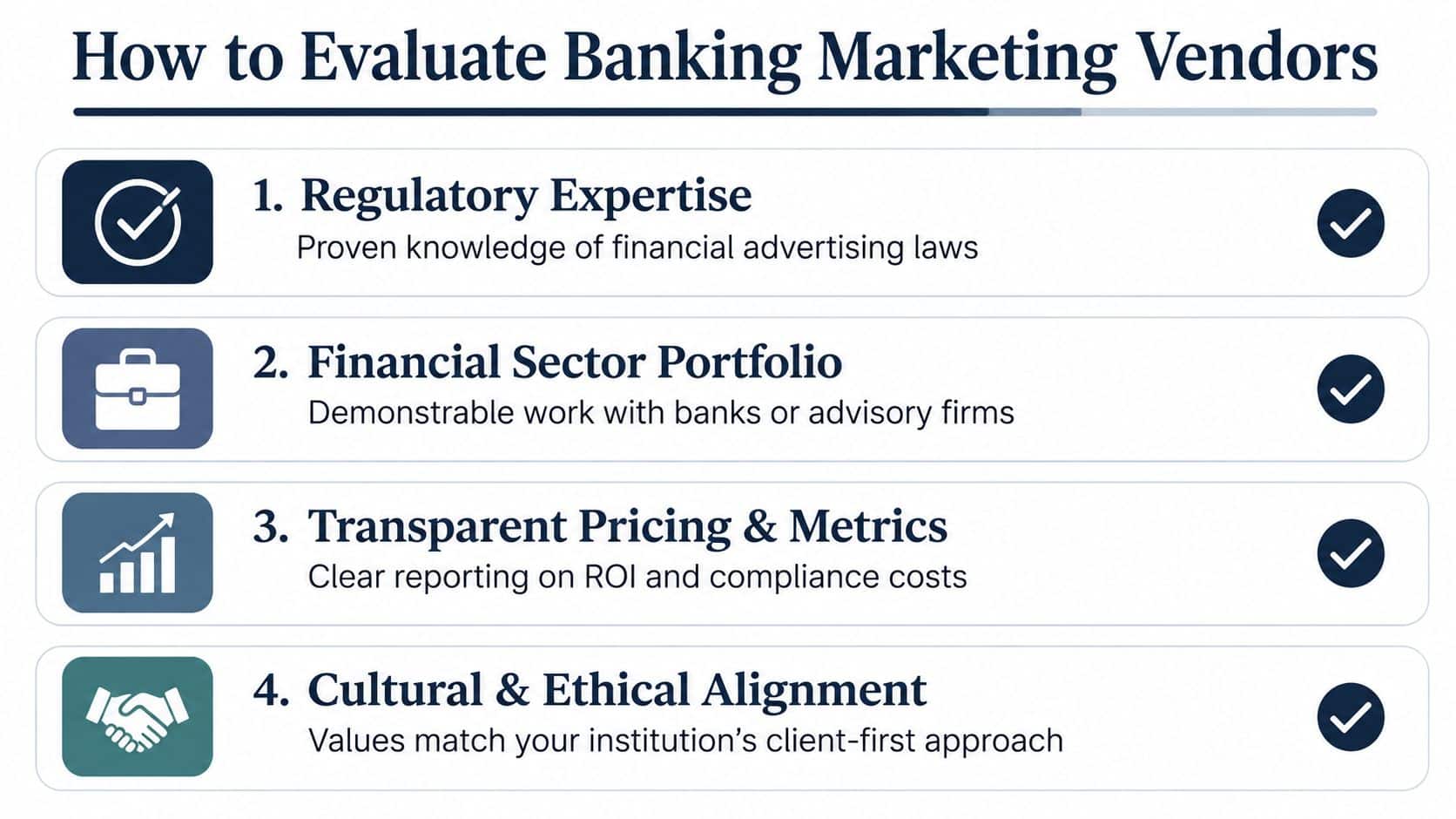
How to Evaluate Banking Marketing Vendors
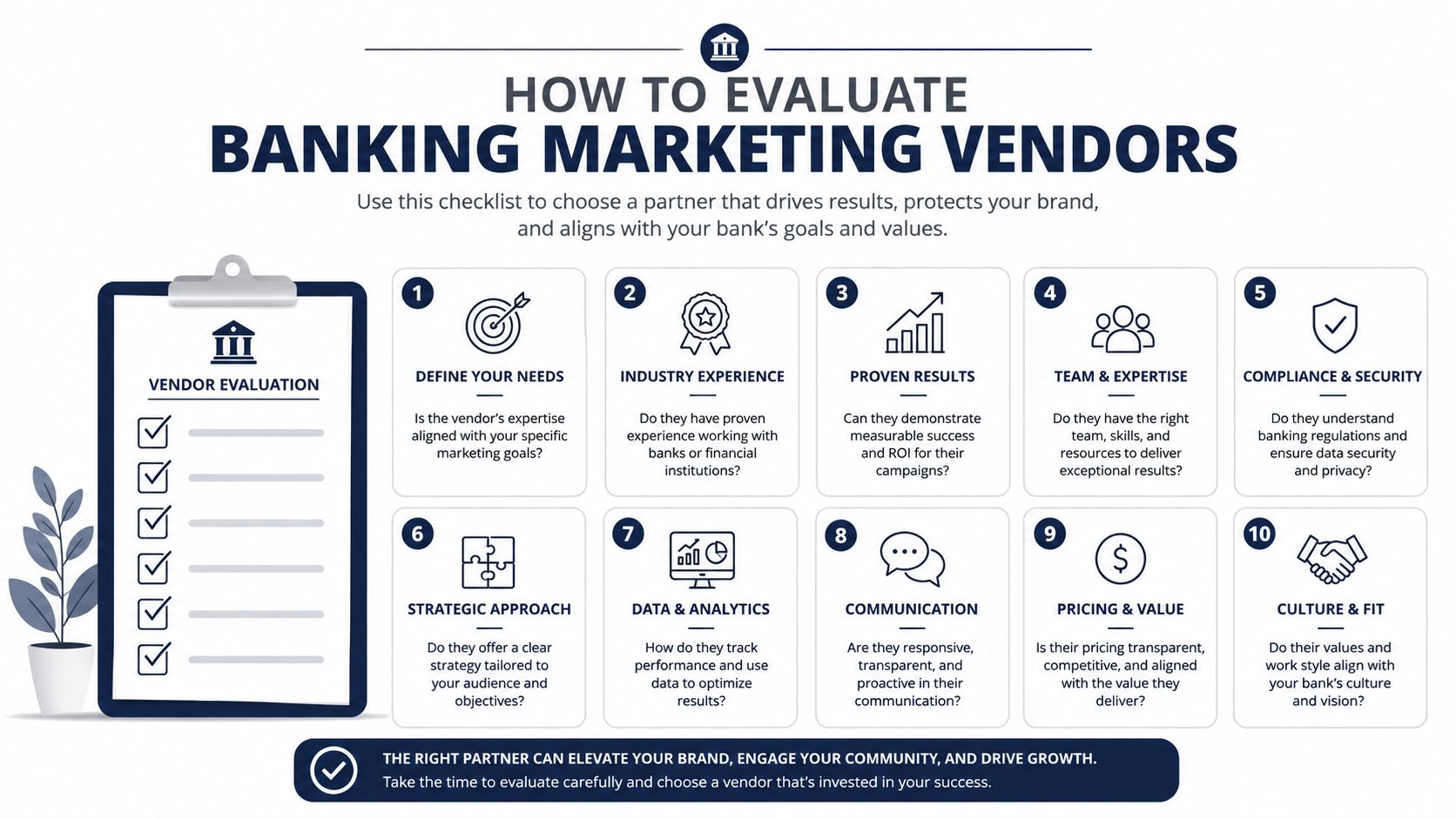
Vendor selection in this category should start with proof, not polish. A nice deck can hide weak compliance instincts, while a modest presentation can still come from a team that understands financial review, risk language, and the pressure of stakeholder sign-off.
Check for real regulatory fluency
The first filter is whether the team has worked inside regulated workflows before. Ask who writes copy, who reviews disclosures, and how revisions are handled when legal or compliance requests changes. If the answer sounds vague, the vendor probably doesn't have a mature process. A firm that understands SEC-aware workflows can explain how it reduces review cycles and keeps content usable after edits.
Ask for examples of how they handle issue spotting, version control, and archiving. That's more useful than asking for generic “financial services experience,” because many agencies can say they've worked with a bank once or twice without knowing how a real approval chain functions.
Look for full-funnel capability
A vendor should be able to support the work from brand through lead generation and follow-up. That includes websites, content, advertising, intake optimization, and coaching where needed. If one provider only handles design and another only handles media, the institution may end up stitching together a process that nobody fully owns.
The guide for founders on data analytics is useful context for the kind of operational thinking that matters here, especially when a bank wants measurement discipline without building everything in-house.
Ask for proof, not promises
A strong vendor can explain how it measures performance, how it documents claims, and how it keeps messaging aligned across channels and states. That matters because banking marketing services aren't just about producing assets, they're about reducing unnecessary risk while creating qualified demand.
Signs a vendor may be weak include:
- Overly broad claims, especially if they promise fast growth without discussing review constraints.
- Thin financial-sector history, particularly if their examples come from unrelated industries.
- No workflow detail, which usually means no real system for compliance review.
- Separation between marketing and coaching, which makes lead volume look better than lead quality.
A useful internal benchmark is the guide on how to choose a bank advertising agency. It helps frame the difference between a vendor that can run ads and one that can work inside bank-grade approvals and conversion requirements.
Practical rule: if a vendor can't explain how it handles revisions, disclosures, and approvals without improvising, the institution is buying risk along with marketing.
Measuring What Matters in Financial Marketing
The easiest numbers to report are often the least useful. Impressions, clicks, and reach can help diagnose performance, but they do not show whether a campaign produced a qualified relationship, a compliant inquiry, or a stronger pipeline. In regulated financial services, measurement has to connect marketing effort to business outcomes that leadership can defend.
A weak reporting setup often looks busy and still misses the mark. It counts activity without showing whether the bank attracted the right prospects, cleared internal review, or generated leads the business can service.
Use outcomes that match the business
The right KPIs start with lead quality, not traffic volume. That means tracking how many prospects meet the institution's fit criteria, how many move through intake without friction, and how many remain worth the servicing cost once they become clients. A campaign that produces lots of low-quality inquiries can still waste staff time and create operational drag.
The shift toward digital spend explains why this matters. Banks have pushed more budget into digital channels, and that level of investment demands reporting that shows what happened after the click. If the dashboard only tracks visits, it leaves out the part leadership cares about most, which is whether the activity produced a relationship the institution can support.
Track measurement in a way compliance can accept
| KPI Category | Metric | Why It Matters | Measurement Approach |
|---|---|---|---|
| Acquisition quality | Qualified lead volume | Shows whether campaigns attract the right prospects | Review intake outcomes against target criteria |
| Conversion | Compliant lead conversion rate | Connects marketing to usable pipeline | Compare leads that pass review with total inquiries |
| Website performance | Form completion and next-step actions | Shows whether the site supports trust and action | Monitor page behavior and submission flow |
| Content impact | Content-assisted inquiries | Shows whether education is helping the funnel | Attribute inbound conversations to content touchpoints |
A dashboard built this way helps leadership see which channels support growth and which ones only create activity. It also keeps reporting closer to audit-friendly documentation because the numbers are tied to actual process stages, not vanity outcomes.
The market data in banking points in the same direction. Analysts have reported higher acquisition costs, stronger credibility tied to website design, and wide gaps in conversion performance across banking sites, which makes disciplined measurement more important than ever. Those patterns do not justify sloppy reporting. They make the case for tighter attribution, cleaner definitions, and more realistic expectations.
For teams comparing reporting structures or budget models, the MCP server pricing details offer a useful reference point for how pricing clarity affects measurement discipline. In banking, the same principle applies, if the reporting structure is vague, the results usually are too.
Understanding Pricing and Budget Allocation
A budget decision in banking starts with fit, not size. A national institution, a regional bank, and a community bank all face different approval paths, risk limits, and growth targets, so the same marketing structure will not work for all three.
Compare budget realities by institution type
Large institutions often operate with broad brand programs, multiple business lines, and heavier coordination demands, so their marketing budgets reflect that complexity. Smaller banks usually work with tighter operating limits and more selective campaign plans, which means every dollar has to support a specific business outcome. The practical point is simple, the budget has to match the institution's structure and growth goals.
For specialized work, pricing usually shifts with scope. A branding and website engagement looks different from an ongoing content and advertising program, because one is a defined project and the other is a recurring operating rhythm. Retainers fit situations where review cycles are steady and the institution needs continuity. Project fees make more sense for discrete launches. Performance-based structures can sound attractive, but in regulated markets they can create weak incentives if the vendor is rewarded for volume instead of compliant quality.
Spend where coordination matters most
A fragmented budget can produce strong-looking assets that never work together. Mature bank marketing plans usually put money into the parts that affect the whole funnel, website structure, content clarity, paid media alignment, and coaching that improves conversion. That mix still needs to fit the institution's size and internal bandwidth, because an overbuilt plan can be just as inefficient as an underfunded one.
Budget discussions also need pricing transparency. The MCP server pricing details page is a useful reminder that buyers should be able to see what is being paid for and why, even if the category is different.
Practical rule: if a proposal does not separate strategy, production, media, and compliance work, the institution will not know what it is really paying for.
Building Your Implementation Roadmap
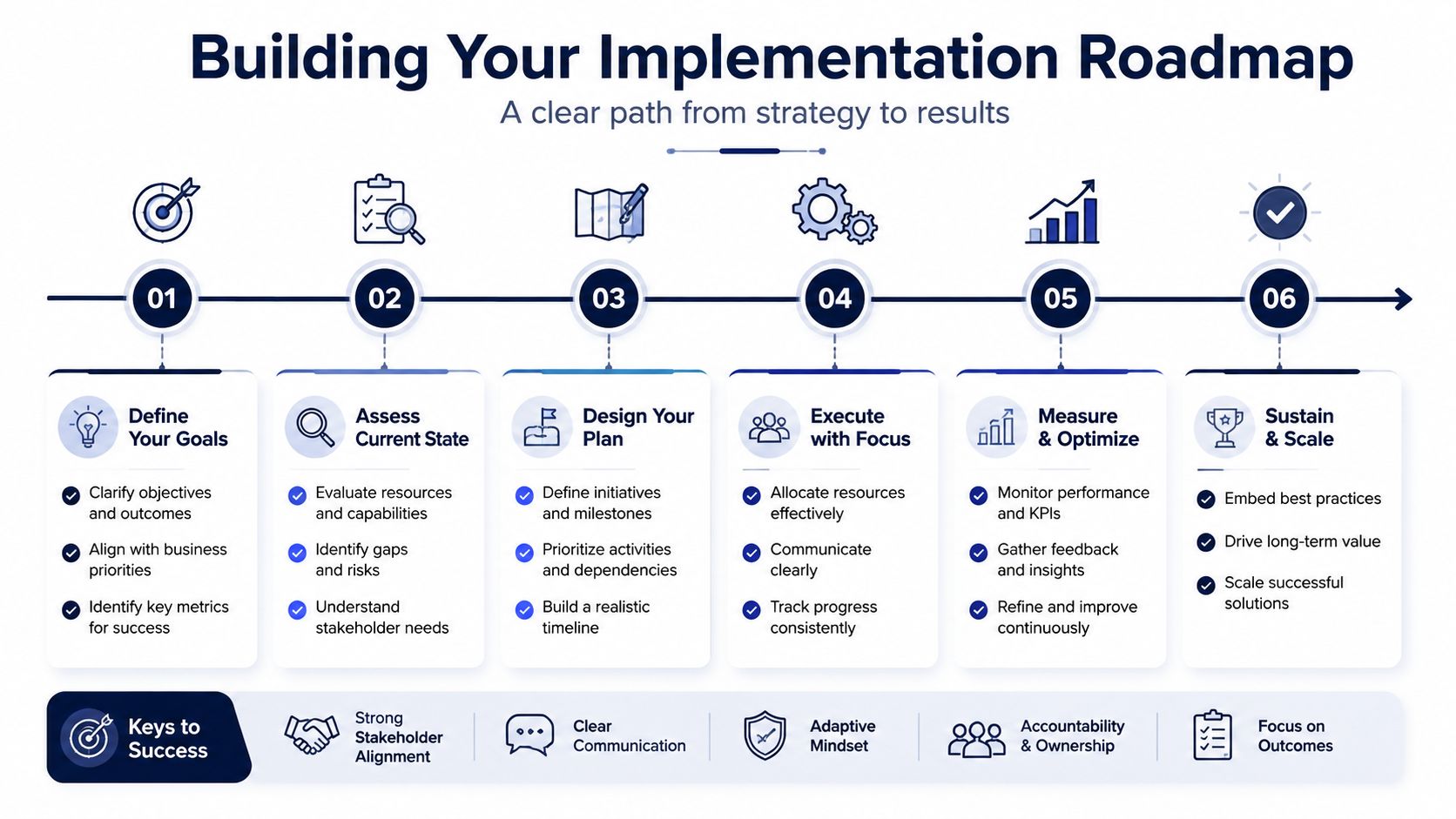
Successful launches usually start with the parts nobody sees. Strategy, approvals, infrastructure, and intake readiness have to come before broad promotion, or the institution ends up paying to send people into a broken path.
Start with the foundation
The first step is message architecture. That means knowing who the institution wants to attract, what it can safely promise, and what proof points are permitted. The second step is the website and intake flow. If prospects can't understand the offer or complete the next action cleanly, media spend gets wasted.
The third step is content preparation. Articles, landing pages, and social assets should be approved before campaigns launch so the institution isn't building under pressure. That matters because regulated organizations tend to lose time when promotion begins before the content library is ready.
Sequence promotion after readiness
Advertising comes after the foundation, not before it. A bank can run search or social campaigns without proper supporting pages, but the odds of inefficiency go up fast. Once the core messaging and conversion path are stable, campaigns can be expanded with more confidence.
Then comes coaching and operational alignment. The intake team, branch staff, or advisor group has to know how to handle the leads the marketing program generates. If they don't, the institution gets activity without progress. The final step is ongoing refinement, which is where leadership reviews what's working and trims what isn't.
The same logic applies when multiple providers are involved. One team may handle design, another advertising, and another internal training, but a single owner should manage the handoffs. That prevents the common failure mode where every piece is good in isolation and weak in sequence.
Common Mistakes and How to Avoid Them
The most expensive mistakes in financial marketing aren't always dramatic. They're often small, repeated, and easy to excuse until they start affecting trust and conversion.
Don't confuse visibility with credibility
Inconsistent branding across website pages, branch materials, and digital campaigns makes a bank look less stable than it is. Prospects notice when the message changes from channel to channel, especially in a category where trust is the main currency. A unified brand system is not decoration, it's a signal of operational discipline.
Another common mistake is treating marketing as a discretionary expense rather than a measurable function. That mindset leads to underfunded testing, inconsistent staffing, and weak reporting. Banks that already understand marketing as a line item tend to make better decisions about continuity and accountability.
Don't assume one message fits every segment
Broad inclusion language can sound good internally and still miss the people the institution wants to reach. The FDIC notes barriers such as language, identification, and location issues, and its review emphasized targeted marketing approaches such as local newspapers, ethnic publications, community events, direct mail, and radio or TV (FDIC report). That's a reminder that underbanked and distrustful audiences respond better to segment-specific trust signals than to generic slogans.
Research on underserved markets also shows the value of mixed-channel access methods, including tier 1 accounts, women-focused products, disability-focused products, radio jingles, market activations, focus groups, SMS, USSD, and inclusive technology (Nigerian banking inclusion research). The lesson is simple. If the audience doesn't trust a purely app-first path, the institution needs a practical alternative, not a prettier version of the same assumption.
A final mistake is separating marketing from follow-up. If the campaign generates attention but the intake or onboarding process is clumsy, the institution absorbs the cost without the relationship. That's why banking marketing services work best when they include conversion coaching, not just creative production.
A campaign can be compliant and still fail if the next step is unclear, slow, or disconnected from the promise that brought the prospect in.
Advisor Momentum helps regulated financial firms connect website design, content, advertising, branding, coaching, and recruiting inside one compliance-first system, so marketing doesn't stall in review or break down at intake. For banks and advisory teams that need growth without sloppy execution, visit Advisor Momentum to see how a regulated-firm marketing partner approaches the full funnel.
