
A lot of firms are sitting in the same spot right now. The website is live, the logo looks acceptable, the team has a brochure, and compliance still sends back edits late in the process that slow everything down. Meanwhile, prospects bounce between advisor sites that all sound alike, use the same stock language, and make the same promises about trust, planning, and personal service.
That's the core problem with branding for financial services. It isn't that firms ignore branding. It's that they treat branding as surface design, then treat compliance as a separate cleanup exercise. In a regulated industry, that split creates weak differentiation, slower execution, and avoidable credibility problems. The firms that stand out usually do one thing differently. They build brand strategy and compliance workflow together from the start.
Table of Contents
- Why Most Financial Brands Fail to Stand Out
- Laying the Foundation with Brand Strategy
- Crafting Your Visual and Verbal Identity
- Building a Compliant Digital Presence
- Activating Your Brand with Content and Video
- Creating Brand Guidelines to Ensure Consistency
- Measuring Brand Health and Proving ROI
- Your Roadmap to a Standout Financial Brand
Why Most Financial Brands Fail to Stand Out
Most firms don't have a visibility problem first. They have a sameness problem.
A prospective client searches for help with retirement planning, portfolio management, or banking services and finds page after page of near-identical messaging. Conservative colors. Abstract promises. Generic claims about service. Little proof of a distinct point of view. When every brand presents itself as stable, experienced, and client-focused, none of those words create separation.
That creates a business issue, not a creative one. Recent PwC research established that companies perceived as having a stronger brand image outperform their competitors by 25% in terms of three-year growth of total shareholder return according to this financial services branding analysis. Stronger branding doesn't just change appearance. It changes financial outcomes.
The sea of sameness has a cause
In financial services, firms often default to what feels safe. They copy the visual cues of established institutions, soften every statement in anticipation of compliance edits, and strip out anything that sounds distinctive. The result is branding that avoids risk but also avoids relevance.
A second mistake follows quickly. Teams jump into website copy, logo revisions, or campaign production before they've decided what the brand stands for in the market. Without that strategic base, every downstream decision becomes subjective.
A brand that says nothing risky usually says nothing memorable.
What works and what doesn't
A useful contrast makes the problem clearer:
| Approach | What happens |
|---|---|
| Generic positioning | Prospects struggle to tell one firm from another |
| Late-stage compliance review | Content gets softened, delayed, or rewritten |
| Clear market position | Messaging becomes easier to defend and repeat |
| Embedded compliance workflow | Teams produce materials faster with fewer revisions |
The firms that stand out usually make deliberate choices in three areas:
- Audience clarity means the brand speaks to a defined client type, not everyone with money.
- Operational discipline means marketing and compliance work from shared rules instead of separate agendas.
- Consistent execution means the website, decks, videos, forms, and follow-up communication all feel like they came from the same institution.
Branding for financial services works when it's built to survive real-world scrutiny. That includes legal review, digital execution, client skepticism, and internal handoffs. If a brand only works in a presentation deck and falls apart on the website or in advisor communications, it isn't a working brand.
Laying the Foundation with Brand Strategy
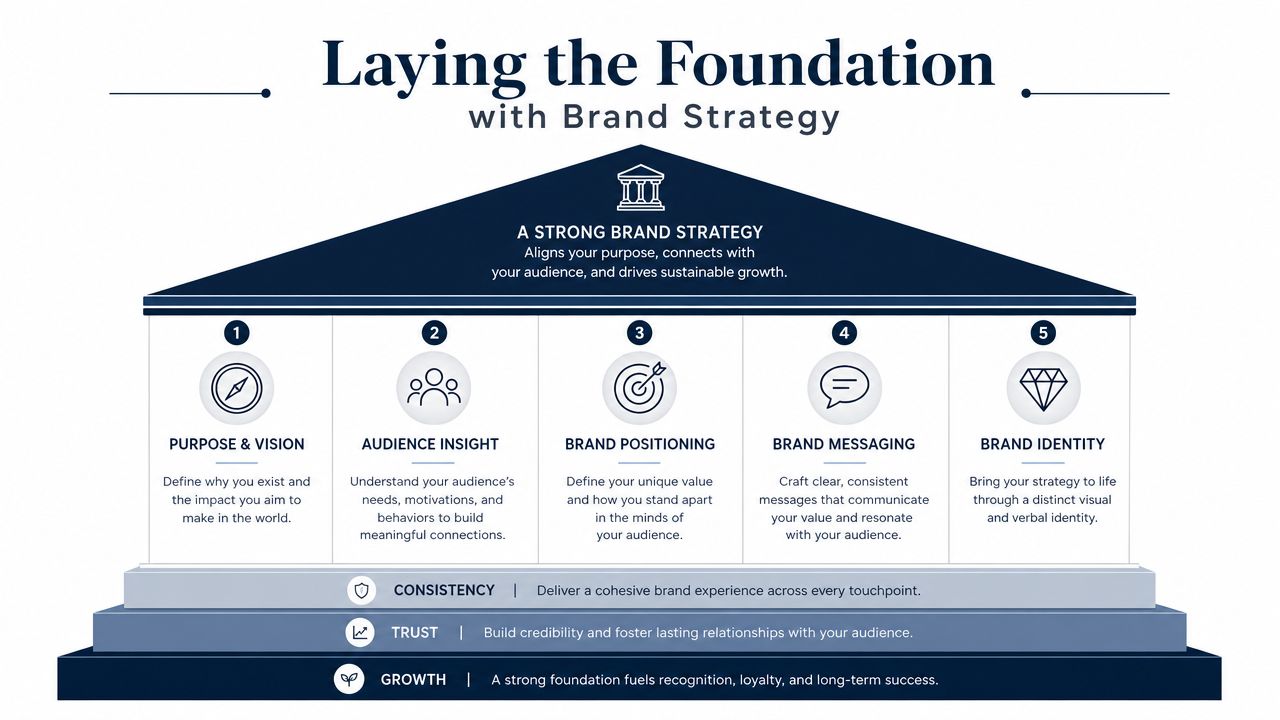
Creative work should start late, not early. Before colors, naming, and homepage copy, a firm needs a position it can explain internally and defend externally.
A practical framework for financial services branding starts with mission and objectives, then moves through audience research, differentiation, core identity, rollout, and feedback. That sequence is outlined in this guide to brand strategy for financial services. The order matters because each step reduces guesswork in the next one.
Start with business intent
A brand strategy should answer a hard question first. What is the firm trying to become?
That sounds obvious, but many advisory firms and banking teams skip it. They define a style before they define a destination. A stronger approach sets the commercial intent up front. Is the firm trying to attract higher-net-worth households, appeal to business owners, modernize after a leadership transition, or prepare for expansion into new markets? Branding should support that business move directly.
A mission statement on its own isn't enough. The strategy needs practical boundaries.
- State the objective clearly so marketing decisions support growth priorities.
- List the essential elements such as fiduciary posture, service model, or client experience standards.
- Document compliance constraints early so the brand doesn't rely on claims legal teams won't approve.
Define the audience before the creative
Audience research in this industry has to go deeper than age bands or asset tiers. It should identify what clients are worried about, what language they trust, what signals competence to them, and where they get confused.
A retirement-focused advisor might discover that prospects don't want more sophistication in language. They want more clarity around process. A regional bank might find that small business owners respond better to responsiveness and local decision-making than to broad institutional claims.
That kind of insight becomes useful only when it changes the brand.
Practical rule: If audience research doesn't alter messaging, offers, or site structure, it was just an exercise.
For teams refining internal planning, resources on unlocking content value with a brand strategy can help connect high-level positioning to the content that eventually reaches prospects.
Build a position that can survive scrutiny
Differentiation in finance has to be credible. It can't rely on exaggerated promises, vague innovation language, or borrowed fintech vocabulary. A sound positioning statement names who the firm serves, what problem it solves, how it solves it differently, and why that difference matters.
Here's a simple test:
| Question | Weak answer | Strong answer |
|---|---|---|
| Who is this for | Everyone planning for the future | Owners preparing to exit a closely held business |
| What is different | Personalized service | A defined planning process tied to tax, succession, and liquidity decisions |
| Can compliance support it | Probably | Yes, because it reflects actual process and scope |
That's the point of strategy. It prevents the brand from becoming a collection of attractive but unsupported claims.
Crafting Your Visual and Verbal Identity
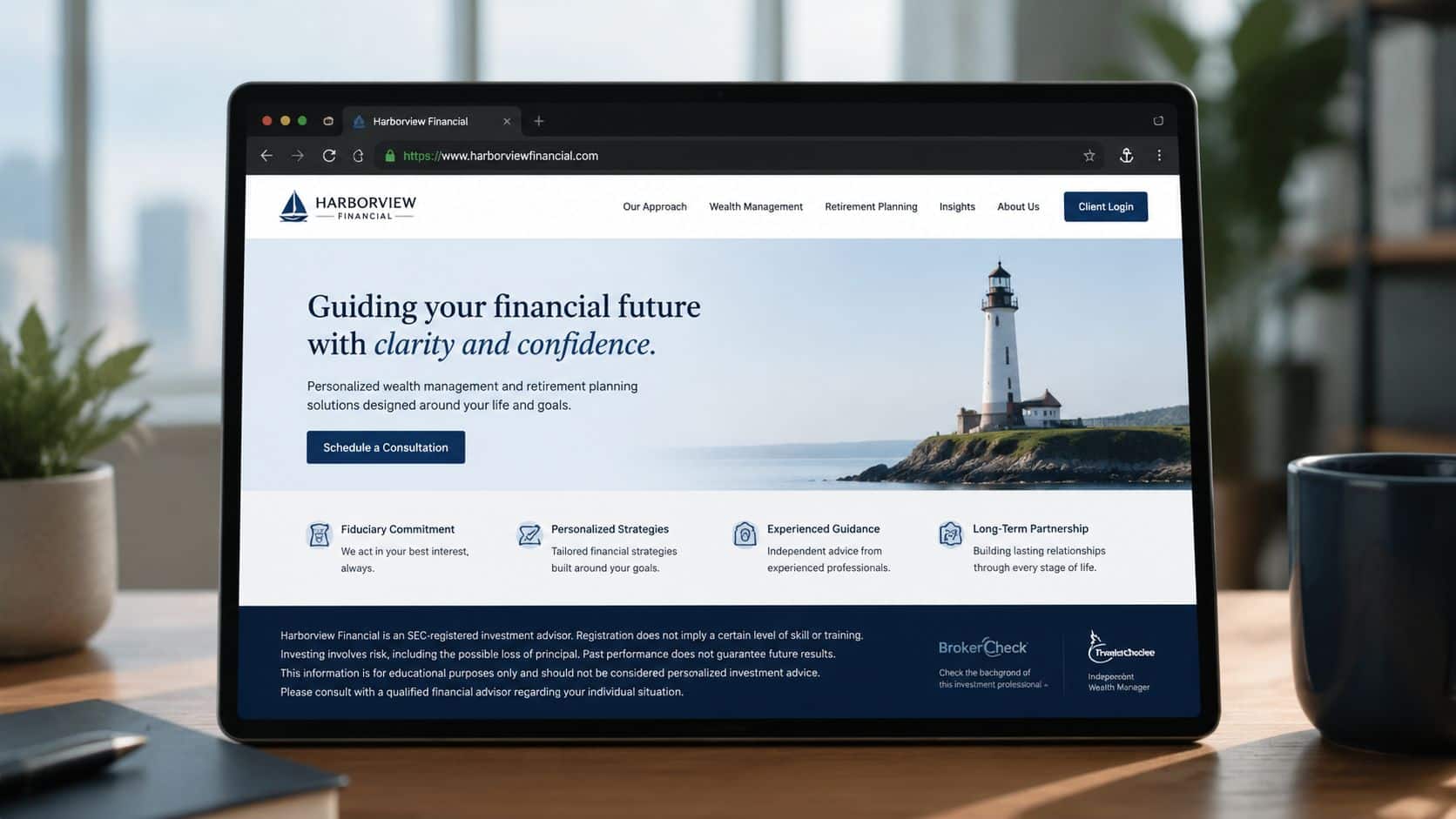
Once the strategy is settled, identity work becomes easier because the firm is no longer guessing what it wants to signal. The name, logo, typography, imagery, and messaging all need to express the same market position. If they send mixed signals, prospects feel that friction immediately.
A modern financial brand doesn't need to look flashy. It needs to look intentional.
Choose a name and look that fit the promise
A firm name should be memorable, pronounceable, and aligned with the market position already defined. In practice, that means avoiding names that are so abstract they communicate nothing, but also avoiding names that lock the firm into a narrow service line it may outgrow.
Visual identity decisions should follow the same logic. A boutique planning firm serving executives may need a cleaner, more restrained system than a community-facing retail banking division. Both can look credible, but they should not look interchangeable.
A useful review process checks each identity element against three filters:
- Recognition. Can a prospect remember it after a short website visit?
- Flexibility. Does it work on a website, presentation, social graphic, and client document?
- Credibility. Does it fit the expectations of a regulated financial decision?
What doesn't work is choosing colors or symbols based on trend alone. If the visual system looks modern but feels disconnected from the service experience, it creates doubt instead of trust.
Develop a voice clients can recognize
Verbal identity matters just as much as visuals. Most firms already have language habits. The problem is that those habits often come from compliance edits, product descriptions, or legacy brochures rather than a defined brand voice.
A usable verbal system usually includes:
- Messaging pillars that explain the firm's core promises in plain language
- Tone guidance that shows how to sound clear, steady, and human without becoming casual
- Proof language tied to process, expertise, and service model rather than unsupported superlatives
Clients rarely reject a financial brand because it was too clear. They leave because the language felt vague, inflated, or interchangeable.
A helpful exercise is to rewrite common website lines. “We provide customized financial solutions” says almost nothing. “Clients work through a structured planning process built around cash flow, tax exposure, and long-term goals” says much more and gives compliance teams something concrete to evaluate.
Identity should reduce friction, not add it
The best creative systems make execution easier. They give advisors, marketers, and operations teams approved language blocks, standard descriptors, image styles, and clear layout rules. That lowers the number of subjective debates and reduces the risk that every new asset starts from scratch.
Strong identity work doesn't end with a polished logo file. It ends when a team can use the system consistently in ordinary work.
Building a Compliant Digital Presence
A financial website isn't just a digital brochure. It's an advertisement, a trust signal, a lead qualification tool, and a recordkeeping obligation. That's why compliance can't sit at the end of the web process waiting to approve or reject finished pages.
The better model is compliance by design. That means legal and compliance considerations shape site architecture, messaging patterns, content approvals, and storage processes from the beginning.

Compliance by design beats compliance at the end
Late-stage review creates predictable problems. Marketing builds pages around language that won't be approved. Designers use testimonials or implications that trigger revisions. Teams publish quickly but fail to preserve the right records. None of that is efficient.
Under current SEC advertising rules, records of a financial advisor's website advertisement must be complete and accurate for at least five years from the end of the fiscal year in which the advertisement was most recently used, as explained in this adviser website compliance resource. That requirement alone should change how web teams handle publishing workflows, revisions, and archived copies.
A practical compliance-by-design workflow includes:
- Pre-approved claim categories so writers know what language is allowed before drafting
- Required disclosure logic built into templates and page types
- Version control and archiving tied to each published update
- Early compliance review at sitemap and messaging-outline stage, not only before launch
For firms evaluating a purpose-built approach to compliant site execution, a review of financial advisor website services can help frame what should be included operationally.
A compliant website still has to feel modern
Compliance doesn't excuse a weak digital experience. That's where many firms lose momentum. They become so cautious that the site turns sterile, text-heavy, and difficult to use.
That's a costly mistake in a market where digital trust is formed across many touchpoints. The digital identity gap is substantial. Research summarized in this article on digital brand identity in financial services argues that over 99% of the customer journey for financial services prospects remains underserved when firms fail to adapt brand assets and messaging for digital use.
The implication is straightforward. A compliant site still needs a strong user experience. Visitors should know within seconds who the firm serves, what it offers, and what next step to take.
What a regulator-ready website should include
| Website element | Why it matters |
|---|---|
| Clear service descriptions | Reduces ambiguity and supports accurate expectations |
| Defined calls to action | Moves users into appropriate inquiry paths |
| Accessible disclosures | Helps legal language live with the content it qualifies |
| Structured content system | Makes updates easier to review and archive |
Where firms usually get into trouble
The common weak spots are avoidable. Teams imply outcomes instead of describing process. They publish educational content that drifts into promotional claims. They let advisors improvise bios and homepage copy without a style standard. They also forget that every web update may need to be retained and reproduced accurately later.
A compliant digital presence doesn't mean thin content. It means disciplined content. That discipline strengthens branding for financial services because it produces clearer claims, cleaner layouts, and more reliable trust signals.
Activating Your Brand with Content and Video
A website alone won't carry a brand. Prospects learn what a firm stands for through repeated exposure. Blog posts, short videos, email sequences, social updates, landing pages, and client education pieces all reinforce or weaken the brand over time.
The difference usually comes down to whether content was built around education or around promotion disguised as education.
The risky version of content marketing
Consider a common scenario. An advisory firm wants more visibility, so it starts publishing market commentary and investment recaps. The posts are frequent, but they drift into implication. A headline hints at what investors should do next. A video host starts speaking too confidently about likely outcomes. A social caption oversimplifies a nuanced point to attract attention.
That approach creates two problems. First, the brand starts sounding reactive rather than steady. Second, the compliance risk goes up fast.
The SEC Marketing Compliance Rule, which went into effect on May 4, 2021, explicitly prohibits marketing communications from predicting or projecting performance, barring specific exceptions, as described in this overview of SEC marketing compliance for advisors. That rule should shape content planning from the beginning, especially in video where off-script language can create problems quickly.
The version that builds trust
A stronger example looks very different. The firm builds a content calendar around recurring client questions. Topics might include how the planning process works, what documents clients should gather before a meeting, how risk tolerance discussions are handled, or what business owners should think about before a transition event. None of that requires speculative claims. All of it can build authority.
Educational content performs best in finance when it removes confusion without implying outcomes.
Video is especially effective when it simplifies complex topics and lets prospects see how the firm communicates. Short explainers, advisor introductions, service walkthroughs, and onboarding expectations often work better than highly produced promotional reels. They feel more credible because they help the viewer make sense of the decision process.
Teams that need a starting point for structure can review financial services video templates to map common formats such as explainers, service overviews, and client education pieces.
A low-risk content mix
- Evergreen articles that answer recurring planning or banking questions
- Short educational videos that explain process, terminology, or service expectations
- Advisor bios and team stories that show background and working style without hype
- FAQ content that addresses objections and next-step concerns clearly
One operational note matters here. Content approval should not start from a blank page every time. The most effective firms use approved topic categories, standard disclaimers where needed, and voice guidance that keeps educational material aligned with the brand.
That's also where one coordinated provider can help. Advisor Momentum offers SEC-aware content workflows and video production designed for advisors and banking teams, which is relevant when a firm wants the brand voice and compliance process handled within the same operating model.
Creating Brand Guidelines to Ensure Consistency
A brand becomes expensive when every advisor, marketer, and compliance reviewer interprets it differently. That's why brand guidelines are not a design artifact. They are an operating document.
The business case is strong. Companies that maintain consistent branding across all touchpoints report a revenue increase of 10 to 20%, according to this financial services branding governance resource. In regulated firms, consistency also reduces the hidden cost of repeated corrections, delayed approvals, and conflicting client-facing materials.
What the guide needs to contain
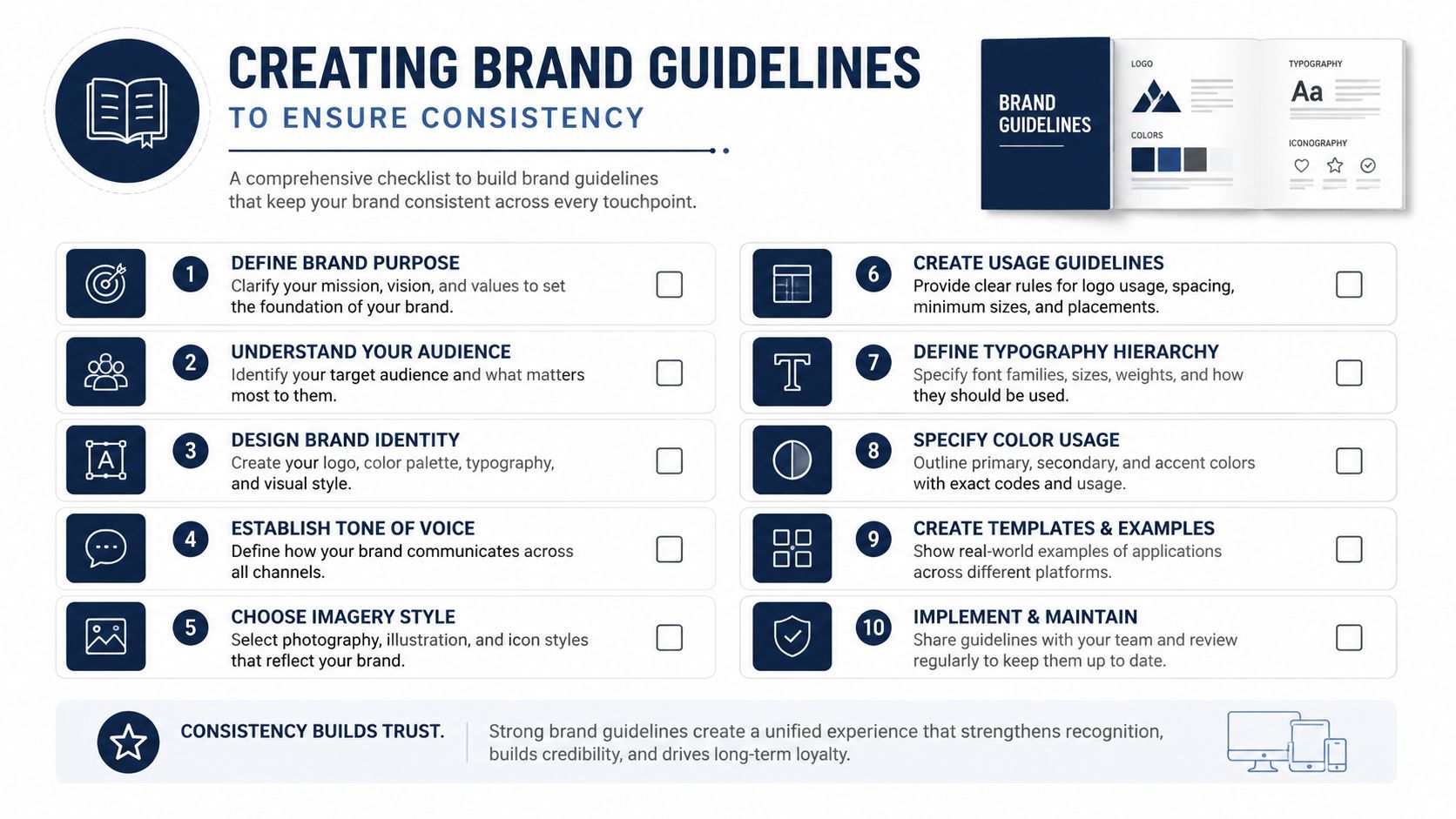
A useful brand guide should answer the practical questions teams ask during production. It isn't enough to show a logo and a color palette.
At minimum, the guide should define:
- Logo usage rules including spacing, sizing, and unacceptable modifications
- Color and typography standards for web, documents, and presentations
- Voice and tone guidance with examples of approved phrasing
- Messaging pillars that explain core value propositions
- Disclosure and compliance conventions where brand execution overlaps with regulatory review
- Template examples for common assets such as bios, presentations, landing pages, and educational content
A review of financial services brand guide development can be useful when teams need to translate these standards into day-to-day materials instead of leaving them as abstract rules.
Why governance reduces review cycles
A brand guide earns its value when it changes workflow. If teams still create assets from scratch and wait for marketing or compliance to fix them manually, the guide hasn't done enough.
The strongest governance systems turn standards into defaults. Writers use approved descriptors for services. Designers start from prebuilt layouts. Advisors pull from controlled bio formats and presentation templates. Compliance reviews fewer one-off phrasing experiments because common materials already fit the rules.
Good governance doesn't restrict the team's output. It removes preventable variation.
What happens with and without guidelines
| Situation | Result |
|---|---|
| No shared standards | More revisions, mixed quality, slower approvals |
| Static PDF only | Rules exist, but teams ignore them in daily work |
| Guidelines plus templates | Faster production and more reliable compliance review |
| Guidelines embedded in workflow | Brand consistency becomes repeatable |
That is the overlooked advantage in branding for financial services. Consistency doesn't just improve recognition. It creates operational efficiency.
Measuring Brand Health and Proving ROI
Branding gets dismissed when firms measure only vanity signals. A polished website and a new identity package don't prove much on their own. What matters is whether the market recognizes the brand, trusts it, and converts through it.
That matters even more in finance because reputation often drives the selection decision before a prospect ever compares details. Research from Amp Corporate Communications reveals that 37% of consumers prioritize reputation above both product features and price when selecting financial services, according to this discussion of why brand tracking matters in financial services. If reputation carries that much weight, it needs to be monitored like any other business asset.
Track signals that influence buying decisions
Brand health in financial services is usually visible through a mix of qualitative and operational indicators rather than a single dashboard number.
Useful categories include:
- Brand awareness through branded search activity, direct traffic patterns, and referral mentions
- Brand sentiment through reviews, client feedback, sales-call language, and social commentary
- Message retention through whether prospects can repeat the firm's value proposition accurately
- Lead quality through fit, readiness, and alignment with the target audience defined in strategy
One emerging area is search visibility inside AI-generated results and answer experiences. For teams trying to understand how a brand appears in those environments, AI Search Monitoring can provide a practical lens for tracking visibility and mention quality.
Tie brand metrics to operational outcomes
Brand reporting becomes useful when it connects to action. If branded search increases but inquiry quality drops, the issue may be audience mismatch. If client feedback is positive but close rates remain weak, the sales process may not be carrying the same message as the website. If sentiment worsens after a redesign, the problem may be clarity rather than aesthetics.
A simple review cadence can help:
- Check awareness signals to see whether the market is finding the brand.
- Review sentiment inputs to understand how the firm is being interpreted.
- Assess lead fit to confirm the branding is attracting the right audience.
- Report recurring friction back into messaging, design, and compliance workflow decisions.
The point of brand measurement isn't to admire the brand. It's to catch drift early and correct it before it affects revenue or credibility.
That's the discipline many firms miss. They launch, then assume the market understood the message exactly as intended. In reality, brands need active monitoring because trust can strengthen gradually and erode subtly.
Your Roadmap to a Standout Financial Brand
Branding for financial services works when it's treated as a system, not a style exercise. The firms that build durable brands usually make a series of disciplined choices. They define a clear position. They translate that position into a recognizable visual and verbal identity. They launch it through a website built with compliance in mind from day one. They keep it active through useful content and educational video. They protect it with guidelines and templates. Then they measure whether the market is responding the way they intended.
That approach solves two common problems at once. It helps a firm stand out in a crowded market, and it reduces the internal drag caused by repeated rewrites, subjective creative debates, and late compliance intervention.
A financial brand doesn't need to be louder to be stronger. It needs to be clearer, more consistent, and easier to execute under regulatory pressure. That's how credibility compounds.
Advisor Momentum helps financial advisors, planners, and banking teams build compliant websites, brand systems, content programs, and growth workflows that fit the realities of regulated marketing. Firms that want a coordinated partner for branding, digital execution, and compliance-aware marketing can explore Advisor Momentum.
