

A steady stream of prospects can hide a serious business problem. An advisor may publish consistently, receive qualified inquiries, and keep a full calendar, yet still lose opportunities through slow follow-up, inconsistent discovery calls, overloaded staff, or an onboarding process that breaks at every handoff. More demand won't fix a firm that can't reliably convert and serve the demand it already has.
That's where financial advisor business coaching earns its place. The useful work isn't motivational theater or another generic sales script. It's a disciplined examination of how marketing, compliance, technology, people, and client service interact, followed by practical changes that increase the firm's ability to deliver.
Table of Contents
- When More Leads Are Not the Real Problem
- What Financial Advisor Business Coaching Actually Is
- The Five Coaching Models Advisors Use Today
- Measurable Outcomes From Coaching Engagements
- Coaching Marketing and Compliance Together
- KPIs and ROI Benchmarks That Hold Up
- A Step-by-Step Vendor Evaluation Checklist
- Next Steps for Hiring the Right Coach
When More Leads Are Not the Real Problem
A $180 million AUM practice can have healthy lead volume and still feel stuck. The advisor publishes useful content, receives inbound interest, and books discovery calls. Yet the close rate remains near 12 percent, calls accumulate faster than anyone can follow up, and new-client onboarding slips by three weeks.
The obvious response is to buy more marketing. That response misses the constraint. If scheduling is inconsistent, CRM records are incomplete, follow-up depends on memory, and no one has modeled capacity against expected demand, additional leads create a larger queue rather than better growth.
A coach examining this firm would map the path from first inquiry to funded relationship:
- Inquiry capture: Does every prospect enter one accountable workflow?
- Response ownership: Does a named person respond, and within a defined service standard?
- Discovery preparation: Does the advisor receive complete information before the meeting?
- Decision follow-up: Does each prospect leave with a documented next step?
- Onboarding handoff: Does operations know exactly when responsibility transfers from business development?
- Capacity planning: Can the team absorb new households without delaying existing clients?
The coach isn't there to declare that the advisor needs more confidence. The coach identifies where the system leaks value. A missed follow-up, an unclear service promise, or a compliance review that begins after creative work is finished can each reduce conversion without any failure in the advisor's technical expertise.
Practical rule: Diagnose the workflow before prescribing more prospecting.
The market backdrop makes this operational lens increasingly important. SmartAsset's summary of a 2023 advisor survey found that 46% of advisors reported working with a coach, with respondents connecting coaching to professional improvement, business clarity, client retention, and work-life balance. Meanwhile, Schwab's 2025 RIA Benchmarking Study reported compound annual growth from 2019 through 2024 of 12.6% in AUM to $615 million, 12.4% in revenue to $3.8 million, and 6% in client growth to 345 clients per firm. Those figures suggest that many practices are scaling faster than their internal systems can mature. SmartAsset's advisor coaching overview provides the relevant market context.
The right engagement therefore sits between marketing and operations. It turns an existing pipeline into a process the firm can convert, onboard, and serve without creating compliance exposure or exhausting the team.
What Financial Advisor Business Coaching Actually Is
Financial advisor business coaching is a structured engagement that diagnoses practice bottlenecks, establishes measurable goals, and assigns accountability for implementation. It differs from both consumer financial coaching and generic small-business coaching.
Consumer financial coaching helps individuals manage personal finances, such as budgets, debt, savings, or financial capability. The CFPB's Financial Coaching Initiative reviewed 23,005 clients and 50,472 coaching interactions, averaging 2.2 sessions per client, and found that 57% of clients improved their Financial Capability Score while 11% declined. That program addressed consumer outcomes, not advisory-firm management, but it demonstrates that coaching can be organized around evidence and measurable change. The CFPB's Financial Coaching Initiative report documents that operating history.
Generic business coaching can help a company improve revenue, hiring, or leadership. It may not account for fiduciary obligations, advertising review, suitability considerations, recordkeeping, state requirements, or the practical limits imposed by an advisory firm's compliance program. An advisor needs growth advice that works inside those guardrails.
A useful analogy is specialized physical therapy. A personal trainer can improve general fitness. A sports therapist examines the precise movement that fails during competition and designs corrective work around it. Advisor coaching addresses the mechanics of pipeline conversion, client onboarding, team capacity, service delivery, and compliant marketing.
The core deliverable
A credible engagement should produce more than calls and worksheets. It should include:
- A baseline diagnosis, using CRM, calendar, onboarding, staffing, and marketing-review data.
- A prioritized operating plan, focused on the bottleneck most likely to affect capacity or revenue.
- Defined ownership, so each workflow change has a responsible person and deadline.
- Review cadence, with leading indicators checked before lagging revenue results appear.
- Documented procedures, so improvements survive beyond the coaching relationship.
Common formats include one-on-one coaching for owners who need customized intervention, cohort coaching for firms that benefit from peer comparison, and hybrid programs combining private sessions with group implementation. Peer advisory groups can also provide outside accountability for solo advisors who want structured discussion without the intensity of weekly individual coaching.
The distinction matters because the wrong coach can produce activity without a strategic edge. A sales coach may increase conversations while operations falls behind. An operations consultant may improve handoffs while the firm's positioning remains unclear. The useful prescription starts with diagnosis, then combines capabilities according to the constraint.
The Five Coaching Models Advisors Use Today
Advisors generally encounter five coaching archetypes. They shouldn't treat the categories as a shopping list. A firm with a conversion issue and an overloaded service team may need sales and operations work together, while a growing ensemble may require leadership coaching layered onto both.
| Coaching Model | Primary Focus | Engagement Length | Typical Cost Range | Best-Fit Advisor Profile |
|---|---|---|---|---|
| Sales and pipeline coaching | Discovery calls, closing process, referrals, follow-up | Short to medium term | Varies by provider and scope | Solo advisors with inconsistent conversion |
| Operations and capacity coaching | Team leverage, service workflows, onboarding, role ownership | Medium term | Varies by provider and scope | Firms with demand but delivery delays |
| Leadership and team coaching | Delegation, accountability, hiring, decision rights | Medium to long term | Varies by provider and scope | Multi-advisor teams developing structure |
| Niche and ICP coaching | Positioning, ideal-client definition, messaging | Short to medium term | Varies by provider and scope | Advisors whose marketing attracts poor-fit inquiries |
| Holistic practice mastery coaching | Mindset, planning, business development, leadership | Long term or cohort-based | Varies by provider and scope | Owners seeking broad practice transformation |
How to read the grid
Sales and pipeline coaching is appropriate when prospects receive prompt service, the firm has delivery capacity, and the primary failure occurs during discovery or follow-up. It isn't a sensible first move when onboarding is already delayed.
Operations and capacity coaching focuses on the work that happens after interest is created. It may redesign intake forms, assign service tiers, clarify handoffs, and remove repetitive administrative work. Kitces Research found that typical financial advisors spend only 50% of their time on direct client activity, with less than half of that time spent in actual meetings. Niche-focused advisors gained more than 150 hours per year for high-value client-facing work and spent 13% less time on middle- and back-office tasks. The Kitces Research analysis of advisor time allocation supports an operations-first diagnosis.
Leadership and team coaching becomes important when the founder can no longer make every decision. Niche and ICP coaching addresses a different problem, unclear relevance in the market. Holistic practice mastery can help owners who need an integrated program, but broad coverage shouldn't replace specific operating commitments.
The best prescription is diagnostic. A coach should be able to explain why a particular model fits the firm's present constraint and what evidence would show that the diagnosis was wrong.
Measurable Outcomes From Coaching Engagements
Coaching outcomes should be tied to observable workflow changes, not vague claims about transformation. A firm can measure whether an advisor spends more time with clients, whether an onboarding file moves cleanly through review, and whether a marketing claim reaches publication with complete substantiation.
| Outcome | Operational Lever | Benchmark Range |
|---|---|---|
| More client-facing capacity | Role specialization, calendar redesign, administrative reduction | Kitces found typical advisors spend 50% of time on direct client activity |
| Better use of advisor time | Niche focus and middle-office delegation | More than 150 additional hours annually for high-value work among niche-focused advisors, with 13% less middle- and back-office time |
| Faster onboarding | Standardized intake, documented handoffs, embedded compliance checks | Simple relationships may take days to two weeks, external-funded accounts 1 to 4 weeks, and complex wealth management 4 to 12 weeks |
| Greater organizational capacity | Clear role ownership and repeatable service workflows | Qualitative improvement should be verified through workload and backlog tracking |
| Stronger growth execution | Sales process layered onto reliable fulfillment | Measure conversion only after response, discovery, and onboarding workflows are stable |
What the numbers can and cannot prove
The Kitces findings don't promise that every firm will recover the same amount of time. They show why time allocation is a credible coaching target. A coach should inspect the advisor's calendar, identify low-value work, and test whether delegation or standardization releases capacity without weakening service.
Onboarding deserves equal attention. Industry guidance identifies different cycle times based on relationship complexity, from days to two weeks for simple fee-only relationships, one to four weeks for brokerage or custodial account opening with external funding, and four to twelve weeks for complex wealth management involving tax and estate coordination. The financial-services onboarding guide from Select Advisors Institute recommends tracking time-to-first-advice, completion rate, dropout points, compliance exceptions, and rework time.
Sales-only coaching often increases activity without improving retention because the service model remains fragile. Operations-only coaching can produce a tidy backend without solving weak positioning or inconsistent business development. The practical sequence is to stabilize the workflow, then improve conversion, while monitoring complaints, rework, and review findings alongside revenue indicators.
Coaching Marketing and Compliance Together
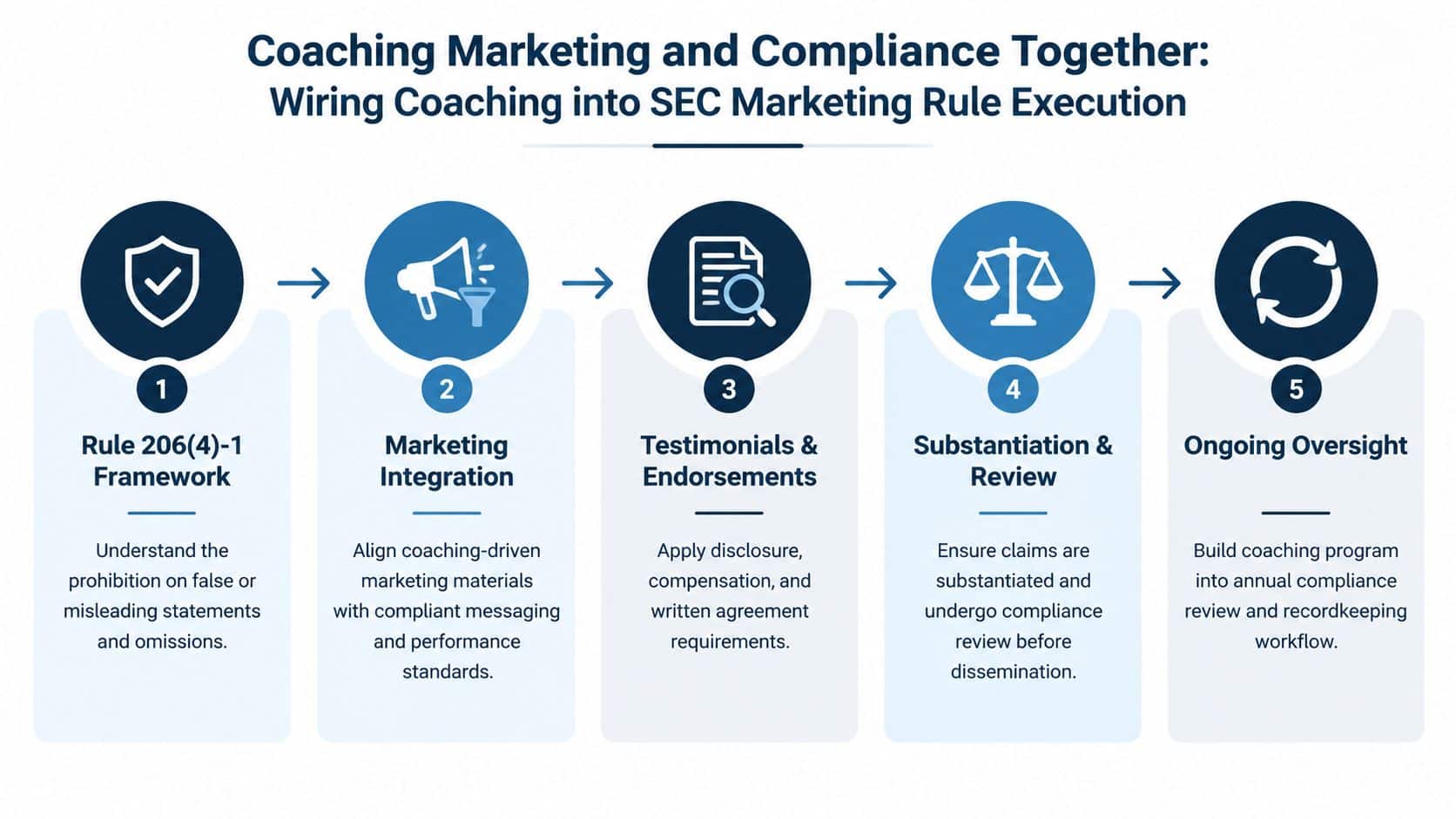
Marketing coaching for an advisory firm has to operate inside SEC Rule 206(4)-1, the Marketing Rule under the Investment Advisers Act of 1940. The framework replaced separate advertising and cash-solicitation rules and expressly addresses testimonials, endorsements, third-party ratings, and performance advertising. The SEC states that advisers could comply with the amended rule in full beginning on May 4, 2021, with an 18-month transition period before full compliance was required. The SEC's Marketing Rule FAQ explains the framework and transition.
A coach should wire marketing execution to review procedures rather than treating compliance as a final editorial hurdle.
Four workflows that belong in the coaching program
- Testimonial intake: Use a form that records the speaker's relationship to the firm, compensation, affiliation, required disclosures, approval status, and publication location before a quote enters the content calendar.
- Performance substantiation: Maintain templates that identify the measurement period, fee treatment, benchmark, assumptions, supporting records, and required risk context.
- Pre-publication routing: Send every advertisement, blog article, video script, email, and social caption through the CCO or designated marketing reviewer before dissemination.
- AI drafting controls: Permit AI to assist with outlines or first drafts, but require human review for factual accuracy, omissions, performance language, testimonials, endorsements, and tone.
The Rule contains seven general prohibitions covering misleading statements or omissions, unsubstantiated material facts, misleading implications, unbalanced benefit and risk presentation, unfair references to specific advice, unfair performance presentation, and other materially misleading content. A compliance analysis of the Marketing Rule prohibitions shows why ordinary web copy can require the same documentation discipline as a formal campaign.
The January 15, 2026 SEC FAQ update added practical nuance around certain net-performance fee calculations and compensation for some testimonial or endorsement providers subject to a disqualifying event, provided specified conditions are met. This summary of the SEC's 2026 FAQ update is a reminder that coaches shouldn't rely on simplified rules of thumb. The CCO still needs to make the final determination.
Compliance can accelerate marketing when the process is designed early. Approved claims, documented evidence, and reusable disclosures reduce avoidable review cycles and give advisors clearer language for discovery conversations. Advisor Momentum's compliance marketing services reflect this integrated approach by connecting content production with regulated review requirements.
KPIs and ROI Benchmarks That Hold Up
A coaching dashboard should pair leading indicators with lagging outcomes and risk controls. Otherwise, an advisor may celebrate more appointments while the firm accumulates incomplete paperwork, excessive rework, or unresolved compliance findings.
Pipeline indicators
Track lead-to-appointment movement, appointment-to-client conversion, response time, follow-up completion, and the percentage of inquiries that fit the firm's stated client profile. These metrics reveal whether the problem lies in message-market fit, discovery execution, or handoff discipline.
Capacity indicators
Measure advisor-to-household load, hours per plan delivered, administrative hours per client, onboarding backlog, and the number of service tasks completed without advisor intervention. A capacity metric becomes useful only when segmented by client complexity. A retirement-focused household and a complex business-owner relationship shouldn't be treated as equivalent workload units.
Revenue and risk indicators
Revenue per advisor, revenue per client, gross margin, client retention, complaint ratio, compliance finding rate, and NIGO rate on new paperwork belong on the same dashboard. The firm should also track time from signed agreement to first advice, because a signed prospect isn't yet a successfully delivered relationship.
| KPI Family | Metric | Typical Range | Coaching Lever |
|---|---|---|---|
| Pipeline | Lead-to-appointment rate | Qualitative baseline first | Message clarity, response ownership, scheduling |
| Pipeline | Appointment-to-client conversion | Qualitative baseline first | Discovery structure, fit criteria, follow-up |
| Capacity | Advisor-to-household ratio | Segment-specific | Service tiers, delegation, role design |
| Revenue | Revenue per advisor and client | Firm-specific | Pricing, capacity, specialization, client mix |
| Risk | NIGO rate and compliance findings | Downward trend | Intake quality, review controls, documentation |
The ROI calculation is straightforward:
ROI = (incremental gross revenue minus coaching fees minus implementation cost) divided by total investment.
A firm should define incremental revenue before the engagement begins and separate it from market movement, fee changes, or one-time events. The implementation cost includes staff time, process redesign, content review, technology changes, and training.
For a practical measurement framework, Advisor Momentum's financial advisor practice management resource can be used as a reference point for connecting growth goals to workflow and management decisions. The important discipline is not copying a benchmark. It's matching the measure to the firm's segment, then checking whether growth remains deliverable and compliant.
A Step-by-Step Vendor Evaluation Checklist
Vendor selection should test three capabilities: relevant RIA experience, Marketing Rule fluency, and implementation depth. Charisma matters less than whether the coach can inspect a workflow, document a change, and help the team adopt it.
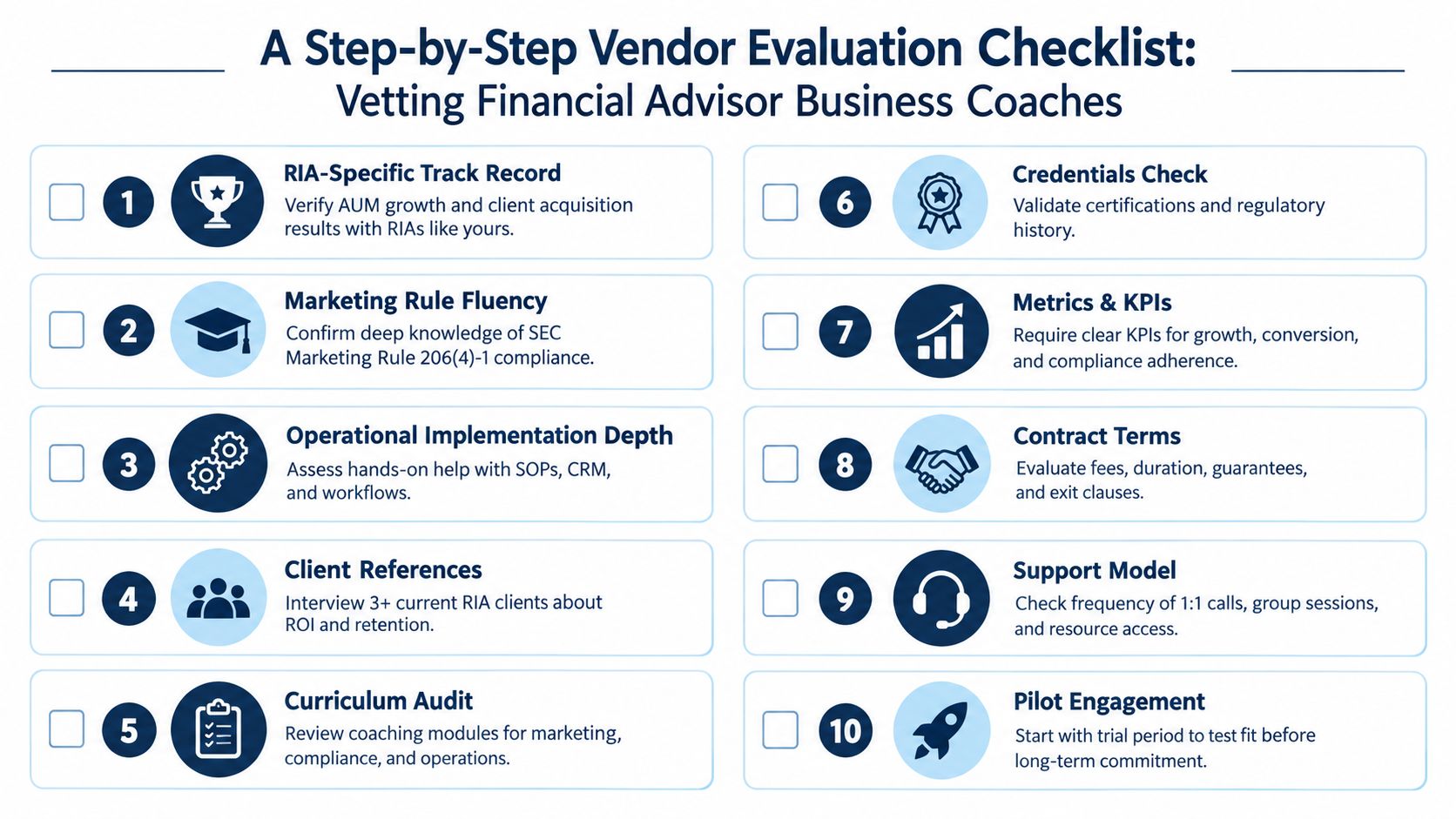
Ten tests before signing
- Request relevant evidence. Ask for anonymized cohort results from firms with a similar service model, staffing structure, and growth stage.
- Test Marketing Rule knowledge. Present a hypothetical testimonial, performance statement, or social caption and ask the coach to identify review requirements.
- Inspect implementation depth. Require examples of standard operating procedures, workflow maps, role matrices, and onboarding playbooks.
- Contact current clients. Speak with at least three current RIA clients about implementation, communication, and measurable outcomes.
- Audit the curriculum. Check whether marketing, compliance, operations, leadership, and client service appear as connected disciplines.
- Validate credentials and history. Confirm professional background and look for unexplained gaps in regulated-industry experience.
- Demand a KPI plan. Every promised outcome should have a definition, baseline, owner, and review date.
- Read the contract carefully. Examine fees, duration, cancellation rights, guarantees, confidentiality, and ownership of deliverables.
- Clarify support. Confirm the frequency of private calls, group sessions, office hours, implementation reviews, and resource access.
- Start with a pilot. A limited engagement can reveal whether the coach understands the firm before the owner commits to a larger program.
Red flags include guaranteed revenue, compensation tied directly to AUM growth, pressure to publish unreviewed claims, and evasive answers about compliance. A coach who calls every review requirement “bureaucracy” may create risk the firm will later have to unwind.
A 90-day pressure test
During weeks 1 through 4, the coach should complete a diagnostic, establish baseline KPIs, map the prospect-to-client journey, and identify the highest-cost bottleneck. The deliverable should be a written priority plan, not a collection of motivational notes.
During weeks 5 through 8, the team should redesign at least the selected workflow, test ownership and handoffs, and review marketing assets against the firm's compliance process. During weeks 9 through 12, the firm should measure capacity, backlog, response quality, and review friction, then document the next implementation cycle.
The plan doesn't need to promise a specific revenue result. It needs to make the coach's work inspectable.
Next Steps for Hiring the Right Coach
The talent problem is becoming a capacity problem. A 2025 McKinsey analysis projected that the U.S. wealth management industry could face a shortage of 90,000 to 110,000 advisors by 2034 at current productivity levels. The analysis said firms would need to raise productivity by 10% to 20% and attract 30,000 to 80,000 net new advisors over the next decade, compared with 8,000 net new advisors in the prior decade. McKinsey's analysis of the looming advisor shortage frames why process efficiency matters.
AI and workflow automation add another layer. They can assist with intake, drafting, meeting preparation, documentation, and routing, but uneven adoption creates new review and ownership questions. A coach should help the firm decide which work can be assisted, which work requires human judgment, and where records must be retained.
Shortlist two or three vendors from the evaluation process. Pay each for a diagnostic session, provide the same operating information, and compare the specificity of the resulting recommendations. Before signing, require a written 90-day plan with named owners, baseline KPIs, review dates, compliance dependencies, and a definition of successful implementation.
The differentiator in 2026 isn't just lead generation. It's execution throughput. The right coach should be measured by how quickly the firm converts agreed changes into reliable workflows, cleaner marketing review, greater capacity, and a better client experience.
Advisor Momentum helps financial advisors connect compliance-first marketing with practical coaching for growth, onboarding, client service workflows, and AI adoption. Visit Advisor Momentum to discuss a focused diagnostic and build a measurable implementation plan for the firm's next stage.
