
Among financial advisors who use social media for marketing, 91% maintain a LinkedIn profile and 82% use at least one social platform for professional marketing, while LinkedIn content in wealth management has been measured at a 1.6% engagement rate versus 0.9% across industries Webtonic's financial advisory social media statistics. That gap is the reason financial advisor LinkedIn is not a vanity channel. It's where professional credibility, due diligence, and prospect education now concentrate for regulated firms that need trust before they need traffic.
A lot of advisor profiles still underperform because they were built like resumes, not conversion assets. The platform is crowded with generic titles, vague bios, and weak follow-up, even though LinkedIn has long been central to advisor prospecting and reputation management LinkedIn's financial advisor research summary. The practical question isn't whether advisors should be there. It's whether their presence is structured to turn visibility into qualified conversations without creating compliance headaches.
Table of Contents
- Why LinkedIn Dominates Advisor Marketing
- Optimizing Your Profile as a Conversion Asset
- Building a Compliant Content Cadence
- Executing Connection-First Outreach Sequences
- Measuring What Drives Client Acquisition
- Addressing Underserved Audiences and Strategic Fit
Why LinkedIn Dominates Advisor Marketing
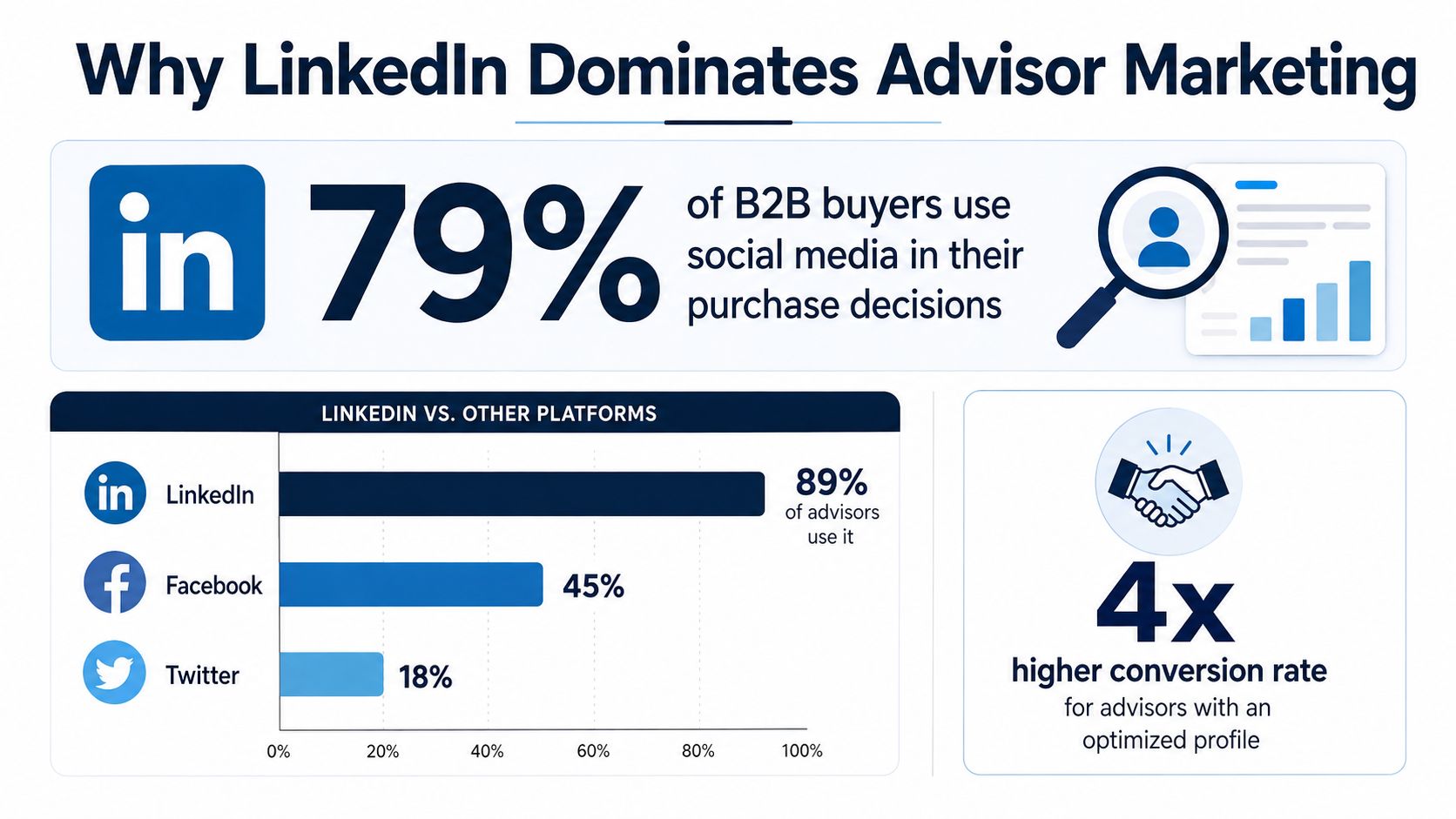
The case for LinkedIn is straightforward. Among advisors who market on social media, 91% maintain a LinkedIn profile Webtonic. That makes it the dominant professional network in a category where credibility matters more than entertainment, and where prospects often want to evaluate expertise before they ever book a call.
LinkedIn also has staying power because advisor usage is not a recent habit. LinkedIn reported that 86% of financial advisors use LinkedIn for personal purposes and 84% use it professionally, based on Greenwich Associates research, and its financial-services guide says 7 in 10 advisors use social networks for business while 9 in 10 use LinkedIn specifically LinkedIn's advisor research summary. That history matters. The platform became central because it matches how advisors sell trust-based services, not because it happened to become fashionable.
Why adoption alone doesn't create results
High adoption does not mean high performance. LinkedIn content in wealth management has been measured at a 1.6% engagement rate, above the 0.9% all-industry benchmark Webtonic. That is a useful signal, but engagement is still only the first layer of value. The work is whether that engagement supports profile visits, replies, meetings, and eventual clients.
A second reason the platform dominates is that advisors' target audiences are already there. LinkedIn's own ecosystem notes that 71% of advisors said their target prospects are active on LinkedIn, and 62% reported getting new clients there LinkedIn research summary. That does not mean every profile converts equally well. It means the network is already aligned with how buyers research professional help.
Practical rule: treat LinkedIn as a credibility layer first, a prospecting layer second, and a performance channel only after the profile and follow-up sequence are tight.
Other social channels trail it materially in advisor marketing usage. For a regulated profession, the winner is usually the channel that supports trust, education, and identifiable expertise. That is why LinkedIn keeps winning budget, time, and attention.
Optimizing Your Profile as a Conversion Asset
A LinkedIn profile should work like a landing page, not a digital résumé. LinkedIn's guidance for advisors emphasizes using the profile as a landing page that says who the advisor helps and the results delivered, which is the right framing for regulated financial marketing LinkedIn engagement strategies for financial advisors. The profile has to help the right visitor self-identify quickly, while also avoiding claims that can create compliance issues later.
Build the headline around a niche
The headline should answer two questions fast. Who is served, and why should that person care? Generic labels like “Financial Advisor” or “Wealth Manager” waste valuable search space and force prospects to guess relevance.
A stronger headline uses a niche and a clear value proposition. Examples that fit a compliance-first approach include:
- Retirement planning for business owners who want clarity before liquidity events
- Financial guidance for executives navigating equity compensation and retirement decisions
- Wealth planning for women who want a relationship-first advisory process
Those are not performance claims. They're positioning statements. That distinction matters because the profile is doing two jobs at once, search relevance and trust signaling.
Use the About and Featured sections to reduce friction
The About section should sound like a conversation, not a brochure. It should describe the type of client served, the problems that show up in real life, and the process used to help, without drifting into individualized financial advice or promising outcomes. The Featured section should then reinforce that positioning with educational material, commentary, or other trust-building assets.
For a deeper checklist on profile structure, it's useful to cross-check against best LinkedIn profile advice and then adapt the ideas through a compliance lens. The core lesson is simple, the profile needs to show relevance, not just credentials.
A profile that sounds polished but generic usually attracts polite views and weak replies. A profile that is specific enough to matter, yet restrained enough to stay compliant, does the opposite.
The remaining fields matter too. Banner images should support the niche, experience entries should read like proof of competence rather than a list of job duties, and contact details should make follow-up easy. Advisors should avoid language that looks like a performance guarantee, a recommendation, or a testimonial unless it has been reviewed for the applicable jurisdiction.
Building a Compliant Content Cadence
Content works only when the posting rhythm is sustainable and reviewable. A strong cadence for a financial advisor linkedin program usually starts with a small set of content pillars, then repeats them with enough consistency to build recognition without flooding the feed. For a useful framing on content planning, see the blog for SaaS marketers, then translate the same discipline into an advisor workflow. The practical trade-off is simple, a thinner calendar with clearer themes is easier to approve, easier to maintain, and usually better for conversion than a busy schedule that nobody can keep up with.
Structure the week around education, not promotion
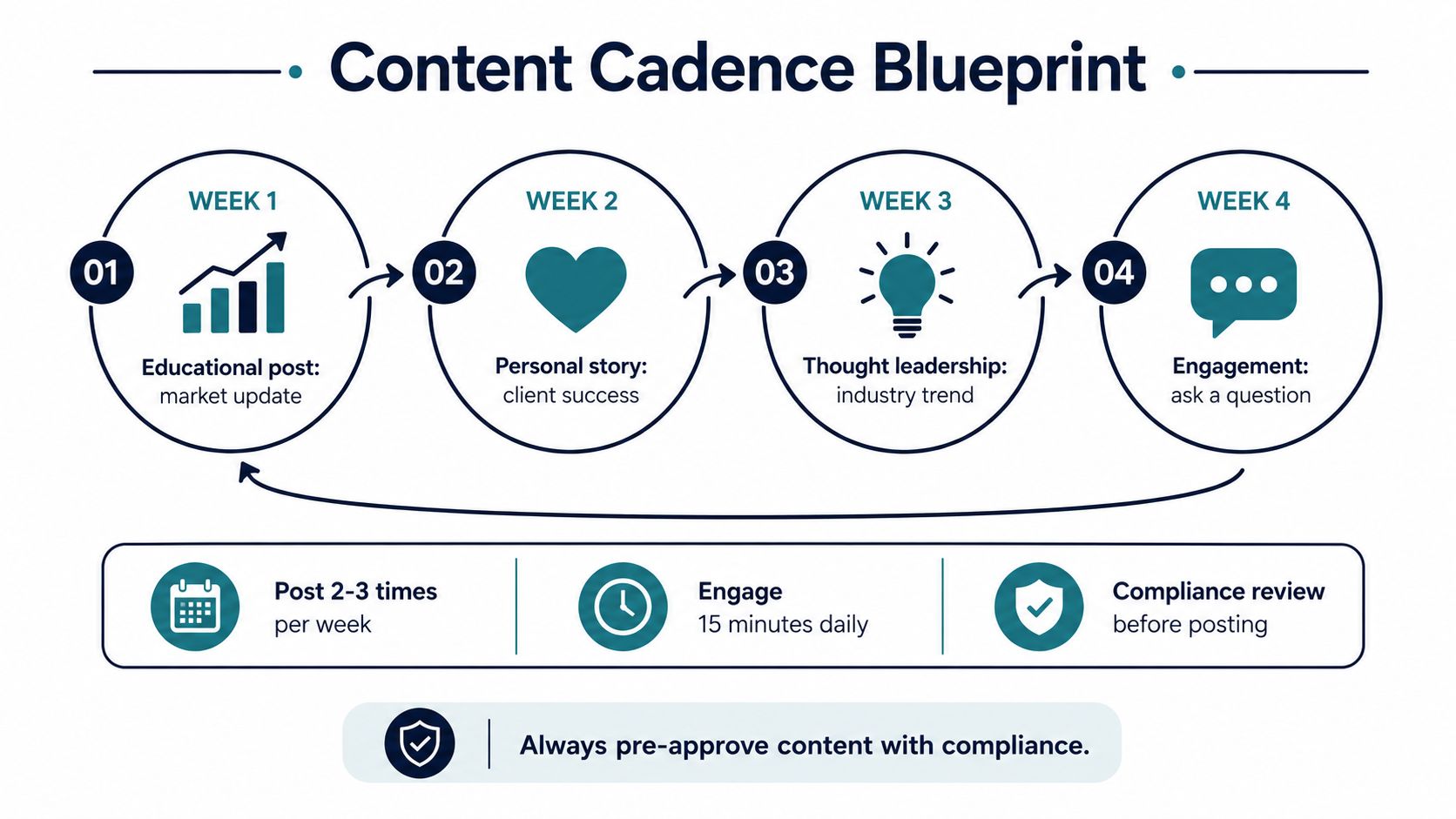
A useful weekly pattern stays grounded in education. One common approach is to reserve one day for market or planning insight, another for a teaching post in a carousel or short video, another for a team or client-life story, and an optional weekend post for light engagement. The content itself should move through review before it ever goes live, because the cadence only works if the approval process can keep pace with it.
The main rule is to teach more than you sell. Guidance for finance professionals also warns against specific financial advice, and it calls out disclaimers plus caution around endorsements and recommendations, since those can become testimonial issues depending on jurisdiction and licensing LinkedInPreview finance guidance. That constraint does not reduce what you can post. It changes what a useful post looks like, and it forces sharper thinking about what helps a prospect trust the advisor.
Use a review workflow that protects speed and consistency
A compliant workflow needs a clear sequence. Draft the post, review it for claims and advice risk, then approve it before publishing. If the topic touches performance, products, testimonials, or a client story, the review step should slow down and check the wording line by line instead of trying to fix problems after the post is already live.
A simple workflow can stay compact:
- Draft with intent: Write one clear takeaway and keep the angle educational.
- Screen for risk: Remove specific recommendations, return claims, or language that sounds predictive.
- Approve and archive: Save the final version and the approval trail for future reference.
For teams building out the compliance side of a social program, an internal guide on financial advisor social media compliance helps connect content production to review discipline. The point is not to turn every post into a legal memo. The point is to make sure the cadence survives scrutiny and still leaves room for consistent publishing.
A stronger content mix usually includes market context, planning education, team spotlights, and client-life stories written in a compliant way. Advisors who spend the entire week posting market takes tend to sound interchangeable. Advisors who teach, translate, and document their process build a presence that is easier to trust and easier to convert.
Executing Connection-First Outreach Sequences
Cold outreach that jumps straight to a pitch rarely earns attention. In advisor-focused LinkedIn commentary, immediate-sales messages are reported to have response rates below 1%, which is why a connection-first sequence works better than a sales-first sequence Rainmakers United. The message has to feel relevant before it feels commercial.
Warm the introduction before asking for time
A strong sequence starts before the connection request. Advisors should identify a narrow ideal client profile, view the person's content, and leave thoughtful comments when there's something substantive to add. That creates familiarity without pretending there's a relationship that doesn't exist yet.
The outreach itself should be short and specific. A connection note can mention the shared context, the type of audience served, or a topic the prospect already talks about. The point is not to sell in the note. The point is to earn the right to continue the conversation.
Move in steps, not leaps
The first follow-up should still be light. It can thank the person for connecting, point to a useful post, or ask a simple question about a topic already in motion. Only after the prospect signals interest should the conversation move toward a meeting invitation.
The fastest way to lose a prospect's attention is to act like the relationship is already warmer than it is.
That sequence is also easier to document. For regulated firms, logging the connection date, the message angle, and any subsequent response creates a clearer audit trail than a scattershot inbox history. It also keeps the team from repeating the same mistake, which is asking for time before trust has been established.
A useful companion resource on Hire BDRs can help frame outreach operations if a firm is considering help with repeatable prospecting activity. For advisors doing this in-house, the operating rule stays the same. Segment tightly, open politely, and let the prospect's response pace dictate the next step.
Measuring What Drives Client Acquisition
LinkedIn should be measured like a funnel, not like a popularity contest. Advisor marketing research notes that some investors say an advisor's social presence affects whether they make contact, and that advisors who prospect on LinkedIn can bring in meaningful new assets. Rainmakers United Those signals matter only when the advisor knows which stage is doing the work.
Track each stage separately
A healthy measurement system follows the path from visibility to revenue. Profile views show whether the profile is getting found. Connection acceptance shows whether the positioning is relevant. Replies show whether the outreach is landing. Meetings booked show whether trust is deepening. Client conversion shows whether the effort is commercially real.
The practical benchmark in advisor marketing contexts is that roughly 10% to 12% of digital leads convert into one-on-one meetings. That means the question is not whether a post got engagement. It's whether that attention moved someone closer to a meeting or a client relationship.
Stop mistaking motion for progress
Vanity metrics make advisors feel active even when the funnel is weak. Follower counts, likes, and impressions can rise while the pipeline stays flat. That's why each campaign should be tied to CRM data and reviewed against the stage where leads stall.
For teams using automation or AI support to organize outreach and follow-up, an internal guide on AI tools for financial advisors can help frame what to streamline and what still needs human judgment. The key is not speed for its own sake. It's a cleaner handoff from LinkedIn activity to booked conversations.
A second useful benchmark is qualitative rather than numeric. If a profile gets views but no replies, the positioning is too broad. If replies happen but meetings don't, the conversation is too generic. If meetings happen but clients don't close, the audience or offer is off.
For firms that want support with repeatable prospecting activity, Hire BDRs can help frame the operating side of outreach. In-house teams still need the same discipline. Segment tightly, open politely, and let the prospect's response pace set the next step.
Addressing Underserved Audiences and Strategic Fit
LinkedIn becomes more effective when the message feels relevant to the person behind the balance sheet. LinkedIn's own finance guidance notes that many women feel underserved because advisors focus on numbers and formulas while overlooking emotional needs, personal goals, and lived experiences. That's a positioning problem, not just a content problem. Advisors who only talk portfolios and returns may miss the decision-maker who wants empathy, life-stage understanding, and support before advice turns technical.
The same lens helps with strategic fit. LinkedIn is not automatically the right primary channel for every practice. It often works well for trust-building, referral amplification, and recruiting, especially when the firm serves professional niches or audiences that already spend time in business contexts. It can be less efficient for advisors whose best prospects are highly local, low-intent, or difficult to segment online.
A good test is simple. If the firm can clearly name its audience, explain a repeatable problem, and sustain educational content with compliance review, LinkedIn deserves serious investment. If the practice depends almost entirely on local walk-ins, broad consumer appeal, or fast promotional cycles, the platform may be better as a support channel than a lead engine.
The right channel is the one that matches how the client buys, not the one that looks busiest on paper.
Advisor Momentum helps financial firms build compliant digital marketing programs, including LinkedIn strategy, profile positioning, and content workflows that fit regulated practices. For advisors who want a channel plan tied to conversion instead of busywork, visit Advisor Momentum and review how its compliance-first marketing support can align LinkedIn with real client acquisition goals.
