

A lot of financial advisors are sitting on the same uncomfortable problem. The phone still rings, referrals still happen, and compliance still makes every new marketing idea feel slower than it should. Meanwhile, prospects are watching video to decide who feels credible, who sounds clear, and who seems worth a discovery call, while many firms keep treating video like a side project instead of part of the core marketing system.
The bottleneck isn't just production. It's that most firms design video like a broadcast asset, then ask compliance to clean it up at the end, which is exactly how review cycles stretch and personality gets stripped out. A better approach treats compliance as a content-design problem, so the message, format, and review path are built together from the start.
Table of Contents
- Why Financial Advisor Video Marketing Matters Now
- Building a Video Marketing Funnel for Financial Advisors
- Scripting and Producing Video Content That Stands Out
- Distributing and Repurposing Video Across Channels
- Measuring Video Marketing ROI for Financial Advisors
- Building a Compliance Review Process for Video Content
Why Financial Advisor Video Marketing Matters Now
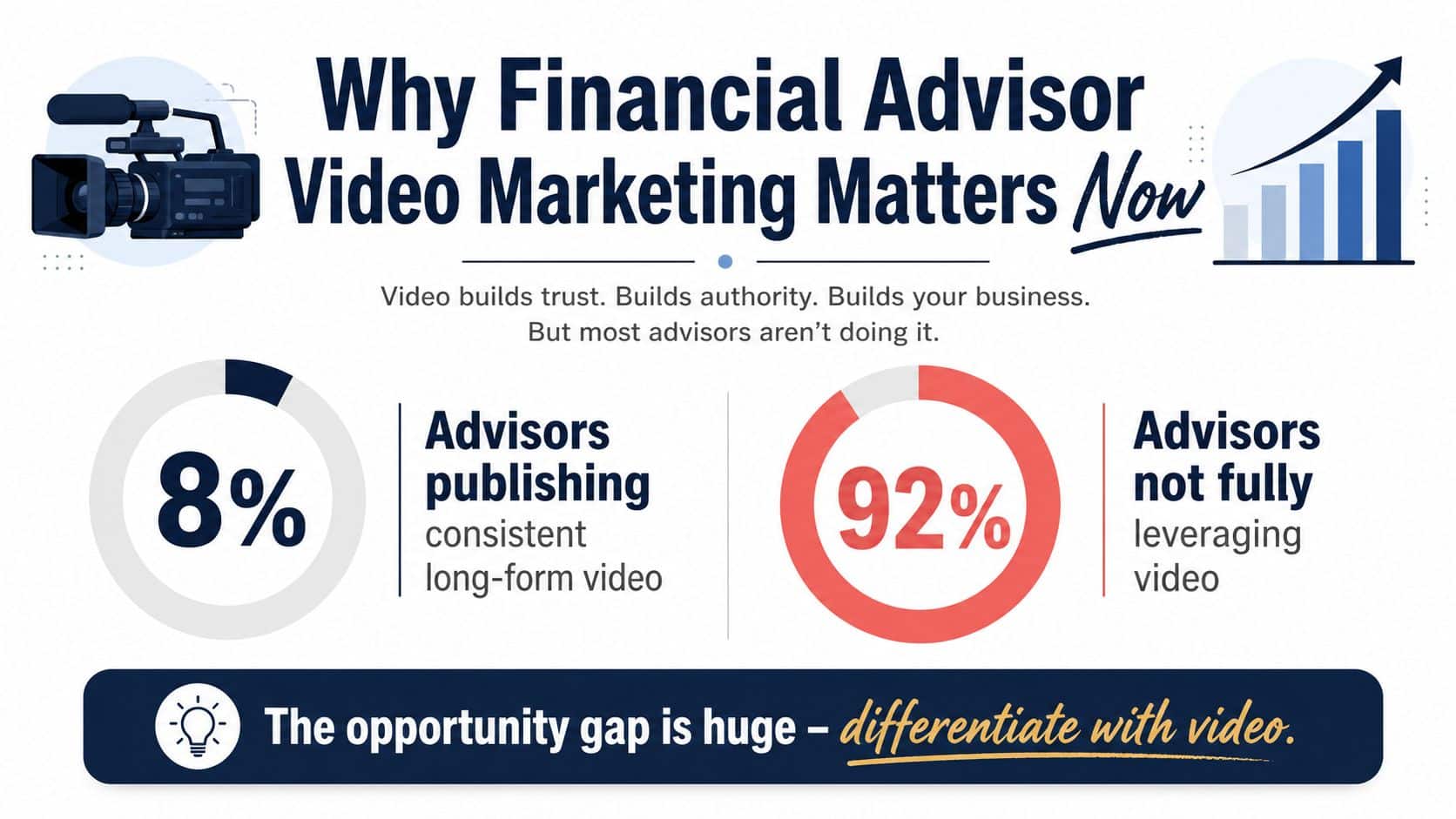
The opening is still wide because so few advisors have built real video habits. An advisory research summary, supported by an infographic showing that only 8 percent of financial advisors publish consistent long-form video content., shows that the channel is still underused rather than saturated. The same summary also noted that 92% of marketers planned to maintain or increase video spend in 2026. That gap matters because early adopters do not have to fight for attention the way crowded channels force them to.
The broader media market makes the case even stronger. Analysts at the IAB reported that U.S. digital video ad spend rose 15% year over year to $54 billion in 2023 and was projected to reach $63 billion in 2024 (IAB video ad spend study). They also projected that digital video would take 52% of total media share versus linear TV in 2024, with CTV, social video, and online video all expected to post double-digit increases, and CTV projected to grow 32% faster than total media overall. For advisory firms, that means prospects are already spending time in video-heavy environments, and media dollars are following them there.
What that means for an advisory practice
Practical rule: Video works best when it helps a prospect decide whether the advisor sounds informed, steady, and worth a conversation.
A useful resource for firms shaping their own media roadmap is the full video strategy playbook, especially if the practice is deciding where video fits alongside email, SEO, and referral activity. The point is not to produce more content for its own sake. The point is to show up where trust is already being built, then use video to shorten the distance between curiosity and a booked meeting.
Financial advice is still relationship-driven, but the relationship now often starts before the first call. Video gives prospects a chance to hear tone, see judgment, and decide whether the firm feels competent enough to move forward. That is why video should be treated less like brand decoration and more like a conversion layer that supports awareness, education, and appointment setting.
Building a Video Marketing Funnel for Financial Advisors
A prospect usually does not need a long presentation first. They need a quick sense of whether the advisor sounds informed, steady, and worth a conversation. A short 90 to 120 second introduction or about-the-firm video can do that work on the website, in email, and across social channels, and it gives compliance fewer moving parts to review than a sprawling script.
| Video format | Ideal use | Primary channel | Funnel stage |
|---|---|---|---|
| About-the-firm intro | Explain the firm quickly | Website, email, social | Awareness |
| Educational explainer | Answer one client question well | YouTube, website, email | Consideration |
| Short clip | Reinforce one idea or takeaway | Social feeds, email snippets | Awareness to consideration |
| Webinar | Go deeper on one planning theme | Live or on-demand | Consideration to conversion |
| Personalized follow-up video | Make the next step easy | Email, direct outreach | Conversion |
The funnel works better when each asset has a job. A firm that tries to make one video do everything usually ends up with something too broad for prospects and too hard for compliance to review. A practical planning lens comes from the same playbook that benchmarks filming and editing at about $400 to $1,200 per video with a phone and lavalier setup, or $2,000 to $5,000 with a small crew. Those ranges matter because a repeatable funnel usually comes from a sequence of assets built for different stages, not a single polished hero video. For a broader view of how a brand strategy for financial advisors supports that sequence, the message and visual style should stay consistent from one stage to the next.
Matching format to intent
Educational YouTube content fits the earlier research phase, where a prospect wants a practical answer and a sense of how the advisor thinks. Short-form clips work when the goal is to create a quick point of entry. Webinars are better when the audience already has a reason to care about one planning topic and is willing to spend more time with the firm. A personalized video message usually belongs at the conversion edge, where friction drops when the next step feels human rather than transactional.
The sequencing matters more than the format itself. A short introduction can open the door, an explainer can answer the first objection, and a follow-up video can make outreach feel specific instead of generic. Firms that want a second perspective on conversion paths can review estratégia de vídeo para conversão and compare that structure with their own funnel design. One well-planned video can support several follow-up assets if the script is written with reuse in mind from the start.
Scripting and Producing Video Content That Stands Out
The common mistake is assuming compliance forces every advisory video to sound like a template. It doesn't. The harder task is keeping a distinct point of view while staying inside review boundaries, which means the script has to be clear, plainspoken, and specific without drifting into claims that invite avoidable edits.

Write for clarity, not generic safety
A strong script starts with one decision. What is the exact planning problem, question, or misconception being addressed? From there, the language should stay simple enough for a client to follow, but disciplined enough that compliance can review it without reworking every sentence. That usually means fewer sweeping promises, fewer vague market statements, and more explanation of the advisor's reasoning.
A useful way to keep the video compliant and memorable at the same time is to organize each script around three parts:
- One client problem. Pick the issue the viewer is already thinking about, then stay on that lane.
- One point of view. State how the firm approaches the issue, not just what the issue is.
- One next step. End with a clear, reviewable invitation that fits the firm's approval rules.
The best advisory videos don't sound like ads. They sound like a careful professional answering the question a prospect was already going to ask.
Production choices that raise credibility
Production doesn't need to look expensive, but it does need to look intentional. Lighting should keep the face visible, audio should be clean enough that no one strains to hear, and framing should make the speaker look settled rather than cramped. A phone, a lavalier mic, and a quiet room can work well when the message is strong and the delivery is steady.
Brand presentation matters too, because prospects make judgments fast. An advisor who appears in a plain, thoughtful setup usually feels more credible than one buried in stock visuals that make every firm look interchangeable. For firms working on that broader identity problem, the internal guidance at Advisor Momentum branding resources can help align the visual style with the message without turning the video into a polished but forgettable brochure.
The best test is simple. If the script sounds like a compliance memo, the video has gone too far in the wrong direction. If it sounds like a real advisor with a clear philosophy and a clean call to action, it's probably in the right zone.
Distributing and Repurposing Video Across Channels
A good video only matters if the right people see it. Distribution should follow audience intent, not convenience, because the same recording can serve different jobs on YouTube, LinkedIn, email, and the firm's own site. In practice, I see firms waste strong content when they post once and stop, even though the same message could support research, trust, and follow-up if it is cut with the channel in mind.
Prospects also consume video in different ways depending on how far along they are. A separate advisory research summary reported that high-net-worth individuals engage with video content from financial advisors, and many prefer short-form clips under a minute. For firms that want a source on that pattern, wealth management video marketing statistics is one reference point, but the takeaway is simpler, the format has to match the moment.
That split argues for a layered distribution plan rather than a single upload-and-wait approach. Educational YouTube content fits deeper questions, short clips fit attention capture, and webinars work better when the audience already wants detail on one planning theme. LinkedIn-style thought leadership performs best when it sounds like a clear point of view, not a sales pitch, while email is often the best place to reuse the same video for warm contacts who already know the firm.
A practical repurposing workflow
One recording session can become a month of useful assets if the edit plan is set before filming starts.
- Primary cut: Keep the full explanation for the main channel where depth matters most.
- Short cut: Pull the clearest 30 to 60 second segment for social distribution.
- Email clip: Use a tighter version with one line of context and one invitation.
- Website embed: Place the full or near-full version where it supports trust on key pages.
- Webinar excerpt: Reuse a strong answer or takeaway in a follow-up nurture sequence.
That workflow saves the advisor from inventing a new topic every week. It also avoids the common failure mode where one team wants a long-form video, another wants a social clip, and compliance has to review each version from scratch. A smarter production day gives the firm enough material to test audience response without multiplying the workload. If the team needs a faster way to cut the same source footage into channel-specific versions, the ShortGenius AI video ad maker can fit into that repurposing step without changing the message.
The key judgment is channel fit. A long explanation that works for prospects doing research may feel too slow in a short feed-based environment. A short clip can earn attention, but it may still need a deeper home on the website or in a follow-up email if the goal is a meeting.
Measuring Video Marketing ROI for Financial Advisors
A partner reviews a clip and asks a simple question, did this help start a real conversation or did it just collect views. That is the right frame for financial advisor video marketing. Views and follower counts can make a report look active, but they do not show whether the video helped book a meeting, improve conversion, or support revenue growth. The better question is how the content affects the parts of the funnel that lead to new clients and assets.
Finance B2B video benchmarks provide useful guardrails. One advisory video source reported an average 8% to 14% play rate, a 3% to 8% rate of action, and about 65% average watch percentage for finance B2B video content. It also reported landing pages with video converting at 4.8% versus 2.9% without video, with video testimonials lifting B2B conversions by 39% and optimized placement driving lifts of up to 80%. Those figures are not a substitute for firm-specific tracking, but they do show why video should be judged by more than surface engagement. The source used for those benchmarks is video metrics benchmark source.
What to track instead
- Cost per discovery call booked. This shows whether the video helps create real sales conversations.
- Discovery-call-to-retainer conversion rate. This reveals how well the video is pre-qualifying and educating prospects.
- CAC over a 24-month look-back. This helps compare video against other acquisition paths over a realistic planning window.
- Attributed AUM growth. This ties the content back to firm growth rather than attention alone.
Rule of thumb: If a metric does not help a partner decide whether to make more video, change the video, or stop the campaign, it is probably not the right metric.
The cleanest measurement setup uses one source of truth for the lead path and one consistent way to tag video-originated activity. That makes it possible to tell whether an educational clip, a homepage video, or a personalized follow-up moved the prospect closer to a booked meeting. For firms that also need a tighter workflow around distribution and review, Advisor Momentum's guide to social media compliance for financial advisors is a useful reference point for keeping approvals organized without flattening the firm's voice. Advisor Momentum also builds professional video production for financial advisors as part of a broader marketing stack, which helps firms connect video content to the rest of their lead-generation workflow without separating the creative from the conversion logic.
Building a Compliance Review Process for Video Content
A video program usually slows down because the review path is unclear, not because the idea is weak. The fix is to define who approves what, when the review happens, and which parts of the script are pre-cleared before filming starts. When that structure exists, compliance becomes a quality gate instead of a late-stage obstacle.
The cleanest workflow starts before the camera turns on. Scripts should be drafted with enough detail for review, then routed through a pre-approval step that catches risky phrasing, unsupported comparisons, and vague claims before they reach production. That saves time because the team isn't asking reviewers to evaluate a moving target after the recording is already finished.
A workable review sequence
- Topic approval. The firm confirms the subject is appropriate and not likely to create avoidable regulatory friction.
- Script review. Compliance checks the language, disclosures, and claims before recording begins.
- Recording approval. The final take is matched against the approved script so no late improvisation slips in.
- Publication review. The description, captions, and call to action are checked before posting.
- Archive and reuse. Approved assets are stored so future edits or clips don't restart the whole process.
That structure is especially helpful when a firm wants to stay active across web, social, and video without creating separate review lanes for each format. A former CCO-led approach can be useful here because it forces the team to think like reviewers early, not after the creative work is done. For firms looking to connect that process with social publishing standards, the internal guide at financial advisor social media compliance is a relevant companion resource.
The biggest mistake is waiting until the end to ask for legal or compliance approval. By then, the speaker may have developed a rhythm, the edit may already be built, and every change feels expensive. Early checkpoints protect speed and reduce frustration, which is exactly what a sustainable video program needs.
If this feels like the right moment to build a compliant video system that still sounds like your firm, visit Advisor Momentum to explore how its compliance-first marketing support can help connect video production, review workflow, and lead generation into one practical program.
