

The campaign is live, the landing page looks polished, and the agency dashboard is full of impressions. Then compliance asks a simple question: which approved evidence supports the claim, who reviewed the AI-assisted copy, and where is the final disclosure record? For many RIAs, banks, and wealth teams, the problem isn't a lack of marketing activity. It's that disconnected financial services marketing services create disconnected accountability.
A better system connects brand, content, websites, paid media, coaching, recruiting, and measurement to the same compliance workflow. The objective isn't more traffic for its own sake. It's qualified opportunities, defensible communications, and a clear path from first interaction to advisory meeting, account opening, or hire.
Table of Contents
- Why Financial Services Marketing Services Need a Compliance-First Lens
- Core Service Categories Every RIA and Bank Should Know
- The Compliance Backbone Behind Every Marketing Channel
- Pricing Models for Financial Services Marketing Services
- How to Choose the Right Marketing Partner for an Advisory or Bank Team
- Real-World Examples of Marketing Services in Action
- Putting It All Together With a 12-Month Growth Plan
Why Financial Services Marketing Services Need a Compliance-First Lens
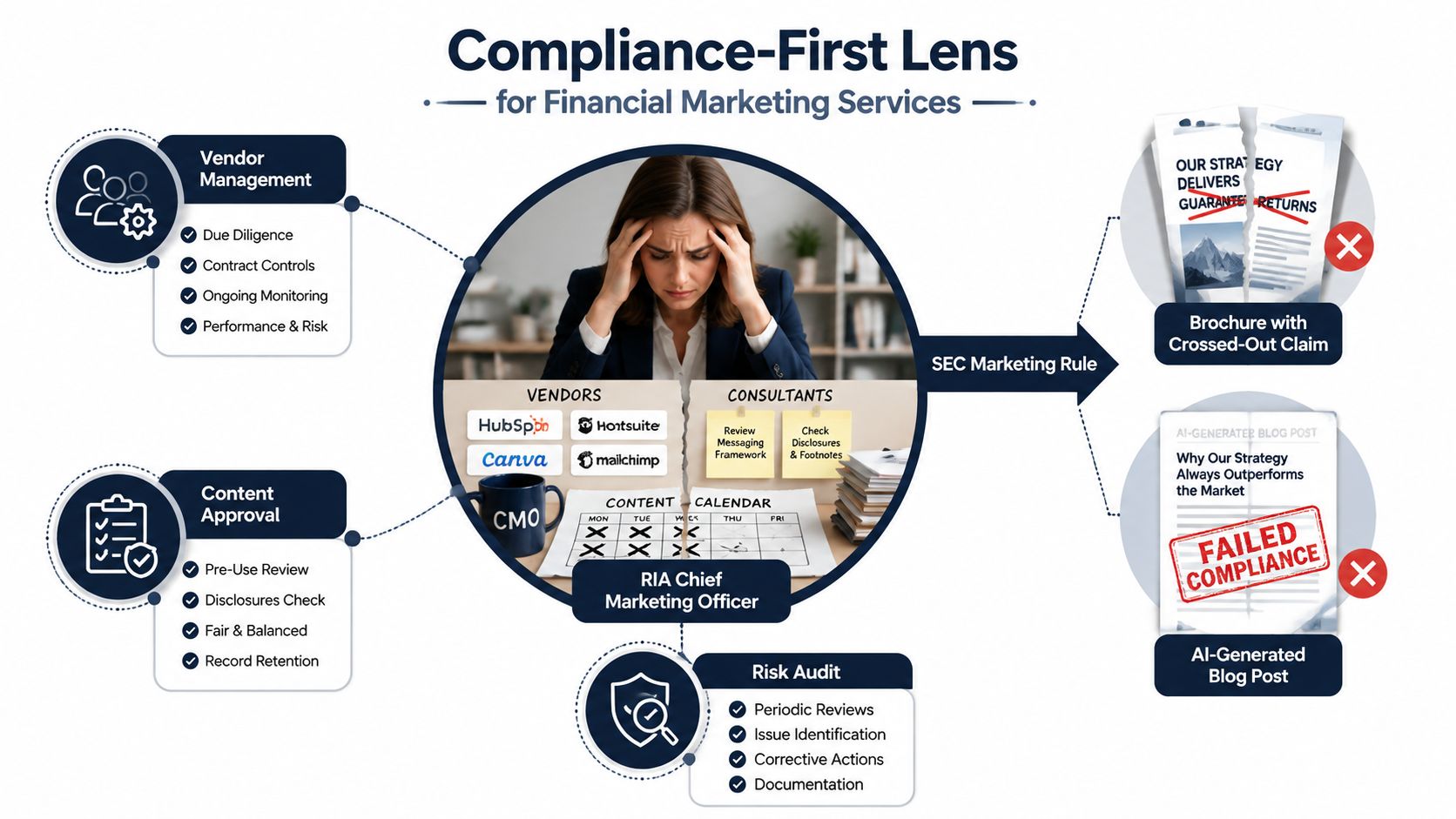
An RIA chief marketing officer manages four vendors, two consultants, and a crowded content calendar. A brochure comes back from review with an unsupported claim. Hours later, an AI-written article fails for invented credentials and statistics. None of the vendors owns the full chain, so the CMO has to reconstruct who drafted, edited, approved, and published each asset.
That situation is avoidable. The SEC's modernized framework defines an advertisement broadly, including direct or indirect communications offering advisory services to prospective clients or existing clients seeking new services, as explained in the SEC's marketing rule announcement. The framework can reach websites, lead magnets, email, video, social content, paid ads, testimonials, endorsements, and recruiting-related communications, depending on the facts and the firm's activities.
Fragmentation creates review risk
The core issue isn't that marketing vendors lack creativity. It's that fragmented ownership weakens supervision. A copywriter may know search intent but miss a performance presentation requirement. A media buyer may optimize a campaign while treating a lead as equally valuable regardless of suitability or qualification. An AI tool may produce fluent copy that contains facts nobody has verified.
The SEC framework also reaches compensated testimonials and endorsements, digital media, video, social platforms, and websites, according to the SEC's small-business compliance guide. That breadth makes a shared approval process more practical than channel-by-channel improvisation.
Three forces make this shift urgent:
- Performance scrutiny: Firms need a reasonable basis for claims and accurate context around results.
- Generative AI adoption: AI can accelerate drafting, but it can also fabricate case studies, credentials, or financial facts.
- Client expectations: Prospects increasingly want transparent explanations, clear fees, relevant expertise, and communication that feels human.
Practical rule: A marketing asset isn't finished when creative production ends. It's finished when the firm can show what was claimed, what supports it, who approved it, and where it appeared.
The SEC's amended rule became effective on May 4, 2021, with advisers given until November 4, 2022 to comply after an 18-month transition period, according to SEC staff guidance on the marketing rule transition. That history matters because compliance can't remain a final inspection. It has to shape strategy, production, review, and measurement from the beginning.
For teams evaluating SEC compliance for advisors, the practical standard is straightforward: build a unified stack where every service has an owner, every claim has evidence, and every publication has an approval trail. That structure protects growth because it lets teams move faster with fewer surprises.
Core Service Categories Every RIA and Bank Should Know
Financial services marketing services work best as a connected operating system. A website without a message produces weak conversion. Content without distribution stays invisible. Paid media without qualification sends expensive, low-value inquiries to advisors. Coaching without tracking makes referral activity difficult to improve.
The main categories are below.
| Category | What It Covers | Primary Outcome |
|---|---|---|
| Website design and development | Conversion architecture, accessible design, service pages, forms, gated content, analytics, and approval-ready copy | More qualified inquiries and clearer user journeys |
| Branding, messaging, and positioning | Brand strategy, visual identity, value propositions, audience definitions, and message governance | Consistent market perception |
| Content marketing | Search-led articles, newsletters, lead magnets, editorial planning, and social content | Intent capture and trust development |
| Video production | Explainers, advisor interviews, onboarding content, webinars, and short-form video | Human credibility and stronger education |
| Paid advertising | Search, professional-network advertising, display, retargeting, and approved social campaigns | Measurable demand generation |
| Advisor and banker coaching | Referral conversations, workshops, client-service workflows, and Centers of Influence programs | Better conversion from existing relationships |
| Recruiting marketing | Employer positioning, role pages, candidate campaigns, and recruiting content | A stronger advisor and relationship-manager pipeline |
Start with the conversion foundation
Website work should begin with the prospect journey, not a visual mood board. Each page needs a clear audience, a defensible promise, an appropriate call to action, and a form or scheduling path that captures useful qualification data. Accessibility, content governance, gated resources, and analytics belong in the initial architecture.
Branding and positioning solve a different problem. Advisors, bankers, and recruiters need one coherent explanation of who the firm serves, what it does, and why the relationship matters. A brand guide should cover approved language, visual standards, disclaimers, and claims that require evidence.
Build demand around intent
Content marketing turns recurring client questions into searchable and shareable education. Strong programs use articles, newsletters, guides, and social posts that answer specific concerns without drifting into unsupported promises. Teams exploring broader marketing for financial institutions can use that perspective to connect campaign management with institutional growth objectives.
Video makes complex ideas easier to understand and gives prospects access to the people behind the firm. Explainers, onboarding videos, interviews, and short-form clips should be scripted, reviewed, captioned, and archived like any other client-facing communication.
Paid advertising provides speed, but it also exposes weak messaging quickly. Search, professional-network, display, and social campaigns need approved claims, landing-page alignment, audience controls, tracking, and a defined lead qualification process.
Convert relationships and attract talent
Coaching helps advisors and bankers act on demand already present in their networks. Referral conversations, educational workshops, and Centers of Influence programs need practical scripts, follow-up ownership, and measurement tied to meetings rather than activity alone.
Recruiting marketing gives firms a way to compete for talent with a credible story about support, culture, career development, and operational resources. The same compliance discipline applies when recruiting materials make claims about compensation, production, training, or advancement.
A coordinated digital marketing approach for financial services prevents each category from becoming a separate purchase. The firm should know how a brand message appears on a website, how content feeds paid campaigns, how leads enter a CRM, and how advisors or recruiters follow up.
The Compliance Backbone Behind Every Marketing Channel
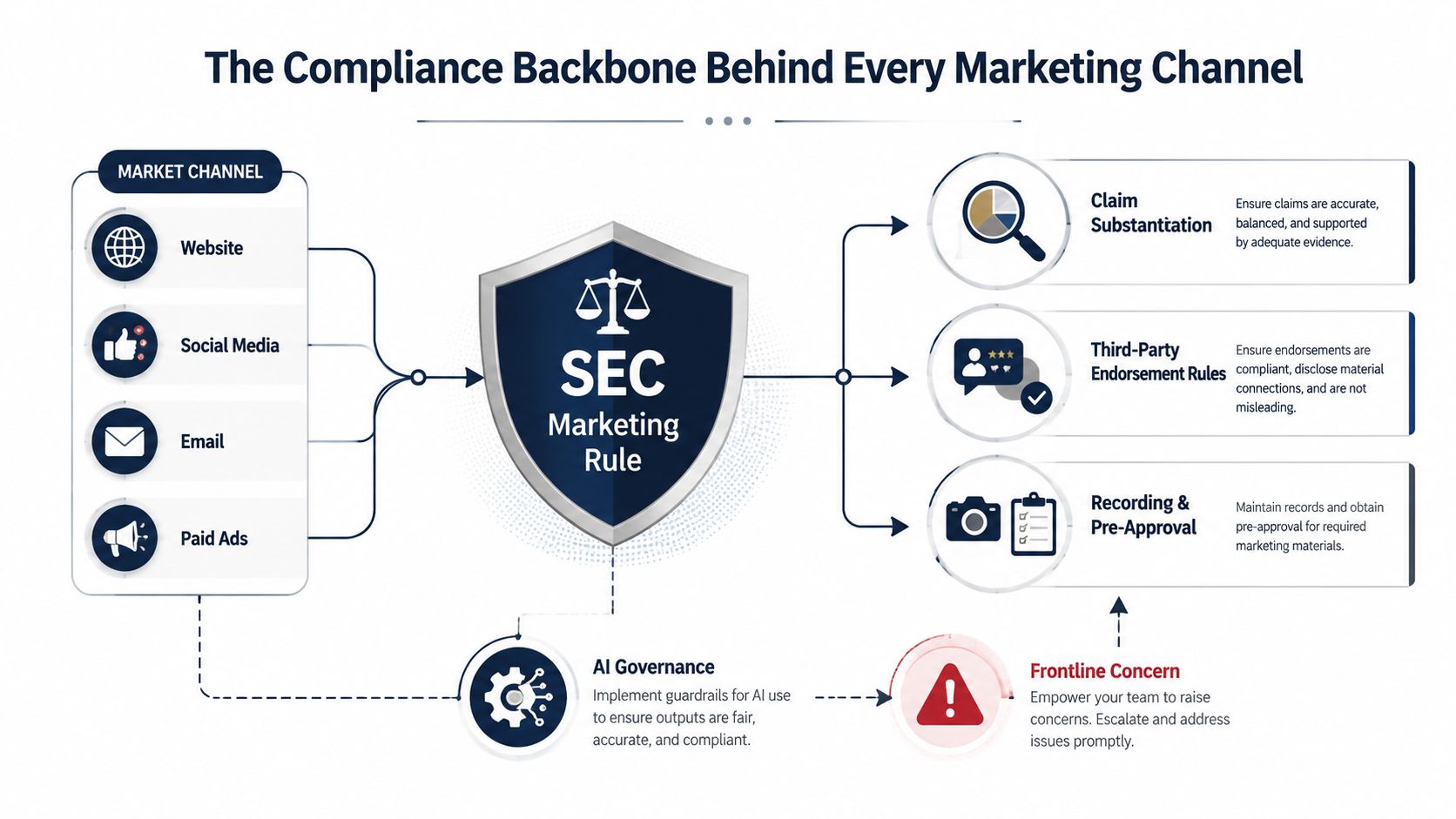
A campaign can generate qualified meetings and still create regulatory exposure. Build the compliance record before production starts. Identify the audience, channel, communication purpose, claims, data used, reviewer, retention requirement, and final destination. That record gives the firm a defensible approval process and connects marketing activity to measurable conversion outcomes.
Match the control to the asset
Website copy needs evidence for factual statements, a fair presentation of services, and appropriate performance context. Performance information should have a reasonable basis and, where applicable, state whether results are shown net of fees. A gated lead magnet follows the same advertising standards as a public page. Requiring an email address does not remove those obligations.
Retain approved drafts, supporting evidence, disclosures, and publication details. Video needs added control because spoken claims, on-screen text, captions, descriptions, and calls to action must agree. Paid ads warrant strict review. Short formats compress the message, which makes balanced presentation harder and can turn a qualified-lead campaign into a costly compliance problem.
The SEC Marketing Rule permits testimonials and endorsements when disclosure and oversight conditions are met. Disclosures can include whether the person is a client or non-client, whether compensation was received, and whether material conflicts exist, as explained in this analysis of the SEC testimonial and endorsement requirements. Prior to the marketing rule, advisers faced longstanding restrictions on testimonials, as reflected in earlier SEC social media guidance.
Treat AI as a governed workflow
AI governance remains a neglected part of financial marketing. Industry coverage reports that 61% of 148 financial institutions had implemented or were piloting AI or machine learning in compliance operations. It also reports that 57% of RIA compliance officers identified AI usage as a top compliance topic and 46% reported increased testing of AI-related controls. Brand-safety and compliance concerns constrained AI adoption for 55% of financial-services marketers, while technology integration concerns constrained it for another 55%. These figures appear in Wolters Kluwer's financial-services AI coverage.
AI can invent a client story, misstate a credential, combine separate sources, or create a plausible but unsupported statistic. Set four controls before allowing it into production:
- Permitted uses: Separate internal brainstorming, summarization, and formatting from client-facing drafting.
- Data boundaries: Keep confidential, personal, and unapproved proprietary information out of the model.
- Review evidence: Retain prompts, source material, drafts, edits, reviewer identity, approval date, and published versions when firm policy requires them.
- Escalation rules: Route performance claims, testimonials, endorsements, personalized recommendations, and unusual disclosures to designated reviewers.
The objective is controlled use, not a blanket ban. Make human review visible and repeatable. Tie each asset to the compliance calendar, supervisory procedures, evidence file, and conversion report. That operating discipline lets the firm scale channels without treating compliance as a late-stage obstacle.
Pricing Models for Financial Services Marketing Services
Pricing should follow the growth problem, not the vendor's preferred billing method. A firm building its first credible digital foundation needs a different arrangement from a bank testing several acquisition channels or an RIA with a capable internal marketing manager.
| Pricing Model | Typical Range | Best For | Watch Outs |
|---|---|---|---|
| Monthly retainer | Commonly structured around ongoing scope, staffing, and channel responsibility | Continuous content, website management, paid media, and reporting | Vague deliverables, unused capacity, and unclear review ownership |
| Project-based fee | Quoted for a defined initiative | Website rebuilds, brand refreshes, campaign launches, or video projects | Change requests, missing maintenance, and post-launch support |
| Performance or hybrid | Linked partly to qualified outcomes or agreed growth measures | Demand generation teams with reliable attribution | Lead-quality disputes, compliance limits, and incentives that favor volume |
| Hourly consulting | Billed for advisory time | Coaching, audits, recruiting support, and specialist reviews | Open-ended scope and limited execution capacity |
Retainers work when the firm needs a steady operating cadence. The agreement should specify content volume, revision rules, reporting, meetings, compliance coordination, media management, and what happens when priorities change. Compliance review, ad spend, video production, travel, and major development work often need separate treatment, so vague “all-inclusive” language can create friction.
Project fees make sense for a website rebuild or repositioning effort. They don't solve the ongoing need for editorial planning, analytics, campaign optimization, or approval management. A project should include handoff documentation and a clear decision about who owns updates after launch.
Performance arrangements sound attractive but require mature tracking. A qualified meeting, completed application, funded account, and new client relationship aren't interchangeable outcomes. Firms should define attribution windows, qualification standards, compliance responsibilities, and payment triggers before launch.
Budget test: If the firm can't state the business event that proves value, it isn't ready for performance pricing.
A practical selection heuristic is simple. Smaller teams with limited internal capacity often benefit from a focused retainer. Firms with strong internal operators may use project fees for specialized work and hourly consulting for targeted gaps. Teams prioritizing demand generation should fund measurement and qualification before adding channels. Teams still struggling with positioning should fix the brand and website foundation first.
How to Choose the Right Marketing Partner for an Advisory or Bank Team
Vendor selection should look more like operational due diligence than a creative portfolio review. A polished website tells little about whether a partner can document claims, manage revisions, coordinate with compliance, or distinguish an inquiry from a qualified opportunity.
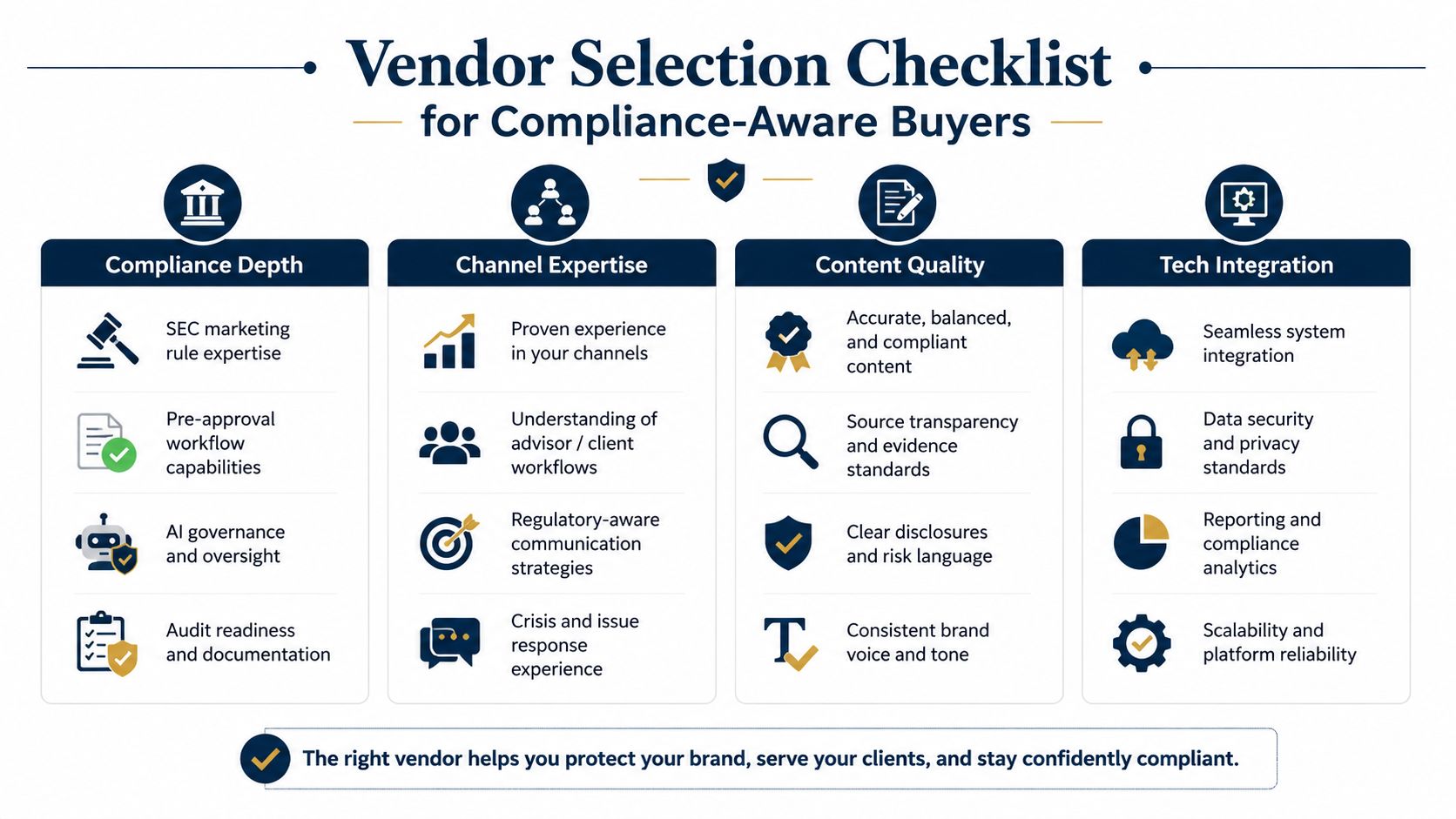
Evaluate four dimensions
Compliance depth comes first. The partner should understand the SEC marketing rule, maintain pre-approval workflows, support evidence files, and explain how AI-generated work is controlled. For teams subject to additional oversight, the partner should also demonstrate familiarity with relevant FINRA and state review expectations.
Industry focus matters because an RIA, bank, credit union, and wealth-management firm don't share identical buying journeys or supervisory structures. Ask for references that resemble the firm's audience, distribution model, and compliance environment. Generic business-to-business experience isn't a substitute for regulated financial-services knowledge.
Measurable outcomes separate useful reporting from vanity dashboards. Require examples that track qualified meetings, lead-to-conversion movement, cost per qualified opportunity, account openings, or recruiting pipeline progress. Reach and engagement can provide context, but they shouldn't be the final scorecard.
Integration determines whether the work survives contact with the organization. The partner should be able to coordinate with the existing CRM, marketing automation, website analytics, advisor coaching, client service, and recruiting processes. A useful client account management guide can help teams clarify ownership and follow-up expectations before vendor conversations begin.
Ask finalists difficult questions
Seven questions reveal more than a long capabilities deck:
- Who owns the final compliance workflow?
- How are claims matched to evidence?
- What happens when AI contributes to a draft?
- Which metrics define a qualified opportunity?
- How are rejected assets documented and revised?
- Which systems can the partner integrate with?
- What costs sit outside the proposed scope?
Red flags include templated compliance language, no experience with dual-registered environments, offshore creative production without appropriately trained reviewers, and contracts that commit ad spend without clear attribution. A partner that avoids these questions before signing won't become more transparent after launch.
Advisor Momentum can serve as one option for teams seeking coordinated website, branding, content, advertising, coaching, video, and recruiting support designed for financial advisors and banking professionals. The relevant question isn't whether a provider offers every service. It's whether the provider can connect those services to the firm's supervisory process and commercial objectives.
Real-World Examples of Marketing Services in Action
The following examples are realistic operating scenarios, not verified case studies. They show how a compliance-first program can be designed and what a firm should measure without inventing performance claims.
A mid-market RIA rebuilds the prospect journey
A mid-market RIA has strong referrals but an outdated website and inconsistent advisor biographies. The firm commissions a conversion-focused rebuild, rewrites service pages around client questions, creates a gated planning guide, and produces a thought-leadership video series with approved scripts.
The team tracks qualified consultation requests, landing-page conversion, source attribution, and the percentage of inquiries that meet the firm's target profile. It accepts a slower launch because every claim, disclosure, transcript, and form flow passes review before publication. The takeaway is practical: a website project should improve qualification and follow-up, not modernize the design.
A regional bank unifies branch-market marketing
A regional bank finds that individual markets use different messages for deposits, small-business relationships, and community involvement. The bank creates a shared brand framework, approved local content templates, search campaigns tied to specific account journeys, and landing pages that reflect each market without allowing uncontrolled claims.
The marketing team measures completed account openings, qualified applications, cost per qualified action, and performance by branch market. It trades creative freedom for consistency, giving local teams approved modules rather than a blank page. That compromise makes review easier and gives leadership a clearer comparison across markets.
An independent advisory firm supports hiring
A growing independent advisory firm needs more producers but has no consistent candidate story. It combines recruiting pages, advisor interviews, role-specific content, referral coaching, and a structured follow-up process for applicants and recruiting sources.
The firm tracks qualified applicants, interview progression, accepted offers, time from hire to productive activity, and candidate-source quality. It avoids promising outcomes that depend on individual production and instead explains support, expectations, training, and advancement accurately. The lesson is that recruiting marketing works best when messaging and onboarding operations reinforce each other.
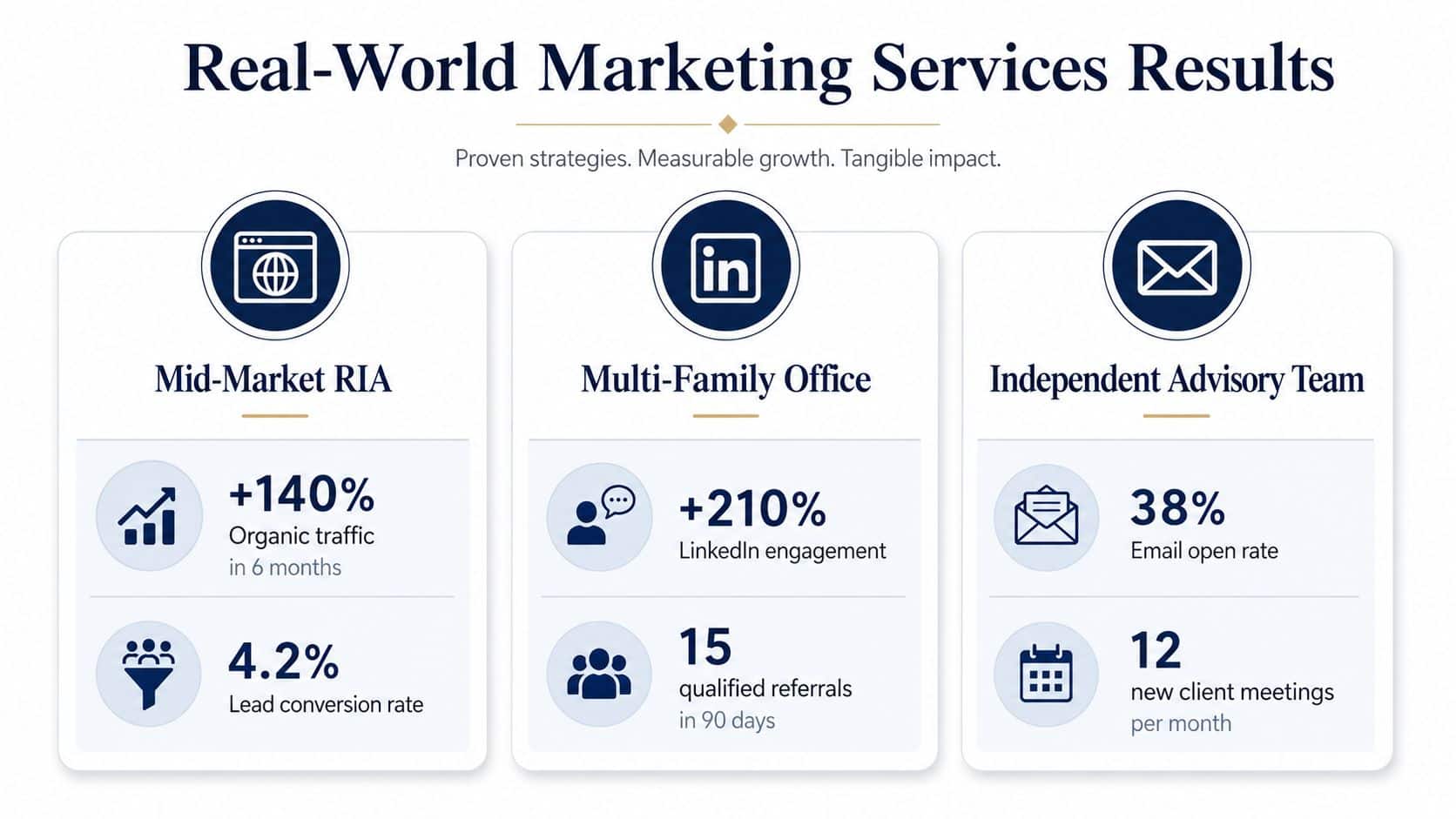
Across all three scenarios, the measurement framework stays close to business value. Traffic, views, clicks, and impressions provide diagnostic information. Qualified meetings, applications, openings, hires, and conversion quality determine whether the program deserves more investment.
Putting It All Together With a 12-Month Growth Plan
A 12-month plan should sequence risk reduction before scale. Firms that launch paid campaigns before fixing positioning, forms, follow-up, and approvals usually buy more noise instead of more growth.
Months one through four establish control
Begin with a compliance and communications audit. Inventory websites, brochures, social profiles, email sequences, video, lead magnets, recruiting pages, and paid campaigns. Create a claims library, disclosure standards, reviewer matrix, AI-use policy, and evidence-file process.
Next, refresh the brand and rebuild priority website journeys. Validate service descriptions, calls to action, accessibility, analytics, forms, and qualification questions before publishing. The first measurement set should include marketing-qualified leads, advisory meetings, source quality, and content-to-conversion movement.
Months five through eight create repeatable demand
Launch an editorial engine built around approved subject areas and recurring client questions. Add newsletters, search-led articles, lead magnets, and expert-led video. Paid testing can begin with a limited set of messages and landing pages, each connected to a defined qualification event.
AI may assist with research organization, transcription, repurposing, and internal drafts, but client-facing output needs documented human review. Review cycles can become faster when reviewers work from approved claims, reusable disclosure blocks, and clear escalation rules rather than reviewing every asset from scratch.
Months nine through twelve scale what earns trust
Add advisor or banker coaching, workshops, referral programs, and a recruiting marketing sprint. By this point, the firm should compare channels using blended cost per qualified opportunity, meeting progression, conversion quality, and recruiting pipeline velocity.
Increase spend only where the evidence supports it. Financial-services marketing is measurable but not frictionless. One benchmark reports an average finance-sector conversion rate of 6.35%, while financial-services firms typically allocate about 8% to 14% of revenue to marketing, with some SaaS and fintech businesses spending up to 25%, according to Ruler Analytics' financial-services benchmark. Those figures reinforce the need to protect every stage of the funnel, from compliant message to qualified follow-up.
Paid media also requires disciplined economics. A benchmark reports a Google Ads conversion rate of 5.10% and a CPA of $81.93, while another benchmark set reports an average CPC of $4.25 and conversion rate of 5.9%, as shown in financial-services paid-media benchmarks. The operational conclusion is clear: better qualification and landing-page conversion can matter more than buying additional clicks.
The roadmap should end with a quarterly planning rhythm, monthly performance reviews, and an evidence file that keeps marketing, operations, and compliance aligned.
Advisor Momentum offers compliance-ready website development, branding, content, advertising, video, coaching, and recruiting support for financial advisors, wealth firms, and banking teams. Teams can connect those services to a practical approval process and measurable conversion goals by visiting Advisor Momentum and discussing the next growth priority.
