

Most firms still describe Form ADV Part 2A as an annual brochure update. That advice is incomplete, and it creates the wrong operating habit. The annual amendment matters, but the larger compliance risk appears between filings, when a billing practice changes, a custodian is added, an affiliate receives compensation, or a disciplinary matter alters the firm's disclosure story.
Part 2A is a plain-English narrative disclosure, not a historical snapshot. The SEC's framework requires advisers to explain their business practices, investment strategies, fees, conflicts of interest, and disciplinary information, and the rule requires annual updating as part of the adviser's fiscal-year updating amendment. The brochure also must be revised when information becomes materially inaccurate, with updated delivery obligations following the fiscal year-end process. The governing brochure rule makes clear that brochure governance is recurring, not a once-a-year document production task.
The firms that manage this well don't wait for filing season to discover that their brochure no longer matches client agreements, custodial arrangements, invoices, or affiliate disclosures. They treat Part 2A as a controlled business record with owners, triggers, version history, and delivery evidence.
Table of Contents
- Why Form ADV Part 2A Is More Than Annual Housekeeping
- The 18-Item Disclosure Architecture Explained
- High-Risk Disclosure Items That Trigger SEC Scrutiny
- Drafting and Filing Your Brochure Correctly
- SEC-Registered Versus State-Registered Adviser Requirements
- Building Event-Driven Governance Controls
- Common Compliance Pitfalls and How to Avoid Them
Why Form ADV Part 2A Is More Than Annual Housekeeping
The popular “update it once a year” approach usually begins with a calendar reminder, a review of assets under management, and a rush toward the annual filing deadline. That process can produce a technically filed brochure while leaving the firm's current operations inaccurately described. The SEC adopted the modern narrative brochure after its 2010 amendments, replacing the older check-the-box approach with a disclosure document intended to help clients understand how an adviser operates. The SEC's final rule release describes the revised framework and its required disclosure subjects.
The current brochure must match the current business
A brochure that accurately described the firm before a material operational change may become misleading afterward. A new fee arrangement can affect Item 5. A changed custody relationship can affect the firm's custody narrative. A new affiliate or revenue-sharing arrangement can alter the conflict disclosures that clients rely on when evaluating the adviser.
The practical problem isn't limited to the PDF. Compliance teams must compare the brochure against the documents and systems that produced the underlying facts:
- Billing records: Confirm that stated fee methods, billing frequency, minimums, discounts, refunds, and termination practices match actual invoices.
- Custodial records: Verify that the custody description reflects current custodians, account authority, standing instructions, and related-party arrangements.
- Affiliate documentation: Reconcile ownership, compensation, referrals, clearing relationships, and other financial benefits across the brochure and related disclosures.
- Client communications: Check that onboarding materials and contract language don't promise a practice that the brochure describes differently.
A stale brochure can therefore expose a control failure even when the annual amendment was filed on time. Examiners can compare the filed document, the version delivered to clients, and the firm's operating evidence. If those versions tell different stories, the issue is broader than poor drafting.
Practical rule: Every material business event should create an ADV impact question, not just a calendar task.
Annual delivery is only one part of the obligation
The SEC's brochure history goes back to its March 2000 statement that advisers must deliver or offer a brochure to prospective clients and deliver or offer one annually to existing clients. The public archive for Part 2 brochures on the SEC adviser database reaches back to April 2007, illustrating how the document became an institutionalized, searchable part of adviser transparency. The SEC's historical brochure rule materials provide the regulatory background.
Current delivery timing remains specific. Advisers generally provide the brochure before or when a client enters an advisory contract, then provide an updated brochure or a summary of material changes within 120 days after fiscal year-end when material changes occurred. The brochure delivery guidance sets out that timing.
The operational lesson is straightforward. A firm needs a process for identifying changes when they happen, deciding whether they are material, revising the affected disclosure, approving the new version, and preserving evidence of delivery. Annual filing should confirm that process, not substitute for it.
The 18-Item Disclosure Architecture Explained
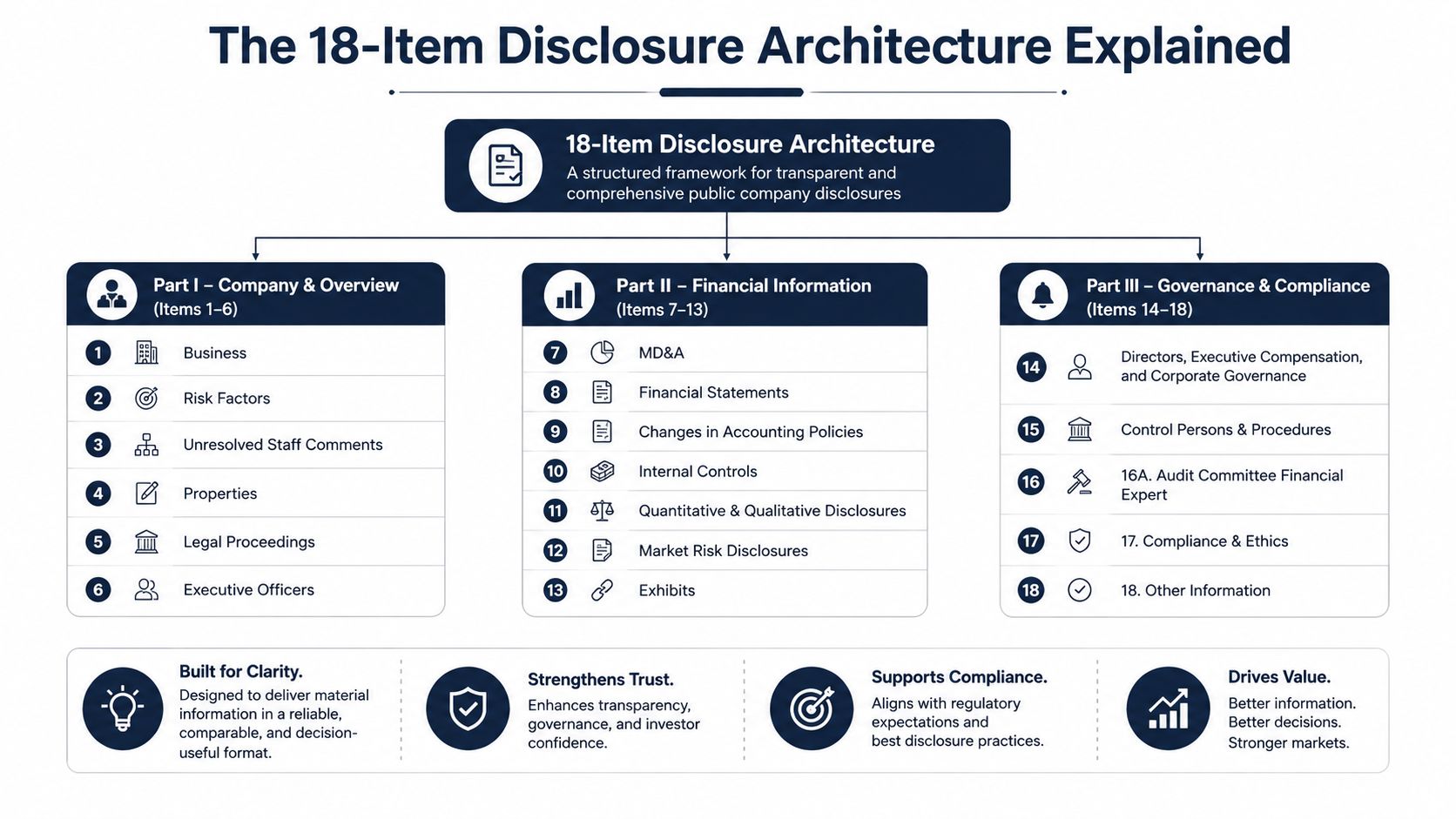
Form ADV Part 2A uses a standardized architecture of 18 disclosure items. The SEC designed that structure to make advisers easier to compare and to reduce the risk that firms omit subjects that matter to clients. Investor.gov's explanation of the brochure structure identifies the 18-item framework and the required cover-page information.
The items work as a connected narrative:
- Cover page: Names the adviser, business address, contact information, website address if available, and brochure date.
- Material changes: Identifies material changes from the prior brochure and helps existing clients understand what changed.
- Table of contents: Gives readers a usable route through the document.
- Advisory business: Describes the firm, its services, management structure, and the type of advice it provides.
- Fees and compensation: Explains advisory fees, billing methods, other fees clients may pay, and compensation-related conflicts.
- Performance-based fees and side-by-side management: Discloses performance compensation and conflicts created by managing accounts under different fee arrangements.
- Types of clients: Identifies client categories and any account minimums or other eligibility conditions.
- Methods of analysis, investment strategies, and risk of loss: Explains how the firm analyzes investments, implements strategies, and communicates meaningful risks.
- Disciplinary information: Addresses legal or disciplinary events material to a client's evaluation of the adviser.
- Other financial industry activities and affiliations: Describes outside activities, related businesses, and affiliations that may create conflicts.
- Code of ethics, participation or interest in client transactions, and personal trading: Explains the code and how personal or proprietary interests are handled.
- Brokerage practices: Covers broker selection, directed brokerage, research benefits, aggregation, and related conflicts.
- Review of accounts: States who reviews accounts, what is reviewed, and how often the firm conducts reviews.
- Client referrals and other compensation: Discloses referral arrangements and compensation received for client introductions.
- Custody: Explains custody circumstances and how clients should understand the role of custodians.
- Investment discretion: Describes discretionary authority and any limitations on that authority.
- Voting client securities: Explains proxy voting policies and how clients can obtain information.
- Financial information: Addresses financial condition, bankruptcy disclosures where relevant, and advance fees or other circumstances that may concern clients.
The structure isn't a checklist to complete mechanically. Item 5 must align with invoices and contracts. Item 8 must describe strategies the firm uses. Items 10 and 12 must work together when affiliates, clearing relationships, or revenue sharing influence brokerage decisions.
Drafting teams that work from a form-field mindset often focus on populating boxes rather than building a coherent disclosure. A practical primer on understanding form fields in PDFs can help staff understand document mechanics, but compliance judgment still determines whether the narrative is accurate, readable, and complete.
The best brochure reads as one conflict story. A client shouldn't find a benefit disclosed vaguely in Item 10, described differently in Item 12, and omitted from the fee explanation. Standardization helps only when the firm uses the architecture to connect facts, not conceal them in isolated paragraphs.
High-Risk Disclosure Items That Trigger SEC Scrutiny
Examiners tend to focus on the places where a brochure can diverge from the firm's economic reality. The highest-risk items aren't necessarily the longest ones. They are the items that describe money, incentives, authority, conduct, and relationships.
Item 4 and Item 8 must describe actual advice
Item 4 often becomes a marketing summary rather than an operational description. A firm may describe broad investment capabilities while its current portfolios, models, or advisory agreements reflect a narrower practice. Item 8 creates a similar problem when teams leave generic methods and strategies in place after the firm stops using them.
The drafting test is practical: could operations, investment staff, and client service personnel recognize the described process? If not, the language needs revision. Risk disclosures should identify meaningful risks associated with the firm's actual strategies, rather than relying on broad statements that apply to almost every investment adviser.
Item 5 is where prose meets invoices
Fee disclosure fails when it describes a formula but not the way the firm applies it. Teams should reconcile the brochure with billing schedules, account-level calculations, negotiated discounts, termination procedures, refunds, and third-party charges. A disclosure that says fees “may be negotiable” doesn't explain who can negotiate, what factors matter, or how the resulting arrangement is documented.
Recent regulatory commentary also highlights an easily missed consumer-protection issue, whether refunds are applied automatically or only after a client requests them. That operational detail belongs in the firm's control review, not only in a drafting meeting.
Items 10 and 12 require one conflict narrative
Affiliates, clearing arrangements, and revenue sharing can create layered conflicts. Recent SEC examination findings identified omissions and internal inconsistencies involving indirect benefits to affiliated broker-dealers and incomplete brokerage-practice narratives. The regulatory update discussing these findings reinforces why advisers should reconcile Item 10, Item 12, fee disclosures, and related documents.
| Item Number | Disclosure Area | Common Deficiency | Drafting Recommendation |
|---|---|---|---|
| Item 4 | Advisory business | Services or strategies no longer match actual practice | Compare narrative language with agreements, models, and holdings |
| Item 5 | Fees and compensation | Billing, discounts, refunds, or other charges are unclear | Test the disclosure against invoices and written fee arrangements |
| Item 8 | Methods and strategies | Generic methods remain after practices change | Remove unused strategies and explain material risks plainly |
| Item 10 | Affiliations and other activities | Indirect benefits or outside activities are omitted | Map ownership, compensation, and personnel activities |
| Item 11 | Code of ethics | Policy language doesn't match enforcement practice | Confirm training, approvals, reviews, and exceptions |
| Item 12 | Brokerage practices | Benefits and broker-selection factors are incomplete | Reconcile clearing, research, revenue sharing, and direction practices |
The firm should avoid both extremes. Boilerplate may omit the conflict that matters, while overcommitting language can create a new problem by promising controls that staff don't consistently perform. The right standard is specific, plain, and demonstrably operational.
Drafting and Filing Your Brochure Correctly
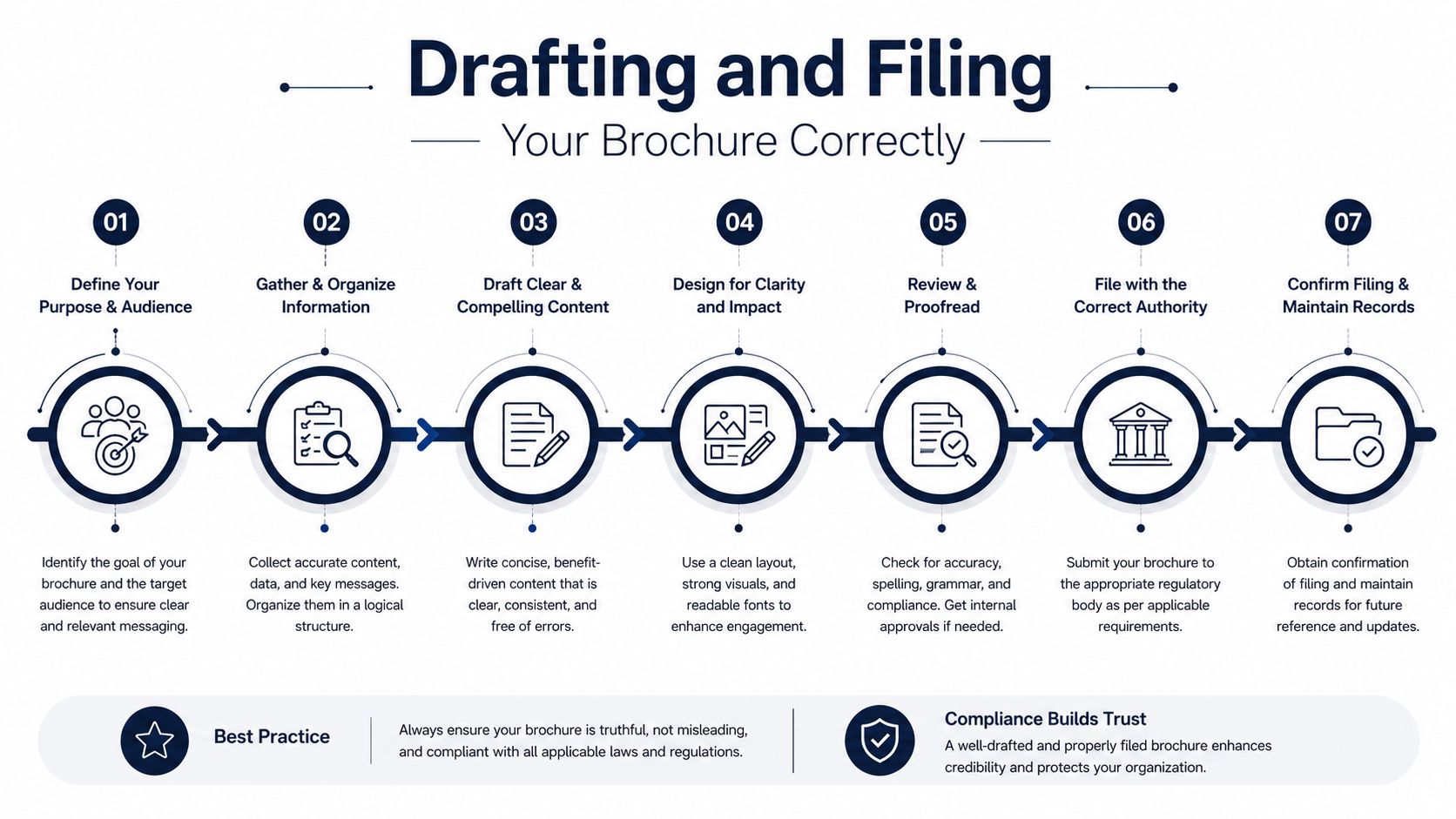
A reliable drafting process starts outside the filing system. The compliance team should first map the firm's actual practices, then translate those facts into a client-readable narrative. The SEC's guidance confirms that Part 2A uses a plain-English brochure format rather than the former check-the-box style, and SEC-registered advisers file electronically through IARD and deliver the brochure to clients. The SEC's IARD and Form ADV guidance explains that framework.
Build the facts before drafting
A strong workflow separates fact collection from prose editing:
- Inventory the business: Gather current services, strategies, fees, custodians, affiliates, outside activities, proxy voting practices, and disciplinary information.
- Assign item owners: Operations should validate custody and account review language. Finance should validate fees and compensation. Legal or compliance should assess disciplinary and affiliate matters.
- Cross-check source records: Compare the draft with advisory agreements, billing records, policies, and client communications.
- Draft for clients: Replace legalistic phrasing with direct explanations of what the firm does, who benefits, and how conflicts are addressed.
- Review the complete story: Read Items 4, 5, 8, 10, 12, and 15 together, not as isolated answers.
- Approve and version: Record the change, triggering event, approver, effective date, and delivery population.
- File and deliver: Upload the approved document through the required process and retain evidence that clients received the applicable version.
For the cover page, the required information includes the adviser's name, business address, contact information, website address if available, and brochure date. The disclosure document requirements make the cover page a substantive compliance component, not a decorative front page.
Control the amendment, not just the upload
The annual updating amendment occurs at the adviser's fiscal-year updating cycle, while material inaccuracies require attention when they arise. Firms should not batch an identified material change merely because the annual filing is approaching. A change log should show what changed, why it changed, who approved it, and when clients received the updated brochure or material-changes summary.
Part 2B supplements deserve coordination as well. They describe supervised persons, and the firm should keep them consistent with Part 2A, personnel records, and other regulatory disclosures. A missing supplement, wrong PDF version, or absent delivery evidence signals weak document controls even when the main brochure is well written.
SEC-Registered Versus State-Registered Adviser Requirements
Registration status determines the primary regulator and changes the filing workflow. SEC-registered advisers file electronically through IARD and deliver the brochure under the federal brochure framework. State-registered advisers work with state securities authorities, where additional filing, delivery, or supplement requirements may apply.
The difference is operational rather than merely jurisdictional. A state-registered firm may need to monitor state-specific instructions that affect the brochure or related documents. A firm operating across multiple states must track notice filings, registration status, delivery expectations, and any local disclosure requirements without allowing state tailoring to create contradictions in the core narrative.
| Requirement | SEC-Registered Advisers | State-Registered Advisers |
|---|---|---|
| Primary regulator | SEC | Applicable state securities authorities |
| Electronic filing | File through IARD | State filing requirements may apply through IARD or state systems |
| Brochure framework | Federal Part 2A requirements | Federal framework plus applicable state requirements |
| Delivery | Deliver to clients and prospective clients under the brochure rule | Follow federal requirements where applicable and state-specific obligations |
| Supplements | Maintain and deliver applicable Part 2B supplements | State filing or delivery rules may vary |
| Multi-jurisdiction control | Track federal status and state notice obligations | Track each state's registration and disclosure rules |
The brochure should also support the firm's broader fiduciary explanation. A practical resource on how to become a fiduciary can help firms connect regulatory obligations with the client-facing language used to explain their advisory role.
State-specific drafting creates a genuine trade-off. A single national brochure is easier to control, but it may not satisfy every state-specific requirement. Multiple versions can address local rules more precisely, but they increase version-control and delivery risk. The firm should document which version applies to which client population and ensure that all versions remain consistent.
Building Event-Driven Governance Controls
A calendar reminder can't detect a new affiliate, a changed fee practice, or a revised custodial arrangement. People and systems have to create that connection. The firm should establish event triggers that route business changes to compliance before the change becomes embedded in client communications or billing.
Assign ownership by source of change
The most effective control model gives each function a defined monitoring responsibility:
- Operations: Escalates new custodians, changes in account authority, standing instructions, and custody-related service arrangements.
- Finance: Reports fee changes, discounts, billing exceptions, refunds, third-party compensation, and revenue-sharing developments.
- Legal and compliance: Reviews disciplinary matters, regulatory inquiries, affiliate changes, and material policy revisions.
- Investment team: Flags new strategies, discontinued methods, model changes, and material risk changes.
- Human resources and supervision: Identifies outside business activities, new responsibilities, departures, and changes affecting supervised-person disclosures.
A new product, acquisition, personnel move, or regulatory inquiry shouldn't close without an ADV impact assessment. The assessment may conclude that no amendment is needed, but the decision should be recorded with the facts considered and the reason for the conclusion.
A documented immateriality decision is evidence of judgment. An undocumented decision looks like an oversight.
Make synchronization visible
A quarterly compliance committee can maintain a standing agenda that compares business developments against the current brochure. The review should include billing reports, custodian changes, affiliate registers, disciplinary questionnaires, and open regulatory matters. Mid-year spot checks are particularly useful because they test whether the annual control process works under normal operating pressure.
Recent regulatory commentary questions whether Part 2A is becoming closer to a real-time compliance document than a static brochure. The public disclosure system makes current brochures accessible to investors, while examination findings continue to identify missed compensation beneficiaries and unclear refund practices. The regulatory update on evolving brochure expectations supports an event-driven approach.
The firm should maintain a central register of brochure-impacting events, with status fields for assessment, drafting, approval, filing, delivery, and evidence retention. That register turns synchronization across custodial, billing, and affiliate disclosures into an auditable workflow instead of a memory exercise. Firms looking to strengthen adjacent controls can also review these financial advisor practice management principles, particularly around ownership and repeatable operating processes.
Common Compliance Pitfalls and How to Avoid Them
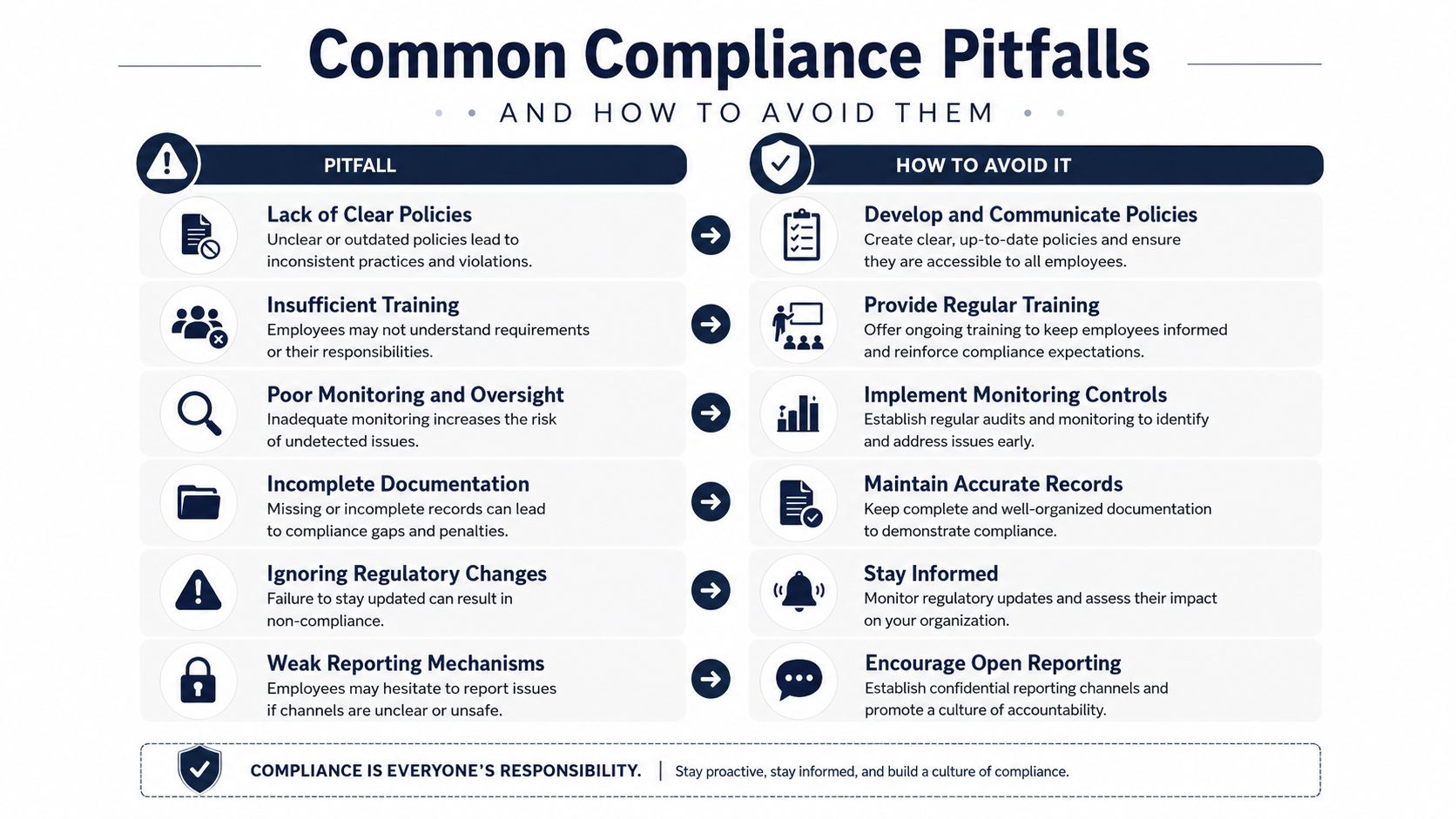
The most useful Part 2A review is a reconciliation exercise. Compliance staff should test what the brochure says against what the firm bills, delivers, supervises, and records. A polished document can still fail if the underlying facts haven't been checked.
A working review checklist
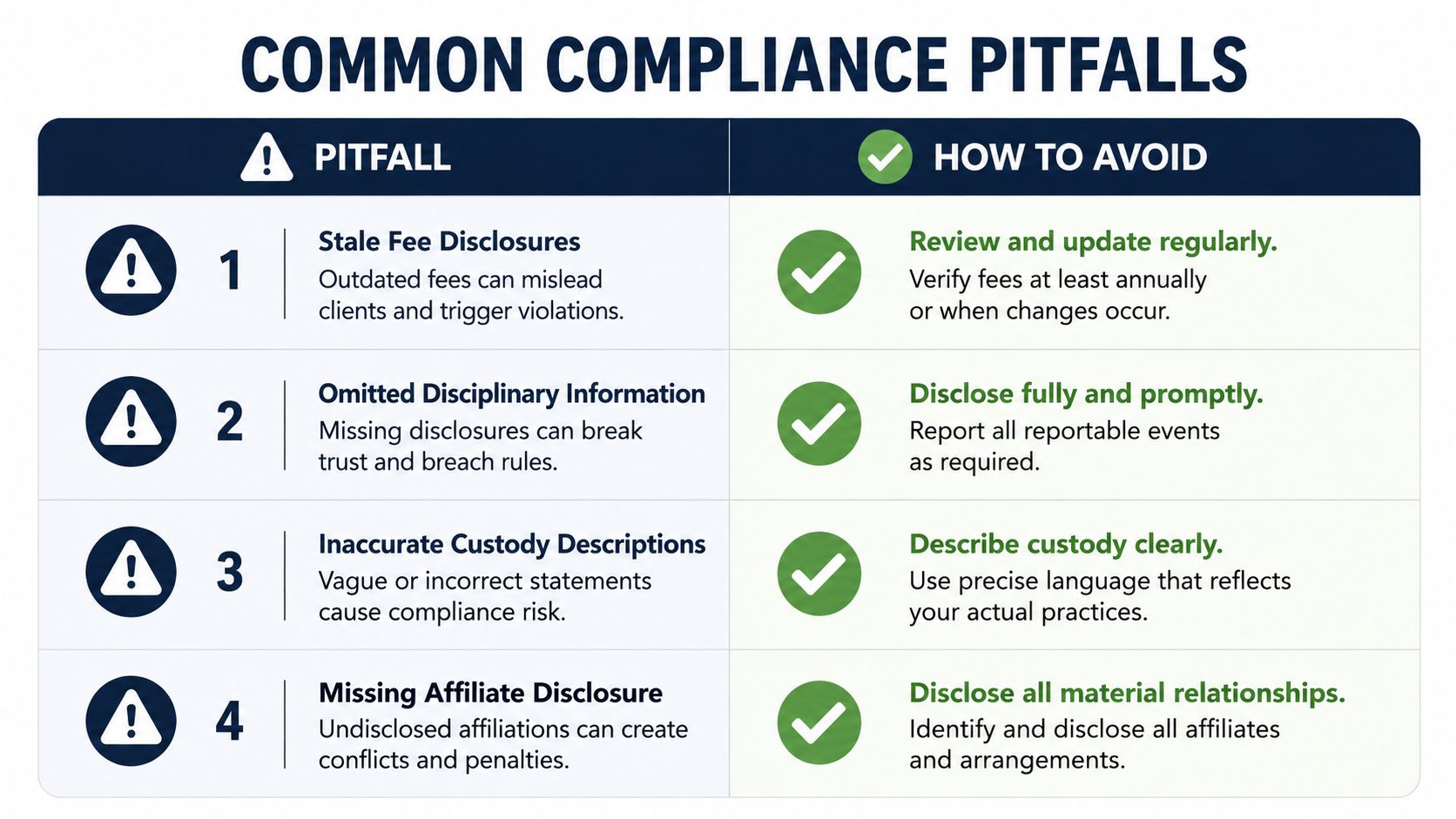
- Stale fee disclosures: Compare Item 5 with current invoices, fee schedules, discounts, billing dates, termination calculations, and refund practices.
- Inaccurate custody descriptions: Compare Item 15 with custodial agreements, account authority, standing letters, and related-party access.
- Omitted disciplinary information: Confirm that current events and material historical matters have been evaluated and disclosed where required.
- Generic affiliate language: Replace copied wording with a description of the specific relationship, economic benefit, conflict, and mitigation process.
- Outdated strategies: Remove methods in Item 8 that the firm no longer uses, and confirm that stated risks reflect current implementation.
- Unreported outside activities: Reconcile Item 10 with personnel questionnaires, supervisory records, and affiliation registers.
The review should assign an owner to every item, but ownership alone isn't enough. Each owner should identify the evidence used to validate the answer, the date of the review, and any unresolved judgment. That record helps the compliance officer distinguish an intentional conclusion from an unexamined carryover.
Test the brochure against the client experience
A useful spot check follows a client's journey. Start with the brochure delivered during onboarding, then compare it with the advisory agreement, fee authorization, invoice, custodian communications, and any referral or affiliate disclosure. If a client would receive different explanations from those documents, the firm has a synchronization issue.
The same test should apply after a material event. Compliance should identify which client populations are affected, determine whether a revised brochure or material-changes summary is required, approve the document, and preserve delivery evidence. Firms evaluating broader risk controls may find the framework for insider risk compliance strategies useful when assigning responsibilities and monitoring employee-driven changes.
The strongest firms don't define success as filing on time. They define it as maintaining one accurate disclosure story across the brochure, billing process, custody arrangements, affiliates, personnel disclosures, and client delivery records.
Advisor Momentum helps RIAs and financial advisory firms build compliance-ready websites, content programs, branding, and client-growth systems that support the same disciplined disclosure standards used in Form ADV Part 2A governance. Visit Advisor Momentum to discuss a coordinated marketing and practice-management approach for a regulated advisory business.
