
The initial encounter with a 401(k) often occurs in the least inspiring way possible. It shows up inside a pile of onboarding forms, next to health insurance elections and payroll paperwork, and the investment menu looks like it was written for someone with a finance degree. That's why many employees either delay enrollment, pick something at random, or leave the default settings untouched for years.
That hesitation is common, but it's expensive. Learning how to invest in a 401(k) doesn't require market forecasting or advanced portfolio theory. It requires a clear sequence of decisions: enroll, set the contribution rate, choose a sensible investment structure, decide between Traditional and Roth contributions, and review the account on a schedule instead of by emotion.
The good news is that a 401(k) is one of the simplest long-term wealth tools available once the moving parts are translated into plain language. For readers also trying to achieve early financial freedom, the habits built inside a workplace retirement plan often become the foundation for every other investing decision later on.
Table of Contents
- Why Your 401k Is Your Most Powerful Wealth Building Tool
- Your First Critical Decisions Enrollment and Contributions
- Decoding Your Investment Choices Funds and Fees
- Traditional vs Roth 401k A Strategic Tax Choice
- Managing and Optimizing Your 401k Over Time
- Common Mistakes and Your 401k Action Checklist
Why Your 401k Is Your Most Powerful Wealth Building Tool
A new employee often sees the 401(k) form as one more administrative task. In reality, it's usually the most valuable page in the entire packet. This account gives workers a direct system for saving automatically from each paycheck, investing for the long run, and building retirement assets without having to reinvent the process every month.
The power comes from three features working together. First, the account offers tax advantages. Second, many employers add matching contributions. Third, the money stays invested for years, which gives compound growth time to do its job.
Practical rule: A 401(k) works best when it runs in the background. Payroll deductions create consistency, and consistency is what turns a good idea into a large balance over time.
Employer matching is the feature that changes this from ordinary saving to high-value saving. Many companies cap matches at 6% of salary, and if an employee earns $60,000, a full 6% match adds $3,600 annually in employer money, according to this overview of common 401(k) investment structures and matching practices. That isn't a market return. It's compensation that only shows up if the employee participates.
There's another reason this account matters so much. It forces good behavior. Money goes in before it can be spent elsewhere, and the investment process keeps running through up markets and down markets. That structure protects investors from one of the most common mistakes in personal finance, which is treating long-term investing like a short-term reaction exercise.
For workers comparing retirement plans across jobs, it also helps to understand where a 401(k) fits relative to other workplace arrangements. This concise explanation of a 403(b) retirement plan is useful for anyone moving between nonprofit, education, and private-sector roles and trying to understand why the account labels differ even when the planning issues feel similar.
A 401(k) may look boring on day one. That's fine. Boring is often exactly what long-term investing should be. The account's job isn't to entertain. Its job is to compound, capture employer dollars, and give future retirement choices far more flexibility than a checking account ever could.
Your First Critical Decisions Enrollment and Contributions
Enrollment is where many either build momentum or lose it. The form usually asks for a contribution percentage, a beneficiary designation, and an investment election. Those choices feel permanent, but they aren't. The important thing is to make a sound initial decision and then improve it over time.
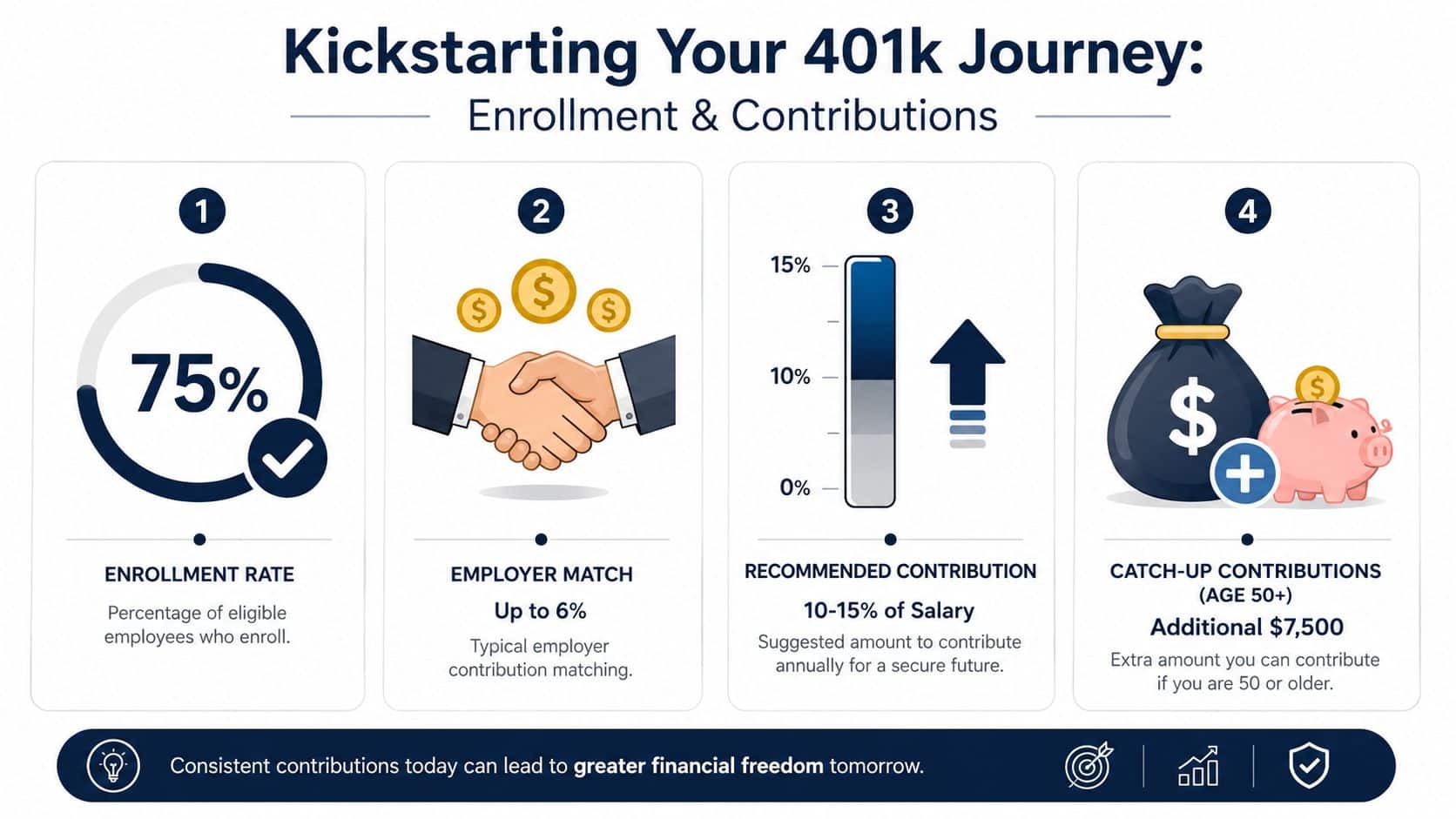
The first decision is whether to participate at all. The correct answer for most employees is yes, immediately. Delaying enrollment usually means missing payroll cycles that could have been invested and, in many plans, leaving employer matching contributions unclaimed.
Start with the match, then raise the rate
A useful way to think about contributions is in layers.
- First layer: contribute enough to get the full employer match.
- Second layer: increase the rate toward a long-term retirement target.
- Third layer: use annual raises or bonuses to push the percentage higher without feeling the change as sharply in take-home pay.
The gap between what people should save and what they save is wide. For 2026, the annual employee contribution limit is $24,500 for workers under age 50, and workers age 50 or older can contribute an additional $8,000, bringing the total to $32,500. The same source notes that the average employee contributes only 7.7% of salary, well below the 15% savings rate often recommended by financial planners (SmartAsset on 401(k) contribution limits and average savings rates).
That doesn't mean every worker needs to jump straight to 15% on the first paycheck. It means the employee should set a path. If cash flow is tight, start at the level required to get the full match and increase the percentage on a schedule. A one-point increase each time pay rises is often easier to sustain than a dramatic jump all at once.
Missing the full match is one of the few retirement mistakes that creates an immediate and avoidable loss.
Know the 2026 contribution limits
For workers who want to save aggressively, the annual limits matter because they define the outer boundary of what the plan can hold. Fidelity notes that the 2026 maximum employee contribution limit is $24,500 for either pre-tax or Roth contributions (Fidelity's 2026 401(k) overview).
Older workers get additional room. For 2026, participants age 50 and older can make the standard catch-up contribution, and workers age 60 through 63 may qualify for an enhanced catch-up under SECURE 2.0, depending on plan rules. The main planning point is simple: employees who are behind on retirement savings should check whether catch-up provisions apply and whether the employer's plan has implemented the enhanced option.
A clean enrollment checklist looks like this:
- Join immediately: Don't wait for the “right time” to start.
- Capture the match: Set the contribution rate at or above the threshold needed for the full employer contribution.
- Pick a target increase plan: Raise the savings rate whenever income rises.
- Check the annual cap: High savers should monitor progress toward the yearly employee limit.
- Review payroll deductions: Confirm the election was processed correctly after the first paycheck.
The best enrollment decision is usually not perfect. It's active, intentional, and easy to maintain.
Decoding Your Investment Choices Funds and Fees
A typical 401(k) menu creates the same problem for a lot of new investors. There are dozens of funds, several sound interchangeable, and the plan gives little help on how to turn that list into a usable portfolio.
The professional approach is simpler than the menu makes it look. Start with the job each fund needs to do in the account, then choose the lowest-cost option that fills that role well. That shifts the decision from "Which fund is best?" to "What mix of assets am I trying to own, and what is the cleanest way to own them in this plan?"
The simplest path for most investors
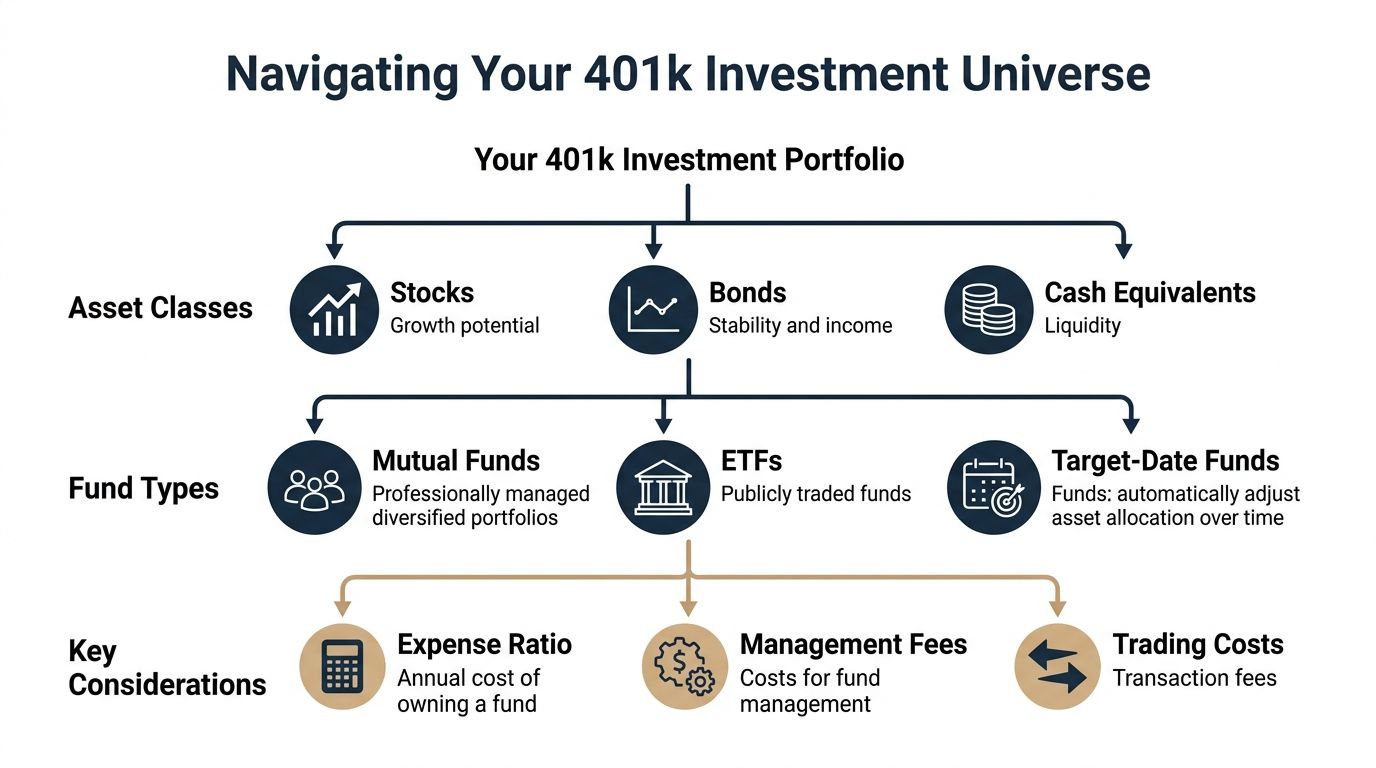
For many employees, a target-date fund is the right answer. It packages U.S. stocks, international stocks, and bonds into one fund and adjusts the allocation as retirement gets closer. That solves two common problems at once. It gives the account a full asset mix, and it removes the burden of rebalancing.
I often view target-date funds as the best choice for investors who want a sound default and are unlikely to monitor allocations closely. Convenience matters, but the bigger benefit is behavioral. A simple portfolio is easier to stick with during market swings.
Costs still matter. The Investment Company Institute reports that in 2023, the asset-weighted average expense ratio was 0.44% for hybrid funds, a category that includes many target-date funds, and 0.05% for equity index mutual funds (ICI research on mutual fund fees and expenses). Lower expenses leave more of the return in the participant's account year after year.
How to build a portfolio from a crowded fund menu
Some investors want more control, and a 401(k) usually gives enough raw material to build a strong allocation even if the menu looks messy.
A practical framework uses three building blocks:
- Broad U.S. stock exposure: the main source of long-term growth
- International stock exposure: diversification across markets outside the United States
- Bond exposure: stability, income, and a buffer during stock market declines
A common starting point is to set the stock-bond split first, then divide the stock side between U.S. and international funds. One age-based rule uses 110 minus age as a rough estimate for the stock percentage. It is only a starting point. Someone with a long time horizon and high risk tolerance may hold more in stocks. Someone who loses sleep during downturns should hold less, because the best allocation is one the investor can maintain through a bad year.
That is the strategic framework professionals use. Asset allocation comes first. Fund selection comes second.
What to check before choosing any fund
A fund name is marketing. The useful details are in the fund description and fee line.
| What to review | What to look for |
|---|---|
| Role in portfolio | Does the fund fill a clear slot such as U.S. stocks, international stocks, or bonds? |
| Cost | Is the expense ratio low compared with similar options in the plan? |
| Management style | Is it an index fund tracking a broad market, or an active fund making manager-driven bets? |
| Overlap | Does it duplicate exposure you already own somewhere else in the account? |
| Risk level | Does the fund's volatility fit the job you want it to do? |
Fees deserve close attention because they are one of the few variables an investor can control. The U.S. Securities and Exchange Commission explains that even small differences in annual fees can reduce long-term retirement balances in a meaningful way (SEC bulletin on 401(k) plan fees). In practice, low-cost broad index funds usually set the standard that active funds need to justify beating.
Active funds are not automatically bad. They just need a reason. If a plan's active option is expensive, inconsistent, or hard to explain, it usually does not belong in a core 401(k) allocation.
A clean decision process looks like this:
- Use a low-cost target-date fund if you want one fund that handles allocation and rebalancing.
- Build your own mix if the plan offers low-cost U.S. stock, international stock, and bond index funds.
- Use active funds sparingly, and only when the role, cost, and strategy are clear.
Good 401(k) investing usually comes from a plain structure executed consistently. The accounts that go off track are often the ones stuffed with overlapping funds, avoidable fees, and no clear allocation plan.
Traditional vs Roth 401k A Strategic Tax Choice
Many employees treat the Traditional versus Roth election as a side detail. It isn't. This choice affects when taxes are paid, how current take-home pay feels, and what retirement withdrawals may look like later.
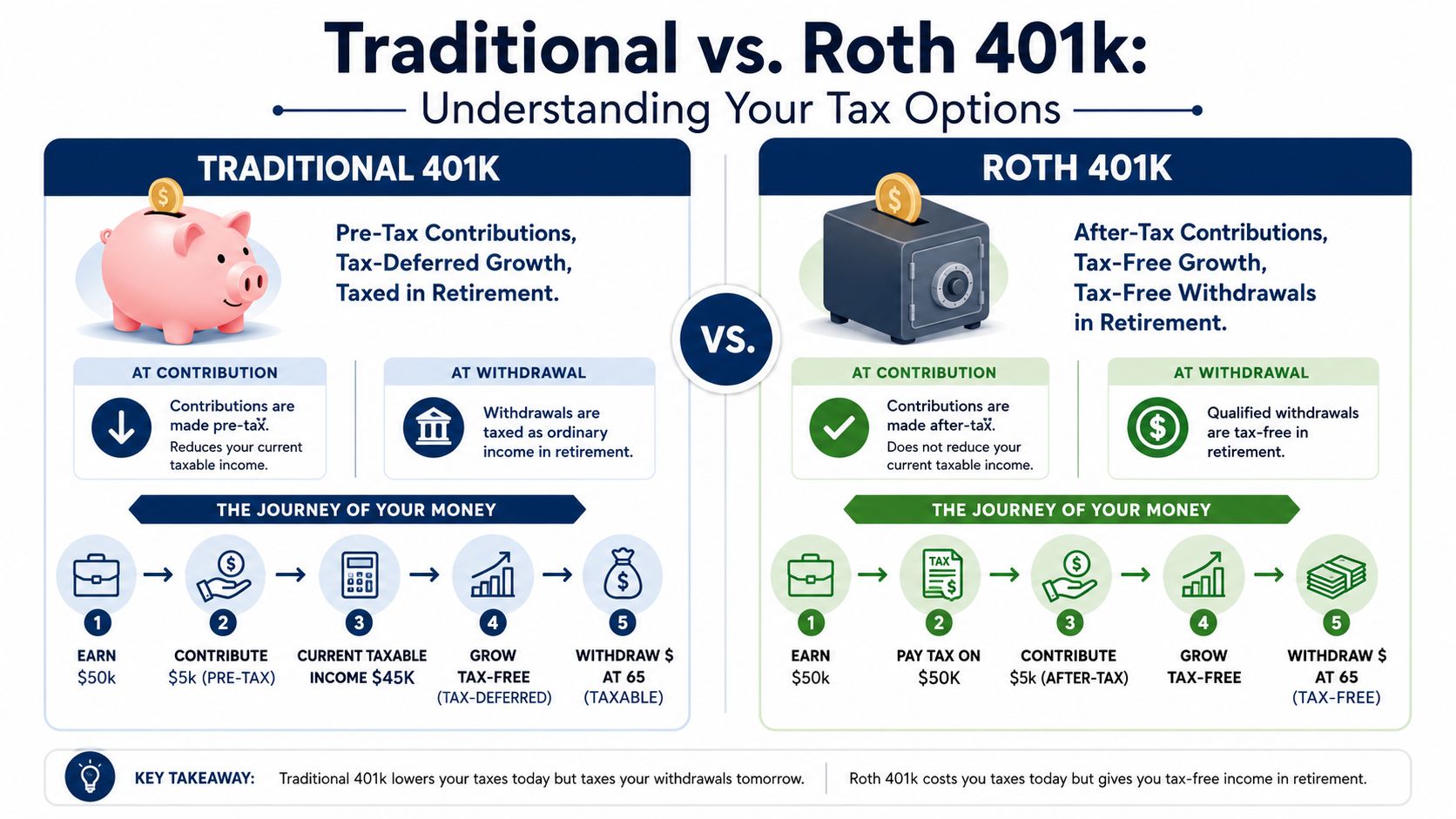
The core distinction is straightforward. A Traditional 401(k) uses pre-tax contributions and defers taxes until withdrawal. A Roth 401(k) uses after-tax contributions, but qualified withdrawals in retirement are tax-free.
How the tax trade-off works
A Traditional contribution usually lowers current taxable income. That appeals to workers who want the immediate tax break now. A Roth contribution does the opposite. The employee pays taxes on the income first, contributes after tax, and gives up the current deduction in exchange for tax-free qualified distributions later.
The right answer depends on tax timing, not on whether one account type sounds more complex.
| Feature | Traditional 401(k) | Roth 401(k) |
|---|---|---|
| Contribution type | Pre-tax | After-tax |
| Tax treatment today | Lowers current taxable income | No current deduction |
| Growth inside account | Tax-deferred | Tax-free qualified growth |
| Retirement withdrawals | Taxable | Tax-free if qualified |
There is also a rule change older high earners need to know. Under 2026 rules, participants whose prior-year FICA wages exceeded $150,000 must make catch-up contributions as Roth contributions rather than pre-tax contributions under SECURE 2.0 (Siebert on 2026 catch-up contribution treatment).
When Roth deserves serious consideration
A lot of basic retirement guidance defaults to pre-tax contributions, but that shortcut can miss the better answer for younger workers or employees currently in lower tax brackets. Financial coaches often advise those investors to prioritize the Roth side because paying taxes now can produce tax-free growth and tax-free withdrawals in retirement, which may be more valuable than the immediate deduction (discussion of Roth 401(k) positioning for younger or lower-bracket investors).
That makes Roth especially worth considering in situations like these:
- Early career earnings are modest: current tax rates may be lower than future rates.
- Career income is likely to rise: taxes paid now may be cheaper than taxes paid on future retirement withdrawals.
- The employee wants tax diversification: having both pre-tax and Roth assets can create more flexibility later.
Paying taxes now isn't automatically painful if it buys tax-free income later when the account is much larger.
Traditional contributions still make sense for many households, especially when current tax relief is valuable and cash flow is tight. The important point is to make the choice deliberately. This is a strategy decision, not a coin flip on an enrollment form.
Managing and Optimizing Your 401k Over Time
A solid 401(k) setup is only the beginning. Markets move, account balances drift, jobs change, and investor behavior becomes the main risk if no structure is in place. Long-term success comes less from finding a brilliant fund and more from using a repeatable maintenance process.
Use an IPS to remove emotion
Professionals don't usually manage retirement accounts by asking how they feel about the market this week. They work from a written standard. Individual investors can do the same with a simple Investment Policy Statement, or IPS.
An IPS doesn't need legal language or a long template. It can be a brief written note that states the target allocation, the role of each fund, and when the portfolio will be reviewed and rebalanced. That document matters because it creates rules before emotions show up.
According to Investopedia's guidance on choosing 401(k) assets and rebalancing discipline, investors who create a simple written IPS and rebalance at least semi-annually achieve superior long-term results. The discipline helps investors ignore short-term noise and stick to the strategic allocation instead of reacting to headlines.
A practical IPS can include:
- Target allocation: the intended mix of stock and bond exposure
- Fund selection rule: which funds represent each asset class
- Rebalancing schedule: a planned review at least twice each year
- Behavior rule: no changes based on market fear or excitement alone
Handle job changes carefully
A 401(k) also needs attention when employment changes. Many good savers make a bad move by treating the old balance like available cash instead of retirement capital.
In most cases, the smarter path is to evaluate a direct rollover to an IRA or to a new employer's retirement plan rather than cashing out. A rollover keeps the money in the retirement system and preserves the long-term purpose of the account. Employees with government service history or crossover planning questions may also benefit from more specialized reading on retirement planning for federal employees, especially when comparing transfer options across different plan types.
For broader context on how retirement investing fits inside a full financial life, this breakdown of the stages of financial planning is useful because 401(k) decisions rarely exist in isolation. They interact with debt management, cash reserves, family planning, and retirement timing.
The ongoing discipline is simple. Write the plan down, review it on schedule, rebalance without drama, and protect the account when changing jobs.
Common Mistakes and Your 401k Action Checklist
Most 401(k) mistakes aren't complicated. They're ordinary errors repeated for years. That's why they matter. A small avoidable problem inside a retirement account has a lot of time to become a large one.
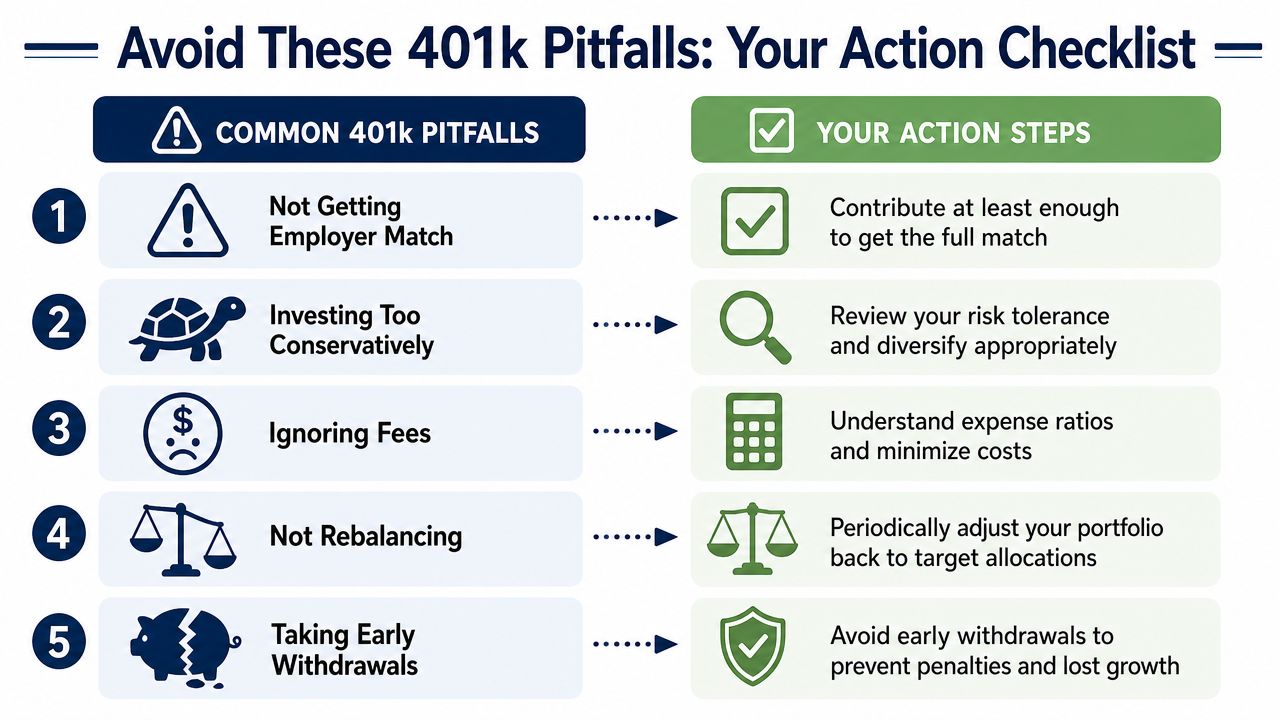
The mistakes that do the most damage
The first mistake is failing to get the full employer match. That is compensation left on the table.
The second is paying little attention to fees. Even when investment options look similar, higher costs reduce how much of the return stays in the account. That's why low-cost index funds often deserve first consideration.
The third is making emotional allocation changes. Investors often feel brave near market highs and fearful during declines, which is exactly backward for long-term decision-making. A written IPS and scheduled rebalancing exist to block that behavior.
The fourth is staying too conservative for too long. Cash-heavy or bond-heavy portfolios can feel safe, but they can also leave long-term growth behind if the investor has many working years ahead.
The fifth is cashing out after leaving a job. That interrupts compounding and turns a retirement asset into short-term spending money.
The best 401(k) investors usually aren't the most active. They're the most consistent.
A practical 401k checklist
A strong retirement process should be easy to scan and follow. This checklist keeps the account on track without turning it into a hobby.
- Enroll promptly: Get the payroll deduction started as early as possible.
- Secure the full match: Check the employer formula and contribute enough to receive all available matching dollars.
- Choose a structure: Use either a target-date fund or a simple diversified mix of broad stock and bond funds.
- Watch costs carefully: Prefer low-cost options when comparable choices exist.
- Make the tax election intentionally: Pick Traditional or Roth based on current versus future tax expectations.
- Write down the policy: Record the target allocation and review rules in a short IPS.
- Rebalance on schedule: Bring the account back to target instead of letting market moves dictate risk.
- Protect old balances: If employment changes, review rollover options before taking any distribution.
For readers still unsure how to invest in a 401(k) after going through this framework, that uncertainty usually means one thing. The person doesn't need more fund names. The person needs a personalized recommendation tied to income, tax bracket, risk tolerance, and retirement timeline. That's where working with a qualified financial advisor can be worth it, especially when the household's broader plan is starting to become more complex.
Advisor Momentum helps financial advisors and firms present complex planning topics with clarity, credibility, and compliance in mind. For advisory teams that want stronger digital positioning, better educational content, and a marketing system built for regulated financial services, Advisor Momentum is worth a close look.
