

An advisor scrolls through a financial news portal on her phone between client meetings. She pauses on a unit titled “5 Tax Moves Before Year-End”, styled almost like a Bloomberg article, but a small “Sponsored” label makes the commercial relationship clear. The placement feels relevant enough to earn attention, yet the label also raises the question every regulated firm should ask: can this format create qualified interest without creating a compliance problem?
That is the practical challenge behind programmatic native advertising. The format combines automated ad buying with placements designed to match the form, function, and visual rhythm of the host page. Unlike a static banner, a native unit is assembled from structured fields such as a headline, image, description, sponsor name, and call to action. The publisher then renders those components inside its own template.
The opportunity is substantial. One market estimate values global native advertising at USD 137.85 billion in 2025 and projects USD 451.99 billion by 2034, while another estimates the native advertising adtech market at USD 37.38 billion in 2024 and projects USD 76.34 billion by 2030. Both estimates identify North America as the largest regional market, although their reported shares differ. These projections are available in Fortune Business Insights' native advertising market analysis.
For financial firms, scale isn't the hard part. Supply quality, disclosure rendering, approval workflows, privacy controls, and lead quality determine whether the channel becomes useful or troublesome. The mechanics matter, but so does the discipline around them.
Table of Contents
- What Programmatic Native Advertising Means in Practice
- How the Programmatic Pipe Handles Native Ads
- Native Ad Formats Financial Marketers Use Most
- Why Native Outperforms Standard Display for Advisory Brands
- Compliance Mechanics for Financial Firms
- Hidden Risks in Programmatic Native Supply
- Building a Programmatic Native Campaign That Works
- Key Takeaways for Financial Marketing Leaders
What Programmatic Native Advertising Means in Practice
An advisor browsing a financial article may see a sponsored recommendation that matches the page's spacing, typography, and content rhythm. The placement feels part of the reading experience, yet its sponsor label and call to action identify it as paid media. That balance defines programmatic native advertising in a regulated setting.
A banner occupies a fixed position and arrives as a finished creative file. A native ad provides modular information that the publisher's system assembles for a particular placement. The asset may include a headline, image, description, sponsor name, and call to action rather than one fixed image.
The difference from traditional display
Programmatic buying automates the search and bidding process for available ad placements. Native rendering adapts the approved creative to the publisher's environment. Combined, these functions let an RIA or bank buy across many placements without producing a separate fixed banner for every layout.
The technical foundation is a structured payload. The IAB native advertising specification and OpenRTB native guidance describe native inventory as a container for data, image, animation, and video assets. Those fields can carry the headline, image, description, sponsor information, destination, and other components through the buying process.
For a financial brand, the value is contextual relevance. Someone researching retirement income may respond better to an educational article or calculator than to a generic display unit. Relevance still has limits. A native placement should fit the page without resembling editorial content so closely that the reader misses its commercial purpose.
Practical rule: Native should feel relevant to the page, never deceptive about who paid for it.
Why financial brands need more control
Financial products involve long consideration cycles, sensitive claims, and reputational risk. A headline that seems harmless in a consumer campaign can imply a guarantee, prediction, or tax conclusion when used by an advisory firm. Thumbnail imagery can create the same problem if it suggests certainty, wealth, or performance that the landing page cannot support.
Compliance review must cover more than the final headline. Teams need governance for structured creative fields, vetted inventory, transparent supply paths, privacy controls, disclosure rendering, and landing-page consistency. Measurement should examine lead quality and downstream actions, not clicks alone.
That operating discipline separates a useful lead channel from a regulatory headache. Native's flexible format creates room for relevance, but every component still needs an owner, an approval path, and evidence that the message matches what the firm can substantiate.
How the Programmatic Pipe Handles Native Ads
A native campaign moves through several connected systems, but the basic sequence is easier to understand than the terminology suggests.
The six steps behind a native impression
The publisher exposes inventory. A financial media site makes a native slot available through a supply-side platform or directly through an exchange.
The page generates a bid request. When a reader loads the page, the supply side sends information about the available placement. An OpenRTB native payload can describe requested fields such as title, image, description, sponsor attribution, and destination URL.
The demand side evaluates the opportunity. A demand-side platform compares the placement with the firm's audience rules, geographic requirements, contextual preferences, exclusion lists, and approved campaign assets.
The buyer returns a bid. The response includes the bid price and the structured creative components that the publisher needs to assemble the unit.
The auction selects a buyer. If the bid wins, the exchange passes the response into the publisher's rendering process.
The publisher renders the ad. The headline, image, sponsor label, and other fields appear inside the publisher's native template. Rendering can happen through server-side or client-side methods, depending on the implementation.

The IAB Europe handbook notes that native ads entered programmatic protocols through the OpenRTB Dynamic Native Ads API Specification in 2015, making automated native products available to demand-side platforms. That milestone matters because it turned native from a design approach into a transaction-ready format.
Where private buying helps
Open auctions can provide reach, but regulated financial advertisers often need more control than a broad pool of inventory provides. Private marketplaces and curated deals can narrow the supply path to named publishers, agreed placements, and documented quality standards.
A buyer should ask who owns each part of the route, which supply-side platforms touch the impression, whether the publisher domain is visible in reporting, and whether placement-level data is available after launch. A practical overview of the wider discipline appears in 2026 performance advertising by Wojo Media, particularly for teams connecting media buying with measurable business outcomes.
Financial marketers can also use this programmatic advertising best-practices resource when documenting targeting, inventory, creative testing, and reporting requirements. The key principle is simple: automation should reduce manual trafficking, not remove human oversight.
Native Ad Formats Financial Marketers Use Most
Financial marketers generally buy four native formats through programmatic pipes. Each suits a different stage of the decision process, and none should be treated as a universal lead-generation unit.
| Format | Placement | Best For | Watch Out For |
|---|---|---|---|
| In-feed unit | Inside an article stream or publisher content feed | Awareness, educational content, and broad RIA reach | Disclosure can become visually weak if the publisher template is poorly controlled |
| Recommendation widget | Near the end of a financial article or content page | Reaching readers who have already consumed related information | Low-quality sites and unclear placement reporting |
| Sponsored content placement | On the publisher's domain with an editorial-style page | Explaining retirement income, estate planning, or complex wealth topics | High production effort and a need for careful claim review |
| In-app native unit | Inside finance, investing, or banking applications | Product education and reaching retail investors in a focused context | Mobile rendering, consent signals, and small-screen disclosure visibility |
Matching the format to the objective
In-feed units are useful when an RIA needs to introduce a planning guide or financial education asset to a wider audience. The creative must earn the click with a specific question or useful promise, not a vague claim about better financial outcomes.
Recommendation widgets can reach readers who have just finished an article about markets, taxes, or retirement. That context may support stronger intent, but the advertiser needs to inspect the surrounding content and exclude low-quality placements rather than assuming every recommendation environment is premium.
Sponsored content works for topics that require explanation. A long-form article about retirement income can answer objections and establish a firm's perspective before asking for a consultation. It shouldn't blur editorial authorship. A clear sponsorship label and a visible firm identity protect the reader and the advertiser.
In-app native units can reach retail investors while they use finance applications. The format is compact, so the creative needs a short headline, a legible sponsor label, and a landing page that works cleanly on mobile.
Banks may prioritize brand lift and product education, while RIAs may prioritize consultation requests or guide downloads. Wealth platforms may need a sequence that introduces a concept before presenting a product. The format should follow the objective, not the other way around.
Why Native Outperforms Standard Display for Advisory Brands
A native placement can earn more attention than a standard display banner, but the result depends on supply, message, and execution. Independent benchmark discussions have reported stronger viewability, engagement, and brand recall for native placements than standard display in some benchmark sets, as summarized by the independent native advertising benchmark discussion. Treat those findings as directional, not as a forecast for every bank, RIA, or wealth manager.
The practical reason is straightforward: a unit that fits the reader's current environment can attract attention more effectively than a visually separate banner competing with the rest of the page. Relevance helps, but it does not compensate for weak publishers, unclear sponsorship, or a landing page that breaks the promise made in the ad.
| Metric | Standard Display | Programmatic Native |
|---|---|---|
| Viewability | More dependent on banner position and page clutter | Can benefit from integration with the content stream |
| Click behavior | Often interrupted by banner blindness | More likely to attract readers when context and message align |
| Brand recall | Weaker when the unit receives little attention | Can improve when the content frame and brand promise fit |
| Lead quality | Frequently mixed when optimized mainly for clicks | Stronger when optimization includes engagement and post-click behavior |
| Compliance exposure | Usually concentrated in the fixed creative | Distributed across assets, labels, templates, and landing pages |
What the difference means operationally
For an advisory brand, attention has value only when it leads to a credible next step. An ad about year-end tax planning should send readers to a page that continues that educational promise. A retirement-income headline should not route them to a generic homepage with no explanation of the advertised topic.
The creative also needs enough space for the sponsor label to remain clear. If the native treatment becomes difficult to distinguish from unpaid editorial content, the same design choice intended to improve attention can create a trust and compliance liability.
Why native still fails
Poor supply can erase the format's advantage. A relevant headline placed on a low-quality site, beside unsuitable content, or within a broken mobile template will not create the experience an advisory brand expects from a vetted financial publication. Placement controls, content exclusions, and active supply review therefore matter as much as the bidding strategy.
Generic creative creates another failure point. A bank that uses one broad message across every context gives the publisher little reason to present the unit prominently or persuasively. The message should match the reader's topic, stage of consideration, and permitted claim set.
The practical benchmark is not raw impression volume. It is viewable attention, meaningful engagement, qualified form activity, and compliant lead quality. Native earns budget when those signals connect to business outcomes without creating avoidable review issues.
Compliance Mechanics for Financial Firms
A native unit can meet every delivery requirement and still fail review. The problem starts when sponsored content looks so much like editorial material that a reader cannot recognize the promotion before clicking.
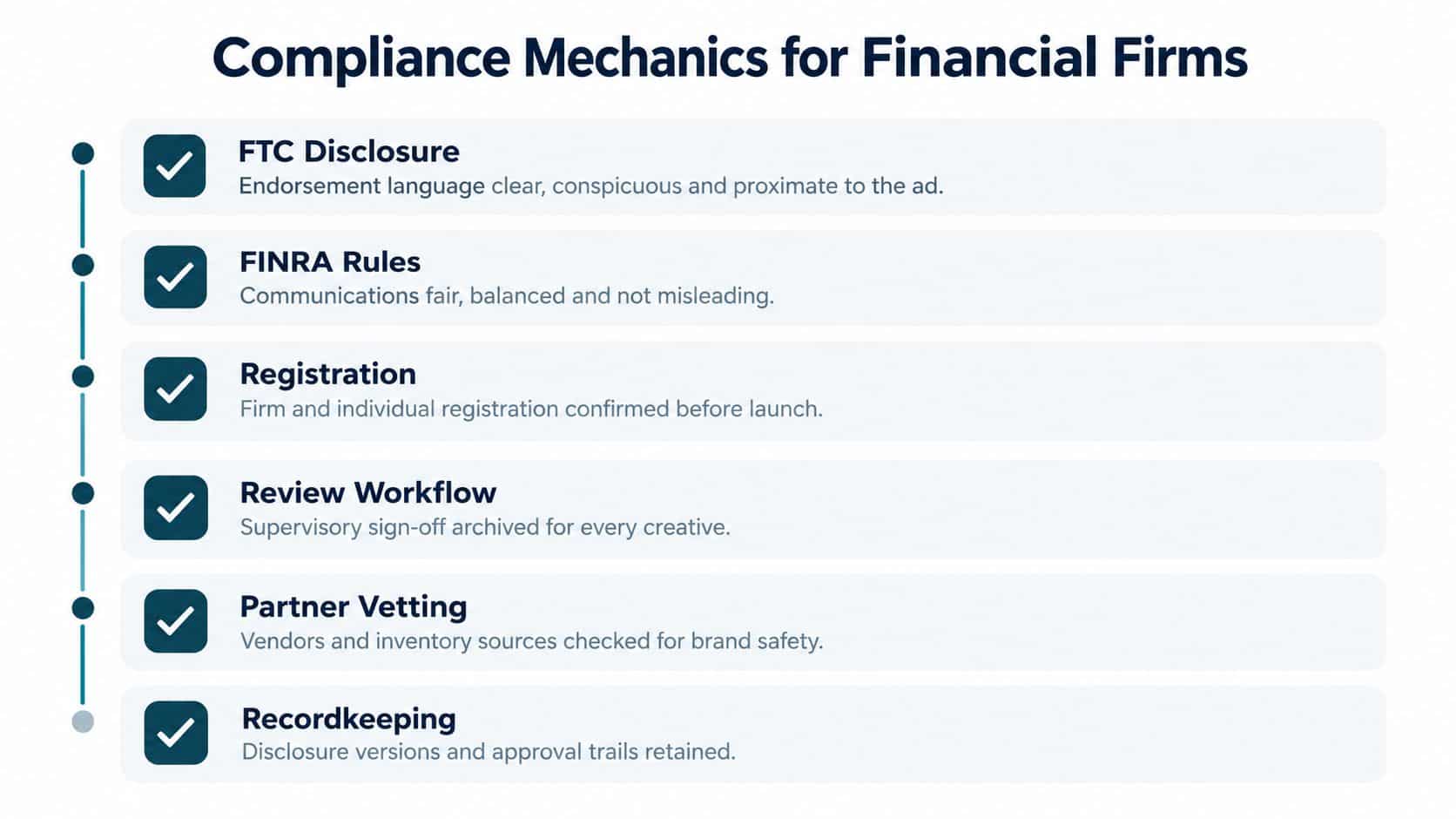
The Federal Trade Commission's native advertising guidance requires advertising to be identified as advertising rather than presented as independent editorial content. Disclosures should be clear, prominent, close to the ad, and easy to read. For video, the disclosure must stay visible long enough for viewers to notice and understand it. The advertiser is responsible for identification at the teaser or placement level, not only on the landing page.
A workable review stack
Start with the claim. Review the headline, description, image, sponsor name, call to action, and landing page as one connected message. A restrained headline can become misleading when paired with a dramatic image or an unsupported outcome.
Review every variant. Native systems may assemble different combinations of approved assets. One approved preview does not cover every possible headline and image pairing. Archive the approved combinations, define the permitted claim set, and restrict delivery to those combinations.
Build in financial firm supervision. Member firms should route communications through their existing supervisory process before launch. RIAs and banks also need to apply their own policies, registration status, state obligations, and recordkeeping procedures. The reviewer should confirm who approved each asset, which audience received it, and where the final record is stored.
Test the rendered unit. A disclosure that looks clear in a desktop preview may become tiny, truncated, or displaced in a mobile feed. Check the rendered creative across in-feed placements, recommendation modules, and applications before meaningful spend begins.
Technical requirements also affect approval. In native advanced implementations, the ad attribution badge is required, and placement specifications can govern badge size, minimum asset dimensions, and video rendering. Confirm the current native ad implementation requirements for each buying environment before creative production, rather than assuming one specification works everywhere.
A financial firm can document its compliance marketing workflow using resources such as compliance marketing guidance for advisory firms. Internal control remains the deciding factor. Disclosures must travel with the native asset structure, appear correctly in the publisher's actual rendering environment, and remain attached to the approval record. That evidence gives compliance teams a usable audit trail when a campaign changes after launch.
Hidden Risks in Programmatic Native Supply
A financial firm can approve a native campaign, meet its disclosure requirements, and still lose control of where the ad appears. Supply quality remains the central bottleneck because available inventory is not the same as inventory a buyer can verify and trust.
Many publishers offer native placements, but programmatic access may be limited. Buyers can also face weak mobile execution and uncertainty about how publisher-direct sales connect with programmatic demand. Industry reporting on the scale challenge in programmatic native describes the gap between theoretical availability and inventory buyers can evaluate with confidence.
The supply path can hide the placement
An advertiser may know the exchange or buying route without knowing the exact page where the unit appeared. Inventory can pass through several intermediaries, while domains may be represented inaccurately or resold with limited transparency. Made-for-advertising sites and domain spoofing create added risk for banks and advisory firms. A cheap impression is still expensive if the surrounding page damages credibility.
Before launch, request:
- Domain-level reporting: Reports should identify the publisher and placement, not only a broad exchange category.
- Supply-path visibility: The agency or DSP should identify the intermediaries involved in the impression.
- Suitability controls: Use allowlists, exclusion categories, and human review for sensitive environments.
- Mobile QA: Confirm that the sponsor label, image, and call to action remain readable on small screens.
A second risk appears after the supply path is documented: the bid request may still carry incomplete privacy signals.
Privacy adds a native-specific control layer
Native advertising is not automatically privacy-safe. Firms using first-party advisor or client audience lists still need a lawful basis, appropriate consent handling, contractual controls, and clear data governance. Rules such as GDPR, CCPA, and state data-broker requirements can affect audience activation, matching, suppression, and retention.
For native campaigns, audit whether publishers pass consent signals in the OpenRTB bid request. Confirm that the DSP suppresses audiences without documented consent before bidding, and retain evidence of that configuration. Contextual signals, first-party data, and engagement measures such as time on page, scroll depth, and post-click navigation can support optimization without relying as heavily on cross-site identifiers. An explanation of privacy-constrained programmatic native advertising highlights these deeper engagement signals.
Those signals do not replace governance. A single unsuitable placement or unauthorized audience use can create regulatory and reputational exposure far beyond the media spend. For a regulated advertiser, supply-path records, consent evidence, and placement reviews belong in the campaign file before performance results are judged.
Building a Programmatic Native Campaign That Works
A regulated campaign should be built in controlled stages. The team should narrow risk first, then expand only after the creative, supply, and approval process performs as expected.
Define the audience and inventory
Begin with the business outcome. An RIA seeking consultation requests may target readers engaging with retirement or planning content. A bank may prioritize awareness around a financial product. A wealth platform may need educational engagement before asking for an application.
Use compliant first-party data and carefully governed lookalike modeling where appropriate. Avoid overly narrow retargeting that depends on sensitive assumptions or unexplained audience expansion. Then select vetted publishers, private marketplaces, and curated deals that provide enough contextual relevance and placement visibility.
Build assets for assembly
Native ads don't arrive as one finished banner. The team should prepare separate fields for:
- Headline: Write a concise insight that can survive truncation.
- Image: Use an image that supports the subject without implying guaranteed outcomes.
- Description: Add useful context rather than repeating the headline.
- Sponsor identity: Make the firm name and commercial relationship clear.
- Call to action: Match the action to the reader's likely intent.
A headline that works as a complete sentence may lose meaning when a publisher shortens it. Each field should remain accurate on its own and in combination with the other approved fields.

Align the landing page and disclosure
The landing page should continue the ad's promise. A unit about retirement income should lead to retirement income content, not a generic lead form with no explanation. On mobile, the disclosure and the essential qualification language should appear before the user has to work through the page.
Disclosure design belongs in the build, not at the end. The sponsor label needs to remain legible in the publisher's font size and position, and the team should confirm that the label appears on the teaser, not only on the destination page.
A useful launch sequence is:
- Start narrow: Use a limited group of vetted placements and approved assets.
- Run compliance QA: Review live renders, not only platform previews.
- Expand supply: Add publishers after the first group passes quality and disclosure checks.
- Optimize for depth: Examine engaged visits, scroll depth, form starts, and qualified lead quality.
- Change one lever at a time: Adjust supply, creative, audience, or landing page alignment so the team can identify the cause of improvement or decline.
Teams evaluating broader financial acquisition programs can also review full funnel paid media for community banks for a related view of connecting awareness activity with downstream conversion.
When performance lags, the first question shouldn't be whether the bid is too low. The team should inspect placement quality, message match, disclosure visibility, page speed, form friction, and lead qualification. Increasing volume before fixing those issues usually creates more expensive noise.
Key Takeaways for Financial Marketing Leaders
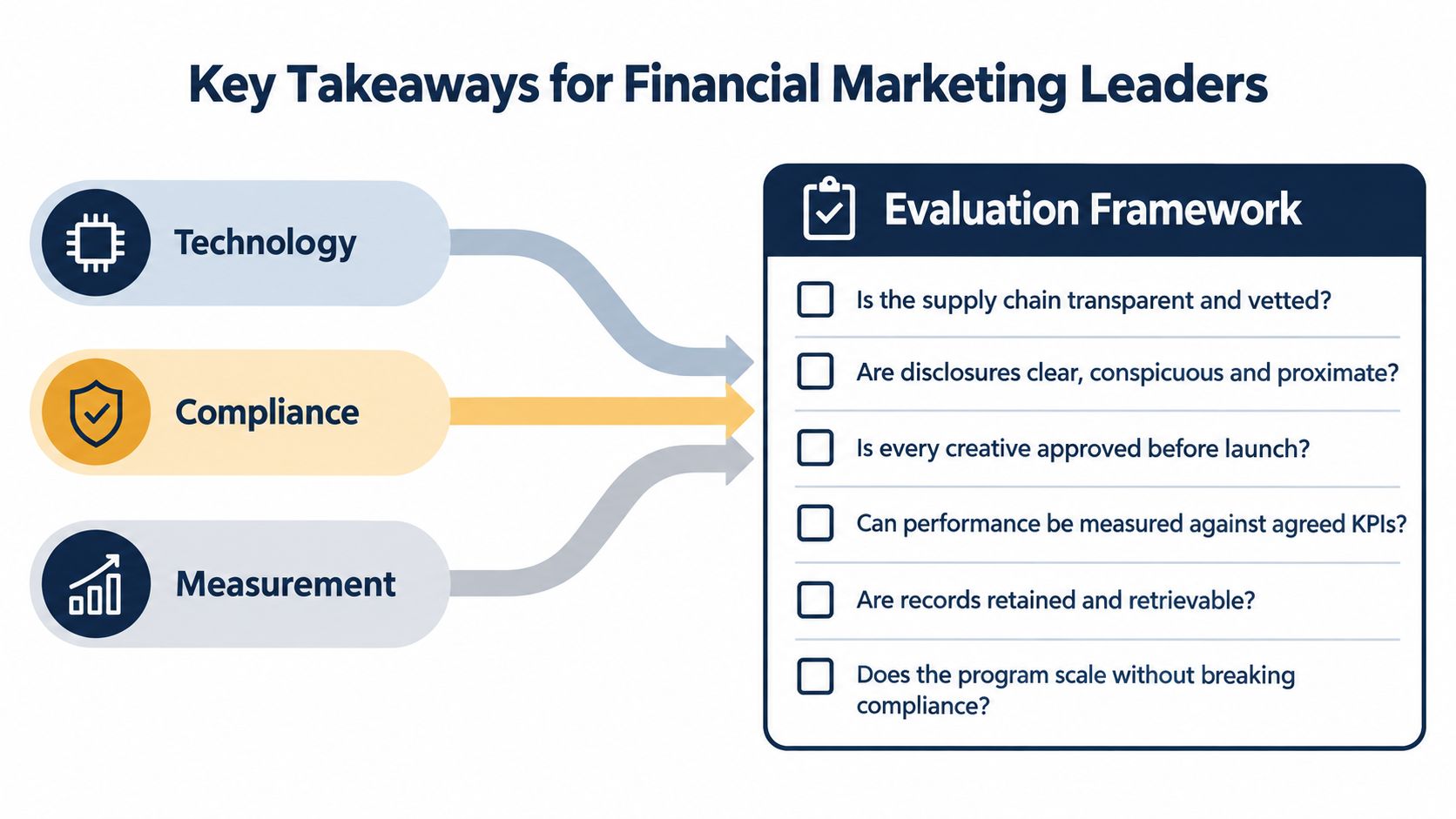
Programmatic native advertising works for financial firms only when technology, compliance, and measurement operate as one system. A technically efficient buying pipe can't rescue weak supply. A compliant label can't rescue a misleading headline. A strong engagement rate can't justify leads that sales or advisors can't use.
A proposal deserves direct questions before approval:
- Is the supply chain transparent? The buyer should receive publisher and placement reporting, along with a clear explanation of intermediaries.
- Does the disclosure render at the publisher level? A label in a creative preview isn't enough if the live template makes it unreadable.
- Does review cover every variant? Headlines, images, descriptions, sponsor names, calls to action, and landing pages should be approved as actual combinations.
- Do the claims match the destination? The landing page should support the ad's promise and carry consistent disclosures.
- Are the KPIs meaningful? Engagement depth, form starts, qualified leads, and post-click quality should matter more than impressions alone.
- Can the records be retrieved? Approval trails, disclosure versions, placement reports, and optimization decisions should remain accessible.
Privacy constraints make the measurement question more important. Recent reporting describes programmatic native as increasingly tied to contextual targeting, first-party data, and deeper engagement signals rather than unrestricted behavioral tracking. That shift should push financial marketers toward cleaner experiments, documented consent practices, and outcome definitions that sales and compliance teams both understand.
The practitioner verdict is straightforward: programmatic native is worth the overhead when a financial firm has a useful story, vetted supply, and compliance controls designed before launch.
Advisor Momentum helps financial advisors, RIAs, wealth managers, and banking teams connect compliance-ready content, programmatic advertising, conversion-focused websites, and lead-generation strategy. Visit Advisor Momentum to discuss a financial marketing program built around credible messaging, supervised execution, and qualified client growth.
