
96% of Americans research a financial advisor online before making a hiring decision, according to a 2026 survey of advisor selection behavior (Wealthtender). That finding changes the role of search visibility. A referral may open the door, but the prospect often decides whether to walk through it after reviewing a firm's website, reputation, specialties, and public claims.
For registered investment advisers, search optimization can't be separated from advertising compliance. A page designed to rank in traditional search may also be read by an answer engine, extracted into an AI-generated response, or reviewed by a regulator as an advertisement. Effective SEO for financial advisors therefore requires two disciplines at once: content must be clear enough for search systems to understand and controlled enough for compliance teams to approve.
Table of Contents
- Why Search Visibility Defines the Modern Advisory Practice
- Keyword Research That Captures High-Intent Advisory Queries
- On-Page and Technical SEO for AI-Ready Content
- Local Search and Reputation Building Under SEC Rules
- Content Governance and the SEC Marketing Rule
- Measuring SEO ROI in a Regulated Environment
- Building Your Compliance-First SEO Stack
Why Search Visibility Defines the Modern Advisory Practice
A referred prospect may still cross-check an advisory firm's website, reviews, credentials, specialties, and public claims before returning the call. The same 2026 survey found that 97% plan to interview multiple advisors, while 83% want to investigate reputation through online reviews and awards, 72% want to visit an advisor's website, and 64% want to understand areas of specialization before contacting a firm (Wealthtender). The website has become part of the selection process, not merely a digital brochure.
Search engines support that validation. 49.8% of respondents said they use search engines such as Google or Bing to find a financial advisor, compared with 62.0% who use referrals from friends or family. Search visibility does not replace trust transferred through a referral. It helps a prospect assess whether the referred firm appears capable, relevant, transparent, and suited to their circumstances.

Search is part of the trust decision
A firm can rank for a broad service term and still lose the prospect. Vague copy, hidden specialties, unclear fees or process, and unsupported claims make a weak impression once visibility brings more visitors to the page.
Treat every important page as a trust signal with a search function. A retirement planning page should identify its audience, explain the advisory process in plain language, present relevant credentials, and offer a sensible next step. A local profile should match the firm's actual identity and location. An educational article should answer a genuine client question without promising investment outcomes.
The advisory market continues to expand. SEC Investment Adviser Statistics report 16,544 investment advisers in 2025, while the number of clients served increased by 7.7% to 73.7 million (SEC investment adviser statistics). More firms and a larger client base increase competition for searches involving retirement planning, fiduciary advice, wealth management, and fee-only services.
Practical rule: Search traffic matters only when the page helps a qualified prospect decide whether the firm deserves a conversation.
AI answer engines add a compliance consideration. Prospects ask conversational systems for advisor recommendations, explanations of fiduciary relationships, and comparisons among service models. Content built with clear questions, direct answers, structured facts, and consistent firm information gives answer engines material they can interpret. It also gives compliance reviewers a defined set of claims to evaluate under the SEC Marketing Rule. Traditional rankings still matter, but legibility to answer engines now forms part of discoverability.
Keyword Research That Captures High-Intent Advisory Queries
Broad terms such as “financial advisor” or “wealth management” describe a category, not a buying situation. They may attract attention, but they rarely tell a firm which audience, problem, location, or readiness level sits behind the search.
High-intent research starts with the questions prospects ask before a consultation. The phrase “how to roll over a 401(k) after a job change” reflects a problem. “Fee-only retirement advisor near me” adds a service model and local intent. “Fiduciary for small business owners” identifies a target audience and a relationship expectation. These phrases provide better editorial direction than a generic keyword list.

Start with client language
Ask advisors, client service staff, and business development teams to collect recurring questions from meetings and intake forms. Group them by:
- Life stage: retirement transition, inheritance, career change, business sale, or accumulating wealth.
- Audience: physicians, executives, business owners, families, or retirees.
- Service: financial planning, investment management, tax-aware planning, or retirement income planning.
- Location: city, metropolitan area, state, or a clearly defined service region.
- Decision concern: fees, fiduciary status, investment philosophy, minimums, communication, or onboarding.
The resulting themes become keyword clusters, not isolated phrases. A retirement income cluster might include questions about withdrawal planning, Social Security coordination, portfolio risk, and advisor selection. Each page should have one primary purpose, while related pages link together to demonstrate depth.
Separate education from selection
Informational queries answer a question. Commercial queries help a prospect compare options. Navigational queries seek a specific firm or advisor. Each intent deserves a different page experience.
An educational article should explain a topic carefully and identify when professional guidance may be appropriate. A service page should state who the firm serves, what the engagement includes, and how the process works. A comparison page must avoid unsupported superiority claims and explain meaningful differences without implying that one approach suits everyone.
Make questions usable for answer engines
AI systems favor content they can interpret without guessing. Write the question as a subheading, answer it directly in the opening paragraph, then provide qualifications and context. For example, a page about fiduciary advice can define the term, explain how the firm applies it, and distinguish the firm's stated process from broader industry assumptions.
Keyword research should also include the questions people ask conversationally. Search behavior may use fragments, while answer engines receive complete prompts. A content plan that captures both forms can serve traditional rankings and AI-generated shortlists without stuffing phrases into awkward copy.
Compliance limits the temptation to chase every attractive query. A firm shouldn't create a page around a claim it can't substantiate, a performance promise it can't fairly present, or a specialty it doesn't serve. The most valuable keyword is the one that matches the firm's real capability and a prospect's real decision.
On-Page and Technical SEO for AI-Ready Content
AI-ready content isn't mysterious. It's organized, explicit, and easy for a human reviewer to verify. Traditional search systems and answer engines both benefit when a page clearly identifies its subject, audience, author, firm, and purpose.
Begin with the page title and primary heading. They should describe the service or question in language a prospect recognizes. The opening paragraph should answer the central question rather than delay the useful information behind a brand introduction. Subsequent headings can cover eligibility, process, fees, limitations, and next steps.
Structure pages for extraction
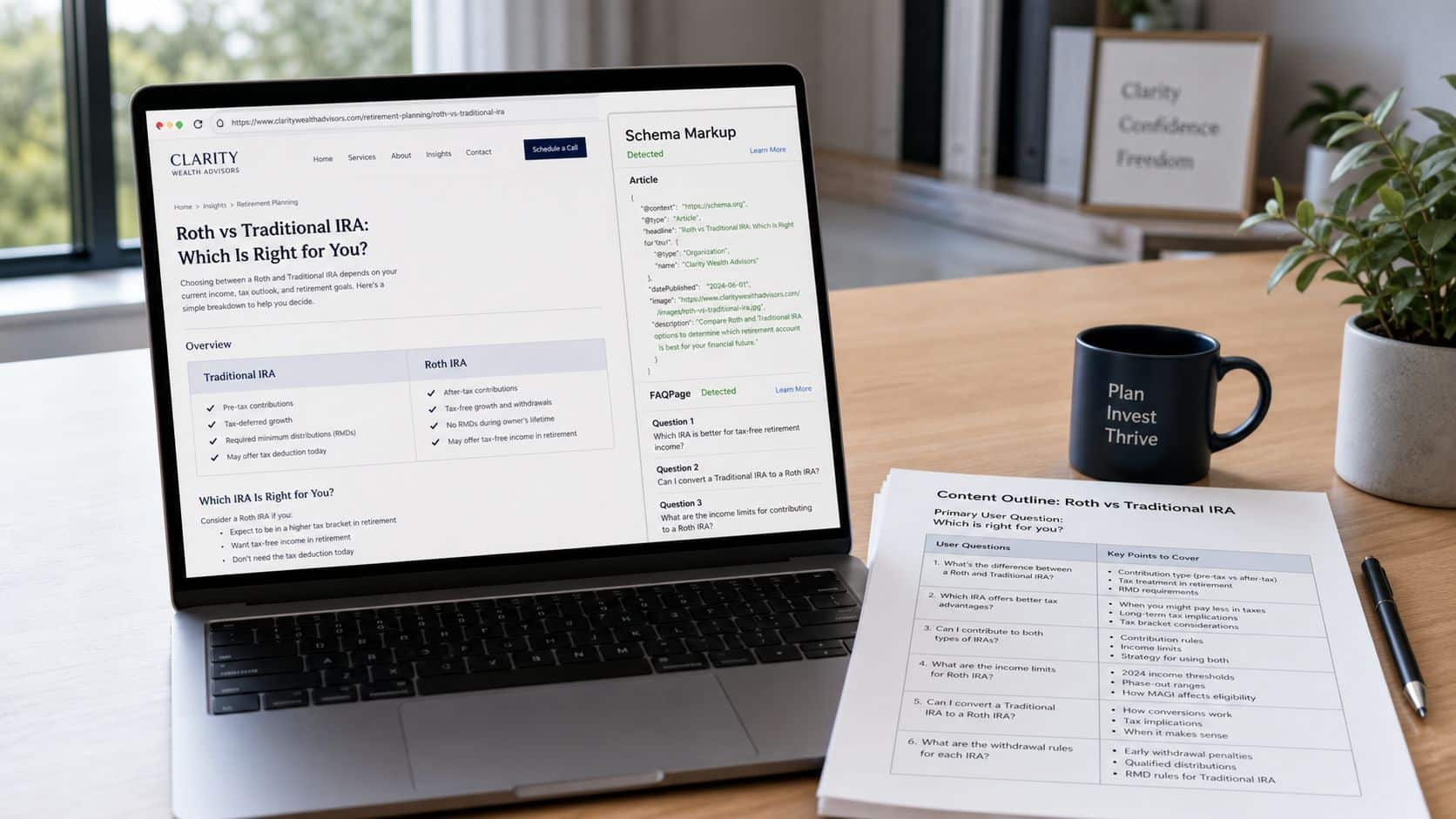
FAQ content works best when each question has a complete answer. Avoid answers that depend on a previous paragraph or use vague references such as “this strategy.” An answer engine should be able to extract the response while preserving the firm's intended meaning.
Useful page elements include:
- Service definitions: State what the firm does and who the service is designed for.
- Advisor identity: Present credentials, roles, areas of practice, and relevant disclosures consistently.
- Process explanations: Describe discovery, analysis, recommendations, implementation, and ongoing communication without implying guaranteed outcomes.
- Structured data: Use appropriate schema for eligible page types, organization details, people, services, and FAQs, subject to technical and compliance review.
- Internal links: Connect educational questions to relevant service pages and contact paths.
Structured data won't make an unsupported claim acceptable. It only makes existing information more machine-readable. The visible page still needs to match the markup, and the firm should maintain a review record for material statements.
Fix the technical foundation
A technically weak website creates friction before content earns trust. Pages should work on mobile devices, use secure connections, load efficiently, and provide a logical navigation path. Broken links, duplicate pages, inaccessible content, and confusing redirects can prevent both users and crawlers from understanding the site.
Internal linking should follow the prospect's decision path. An article about retirement income can link to a retirement planning service page, an advisor biography, and a contact page. That structure helps a person continue researching while showing search systems how topics relate.
Firms that need deeper support can review technical SEO services as a reference point for audits, crawlability, performance, and site architecture. The provider matters less than the operating discipline: every technical recommendation should be documented, prioritized, tested, and reviewed for its effect on public claims and user experience.
Local Search and Reputation Building Under SEC Rules
For many advisory firms, local visibility is more commercially useful than a national ranking for a broad term. A prospect searching for a fiduciary planner in a specific area has already supplied context about location and likely intent. That makes the firm's local profile, website location pages, and reputation signals central to the conversion path.
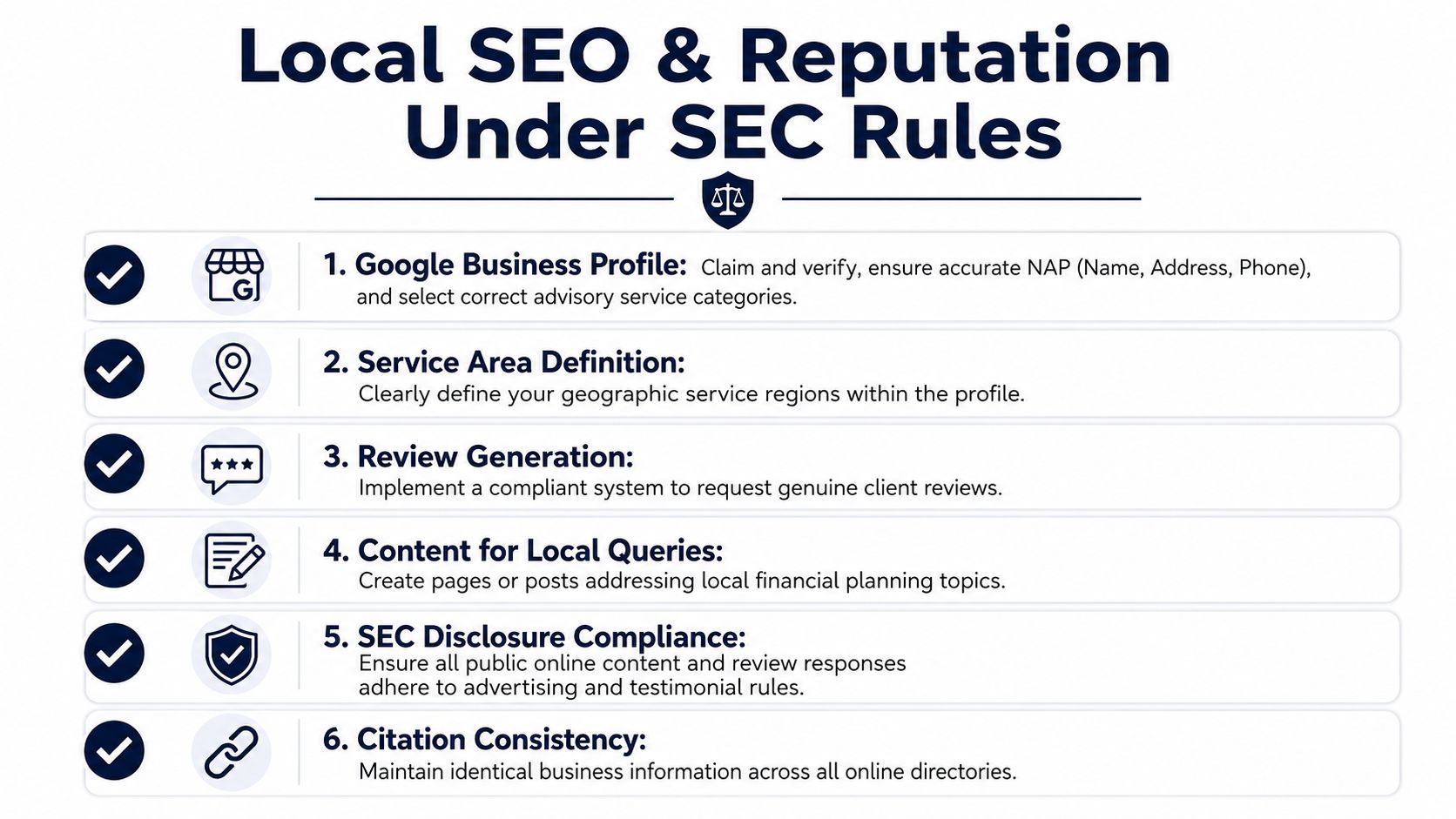
A complete business profile should use the firm's accurate name, address, phone number, website, categories, service descriptions, hours, and geographic coverage. The same information should appear consistently across relevant directories and professional profiles. A firm with multiple offices should create distinct location experiences only when each location represents a genuine, supportable business presence.
Treat reviews as regulated marketing content
Reviews deserve more care than a simple request for positive feedback. The SEC Marketing Rule applies to advertising by investment advisers, and the SEC identifies testimonials, endorsements, and third-party ratings as areas of marketing scrutiny (SEC investment adviser marketing guidance). A public review may be written by a client, but the firm's solicitation, display, response, or reuse can create compliance considerations.
A defensible review workflow should include:
- Neutral requests: Invite genuine feedback without directing clients toward favorable wording or promising an incentive.
- Review monitoring: Preserve the relevant review, date, platform, request language, and firm response.
- Response controls: Avoid discussing client circumstances, outcomes, performance, or confidential details in public replies.
- Disclosure review: Assess whether compensation, conflicts, relationship status, or rating methodology requires disclosure.
- Removal decisions: Escalate misleading, confidential, or otherwise problematic content according to documented policy.
A firm shouldn't copy a review from one platform to its website without checking whether the presentation changes its regulatory meaning. Awards and ratings need similar care. The marketing team should retain the basis for the recognition, the period covered, eligibility criteria, payment disclosures, and the exact wording used publicly.
For advisors refining their local profile, this guide to improving a listing on Google offers a practical local-search reference. Local content can address topics such as retirement planning in the firm's service area, but geographic relevance must reflect where the practice operates and serves clients.
Content Governance and the SEC Marketing Rule
Many advisory firms mistakenly treat blog posts as purely educational content, outside the scope of advertising review. The SEC Marketing Rule, Rule 206(4)-1, applies to an investment adviser registered or required to be registered with the SEC that directly or indirectly disseminates an advertisement. The rule, related books and records requirements, and Form ADV amendments became effective on May 4, 2021, with a compliance date of November 4, 2022, as described in the SEC investment adviser marketing guidance.
A service page clearly promotes an advisory offering. A blog article may also function as advertising if it directs prospects toward that offering. Title tags, landing-page copy, FAQs, biographies, lead forms, and educational articles should therefore be classified by purpose and context, not format alone. That classification matters for both traditional SEO and AI answer-engine optimization, because concise claims may be extracted from pages and repeated without the surrounding qualification.
Substantiate before optimizing
Advertisements cannot include untrue statements of material fact, omit information that makes a statement misleading, present factual claims that cannot reasonably be substantiated, or describe benefits without fair and balanced disclosure of risks and limitations, according to the InvestmentNews Marketing Rule compliance guide.
A practical substantiation file should record:
- The claim: The exact sentence, headline, metadata, or structured-data statement.
- The evidence: The internal record, policy, credential, methodology, or third-party basis supporting it.
- The reviewer: The person responsible for compliance approval.
- The version: The page copy, publication date, and later revisions.
- The limitation: The qualification or risk disclosure needed for fair presentation.
Optimize only after the claim is defensible. A target keyword should not force language such as “best advisor” or “guaranteed retirement income” when the firm cannot support it. For AEO and GEO, put the supportable answer in plain language, then keep relevant limitations close enough that both readers and answer systems receive the intended context.
Handle performance language with discipline
Performance content carries additional requirements. When an advertisement presents gross performance, net performance must receive equal prominence, and SEC staff issued further guidance on model fee net performance calculations in January 2026 (McGuireWoods analysis of the SEC FAQs). A page focused on returns, portfolio outcomes, or strategy comparisons can trigger these rules even when it resembles a general educational article.
Use a documented workflow so compliance review does not become a late-stage bottleneck. Editorial staff can draft, SEO staff can assess structure and search intent, and compliance reviewers can evaluate claims, disclosures, testimonials, endorsements, and performance language before publication. The SEC compliance guide for RIAs provides another reference for coordinating these requirements with counsel and the firm's compliance program. Teams can also consult financial services content marketing for operational planning, while applying the firm's own approval standards to every asset.
Measuring SEO ROI in a Regulated Environment
SEO reporting fails when it stops at impressions, rankings, or sessions. Those measures can show visibility, but an advisory firm needs to know whether search is producing relevant conversations and whether those conversations progress through a controlled intake process.
The measurement model should connect four layers:
- Discovery: Organic visits, branded searches, local profile actions, and assisted interactions.
- Engagement: Visits to service pages, advisor biographies, fee explanations, and contact paths.
- Qualification: Consultation requests that meet the firm's audience, location, service, and asset-fit criteria.
- Business outcome: Opportunities that progress through the firm's documented sales process and become clients where the firm can reliably attribute the source.
AI answer engines complicate direct attribution because a prospect may encounter a firm in an answer, search the name separately, and arrive through a branded query. Intake forms and consultation conversations should therefore ask how the prospect first heard about the firm, while analytics records the immediate source. The two signals answer different questions and shouldn't be collapsed into one number.
| Metric Type | Example | Business Value | Compliance Note |
|---|---|---|---|
| Visibility | Non-branded search impressions and local profile discovery | Shows whether target audiences can find the firm | Preserve reporting periods and definitions |
| Engagement | Visits to service, process, and advisor pages | Indicates whether prospects are researching fit | Avoid treating time or page depth as proof of intent |
| Qualified demand | Consultation requests matching the firm's target profile | Connects organic activity to sales capacity | Record qualification criteria consistently |
| Pipeline progression | Opportunities attributed or assisted by organic search | Shows whether search contributes beyond the first visit | Protect personal information and restrict access |
| Client acquisition | New relationships linked to search-assisted journeys | Supports channel allocation decisions | Document attribution method and limitations |
A compliance-aware dashboard should retain the methodology behind each metric, not just the result. If a firm changes form fields, tracking consent, intake questions, or qualification definitions, the reporting record should show that change. That documentation helps partners evaluate budget decisions and gives compliance personnel a clearer record of how marketing performance is represented.
Measurement principle: A qualified conversation is more useful than a large traffic number, but neither should be presented without the method used to define it.
Building Your Compliance-First SEO Stack
A practical stack has four layers: keyword research, technical auditing, content production, and measurement. The firm can manage question collection and initial content briefs internally, while technical remediation, schema implementation, and attribution design may require specialist support.
The governance layer should include:
- A claim register with evidence and approval status.
- A page inventory identifying advertisements and review dates.
- A version archive for published copy, disclosures, and material edits.
- A review workflow assigning ownership to marketing, subject-matter, and compliance staff.
- A reporting dictionary defining every SEO and pipeline metric.
A 90-day rollout should begin with the highest-value service and location pages, then address technical barriers, build question-led content, and establish reporting before expanding publication. Vendor contracts should define approval responsibilities, substantiation standards, access controls, ownership of analytics, and procedures for correcting published content. Advisor Momentum offers compliance-aware website, content, SEO, AEO, and GEO support for financial professionals, which can be evaluated alongside an internal team or other specialist arrangements.
Advisor Momentum helps financial advisors build compliance-ready websites and coordinated SEO, AEO, and GEO programs that turn search visibility into clearer prospect journeys. Visit Advisor Momentum to discuss a search strategy built around regulated content governance, local reputation, and measurable advisory growth.
