

Geo targeting is the practice of delivering ads, content, or website experiences to people based on geographic location, from country or region down to city, ZIP code, or DMA, using signals like IP, GPS, and Maps behavior. Google Ads supports location targeting at these broad and local levels, while a 2026 industry analysis reported that advertisers spent at least $57 billion on location-targeted campaigns in 2025, showing how central the practice has become.
A financial advisor can understand the appeal quickly. A firm may serve clients in only a few states, operate branches in selected markets, or need separate disclosures for different jurisdictions. Yet a broadly distributed campaign can reach people the firm can't lawfully serve, prospects outside its operating footprint, or audiences who generate attention without creating a viable business opportunity.
For regulated firms, the question isn't how to reach more people. It's how to choose the markets where the firm can provide advice, control distribution, protect marketing spend, and document the reasoning behind each campaign. That makes geo targeting less like a clever advertising feature and more like a market-selection and risk-management process.
Table of Contents
- A Familiar Moment for Any Growing Advisory Firm
- What Geo Targeting Actually Means in Plain English
- How the Main Geo Targeting Methods Differ
- Why Geo Targeting Matters for Advisors and Banks
- Compliance and Privacy Rules That Reshape the Tactic
- Where Geo Targeting Shows Up in Practice
- Measuring Whether Geo Targeting Actually Worked
- Smart Next Steps for Your Firm
A Familiar Moment for Any Growing Advisory Firm
A mid-sized registered investment advisor headquartered in Ohio has begun serving clients in Kentucky and Indiana. The firm has invested in a new website, refreshed its messaging, and launched Google Ads to support the expansion. The marketing lead expects search activity to build across the three-state footprint.
Instead, a warning appears in the advertising account. Ads associated with several states have been disapproved. The firm now has to determine whether the problem involves location settings, financial-services policy, licensing boundaries, or the wording on the landing page. The immediate temptation is to broaden delivery and sort out the details later, but that approach creates more exposure, not less.
The advisor's operating reality has changed. National visibility may look attractive in a report, but impressions from states where the firm can't provide services don't represent useful reach. They can create review work, consume budget, and send prospects into a sales process that ends before a compliant conversation can begin.
Three questions now sit beside the growth target:
- Where is the firm authorized to operate? State registrations and service capacity should define the initial market.
- Where can the firm support new relationships? A licensed state may still be a poor target if the team lacks onboarding or service capacity.
- Where should the message be excluded? Exclusions matter when location signals are uncertain or a campaign includes markets under review.
Practical rule: A campaign shouldn't target a market merely because the platform makes that market available. The firm should first establish that it can serve the audience and support the message.
The tension is familiar across advisory and banking organizations. Growth teams want visibility, while compliance and operations teams need jurisdictional control. The central question follows naturally: how can a regulated firm control where its message appears, and what practice makes that control possible?
What Geo Targeting Actually Means in Plain English
Geo targeting means choosing who sees an ad, content, or website experience based on a geographic location signal. The selected area can be broad, such as a country or region, or more specific, such as a city, ZIP code, DMA, or radius around a location.
A useful analogy is postage. A national campaign is like preparing one mailing for an entire country. Regional targeting narrows the postage zone to selected states or provinces. City and ZIP targeting move the delivery boundary closer to the neighborhoods a business serves. Radius targeting acts like dropping a delivery pin around a branch, event, or other physical location.
The platform doesn't necessarily know a person's exact address. It may infer location from a network address, device data, location settings, search activity, Maps behavior, past searches, or past physical locations. Google Ads describes geographic delivery as reaching people who are in, regularly in, or interested in a selected location, using multiple signals rather than one permanent coordinate (Google Ads geographic targeting documentation).
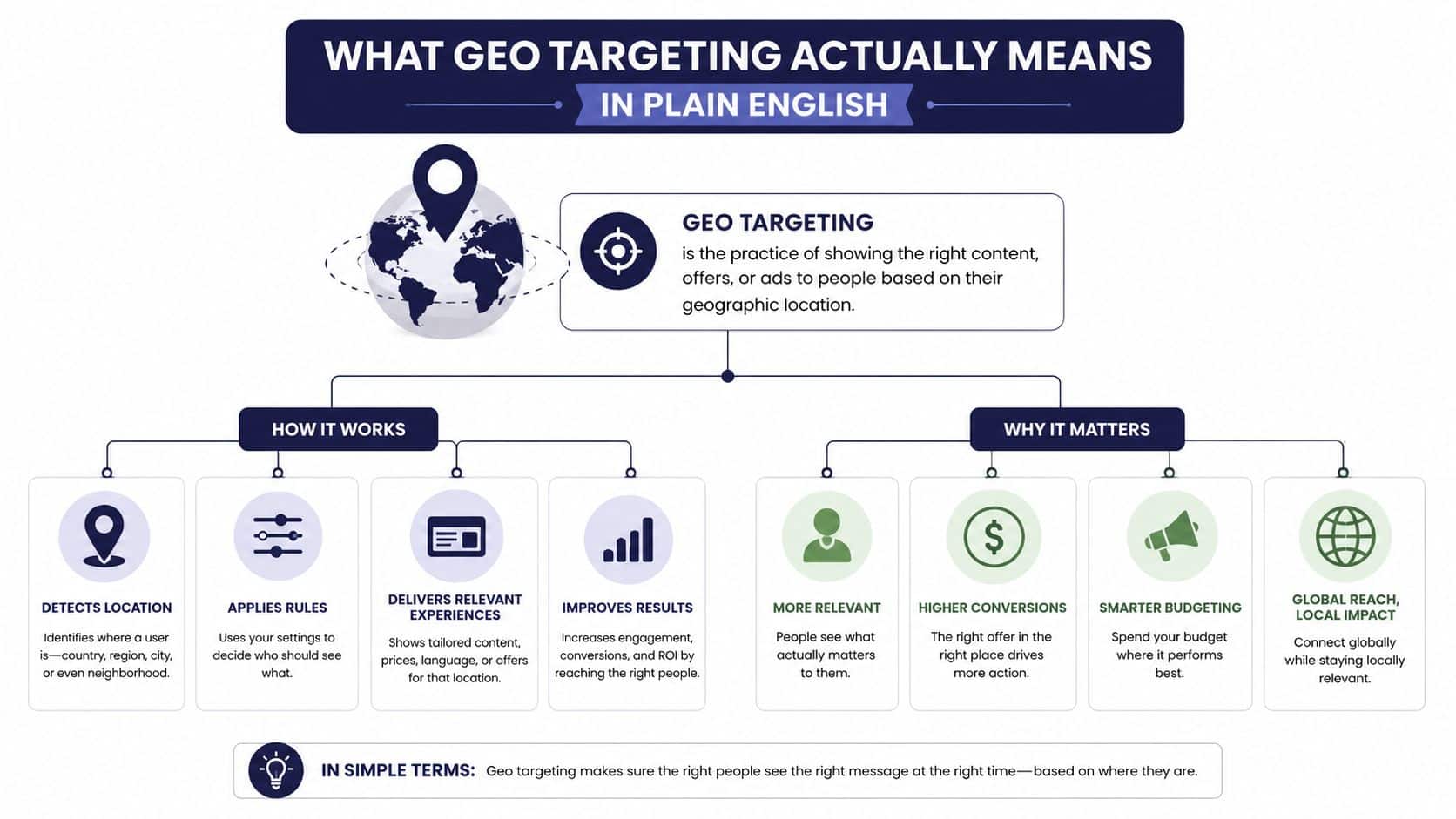
That hierarchy creates an important distinction between market selection and moment-based proximity. Geo targeting usually works at a broader geographic level, such as a state, city, ZIP code, or DMA. Proximity targeting narrows the focus to a smaller area around a store, event, or venue. Geofencing goes further by using a defined virtual boundary and a trigger associated with entering or leaving it.
An advisory firm can use geo targeting to select Kentucky and Indiana as growth markets without trying to identify every person standing near an office. A bank can select a metropolitan area for brand exposure without turning every branch into a separate trigger campaign.
Readers who want a practical framework for deciding which audiences should receive different experiences can review who to show your A B test, especially when location is one audience attribute among several. For advisors and banks, the point isn't novelty. Geo targeting is a way to control market coverage and manage reach within real operating and compliance boundaries.
How the Main Geo Targeting Methods Differ
Different location signals answer different business questions. A national bank may need dependable regional reach, while an advisory firm may need to concentrate spend in a limited set of ZIP codes. Treating every method as equally precise creates false confidence.
IP-based targeting uses the registered location associated with an internet connection. It often works well for country or broad regional delivery, particularly on desktop and fixed networks. It becomes less dependable for city-level decisions when mobile carrier routing, VPNs, corporate networks, or shared connections obscure the user's actual location.
GPS-based targeting relies on device coordinates. It can be highly accurate when a person has granted permission and the device can provide a useful signal, but availability depends on user settings and the mobile environment. It works most naturally in mobile applications and permission-based experiences, not as a universal source of truth.
DMA targeting uses designated television market areas. These markets fit broadcast, connected-TV, and broad brand campaigns because they reflect established media planning boundaries. DMA targeting can provide useful scale for a regional bank or wealth manager, but it isn't designed to identify an individual branch visitor or a tightly bounded neighborhood.
ZIP code targeting offers a more granular standard option. It can help an advisory firm align campaigns with service territories and local search demand, but platform rules can restrict its use in regulated categories. Google Ads states that ZIP code location targeting can't be used for Housing, Employment, and Consumer Finance ads in the United States and Canada, although radius, city, and country targeting remain available under its policy (Google Ads personalized advertising policy).
| Method | Precision | Best Use Case | Primary Limitation |
|---|---|---|---|
| IP-based | Broad regional | Country, state, or regional delivery | Mobile routing, VPNs, and shared networks can distort location |
| GPS-based | Potentially fine | Permissioned mobile and app experiences | Requires access and user permission |
| DMA | Market-level | Broadcast, CTV, and regional brand campaigns | Too broad for branch-level decisions |
| ZIP code | Local market | Service-area planning and local search campaigns | Regulatory and platform restrictions may apply |
A firm evaluating personalization should also consider how location combines with other audience signals, rather than treating geography as the whole profile. A general discussion of AI-driven growth with SupportGPT can help marketing teams think about personalization logic while keeping compliance review separate from automated delivery decisions.
Why Geo Targeting Matters for Advisors and Banks
An RIA doesn't need nationwide attention if its registration, staffing, and service model cover only selected states. Geo targeting lets the firm concentrate media in markets where it can hold discovery calls, onboard clients, and deliver ongoing service.
That focus can improve lead quality even when it doesn't guarantee better performance. A click from an in-territory prospect has a clearer path to a compliant conversation than a click from someone in a state the firm can't serve. The tactic also gives marketing and compliance teams a shared operating language. Instead of debating whether a campaign feels national, they can review selected states, cities, ZIP codes, exclusions, landing pages, and documented service boundaries.
For a bank with multiple branches, geographic planning can support a different kind of decision. A regional team may compare demand across metropolitan areas before adding a branch, expanding a wealth-management offering, or assigning additional advisor capacity. A firm can test a city as a market without immediately treating that city as a permanent investment.
Geo targeting doesn't make a firm local. It helps the firm decide where local investment is justified.
The limits matter just as much as the advantages. Location signals can be imprecise, mobile users move, and VPNs or shared-office networks can place an ad in front of someone who isn't physically where the platform believes they are. A person may search for an advisor while traveling, express interest in a location without living there, or use a device whose settings don't support reliable geographic inference.
That uncertainty means a campaign shouldn't use location as the only qualification signal. The firm should combine geographic settings with service eligibility, campaign exclusions, form fields, disclosure language, and human review. A location setting can reduce unnecessary distribution, but it can't determine licensing eligibility by itself.
Marketing teams evaluating local visibility can also review this guide to improving a firm's Google listing. The broader lesson is strategic: geo targeting is risk-managed reach, not a promise of perfect precision or automatic conversion efficiency.
Compliance and Privacy Rules That Reshape the Tactic
Compliance changes the question from “How narrow can the audience become?” to “Which geographic controls can the firm use lawfully and defensibly?” That distinction is especially important for consumer finance advertising, where platform policy can remove settings that appear available in other categories.
Google Ads policy prohibits ZIP code location targeting for Housing, Employment, and Consumer Finance ads in the United States and Canada. The policy permits radius, city, and country targeting, but radius targeting must begin at least 1 km from the selected location (Google Ads personalized advertising policy). Separate Google Ads geographic-targeting rules also state that radius targeting can't be set below 1 km, and campaigns must meet minimum area and user-count thresholds (Google Ads geographic targeting requirements).
That creates a practical planning constraint. A consumer finance campaign may need broad market settings rather than ZIP-level delivery, while a firm might still use city or country controls. The correct setting depends on the product category, jurisdiction, platform policy, and approved campaign structure. A compliance officer should review the campaign before launch, not after a disapproval interrupts delivery.
Privacy rules add another layer. California treats precise geolocation as sensitive personal information, and Oregon has moved to restrict processing of precise geolocation and targeted advertising involving minors (analysis of state privacy developments and geo targeting). Precise coordinates can therefore create obligations that don't apply in the same way to broad market selection.
The FTC's 2024 settlements reinforced expectations around precise geolocation. Companies collecting, using, or selling that data should obtain affirmative express consent and maintain a clear written policy explaining what data is collected, why it is used, which third parties may receive it, and how consumers can opt out (FTC settlement guidance on geolocation data).
For a regulated firm, a geofence around a sensitive location raises immediate questions about purpose, consent, inference, retention, and audience exclusions. The practical consequence is clear:
- Broad market targeting may be easier to govern than precise individual movement data.
- Consent records should match the data collected and activated.
- Vendor documentation should explain signal sources, sharing, retention, and opt-out controls.
- Campaign records should preserve the approved geography and the reason it was selected.
Compliance isn't a barrier placed outside the marketing plan. It defines which targets are available in the first place.
Where Geo Targeting Shows Up in Practice
Geo targeting appears in several parts of a financial firm's marketing system, and each surface requires a different operating decision.
Search campaigns and exclusions
An RIA operating in three states can set target locations around its licensed service footprint and exclude nearby states that create unwanted traffic. The marketing team should inspect both the selected geography and the platform's interpretation of location, because an audience can be physically present in a target area, regularly visit it, or show interest in it.
Search campaigns should also connect the location setting to the landing page. A state-specific page can explain service availability and present the approved disclosure, while the form can request the information needed for an eligibility review. A firm assessing campaign execution can reference Google Ads for financial advisors as part of a broader paid-search planning process.
Display and connected television
A regional bank opening branches in a new market may buy display or connected-TV inventory at the DMA level. The creative can introduce the bank's presence across the wider market, while branch pages and appointment paths handle the local follow-through.
This approach differs from a tight perimeter trigger. The bank is selecting a market for awareness and demand creation, not trying to message only people standing beside a branch at a particular moment. Market-level delivery also gives the firm a clearer unit for budget planning and reporting.
Website experiences and geofencing
A website can detect an approximate visitor location and present a relevant experience, such as a state-specific disclosure banner or a link to the appropriate service team. That experience should remain transparent and avoid implying that the firm knows a visitor's exact location.
Geofencing is narrower. A financial institution might use it around an approved event venue, but the campaign needs a documented purpose, careful data handling, and a clear decision about whether the boundary is necessary. A location signal should never be treated as proof of a person's financial situation, health status, or eligibility.
Local search visibility
Local SEO uses public business information and location-relevant content rather than only paid delivery. Accurate Google Business Profile information, consistent name-address-phone details, and useful city or service-area pages help prospective clients discover an advisor in the markets the firm serves.
Teams exploring how digital signals can identify potential business interest may also review LinkedIn lead detection, while keeping lead qualification and privacy review distinct from geographic advertising. Local visibility works best when the firm's public information, paid campaigns, website disclosures, and actual service footprint agree.
Measuring Whether Geo Targeting Actually Worked
Setting a location is easy. Proving that the setting created incremental advisory business is harder.
A geo-targeted click may represent a genuine new inquiry, but it may also come from someone who would've found the firm through organic search, a referral, a branch visit, or existing brand awareness. Last-click reporting can assign credit to the ad even when the ad only captured demand that was already forming. That makes measurement a business question, not a platform-reporting exercise.
A practical KPI stack can start with these measures:
| KPI | How to Calculate | Why It Matters for Advisors |
|---|---|---|
| Click-through rate by geo segment | Clicks divided by impressions for each selected market | Shows whether creative attracts attention in the chosen geography |
| Cost per qualified lead by DMA or ZIP | Spend divided by leads that meet the firm's qualification criteria | Separates inexpensive traffic from useful prospect flow |
| Landing-page conversion rate | Completed approved actions divided by landing-page visits | Shows whether the local experience supports the ad promise |
| Assisted pipeline revenue | Revenue or pipeline value influenced across the prospect journey, not only at the final click | Recognizes that advisory decisions often involve several touchpoints |
Small ZIP-level audiences can produce unstable results. Seasonality can make a market look stronger or weaker than it normally is, and lookalike or audience expansion settings can spill delivery into untargeted areas. A platform report may therefore look precise while the underlying conclusion remains uncertain.
A disciplined firm can reserve one branch market or ZIP cluster as a holdout for a quarter, while comparable markets receive the campaign. The comparison won't be perfect, but it can show whether treated markets generate stronger qualified pipeline than markets that didn't receive the same geographic investment. The design should define the outcome before launch, preserve the exclusion, and account for baseline differences.
Measurement standard: A geographic campaign earns confidence when the firm can explain not only where ads appeared, but what changed because they appeared there.
Compliance review applies to measurement claims too. If an advisory firm uses geographic performance in marketing materials, the firm should be able to substantiate the methodology, qualification standard, attribution window, and limitations. A claim based only on clicks shouldn't be presented as proof of new advisory revenue.
Smart Next Steps for Your Firm
A marketing lead, advisor, or compliance officer can turn the framework into a focused business-week review.
Audit current Google Ads settings. Confirm that target and excluded locations match the firm's licensing footprint, service capacity, and approved product category. Review whether the platform's location option reaches people physically in a market, regularly there, or merely interested in it.
Identify the ZIP codes already associated with qualified leads. Pull the firm's CRM and intake records, then build a tighter market segment around the locations that produce legitimate opportunities. The purpose isn't to assume past performance will repeat. It's to give the next test a defensible starting hypothesis.
Check local search foundations. Review name, address, and phone consistency, location pages, service-area language, and the firm's Google Business Profile. Incorrect public information can undermine both organic discovery and the credibility of paid landing pages.
Run a controlled proximity test only after review. A small campaign around one high-value branch or approved event venue can reveal whether proximity adds value, but the firm should confirm consent, data handling, sensitive-location exclusions, platform eligibility, and the approved message before launch.
Document a measurement plan with a holdout market. Define the qualified-lead standard, reporting window, attribution limits, and untreated market before spending begins. Compliance and operations should approve the method alongside the creative and targeting settings.
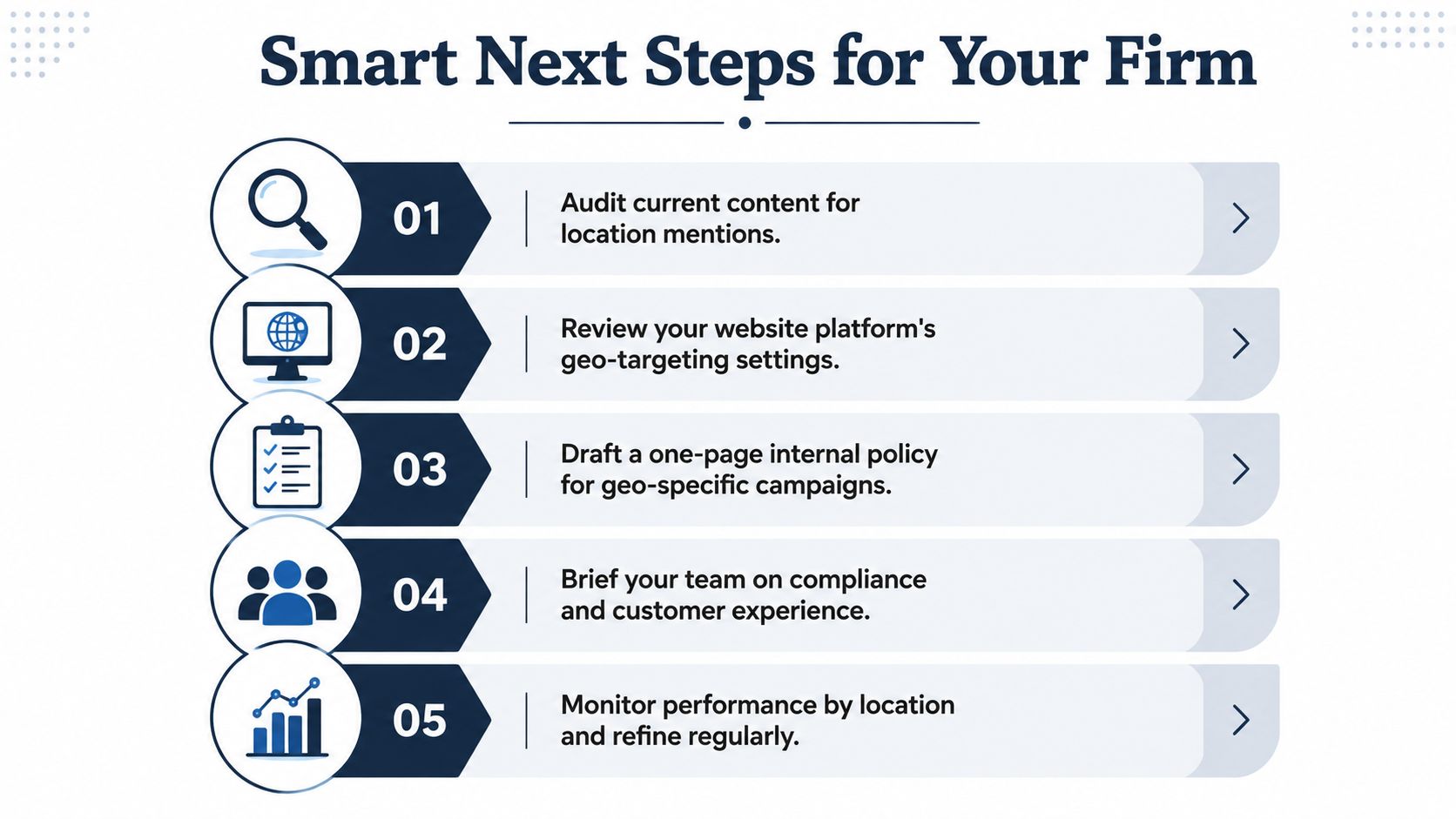
The safest sequence moves from broad-market auditing toward more precise activation. Compliance should join at the planning stage, because the available geography, data signal, message, and measurement claim all depend on the same decision.
Advisor Momentum helps financial advisors, RIAs, wealth managers, and banking teams coordinate compliance-aware SEO, GEO, AEO, Google Ads, programmatic advertising, website development, and content marketing around the markets they can serve. Visit Advisor Momentum to discuss a location-focused growth plan that connects geographic reach with compliant execution and qualified lead follow-up.
