

A financial advisor can be excellent with clients and still be nearly invisible on Google. The office is established, the credentials are solid, the planning process is disciplined, but local prospects search for help and find someone else first. That disconnect usually isn't caused by a lack of expertise. It's caused by an unmanaged Google presence.
For advisors, the problem gets harder fast. A standard local SEO checklist tells firms to add keywords, ask for reviews, and post often. That advice skips the central issue in regulated marketing. Every profile field, post, photo caption, review response, and service description can become a compliance issue if the language drifts into promissory claims or unapproved testimonials.
That gap is getting wider. The FTC trend highlighted here notes a 35% rise in penalties for unregistered "investment advice" claims in digital profiles, yet most guidance still doesn't explain how to write a compliant business description that attracts prospects without creating risk. Firms trying to improve listing on Google need a framework that treats visibility and compliance as one job, not two separate tasks.
Table of Contents
- Why Your Google Listing Is Your Most Important Digital Asset
- Building the Foundation of Local Visibility
- Structuring Your Profile for Client Trust and Compliance
- Engaging Prospects with Active and Timely Content
- Building Your Digital Reputation Through Client Reviews
- An Ongoing Maintenance Checklist for Financial Advisors
Why Your Google Listing Is Your Most Important Digital Asset
A financial advisory firm's Google Business Profile often becomes the first serious trust check a prospect performs. Before a prospect reads a whitepaper, schedules a consultation, or downloads a guide, that prospect sees the firm's name, category, reviews, hours, location details, and business summary. In practice, that profile functions like a digital front door.
That matters more for local intent than many firms realize. Prospects searching for an advisor nearby usually aren't beginning with a deep due diligence process. They're making a short list. If the profile looks incomplete, vague, outdated, or overly promotional, the firm loses attention before the website visit even happens.
Why this asset carries more risk for advisors
Most industries can afford to be loose with profile copy. Advisory firms can't. A profile that says too little looks weak. A profile that says too much, or says it carelessly, can create marketing and supervision problems.
Practical rule: A strong Google listing for a financial advisor should increase confidence without implying certainty, superiority, or a promised result.
The firms that improve listing on Google most effectively usually treat the profile as regulated public-facing content. That means approved positioning, controlled language, current business information, and documented review procedures. It also means resisting the usual local SEO habits, such as stuffing "best financial advisor" into descriptions or repeating city names unnaturally.
What works better than generic SEO advice
For advisors, the better approach is compliance-first optimization. The profile should be persuasive, but the persuasion should come from clarity. Accurate categories. Clean service descriptions. Consistent business details. Useful updates. Professional photos. Review management with retention in mind.
Firms also need to think beyond classic search. Prospects increasingly discover brands through AI-assisted search experiences, which makes reputation signals and entity consistency more important. For teams evaluating that broader shift, this collection of Recommendations for AI search offers a useful outside perspective on how brands stay visible as discovery behavior changes.
Building the Foundation of Local Visibility
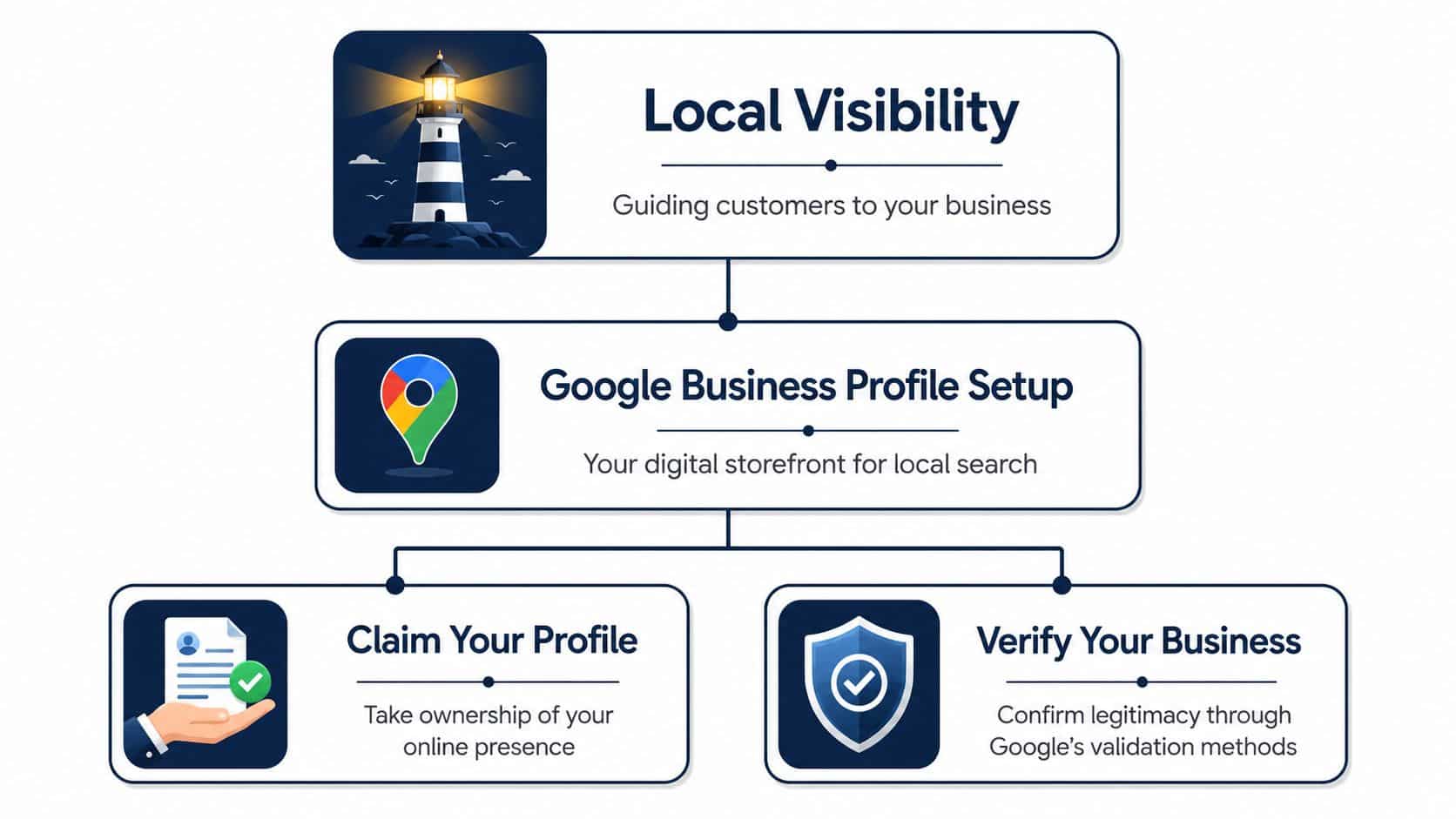
The first job isn't creative. It's administrative accuracy. A firm can't improve listing on Google if the profile hasn't been claimed, verified, and aligned with the business information used everywhere else online.
Google evaluates local listings using Proximity, Relevance, and Prominence, and Google's guidance on local ranking factors also notes that inconsistencies in Name, Address, and Phone data can reduce visibility because the system prioritizes accuracy and trustworthiness. For advisory firms, that means local visibility starts with operational discipline.
A visual summary helps clarify the order of operations.
Claim and verify before changing anything else
Many firms jump straight to rewriting descriptions or adding photos. That's backwards. If the profile isn't under firm control, every later improvement sits on weak ground.
The sequence should look like this:
- Claim the profile so the firm controls edits, access, and notifications.
- Complete verification using Google's process.
- Restrict internal access to the right marketing and compliance stakeholders.
- Document ownership so profile credentials don't disappear when staff changes.
This sounds basic because it is. It's also where many firms slip. A surprising number of advisory practices still rely on a former employee, outside consultant, or generic office account to manage the listing.
Clean up NAP consistency everywhere
Once the profile is controlled, the firm should compare its exact business data across every place it appears online. That includes the website, local directories, industry listings, map references, and social profiles.
Small differences matter. "Suite 200" in one place and "Ste 200" in another may not always cause a visible issue, but a pattern of discrepancies creates doubt. Google wants confidence that the same firm exists at the same location with the same contact information.
A practical NAP audit should check:
- Legal business name: Use the same approved version everywhere.
- Street address formatting: Keep abbreviations and suite details consistent.
- Primary phone number: Avoid switching between multiple office numbers.
- Website URL: Point to the correct main domain or approved location page.
- Hours of operation: Match posted office and appointment availability.
The firms that rank well locally usually don't have the flashiest profiles. They have the cleanest data.
Understand what Google is trying to confirm
The ranking factors are useful because they shape the work:
| Ranking factor | What Google is assessing | What the firm should do |
|---|---|---|
| Proximity | How close the business is to the searcher | Define the right office location and service area |
| Relevance | How closely the profile matches the search intent | Use accurate categories and service descriptions |
| Prominence | How established and trusted the business appears online | Build reviews, citations, and consistent references |
A firm can't manipulate proximity much, but it can strengthen relevance and prominence through accurate setup. That's why foundational cleanup usually produces better results than writing clever marketing copy too early.
What doesn't work at this stage
Several common moves waste time or create problems:
- Keyword stuffing the business name: This may trigger edits, suspensions, or trust issues.
- Using tracking numbers as the main phone line: This can create data inconsistency across listings.
- Ignoring duplicate profiles: Multiple listings split signals and confuse users.
- Leaving old office data live online: Former addresses can keep surfacing in search.
For financial advisors, the bedrock is simple. Claim the profile. Verify it. Standardize the business data. Then build from there.
Structuring Your Profile for Client Trust and Compliance
Once the basics are clean, the profile needs substance. A sparse listing tells prospects very little. An overcooked listing tells regulators too much. The best profiles are complete, specific, and controlled.
For financial advisors, this local SEO guidance for advisory firms states that local visibility improves by 60-70% when Google Business Profiles are 100% complete, and that selecting accurate categories and embedding a booking button can drive 30% more appointment conversions than static descriptions. Completion isn't busywork. It's a trust signal.
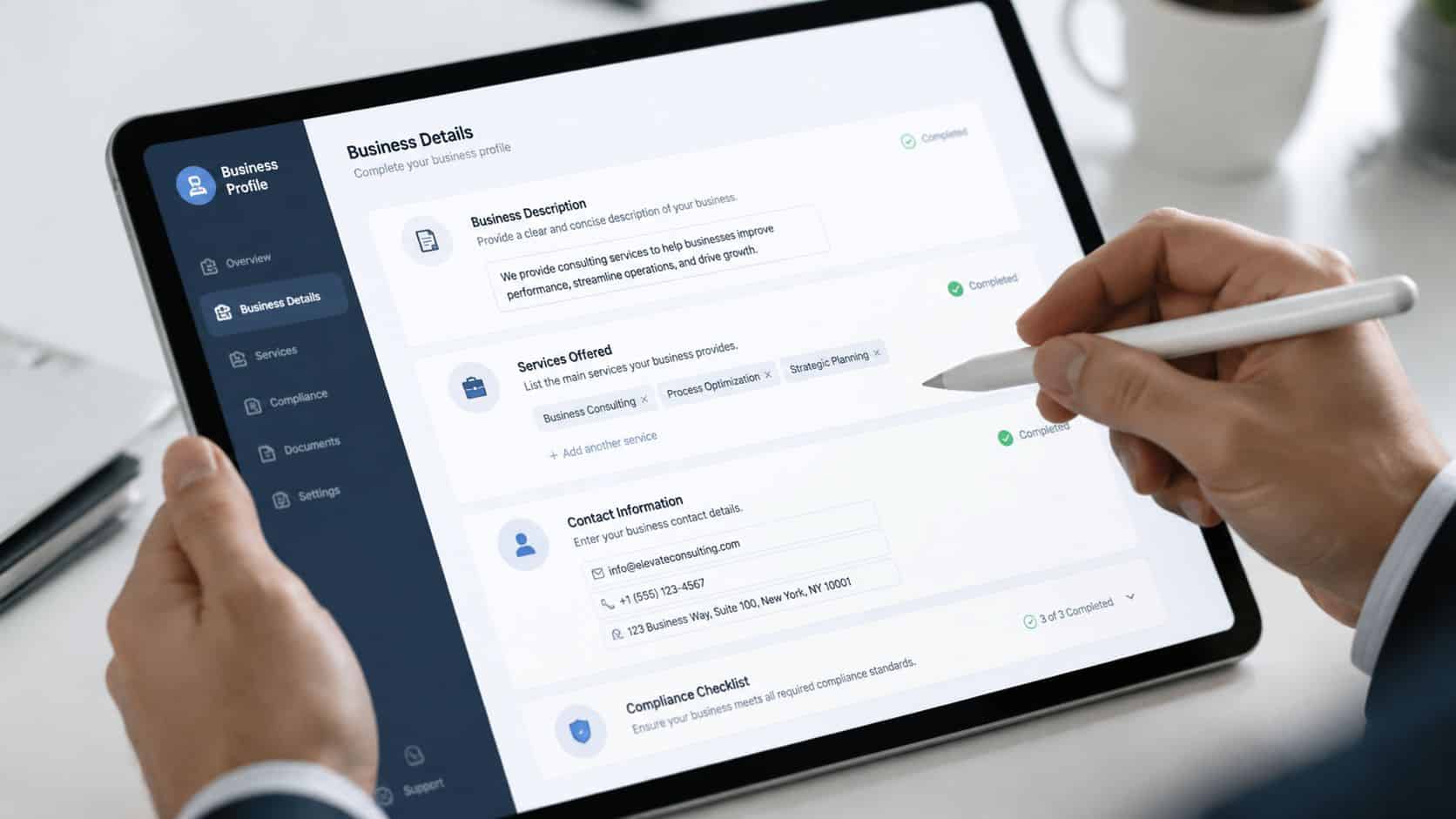
This is what that profile work often looks like in practice.
Choose fields that describe the firm accurately
A profile should match what the firm does, how it serves clients, and where it can legally operate. Accuracy matters more than breadth.
A few fields deserve extra scrutiny:
- Primary category: This should reflect the core client-facing service, such as financial planning where appropriate.
- Secondary categories: These should add legitimate context, not expand into services the firm doesn't meaningfully provide.
- Service area: This should reflect approved geographic reach without pretending the firm has a physical presence everywhere.
- Appointment link: This should lead to a real scheduling page with a compliant handoff.
- Business hours: These should reflect actual availability or clear office hours.
The profile should also align with the firm's broader brand language. Advisors refining that positioning often benefit from clear messaging standards, and this overview of branding for financial services is a useful reference point for tightening public-facing language.
Write a description that attracts interest without making promises
The business description is where many firms get into trouble. Advisors want to sound credible and persuasive, but the obvious shortcuts are risky. Phrases like "best advisor," "trusted by everyone," "guaranteed returns," or "proven to outperform" are the wrong path.
A stronger description focuses on who the firm serves, what process it follows, and what kind of planning relationship clients can expect.
A safer structure often includes:
- Who the firm works with
- What planning areas it covers
- How clients engage with the team
- What differentiates the experience, without superiority claims
For example, compliant language usually sounds like this in principle:
- A fee-based advisory firm serving pre-retirees, retirees, business owners, or families.
- Planning centered on retirement, tax-aware coordination, estate considerations, or portfolio oversight.
- A process built around consultation, education, and ongoing review.
- An emphasis on clear communication and long-term planning discipline.
It usually should not sound like this:
- The top-rated or best choice in a city
- A firm that delivers guaranteed outcomes
- A team that can eliminate market risk
- A practice claiming unmatched performance
Public profile copy should describe the firm's process and audience. It shouldn't imply certainty, superiority, or personalized advice before a relationship exists.
Fill the profile completely, but not carelessly
Completeness helps because prospects use every field to judge credibility. A missing appointment link makes the firm harder to contact. Missing services reduce relevance. Empty photos make a real office look questionable.
A practical completion review should include:
| Profile element | Good approach | Risky approach |
|---|---|---|
| Business description | Specific, factual, audience-centered | Promotional, absolute, performance-heavy |
| Categories | Tight alignment with actual services | Broad category stacking |
| Photos | Team, office, signage, professional environment | Generic stock imagery posing as the firm |
| Appointment setup | Clear next step with approved language | Vague "contact us" dead ends |
| Services | Plain-English service labels | Overpromising or regulated claim language |
The profile should feel complete enough to build confidence, but restrained enough to survive compliance review. That's the balance generic SEO advice rarely addresses.
Engaging Prospects with Active and Timely Content
A complete profile is only the starting line. If nothing changes for months, the listing looks neglected. Prospects notice that. So does Google.
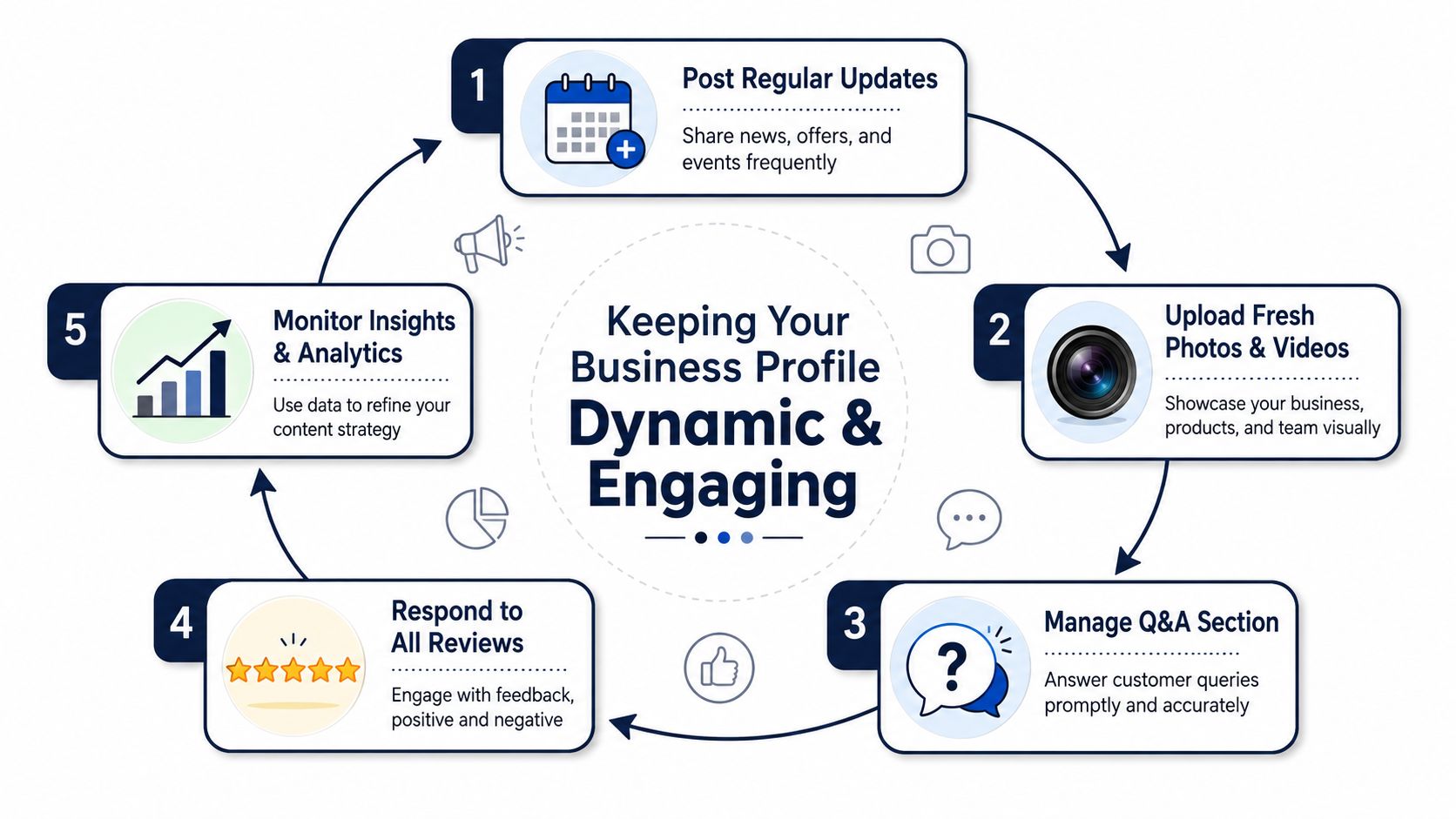
Regular activity signals that the firm is active, responsive, and relevant. According to this guidance on optimizing Google Business Profiles, businesses that publish weekly posts report up to a 30% increase in click-through rates to their websites. For an advisory firm, that doesn't mean turning the profile into a constant stream of promotions. It means showing signs of life in a disciplined way.
This ongoing rhythm is easier to maintain when the work is visible as a process.
Use posts to reinforce relevance, not to chase clicks
The best Google posts for advisors are useful, brief, and compliant. They don't need hype. They need clarity.
Good post topics often include:
- Educational updates: Short summaries of new articles on retirement planning, tax considerations, or market education.
- Firm news: Team additions, office updates, community events, or schedule changes.
- Seasonal reminders: Deadlines, planning checklists, or year-end review prompts.
- Client process explanations: What a first meeting includes, what documents to bring, or how review meetings work.
Weak posts usually fail in one of two ways. Some are too generic to matter. Others drift into implied advice, performance framing, or market predictions that create unnecessary risk.
Build a posting cadence the firm can actually sustain
Most firms don't need elaborate content calendars for their profile. They need a repeatable pattern that compliance can review and the team can maintain.
A workable cadence might include:
- one post each week
- one fresh photo set on a recurring schedule
- one review of the Q&A area during the same weekly check
- one monthly review of profile insights and actions
That rhythm works because it reduces friction. The profile remains active without becoming another neglected channel.
For teams refining website conversion paths behind those posts, this guide for B2B lead generation is a useful resource for thinking through how landing pages support next-step action after a profile click.
Keep content educational and operational
Advisory firms usually perform better when profile content sticks to education and operations rather than sales copy. "Schedule a consultation" can work. "Get the best retirement outcome" shouldn't.
A strong post often includes:
- a short headline
- one useful takeaway
- a clear next step
- a destination page that matches the promise of the post
Firms looking for practical editorial themes can also draw from these educational content ideas for financial advisors to keep profile updates consistent with broader content strategy.
Fresh profile activity should answer a prospect's next question, not force a hard sell.
Don't neglect photos and Q&A
Posts aren't the only freshness signal. New office photos, current team headshots, event photos, and clean interior shots can reinforce legitimacy. The key is authenticity. If the firm's profile shows actual people and an actual office, the profile feels real.
The Q&A section also deserves active supervision. Left alone, it can fill with inaccurate or outdated information. A regulated firm should monitor questions promptly and answer them with approved, factual language.
The firms that improve listing on Google over time don't treat the profile like a brochure. They treat it like a living public record.
Building Your Digital Reputation Through Client Reviews
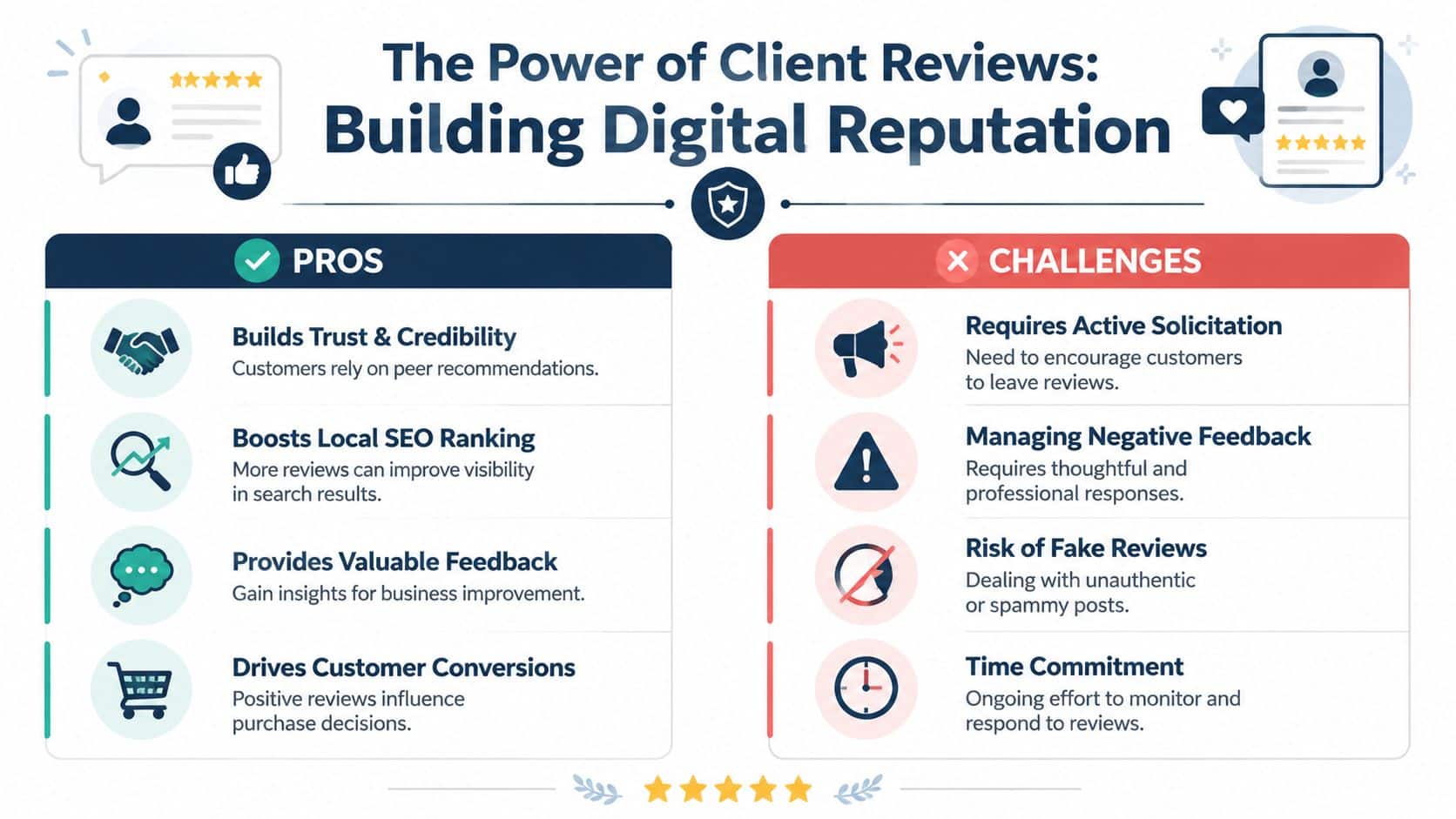
Reviews carry unusual weight because they influence both visibility and trust. Prospects read them to decide whether the firm feels credible. Search engines read them as a signal of prominence. For advisory firms, though, reviews are never just a marketing asset. They are also supervised public communications.
That changes how firms should request them, respond to them, and archive them. Under SEC Rule 204-2 guidance summarized here, Registered Investment Advisors must retain website records, including advertisements and marketing pieces like public responses to reviews, for at least five years from the end of the fiscal year in which the content was most recently used. A review workflow without retention is incomplete.
This is the trade-off. Reviews can strengthen local reputation, but they need process.
Ask for reviews in a fair and documented way
The cleanest review process is simple and consistent. The firm identifies appropriate moments to ask, uses approved language, avoids incentives, and applies the same method broadly rather than cherry-picking only the happiest clients.
A compliant approach usually includes:
- Standard timing: Ask after a planning milestone, onboarding completion, or review meeting.
- Neutral language: Invite feedback without suggesting what the client should say.
- No compensation: Never exchange gifts, discounts, or benefits for reviews.
- Documented workflow: Keep records of request templates and approval status.
The request should feel polite, not engineered. A short message asking a client to share honest feedback is usually enough.
Respond without confirming the reviewer is a client
Many firms fall short in this aspect. A warm, personalized reply may feel natural, but it can create disclosure issues. If a firm publicly confirms a relationship or discusses specifics, the response can reveal more than intended.
Safer response patterns usually look like this:
| Situation | Better response style | What to avoid |
|---|---|---|
| Positive review | Thank the reviewer for the feedback and invite offline contact for any follow-up | Confirming account details or discussing results |
| Negative review | Acknowledge the concern, avoid defensiveness, and move the conversation offline | Arguing facts in public or disclosing personal information |
| Suspicious review | Review internally, preserve records, and use platform procedures if appropriate | Posting an emotional public rebuttal |
A public review response should be written as if a regulator, a prospect, and opposing counsel will all read it later.
Treat review management as reputation control
Review management isn't just customer service. It's reputation infrastructure. A prospect often learns more from how a firm responds to criticism than from the criticism itself.
That makes consistency essential:
- review the profile regularly
- answer with approved templates
- escalate unusual comments internally
- retain screenshots and response records
- align responses with the firm's testimonial and advertising policies
For firms thinking more broadly about online perception, this outside resource on reputation management for professionals gives a useful general framework for protecting credibility across public digital channels.
A strong review strategy doesn't chase praise. It builds a system the firm can defend.
An Ongoing Maintenance Checklist for Financial Advisors
The firms that improve listing on Google consistently don't rely on one cleanup project. They run a maintenance cycle. That cycle keeps the profile accurate, active, and easier to supervise.
A practical schedule should be light enough to sustain and strict enough to prevent drift. Most firms don't need daily profile work. They need recurring ownership and a checklist that connects marketing actions to compliance review.
Weekly actions that keep the profile alive
Weekly work should focus on visible activity and public interaction. If the firm falls behind here, the profile starts to look stale quickly.
Weekly priorities usually include:
- Review new questions: Answer factual Q&A items with approved language.
- Check for reviews: Respond promptly using compliance-safe templates.
- Publish one post: Share an educational or operational update.
- Confirm key details: Make sure no unauthorized edits appeared.
Monthly checks that prevent inconsistency
Monthly reviews are less about speed and more about drift, allowing firms to catch quiet problems before they affect trust.
A monthly review should cover:
- Photos: Add recent office, team, or event images if appropriate.
- Profile completeness: Confirm links, services, and descriptions still reflect the firm.
- User actions: Review profile insights to see what people are clicking.
- Internal records: Archive posts, responses, and public changes for retention.
Quarterly audits that protect long-term performance
Quarterly work should be broader. This is the point to compare the profile against the firm's website, office operations, and approved messaging.
A quarterly audit should check:
- NAP consistency: Compare the firm's core business data across major citations and owned properties.
- Category accuracy: Make sure the selected categories still match the firm's service model.
- Service descriptions: Remove outdated language or newly risky phrasing.
- Access control: Verify that only current approved users can edit the profile.
The checklist below turns those tasks into a manageable operating document.
| Frequency | Task | Compliance Note |
|---|---|---|
| Weekly | Review new Google reviews and respond where appropriate | Retain response records and avoid confirming client relationships publicly |
| Weekly | Publish one Google Business Profile post | Use approved educational or operational language, not promissory claims |
| Weekly | Check the Q&A section | Answer factually and avoid personalized financial guidance |
| Monthly | Upload new photos | Use authentic firm imagery and avoid misleading representations |
| Monthly | Review profile performance and user actions | Keep records of significant profile changes and campaign tie-ins |
| Monthly | Confirm links, hours, and appointment flow | Make sure public information matches current operations |
| Quarterly | Audit NAP consistency across web properties | Correct discrepancies before they multiply across listings |
| Quarterly | Review categories and services | Ensure labels still reflect actual regulated activities |
| Quarterly | Review user access and internal ownership | Remove former staff or vendors who no longer need profile control |
| Quarterly | Reassess profile description and public responses | Check for language that may trigger testimonial or advertising concerns |
A Google Business Profile rewards firms that behave like disciplined operators. Accuracy builds trust. Activity builds visibility. Documentation protects the firm when questions come later.
Advisor Momentum helps financial advisors, RIAs, and banking teams build compliant digital visibility without sacrificing growth. Firms that need support with Google Business Profile strategy, compliant content, brand positioning, websites, or lead generation can learn more at Advisor Momentum.
