
A productive advisor sits in a familiar tension point. The book is solid, client relationships are strong, and production has proven the advisor can win. But the broker-dealer structure starts to feel smaller each year. Product shelves shape recommendations, supervisory layers slow change, and clients ask a sharper question than they used to ask: whose side is the advisor really on?
That question is why so many experienced professionals start looking up how to become a fiduciary. They aren't asking only about licenses. They're asking how to move to an independent RIA model without breaking operations, losing clients, or stepping into a compliance problem that could've been avoided with better planning.
The transition is less like changing a title and more like changing the operating model of a business. Legal registration matters. Exams matter. But the advisors who handle this well also rebuild disclosure practices, fee communication, account transition workflows, and continuity planning. In that sense, the move resembles the discipline behind a guide to pricing transparency for SaaS. Clear alignment between what the firm does, how it gets paid, and what the client should expect becomes part of the value proposition, not just a disclosure obligation.
Table of Contents
- What It Truly Means to Be a Fiduciary Advisor
- Laying the Foundation with Exams and Credentials
- The Registration Crossroads State vs SEC Filing
- Building Your Fiduciary Practice Compliance and Operations
- Navigating the Transition from a Broker Dealer Model
- Maintaining Your Fiduciary Status with Ongoing Obligations
What It Truly Means to Be a Fiduciary Advisor
A top producer at a wirehouse can look successful on paper and still feel boxed in. The advisor knows certain recommendations are suitable. The advisor also knows suitability isn't the same as building a practice around undivided client loyalty. That gap becomes hard to ignore when discerning households start asking about conflicts, fees, and whether advice changes based on compensation structure.
A fiduciary advisor operates under a different standard of responsibility. This isn't just a marketing phrase. It's a legal and ethical posture that requires the advisor to put the client's interest first. For an experienced broker, that shift changes more than account paperwork. It changes how recommendations are documented, how fees are explained, how conflicts are identified, and how service models are built.
The practical difference in daily work
Under a broker-dealer model, the business often revolves around products, supervision, and suitability reviews. Under an independent fiduciary model, the business revolves around advice, disclosure, and ongoing duty of care. That means the advisor has to defend not only what was recommended, but why that recommendation served the client better than reasonably available alternatives within the practice model.
Practical rule: If a recommendation would be hard to explain in plain English to the client and a regulator on the same day, it probably isn't ready to leave the office.
That's why the move to fiduciary status tends to appeal most to advisors who already think like planners. They want the freedom to lead with advice instead of shelf space. They also want their brand to reflect that the client relationship isn't built around transaction logic.
Why this becomes a business decision
The best advisors don't make this transition because the label sounds better. They make it because the fiduciary model supports stronger alignment between service, pricing, and client expectations. It often simplifies the story the firm tells the market: this practice gets paid for advice and portfolio oversight, discloses conflicts directly, and structures operations around client best interest.
That clarity is valuable internally too. Staff training gets simpler. Client reviews become more consistent. Marketing language becomes easier to defend. The question stops being whether the transition should happen and becomes whether the advisor is prepared to build the business around it.
Laying the Foundation with Exams and Credentials
A lot of successful brokers hit the same wall early in this transition. They know how to win business, retain households, and manage revenue. Then they discover that none of that shortens the licensing process, fixes a registration gap, or protects them if an advisory recommendation is made before the right credentials are in place.
Choose the licensing path that fits the existing registrations
The first practical decision is not academic. It affects launch timing, staffing, supervision, and how quickly the new firm can start giving advice under the proper structure.
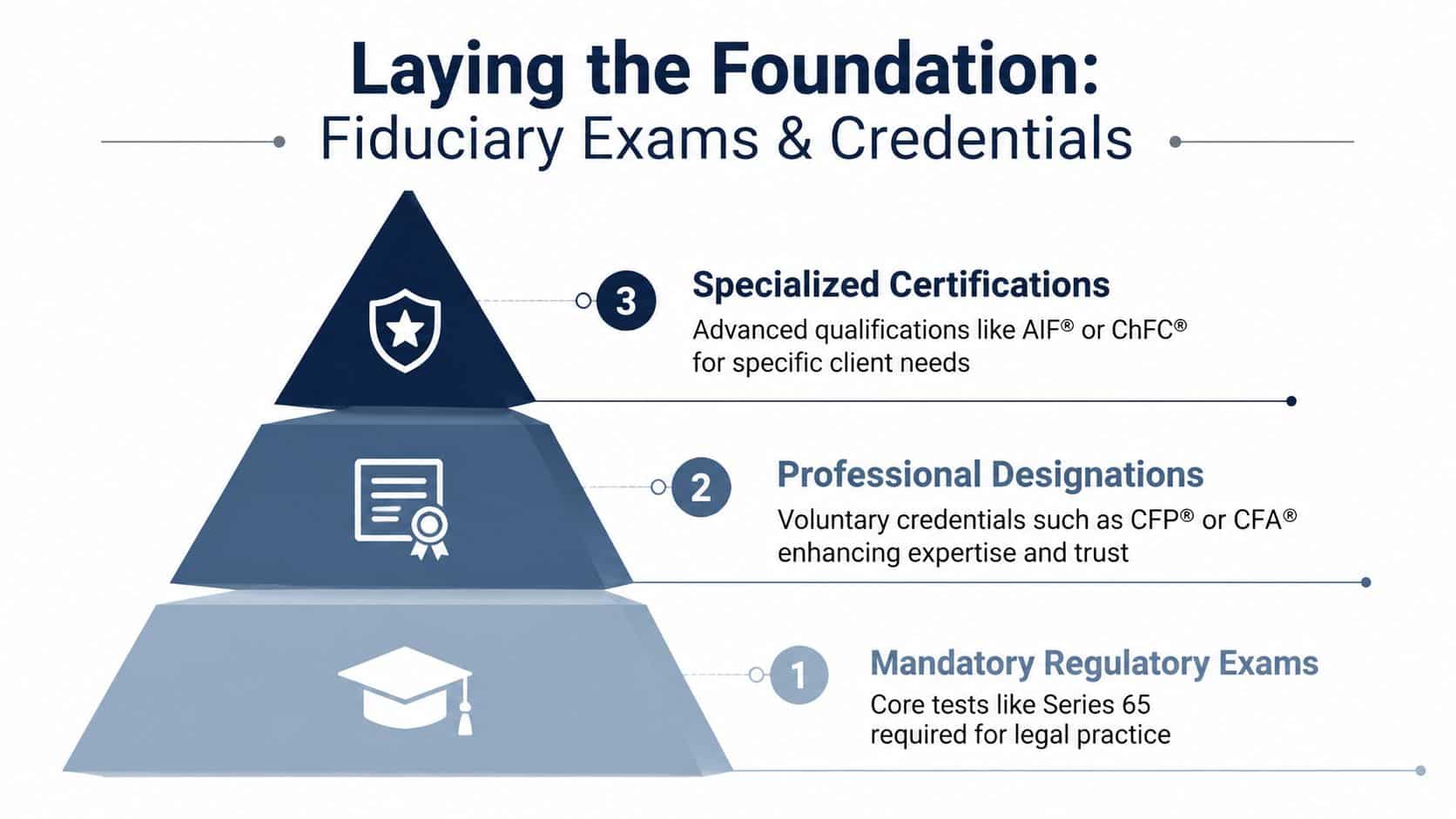
A common route into advisory licensing is the Series 65, or the Series 66 for advisors who already hold the Series 7. The right path depends on the registrations already in place, whether the advisor is breaking away from a broker-dealer or joining an existing RIA, and how the firm plans to staff client relationships during the transition.
For a producing broker with an active Series 7, the Series 66 may be the more efficient fit because it builds on the current licensing base. For an advisor moving straight into an investment advisory role without that combination, the Series 65 is often the cleaner option. The choice is operational, not just personal. If the founder is ready but associate advisors are not, the firm can end up with client service bottlenecks, delayed handoffs, and compliance risk around who is giving advice.
Use a simple planning grid before filing anything:
| Current position | Most practical next step | Why it works |
|---|---|---|
| Existing broker with Series 7 | Evaluate Series 66 path | It may align with the current licensing footprint |
| Advisor without that combination | Prepare for Series 65 | It is the direct advisory qualification path |
| Team member entering an advisory role | Confirm state-specific exemptions or requirements | The registration sequence can vary by role and jurisdiction |
Transition planning gets more serious than many advisors expect. Every client-facing person needs to be mapped by function: who gathers data, who discusses allocation changes, who makes recommendations, and who signs advisory documents. Titles do not control regulatory status. Job duties do.
Firms that handle this well usually build the org chart and licensing matrix at the same time. For teams formalizing that process, financial advisor training programs can help connect role design, advisor development, and registration planning.
Use voluntary credentials strategically
Licensing gets the firm legally positioned to offer advice. Credentials serve a different purpose. They can support credibility, sharpen specialization, and help explain the firm's new identity to clients who still associate the advisor with a brokerage model.
The trade-off is straightforward. A designation can improve market positioning, but it does not reduce the need for sound policies, documented advice processes, or clean disclosures. Advisors sometimes overvalue the letters after their name and undervalue the operating discipline regulators will examine.
The Certified Financial Fiduciary designation is one example. The issuing body, the National Association of Certified Financial Fiduciaries, describes it as a designation built around fiduciary standards, ethics, and advisor accountability. For some firms, that may support a repositioning strategy, especially if the advisor is leaving a commission-based identity and wants the market to see a clear shift.
Used well, a credential supports the business model already being built. Used poorly, it becomes marketing decoration attached to a practice that still runs like a broker-dealer.
State-specific licensing issues also need attention here, especially for firms operating across multiple jurisdictions or serving clients in specialized fiduciary capacities. Those problems are expensive when discovered late. The cleaner approach is to review role-based licensing, credential use, and jurisdictional requirements before the firm starts rewriting agreements, updating Form ADV, or announcing the transition to clients.
The Registration Crossroads State vs SEC Filing
Many advisors talk about “starting an RIA” as if it were one task. It isn't. The first structural fork in the road is deciding whether the firm falls under state registration or SEC registration. That decision affects oversight, filing detail, examination expectations, and how the launch calendar should be built.
Know which regulator will oversee the firm
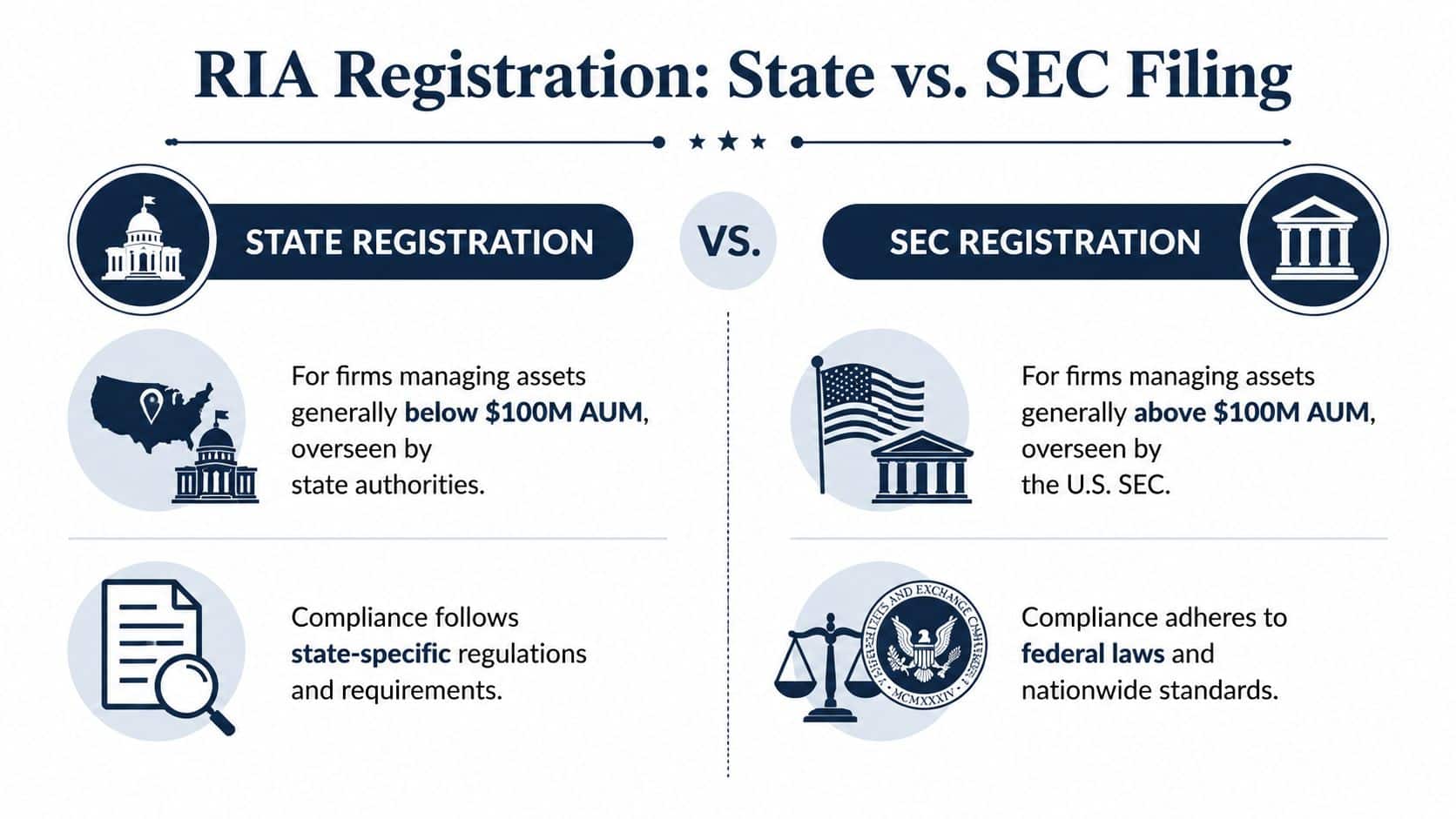
The dividing line is assets under management. If an advisor manages over $100 million in assets, they can register directly with the Securities and Exchange Commission, whereas those managing less must register with their state's securities office using Form ADV, according to SmartAsset's explanation of how to become a fiduciary.
That threshold shapes the entire registration strategy. A firm near the line should model growth carefully and decide whether it expects to remain under state oversight for a meaningful period or cross into SEC registration soon after launch. Neither path is automatically better. They are different oversight environments with different practical implications.
A simple comparison helps frame the choice:
| Registration path | Typical oversight | Practical effect |
|---|---|---|
| State registration | State securities office | State-specific filing expectations and examination practices |
| SEC registration | Federal regulator | Federal framework and nationwide oversight standards |
This is similar to choosing between a local operating license and a federal charter. The business may offer similar services under either path, but the supervising authority and review process change.
Treat Form ADV like a business document, not a formality
Form ADV is where many transitions start to feel real. It isn't just an application. It is a disclosure architecture that regulators and clients both rely on to understand the firm.
Advisors who approach the ADV as a template-filling exercise usually create future problems. Language in the brochure needs to match how the firm works. If the firm says it provides ongoing monitoring, then operations must support ongoing monitoring. If the brochure describes fee billing, trading authority, outside business activities, or conflicts in a certain way, internal procedures need to line up with those statements.
The ADV should read like the firm that will exist on day one, not the firm the advisor hopes to build two years later.
Strong filings usually share the same traits:
- Clear service descriptions: Advisory services, planning scope, and account oversight are described in plain language.
- Accurate conflict disclosure: Compensation arrangements, affiliations, and outside activities are disclosed without softening the issue.
- Operational consistency: The brochure, agreements, billing practices, and compliance procedures match each other.
- Client usability: A client can read the document and understand what the firm does, how it gets paid, and what risks or conflicts exist.
A broker moving to independence often underestimates how exposed inconsistency becomes once the ADV, website, onboarding documents, and review process all have to tell the same story. Registration isn't complete when the filing is submitted. It's complete when the filing accurately describes a business that can withstand scrutiny.
Building Your Fiduciary Practice Compliance and Operations
Registration creates the legal shell. Operations determine whether the firm can function as a fiduciary in practice, influencing whether many transitions either become durable or become chaotic.

Build the internal operating system first
A fiduciary firm needs a compliance manual that reflects the actual business model, not generic language copied from a different practice. It needs supervisory procedures that assign responsibility, escalation protocols that define who reviews exceptions, and a Code of Ethics that staff can follow without guessing.
The strongest launch plans build these pieces before client assets move. That sequence matters. Advisors who transition clients first and write procedures later usually spend months fixing disclosure mismatches, documenting ad hoc practices, and retraining staff on workflows that should've been settled in advance.
Core operating documents usually include:
- Compliance manual: The central reference for policies, reviews, reporting obligations, and recordkeeping.
- Code of Ethics: Personal trading rules, reporting expectations, standards of conduct, and conflict controls.
- Client advisory agreement: Scope of services, discretionary authority if any, fees, termination terms, and responsibilities.
- Business continuity procedures: A documented response for disruption, absence, illness, or operational interruption.
- Billing and fee procedures: A repeatable method for calculating, reviewing, and documenting client charges.
California offers a good example of how compliance can extend beyond broad principles into concrete entry standards. A professional fiduciary in that state must be at least 21 years old, be a U.S. citizen or legally admitted resident, and complete 30 hours of pre-licensing education, including one hour focused on cultural competency, according to this California fiduciary licensing overview. Even advisors who aren't pursuing that exact license should pay attention to the lesson. Regulators expect fiduciary professionals to document competence, responsibility, and fitness for practice in specific ways.
Design a client experience that supports the fiduciary standard
Operations aren't just back-office controls. They shape what clients experience. If the firm says it is conflict-aware, fee-transparent, and advice-first, the onboarding process needs to prove that.
That usually means simplifying agreements, clarifying how planning and investment management interact, and making signatures and document delivery easy to complete and archive. Many firms use digital workflows to reduce friction and maintain records cleanly. A practical example is the Closer Innovation Labs eSignature platform, which illustrates how firms can structure document execution around secure, trackable client workflows rather than email chaos and paper bottlenecks.
A strong fiduciary client experience usually includes:
- A plain-language engagement explanation that tells the client what the firm will do and what it won't do.
- A fee discussion before account movement so there is no confusion about how compensation changes under the new model.
- A documented investment process that ties recommendations to goals, constraints, and risk parameters.
- A service calendar so review frequency and communication expectations are defined upfront.
Good compliance isn't separate from service. It is service that has been thought through carefully enough to survive examination.
Client service teams also need role clarity. A transition often fails at the handoff point between advisor promise and staff execution. Firms that want service standards to hold up should define workflows for onboarding, review scheduling, issue resolution, and documentation. For firms refining that infrastructure, advisor customer service guidance can help translate abstract service goals into repeatable processes.
Navigating the Transition from a Broker Dealer Model
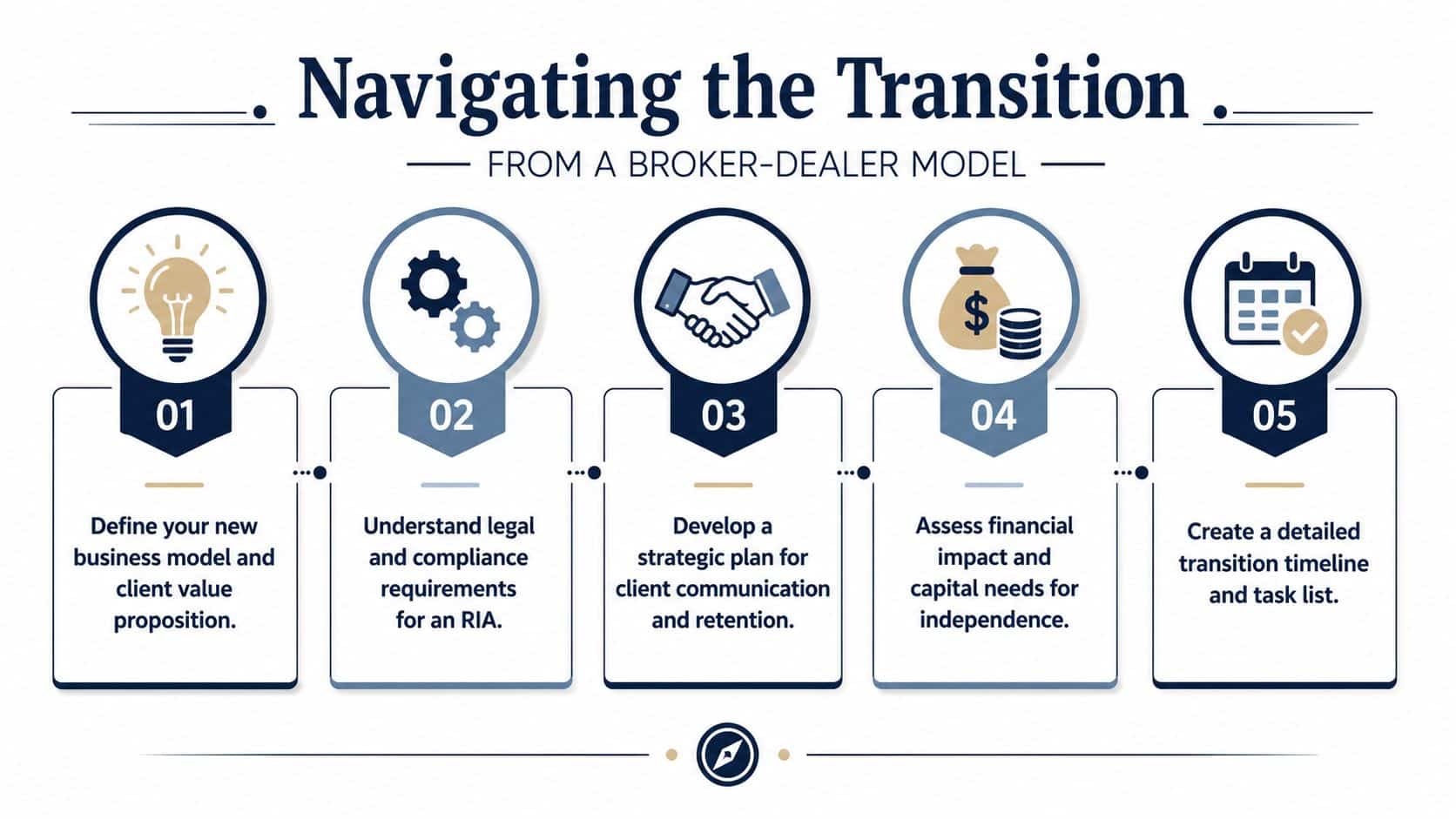
The move from broker-dealer to independent fiduciary practice is part legal project, part client-retention project, and part business rebuild. Advisors who treat it as only a registration exercise usually create avoidable losses. The clients need a reason to move. The accounts need a path to move. The business needs enough structure to support the move without exposing the advisor to unnecessary risk.
Start with the client message
Clients rarely care about registration mechanics. They care about what changes for them. A strong transition message explains the shift in terms of alignment, advice structure, service model, and continuity. It does not drown the client in industry jargon.
The most effective communication usually answers four questions quickly:
- Why the change is happening: The advisor wants to serve under an advice-first model with clearer alignment.
- What changes operationally: New agreements, a new custodian relationship, and revised service documents may be required.
- What stays the same: The relationship, planning philosophy, and commitment to the client remain intact.
- What the client must do next: Sign paperwork, review disclosures, and ask questions before transfer steps begin.
This message should be tested internally before it ever reaches a client. If the service team can't explain the change clearly, the client experience will break down once account transfers begin.
Independence requires risk controls
Most “how to become a fiduciary” guides stop too early. They explain licensing, maybe registration, and then imply the advisor is ready. That isn't enough for an independent operator.
As Marshall Fiduciary's fiduciary questions document points out, aspiring independent fiduciaries need to consider whether they are bondable and insured and whether they have continuity plans for vacations or illness. Those aren't side issues. They are basic operating realities.
A broker inside a large institution inherits a lot of invisible support. An independent fiduciary has to replace it intentionally. That includes:
| Operational issue | Why it matters during transition |
|---|---|
| Insurance coverage | Protects the practice against errors and claims exposure |
| Bonding | May be necessary for credibility, operational readiness, or specific roles |
| Continuity planning | Clients need to know who responds if the advisor is unavailable |
| Account transfer workflow | A weak process creates frustration, delays, and attrition |
| Employment agreement review | Restrictions and obligations can affect timing and communication |
Employment agreements deserve special caution. Non-solicit provisions, notice obligations, confidentiality terms, and garden leave mechanics can all affect the sequence of departure. Advisors who move too fast often create legal distractions that undermine client communication and operational setup. Advisors who move too slowly risk letting uncertainty bleed into client confidence.
Independence works best when the advisor builds the landing before making the jump.
The transition plan should therefore run on a timeline with legal review, registration preparation, client messaging, document setup, insurance confirmation, continuity planning, and transfer operations all synchronized. That isn't glamorous work. It is the work that keeps the business intact.
Maintaining Your Fiduciary Status with Ongoing Obligations
A year after launch, many newly independent advisors hit the same problem. Registration is done, clients are on board, revenue is coming in, and the firm starts acting as if the hard part is over. Then the business changes. Fees are adjusted. A new planning service is added. A staff member starts handling tasks that were never reflected in written supervision. That is where fiduciary risk starts to build.
Fiduciary status is maintained through operating discipline. Regulators do not evaluate intent alone. They review whether the firm's disclosures, policies, records, and actual practices line up. Clients do the same, even if they never use that language. If your ADV says one thing, your service model says another, and your staff follows a third version, you have a compliance problem and a business problem at the same time.
Maintenance has to be built into the operating calendar
Independent firms need a repeatable review cycle. Annual amendments matter, but they are only one part of the job. Material changes need to be identified when they happen, not months later. New conflicts need to be documented when they arise. Supervisory processes need evidence, not assumptions.
A working maintenance routine usually includes four areas:
- Disclosure review: Confirm Form ADV, advisory agreements, fee schedules, and client-facing descriptions continue to match how the firm operates.
- Policy testing: Verify that procedures are being followed in practice, especially around trading, billing, personal securities activity, and books and records.
- Training and supervision: Train staff on conflicts, documentation standards, marketing rules, privacy, and escalation procedures. Then document that the training occurred.
- Continuity updates: Review continuity and succession procedures based on current staffing, vendors, access controls, and client service dependencies.
Many former broker-dealer advisors underestimate the shift. In a large firm, someone else usually owns the testing calendar, policy updates, and supervisory evidence. In an independent RIA, leadership owns it. If the firm grows and the control structure does not grow with it, gaps appear fast.
Competence requires continuing development
Ongoing education supports fiduciary status because competence is part of the standard. That includes formal continuing education where required, role-specific training for supervised persons, and documented review when regulations, services, or risks change. The point is not collecting certificates. The point is keeping advice, disclosures, and supervision current as the business evolves.
Firms that handle this well treat learning as an operating function. They schedule it, assign responsibility, and tie it to risk areas inside the practice. This overview of what professional development means is a useful framing point, especially for regulated professionals who have to show that growth in the business does not outpace competence inside the firm.
A simple test helps. If an examiner asked why your current procedures, disclosures, and training program are appropriate for the business you run today, could you answer with records, review dates, and documented decisions? Well-run fiduciary firms can. That is what keeps the standard intact.
