
If the pipeline feels random, it usually means the practice is busy, not built. One week a few prospects come in from referrals, the next week a webinar or ad gets a spike, then everything goes quiet again. That inconsistency is exhausting for advisors and confusing for the people trying to manage growth, because financial advisor lead generation only becomes reliable when it works as a system, not a stack of disconnected tactics.
A system matters even more now because buyers do their research digitally before they ever raise a hand. Capgemini reports that 53% of affluent investors now use digital channels for financial-advice interactions, yet firms still need compliant, high-trust follow-up to turn interest into action, which means the true advantage sits in conversion, not just visibility (Capgemini context cited in this industry analysis). For teams that want to capture interest around the clock, a resource like 24/7 financial advisor lead capture can be useful as part of the broader architecture, but only if the rest of the process is designed to qualify and nurture leads well.
Table of Contents
- Beyond Tactics to a Repeatable System
- Auditing Your Foundation and Defining Your Niche
- Building Your Compliant Digital Presence
- Executing Targeted Acquisition Campaigns
- Nurturing Leads with Automated Workflows
- Integrating Compliance into Every Step
- Measuring Performance and Optimizing for Growth
Beyond Tactics to a Repeatable System
The common failure in advisor marketing isn't effort, it's fragmentation. A firm posts on LinkedIn for a while, tries a few paid campaigns, asks for referrals more often, then wonders why the pipeline still feels uneven. Those activities can all work, but they don't compound unless they're tied to one operating model.
The real shift is from activity to architecture
A repeatable system starts with a narrow audience, one clear promise, one intake path, and one follow-up sequence that every lead passes through. That sounds simple, but simplicity is what keeps campaigns measurable, compliant, and scalable. Without it, teams can't tell whether a meeting came from search, referral, email, or social, which makes budget decisions little more than guesswork.
Practical rule: if a lead enters the pipeline without a source, a stage, and an owner, it's already harder to convert.
That's why the best practices around financial advisor lead generation now lean toward conversion efficiency. Industry guidance shows that the overall average conversion rate is 4.3%, while strong benchmark performance sits in the 5% to 8% range, and top performers can reach 23%. When conversion improves, the firm doesn't need to chase as many leads to reach the same business outcome.
The most useful mindset shift is to treat marketing like an operational asset. A defined process, especially one that captures and routes leads cleanly, makes the entire practice more predictable. It also gives leadership a way to say no to random activity that creates noise instead of meetings.
Auditing Your Foundation and Defining Your Niche
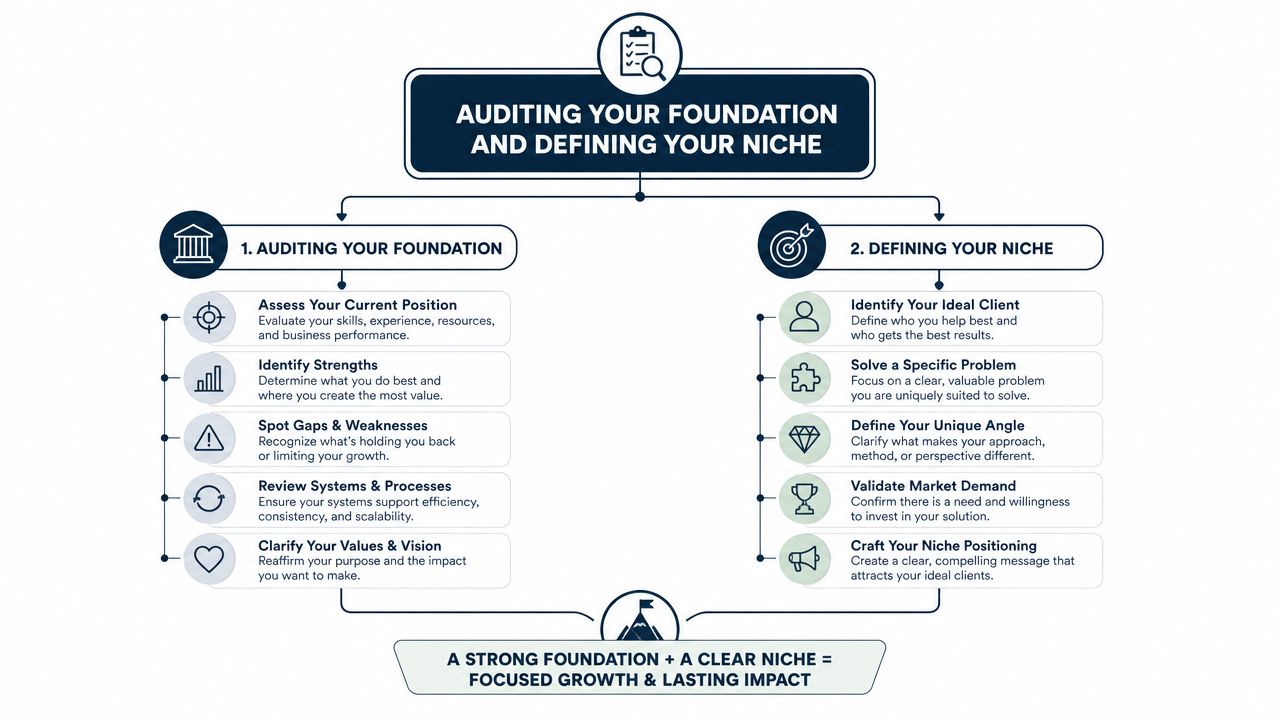
Before any campaign goes live, the firm needs an honest audit of what already exists. That means reviewing the website, intake forms, email follow-up, content library, and referral process together, not as separate marketing chores. If the message changes from page to page, prospects feel it immediately, and trust weakens before a conversation even starts.
Start with the assets already in play
A practical audit asks four questions. Can a prospect tell who the firm serves? Can they see why the firm is different? Is there a clear next step on every important page? And does every lead route into a place where someone owns the follow-up? If any of those answers is fuzzy, the firm doesn't have a lead generation problem yet, it has a clarity problem.
That clarity comes from an Ideal Client Profile, or ICP, which is a precise picture of the person the firm is best equipped to help. A useful ICP includes the client's stage of life, likely financial concerns, decision style, and the type of relationship they want with an advisor. It is better to serve a smaller, better-defined audience well than to write generic messaging for everyone.
A strong value proposition follows naturally from that definition. It should say what the firm does, who it helps, and why that combination is credible. A niche-focused message also reduces friction inside compliance review, because the content becomes more specific and less bloated with unnecessary promises.
For firms trying to tighten that positioning, WaveGen.ai for advisors offers a useful example of how brand clarity supports lead quality without turning the site into a brochure. The point is not style for its own sake, it's making the market understand the firm fast enough to take the next step.
Define the niche before scaling channels
The best channel strategy still fails if the firm is speaking to the wrong audience. One message for retirees, business owners, and executives usually ends up sounding flat to all three. A tighter niche lets the firm choose the right educational offer, the right call to action, and the right examples.
A niche is not a limitation when the firm wants better-fit clients. It's the filter that keeps outreach relevant.
That doesn't mean the practice has to reject everyone outside the niche. It means the marketing engine is built around a specific market segment, so every campaign gets sharper over time. Once that foundation is clear, the website, content, and outreach all become easier to manage.
Building Your Compliant Digital Presence
A firm's website is its digital office, and prospects judge it quickly. If the site feels outdated, confusing, or slow to load on mobile, the firm loses credibility before a conversation starts. A compliant lead generation engine needs the site to do three jobs at once, establish trust, capture contact information, and make the next step obvious.
Build pages that reduce friction
The homepage shouldn't try to say everything. It should answer the basic questions a serious prospect already has, who the firm helps, what problems it solves, and what happens after a form is submitted. Landing pages should be even more focused, with one educational offer, one message, and one action.
Trust signals matter here, but they have to be handled carefully. Disclosures, professional credentials, and clear explanations of process can strengthen confidence without drifting into hype. Testimonials, where permitted and properly reviewed, work best when they're specific and restrained, because the goal is reassurance, not sales theater.
Advisors can also improve local discoverability by using location-specific keywords in page titles, headings, and copy, publishing area-specific financial articles or resources, maintaining a mobile-friendly, quick-loading site, and using clear CTAs (local SEO guidance). That matters because local search often captures intent that's already close to action, especially for firms serving a defined geography.
A useful way to think about the site is as a chain of small decisions. Every page should make the visitor feel that the next step is safe, relevant, and not time-consuming. If any page asks for too much too soon, leads drift away.
Turn content into an owned channel
Organic content compounds in a way paid traffic doesn't. A blog post answering a recurring client question can keep attracting the right readers long after it's published, especially if the topic matches the firm's niche. That makes content a durable asset, not a one-time deliverable.
The most effective content programs stay practical. They answer questions prospects ask, explain common planning trade-offs, and connect back to the firm's core value proposition. That approach builds authority without sounding self-congratulatory, which is important in a regulated profession.
The site should also make it easy for people to move from reading to acting. A short educational article should end with a clear next step, such as a consultation request or a downloadable guide. For teams refining the mechanics of contact capture, optimizing your lead capture forms is a useful lens because the form itself often determines whether a visitor becomes a lead at all.

Executing Targeted Acquisition Campaigns
Once the digital foundation is in place, acquisition becomes a question of channel mix, not random experiments. The right mix usually combines paid visibility, referral momentum, and selective in-person outreach, but each channel has a different job. Paid campaigns create speed, referrals create trust, and events create context.
Use each channel for its strength
Paid channels are best when the firm needs controlled reach and fast testing. They work well for educational offers, location-specific messages, and niche landing pages because the targeting can be tightly aligned with the ICP. A helpful internal resource for this part of the process is Google Ads for financial advisors, which fits naturally into a broader acquisition plan.
Referrals, by contrast, are strongest when the firm wants warm introductions that move faster. The 2024 Broadridge Financial Advisor Marketing Trends Report found that advisors with a defined marketing plan generated 168% more website leads per month than those without one, and that client referrals convert twice as quickly as marketing prospects (Broadridge report). That is a strong reminder that referrals should be managed like a process, not hoped for as a byproduct.
Referral systems work best when they're specific. A vague request for introductions usually produces less than a structured ask tied to a clear client profile.
Events and seminars sit between the two. They can attract qualified attendees who want education, but the follow-up determines whether those names turn into meetings. If the presentation is useful but the intake process is sloppy, the event becomes an awareness exercise instead of a client pipeline.
Keep acquisition tied to capture
The most common mistake in acquisition is overfocusing on traffic and underfocusing on what happens after the click. That's why the form, the landing page, and the routing behind it matter so much. If a campaign produces interest but the lead capture process loses the lead, the budget is wasted even when the ad looks successful.
The cleanest approach is to connect every channel to one measurable path. Each lead should land somewhere designed to qualify the prospect, record the source, and move them into follow-up quickly. That way the practice can compare channels on lead quality instead of being distracted by shallow metrics.
Lead capture also has a behavioral side. If the offer feels too broad, prospects hesitate. If it feels too narrow and relevant, they're more likely to act because the value is clear.
Nurturing Leads with Automated Workflows
A lead that never gets a thoughtful follow-up stays a contact, not a prospect. The biggest gains usually come after the first form fill, because many people need time, reassurance, and repeated value before they agree to a meeting. That is why nurture sits at the center of financial advisor lead generation.
Build the follow-up around stages, not guesswork
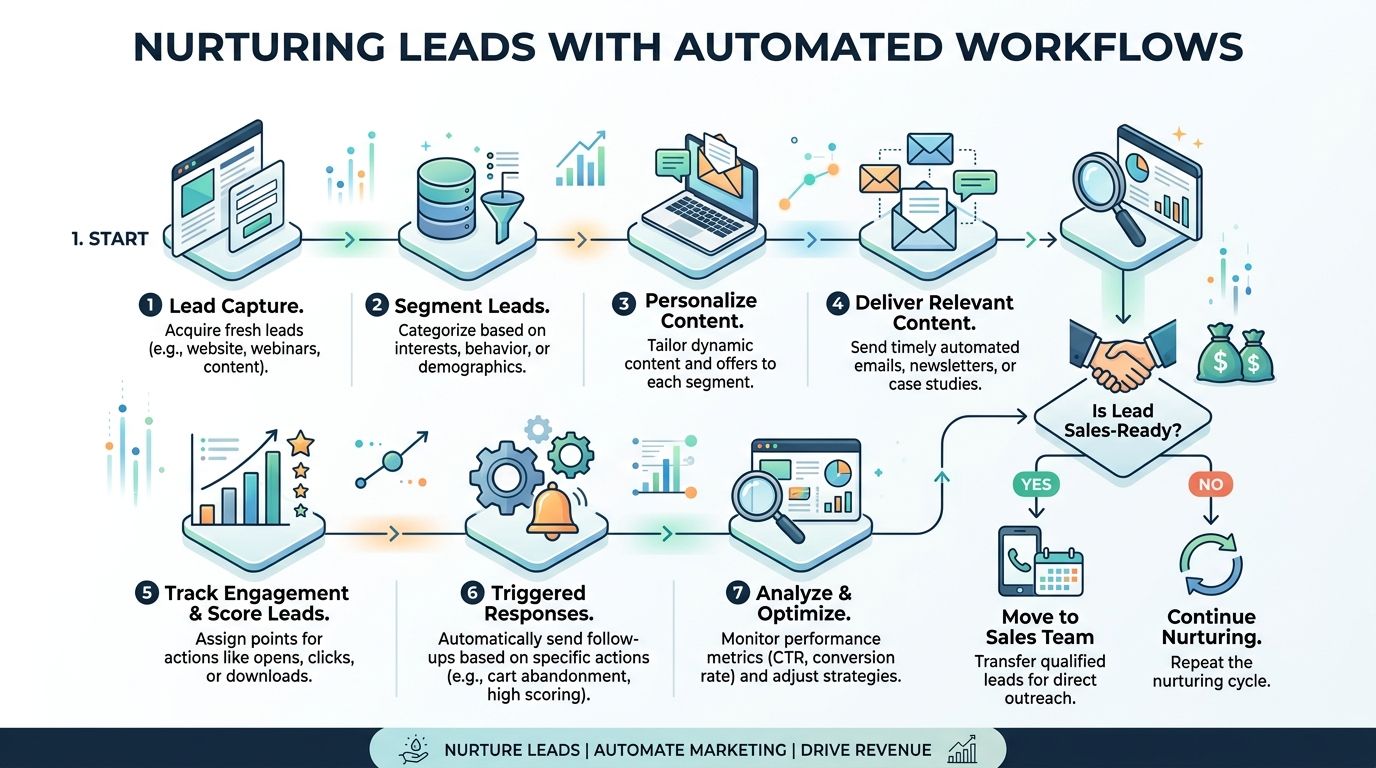
Every lead should enter a CRM with a source, a tag, and a stage. That lets the firm segment by interest and treat a retirement planning inquiry differently from someone asking about business-owner strategies. Segmentation keeps messaging relevant and helps staff avoid sending the same email to every contact.
A practical nurture sequence should stay short enough to read and long enough to build familiarity. The strongest structure is a series of educational emails that answer likely objections, explain one concept at a time, and end with a single next step. A steady cadence works better than a flood of generic messages.
An effective financial-advisor nurture campaign should be segmented by interest, include 5 to 7 emails over a few weeks, focus on education rather than selling, and include a strong call to action in each message. That structure gives the prospect time to learn without feeling pushed.
Email nurture works best when it is tied to a clear content path. A sequence built around financial advisor email marketing can keep the message consistent while giving each contact a logical next step.
Use automation to support, not replace, judgment
Automation should handle routing, reminders, and basic sequencing. It should not write the firm's entire personality or decide when a human conversation is needed. The strongest systems use automation to protect response time and consistency, then hand off to a real person once the prospect shows intent.
A useful workflow starts with confirmation, then education, then a specific offer. The first email confirms receipt and sets expectations. The next messages answer common questions and explain the issue in plain language. The final step offers a meeting or the next relevant resource. If there is no response, the system should keep the contact warm without becoming noisy.
Strong nurture feels like help, not pressure. The prospect should leave each message more informed than they were before.
A well-built CRM makes that possible because it turns follow-up into a visible process. No lead should sit in an inbox waiting for someone to remember it later. That kind of slippage undermines every acquisition effort that came before.
Integrating Compliance into Every Step
Compliance works best when it's part of the workflow, not the final gate that slows everything down. If marketing drafts go through review only after they've been built in the wrong direction, the team wastes time and the firm adds avoidable risk. A compliance-first process is faster because it removes rework.
Make review a built-in stage
The practical model is simple. Messaging is drafted against the ICP, reviewed for claims and disclosures, then approved before launch. That applies to ads, landing pages, emails, and any downloadable educational piece. When the review step is visible from the start, marketers stop treating compliance as a surprise.
Documentation matters just as much as approval. Teams should keep a record of what was published, when it went live, and who approved it. That record-keeping becomes useful when a campaign needs to be updated, reused, or audited later.
The discipline also improves execution quality. A team that knows a message will be reviewed tends to write more clearly, avoid unnecessary claims, and stay closer to the firm's actual value. That's good for regulators, but it's also good for conversion.
Speed comes from clarity, not shortcuts
The fastest compliance process is the one with the fewest ambiguous assets. Vague promises, broad performance language, and untidy disclosures create delays because they invite questions. Clear educational messaging is easier to approve and easier for prospects to understand.
There's also a cultural advantage here. When advisers, marketers, and compliance teams work from the same playbook, fewer campaigns get stuck in last-minute edits. That makes marketing more confident, and confidence shows up in better output.
The right goal isn't to market recklessly. It's to make compliant marketing so organized that the team can move without constant hesitation. That balance protects the firm and helps the pipeline stay active.
Measuring Performance and Optimizing for Growth
Traffic matters, but it does not pay the bills. Growth depends on the metrics tied to meetings and clients, especially cost per qualified lead, lead-to-meeting conversion rate, and client acquisition cost. Those numbers show whether the system is creating real business or just producing activity.
Track the numbers that reveal quality
A firm can generate plenty of leads and still struggle to grow if those leads are poorly matched or weakly nurtured. That is why conversion efficiency needs to sit at the center of reporting. A channel that produces fewer leads but more meetings may be the better investment, especially when compliance limits how aggressively a firm can market.
As noted earlier, the gap between average and top-performing conversion rates changes the entire operating model. When the conversion rate is low, the firm needs far more qualified leads to reach the same client target, which increases pressure on paid spend, follow-up, and sales capacity. The practical lesson is simple, quality beats volume when the goal is predictable growth.
A simple reporting rhythm helps. Review sources, meeting rates, and close rates by channel, then compare those results against the time and money each channel requires. The goal is to find the combination that produces the best-fit clients with the least waste, not the most names in a spreadsheet.
If a channel creates leads but not meetings, the problem usually sits in the offer, the targeting, or the follow-up. Often, all three need attention.
Optimize one variable at a time
Most campaign testing fails because too many things change at once. Better performance comes from isolating one variable, such as the offer, headline, audience segment, or follow-up sequence. That makes it possible to see what moved the result and what merely changed noise in the report.
Optimization should be steady, not dramatic. Keep the strongest channels active, cut the weak ones, and refine the steps between lead and meeting. Over time, that discipline builds a more efficient pipeline and a more predictable practice.
Measurement also gives leadership a clear basis for decisions. The team can see where the business is gaining traction, and marketing can defend budget with evidence instead of instinct. That is what a mature lead generation system looks like.
