
Most advisory firms already have the same problem. The inbox is full, the website gets traffic, and yet the pipeline stays thin because messages aren't built to earn trust, pass review, and move a prospect toward a conversation. Financial advisor email marketing works when it behaves like a disciplined client communication system, not a broadcast habit.
The firms that get it right treat every send as part of a compliance-first workflow. They collect permission cleanly, segment by real client context, write with restraint, and measure whether the right people take the next step. That's how email becomes a durable asset instead of a recurring risk.
Table of Contents
- Building Your Compliant Email Foundation
- Audience Segmentation for Maximum Relevance
- Crafting Compelling and Compliant Content
- Automating Your Outreach with Compliant Workflows
- Measuring Performance and Ensuring Deliverability
- Your Path to Sustainable Growth Through Email
Building Your Compliant Email Foundation
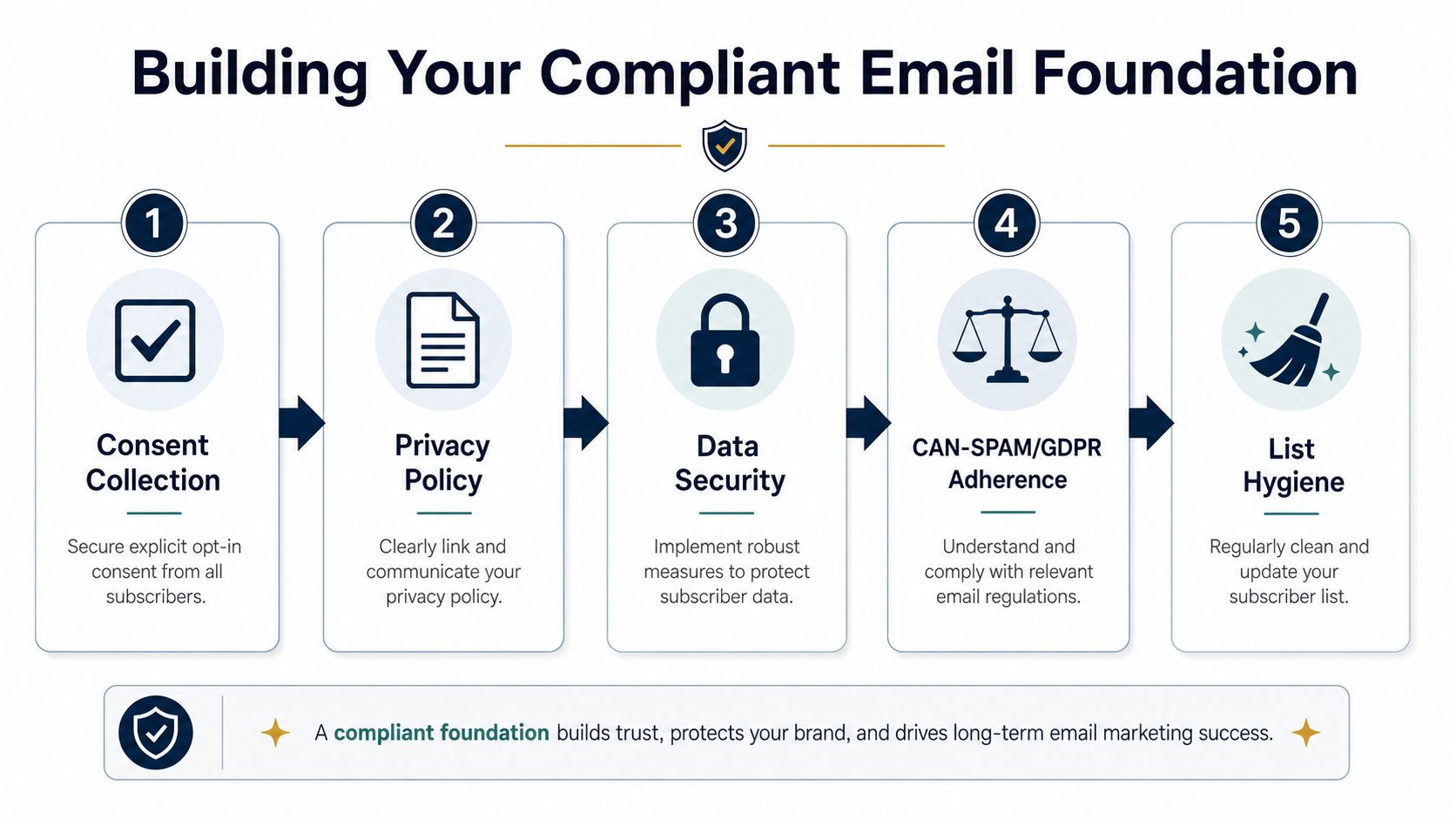
Many advisory firms face the same problem, a full inbox and website traffic that do not turn into a stronger pipeline. The fix starts with permission. A clean list built on explicit opt-in is the only sensible starting point for advisory email, because the list is the asset and the reputation behind it is the constraint. Purchased lists usually create the wrong kind of activity, low engagement, more complaints, and deliverability problems that are hard to reverse.
Build the list like a regulated audience asset
Signup forms should collect more than an address. At minimum, a firm should ask for a field that helps route the subscriber into the right future sequence, such as a primary planning concern, life stage, or profession. That one extra field is often the difference between generic newsletter drift and relevant communication that feels earned.
Practical rule: every new contact should enter the database with a clear reason for being there, a clear source of consent, and a clear path to relevant follow-up.
That structure matters because email quality depends on more than volume. Strong advisory programs keep list growth tied to service interest, educational content, and event signups, then separate contacts by lifecycle stage before the first campaign goes out. The result is a list that supports segmentation later instead of forcing a one-size-fits-all broadcast.
Keep hygiene and compliance tied together
A compliant foundation also includes privacy communication, secure data handling, and regular list cleanup. Bounces, unengaged contacts, and outdated records should not sit in the system indefinitely, because stale data distorts performance and weakens sender reputation. The operational mindset has to be simple. If a contact is not valid, active, or relevant, it should not keep shaping campaign results.
Relevance also reduces compliance friction. Clear permission records, consistent suppression rules, and simple preference management make reviews faster and lower the chance of sending to the wrong audience. That is the practical side of financial advisor email marketing, and it is why firms that treat consent and hygiene as part of the same workflow usually avoid more avoidable risk than firms that treat them as separate tasks.
Audience Segmentation for Maximum Relevance
A single list of clients and prospects hides too much. A pre-retiree, a young accumulator, and a physician with a concentrated compensation pattern do not need the same subject line, the same call to action, or the same level of technical depth. Segmentation turns the list into a set of audiences that can each receive a message worth opening.
Group people by decision context, not just demographics
The best segments come from financial context. That can include current clients, high-intent prospects, event attendees, or niche groups with distinct planning patterns. A household preparing for retirement income questions needs different framing than an early-career professional trying to understand cash flow, and that difference should show up in the email's angle immediately.
Many firms overcomplicate things. They try to build dozens of tiny groups before they've defined the few that matter most. Start with the questions that change the message, then add more detail only when the content library can support it. The goal is relevance, not administrative clutter.
Use client data carefully and deliberately
Good segmentation is not about collecting every possible field. It's about using the right fields to decide what gets sent, what gets delayed, and what gets suppressed. When content maps to life stage, planning concern, or engagement level, the email reads like a professional note, not a mass blast.
For firms looking for a practical content connection point, the article on financial advisor content marketing gives a useful companion lens on how email should fit into the broader messaging system. The fundamental discipline is consistency, because segmented lists only work when the sender keeps honoring the differences between groups.
Compliance-safe insight: segmentation should improve relevance first, and only then should it be used to increase response. If the content cannot be defended as useful for the recipient group, it probably doesn't belong in that segment.
Crafting Compelling and Compliant Content
Strong advisory email copy doesn't sound cautious because it's weak. It sounds disciplined because it knows the difference between education and promotion. The best messages explain, clarify, and invite, without leaning on vague promises or language that a reviewer would flag as exaggerated.
Write like a professional, not a headline machine
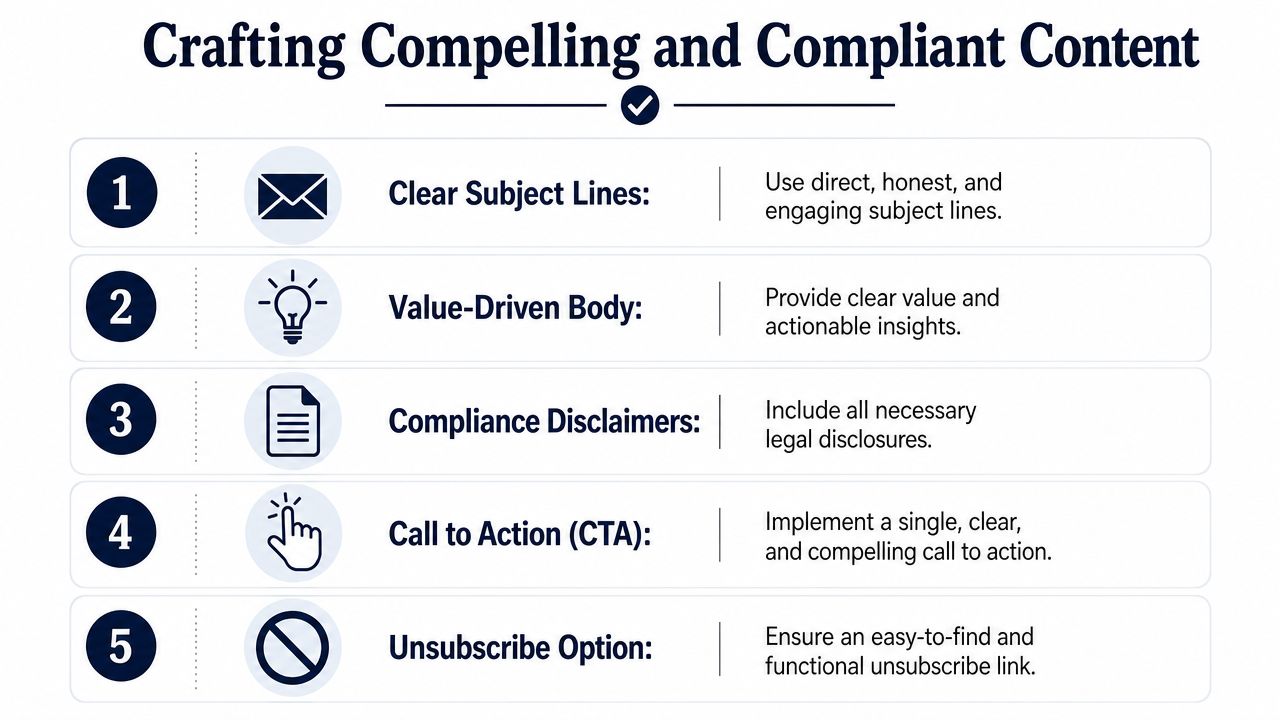
Subject lines should be clear enough to survive scrutiny and short enough to avoid truncation. Overly clever wording usually hurts more than it helps, especially when the email has to be reviewed by compliance before launch. A straightforward subject line that reflects the body content is safer and usually more credible.
For a practical creative reference, the subject line guide from Prompt Builder is useful because it reinforces the core discipline here, clarity beats gimmicks. A critical test is simple, would a busy recipient understand the point before opening it, or would the subject line feel like bait?
Keep the body copy educational and restrained
The body should deliver one clear idea, one practical takeaway, and one action. That action can be a webinar registration, a meeting request, or a resource download, but it should not try to do all three at once. Too many choices dilute response and create more review risk because the message becomes harder to defend as focused and fair.
A good rule is to say what the recipient can learn, what problem it helps solve, and what the next step is. A bad version sounds inflated, vague, or guaranteed. Compliance teams tend to catch that tone quickly, especially when the message suggests outcomes instead of describing process.
Treat disclosures as part of the message
For any email sent to a retail audience defined as more than 25 people, principal or CCO review is required before transmission, according to the compliance threshold outlined in the SEC Rule 206(4)-1 guidance for advisor email marketing. That review should confirm the presence of firm identity, registration details, unsubscribe access, and risk language where needed. It should also confirm that the email doesn't imply certainty where only probability exists.
The takeaway is not to bury disclosures in tiny print and hope for the best. The stronger move is to write the email so that the compliance language feels integrated, because integrated disclosures are easier to approve and easier to trust.
Automating Your Outreach with Compliant Workflows
A prospect downloads a guide on retirement income, then receives a welcome email, a follow-up with one useful next step, and a final invitation to speak with the firm. That kind of sequence works because it keeps the message tied to the stated interest and avoids improvisation after the trigger fires. Automation should reduce manual effort for the sender and keep the recipient in a path that compliance already reviewed.
Use simple triggers and predictable paths
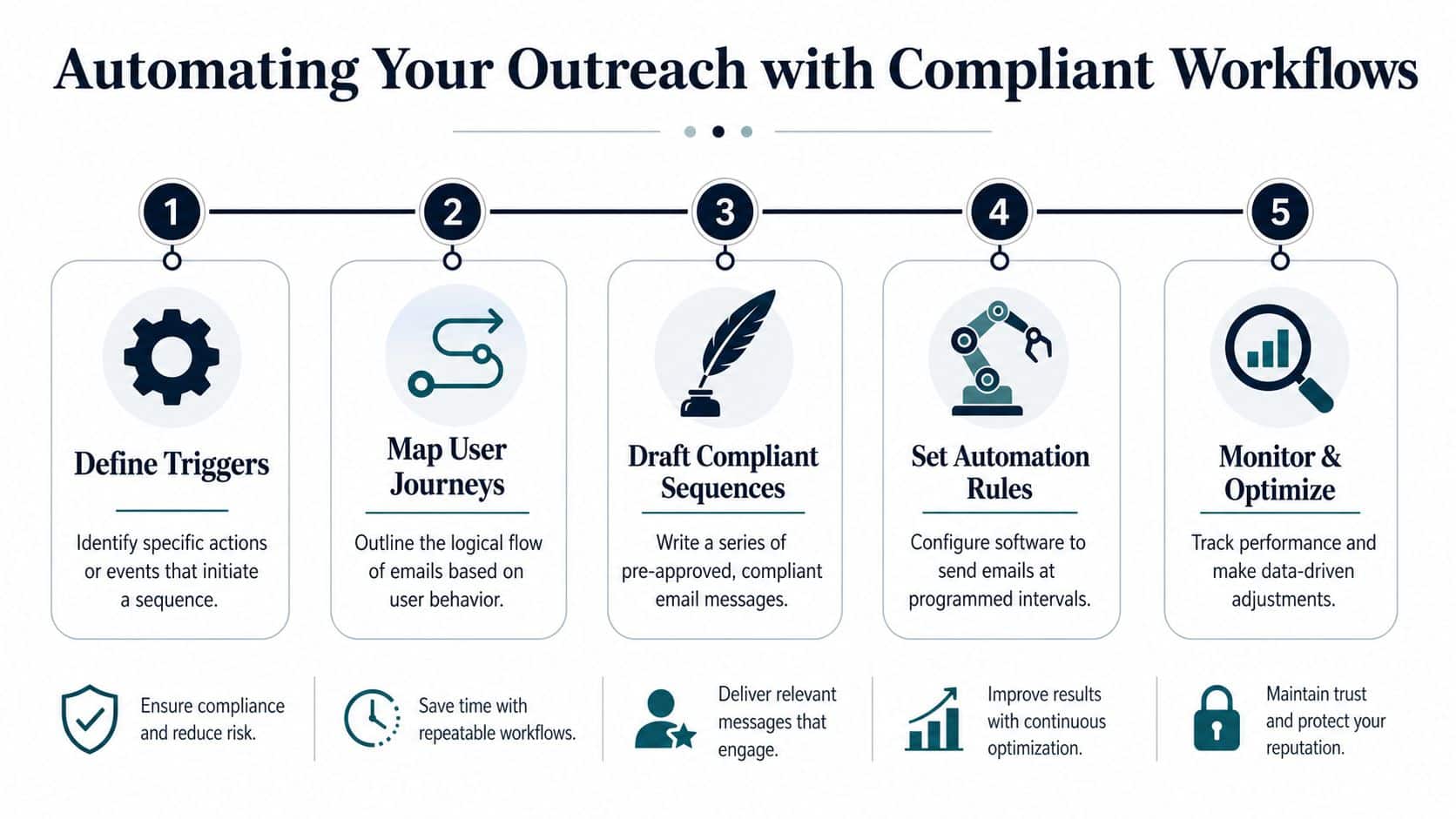
The cleanest automation starts with one clear event, such as a signup form, a webinar registration, or a guide download. Each next step should follow that stated interest, because the contact has already told you what kind of information they want. A new subscriber should not be pushed into a broad newsletter sequence before receiving the promised resource and a clear sense of what happens next.
A strong welcome series usually begins with delivery, then education, then a direct invitation to continue the conversation. That order respects the initial permission while still moving the relationship forward. The workflow can handle timing, but the content still needs review before the sequence goes live.
Pre-approve the sequence before launch
Efficient firms build sequences ahead of time, send them through review once, and keep them stable unless something material changes. That cuts down on back-and-forth and avoids treating automation like an informal drip campaign that never gets checked again. It also gives the recipient a more consistent experience, because the message stays aligned from one step to the next.
Approved automation is not a substitute for judgment. It is a way to apply judgment at scale.
For the operational side of that process, the client relationship management resource is a useful companion, because workflow only works when the contact journey is mapped cleanly. The right setup also makes it easier to pause a sequence when a prospect becomes a client or moves into a different service track.
Build for warm interest, not volume
Automation performs better when it speaks to people who already showed intent. That is where safe personalization matters most, because a firm can use the topic a contact selected, the content they requested, or the event they attended without crossing into unsupported claims. For advisors, the goal is not to sound clever, it is to stay relevant and defensible.
A useful way to approach this is through clean routing and prompt follow-up, not generic mass sends. That is also where best practices for developer emails can be a practical reference point, since sender reputation depends on stable lists, clear permissions, and consistent sending habits. In advisory marketing, the same discipline supports deliverability and lowers the chance that a helpful sequence turns into a review problem.
The benchmark data in the wealth management marketing benchmarks points in the same direction, with stronger results tied to engaged audiences and higher-intent offers. The lesson is simple. Make each automated step match the relationship stage, and keep the sequence short enough that compliance can approve it without hesitation.
Measuring Performance and Ensuring Deliverability
Email performance should be judged by movement, not applause. Opens matter, but replies, clicks, consult requests, and booked conversations matter more because they show whether the email changed behavior. A campaign that looks busy but doesn't move qualified prospects is just expensive noise.
Use the right benchmarks, then look past them
Institutional finance email programs should track open rates between 20% and 25%, click-through rates between 2.4% and 3.1%, and deliverability rates of 95% or higher, while wealth management open rates often average between 24% and 26% due to stronger relevance, according to the FMG Suite advisor email benchmarks. Those numbers are useful because they frame what healthy delivery and engagement look like in a regulated environment.
Still, a benchmark is not a strategy. A firm can hit a decent open rate and still fail to create consultations if the offer is weak or the call to action is unclear. That's why the better internal conversation is about which emails produce the next meaningful step, not which ones drew attention.
Protect deliverability as a core operational task
Deliverability depends on sender reputation, list hygiene, and consistency. Random sending patterns make systems look unstable, while stale contacts inflate bad signals and obscure what's working. A reliable schedule, even if it's modest, is usually better than an erratic one that spikes and disappears.
For the technical hygiene side, the best practices for developer emails provide a useful reminder that inbox placement is earned through clean sending habits, not clever wording. Advisory teams should apply the same discipline, because a message that never reaches the inbox can't be reviewed, read, or acted on.
Read the numbers as a risk-control tool
Low click-through rates can point to weak relevance, weak calls to action, or an audience that was segmented too broadly. Rising unsubscribes usually point to mismatched expectations or too much frequency. Poor response rates can mean the content is informational but not directional enough to support the next step.
The goal is to connect the metrics to the workflow. If a sequence is designed to generate consultation requests, then the primary question is whether the email moved enough qualified readers to take that action without raising review concerns. That's the standard that supports sustainable growth.
Your Path to Sustainable Growth Through Email
The firms that build durable email programs do a few things well and do them every time. They ask for permission, segment for relevance, write with restraint, review messages before launch, and measure whether the communication creates actual pipeline movement. That combination is what makes email a trust-building channel instead of a liability.
The next advantage is operational. Once the process is stable, advisory teams can use email to support broader funnels, connect educational content to client journeys, and keep prospects warm without improvising each send. For a deeper view of how email supports downstream conversion, the guide on create converting sales funnels is a useful companion because the email should never exist in isolation.
The future of advisor marketing belongs to firms that can combine relevance with control. The compliance standards aren't going away, and neither is the need to communicate clearly with people who are deciding whether to trust a firm with their financial life. The winners will be the teams that build systems strong enough to stay useful, reviewable, and human at the same time.
A CTA for Advisor Momentum.
