
A retirement post goes live on Monday. By Wednesday, the advisor team is already sharing it with prospects because the topic is timely and the language feels client-friendly. Then compliance spots a claim that needs to be softened, a disclosure that needs to move, and a phrase that reads too much like a promise. The post gets revised, resubmitted, and delayed long enough that the early SEO lift starts to fade.
That scenario is common because most content programs are built like they belong in ecommerce or SaaS, then handed to a reviewer at the end. Financial services content marketing does not work that way. In a regulated firm, the approval path is part of the strategy, not an obstacle to it.
The firms that get this right stop treating compliance as a final gate and start using it as an editorial design principle. That changes what gets written, how fast it moves, and how much trust it builds when it reaches market. It also makes the workflow easier to scale, because the review questions were anticipated before the draft was ever written.
Table of Contents
- Why Financial Services Content Marketing Demands a Different Approach
- The Core Concept Behind a Compliance-First Content Engine
- Segmenting Audiences Across Advisory and Banking Verticals
- Choosing Content Formats That Survive Compliance Review
- Designing the Editorial Workflow and Approval Process
- Distributing Content Through SEO, AEO, GEO, and Paid Channels
- Measuring ROI That Holds Up to Compliance and Finance Scrutiny
- Team Roles, Common Mistakes, and a 90-Day Rollout
Why Financial Services Content Marketing Demands a Different Approach
An advisor publishes a retirement-income article on Thursday. The first version gets traction because it answers a real question in plain English, and the team starts to feel momentum. Then compliance flags the draft after publication, the post is rewritten, and the firm has to decide whether to preserve the URL, rework the copy, or start over.
That is where generic content advice breaks. In a regulated business, a late-stage fix is not just a writing edit. It can create reapproval delays, split internal ownership, and waste the trust the article had already earned. The workflow itself becomes part of the marketing risk.
Practical rule: if a reviewer would object to the claim after publication, that objection belongs in the outline stage, not in the cleanup stage.
Financial services content has to do two jobs at once. It has to educate prospects clearly enough to earn attention, and it has to stay inside claim boundaries so it survives review. That's why the standard “publish faster” advice often backfires here, while a compliance-aware process usually speeds things up once the team gets used to it.
The broader category also rewards discipline. Financial services content averages 1 minute and 51 seconds of attention, up from 1:26 in 2018, which is a 29% increase in attention time year over year, and it also shows a 70% average engagement rate and a 52% average finish rate for finance-related content, according to industry reporting compiled by NYT Licensing and Contently's benchmark data (NYT Licensing financial content stats). That's a strong signal that readers will go deep when the topic is relevant and the structure is clear.
The lesson is simple. In this category, the content program succeeds when compliance is built into the editorial system, not bolted on after the draft is already doing its job. That's the difference between a workflow that stalls and one that keeps moving.
The Core Concept Behind a Compliance-First Content Engine
A compliance-first engine turns subject matter expertise into education-first assets with claim boundaries, disclosures, and review paths designed from the start. It is not a blog factory. It is a repeatable system for creating content that can be drafted, reviewed, published, and reused without triggering avoidable back-and-forth.
The four pillars
The first pillar is editorial planning with claim matrices. Each topic should be mapped to the exact claims, proof points, and prohibited language before the writer starts. Without that, writers guess, reviewers rewrite, and the program slows down.
The second pillar is compliant content formats. Some formats create far less risk because they reduce room for ambiguity. Question-led articles, short answer blocks, FAQ sections, and tightly scoped explainer assets make it easier to keep a draft reviewable.
The third pillar is approval workflow with parallel review. Marketing should not wait until one asset is fully approved before preparing the next draft. When drafting and reviewing happen in parallel, the team keeps momentum without weakening controls.
The fourth pillar is the measurement loop. A compliant content engine does not only track traffic or shares. It also watches conversion behavior, review friction, and which topics generate unnecessary compliance flags. That turns compliance from a cost center into a signal source.
A common mistake is to treat these pillars as separate disciplines. They are not. Strong planning makes review easier. Better formats reduce revision cycles. Faster approvals create more room for measurement. Measurement then feeds the next planning cycle.
A program that cannot explain its claims before drafting usually cannot defend them after drafting either.
For teams auditing their current setup, the key question is whether each stage has a named owner and a written artifact. If the answer is no, the engine is still improvising. A compliance-first model becomes durable only when the workflow is visible enough that both marketing and compliance can trust it.
Segmenting Audiences Across Advisory and Banking Verticals
A retirement-focused RIA and a branch-based retail bank do not buy content for the same reason. One needs planning education that builds confidence in a human relationship. The other often needs product education that reduces confusion and supports self-directed action. Treating them as one funnel usually produces content that lands halfway and converts nowhere.
Different audiences, different intent
Individual investors usually arrive with a problem they want explained in plain language. They are searching for clarity, comparisons, and next steps. That makes bottom-of-funnel education and buyer-enablement content more useful than broad awareness posts.
Business owners often need succession, benefits, or cash-flow guidance. Their trust signals tend to include practical specificity, operational relevance, and clear explanations of tradeoffs. Content that feels generic misses the point because it doesn't speak to the pressure they're under.
High-net-worth families are usually comparing advisors, not just reading about markets. They want credibility, judgment, and a sense that the firm understands complexity. In that segment, polished but shallow content tends to underperform because it doesn't show depth.
Bank customers typically want product education, process clarity, and reassurance. They respond to content that makes the next step obvious and removes friction. Institutional buyers, by contrast, evaluate platforms, operational fit, and proof of reliability, so the content has to sound more precise and less promotional.
A useful planning habit is to match each segment to three things, search intent, trust signal, and preferred format.
| Segment | Dominant intent | Trust signal that matters most | Content format that usually fits |
|---|---|---|---|
| Individual investors | Understand options | Plain-language guidance | Q&A article or explainer |
| Business owners | Solve a planning problem | Specific operational relevance | Buyer-enablement guide |
| High-net-worth families | Compare advisors | Depth and discretion | Pillar page or private-presentation asset |
| Bank customers | Learn a product | Process clarity | FAQ-led education page |
| Institutional buyers | Evaluate fit | Reliability and rigor | Structured solution brief |
The strategic shift is to stop asking, “What can the firm publish?” and start asking, “Which audience is closest to action, and what proof does that audience need before it moves?” That's why the smartest programs begin with trust-building content that helps a prospect compare options, not with broad awareness that sounds nice but sits too far from revenue.
Choosing Content Formats That Survive Compliance Review
The safest formats are not always the flashiest ones, and the flashiest ones are not always worth the review burden. The right mix depends on how much claim risk the team can manage, how much proof the format can carry, and whether the asset is likely to move a prospect forward.
What tends to work
SEC-compliant blog articles remain the backbone because they can answer a specific question in a controlled way. They are easier to review when they stay narrow, avoid sweeping promises, and use explicit disclosure placement. They also support search visibility better than vague brand prose.
Explainer video can work well when the script is reviewed before filming and the final cut stays close to that script. A compliant video is usually more effective when it explains one concept at a time instead of trying to cover every product benefit in one sitting.
Social posts can be useful, but only when they are calibrated to the channel and written as short, reviewable snippets. Financial services social has very different platform performance patterns, with average industry engagement rates reported at 3.8% on Instagram, 3.2% on LinkedIn, 3.1% on Instagram Reels, 2.1% on X, 1.8% on Facebook, and 1.6% on TikTok, according to Hootsuite's financial services benchmarks (Hootsuite financial services benchmarks). That reinforces the need to match message style to channel behavior instead of reposting the same asset everywhere.
What creates review drag
Interactive calculators can be powerful, but they create extra scrutiny when the inputs, assumptions, or footnotes are unclear. If the logic cannot be explained with ease, compliance will spend more time validating the experience than the marketing team spends building it.
Original research can earn citations in AI-generated answers and give a firm something unique to say, but it also requires stricter sourcing discipline. That trade-off is worth it only when the team can defend the methodology and keep the claims bounded.
A practical mix usually looks like this, one core article, one derived social or video asset, and one higher-effort asset only when the proof case is strong. For teams building that calendar, a content calendar planning guide can be a useful reference point for sequencing topics without losing editorial control. For advisors who want a stronger video play, this financial advisor video marketing resource fits naturally into the same planning conversation.
Rule of thumb: if the format creates more questions than the topic can answer, the format is too expensive for the idea.
The best portfolio in this category is usually not the most complex one. It is the one that can be reviewed cleanly, reused often, and tied to an actual conversion path.
Designing the Editorial Workflow and Approval Process
Compliance review feels slow when the workflow is built around handoffs, not around shared visibility. The fix is not to pressure reviewers harder. The fix is to make the approval process predictable enough that every role knows what happens next.
A workflow that keeps moving
Start with topic intake, where marketing records the audience, intent, and primary claim boundaries. Then move to claim matrix creation, which lists the exact statements that can appear, what proof supports them, and what language should be avoided.
Drafting comes next, but not in isolation. A legal or compliance pre-check can review the outline before the full draft is written, which prevents avoidable rework later. After that, routing should move in parallel, so one asset can sit with compliance while the next is already in draft.
A simple workflow table helps keep the system honest.
| Stage | Primary owner | Parallel reviewer | Compliance artifact |
|---|---|---|---|
| Topic intake | Content strategist | Compliance liaison | Intake brief |
| Claim matrix | Strategist or editor | Subject matter expert | Claim log |
| Drafting | Writer | Editor | Version history |
| Pre-check | Compliance liaison | Legal, if needed | Annotated outline |
| Final review | Editor | Compliance | Approval sign-off |
| Publish and archive | Operations or editor | Compliance liaison | Archived final copy |
The point of parallel review is not speed at any cost. It is to keep the next asset moving while the current one is being checked. In regulated content programs, that alone can make the team feel less blocked because everyone is working from the same queue instead of waiting in line.
Documentation matters just as much as tempo. Version history, reviewer sign-offs, and disclosure placement should all survive an exam or internal audit. The best archive is not fancy. It is complete enough that someone new can reconstruct what was approved, when it was approved, and why it went live.
For practical planning, the content calendar planning guide mentioned earlier is useful as a scheduling reference, but its true advantage comes from pairing calendar discipline with an effective approval chain. Once that happens, compliance stops feeling like a stop sign and starts acting like a quality filter.
Distributing Content Through SEO, AEO, GEO, and Paid Channels
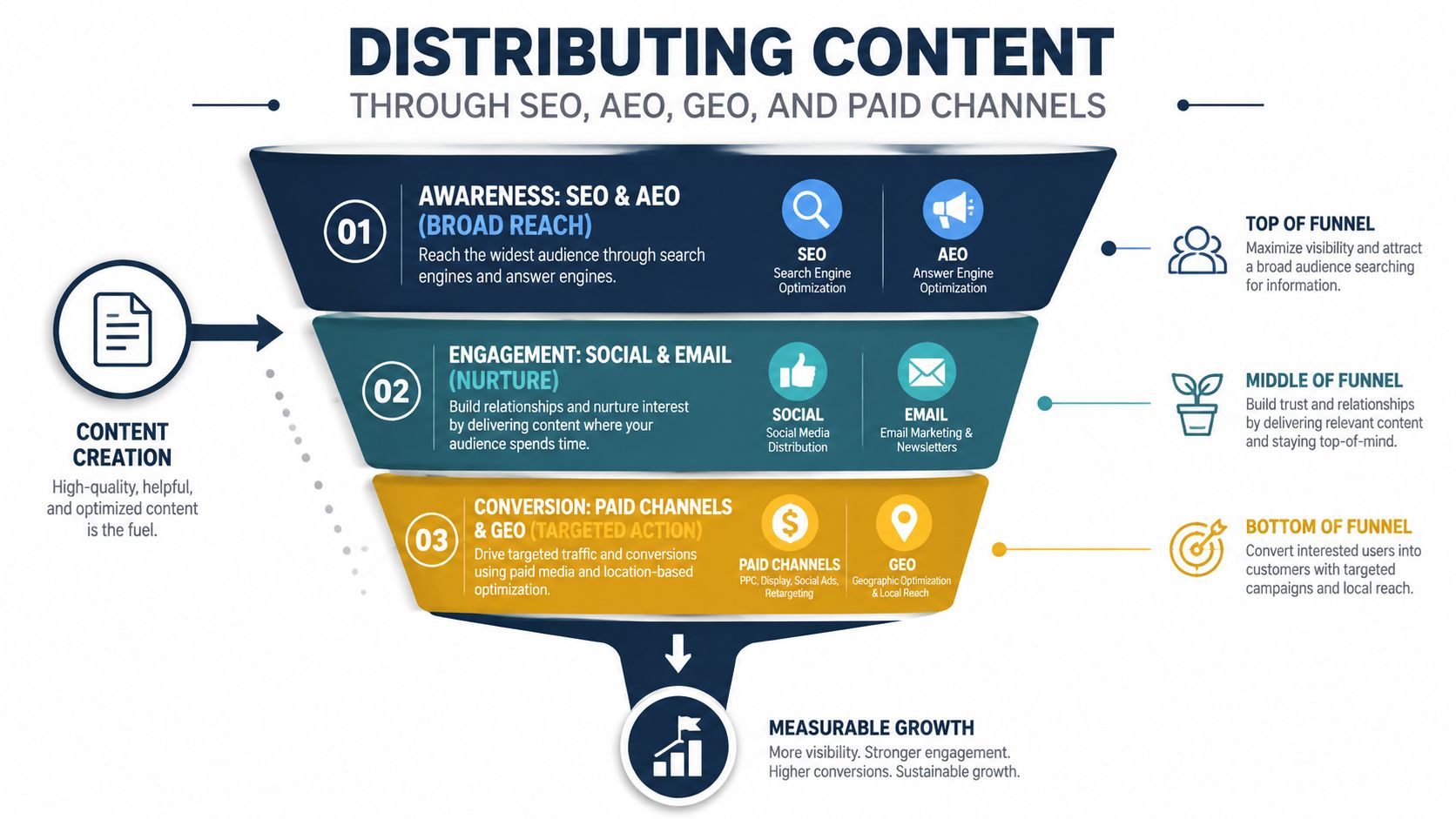
Most financial content programs fail because they publish into a vacuum. The asset gets approved, goes live, and then depends on luck. Distribution has to be planned before the content is written, or the firm ends up with a library that nobody sees.
Build the layers in order
SEO should carry the durable, intent-driven pages. That means structured articles, clear headings, and answer blocks that let both readers and crawlers find the point quickly.
AEO and GEO matter because search is no longer only about ranking blue links. Financial-services content should be built as machine-readable answer units, with concise 40- to 60-word answer blocks under question-style headings, plus FAQPage, Article, and FinancialService schema, named authors with verifiable credentials, and transcripts for every video or audio asset (AEO and schema guidance). That structure increases the odds that regulated content is indexed, surfaced, and reused in AI-generated answers instead of disappearing inside long prose.
Paid search still has a place for high-intent terms, especially where competition is intense. A 2024 analysis reported that financial services can account for over 14% of overall spending in online advertising, some keywords can cost $50 or more per click, and the average search conversion rate was 5.10% compared with 1.19% for display network ads, with an average $160 cost per lead (financial services content marketing analysis). Those numbers show why paid placement has to be reserved for the moments where intent is close to action.
Nurture after the click
Email and social belong in nurture, not as a substitute for a distribution plan. They keep the audience warm, reinforce the message, and give compliance-approved content a second life.
For teams trying to understand how AI search fits into this mix, the free guide from Surva.ai offers a useful way to think about discoverability without treating AI as a separate universe. A similar strategic lens also helps firms decide when to use internal channels and when to push more aggressively through paid placement.
Distribution should follow intent, not ego. High-intent pages deserve measurable placement. Educational pages deserve durable discoverability.
Advisor Momentum is one option for firms that want SEO, AEO, GEO, and paid distribution managed in a compliance-aware way alongside content production and website execution. The useful question is not which channel sounds newest, but which channel matches the stage of the buyer journey and the review cost of the asset.
Measuring ROI That Holds Up to Compliance and Finance Scrutiny
Traffic alone won't convince a finance leader, and it certainly won't reassure compliance. A regulated content program needs measurement that links editorial work to qualified leads, review friction, and downstream revenue influence. Otherwise, the team ends up defending pageviews instead of decisions.
What to track instead
The first useful report is the content-to-lead report, which shows which assets generated qualified actions, not just visits. That should include form fills, booked meetings, and any other conversion defined by the firm.
The second is the assisted conversion view, which helps longer-cycle advisors understand how educational content supports later action. A prospect may read three articles before reaching out, and that sequence matters even if the final conversion came through another channel.
The third is the compliance friction report, which tracks how often content gets flagged, what kinds of claims trigger edits, and where review slows the publishing queue. That report gives compliance a positive role in the dashboard because it shows risk reduction, not just veto power.
For firms with a longer sales cycle, attribution should stay practical. The goal is not to pretend every content touch can be measured with perfect precision. The goal is to show directional influence over 6 to 12 months and connect content to a real business outcome without overstating the result.
What should stay out of the review deck
Vanity metrics do not belong in a serious content review because they can't answer whether the program is working. Follower counts, raw impressions, and isolated pageviews usually distract more than they inform.
A better question is whether a piece helped a buyer move from confusion to contact. If the answer is yes, the content earned its place. If the answer is no, the team should examine whether the problem was the topic, the format, or the distribution path.
A good dashboard helps leadership decide what to publish next, not just what looked busy last month.
The right measurement frame protects both marketing and compliance. Marketing gets credit for useful work. Compliance gets evidence that the process is reducing risk. Finance gets a cleaner way to judge whether the content engine deserves more investment.
Team Roles, Common Mistakes, and a 90-Day Rollout
The fastest way to stall a regulated content program is to leave ownership vague. A content strategist owns the calendar, a compliance liaison keeps the review path sane, subject matter experts supply the nuance, and the editor protects clarity. Add a technical SEO lead and a producer for video or interactive assets, and the program starts to look like a system instead of a scramble.
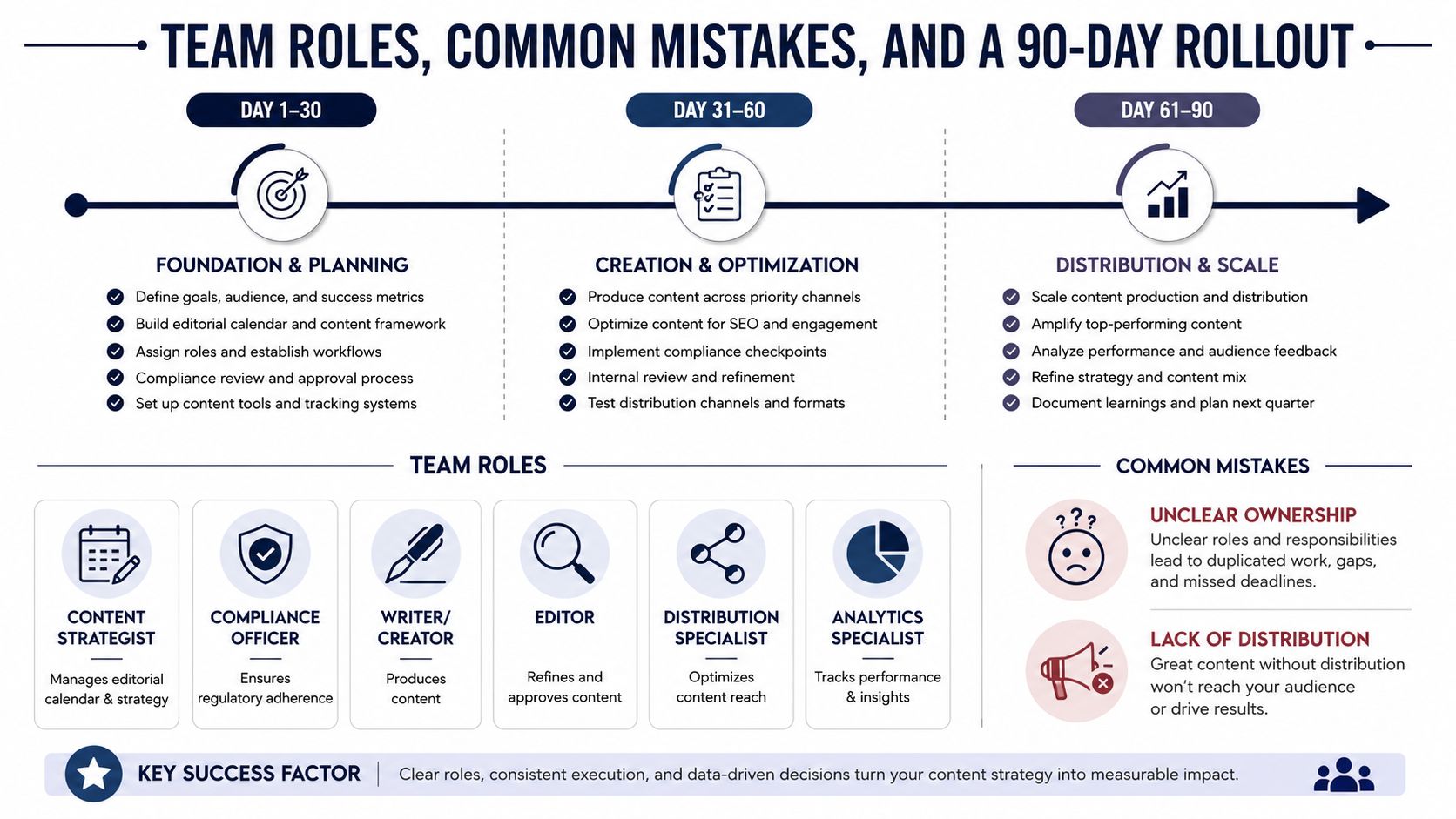
The most common mistakes are predictable. Unclear ownership makes every review feel political. Publishing without a claim matrix guarantees rework. Measuring only traffic encourages shallow content that feels active but doesn't move business.
A workable 90-day rollout usually starts with foundation work, then moves into the first compliant pillar set, then activates distribution and measurement. The order matters because content quality, approval logic, and channel planning need to be stable before the team asks for volume.
For firms that want execution support, Advisor Momentum offers compliance-ready website work, SEC-aware content programs, digital distribution, and coaching for financial advisors, planners, and banking teams. If the current workflow is slowing publication or creating unnecessary review churn, the next step is to visit Advisor Momentum and evaluate how a compliance-first content system could be built around the firm's own review process.
