
A marketing manager publishes a new webpage, a portfolio manager sends a performance summary, and an adviser updates a social profile. None of them changes the compliance manual, yet each action may create a regulatory issue if the message conflicts with Form ADV, lacks required disclosures, or can't be retrieved later. That daily disconnect explains why the question what is SEC compliance can't be answered with a checklist alone.
For a registered investment adviser, SEC compliance is a working system that connects governance, supervision, records, privacy, marketing, portfolio activity, and remediation. The firms that manage it well don't treat compliance as a final approval stamp. They build controls into the way people create, review, publish, store, and correct information.
Table of Contents
- What SEC Compliance Actually Means for Your Firm
- The Core Pillars of Investment Adviser Obligations
- Understanding Form ADV and Marketing Rules
- How Marketing Creates Hidden Compliance Risks
- Common Pitfalls and Enforcement Examples
- Practical Steps to Build a Compliance Culture
- Why Compliance-First Marketing Reduces Risk
What SEC Compliance Actually Means for Your Firm
SEC compliance is an operational control system, not a folder of signed policies. Under Rule 206(4)-7, registered advisers must adopt and implement written policies and procedures reasonably designed to prevent violations of the Advisers Act, review those policies at least annually, and appoint a chief compliance officer to administer them. The rule's focus is prevention and detection, so documentation alone doesn't demonstrate that controls work. The SEC's compliance-program rule explains that framework.
A practical program connects the firm's actual activities to specific controls. Portfolio management needs restrictions, reviews, and escalation paths. Trading needs supervision and records. Privacy and cybersecurity need safeguards that protect client information. Marketing needs review, approval, monitoring, and retention. Conflicts management needs disclosure and ongoing oversight.
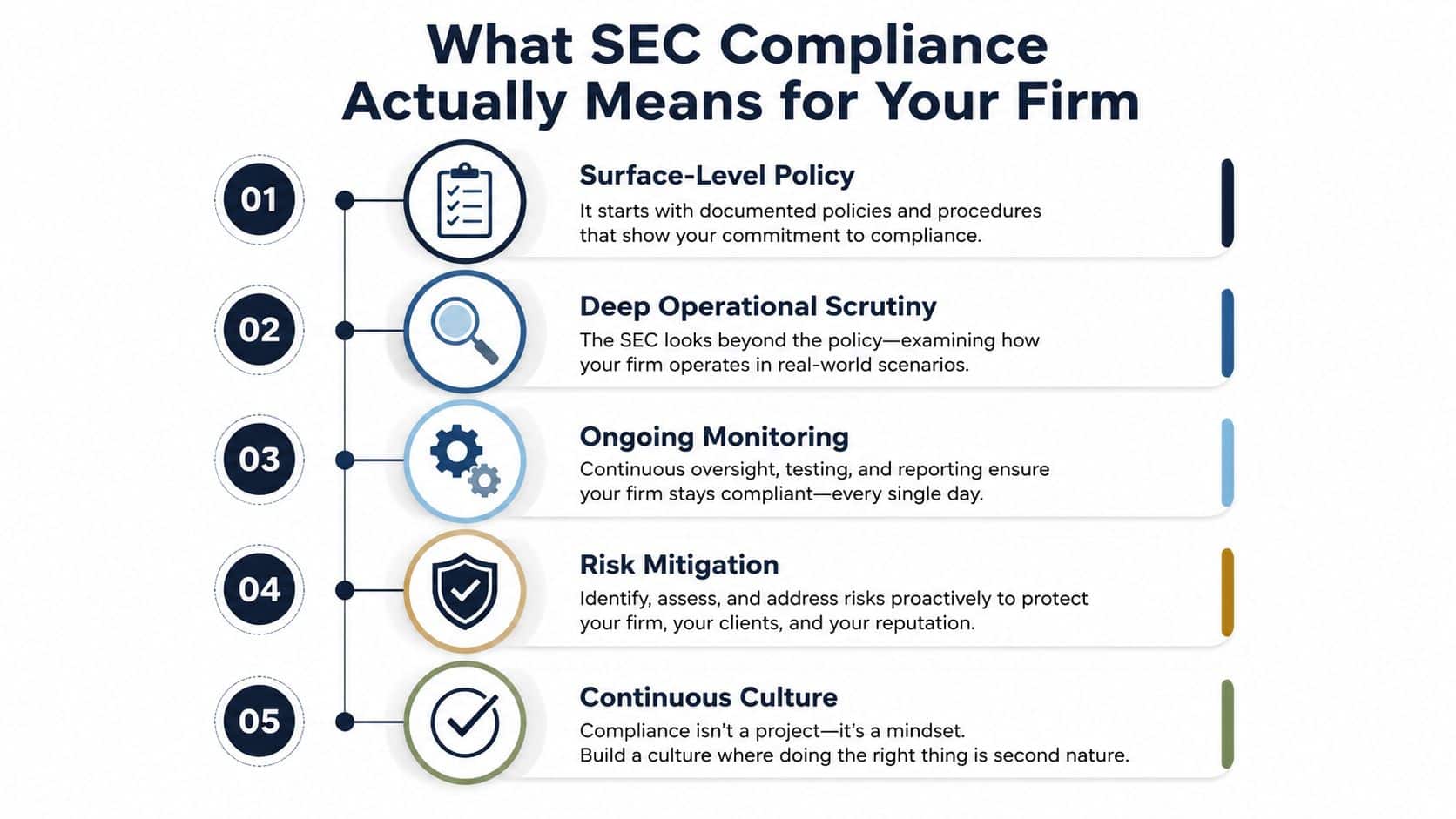
From written policy to working evidence
The SEC's modern compliance-program expectation became effective on February 5, 2004, with a compliance date of October 5, 2004. Those dates mark the formalization of an expectation that firms maintain written policies, conduct periodic reviews, and operate controls under Rule 206(4)-7. The SEC's final rule materials also show why compliance is a rolling calendar rather than a one-time certification.
For example, the privacy and safeguards regime was updated in August 2024. Larger covered entities received a December 3, 2025 deadline, while smaller entities, including advisers under $1.5 billion in AUM, received a June 3, 2026 deadline. Private fund advisers also face staggered requirements, including March 14, 2025 for quarterly statement and audit rules. These deadlines matter because a compliance calendar must assign owners, evidence, testing dates, and remediation steps.
Practical rule: A policy has value only when the firm can show who followed it, what the review found, and how the firm corrected gaps.
A useful comparison is the relationship between SEC compliance and internal audit SOX. The frameworks aren't interchangeable, but both illustrate the same operating principle: controls need ownership, testing, evidence, and follow-through. A CCO who can trace a marketing approval, annual review, exception decision, and corrective action is demonstrating an active program rather than passive intent.
The Core Pillars of Investment Adviser Obligations
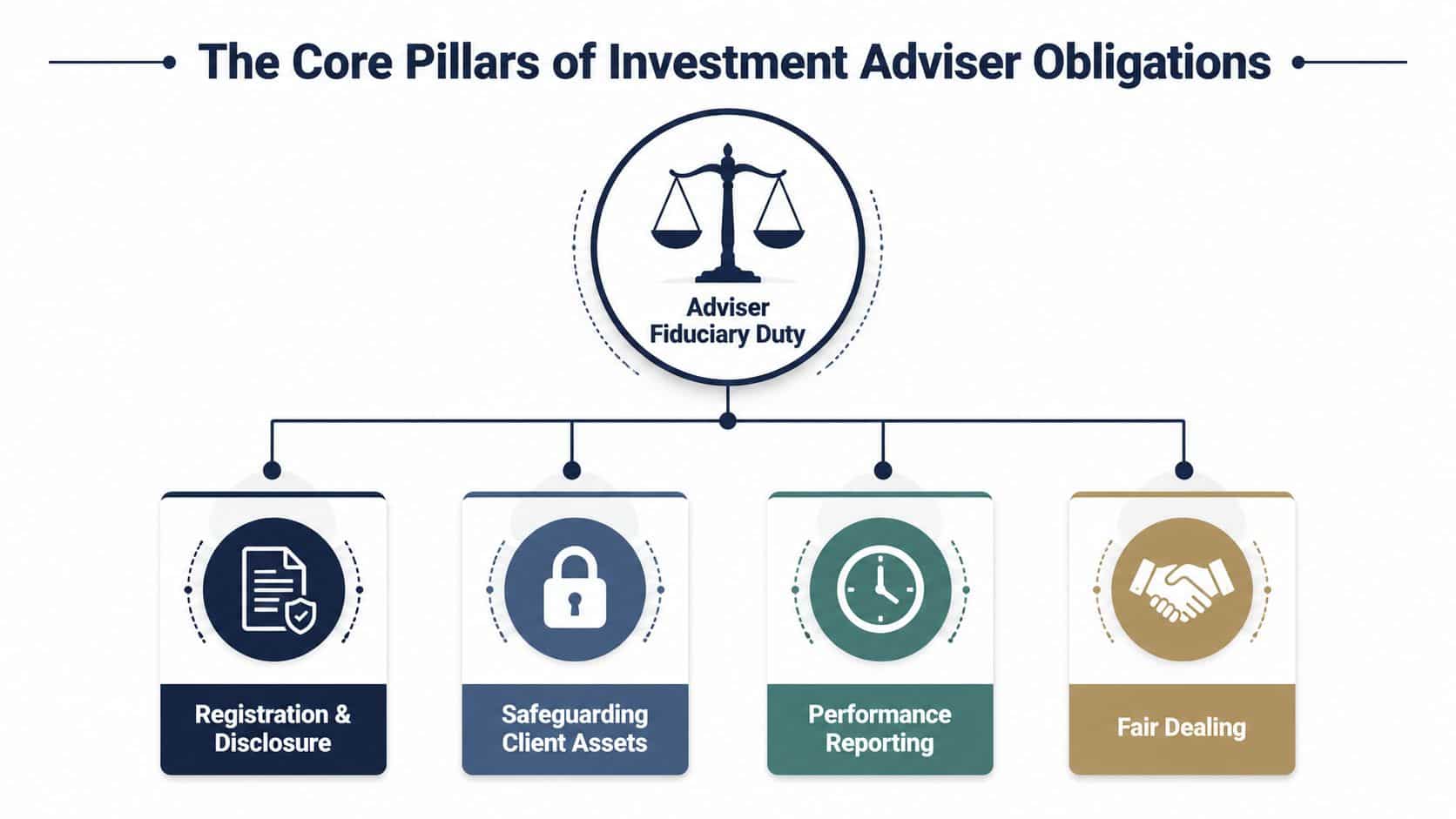
A website claim, social post, or client email can expose a weakness in the same controls that govern portfolios and client records. An adviser must protect client interests, information, assets, disclosures, and supervisory integrity. These duties overlap, so a marketing statement that outruns the firm's disclosures can create a broader compliance problem.
Governance creates the operating structure
Fiduciary duty sets the standard for decisions and communications. Advisers must put client interests first, identify conflicts, provide appropriate disclosures, and supervise conduct. Registration and disclosure make those responsibilities visible to clients and regulators. Form ADV, policies, contracts, website copy, social posts, and other communications should describe the business as it operates.
Safeguarding client assets extends beyond custody procedures. Access controls, vendor oversight, privacy practices, incident response, and employee procedures determine whether the firm can protect sensitive information and keep operations reliable. Cybersecurity belongs in the compliance risk assessment, not in a separate technology folder. A security failure can affect confidentiality, availability, supervision, and client communications at once.
Monitoring connects the pillars
Performance reporting needs support for calculations, presentations, and explanations. Fair dealing requires consistent treatment of clients and prospective clients when the firm distributes comparisons, testimonials, endorsements, ratings, or performance information. Content operations should connect these materials to their source records and approval history.
A practical program assigns each obligation an owner and a review activity:
- Disclosure accuracy: Compare website statements, social content, and client materials with current filings and approved descriptions.
- Supervisory accountability: Give the CCO and operating managers clear escalation responsibilities.
- Information protection: Review access, vendors, retention, and incident procedures together.
- Performance support: Preserve the records and methodology behind every presentation.
- Fair dealing: Test whether communications could mislead a reasonable audience.
A document is only one piece of evidence. The CCO should confirm that it reflects current services, employees follow it, and the firm can produce review records when an examination tests how marketing and operational controls work in practice.
Understanding Form ADV and Marketing Rules
Form ADV is the firm's public disclosure baseline. An SEC-registered adviser must file an annual updating amendment no later than 90 days after the end of its fiscal year. A firm with a December 31 year-end therefore must file by March 30 of the following year. The SEC's IARD filing guidance identifies this annual filing mechanic.
The filing cycle should begin before the deadline. A practical workflow assigns owners to ownership information, services, disciplinary history, business practices, conflicts, and other disclosure items. Each owner confirms what changed, supplies evidence, and explains why the public description remains accurate or needs revision.
Marketing review then uses the updated disclosure as a reference point, not as a document that sits apart from content production. A website statement about specialization, services, conflicts, performance, or client experience should be consistent with the firm's filed disclosures and supporting records. Firms often benefit from maintaining a controlled message inventory, which lists approved claims, required qualifiers, source evidence, owner, approval date, and review status. Guidance on Form ADV Part 2A can help teams think through the relationship between narrative disclosure and public presentation.
Treat every channel as business communication
The SEC Marketing Rule applies to advisers registered or required to be registered under Section 203 that directly or indirectly disseminate advertisements. That can include communications to prospective clients or private fund investors, as well as certain communications to current clients.
The operational question isn't whether a message looks like an advertisement. It is whether the firm can identify what was communicated, who approved it, what evidence supports it, and whether the required disclosures accompanied it. That includes website pages, email campaigns, social posts, presentations, event materials, and other electronic communications related to advisory business.
Books-and-records obligations under Rule 204-2 require advisers to preserve business records, including client communications, advertising materials, performance records, and other advisory documents, for at least five years, with the first two years kept in an easily accessible place. The SEC's marketing-rule release provides the relevant regulatory context. Retention isn't an afterthought. It should happen as part of approval and publication.
How Marketing Creates Hidden Compliance Risks
A firm can have a polished manual, annual signatures, and a diligent CCO while its public content tells a different story. The website may promise a service that Form ADV doesn't describe. A social post may repeat a performance claim without its supporting context. A repurposed testimonial may lose the disclosure that made the original communication acceptable.
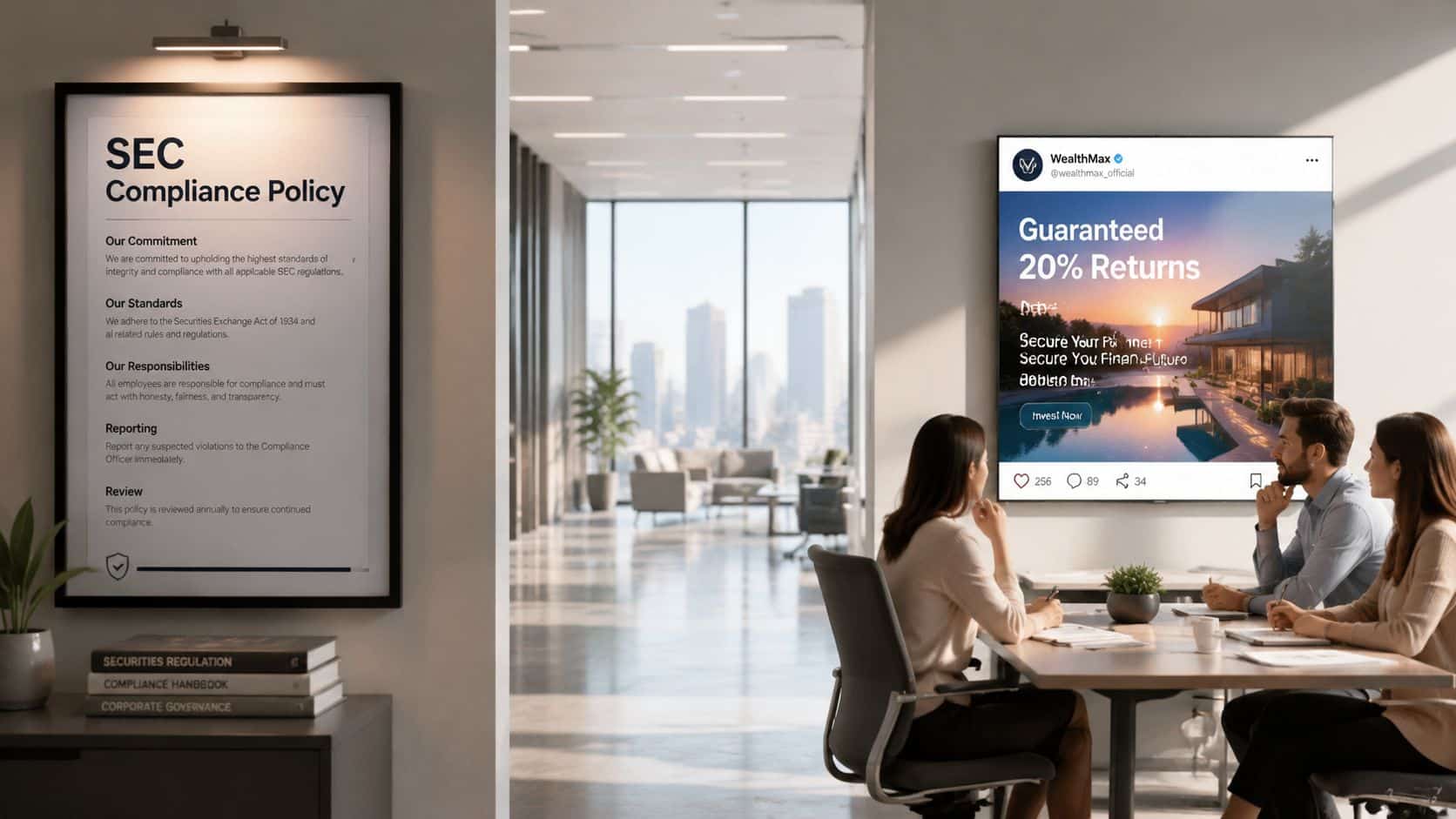
The live-document problem
Marketing content changes faster than formal policies. Someone edits a headline, adds a client quote, updates a rating badge, or turns a long article into several social posts. Each change can alter the impression a reasonable audience receives. A final PDF approval won't control content that continues evolving in a website editor, scheduling queue, or shared document.
The SEC Marketing Rule FAQ was updated on January 15, 2026, and a later Division Risk Alert, updated June 9, 2026, highlighted recurring examination issues involving testimonial and endorsement disclosures, due diligence, and third-party ratings. Those materials point to a practical reality: the difficult work often happens in daily content operations, not in drafting the policy.
A paid testimonial or endorsement also requires a specific screening step. The SEC states that an adviser may not compensate a person for a testimonial or endorsement when the adviser knows, or should know, that the person had a disqualifying event within the prior 10 years. The SEC's small-business marketing guide describes that bad-actor restriction.
What works versus what fails
| Workflow choice | Operational result |
|---|---|
| Centralized intake and approval | Reviewers see the audience, claim, evidence, disclosure, and final version together. |
| Separate review for every repurposed format | A short post doesn't inherit assumptions from a longer approved article. |
| Archived final communication | The firm can show what was published and when. |
| Informal approval by message | The firm may struggle to prove scope, version, or supervisory judgment. |
| Publish first, reconcile later | Unsupported claims and inconsistent disclosures can remain live. |
The first post-Atkins Marketing Rule enforcement action in September 2025 centered on allegedly inconsistent website claims about conflicts of interest, according to a review of SEC enforcement against investment advisers. The lesson isn't that websites are uniquely dangerous. It is that public content must remain synchronized with the firm's formal disclosures and conflict controls.
Common Pitfalls and Enforcement Examples
A firm may complete annual testing, approve marketing, and review conflicts, yet still miss the operational risk. Its website may describe objective advice while current arrangements create a conflict that the public language does not explain clearly. The compliance binder appears complete. The live content tells a different story.
Website copy, social posts, and presentations require the same control discipline as formal filings. Each claim needs an owner, supporting evidence, approval, and a record of the version that reached the public. A change in services, ownership, compensation, or conflicts should trigger a review of related communications, including Form ADV disclosures.
Performance material creates another recurring weakness. A presentation may show favorable results while the firm cannot identify the calculation method, source records, assumptions, or audience-specific disclosures. Mathematical accuracy alone does not resolve the risk. Omission, selective context, or a headline that creates a stronger impression than the supporting material can also mislead.
Examination patterns reveal process weaknesses
Regulators can identify these gaps through requests for records, approvals, policies, communications, and evidence of review. The same breakdowns appear repeatedly:
- Unclear ownership: Employees do not know who approves a claim or escalates a conflict.
- Incomplete supervision: The policy requires monitoring, but the firm cannot produce the completed review.
- Stale disclosure: Public language no longer reflects services, ownership, or business practices.
- Unscreened promoters: The firm pays for an endorsement without completing the required eligibility review.
- Vendor blind spots: A third party publishes or stores content without a defined supervisory process.
- Fragmented records: Final posts, drafts, approvals, and disclosures remain in disconnected locations.
Private fund advisers show why compliance calendars must track more than annual filings. As noted in the SEC's final rule materials, staggered compliance dates can apply to quarterly statement and audit rules, including March 14, 2025. A firm that tracks only recurring filings can miss duties triggered by fund structure, communication type, or a rule transition.
The recurring failure is often a process that stops at approval and never verifies publication, retention, or consistency.
The response should match the failure. A stale webpage requires a content inventory and a named owner. An unsupported performance claim requires source validation and approval controls. A missing record requires channel capture and retention testing. Rewriting the policy without changing the workflow leaves the underlying weakness in place.
Practical Steps to Build a Compliance Culture
A compliance culture becomes visible in routine work. Employees know which claims need evidence, managers understand escalation, and the CCO receives information early enough to act. The following workflow gives firms a practical starting point.
Build the review cycle around the business
- Map the firm's activities. List advisory services, portfolios, trading, client communications, marketing channels, vendors, privacy processes, and conflicts. The map should reflect what employees do.
- Assign control owners. Give each activity a responsible person, reviewer, evidence standard, escalation path, and testing date. The CCO administers the program, but operating managers must own the controls in their areas.
- Run the annual review as testing. Compare procedures with current operations, sample communications, inspect approvals, review exceptions, and document remediation. Don't reduce the exercise to a policy signature.
- Train at the point of work. Marketing staff need examples of supportable claims and disclosure placement. Advisers need guidance on conversations and outreach. Operations staff need retention and escalation procedures.
A controlled documentation process helps preserve consistency when policies, checklists, and standard operating procedures change. Teams developing that process can use an auto-sync documentation platform guide as a reference for keeping procedures current and connected to actual workflows.
Add feedback instead of waiting for an exam
Create a simple exception log. Record the issue, affected content or process, owner, decision, corrective action, and closure evidence. Review recurring exceptions with leadership, because repetition may indicate a design flaw rather than employee carelessness.
Technology can assist with version control, approval routing, searchable archives, access management, and reminders. It can't decide whether a claim is misleading or whether a conflict disclosure is sufficient. Human judgment remains essential, but a reliable workflow makes that judgment visible and repeatable.
Leadership accountability completes the loop. Firm owners should ask for unresolved exceptions, overdue reviews, and changes in business activity, not only confirmation that policies exist.
Why Compliance-First Marketing Reduces Risk
Marketing and compliance don't need to compete for control of the publishing calendar. They should share the same intake process. When the creative team submits the audience, objective, claim, evidence, disclosure, channel, and expiration or review trigger at the start, the compliance reviewer can evaluate the actual communication instead of reconstructing its context later.
That approach changes the trade-off. A rushed review may appear faster, but it often creates revisions, takedowns, missing records, and uncertainty about what was approved. A structured review can require more discipline at intake while reducing avoidable back-and-forth because the reviewer receives the information needed to make a decision.
Turn approval into a reusable system
Centralized workflows should preserve the final version, approval history, supporting evidence, required disclosures, and publication details. They should also distinguish a new communication from a derivative one. A short social post, video caption, email subject line, or landing-page headline may need its own review because format and audience can change the message.
The strongest content programs connect marketing language to the firm's actual disclosures. They maintain a claims library, flag performance and conflict language for enhanced review, screen testimonials and endorsements, and archive communications from every relevant channel. That structure supports speed because approved building blocks can be reused without losing oversight.
Advisor Momentum provides compliance-oriented content, website management, social media content, video production, and marketing services for financial advisors and banking teams. Its financial services content marketing resource is relevant for firms evaluating how editorial production can fit within an SEC-aware workflow.
The central answer to what is SEC compliance is operational: the firm identifies risk, assigns responsibility, supervises conduct, preserves evidence, and corrects weaknesses. Marketing sits inside that system. Website copy, social posts, performance claims, testimonials, and Form ADV disclosures need to tell the same story, because regulators and prospective clients encounter the public version first.
Advisor Momentum offers compliance-ready website development, SEC-aware content programs, video production, advertising, coaching, and recruiting support for financial advisors and banking teams. Visit Advisor Momentum to discuss a marketing workflow that supports growth while keeping review, disclosure, and records connected.
