

An advisor can launch a polished website, approve every headline, and still discover that prospects can't find the right service, compliance can't trace the source of a claim, and search systems can't understand what the firm offers. The site looks finished, but it behaves like a brochure with no operating process behind it.
That problem comes from treating website design and content management as separate assignments. Design controls how visitors move, trust, and inquire. Content management controls who can update claims, approve disclosures, preserve versions, and keep information findable. For an RIA, wealth manager, or bank team, those functions need to work as one compliance-ready conversion system.
Table of Contents
- Why Advisor Websites Fail Before Content Even Starts
- Planning Site Architecture and UX That Converts Advisory Clients
- How to Choose the Right CMS for Regulated Advisory Firms
- Building and Launching a Compliance Ready Website Without Rework
- Running a Content Program That Stays Compliant and Visible in Search and AI Answers
- Your Next 90 Days to a Higher Converting Compliant Presence
Why Advisor Websites Fail Before Content Even Starts
A firm can approve a polished redesign, replace the photography, shorten the navigation, and add a prominent consultation form. Months later, prospects still encounter duplicate service descriptions, outdated biographies, unclear disclosures, and no reliable process for reviewing pages after publication.
The failure starts before visual execution. Screens were designed without deciding which information matters, who owns it, how claims are approved, or what visitor decision each page should support. For an advisory firm, those decisions also determine whether the site can preserve evidence of review and provide a consistent source of truth for search systems and AI answer engines.
A prospective client arrives with a question, not a desire to admire a layout. They may want to know whether the firm serves business owners, how planning works, which credentials apply, or what happens after an inquiry. If vague labels, duplicated pages, or an under-explained form create friction, visual polish will not repair the experience.
The brochure problem
Advisory firms often organize websites around internal language. “Our philosophy,” “solutions,” and “insights” may be familiar inside the firm, yet they do little to help an outside visitor choose a next step. A stronger structure connects each audience to a relevant problem, a clear service explanation, supporting evidence, and a compliant action.
The site also needs to communicate consistently beyond the visible interface. Clear page titles, structured service information, defined entities, and controlled terminology help search engines and AI systems interpret what the firm offers. That machine-readable layer should reflect the approved content, not create a second version of it.
Content operations require the same discipline. Each page needs a named owner, a source record for material claims, an approval status, and a review trigger. Those controls matter for SEC-aware governance because disclosures, credentials, performance-related language, and testimonials can change independently of the page design. Without them, accurate content becomes difficult to maintain and harder to defend.
Practical rule: A page is not complete when it looks approved. It is complete when the firm can identify its owner, support its claims, record the approval, and schedule the next review.
What a durable system includes
A compliance-ready program brings several decisions together:
- Architecture: Organize pages around audiences, services, questions, and journeys.
- Component design: Build reusable modules for disclosures, calls to action, credentials, forms, and proof.
- CMS governance: Set role-based permissions, review states, naming standards, version history, and publication controls.
- Quality assurance: Test accessibility, forms, links, structured content, and high-traffic templates before expansion.
- Measurement: Track internal search failures, duplicate assets, publishing time, review exceptions, and conversion on critical templates.
- Source control: Connect approved claims to the pages, fields, and structured data where they appear.
Hosted and open-source CMS options vary widely in market share, publishing controls, and governance requirements. The platform choice therefore affects more than editing convenience. It shapes permissions, auditability, structured content, and the firm's ability to keep a machine-readable source of truth aligned with the public site.
The right question is whether the firm can publish useful answers, preserve review evidence, keep claims current, and move a qualified visitor into a compliant conversation. A modern design supports that system. It cannot replace one.
Planning Site Architecture and UX That Converts Advisory Clients
Strong architecture starts with decisions, not page names. Before anyone draws a wireframe, the firm should identify its priority audiences, the questions each audience asks, and the action that should follow a useful answer.
A business owner exploring succession planning needs a different path from an existing client seeking a service update. A bank customer comparing advisory options needs clarity about access, scope, and next steps. The site should make those paths visible without forcing every visitor through the same funnel.

Start with page purpose
Every page should answer four questions:
- Who is this for? Define the audience in language that matches the visitor's situation.
- What decision does it support? A page may clarify a service, establish credibility, answer an objection, or prepare someone for contact.
- What evidence belongs here? Use credentials, process detail, educational material, or carefully reviewed client language where appropriate.
- What is the compliant next step? Offer a conversation request, scheduling path, educational resource, or another action that fits the firm's process.
This prevents the common habit of creating pages because a competitor has them. If a page doesn't serve a defined audience or decision, it may add maintenance without adding clarity.
Build a hierarchy visitors can predict
The primary navigation should reflect the firm's external promise rather than its internal departments. A practical structure often includes audience or service pathways, an explanation of the firm, an educational resource area, and a clear contact route. Secondary navigation can carry disclosures, privacy information, accessibility details, and other required material without hiding essential trust information.
Service pages should be modular. A reusable page can contain the problem addressed, who the service fits, how the process works, common questions, limitations or disclosures, and a clear inquiry action. Those same answer blocks can support search results, site search, chat experiences, and internal support workflows when the content is written as direct, self-contained information.
Design forms as controlled handoffs
A form is part of onboarding, not merely a marketing widget. It should collect only information needed for the next human step, explain what happens after submission, and route the inquiry to an accountable owner. Confirmation messages should avoid promises the firm can't guarantee and should point users toward appropriate disclosures or scheduling information.
Wireframes should also show where disclosures appear. Adding legal language after the design is approved usually creates awkward spacing, tiny text, or confusing interruptions. Compliance reviewers should see representative templates early, including a service page, team page, article, testimonial area, and contact flow.
The best sitemap creates a calm progression: recognition, relevance, evidence, understanding, and action. That sequence supports conversion without pushing visitors faster than their trust allows.
How to Choose the Right CMS for Regulated Advisory Firms
A CMS for an advisory firm is part of the compliance operating model. It controls who can draft, review, approve, publish, revise, and retire information. Evaluate ownership, permissions, version history, approval states, security maintenance, portability, and the technical support required for routine changes.
Choose the architecture around governance needs. A hosted visual builder reduces infrastructure work and can suit a small marketing team, but confirm its approval controls, export options, structured content, form settings, and audit visibility. An open-source, extensible system supports custom content types, resource libraries, and integrations, while updates, extensions, hosting, and accountability require named owners. A headless or composable setup distributes structured content across channels and supports machine-readable publishing, but it needs stronger engineering support and careful implementation.
Compare the operating trade-offs
| CMS approach | Operational strengths | Governance trade-offs | Suitable use |
|---|---|---|---|
| Hosted visual builder | Managed infrastructure, accessible visual editing, lower maintenance burden | Approval workflows, exports, structured fields, form controls, and audit records may be limited | Smaller teams with straightforward publishing needs |
| Open-source extensible system | Custom content types, integrations, resource libraries, and broad implementation options | Extensions, patches, hosting, permissions, backups, and rollback require disciplined ownership | Firms with defined technical support and varied content requirements |
| Headless or composable system | Structured content can feed websites and other channels through controlled outputs | Higher implementation complexity, engineering dependency, and testing requirements | Firms building a machine-readable content source across several experiences |
The right choice is the system the firm can govern during staffing changes, redesigns, and content growth. Market prevalence may inform implementation risk, but it does not establish compliance suitability. Usage figures in the 2026 CMS market share dataset indicate adoption, not whether a system supports the firm's review controls.
Ask vendors questions that expose future friction
Use a written evaluation checklist:
- Who can publish? Can writers draft while designated reviewers approve, and can publishing rights be restricted by content type?
- What gets recorded? Does the system preserve versions, authorship, status, approval decisions, and publishing history?
- How are assets organized? Can reviewers locate the source document, approved image, current disclosure, and related expiry or review information?
- What happens during a redesign? Can content remain separate from presentation so the firm avoids re-entering approved material?
- How are extensions governed? Is there a documented process for updates, testing, backups, vulnerability response, and rollback?
- Can the site serve machines as well as people? Check semantic output, structured fields, accessible markup, stable URLs, canonical controls, and clear relationships between services, people, articles, and disclosures.
The CMS should produce one controlled source of truth for human readers, search engines, and AI answer systems. That requires consistent fields, stable page relationships, descriptive metadata, and approval records that show which version is current.
Platform usage can change, so avoid selecting a system solely because it dominates the market. W3Techs' technology history overview illustrates that market position shifts over time. The practical test is simpler: can the firm maintain compliant content, prove who approved it, and publish structured information without creating new technical or regulatory friction?
Building and Launching a Compliance Ready Website Without Rework
Rework usually appears between design approval and production. A page may look correct in a design file while its live component omits a disclosure, handles a form without a clear owner, or exposes different content in another template. A staged build catches those failures while changes remain affordable.
Build the system before the pages
Start with a design system and component library. Define typography, spacing, buttons, cards, alerts, forms, disclosures, navigation states, and article layouts before producing individual pages. Document each component's accessibility behavior, content requirements, approval status, and permitted variations. Visual consistency alone does not protect a regulated firm.
Create structured CMS fields for recurring information. Person profiles, services, articles, disclosures, and testimonials should not rely on editors remembering instructions inside a blank text box. Structured fields support reuse, consistent rendering, easier review, and machine-readable relationships between the firm, its people, services, claims, and disclosures.
Content migration follows. Inventory existing pages, files, claims, links, and approval records. Consolidate duplicates, flag stale material, and assign owners before importing anything. Carrying unverified content into a new interface transfers the old risk and adds migration work.
Treat accessibility as release criteria
An independent February 2026 analysis of one million home pages found widespread detectable accessibility failures. The finding supports a practical rule: accessibility belongs in design and quality assurance, not at the end of the launch checklist.
Prioritize templates with the greatest traffic and business value:
- Semantic structure: Confirm headings, landmarks, lists, and reading order communicate meaning.
- Forms: Pair every input with a usable label, clear instructions, and understandable error messaging.
- Visual access: Verify color contrast, focus visibility, text resizing, and link distinction.
- Interaction testing: Use keyboard navigation and manual checks for menus, forms, dialogs, and other dynamic elements.
Automated scans identify obvious defects, but they cannot validate every screen-reader path or interaction. For websites serving EU consumers, financial institutions should set EN 301 549 and WCAG 2.1 Level AA as a concrete target, consistent with online banking accessibility guidance.
Make content findable for reviewers
Large or regulated sites need role-based ownership, naming conventions, metadata, and versioned libraries. Industry research on information findability, including this Forrester-based summary from Hyland, points to the cost of scattered information. Centralize source materials and define who approves each content type.
Before launch, test redirects, forms, analytics, structured fields, mobile layouts, disclosures, permissions, and rollback procedures. Use a compliance-by-design workflow before publication, so SEC-aware review steps are part of the CMS process rather than an emergency response.
The final release should leave one current, reviewable source of truth for visitors, search systems, and AI answer systems.
Running a Content Program That Stays Compliant and Visible in Search and AI Answers
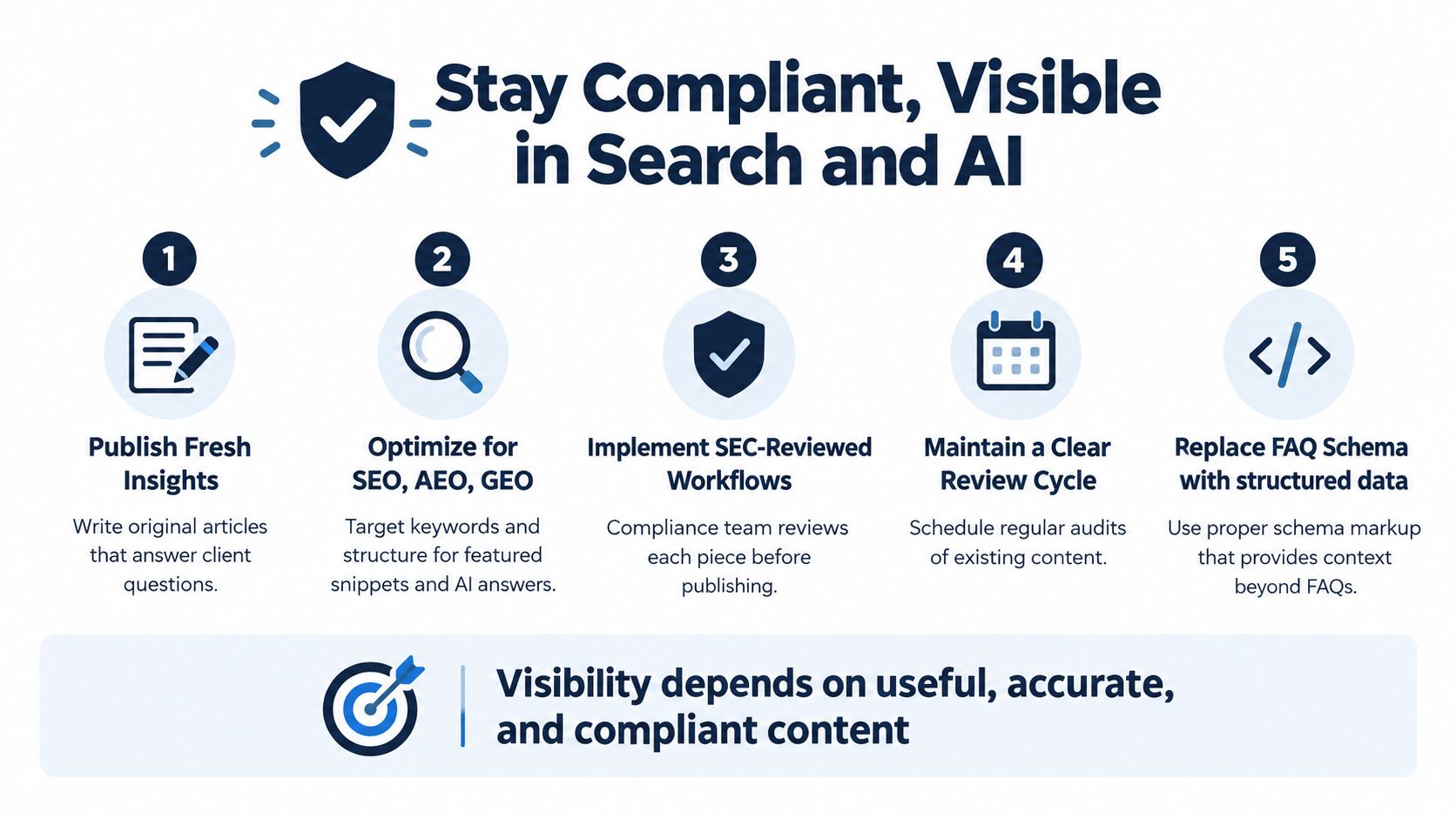
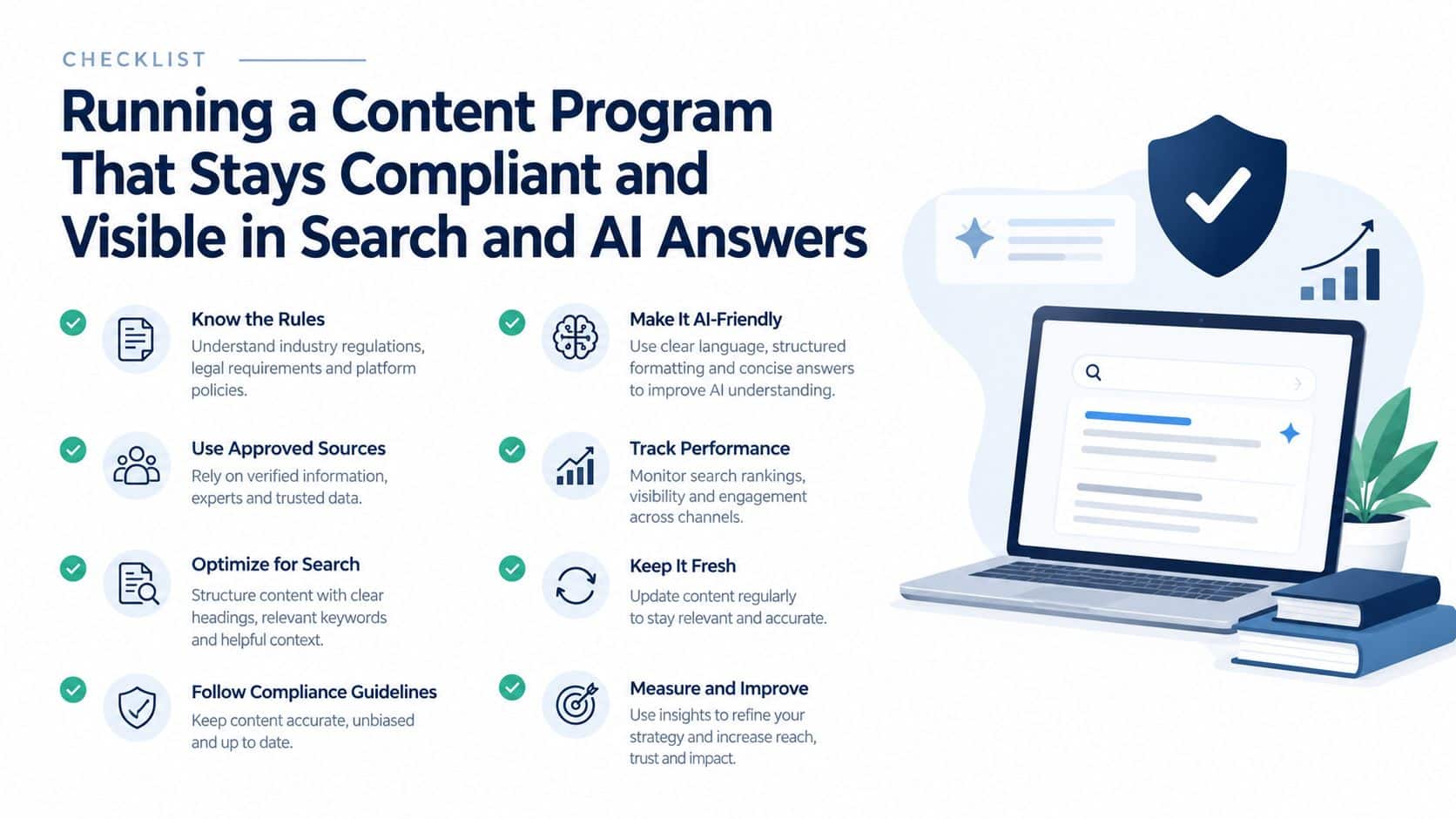
A publishing calendar does not create visibility by itself. Advisory content needs a repeatable structure that helps readers understand an answer, gives reviewers enough evidence to approve it, and lets search and AI systems retrieve facts without guessing.
According to 2026 guidance on FAQ content, FAQ markup has a smaller role in search visibility. Keep questions because they reduce user friction and clarify decisions. Do not build them around the possibility of a special search display.
Write content as reusable answer units
An answer-ready content block should stand on its own. Name the topic, state the answer directly, explain relevant limits, connect the claim to a source or disclosure, and record the date or status that determines whether another review is required.
That format supports several discovery and operating needs:
- SEO: Clear headings, descriptive titles, internal links, and focused pages help search systems interpret relevance.
- AEO: Direct answers and concise definitions give answer interfaces usable passages.
- GEO: Consistent entities, services, credentials, and disclosures help generative systems represent the firm accurately.
- Operations: Structured fields let service and compliance teams reuse approved language instead of copying from scattered documents.
The invisible vendor to obvious choice guide provides context for visibility beyond traditional rankings. The practical point is straightforward: a recognizable firm still needs organized, evidence-backed information that machines can retrieve and people can trust.
Put regulatory review inside the editorial workflow
Testimonials and endorsements need more than a generic approval button. Published SEC marketing guidance says an investment adviser cannot compensate a person for a testimonial or endorsement when the adviser knows, or should know, that the person was subject to a disqualifying event within the prior 10 years, as described in the SEC marketing compliance FAQ.
A commonly cited exemption from the written agreement requirement applies when a promoter receives $1,000 or less in cash or non-cash compensation during the preceding 12 months, according to published guidance on the Marketing Rule. The firm still needs an approval record, a disclosure decision, source documentation, and a process for removing or revising content when circumstances change.
Automated website monitoring can flag missing disclosures, outdated rates, and other review candidates. It cannot decide whether a claim remains accurate, whether context changes its meaning, or whether a testimonial still meets the firm's policy.
Every important asset should have a content owner, compliance reviewer, publication status, review trigger, and archive decision. An SEO roadmap strategy should connect search priorities to the same governance process that controls claims and disclosures. That connection turns the site into a maintained source of truth for visitors, search systems, and AI answers.
Your Next 90 Days to a Higher Converting Compliant Presence
A practical improvement plan starts with one important template and one important workflow. Trying to redesign every page, rewrite every article, and solve every governance issue at once usually creates review bottlenecks and unclear ownership.
The first phase establishes control
Begin with an inventory of service pages, team profiles, articles, disclosures, forms, media, and approval records. Identify duplicate assets, missing owners, stale claims, broken links, and pages that generate important inquiries. Choose one high-value template, such as a primary service page, and document its audience, purpose, evidence, call to action, disclosure placement, and review path.
The firm should also define CMS roles at this stage. Writers, editors, compliance reviewers, administrators, and developers need different permissions. Naming conventions and versioned libraries should make it possible to locate the source of a claim without searching through personal drives or long email threads.
The second phase improves the experience
Build the selected template as a reusable component system. Test its semantic structure, labels, contrast, keyboard focus, mobile behavior, forms, links, and disclosure presentation. Rewrite the page into modular answers that can support navigation, search, chat, and future AI-driven experiences.
Track practical indicators rather than vanity activity:
- Findability: Internal search failures and time spent locating source materials.
- Content hygiene: Duplicate assets, outdated pages, and unresolved review items.
- Execution speed: Time to publish after an approved policy or product change.
- Conversion quality: Completed inquiries and downstream lead handling on the tested template.
- Accessibility: High-severity defects remaining after automated and manual validation.
The final phase expands with discipline
Once the first template and workflow work, apply the pattern to the next priority pages. Establish a recurring review cadence for regulatory changes, team updates, service descriptions, rates, disclosures, forms, and educational content. Keep a decision log so reviewers know why a claim was approved, revised, archived, or excluded.
Website design and content management become durable when every handoff has an owner and every important measure leads to a decision. A firm doesn't need to solve the entire digital estate before improving it. It needs a controlled starting point, a tested pattern, and the discipline to expand only after the pattern works.
Advisor Momentum provides compliance-ready website design, content management, SEO-driven editorial programs, and conversion-focused workflows for financial advisors, planners, wealth managers, and banking teams. Visit Advisor Momentum to discuss a website system that connects design, governance, search visibility, and compliant lead handling.
