

A mid-sized registered investment adviser can spend six months publishing service pages, refining title tags, and building links, only to remain stuck on page two while prospective clients increasingly discover firms through AI-generated answers. The marketing team sees rankings that barely move. Compliance sees drafts arriving too late to review properly. Leadership sees a large budget producing little attributable pipeline.
That situation usually reflects a planning problem, not a lack of effort. A modern SEO roadmap strategy for financial advisors must coordinate three competing discovery surfaces, traditional Google results, AI Overviews, and conversational answer engines, while treating compliance as part of production rather than a final checkpoint.
Table of Contents
- Why Financial Advisor SEO Roadmaps Break Without Compliance and Modern Search in Mind
- Run a Compliance-Aware SEO Audit Before You Plan Anything
- Build a Keyword Plan That Covers SEO, AEO, and GEO Together
- Prioritize Technical Fixes in the Right Order
- Plan Content That Passes Compliance and Wins in Modern SERPs
- Set the 90-Day Cadence, KPIs, and Reporting Rhythm
- What to Do in the First 30 Days and Why Annual Plans Fail
Why Financial Advisor SEO Roadmaps Break Without Compliance and Modern Search in Mind
Traditional plans still assume that search success means reaching one of the ten blue links. That assumption is incomplete. A large benchmark of 4 million Google search results found that the first organic result averaged 27.6% click-through rate and was about 10 times more likely to receive a click than the tenth result. The finding is documented in Google organic click-through benchmarks, and it explains why page-two visibility rarely supports a dependable acquisition program.
The same firm may also need to earn visibility inside an AI Overview, where the user receives a synthesized answer before choosing a traditional listing. Separately, answer engines can draw from recognizable entities, structured pages, and third-party citations when responding to prompts about fiduciaries, retirement planning, or wealth management. A roadmap that optimizes only the blue links leaves two discovery environments unmanaged.

Three surfaces, one regulated reputation
Financial services adds a third constraint: every useful claim must also survive scrutiny. A service page may need accurate credentials, current disclosures, balanced context, jurisdiction-aware language, and careful treatment of performance references. If compliance reviews the page only after keyword research, writing, design, and development, the team can lose the original search opportunity and redo work across several departments.
Google's Search Essentials spam policies identify practices that can result in lower rankings or omission from results, including keyword stuffing, link spam, scraped content, scaled content abuse, misleading functionality, and hidden content. Google's March 2024 search policy update also addressed low-value third-party content produced primarily for ranking purposes, along with expired-site abuse and obituary spam. For an adviser, aggressive shortcuts create both search risk and regulatory risk.
Practical rule: If compliance can reject a claim after production begins, the claim belongs in the brief, not at the end of the workflow.
The fix is a roadmap in which audit findings, keyword sensitivity, technical acceptance criteria, content sources, review ownership, and reporting requirements are designed together. Technical indexing still comes first, but the team also plans for answer-ready content, entity clarity, citation opportunities, and an approval path that keeps publishing realistic.
Run a Compliance-Aware SEO Audit Before You Plan Anything
Planning should begin with an approved inventory of problems, not a list of content ideas. The audit needs two parallel tracks, one for search infrastructure and one for financial-marketing exposure.
Establish the search baseline
The first pass should document crawlability, indexation, canonical rules, sitemap health, internal links, advisor and location page coverage, structured data, mobile rendering, and backlink quality. Review organic sessions, CTR, rankings, conversions, and technical health by market and search intent. Benchmarking guidance recommends a seven-step process, define scope, choose KPIs, gather data, add competitors, normalize, analyze gaps, and set targets, as outlined in this SEO benchmarking guide.
Baseline context matters because a whole-site organic CTR often falls around 1% to 2%, while industry figures can differ materially, including approximately 3.3% for healthcare and 6.6% for legal, according to the same guide. Those figures aren't targets for an advisory firm. They show why a roadmap should compare current performance with its own history and relevant market context rather than import an arbitrary benchmark.
Core Web Vitals belong in the same pass. Google defines the Good thresholds as Largest Contentful Paint of 2.5 seconds or less, Interaction to Next Paint of 200 milliseconds or less, and Cumulative Layout Shift of 0.1 or less, assessed at the 75th percentile of real-user field data in its Core Web Vitals documentation.
Review claims before they become page elements
The parallel compliance review should flag:
- Performance language: Remove or escalate outdated returns, rankings, testimonials, and projections that lack approved substantiation.
- Credential accuracy: Verify advisor titles, designations, registrations, affiliations, and bios against current records.
- Disclosure consistency: Compare disclosures across service pages, footers, forms, social profiles, and location pages.
- Audience clarity: Identify pages that speak broadly to investors without defining the intended client or service context.
- Product comparisons: Require balanced treatment of risks, costs, limitations, and alternatives before publishing comparison content.
- Jurisdiction wording: Route state-specific claims and availability language to the appropriate reviewer.
Each finding should include the URL, issue type, business impact, recommended action, owner, compliance reviewer, review date, required revision, and supporting source. The result is a remediation backlog that marketing, development, and compliance can read without translating one another's terminology.
Pages that promise outcomes, rely on thin affiliate language, or lack meaningful oversight should be consolidated, rewritten, or removed. A smaller inventory of approved, useful assets is more valuable than a large archive that creates review debt.
Build a Keyword Plan That Covers SEO, AEO, and GEO Together
A single keyword list creates confusion because the same service topic behaves differently across search surfaces. A financial advisor should begin with service areas and client life stages, then assign each topic a distinct role in classic SEO, Answer Engine Optimization, and Generative Engine Optimization.
Classic SEO usually needs commercial phrasing such as a service plus location or audience. AEO needs direct questions that can be answered clearly in a short passage. GEO needs entity-rich prompts that connect the firm, advisors, specialties, geography, credentials, and authoritative references. A useful explanation of the difference between AEO and GEO helps teams avoid treating the two workstreams as interchangeable.
Use tags that prevent duplicate work
Every mapped term should carry at least four tags:
- Intent: Informational, commercial, comparison, or decision-oriented.
- Surface: Classic SERP, AI Overview, answer engine, or more than one.
- Sensitivity: Low, standard, or legal-only review.
- Funnel stage: Awareness, consideration, decision, or retention.
The editorial brief should then state whether the page is designed to win a click, supply a concise answer, strengthen entity understanding, or support all three with separate page elements. Teams can also use this GEO targeting resource when assigning geographic relevance to topics and landing pages.
| Service Topic | Classic SEO Keyword | AEO / AI Overview Query | GEO / Generative Engine Prompt | Compliance Notes |
|---|---|---|---|---|
| Retirement income planning | retirement income planning advisor | How does retirement income planning work? | Which fiduciary advisors help households plan retirement income in a specific region? | Avoid outcome promises. Review tax and investment references. |
| Fiduciary advice | fiduciary financial advisor | What does a fiduciary advisor do? | Which advisory firms explain fiduciary duties clearly for local investors? | Define the term accurately and verify regulatory language. |
| Wealth management | wealth management firm for business owners | What services does wealth management include? | Which firms serve business owners with coordinated wealth planning? | Identify intended audience and avoid unsupported superiority claims. |
AEO and GEO can cannibalize each other when writers receive one vague brief. A concise answer page may satisfy an immediate question but provide too little context for entity recognition. A broad location page may reinforce geographic relevance but fail to answer a specific prompt. One topic can support both, but its content blocks, schema, citations, and review requirements should be deliberately separated.
Prioritize Technical Fixes in the Right Order
Technical SEO shouldn't become a spreadsheet of equally urgent tickets. The sequence should follow structural risk, crawl impact, revenue exposure, and the amount of coordination required from development and compliance.
Start with indexation and ownership
First confirm that advisor pages, service pages, and location pages can be crawled and indexed. Resolve accidental noindex directives, incorrect canonicals, blocked resources, duplicate URL versions, orphaned pages, and broken sitemap entries before asking writers to produce more content.
Each ticket needs a testable acceptance criterion:
- Crawl and indexation: The intended advisor URL is crawlable, self-canonical, included in the sitemap, and eligible for indexation.
- Location consolidation: Merged practice locations redirect to the approved destination, with the mapping documented and reviewed.
- Advisor microsites: Retired microsites return the intended status and don't leave unresolved authority or user pathways.
- 404 handling: Discontinued pages lead users to a relevant approved destination rather than a generic dead end.
- Verification: A focused crawl diff confirms the change, followed by an index check within the agreed review window.
Improve money templates, then markup
Once structural blocks are removed, address Core Web Vitals on advisor bios, service templates, calculators, forms, and location pages. Google's field-data thresholds should define the technical target, while the acceptance test should specify the affected template, device context, and reviewer.
A practical website speed optimization checklist can supplement the team's internal technical review, but speed work shouldn't displace indexation fixes that prevent pages from appearing at all.
Schema comes after the basic URL system is stable. Review FinancialService, FinancialProduct where appropriate, Person, and FAQPage markup for accuracy, consistency, and alignment with visible content. Structured data should clarify an approved page, not introduce claims that the page itself doesn't support.
| Priority | Fix Area | Common Issues | Acceptance Criteria |
|---|---|---|---|
| Critical | Crawlability and indexation | Noindex errors, blocked pages, wrong canonicals | Priority URLs are crawlable, canonicalized, and submitted for indexing |
| High | Advisor and location architecture | Orphans, duplicate profiles, unmanaged mergers | Every active page has an approved destination and internal path |
| High | Core Web Vitals | Slow templates, layout movement, delayed interaction | Affected templates meet Google's applicable Good thresholds |
| Medium | Structured data | Missing types, stale credentials, mismatched fields | Markup validates and matches visible, approved content |
| Medium | Redirect and 404 hygiene | Retired microsites, broken location URLs | Redirect map and error handling pass crawl verification |
Plan Content That Passes Compliance and Wins in Modern SERPs
A compliant content brief should prevent avoidable review failures before a writer opens a document. Each brief needs a compliance checklist, a target search surface, and a source citation bank containing approved references and disclosures.
Build the brief around reviewable blocks
Start with the client question, not the keyword. A page about retirement income planning might answer what the process involves, which decisions commonly require coordination, what questions a household should ask an advisor, and where individual circumstances change the analysis. The opening should establish relevant entities such as CFP, RIA, or fiduciary when those terms accurately describe the firm or professional.
Mark every section with a review status:
- Pre-cleared: Approved boilerplate and stable definitions can use the standard workflow.
- Standard review: New explanations, comparisons, or factual claims need a compliance reviewer.
- Legal-only: Projections, performance references, product comparisons, or jurisdiction-sensitive language require escalated review.
FAQ blocks, comparison tables, definitions, and short decision frameworks make content easier for readers and easier for answer systems to parse. They also force the writer to expose qualifications and limitations instead of burying them in a final paragraph.

Separate the answer layer from the authority layer
The AEO layer should contain concise, citation-ready answers, generally short enough to stand alone without removing essential qualifications. The GEO layer should reinforce the firm's entities through consistent advisor biographies, organization information, local relevance, approved citations, and region-specific disclosures. The classic SEO layer still needs compelling titles, useful page structure, relevant internal links, and a clear next step.
Compliance should review the design, not only the words. A disclosure that appears in a footer may not adequately qualify a nearby claim. A location page may contain a correct firm name but an outdated advisor credential. A comparison table may look balanced while omitting a material limitation.
The workflow can use an automated disclosure scan first, followed by human review with a defined 48-hour approval service level. The exact timing should be treated as an operating commitment, not a promise that every regulated claim will clear automatically. Drafts that fail the scanner should return to the writer before reaching the reviewer, which reduces repetitive comments and protects reviewer time.
Set the 90-Day Cadence, KPIs, and Reporting Rhythm
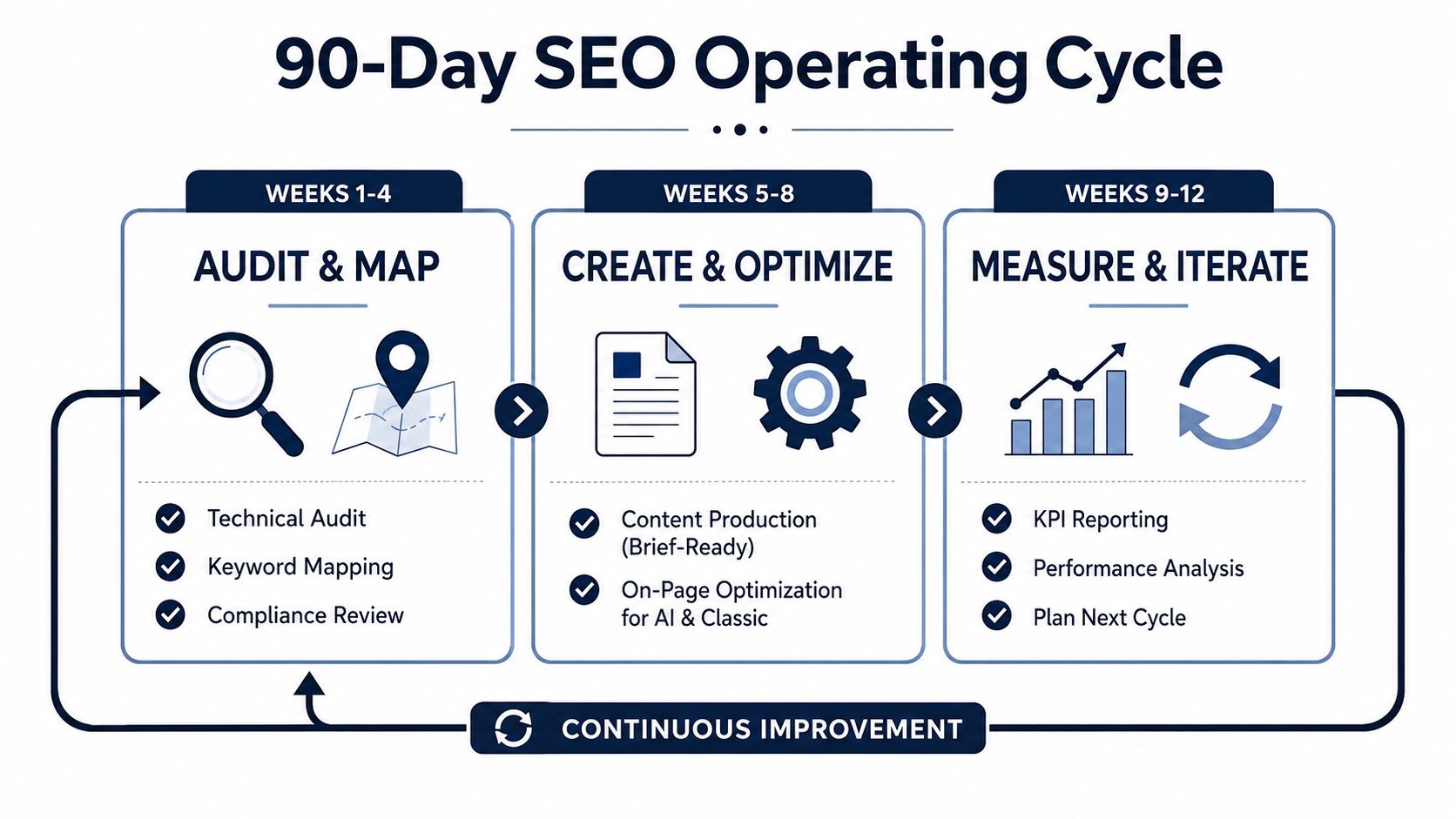
Annual roadmaps set direction, but execution should run in rolling 90-day cycles. Google blue links, AI Overviews, and answer engines change at different speeds. Compliance priorities can shift as well, so each quarter should provide a controlled point to consolidate weak pages, refresh strong ones, or reassign work to a different search surface.
Use three operating blocks
| Cycle Block | Core Work | Primary Decision |
|---|---|---|
| Weeks 1 to 4 | Audit, keyword mapping, technical sprints, compliance inventory | Which blockers and opportunities deserve capacity? |
| Weeks 5 to 8 | Brief-ready content, production, review, on-page optimization | Which assets can publish safely and serve a defined surface? |
| Weeks 9 to 12 | Measurement, refreshes, consolidation, next-cycle scope | What should continue, change, or stop? |
Classic SEO reporting should cover organic sessions, CTR, rankings, and assisted conversions. AEO reporting should track citation frequency, answer share, and the firm's presence in relevant generated responses. GEO reporting should examine local visibility, profile actions, entity consistency, and citations from authoritative finance sources.
AI environments make attribution harder. A 2026 study of 17.8 billion queries across 28 countries found that the first organic result received 41.3% CTR when no AI Overview appeared, compared with 18.6% when one did, a 54.9% decline. The benchmark is available in AI Overview click-through research. A separate 2026 arXiv study of Google AI Overviews found that clicks to cited sources occurred in only about 1% of Overview visits, with fewer clicks and more browsing sessions ending there.
Track operations, not only outcomes
Leading indicators show where the workflow is stalled:
- Indexation rate: Are new advisor and location pages entering the index?
- Approval time: How long does a compliant draft take to clear review?
- Citation acquisition: Are authoritative finance sources mentioning or citing the firm?
- Refresh completion: Are high-value pages being updated instead of endlessly adding URLs?
- Surface coverage: Does each priority cluster have a defined role across classic SEO, AEO, and GEO?
A weekly 30-minute meeting should include marketing, development, and compliance. The mid-cycle review should test business relevance, surface performance, and unresolved approval risks. The quarterly readout should pair KPI interpretation with a compliance attestation for every published asset.
Teams can use our website KPI resource to define the reporting layer, then tie each dashboard metric to a decision, owner, and next action. Vanity metrics can remain visible, but they should not determine capacity.
What to Do in the First 30 Days and Why Annual Plans Fail
A twelve-month plan can document direction, but it can't predict every regulatory clarification, search-layout change, or competitor move. A static plan also encourages teams to defend old assumptions after the evidence has changed. Short cycles create permission to revise priorities before sunk costs become the strategy.
The first month should produce working assets
| Phase | Deliverable | Owner | Annual Plan Outcome |
|---|---|---|---|
| Days 1 to 7 | Baseline dashboard, URL inventory, compliance risk register | Marketing and compliance | A baseline exists instead of a traffic-only narrative |
| Days 8 to 14 | Top technical tickets, redirect map, indexation tests | Development and SEO | Structural blockers receive named owners |
| Days 15 to 21 | One pillar brief with source bank and review tags | Content and compliance | Production begins with approval requirements visible |
| Days 22 to 30 | Answer-surface tracking, weekly meeting, next sprint scope | Cross-functional team | The roadmap becomes an operating process |
The first three technical fixes should address the pages with the greatest combination of crawl exposure and commercial importance. The first content asset should be deliberately narrow enough to review, substantial enough to test across surfaces, and connected to a service page through internal links. Answer-engine monitoring should begin before the team expects meaningful visibility, because a baseline is needed to interpret later changes.
Define the triggers that override the calendar
An off-cycle revision is warranted when a regulatory update changes approved language, an algorithm or result-layout shift alters the target surface, or a competitor begins appearing in AI answers for a priority topic. The team shouldn't wait for the next annual planning meeting to respond.
A roadmap earns trust when it tells every department what happens next, what evidence will change the decision, and who can approve the work.
Advisor Momentum provides compliance-ready website design, strategic keyword research, technical and on-page SEO, schema implementation, internal linking, and SEO-focused copywriting for financial advisors and banking teams. Firms that need a coordinated SEO, AEO, and GEO program with compliance built into execution can visit Advisor Momentum to discuss the right starting scope.
