
A bank CMO can have a strong quarter, a clean campaign calendar, and a polished deck, then still walk into the boardroom and hear the same question, why is marketing spending money faster than it shows returns? That tension is why a bank marketing agency is rarely a creative luxury. It becomes a governance tool, a measurement discipline, and sometimes the only way to keep regulated work moving when compliance, product, and leadership all need different proof before they approve anything.
Table of Contents
- The Real Reason Banks Hire a Marketing Agency
- What a Bank Marketing Agency Is
- Core Services and Where Compliance Touches Each One
- The Compliance-First Workflow That Works
- Outcomes and KPIs Banks Should Track
- How Bank Size Changes the Agency Equation
- Vendor Evaluation Checklist and Onboarding Steps
- Choosing a Bank Marketing Agency Without Repeating Old Mistakes
The Real Reason Banks Hire a Marketing Agency
The buying decision usually starts long before a creative brief exists. A CMO, advisory firm owner, or marketing director is often trying to prove that marketing is not just busywork, because 48% of banking and investing CMOs say marketing is perceived internally as a cost center in an industry article citing Gartner Prosight Financial Association. That perception changes the job. The vendor is not just being asked to run campaigns, it's being asked to help marketing defend itself.
Practical rule: If the agency can't help leadership connect work to business goals, the relationship will feel expensive even when the creative is good.
That's why the strongest engagements start with internal governance. Executives want fewer KPIs, clearer accountability, and a process that survives compliance review without endless rework. In banks especially, the issue is rarely “do we have enough ideas?” It's “can this team keep campaigns moving while staying inside the bank's approval process and budget logic?” The answer has to be visible quickly, usually within the first budget cycle, or the conversation turns back to headcount, pause decisions, and cost containment.
The spending backdrop explains why this pressure keeps intensifying. The global banking sector spent over $82 billion on marketing in 2023, and banks in North America spent $28.5 billion that same year, while digital marketing accounted for 59% of total marketing budgets and 88% of banks globally had a dedicated digital marketing team seosandwitch.com. Those numbers show that banks aren't treating marketing as a side task. They're treating it as an operating function that still needs external expertise when internal teams lack speed, specialized execution, or compliance-aware production.
What a Bank Marketing Agency Is
A useful definition starts with ownership. A bank marketing agency is a specialist partner that handles digital acquisition, brand systems, content, paid media, video, and often coaching or recruiting support for financial institutions, while structuring the work so it can survive compliance review. That is different from a generalist agency that happens to serve banks alongside retailers, SaaS firms, and local services. The difference shows up in disclosure handling, archive discipline, and how early compliance gets pulled into the workflow.
Specialist support versus generalist support
Generalist agencies often work from a campaign-first mindset. A finance specialist works from a review-first mindset. That means the specialist thinks about approvals, regulated claims, product language, and where the landing page needs to preserve evidence for later audit. A generalist may be able to make a campaign look better. A regulated-finance specialist is expected to make a campaign safer to launch and easier to defend later.
That distinction matters because a bank website is not a brochure. It is a conversion system that has to connect search intent, lead capture, CRM routing, and measurement. Financial-services agencies emphasize UX, web development, speed, security, SEO, CRM integration, and analytics because the site is usually the first digital touchpoint and the core entry point for journey orchestration Imaginuity. Banks that treat the site as a static brand asset usually discover too late that traffic without routing logic does not create pipeline.
Where the work usually sits
A well-run agency does not take compliance ownership away from the bank. It structures the work so compliance can do its job without slowing everything to a crawl. That is why a specialist is often better at building briefs, organizing review artifacts, and coordinating across legal, product, and marketing. For branding and positioning work, some firms also keep a tight link between messaging and the bank's broader identity system, which is where banking brand strategy guidance can fit naturally into the internal planning process.
The right vocabulary is simple. The agency may own execution, but compliance still owns approval. That boundary is what makes the model work.
Core Services and Where Compliance Touches Each One
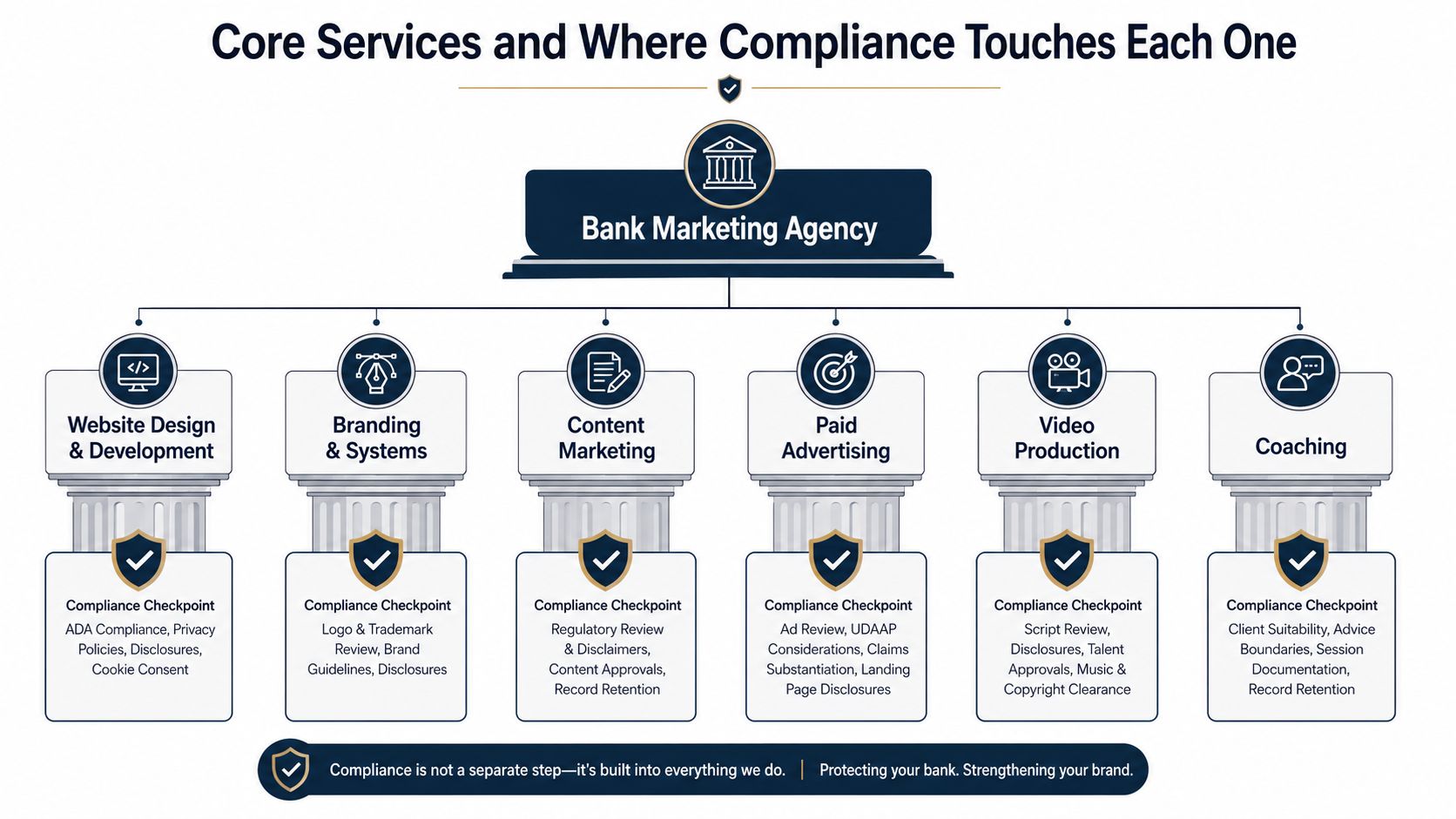
A serious bank marketing program usually lives across six service areas. The point isn't to buy every service. The point is to know which ones are connected and where the review burden lands.
Website design and development
A bank site should be built as a routing engine, not a visual portfolio piece. The deliverables that matter are page templates, service-line landing pages, appointment flows, lead forms, analytics tagging, and CRM handoff logic. Compliance touches the copy, disclosures, claims hierarchy, form language, and any routing that implies product eligibility or rate promises. When the site is built correctly, the first search visit can move toward an inquiry without forcing the user through a maze of dead ends.
Branding and brand systems
Brand work in banking is less about artistic polish and more about consistency under scrutiny. The outputs are naming systems, visual standards, messaging architecture, and approved language for products, branches, or advisor teams. Compliance touches brand systems whenever a phrase could imply performance, exclusivity, or guaranteed outcomes. If the brand language is loose, every campaign becomes a fresh legal debate.
Content marketing and paid acquisition
Content includes blogs, landing pages, service copy, social posts, and editorial planning. Paid acquisition includes search, paid social, programmatic, SEO, AEO, and GEO. These areas are joined at the hip because one piece of content often becomes the supporting evidence for another. Specialist sources for financial firms emphasize governed publishing workflows and compliance collaboration under SEC, FDIC, and NCUA constraints, which is why the content team and review team can't operate in separate silos Select Advisors Institute. For search-driven work, the bank's digital visibility plan should be paired with a broader channel strategy such as digital marketing in financial services.
A compliant content system isn't slower by default. It's usually slower only when the review path is undefined.
Video production and coaching
Video works when it clarifies complex topics and builds trust fast. That means scripts, talking points, disclosure placement, and retention of final cuts matter as much as lighting or editing. Coaching, meanwhile, is the adjacent service many banks overlook. It can cover onboarding, client service workflows, and AI adoption inside advisory or banking roles. Compliance touches both because spoken language can create the same risk as written claims, and training only helps when staff know what they're allowed to say.
Recruiting and staffing support
Recruiting belongs in the same conversation because growth doesn't stop at lead capture. If a bank or advisory firm adds demand without adding operational capacity, service quality breaks down. The best agency support helps align marketing with staffing reality, so growth doesn't outrun the people who have to answer the phone, book the meeting, or onboard the account. In banks with lean teams, that makes recruiting part of the conversion system, not a separate HR project.
The Compliance-First Workflow That Works
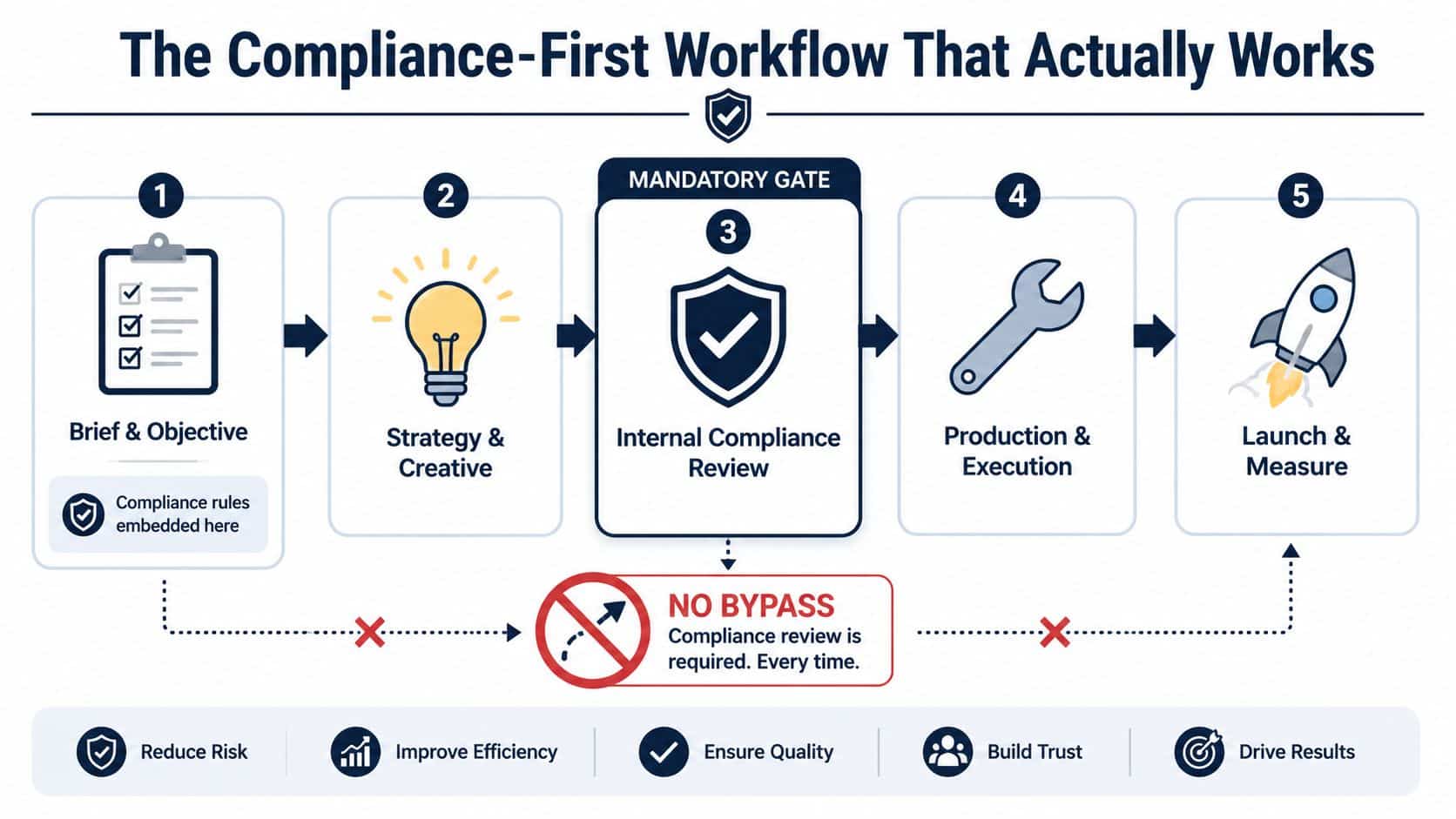
The strongest regulated-marketing teams do not wait for compliance to rescue a rough draft. They build the review path into the brief from the start. That sounds basic until a campaign stalls for the third time because no one documented the claims, required disclosures, audience limits, or owner of record before creative work began.
Start with the brief, not the draft
A proper brief should name the product, audience, objective, required disclaimers, prohibited claims, archive expectations, and approver list. It should also state success in business terms, not only marketing terms. That gives compliance a defined target to review against instead of forcing legal and marketing to infer intent from a polished asset after the fact.
In a bank or advisory firm, the brief is also an internal governance document. If the bank's messaging touches a registered product, a performance claim, a testimonial, or a state-specific disclosure, the brief should say so before the first concept is written. That is where most delays begin, because teams assume review belongs at the end of the process rather than inside the process.
Keep review artifacts together
The workflow moves faster when teams keep the source brief, version history, approved language, and final published asset in one governed folder or system. When those items are scattered, every revision cycle starts from scratch. When they are organized, legal and compliance can trace changes without asking for the same context twice.
A simple version-control habit helps. Name files in a consistent way, store redlines beside the approved draft, and keep one record of who approved what and when. That is not creative overhead, it is how you avoid re-litigating the same disclosure language every time a campaign changes format or audience.
The operational benefit is real. Specialist guidance for regulated financial marketing says compliance review, legal collaboration, and governed publishing reduce risk and speed execution under banking constraints Select Advisors Institute. That does not mean skipping scrutiny. It means reducing revision loops by letting compliance shape the asset before the first draft is locked.
Use the right internal behavior
The smartest sign of maturity is leadership that knows when to stop rewriting. If a compliance reviewer flags a claim as too aggressive, the fix should happen in the brief or message architecture, not through endless copy swaps. The agency's job is to translate that guidance into a cleaner asset, not to argue for speed at the expense of governance.
A short review template helps here. For each asset, ask three questions: What is the claim, what regulation or policy touches it, and what evidence supports it? That keeps the conversation grounded in review standards instead of personal preference. It also gives the marketer a clean record when someone asks why a line was changed.
Version control tools matter for the same reason. A tracked approval history, a locked final file, and a shared archive prevent teams from publishing the wrong variant or reopening an approved claim because someone found a newer draft in email. If your team compares process tools before building this kind of workflow, you can compare top SEO tools for 2026, but the stronger point is that the bank needs a controlled system before it needs another vendor opinion.
Good process: brief, draft, review, approve, archive.
Bad process: draft, panic, redline, re-redline, relabel, relaunch.
Banks that move fastest are rarely the ones with the least oversight. They are the ones that define oversight early enough to keep production moving.
Outcomes and KPIs Banks Should Track
Marketing teams lose credibility when they report activity instead of outcomes. Executives don't need a parade of dashboards. They need a short list of metrics that ties directly to revenue, funded accounts, or whatever business goal the bank is pursuing.
Focus on a small KPI set
Industry guidance cited by Prosight says the practical move is to tie marketing plans to measurable business goals and keep KPI sets to four or fewer so teams can act on the data Prosight Financial Association. That's especially important in banks, where the internal audience includes compliance, product leaders, and executives who all want a different version of the truth. A tighter KPI set makes the discussion more specific and less political.
The most useful measures are the ones that sit close to business conversion. Banks should track qualified lead volume, cost per qualified lead, inquiry-to-funded-account conversion, and website conversion rate. Website credibility matters before any of those metrics move, since 75% of users judge a bank's credibility by the design of its website and banking websites average a 2.3% conversion rate, with top performers reaching 5% Zipdo.
Build the table around the business question
| KPI | Why It Matters | Typical Bank Benchmark |
|---|---|---|
| Qualified lead volume | Shows whether the campaign is reaching the right audience | No universal benchmark exists, compare against prior periods |
| Cost per qualified lead | Connects spend to lead efficiency | No universal benchmark exists, compare by channel and segment |
| Inquiry to funded account conversion | Measures whether leads become actual business | No universal benchmark exists, tie to product and branch capacity |
| Website conversion rate | Shows whether the site turns intent into action | Average 2.3%, top performers 5% Zipdo |
| Credibility signals | Influences whether prospects trust the bank enough to act | 75% of users judge credibility by website design Zipdo |
The budget context also matters. 32% of banks' marketing budgets go to new customer acquisition, and the biggest banks will spend $6 billion or more on marketing in 2025, equal to about 0.10% of total asset value eMarketer. That means the agency conversation has to live in acquisition efficiency, not vanity reach.
For teams evaluating measurement discipline, it helps to compare how SEO reporting fits into broader marketing operations. A practical reference point is compare top SEO tools for 2026, especially when the core question is not software selection but how reporting supports business proof.
How Bank Size Changes the Agency Equation
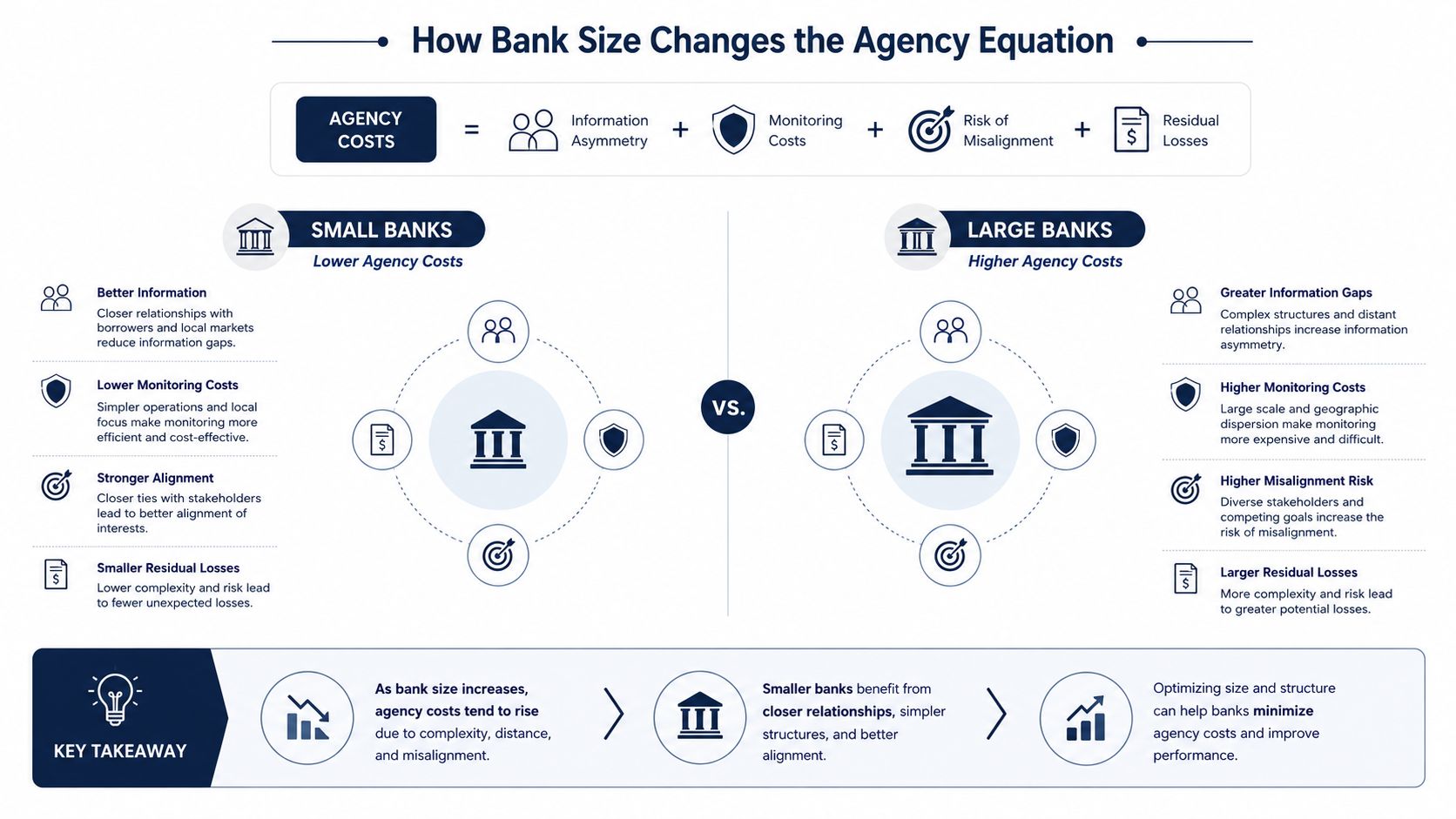
A $1 billion community bank, a regional institution, and a national platform are not buying the same kind of agency help. They may share channels, but they do not share the same staffing reality, review depth, or budget pressure. That difference shapes the agency scope, the approval workflow, and the level of documentation the bank needs to keep on file.
Smaller banks often need efficiency, not layers
The American Bankers Association says banks typically spend between 0.05% and 0.07% of assets on marketing, and that relationship has held for three consecutive years Banking Journal, ABA. For banks with $1 billion to $10 billion in assets, marketing has been measured at about 2.5% of noninterest expense budgets, or 6 basis points of total assets The Financial Brand. That budget profile usually points to a narrow agency role, such as campaign production, website updates, content support, and help with review-ready assets. It does not support a large, layered outside team that needs constant management from the bank.
For a smaller institution, the selection question is operational. The bank needs a partner that can cover gaps quickly, work inside a tight approval chain, and avoid adding another internal management layer. If the agency requires multiple handoffs just to launch a local deposit campaign, the bank is paying for process friction instead of marketing output.
Midsize and larger banks buy coordination
Banks with $10 billion to $100 billion in assets spend about 2.35% of noninterest expense budgets, or 5 basis points of assets The Financial Brand. At that size, the issue is rarely whether the bank has a marketing budget. The issue is whether one agency can coordinate across product lines, regions, branch networks, and multiple approvers without creating delays or version-control problems.
That changes the service mix. A midsize or larger bank may need a partner that can handle paid media, content, web production, campaign trafficking, and archive discipline under a single review process. A generalist vendor can create more work if they do not understand how disclosures, legal edits, and final approvals are handled inside the institution.
Outside help is still common, but banks are narrowing it. The ABA says outside agency support fell from 18% of marketing budget in 2022 to 13% in 2024 The Financial Brand. That shift points to a more selective model. Banks are keeping agency spend tied to specific execution needs, then routing the rest of the work through internal teams or existing governance.
The practical takeaway
A smaller bank usually buys project support plus strategy. A larger bank is more likely to need specialized execution across several disciplines, but with a tighter governance model and clearer division of responsibilities. In both cases, the right fit is not about whether the agency can make the work look polished. It is about whether the agency can match the bank's approval structure, reporting expectations, and staffing capacity without creating avoidable rework.
Vendor Evaluation Checklist and Onboarding Steps
The best vendor conversations sound less like a pitch and more like a process audit. A bank should ask how the agency handles compliance, archive discipline, reporting, and integration before it asks for pretty examples.
What to ask before signing
- Regulated-finance experience: Ask for recent work in banking or closely regulated financial services, plus examples of how the team handled review and disclosure requirements.
- Named compliance workflow: Ask who owns compliance coordination, what gets reviewed, and how issues are tracked from first draft to approval.
- Archive and version control: Ask where final assets live, how revisions are stored, and how the bank can retrieve proof of approval later.
- Measurement integration: Ask how the agency connects to the bank's CRM, marketing automation, and analytics stack so results aren't trapped in a slide deck.
- Relevant references: Ask for clients with similar products, approval structures, and risk tolerance.
If the answer to any governance question is vague, the agency is probably built around convenience, not regulated execution.
Red flags that should end the conversation
If the vendor talks only about traffic, followers, or “brand buzz,” that's a problem. If they can't describe how they work with compliance, that's a bigger one. If they can't say what happens to a campaign asset after approval, the bank is probably buying rework, not speed.
First 90 days of onboarding
The first month should focus on kickoff, asset intake, and compliance mapping. The second should lock baseline measurement, reporting definitions, and review cadence. The third should launch the first governed campaign while preserving all source files, approvals, and final versions in an organized archive.
One option for firms that need integrated digital work, coaching, and recruiting support is Advisor Momentum, which positions those services around regulated financial organizations and compliance-first workflows. That kind of model only works when the bank knows what it wants approved, who approves it, and how results will be measured afterward.
Choosing a Bank Marketing Agency Without Repeating Old Mistakes
A good bank marketing agency isn't the one with the flashiest portfolio. It's the one that can sit across from compliance, operations, and leadership without losing speed or clarity. The bank that tracks four or fewer KPIs, demands a compliance-first workflow, matches agency scope to bank size, and audits onboarding for governance will usually make a cleaner decision than the bank that shops for creative style first.
Advisor Momentum works with regulated financial organizations that need marketing, branding, coaching, and recruiting to operate as one system instead of four disconnected projects. If the next step is to tighten review cycles, sharpen conversion, and make marketing easier to defend internally, visit Advisor Momentum and see how that kind of support can fit the bank's own approval and growth process.
