

A platform can deliver impressive reach and still create a serious problem for an advisory firm. An ad may appear beside unsuitable content, a retargeting audience may include people who should have been excluded, or a platform report may claim conversions that the firm can't reconcile with booked meetings and qualified prospects. When compliance, marketing, and operations teams review the campaign later, “the platform optimized it” isn't an adequate audit trail.
That's why regulated firms judge the best programmatic advertising platforms differently. Reach matters, but so do placement controls, audience exclusions, fee transparency, frequency management, conversion definitions, and access to usable records. Programmatic buying now spans display, video, audio, mobile, and connected television, so a buying decision also determines how the firm handles identity, measurement, and brand safety across channels.
This roundup compares ten platforms through the lens of an RIA, wealth manager, bank marketing team, or financial planning practice. Each option has a different balance of inventory access, operational complexity, compliance controls, reporting, and likely budget fit. The practical question isn't which platform has the longest feature list. It's which platform can help the firm reach the right audience while explaining where the ad appeared, why the audience was eligible, what the firm paid, and whether the result was a qualified business outcome.
Table of Contents
- 1. Google Display & Video 360
- 2. The Trade Desk
- 3. AppNexus Xandr
- 4. Magnite
- 5. Amazon DSP
- 6. Criteo
- 7. Rocket Fuel
- 8. Skai
- 9. C3 Metrics
- 10. MediaMath
- Top 10 Programmatic Advertising Platforms Comparison
- Turning This Shortlist Into a Compliant Buying Decision
1. Google Display & Video 360
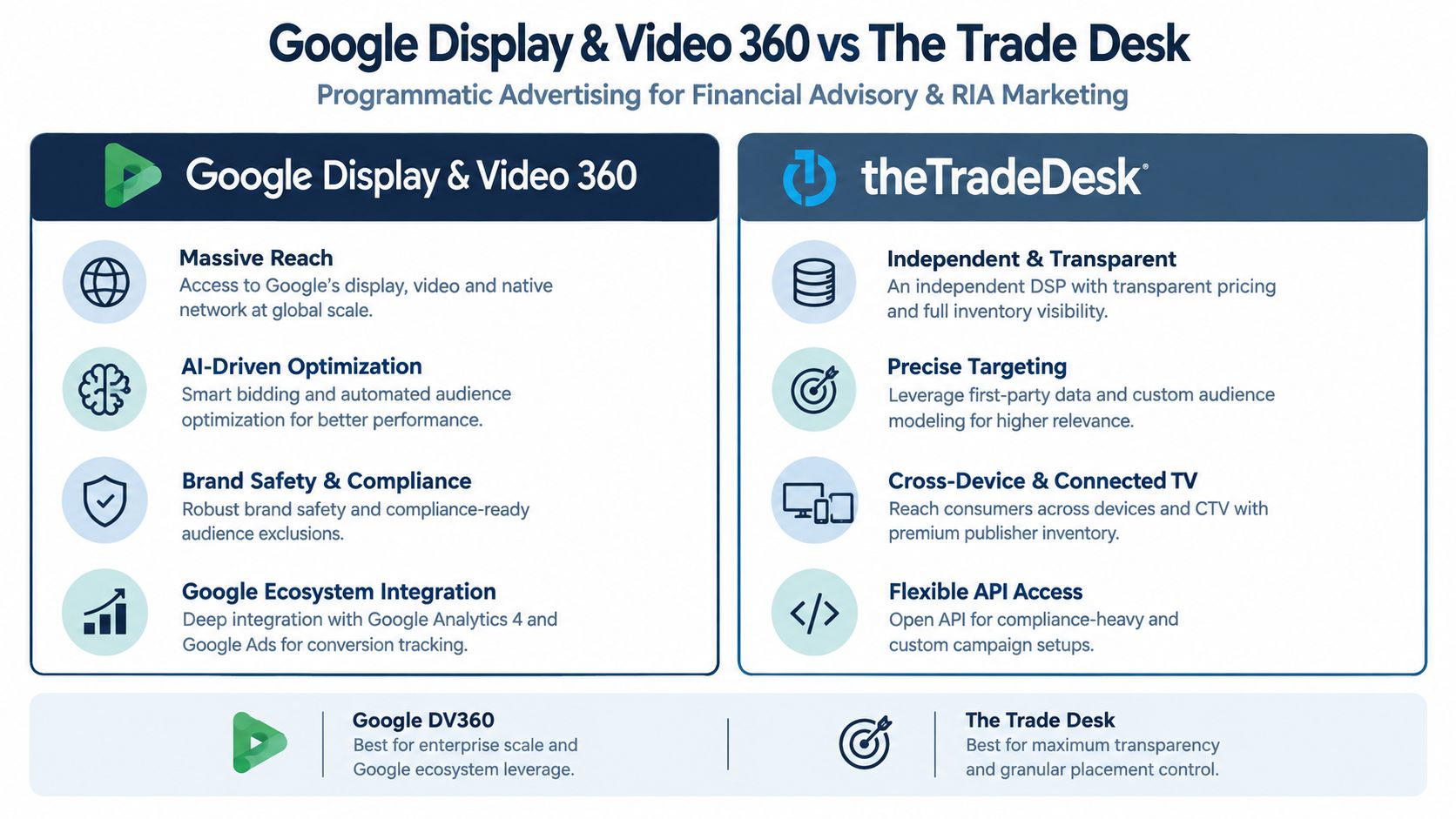
Google Display & Video 360 is a strong choice for firms already operating inside Google's advertising and analytics environment. It combines display, video, native, and connected television buying with access to Google inventory and partner exchanges. For a financial advisor, that creates a practical route from a prospect's research behavior to a controlled sequence of educational ads, provided the firm separates legitimate audience signals from sensitive or unsuitable targeting assumptions.
A retirement planning practice, for example, could create a retargeting campaign for visitors who reviewed retirement service pages but didn't submit a consultation request. The campaign should use clear exclusions, a conservative frequency cap, and a conversion event tied to a meaningful action such as an appointment request. Contextual targeting around wealth management, retirement planning, or financial education can also reduce reliance on personal audience inference.
Practical rule: A platform's audience label isn't a compliance decision. The firm still needs documented exclusions, approved creative, and a clear reason for every targeting layer.
DV360 is particularly useful when the firm needs coordinated reporting across display, video, and YouTube activity. It can also suit financial planning firms reaching prospects across business and news environments, though placements require regular review. Google states that financial-services advertisers may need verification in certain locations, including information about services, licenses, registration numbers, and other business details. Its policy also requires financial advertisers to provide a physical business address and disclose associated fees where applicable, as explained in Google's financial products and services policy.
The trade-off is operational complexity. Firms without dedicated media operations support may need an agency or experienced specialist to manage trafficking, exclusions, floodlight events, and placement reporting. DV360 is best when the organization values Google ecosystem integration and can support disciplined governance, not merely when it wants inexpensive reach.
2. The Trade Desk
A regulated advisory firm can use The Trade Desk to buy display, video, audio, and connected television inventory across independent supply. That reach is useful when campaigns need several formats, but it also creates more places to review publishers, placements, frequency, and audience rules.
The platform reported approximately $2.445 billion in fiscal-year 2024 revenue, compared with approximately $1.946 billion in 2023, representing roughly 25.6% year-over-year growth, according to its 2024 financial filing. The scale of the business may support broad buying capacity, but it does not remove the firm's responsibility to document exclusions, approvals, and conversion logic.
A wealth management firm could activate approved first-party website or email audiences for display, audio, and CTV. A succession-planning campaign might pair contextual business content with entrepreneurship podcasts. The buying record should show why each audience was selected and should exclude existing clients, unqualified users, competitors, and segments that create avoidable compliance risk.
CTV is another reason to assess the platform. Reported CTV and video revenue grew year over year in 2024, indicating a meaningful position in video buying. For an advisory firm, the practical test is whether the team can review supply paths, control frequency across formats, inspect brand-safety settings, and connect exposure data to qualified outcomes.
Minimum spend and operating support also matter. A firm should confirm commercial requirements before building a plan, then establish who owns audience exclusions, creative approvals, reporting exports, and audit records. Teams can use programmatic advertising best practices for financial advisors to structure those controls. Silva Marketing's Google Ads approach can inform broader audience planning, while the advisory firm retains ownership of audiences, pixels, creative records, and historical reports.
An independent DSP suits a regulated firm only when the buying team can inspect supply, export evidence, and explain each targeting decision.

3. AppNexus Xandr
AppNexus, now associated with Xandr, combines demand-side and supply-side capabilities across display, video, and native inventory. That combination can appeal to financial advisory firms that want more visibility into audience development and premium publisher relationships rather than treating audience segments as a black box.
A planning firm might use audience insight tools to refine an ideal client profile based on its existing customer data. That doesn't mean copying a client's sensitive characteristics into an automated lookalike model. It means identifying defensible signals, such as professional context, content interests, geography, or engagement with approved service pages, then documenting why each signal belongs in the campaign.
Xandr can also support private marketplace buying. A wealth management group could negotiate placements with financial news and investment publishers through a PMP, then compare those placements with broader exchange inventory. The comparison should include more than click-through rate. Compliance reviewers may want the publisher, domain, placement type, creative version, audience rule, exclusion list, and approval status in the campaign record.
Where Xandr fits
The platform is most useful when audience insights and premium inventory matter more than a simple self-serve workflow. Its analytics can help teams distinguish between an audience that generates engagement and one that produces qualified inquiry forms. That distinction is important for advisory firms, because an early content visit may be useful without representing a sales-ready prospect.
Machine learning can support bidding and optimization, but it doesn't replace human review. Teams should test automated bidding against a controlled manual approach, use conservative frequency settings in smaller geographic markets, and review whether optimization is shifting delivery toward cheap but unsuitable inventory.
A firm should also confirm data retention, deletion, access rights, and reporting exports before launch. If the vendor can't provide a usable audit trail, audience sophistication won't compensate for the governance gap.

4. Magnite
Magnite is particularly relevant when a financial brand wants premium publisher supply, video placements, and private marketplace access. It is not primarily a shortcut for reaching every possible user. Its value comes from helping advertisers buy more deliberately from publisher environments that fit the firm's audience and reputation.
An RIA could use Magnite PMPs to reach readers of established business and financial publications, while a wealth manager could test video placements within premium news programming. The campaign plan should identify the approved publisher list before launch. It should also state which inventory is excluded, how fraud is screened, how viewability is measured, and what happens when a placement fails those standards.
Premium supply needs proof
Premium branding doesn't automatically guarantee measurable quality. A campaign may still contain reseller paths, unviewable impressions, or delivery that doesn't match the intended environment. Buyers should request seller and domain details, itemized data and technology fees, placement-level reporting, and independent verification.
Magnite makes sense for firms that can afford a more selective supply strategy and have enough creative quality to benefit from premium environments. A campaign promoting complex retirement or estate planning services may gain more from a trusted editorial context than from indiscriminate reach. The trade-off is that tightly curated inventory can limit scale and require more negotiation, trafficking, and review.
Brand suitability begins before the bid. The approved publisher list, supply path, and exclusion rules should exist before creative is released.
Native placements require particular care because the ad can resemble surrounding editorial content. The Federal Trade Commission's native advertising guidance says disclosures must be clear and prominent when needed to prevent deception, and the commercial nature of integrated content must be distinguishable. Firms using Magnite for native or sponsored-style placements should review the complete user experience, not just the ad file.
For teams planning native formats, programmatic native advertising for advisory firms can help frame the creative and review requirements.
5. Amazon DSP
Amazon DSP offers access to Amazon's first-party shopping and browsing signals across display, video, and audio inventory. For financial firms, the platform's relevance is narrower than it is for retail advertisers, but it can still be useful when the audience strategy centers on business owners, executives, or professionals whose marketplace behavior provides a defensible planning signal.
A business succession practice could test audience segments associated with entrepreneurs and small business operators. A wealth manager might reach affluent professional audiences through third-party publisher placements, then compare Amazon DSP with an independent DSP using the same creative, geography, exclusions, and conversion definition. That comparison should account for more than reported clicks, because the audience signal may be valuable while the surrounding inventory or measurement model is less suitable.
Amazon DSP can support display, video, and audio coordination, but firms should examine how much of the delivery occurs on Amazon-owned properties versus third-party inventory. The distinction affects brand context, reporting, audience interpretation, and the ability to validate the supply path.
The compliance decision
Financial-services teams should be cautious about turning purchasing behavior into an overly specific assumption about wealth, health, retirement status, or financial need. Audience categories should have a documented business purpose, an approved privacy basis, and clear exclusion rules. The creative must also avoid implying that the advertiser knows something personal about the viewer.
Attribution deserves separate scrutiny. An awareness campaign may influence later research without producing an immediate form submission. The firm should import qualified offline outcomes where possible, then evaluate whether Amazon's reported conversions match CRM records and approved business events.
Amazon DSP can be a sensible test for business-owner or executive-focused campaigns, but it shouldn't become the default just because it has extensive first-party data. For non-retail financial advertisers, the firm must prove that the audience signal adds value after fees, exclusions, verification, and usable reach are considered.
6. Criteo
Criteo is built around performance advertising, retargeting, and machine learning optimization. That makes it a logical candidate for advisory firms with an established website audience and a clear next action, such as a consultation request, webinar registration, guide download, or appointment booking.
A retirement planning firm could create separate audiences for visitors who viewed retirement income, tax planning, and investment management pages. Each audience would receive a different approved message, with existing clients, employees, competitors, and completed converters excluded. This structure is more useful than showing every visitor the same generic “speak with an advisor” creative.
Retargeting needs restraint
Retargeting can become intrusive when the audience is small or the service category is sensitive. Frequency caps should be set before launch, not added only after prospects complain. Creative should also avoid revealing that the advertiser is reacting to a specific private behavior, such as researching debt, inheritance, or a personal financial concern.
Criteo's performance orientation can encourage teams to optimize toward easy-to-count actions. That can produce a misleading result if a low-value download receives more credit than a booked meeting or a qualified inquiry. Campaign owners should define the primary business event, separate micro-conversions from qualified outcomes, and send approved offline events back into the measurement system.
A financial firm also needs a clear consent and data governance process before placing tracking technology across its website. The team should know what data the tag collects, how long it is retained, how deletion requests are handled, and which vendors receive the information.
Criteo works best when the firm has enough first-party engagement to support meaningful audience segmentation and a landing-page experience that converts responsibly. It works less well when the objective is broad awareness or when the firm lacks the operational capacity to monitor audience fatigue, placement quality, and conversion quality.
7. Rocket Fuel
Rocket Fuel is associated with AI-led programmatic optimization across multiple channels. Its appeal for an advisory firm is straightforward, the platform can process many bidding and audience signals without requiring the marketing team to adjust every setting manually.
That automation is useful only when the firm supplies clear inputs. A wealth management organization could train optimization around approved events such as consultation requests, completed contact forms, or scheduled meetings. It shouldn't let the platform treat every page view, short session, or accidental click as an equivalent success.
A campaign targeting prospective retirees illustrates the risk. The platform may discover that broad content environments generate inexpensive visits, while the compliance team may consider those placements too ambiguous or low quality. Human operators still need to review domains, creative context, audience exclusions, and the relationship between the optimized event and the firm's actual growth objective.
Automation can make a bad conversion definition scale faster. The business event must be correct before the bidding engine is trusted.
Use AI with a review loop
Rocket Fuel can suit firms that want predictive modeling but don't want to manage every bid manually. The team should establish a recurring review that covers:
- Conversion quality: Confirm that optimized actions represent qualified inquiries, not just cheap engagement.
- Audience integrity: Check that modeled audiences don't introduce prohibited, sensitive, or unexplained targeting signals.
- Placement suitability: Review domain and app reports for environments that conflict with the firm's brand standards.
- Budget pacing: Compare delivery against the approved media plan and investigate sudden shifts across channels.
The platform's predictive recommendations can also inform broader planning, but they shouldn't be treated as evidence of causation. A model can identify correlation without proving that an impression generated a booked meeting. Offline validation, CRM matching, and incrementality testing remain necessary for high-consideration financial services.
Rocket Fuel is a fit for teams comfortable with machine learning and structured oversight. It is a poor fit for a firm that wants to hand over responsibility without defining approval rules, reporting access, or an escalation process.
8. Skai
Skai brings search, social, display, and video management into one reporting and orchestration environment. That cross-channel view can help advisory firms avoid treating programmatic as an isolated activity when prospects often move between search research, social content, display exposure, and direct website visits.
A financial planning practice could coordinate a retirement campaign across paid search, social, and display. Search creative might answer an immediate question, social content might introduce the firm's educational approach, and display could support recall during a longer research process. Each channel still needs its own creative approval and placement controls. Unified management doesn't mean unified compliance treatment.
Skai is useful when the marketing team needs to compare lead quality by channel. A platform that produces a large number of inexpensive forms may look stronger than one that generates fewer but better-qualified appointment requests. CRM integration can help the firm trace which campaigns produced prospects who progressed through the approved sales process.
Coordination without cannibalization
Cross-channel budget automation creates a real trade-off. If the system shifts too much money toward the channel with the easiest reported conversion, it may reduce exposure that supports later branded search or direct inquiries. The firm should set channel-specific guardrails, preserve agreed testing budgets, and review whether a reported conversion is observed, modeled, duplicated, or imported from an offline source.
Skai can also help teams identify whether prospects tend to search before contacting an advisor, engage with educational social content first, or encounter the brand through display and video. Those insights are valuable, but they must be interpreted alongside consent status, attribution windows, and CRM outcomes.
The platform is a strong operational fit for firms managing several channels with limited coordination capacity. It is less compelling when the organization only needs a specialized DSP and already has reliable cross-channel measurement. In either case, the buying team should retain access to raw campaign records and avoid relying solely on a blended dashboard.
9. C3 Metrics
C3 Metrics focuses on attribution and analytics for complex, multi-touch customer journeys. That is relevant to advisory firms because the path from first impression to funded relationship often includes education, repeat visits, a phone call, a consultation, and offline follow-up.
A wealth management firm may find that display ads introduce a prospect, while search captures the final active inquiry. Another firm may see a webinar registration precede a consultation by several interactions. C3 Metrics can help map those touchpoints, but its usefulness depends on the quality of the firm's event definitions and data connections.
Measure the outcome the firm actually values
The primary conversion should reflect a business outcome that the sales and compliance teams recognize. Depending on the firm, that might be a qualified consultation, a completed discovery process, an accepted relationship, or another approved event. A content download can remain a secondary conversion, but it shouldn't automatically receive the same value as a serious inquiry.
Attribution reporting must also distinguish between observed and modeled outcomes. A platform-reported view-through conversion isn't equivalent to a directly observed form submission. The firm should document the attribution window, deduplication method, identity conditions, consent basis, and offline event import process for every channel.
C3 Metrics can support creative and audience testing by showing whether a change affects the whole path or only one intermediate metric. For example, a new video may increase site visits but fail to improve qualified consultations. That result should change the creative or audience strategy, not be hidden behind a higher engagement count.
The platform is best for organizations that already have multiple touchpoints and a willingness to invest in measurement discipline. It won't rescue a campaign with inconsistent tagging, vague conversion goals, missing CRM fields, or no agreed definition of a qualified prospect.
10. MediaMath
MediaMath is an enterprise programmatic platform with demand-side, data, and analytics capabilities for coordinated campaigns across markets, services, and audience groups. It can suit a large advisory organization managing separate campaigns for retirement planning, wealth management, business succession, and banking products.
The platform's enterprise orientation supports structured campaign architecture. A national advisory group could separate business units, geographies, service lines, and compliance approval paths rather than placing every campaign inside one undifferentiated account. That structure makes it easier to identify which creative ran, which audience rule applied, and which team approved the asset.
MediaMath is also relevant when supply-path transparency is a priority. A regulated buyer should request seller details, reseller depth, placement-level records, technology and data fees, and access to log-level information. The platform should make it possible to calculate effective cost after invalid traffic, low viewability, unsuitable inventory, and non-working placements are removed.
Enterprise control has a cost
Large-platform capability brings implementation and training requirements. Firms need people who can manage tags, audiences, creative trafficking, pacing, verification, and reporting. A compliance officer also needs a practical review workflow, not just a dashboard full of media metrics.
MediaMath can support private marketplace buying with selected financial publishers, but direct relationships don't eliminate the need for independent verification. Sellers can still differ in audience quality, reporting detail, and placement standards. The campaign contract should define minimum expectations for viewability, invalid traffic, domain reporting, data access, and deletion.
MediaMath is most appropriate for larger advisory groups with multiple markets or service lines and enough internal expertise to operate an enterprise platform. A smaller firm may gain more from a managed programmatic service that provides the same governance essentials without requiring a large technical operating model.
Top 10 Programmatic Advertising Platforms Comparison
| Platform | 🔄 Implementation Complexity | ⚡ Resource Requirements | ⭐📊 Expected Outcomes | 💡 Ideal Use Cases | 📊 Key Advantages |
|---|---|---|---|---|---|
| Google Display & Video 360 | High, enterprise setup, compliance configs | High, significant budget & specialist ops | High-quality scale + measurable ROI for awareness & video | RIAs seeking enterprise programmatic with GA4/Ads integration | Massive reach, strong brand safety, GA ecosystem integration |
| The Trade Desk | High, steep learning curve, custom setups | High, in-house expertise or agency needed | High control over placements; transparent attribution | Firms wanting granular inventory control and transparency | Transparent pricing, placement control, rich targeting |
| AppNexus (Xandr) | Medium–High, technical onboarding for DMP features | Medium, flexible spend, technical support helpful | Precise audience targeting and robust analytics | Growing firms needing data enrichment and PMPs | Strong data marketplace, machine learning, PMP access |
| Magnite | Medium, PMP negotiations and hands-on management | Medium, premium inventory costs more | High-quality brand placements with compliance-ready reporting | Established RIAs prioritizing premium publisher placements | Premium publisher access, fraud prevention, brand safety |
| Amazon DSP | Medium, simpler UI but separate setup from Google | Medium, budget varies; benefits from CRM layering | Strong conversion attribution for e-commerce-adjacent segments | Advisors targeting entrepreneurs/business owners via purchase signals | Unique first-party shopping data; strong attribution |
| Criteo | Medium, easy for retargeting but needs site traffic | Low–Medium, works best with existing traffic & pixels | Excellent conversion lift from warm audiences | Firms focused on lower-funnel retargeting and lead conversion | Dynamic creative, ML-driven conversion optimization |
| Rocket Fuel | High, ML requires clean data & training period | Medium–High, ongoing budgets for AI to learn | Improved efficiency over time; predictive prospecting | Growing firms wanting AI automation with continual spend | AI-driven bidding, predictive audience modeling |
| Skai | High, multi-channel orchestration learning curve | Medium–High, unified platform costs and management | Better cross-channel coherence and budget allocation | Firms running coordinated search/social/display campaigns | Unified reporting, cross-channel optimization, CRM integration |
| C3 Metrics | High, complex integrations with CRM/analytics | High, data engineering and clean data required | Clear multi-touch attribution and offline-to-online ROI | Firms needing true programmatic ROI and audit trails | Multi-touch attribution, granular channel impact insights |
| MediaMath | High, enterprise configuration and governance | High, enterprise spend and specialist teams | Scalable, data-driven optimization across markets | Large multi-office advisory firms with complex campaigns | Enterprise DSP, integrated DMP, predictive analytics |
Turning This Shortlist Into a Compliant Buying Decision
The right platform depends on the firm's inventory priorities, operating model, data maturity, and tolerance for vendor dependence. Google Display & Video 360 can fit organizations already invested in Google's advertising and analytics ecosystem. The Trade Desk is suited to independent omnichannel buying and CTV. Magnite can help firms prioritize premium publisher supply, while Criteo is more appropriate for controlled retargeting. Skai supports cross-channel coordination, and C3 Metrics addresses the measurement problem that appears when the customer journey spans many touchpoints.
A platform comparison shouldn't stop at audience reach or quoted CPM. The ANA-derived 2026 benchmark reported that only 43.3% of programmatic spend produced impressions that were simultaneously viewable, measurable, fraud-free, and free from made-for-advertising inventory, as described in the programmatic quality benchmark. The same benchmark reported median measurability of 86%. Among measurable impressions, 85% were viewable, which implies that roughly 73% of total impressions were both measurable and viewable before additional fraud and inventory-quality filters were applied. Financial advertisers should treat those figures as a reason to demand verification, not as a reason to chase the cheapest inventory.
A practical buying process starts with two or three platforms that fit the budget and available expertise. The firm should define the primary business outcome, approved audience sources, excluded audiences, permitted publishers, creative approval path, consent requirements, and reporting fields before the first impression runs.
Programmatic has reached mainstream scale. Worldwide programmatic revenue reached $162.4 billion in 2025, an increase of $27.6 billion, or 20.5% year over year, according to the IAB and PwC digital advertising revenue report. That scale makes platform selection more consequential, but it doesn't mean every DSP performs equally. Buyers still need independent verification, supply-path visibility, and business-level measurement.
The CTV shift adds another decision layer. A forecast placed programmatic CTV platform buying at $15.7 billion, ahead of projected direct sales of $14.8 billion, while worldwide CTV advertising revenue was projected at approximately $40.3 billion for that year. The forecast also projected The Trade Desk at 59% of the programmatic CTV platform market in 2024, rising to 63% in 2025 and 66% in 2026, as reported by MediaPost's CTV advertising forecast. These are projections, not a universal ranking of every platform. They show why CTV comparisons now include identity, frequency, inventory quality, and measurement rather than reach alone.
Privacy planning should also avoid simplistic assumptions. Google changed its planned Chrome approach so users can continue making choices about third-party cookies through Chrome's Privacy and Security Settings, rather than facing a fixed browser-wide deprecation deadline. The Privacy Sandbox update explains that the approach changed in 2025 after an earlier announcement in 2024. Firms still need first-party data, contextual signals, consented identifiers, server-side events, and clear deletion processes.
A small test should run against real inventory with documented exclusions and a defined measurement window. The review should compare usable reach, qualified inquiries, independent viewability, invalid traffic, supply-path detail, total fees, and CRM outcomes. If the team also needs compliance-ready creative, landing pages, content, or a coordinated advisory marketing mix, Advisor Momentum works with financial advisors, planners, and bankers across all 50 states using a compliance-first approach. Its work can complement broader paid-acquisition planning, including guidance on scaling paid acquisition with Crank 11, while keeping the advisory firm's approval process central.
Advisor Momentum builds and manages programmatic display and video campaigns for financial advisors, planners, and banking teams, with audience targeting, placement controls, and compliance-aware execution connected to the wider marketing plan. Visit Advisor Momentum to discuss a platform shortlist, campaign governance, creative needs, and measurement approach before committing media spend.
