

The popular advice that every credible financial firm needs a founder surname or a polished combination of Wealth, Capital, and Advisors is too narrow. Those formats can work, but they can also blur the firm's positioning, create succession problems, and make compliance reviewers ask whether the name accurately represents the business.
A financial firm's name affects trust, positioning, discoverability, succession, and review readiness at the same time. It appears in a prospect's search results, a regulator's records, a referral conversation, a proposal, and eventually a broader service or ownership structure. The strongest of these brand naming strategies balances memorability with an accurate signal about the firm's services, audience, and regulatory context.
A 1997 survey of 101 companies found that organizations treated naming as critical to new-product success and used systematic processes rather than relying only on spontaneous creativity. The study reported an average of 46 candidate names per assignment, with individual creative thinking used by 90% of companies and brainstorming used by 87%. The original study supports a practical conclusion for regulated firms: creativity should generate possibilities, but structured screening should decide which names survive.
Clarity and credibility should guide creativity.
The ten strategies below are evaluated through four filters: strategic fit, client clarity, future scalability, and compliance risk. Each one also connects to trademark review, domain selection, audience testing, and internal approval.
Table of Contents
- 1. Founder or Advisor Name Strategy
- 2. Descriptive or Functional Naming Strategy
- 3. Acronym or Abbreviation Strategy
- 4. Geographic or Location-Based Naming Strategy
- 5. Niche or Specialty-Based Naming Strategy
- 6. Metaphor or Symbolism-Based Naming Strategy
- 7. Invented or Neologism Naming Strategy
- 8. Personality or Character-Based Naming Strategy
- 9. Compound or Hybrid Naming Strategy
- 10. Compliance-First and Regulatory-Aligned Naming Strategy
- 10-Point Brand Naming Strategy Comparison
- Turn a Shortlist Into a Defensible Brand
1. Founder or Advisor Name Strategy
A founder name gives a financial practice an immediate human center. A firm such as Smith Wealth Management tells prospects who stands behind the relationship, while a practice associated with a recognizable lead advisor can feel more personal than an institutional label. That can suit affluent households seeking continuity, discretion, and direct access to an experienced professional.
The strategic fit is strongest when the founder is central to business development and the firm's value proposition depends on personal counsel. Client clarity is usually high because the audience understands that the business provides advisory or wealth services. Compliance risk rises if the name implies credentials, expertise, or authority that the advisor cannot substantiate in public materials.
The succession problem
A founder-led name can become an asset or a constraint. If the owner plans to sell, merge, add partners, or reduce client-facing responsibilities, the firm needs a transition plan before the name becomes inseparable from one person. A sub-brand can help. For example, a legal entity might retain the founder's name while a broader client-facing architecture introduces a platform or service family that future advisors can operate.
The firm should display relevant credentials and licensing information clearly, but the name itself shouldn't carry unsupported promises. Trademark screening should cover the surname combination and likely shortened forms. Domain and social-handle checks should include spelling variations, because prospects may hear the name before they see it.
A founder strategy works poorly when the individual wants a scalable institution but the brand communicates a solo practice. It works well when personal trust is the product, provided succession, ownership, and approval rules are documented from the start.

2. Descriptive or Functional Naming Strategy
A descriptive name explains the business without requiring interpretation. Cincinnati Wealth Planning, Capital Planning Group, or Retirement Income Planning Specialists signals a service, audience, or market directly. That clarity can reduce confusion during initial research, especially when prospects are comparing firms with limited knowledge of financial terminology.
The strategic fit is high for practices that want immediate category recognition. Client clarity is the main advantage. A prospect searching for retirement guidance can understand a name containing “Retirement Income Planning” faster than an abstract name with no descriptor. Descriptive names also make internal referrals easier because employees and centers of influence can explain the firm without memorizing a brand story.
The trade-off is distinctiveness. Common terms may be difficult to protect, difficult to rank independently, or difficult to own across digital channels. Trademark law treats marks along a spectrum from distinctive or fanciful terms to generic terms. Generic terms can't be registered, while descriptive terms generally require acquired distinctiveness or secondary meaning before registration is available, as explained in this overview of trademark distinctiveness.
Make plain language precise
A descriptive name should match the actual service scope. A firm that offers financial planning but not portfolio management shouldn't imply a broader investment function. Similarly, a name containing “Bank” or another regulated term may require specialized review.
Useful ways to improve a literal name include:
- Add a meaningful modifier: Use a geography, client segment, or service specialty that reflects the practice.
- Avoid inflated scope: Don't use “wealth,” “capital,” or “investment” if the firm's offering doesn't support that description.
- Check digital ownership early: Confirm that the preferred domain and social handles won't force an awkward abbreviation.
This strategy fails when the firm combines several generic terms and expects the result to feel distinctive. It succeeds when plain language is paired with a specific market position and disciplined legal screening.
3. Acronym or Abbreviation Strategy
Acronyms compress long institutional names into a usable public identity. TIAA, associated with Teachers Insurance and Annuity Association, and PIMCO, associated with Pacific Investment Management Company, illustrate how abbreviated names can become independent brands. A smaller practice can apply the same approach to a lengthy legal name, while keeping a descriptive tagline so prospects understand the service.
This strategy fits firms with multiple partners, long entity names, or an established reputation. Client clarity is weaker at launch because unfamiliar letters do not explain the business. Future scalability may be strong when the acronym avoids tying the brand to one founder, city, or narrow service. The trade-off is compliance risk: a polished abbreviation can still obscure the firm's legal identity or imply a broader role than the firm provides.
Test the name before approval
Pronunciation affects referrals, phone conversations, voice search, and assistant-generated transcriptions. Ask representative prospects and employees to read the acronym aloud without coaching. Check negative associations, initials, and possible meanings in every market and language the firm serves.
A regulated firm should keep its full legal name visible in filings, agreements, disclosures, and formal communications. The public brand can use the acronym, paired with a clear descriptor such as “XYZ RIA Partners, financial planning and investment advisory services.” That format supports client clarity without abandoning formal identification.
Before approval, complete four checks:
- Pronunciation testing: Record whether people say the letters consistently and confidently.
- Meaning checks: Review abbreviations and unintended interpretations in target markets.
- Search screening: Confirm that another organization or unrelated industry does not dominate the letters.
- Trademark review: Search the acronym and expanded name, then confirm domain availability.
Acronyms also require a staged workflow. Marketing can develop candidates, legal counsel can assess trademark exposure, and compliance can verify that descriptors, filings, disclosures, and promotional materials match the firm's actual services. Reserve a domain and social handles only after the preferred form passes those reviews.
Acronyms work when existing context gives the letters meaning. They create friction when leadership chooses them to sound institutional.
4. Geographic or Location-Based Naming Strategy
A geographic name can establish relevance before a prospect reads the website. Seattle Wealth Management, Boston Financial Advisors, DFW Wealth Partners, and Colorado Springs Investment Group signal a local market immediately. For a community-based firm, that association may support trust through local relationships, regional knowledge, and accessible service.
The strongest strategic fit appears when growth depends on a defined territory. Client clarity is high in local search and referral conversations, yet the same name can narrow future options. A city or state in the brand may become a problem if the firm later serves clients nationally or acquires practices elsewhere.
Compliance risk deserves early attention. The name should match the firm's actual operating footprint, registrations, advisor licensing, and approved services. A firm expanding across state lines must confirm that advisors can provide the advertised services in each jurisdiction, while disclosures and formal materials accurately describe the business structure.
Design the location signal for growth
A masterbrand with location descriptors can preserve regional relevance without permanently embedding one city in the primary name. The structure may support additional offices, subject to legal and compliance review. Marketing teams should distinguish genuine local expertise from superficial location targeting. Geo-targeting guidance for financial advisors can help shape location signals in campaigns and landing pages.
Before approval, review four questions:
- Service-area accuracy: Does the name reflect where the firm operates and can legally market?
- Registration alignment: Have state-specific licensing and registration requirements been reviewed?
- Expansion path: Can future offices fit the architecture without confusing clients?
- Local meaning: Do residents and nonresidents understand city abbreviations and regional terms?
Run trademark and domain checks on the primary name, descriptors, and likely abbreviations. A clear approval workflow should move candidates from marketing to legal review and then compliance confirmation. Compliance should verify that the name, descriptors, disclosures, filings, and promotional materials match actual services.
Geographic names suit firms built around community relationships. They create friction when a leadership team wants national scalability but keeps adding cities to an increasingly long, unclear name.
5. Niche or Specialty-Based Naming Strategy
A specialty name tells the intended client, “This firm understands your situation.” Physician Financial Advisors, Women's Wealth Management, Executive Transition Planning Advisors, and Business Owner Exit Planning Group direct attention toward recognizable needs. That focus can support relevant content, referral relationships, and repeatable service workflows.
The strongest fit comes from a niche that is real, durable, and large enough to support the practice. Client clarity is high for prospects who identify with the segment, yet limited for people outside it. A physician-focused name may win trust with doctors while creating resistance if the firm later wants to serve technology executives or business owners.
Scalability depends on the brand architecture. A masterbrand can carry broader services, while a focused descriptor identifies a program for retirement planning, executive compensation, or another defined need. The relationship between the parent firm and specialty offering should be clear in website navigation, proposals, disclosures, and campaign materials.
A niche label must also match genuine capability. Credentials, client experience, team composition, documented processes, and educational content should support the position. Compliance reviewers may challenge language that implies expertise, endorsement, exclusivity, or a particular outcome without support.
Before a candidate reaches trademark, domain, and marketing review, test four filters:
- Strategic fit: Does the specialty reflect the firm's actual point of view, service model, and target audience?
- Client clarity: Does it identify a meaningful problem or client group rather than a vague demographic?
- Future scalability: Can adjacent services sit under the same architecture without forcing a full rebrand?
- Compliance risk: Can the firm substantiate the implied expertise and avoid outcome-based or endorsement language?
Check the primary name, specialty descriptor, abbreviations, and likely domain options. Then route the shortlist through marketing, legal, and compliance approval. Reviewers should confirm that the name, disclosures, filings, and promotional materials describe actual services consistently.
Niche naming works when the practice has operational depth behind its positioning. It becomes a constraint when the label is narrower than the business, or when audience selection replaces demonstrated expertise.
6. Metaphor or Symbolism-Based Naming Strategy
Metaphorical names give financial firms an emotional position that descriptive names often lack. Beacon Wealth Management suggests guidance, Compass Financial Advisors suggests direction, Cornerstone Wealth Planning implies stability, and Pathfinder Financial Group evokes help with complex decisions.
Their value depends on the firm's actual client experience. A guidance or stability theme may fit planning, investment, education, and service work, giving the name room to scale. Client clarity remains limited, however, because the metaphor may not identify financial advice without a descriptor.
Distinctiveness is the main challenge. Financial services already use symbols tied to light, navigation, foundations, peaks, and prosperity. A familiar image can feel dependable while blending into the category. A more dramatic image may create compliance risk if clients could read it as a promise of certainty, protection, superior performance, or guaranteed success.
Explain the meaning without overclaiming
Build the interpretation through the website, logo, presentations, and educational content, while keeping the language precise. A compass can represent helping clients make informed decisions. It should not suggest the firm always selects the correct path. A beacon can stand for visibility and guidance without implying that the firm removes investment risk.
Evaluate a shortlist through four filters:
- Strategic fit: Does the symbol reflect the firm's service model and point of view?
- Client clarity: Will the intended audience understand the service after seeing the full name and descriptor?
- Future scalability: Can the idea support adjacent services without forcing a rebrand?
- Compliance risk: Could the name or supporting copy imply an outcome the firm cannot substantiate?
Then test audience response, visual use across marketing materials, trademark availability, domains, and related names. Route the candidates through marketing, legal, and compliance approval. Reviewers should confirm that the name, disclosures, filings, and promotional materials describe the firm consistently.

Metaphor naming works when the firm can support the story in practice. It fails when prospects need a long explanation before they understand the business.
7. Invented or Neologism Naming Strategy
An invented name gives a firm a distinctive verbal asset, but originality does not create trust by itself. Vanguard, Fidelity, and Mercer show how a name can acquire meaning through sustained use. A smaller advisory practice might consider coined constructions such as Prism Financial or Vertex Wealth, subject to legal, linguistic, and client-response checks.
Use this strategy when the firm needs a name that can extend beyond one service, founder, or location. Its four-filter assessment is clear:
- Strategic fit: Does the name support the firm's point of view and allow future services?
- Client clarity: Can prospects identify financial planning, wealth management, or advice from the name plus its descriptor?
- Future scalability: Will the name remain suitable if the firm expands its offer or audience?
- Compliance risk: Could the word suggest certainty, superior performance, protection, or another claim the firm cannot substantiate?
The trade-off is straightforward. Invented names can be more distinctive than generic or descriptive terms, yet they usually require more explanation at launch. Pair the name with an accurate descriptor, then repeat the same positioning across the website, presentations, educational content, disclosures, and client communications.
Trademark screening must cover similar marks, related services, domains, social handles, pronunciation, and unintended cultural meanings. An apparently original word is not automatically available. International filing also requires careful classification. Under the Madrid System, applicants group goods and services into the Nice Classification, which contains 45 classes, including 34 goods classes and 11 service classes, according to WIPO's Madrid System guide.
Make the name earn its meaning
Test the spoken form with prospective clients or internal reviewers. Ask them to repeat, spell, and recall it after hearing it once. Check slang, phonetic associations, and language issues in each intended market. A tagline, content system, and visual identity can explain the name, but the education layer requires sustained investment before the word becomes familiar.
Teams using artificial intelligence for ideation should apply stricter distinctiveness screening. The same discipline applies to digital assistants, including work related to naming an AI for LinkedIn. Before approval, marketing, legal, and compliance should review the shortlist, confirm the descriptor and disclosures, and document trademark, domain, testing, and filing decisions.

8. Personality or Character-Based Naming Strategy
A personality-based name sells a point of view before it explains a service. Prudent Capital signals caution and discipline, while Earnest Wealth suggests sincerity. The name gives the firm a verbal character rather than relying on a founder's identity, location, or service category.
The strategic fit depends on whether leadership can make that character visible in daily client interactions. A firm that calls itself approachable needs clear explanations, accessible communication, and a service model clients can experience. A name suggesting sophistication sets expectations for advisor expertise, presentation quality, and decision support. If the experience contradicts the name, the brand can make skepticism more noticeable.
Client clarity is usually moderate. Personality conveys tone, not necessarily financial planning or advisory services, so a descriptor often belongs in the public-facing name system. Future scalability is strong when the character reflects a lasting operating philosophy. Compliance risk increases when an adjective implies certainty, superiority, safety, or exceptional outcomes that the firm cannot substantiate.
Make the personality operational
Start with a short list of behaviors, not attractive adjectives. “Trustworthy” is too broad to guide naming or execution. Traits such as patient, evidence-led, plainspoken, or long-term oriented can shape content standards, meeting conduct, visual decisions, and approval criteria.
Use four filters during review:
- Strategic fit: Does the character support the firm's positioning, audience, and service model?
- Client clarity: Will a prospect understand the tone while still seeing what the firm does?
- Future scalability: Can the personality remain credible if services, advisors, or markets change?
- Compliance risk: Could the wording imply a guarantee, fiduciary outcome, or unsupported superiority?
Then test the shortlist with clients, advisors, legal reviewers, and compliance. Confirm trademark availability, domain options, and consistent usage before filing or publishing. A descriptor can carry the service meaning, while the character name carries the relationship promise.
This strategy works when leadership can train and measure the intended behavior. It fails when the name expresses an aspiration that clients and employees never encounter.
9. Compound or Hybrid Naming Strategy
Compound names join distinct signals in one expression. Wealth & Wisdom Advisors combines a service category with an expertise cue. Heritage Wealth Management links legacy with service. Tomorrow's Wealth Planning connects future orientation with planning, while Strategic Capital Advisors pairs an approach with a financial category.
This framework can create strong strategic fit because one name carries more than one positioning signal. A regional firm might combine location and specialty. A founder-led practice could pair a surname with its service. A planning firm might connect a metaphor to a clear descriptor. Client clarity generally exceeds that of an invented name, but future scalability depends on whether both elements remain relevant after services, advisors, or markets change.
The trade-off is recall. Adding a founder, city, audience, service, and value proposition can leave prospects with a long name they cannot remember or pronounce. Shortened versions then appear across search listings, domains, email addresses, and social profiles, creating inconsistent public usage.
Build around one lead signal
Choose the primary message before combining words. If “Retirement” leads, the remaining terms should identify the firm or method without competing for attention. A hybrid name should also work in conversation, on a referral, and in a compliance approval queue.
Review the candidate in four ways:
- Strategic fit: Does the combination support the firm's audience, positioning, and service model?
- Client clarity: Can a prospect identify the firm's role without needing an explanation?
- Future scalability: Will the name remain accurate if the firm adds services, advisors, or markets?
- Compliance risk: Could the wording imply certainty, superiority, safety, credentials, or outcomes the firm cannot substantiate?
Run the phrase through trademark screening, domain and handle checks, and search-result review before design work begins. Ask referral partners and clients to say and write it from memory. Confirm one approved short form, if needed, for digital and verbal use. Compliance, legal, and leadership should approve the official form and any abbreviation together.
Compound names work when every element has a defined job. They fail when internal stakeholders treat every preferred word as mandatory.
10. Compliance-First and Regulatory-Aligned Naming Strategy
A compliance-first name earns approval before it seeks attention. Start by checking whether the proposed wording matches the firm's legal entity, registrations, licenses, services, credentials, and marketing claims. This discipline matters for RIAs, wealth managers, banks, and practices operating across jurisdictions.
Evaluate every candidate through four regulated-firm filters:
- Strategic fit: Does the name support the intended audience, positioning, service model, and expansion plans?
- Client clarity: Can a prospect understand the firm's role without a lengthy explanation?
- Future scalability: Will the name remain accurate as the firm adds services, advisors, offices, or markets?
- Compliance risk: Could it imply guaranteed outcomes, superior performance, safety, credentials, or authority the firm cannot substantiate?
Approval readiness is part of brand readiness. The legal entity, masterbrand, descriptors, offices, platforms, and service lines should have clear relationships, so growth does not produce misleading public usage.
Start with a decision record
Record why each finalist exists, which audience it serves, what claims it may suggest, and where it will appear. This keeps internal preference from replacing evidence during legal and compliance review.
A practical workflow begins with a strategic brief covering audience, positioning, service scope, tone, and expansion plans. Generate candidates across several naming strategies, then remove obvious legal, linguistic, domain, and regulatory problems before the team becomes attached to them. Qualified counsel should review relevant trademarks and service categories. Marketing should check domains, social handles, search results, pronunciation, recall, and unintended associations. Compliance approval should document the official form, required disclosures, legal-name usage, approved descriptors, and permitted applications.
The longitudinal naming-process research describes an average working pool of 46 candidates and supports defining objectives before generation, then pursuing registration after evaluation. Use that principle without treating the figure as a quota. A regulated firm needs enough alternatives to reject risky names without forcing a weak finalist through approval.
Industry naming guidance for financial services emphasizes short, pronounceable names that communicate trust, security, and stability while surviving trademark, domain, social-handle, and cross-market checks. Test the name in a referral conversation, a search result, an email address, and an approval file.
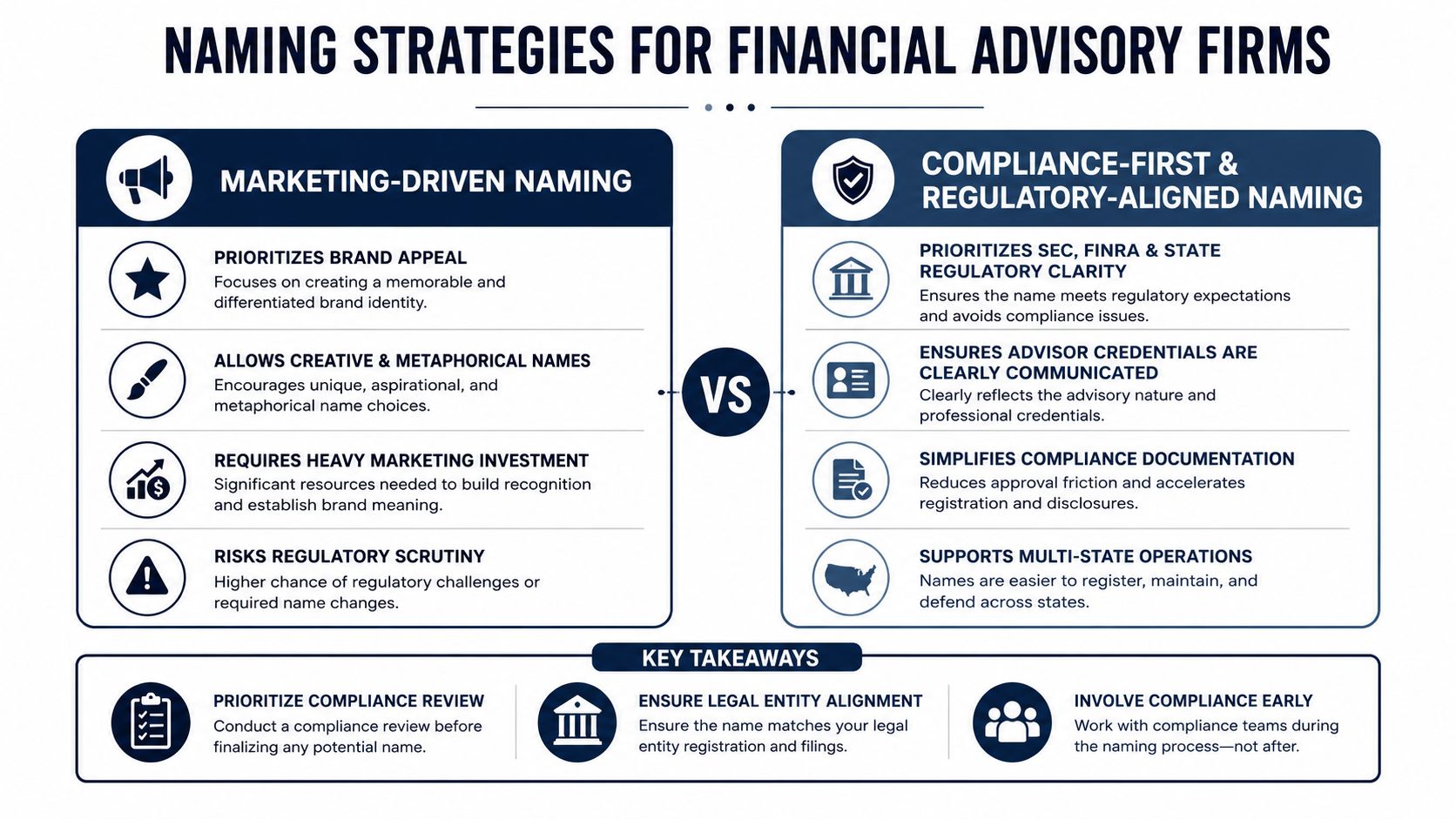
Compliance review protects creative investment by preventing a rejected name from carrying an entire campaign. Firms can use compliance marketing support for financial advisors to coordinate naming, brand language, content, and review workflows. Before selecting a filing path, the team can compare trademark filing fees. A defensible name is clear to clients, usable as the firm grows, and supportable in the record.
10-Point Brand Naming Strategy Comparison
| Naming Strategy | Implementation 🔄 | Resources ⚡ | Expected Outcomes ⭐ / 📊 | Ideal Use Cases 💡 | Key Advantages |
|---|---|---|---|---|---|
| Founder or Advisor Name Strategy | Low–Medium 🔄: straightforward naming but requires succession/legal planning | Low ⚡: minimal initial marketing; moderate compliance checks | High trust ⭐⭐⭐; strong personal credibility; limited scalability 📊 | Solo advisors, boutique RIAs, HNW client focus | Immediate authority; easy personal branding; strong client relationships |
| Descriptive or Functional Naming Strategy | Low 🔄: simple and compliance-friendly | Low–Medium ⚡: SEO and domain investment advised | Clear value proposition ⭐⭐; strong discoverability 📊 | Regional firms, compliance-conscious practices, niche services | Transparent, SEO-friendly, reduces marketing explanation |
| Acronym or Abbreviation Strategy | Medium 🔄: requires careful selection and legal review | Medium ⚡: branding and legal checks to build recognition | Professional, concise ⭐⭐; recognition grows with marketing 📊 | Large firms, multi-location networks, institutional brands | Distinctive shorthand; trademarkable; professional impression |
| Geographic or Location-Based Naming Strategy | Low 🔄: easy to implement but limits mobility | Low ⚡: leverages local marketing and SEO | Strong local recognition ⭐⭐; high local search impact 📊 | Community-focused firms, regional offices, local advisors | Excellent local SEO; conveys market focus and trust |
| Niche or Specialty-Based Naming Strategy | Medium 🔄: requires market validation and expertise proof | Medium ⚡: content and credibility-building investment | High relevance and pricing power ⭐⭐⭐; concentrated market impact 📊 | Specialists (physicians, executives, women's wealth) | Clear differentiation; attracts ideal clients; supports premium pricing |
| Metaphor or Symbolism-Based Naming Strategy | Medium–High 🔄: creative process plus compliance checks | Medium–High ⚡: brand building and storytelling required | High memorability ⭐⭐; emotional connection but requires education 📊 | Competitive markets seeking differentiation, younger clients | Distinctive, evocative branding; strong visual identity potential |
| Invented or Neologism Naming Strategy | High 🔄: creative development and legal clearance | High ⚡: significant marketing to build meaning | Very distinctive ⭐⭐–⭐⭐⭐; slow-to-build awareness 📊 | Tech-forward firms, premium/luxury brands, fintechs | Maximum trademark protection; unlimited brand shapeability |
| Personality or Character-Based Naming Strategy | Medium 🔄: requires defined persona and consistency | Medium ⚡: ongoing content and culture alignment | Strong emotional loyalty ⭐⭐–⭐⭐⭐; risk of misalignment 📊 | Client-centric firms targeting specific demographics (Millennials/Gen‑X) | Humanizes brand; consistent voice; supports thought leadership |
| Compound or Hybrid Naming Strategy | Medium 🔄: needs careful combination and testing | Medium ⚡: branding and possible abbreviation planning | Balanced clarity and distinctiveness ⭐⭐; flexible scaling 📊 | Mid-market RIAs, firms balancing specialty + breadth | Communicates multiple attributes; adaptable for growth |
| Compliance-First & Regulatory-Aligned Naming Strategy | Medium 🔄: involves legal/compliance coordination early | Medium ⚡: compliance reviews, legal fees, documentation | Lower legal risk ⭐⭐⭐; formal credibility; may be less memorable 📊 | Multi-state RIAs, heavily regulated firms, compliance-focused teams | Minimizes regulatory risk; aligns with filings; simplifies audits |
Turn a Shortlist Into a Defensible Brand
A good name isn't the winner of an internal popularity contest. It's the finalist that continues to work when a prospect hears it once, a compliance officer reads it in a campaign, a lawyer reviews related marks, an advisor explains it over the phone, and the firm expands beyond its original business model.
The decision sequence should begin with the audience and positioning. Define the clients the firm wants to serve, the problems it solves, the services it provides, and the tone it can deliver consistently. A retirement practice may benefit from a specialty or descriptive name. A multi-office wealth firm may need a masterbrand with location descriptors. A founder-led practice may retain the surname while building a scalable service architecture around it.
Next, generate candidates from the frameworks that best fit the strategy. The 1997 survey of 101 companies showed that businesses viewed naming as important and used a detailed process rather than treating it as ad hoc creativity. Teams should create enough options to reveal patterns, tensions, and stronger alternatives before they narrow the pool.
Then apply the four regulated-firm filters:
- Strategic fit: Does the name reinforce the firm's positioning and business model?
- Client clarity: Can the intended audience understand the service or relationship quickly?
- Future scalability: Will the name survive new advisors, locations, services, ownership, or technology?
- Compliance risk: Does it accurately represent the legal entity, credentials, registrations, and services?
The shortlist should then move through trademark conflict review, domain and social-handle checks, pronunciation testing, recall testing, and cultural screening where the firm serves multilingual or international audiences. Short names often help memory, but extreme brevity isn't automatically better. A name that's difficult to pronounce or spell can underperform a slightly more descriptive option in referrals, search, and voice interactions. The practical naming benchmark is speakable, searchable, distinctive, and accurate, not merely short.
The firm should document who approved the name, which legal and compliance questions were considered, how the legal name differs from marketing descriptors, and where each approved form can appear. That record supports consistency across websites, proposals, social profiles, advertising, disclosures, and future sub-brands. A structured brand guide should also explain capitalization, abbreviations, descriptors, logo use, and prohibited variations.
Advisor Momentum can be a relevant provider for branding lab services, name development, brand guides, and compliance-first marketing support for financial advisors, planners, and banking professionals. Its broader services include compliance-ready websites, content programs, advertising, coaching, and recruiting, which can help a regulated firm carry a selected name consistently into client acquisition and operations.
The final choice should be scored, not guessed. Use a written evaluation for clarity, distinctiveness, scalability, and approval readiness, then select the name that earns confidence across all four dimensions. For additional guidance on naming a brand for success, the same principle applies: personal preference can start the discussion, but evidence and disciplined review should finish it.
Advisor Momentum provides branding lab services for financial advisors, planners, and banking professionals, including name development, brand strategy, logo design, and brand guides. Visit Advisor Momentum to discuss a compliance-first naming and marketing workflow built around the firm's audience, services, and growth plans.
