
A polished logo can be the least persuasive part of a financial brand. In financial services, 68% of consumers consider a company website important or very important, while 61% apply the same standard to consumer ratings and reviews, according to Trustpilot's financial services trust research. A firm can have excellent typography and still look interchangeable if its website is unclear, its advisors use different messages, and its public proof is difficult to verify.
Trust also affects commercial behavior. Research summarized by Shno's brand marketing statistics reports that 81% of consumers need to trust a brand before considering a purchase, while 88% buy from brands they trust. Those findings make branding more than a design exercise for RIAs, wealth managers, banks, and financial planning practices.
The strongest branding best practices connect differentiation with compliance readiness. Positioning must guide the visual identity. The visual identity must support consistent messaging. Content, proof, distribution, and reputation management must then operate from the same approved system.
The practical path is straightforward: establish strategy and guardrails, build a trustworthy identity, align the website and proof assets, activate search and content, then govern every channel through documented ownership and measurement.
Table of Contents
- 1. Develop a Comprehensive Brand Strategy Aligned with Compliance Requirements
- 2. Build a Compliance-Ready Website Designed for Lead Conversion
- 3. Create Consistent, Authenticated Brand Messaging Across All Channels
- 4. Design a Clear Visual Identity System Including Logo, Colors, and Typography
- 5. Establish Trust Through Client Testimonials and Social Proof Elements
- 6. Develop Thought Leadership Content Positioning Advisors as Knowledgeable Resources
- 7. Leverage Video Content to Explain Complex Financial Concepts and Build Trust
- 8. Implement SEO and Search-First Strategies Targeting Advisor-Relevant Queries
- 9. Implement Targeted Advertising Campaigns with Audience Segmentation and Compliance
- 10. Build Email Marketing Programs and Monitor Brand Reputation Across Digital Channels
- 10-Point Branding Best Practices Comparison
- Turn Brand Standards Into a Governed Growth System
1. Develop a Comprehensive Brand Strategy Aligned with Compliance Requirements
A financial firm needs a documented answer to three questions before it commissions a new logo or launches a campaign. Who does the firm serve? What problem does it solve? Why should a prospect believe it? The answers should define positioning, audience segments, core messages, visual direction, tone, proof standards, and prohibited claims.
For regulated firms, the strategy should also describe how marketing work moves through review. The SEC's investment adviser marketing guidance explains that the Marketing Rule replaced separate advertising and cash solicitation rules with one framework, includes seven general prohibitions against false or misleading advertising, and requires advisers to retain copies of advertisements they disseminate. A brand strategy should translate those obligations into practical decisions rather than leaving compliance to the final proofreading stage.
A useful strategy document includes:
- A one-page brand summary: Give advisors, marketers, vendors, and executives one approved reference for positioning and language.
- Clear exclusions: Document what the firm doesn't promise, target, recommend, or imply. Negative constraints prevent well-intentioned improvisation.
- Compliance ownership: Include the compliance officer when positioning and proof standards are developed, not only when finished assets need approval.
- Annual review: Revisit the strategy when business priorities, audience needs, or regulatory guidance changes.
- Digital accessibility: Store the latest guidelines in a controlled location with version history.
This brand strategy roadmap can help teams organize the strategic work into a usable sequence.

2. Build a Compliance-Ready Website Designed for Lead Conversion
The website is the firm's public operating center. It should explain the offer, establish credibility, answer common objections, and give qualified prospects a clear next step without turning compliance language into an obstacle course.
A conversion-ready financial website starts with information architecture. Service pages should reflect real audience needs, such as retirement planning, business-owner planning, institutional advice, or advisor support. Each page should make the firm's audience, approach, qualifications, limitations, and next action easy to understand. Disclosures should appear near the claims they qualify, rather than being hidden in a distant footer that prospects may never read.
The website also needs a controlled testing process. Marketing teams can test page structure, calls to action, form length, headlines, and proof placement, but compliance should approve the test variants before publication. Analytics can then identify pages where visitors leave, forms fail, or prospects move forward without creating a compliant promise of results.
Practical rule: A disclosure should clarify a claim at the moment a prospect encounters it. It shouldn't be used as permission to make an otherwise unsupported claim.
A separate landing page for each meaningful audience often works better than a single generic “financial services” page. An RIA seeking operational support needs different evidence from a high-net-worth household, and a bank marketing team needs different language from an individual advisor.
The financial advisor website design service describes an approach centered on compliance-ready structure and conversion-oriented execution.

3. Create Consistent, Authenticated Brand Messaging Across All Channels
A prospect shouldn't receive one value proposition on a website, another in an email, and a third from an advisor. Consistency doesn't mean copying the same sentence everywhere. It means preserving the same promise, evidence standard, terminology, and tone while adapting the message to the channel.
A messaging matrix gives teams that flexibility. It can map the firm's primary audience, problem, differentiator, supporting proof, approved call to action, and compliance notes across website pages, social posts, emails, videos, presentations, advertisements, and advisor conversations. The matrix should distinguish between language that is approved for broad use and language that requires additional review.
The firm should also maintain a single source of truth for approved talking points. A shared content library can include current descriptions of services, approved biographies, disclosure language, frequently used answers, visual templates, and examples of unacceptable phrasing.
A practical audit can reveal inconsistencies that internal teams no longer notice:
- Terminology: Check whether the firm uses the same names for services, client groups, and planning processes.
- Credentials: Confirm that bios describe qualifications accurately and consistently.
- Tone: Remove exaggerated certainty, unnecessary jargon, and language that implies guaranteed outcomes.
- Calls to action: Make sure each channel directs prospects toward an appropriate next step.
- Ownership: Assign someone to monitor social and public communications for off-brand or unapproved statements.
A firm may use a warm educational tone in email and a concise professional tone in paid search. Both can work if they express the same underlying position. The mistake is allowing every channel owner to redefine the brand independently.
4. Design a Clear Visual Identity System Including Logo, Colors, and Typography
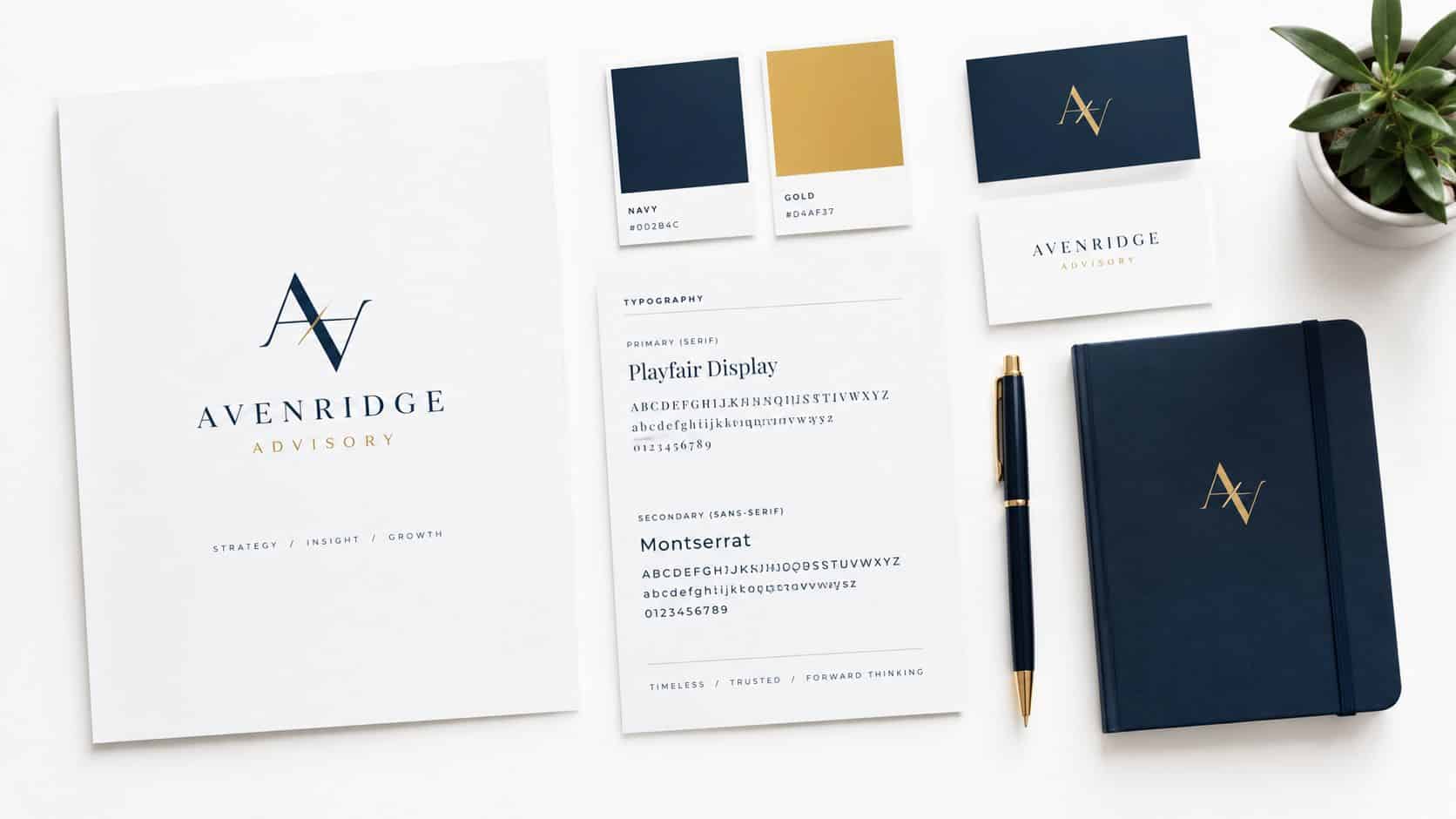
Visual identity should make a financial firm recognizable before a prospect reads every word. The system normally includes the logo, color palette, typography, imagery, iconography, layouts, motion rules, and accessibility standards. The logo is only one component, and often not the component doing the most day-to-day work.
Color choices should support the firm's intended perception without copying category conventions so closely that the result becomes anonymous. Typography should remain readable across websites, presentations, mobile screens, social graphics, and printed documents. Imagery should show credible people and situations that reflect the firm's audience, rather than relying on generic handshakes, city skylines, or abstract wealth symbols.
The brand guide should answer operational questions:
- Logo use: Specify approved versions, minimum size, clear space, background treatment, and prohibited alterations.
- Color use: Define primary and supporting colors, contrast requirements, and suitable applications.
- Typography: Identify typefaces, hierarchy, weight, spacing, and fallback options for common software.
- Imagery: Set direction for photography, illustration, cropping, and representation.
- Templates: Provide ready-to-use files for presentations, social posts, documents, and video.
- Governance: Explain how vendors, branch offices, and independent advisors access current assets.

A visual system should be tested with representative audiences for clarity, professionalism, readability, and accessibility. The firm should also audit third-party use. A compliant message can still look unreliable if a vendor stretches the logo, substitutes an unapproved font, or uses inaccessible color combinations.
5. Establish Trust Through Client Testimonials and Social Proof Elements
Financial firms often describe themselves as experienced, personal, transparent, or client-focused. Those claims are easy to write and difficult for prospects to evaluate. Social proof gives buyers evidence outside the firm's own assertions, but regulated organizations must treat testimonials, endorsements, reviews, awards, credentials, and case studies as controlled marketing assets.
The first question is not where a testimonial should appear. It's whether the statement can be substantiated, authenticated, and presented without implying a result the firm can't support. A compliant testimonial may describe the client experience, communication quality, planning process, or clarity of an interaction. It shouldn't suggest a specific return, guaranteed outcome, or universal result without appropriate evidence and review.
Trust research supports making proof easy to find. Morningstar's summary of financial-company trust research reports that more than 90% of surveyed consumers considered trust very important in relationships with financial firms, with financial soundness and security ranking as the top trust attribute. That finding favors evidence of reliability over decorative claims about innovation.
A strong proof system can include:
- Verified testimonials: Confirm that the person is real, the statement is accurate, and the context is documented.
- Relevant credentials: Display licenses, designations, experience, and affiliations in clear language.
- Specific process evidence: Explain what onboarding, planning, reporting, and service involve.
- Balanced representation: Include clients or scenarios that reflect the firm's genuine service scope.
- Review governance: Route questionable, negative, or potentially material comments to compliance and leadership.
The local business page creation example illustrates how a local presence can support discoverability and credibility. The firm should still validate every public claim before publication.
6. Develop Thought Leadership Content Positioning Advisors as Knowledgeable Resources
Thought leadership works when it demonstrates useful judgment, not when it announces that an advisor is an expert. A financial firm should choose a small set of subjects where its professionals possess genuine experience, a distinct point of view, or access to original analysis.
The content can address questions that prospects ask before a sales conversation. Examples include how business owners evaluate liquidity decisions, how families organize a multigenerational planning process, how institutions assess manager fit, or how a practice improves client onboarding. Educational content should help a reader understand an issue without disguising a sales pitch as research.
Editorial discipline matters. Each article, report, video script, and social post needs an owner, a review path, a source record where appropriate, and a scheduled update process. Forward-looking statements, market commentary, performance references, and comparisons require particular care. Compliance review should protect accuracy without removing the useful insight that makes the content worth reading.
A workable editorial program includes:
- A defined expertise map: Select topics that match actual capabilities and audience demand.
- Journey-stage coverage: Create introductory education, decision-support content, and deeper material for qualified prospects.
- Repurposing rules: Adapt a strong article into an email, video, presentation, or social explanation without changing its meaning.
- Search structure: Use clear headings, direct answers, descriptive metadata, and accessible text alongside visuals.
- Performance review: Evaluate engagement, qualified inquiries, search visibility, and compliance feedback together.
Content SEO services can support the editorial and search side of this work. The firm's subject-matter experts must remain responsible for accuracy, suitability, and the boundaries of each published viewpoint.
Useful thought leadership answers a real financial question before it asks for a meeting.
7. Leverage Video Content to Explain Complex Financial Concepts and Build Trust
Video allows prospects to evaluate more than a firm's claims. They can hear how an advisor explains a complex subject, observe whether the delivery feels clear and measured, and understand what a first conversation may feel like. That makes video particularly useful for financial organizations whose services are difficult to compare from a logo or service list.
A firm can begin with practical formats rather than expensive productions. Advisor introduction videos, short educational explainers, process walkthroughs, market-context videos, and client-service demonstrations can all support the brand. The best format depends on the subject. A technical planning concept may need a whiteboard or animation, while an advisor introduction benefits from a direct, human presentation.
Compliance becomes easier when production is systematized. A pre-approved script structure, visual template, disclosure treatment, captioning standard, thumbnail format, and review checklist can reduce unnecessary variation between episodes. Each final video should have an accessible transcript and captions, both for usability and for people who prefer to read.
A video workflow should include:
- Topic approval: Select subjects that fit the firm's positioning and audience questions.
- Script review: Check factual accuracy, disclosures, forward-looking language, and unsupported implications.
- Production standards: Use consistent framing, sound, lighting, backgrounds, and visual identity.
- Distribution adaptation: Adjust titles, descriptions, aspect ratios, and calls to action for each channel.
- Asset retention: Keep scripts, approvals, final files, captions, and versions in the firm's records.
A guide to making explainer videos can help teams structure educational production. Video shouldn't replace strong written content. Transcripts, captions, and supporting pages let the same approved explanation work across more of the prospect journey.
8. Implement SEO and Search-First Strategies Targeting Advisor-Relevant Queries
Search strategy should begin with the questions a qualified prospect types, not with a list of broad industry terms. A local financial advisor may need visibility for service and location combinations, while a wealth management firm may need pages explaining a specialized client segment or planning approach. The brand becomes more useful when search architecture reflects those real decisions.
Each priority service should have a clear page with a defined audience, helpful explanation, proof, internal links, and a compliant next step. Supporting articles can answer narrower questions and connect readers to the relevant service page. The firm should avoid producing large volumes of thin content that repeat generic advice without adding expertise.
Local optimization is especially important for advisors with defined service areas. A complete Google Business Profile, accurate name and address information, consistent directory listings, service descriptions, current photographs, and review governance help maintain a coherent local presence. Professional directories and association profiles should also use matching credentials and descriptions.
Technical and editorial controls belong together:
- Search intent: Match each page to an informational, navigational, or commercial question.
- Page clarity: Use descriptive titles, headings, summaries, internal links, and accessible image text.
- Structured data: Apply appropriate schema markup only when the page content supports it.
- Local relevance: Create useful community and service-area content instead of copying city names into generic pages.
- Measurement: Monitor queries, impressions, page engagement, qualified inquiries, and compliance findings.
The firm should also make content understandable to answer engines by using direct language, stable terminology, clear headings, and text that explains visual information. Search visibility is not a reason to exaggerate expertise. It is a reason to make legitimate expertise easier to find and verify.
9. Implement Targeted Advertising Campaigns with Audience Segmentation and Compliance
Paid advertising can create visibility before organic search, referrals, and thought leadership have had time to mature. It also creates risk quickly. A vague campaign can waste budget, while an overly aggressive financial claim can create a compliance problem that extends beyond the ad itself.
Segmentation should reflect meaningful differences in need, not create dozens of small audiences. Separate campaigns may be appropriate for retirement planning, business-owner planning, institutional services, advisor recruiting, or banking products, provided the firm can support each audience with accurate landing pages and relevant follow-up.
Search advertising is often a useful starting point because the prospect has expressed an active question. Display and paid social can support awareness and retargeting, but their creative should remain consistent with the website and approved messaging. The firm should exclude irrelevant audiences where possible and avoid targeting practices that conflict with privacy obligations or internal policies.
A controlled campaign process includes:
- Audience definition: State the business reason for each segment and the evidence that supports the targeting.
- Creative templates: Use pre-approved layouts, disclosures, claims, and calls to action.
- Landing-page alignment: Send each audience to a page that answers the ad's promise directly.
- Conversion tracking: Define what counts as a qualified inquiry before launch.
- Budget governance: Review spend, lead quality, search terms, and compliance feedback together.
- Retargeting controls: Set appropriate duration, exclusions, frequency limits, and privacy practices.
Campaign discipline: An advertisement is not successful because it generates a click. It succeeds when the right prospect receives an accurate message and enters a suitable next step.
The firm should test one material variable at a time where practical. Headlines, audience language, proof placement, and calls to action can be evaluated, but every variant should pass the same review standard as the original.
10. Build Email Marketing Programs and Monitor Brand Reputation Across Digital Channels
Email and reputation management address different moments in the trust journey. Email gives a firm a controlled way to educate prospects, support onboarding, and maintain relationships. Reputation monitoring shows how the firm is being discussed outside its owned channels and whether public evidence supports the desired position.
A useful email program starts with segmentation based on legitimate business needs and consent. A prospect interested in retirement planning shouldn't receive the same sequence as an advisor seeking practice-management support. Welcome messages, educational follow-ups, event reminders, service explanations, and onboarding communications should each have a clear purpose and a compliant call to action.
Reputation work needs the same structure. The firm should monitor its name, advisor names, locations, services, media mentions, directory profiles, and public reviews. Responses should remain factual, professional, and privacy-aware. Staff shouldn't disclose client information while attempting to correct a negative review, and they shouldn't offer compensation for positive feedback.
A practical operating rhythm includes:
- Email governance: Maintain approved templates, sender rules, disclosures, consent records, and retention procedures.
- Engagement review: Monitor clicks, replies, unsubscribes, inactive contacts, and qualified actions without treating one metric as the whole story.
- Review requests: Ask for honest feedback through a consistent process, never a promised positive outcome.
- Response training: Give staff approved language for appreciation, clarification, and escalation.
- Escalation rules: Send serious allegations, privacy concerns, impersonation, or regulatory issues to compliance and senior leadership.
- Source control: Keep email, review responses, and public profile descriptions aligned with the current brand guide.
Kantar's financial services trust analysis reports a 24-point gap between the importance consumers place on trust and how well financial services brands deliver it, and says 75% of consumers will walk away from a brand that loses their trust. The lesson is operational. Every email, review response, and service interaction either reinforces the brand promise or tests it.
10-Point Branding Best Practices Comparison
| Item | Implementation Complexity 🔄 | Resource Requirements ⚡ | Expected Outcomes ⭐📊 | Ideal Use Cases 💡 | Key Advantages ⭐ |
|---|---|---|---|---|---|
| Develop a Comprehensive Brand Strategy Aligned with Compliance Requirements | High 🔄; cross‑functional planning, legal input | Moderate ⚡; strategy time, consultant, compliance review | ⭐ Consistent messaging; 📊 reduced compliance risk, streamlined approvals | New/rebranding firms; regulated teams needing guardrails | ⭐ Governance reduces errors; consistent client experience |
| Build a Compliance‑Ready Website Designed for Lead Conversion | High 🔄; UX, dev, compliance workflows | High ⚡; design/dev, content, CRO tools, hosting | ⭐ Higher lead conversion; 📊 central audit trail for disclosures | Firms needing a primary digital asset and lead engine | ⭐ Measurable conversions; SEO + credibility |
| Create Consistent, Authenticated Brand Messaging Across All Channels | Medium‑High 🔄; governance + monitoring | Moderate ⚡; templates, training, approval system | ⭐ Stronger brand recall; 📊 fewer messaging conflicts | Multi‑channel firms, decentralized advisor teams | ⭐ Simplifies approvals; unified prospect experience |
| Design a Clear Visual Identity System (Logo, Colors, Typography) | Medium 🔄; creative process and rollout | Moderate ⚡; designers, asset library, file formats | ⭐ Improved recognition; 📊 faster creative production | New firms or visual refreshes; scale across touchpoints | ⭐ Professional presentation; consistent brand visuals |
| Establish Trust Through Client Testimonials & Social Proof | Medium 🔄; collection process + compliance vetting | Low‑Moderate ⚡; testimonial capture, legal review, media | ⭐ Increased conversions; 📊 higher prospect confidence | Conversion pages, advisor profiles, service pages | ⭐ Peer validation boosts credibility quickly |
| Develop Thought Leadership Content Positioning Advisors as Experts | Medium‑High 🔄; editorial process + compliance checks | Moderate‑High ⚡; researchers, writers, promotion budget | ⭐ Authority building; 📊 inbound leads over time (slow) | Firms seeking differentiation and media attention | ⭐ Long‑term credibility; content reusability |
| Leverage Video Content to Explain Complex Financial Concepts & Build Trust | Medium 🔄; production workflows, approval templates | Moderate‑High ⚡; equipment, editing, hosting, captions | ⭐ High engagement; 📊 stronger trust and conversions | Explainers, advisor intros, testimonials | ⭐ Humanizes advisors; reusable across channels |
| Implement SEO and Search‑First Strategies Targeting Advisor Queries | Medium‑High 🔄; technical + content strategy | Moderate ⚡; SEO specialist, content creation, tools | ⭐ Sustainable organic traffic; 📊 local lead capture (months) | Local visibility, long‑term inbound lead generation | ⭐ Lower long‑term CAC; capture active searchers |
| Implement Targeted Advertising Campaigns with Segmentation & Compliance | Medium 🔄; campaign setup + compliance approvals | High ⚡; ad spend, platform management, creatives | ⭐ Immediate visibility; 📊 measurable leads and ROI | Fast lead generation, testing messaging, market entry | ⭐ Speed to market; precise audience targeting |
| Build Email Marketing Programs & Monitor Brand Reputation Across Channels | Medium 🔄; automation flows + monitoring processes | Moderate ⚡; ESP, content, monitoring tools, team time | ⭐ High ROI; 📊 improved retention and reputation insights | Lead nurturing, client retention, local reputation mgmt | ⭐ Scalable personalization; early issue detection |
Turn Brand Standards Into a Governed Growth System
Financial branding becomes effective when the firm treats it as a connected operating system. Positioning sets the direction. The visual identity makes the firm recognizable. Messaging gives every channel a common vocabulary. The website turns attention into a governed next step. Proof, content, video, search, advertising, email, and reputation management then extend the same promise into the places where prospects make decisions.
The rollout should happen in a deliberate sequence. First, document the audience, position, differentiators, proof standards, exclusions, tone, and compliance guardrails. Next, approve the logo, colors, typography, imagery, templates, and messaging matrix. Then bring the website, biographies, service pages, disclosures, testimonials, directory profiles, and sales collateral into alignment.
Only after those foundations are stable should the firm scale distribution. Search content can answer high-intent questions. Video can explain complex concepts. Advertising can reach defined audiences. Email can nurture appropriate contacts. Reputation workflows can monitor public evidence and escalate concerns. Each channel should have an owner, an approval path, a version-controlled source of truth, and a defined measurement routine.
Measurement should stay focused. Wizbrand's brand benchmarking guidance recommends a stable core KPI set, coverage of the trust journey from pre-click reputation through post-purchase support, and segmentation by region, persona, product line, or channel. It also emphasizes standard definitions and dashboards tied to actions such as messaging changes, user-experience improvements, or stronger proof. That approach prevents averages from hiding weak points.
The commercial case for governance is also clear. Marq and Lucidpress research summarized by Fit Small Business links consistent brand presentation across channels with potential revenue increases of 10% to 20%, while some summaries cite higher ranges when consistency is enforced more rigorously. The finding supports a practical conclusion: brand consistency deserves operational ownership, not occasional design review.
A second benchmark from Capital One Shopping's branding research reports that 68% of organizations say brand consistency contributed at least 10% to revenue growth, 82% use templates to enforce consistency, and only 30% say their brand guidelines are widely used and recognized across the organization. Templates help, but adoption requires training, accessible assets, approval discipline, and leadership reinforcement.
Advisor Momentum is one relevant option for financial firms that need compliance-ready branding, websites, content, video, advertising, coaching, and related growth execution coordinated through one operating approach.
Advisor Momentum offers financial advisors, RIAs, wealth managers, and banking teams compliance-ready brand strategy, websites, content, video, advertising, coaching, and recruitment support. Firms seeking a governed branding system that connects credibility with lead generation can visit Advisor Momentum to discuss the next practical step.
