
A lot of advisory firms are in the same spot right now. The partners know they do strong work, clients are satisfied, and referrals still arrive, but they arrive unevenly. One quarter feels healthy, the next feels thin, and business development starts depending on who happened to mention the firm at the right dinner, board meeting, or estate planning conversation.
That model feels efficient until growth stalls. The pipeline looks active on paper, yet very little is predictable. For RIAs, that uncertainty creates a second problem beyond revenue. It also creates compliance risk, because ad hoc networking tends to produce ad hoc messaging, undocumented follow-up, and inconsistent expectations about what outside professionals can say on the firm's behalf.
Table of Contents
- Beyond Handshakes The Case for a Systematic COI Program
- Pinpointing Your Ideal Centers of Influence
- Crafting Your Compliant Outreach and Nurturing Sequence
- Structuring Mutually Beneficial Referral Agreements
- Tracking Performance and Maintaining Compliance
- From Connections to a Scalable Growth Engine
Beyond Handshakes The Case for a Systematic COI Program
A familiar pattern shows up in advisory firms that have outgrown casual networking. The founder has strong community ties, knows several attorneys and CPAs, and has built a respectable book through reputation. Then growth flattens. Those same relationships remain friendly, but they aren't producing a dependable flow of introductions, and no one inside the firm can explain why some connections produce meetings while others go silent.
That is where centers of influence stop being a social concept and become an operating discipline. A Center of Influence (COI) is a trusted professional, like an attorney or CPA, with relationships to high-net-worth clients. COI relationship mapping identifies who influences access to ideal prospects, how they are connected, and how strong those connections are, which helps create warm introductions that matter in client acquisition, as described by Altrata's overview of COI relationship mapping.
A firm that treats COIs casually usually does three things wrong. It confuses familiarity with influence, it pursues too many loose relationships, and it documents too little. That combination creates weak follow-through and a poor audit trail.
Practical rule: If a relationship isn't mapped, prioritized, and reviewed, it isn't a COI program. It's networking.
A systematic program changes the question from "Who knows affluent people?" to three better questions:
- Who has access to the firm's best-fit prospects through active professional relationships
- Where does shared context already exist through boards, charities, executive circles, or client overlap
- Which relationships are strong enough to support a warm introduction without putting the other professional's credibility at risk
That shift matters because RIAs can't afford vague growth channels. A compliant COI program requires consistent messaging, records of outreach, internal ownership, and clear boundaries around co-marketing and referrals. Without that structure, firms don't just waste time. They increase the chance that an offhand email, social post, or joint event drifts outside what compliance can defend.
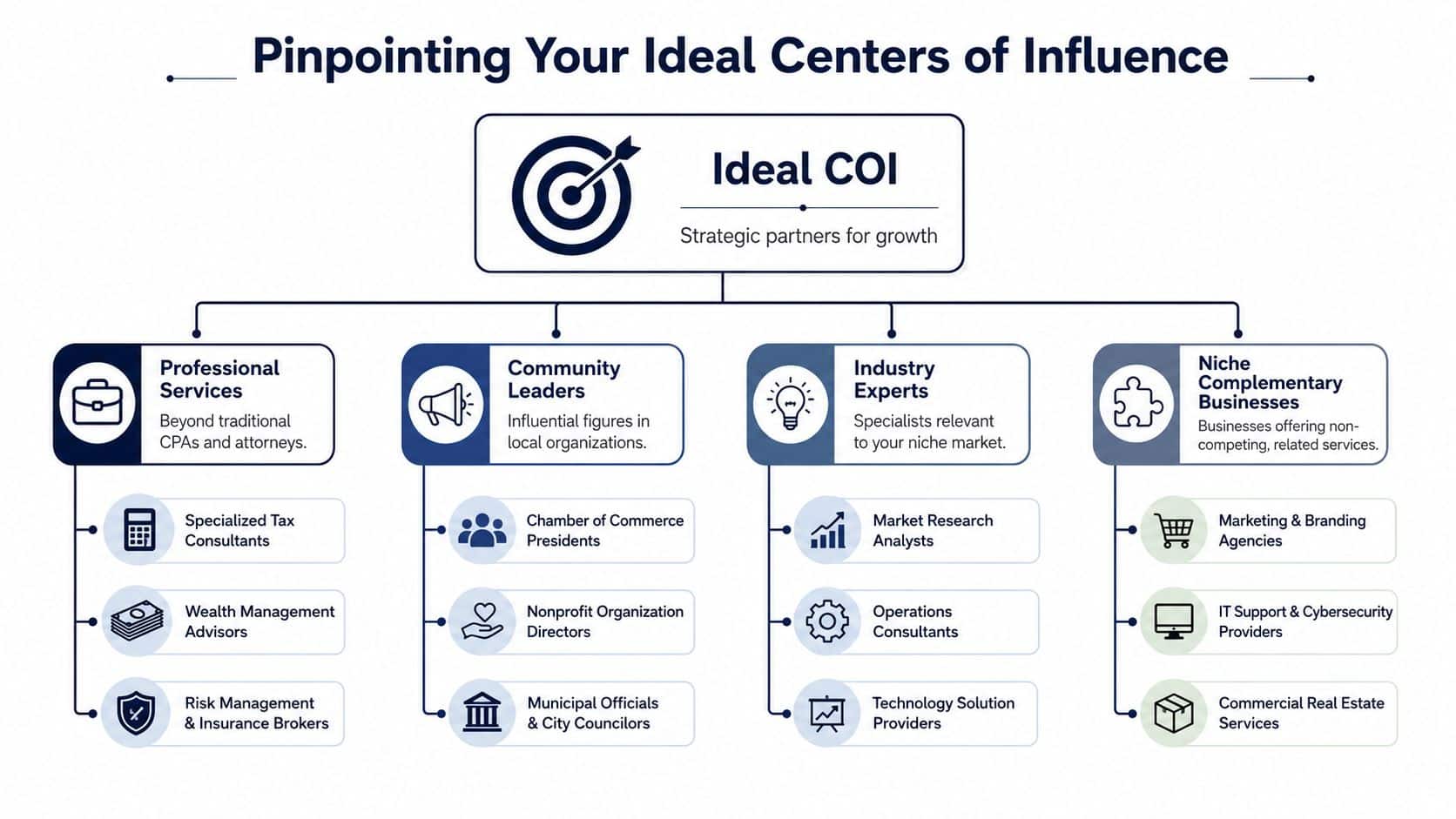
Pinpointing Your Ideal Centers of Influence
A firm can spend six months attending lunches with attorneys, CPAs, and consultants and still add nothing useful to its pipeline. The usual failure point is not effort. It is target selection. If the COI list is built around job titles instead of client fit, advisors end up with friendly contacts, weak referral potential, and poor compliance support for why those relationships belong in a formal growth program.
Start with the client base the firm already serves well
The best COI profile usually comes from the firm's existing book. Review the households, business owners, or executives the firm serves best. Then identify which outside professionals were involved before, during, or after the planning issues that made those relationships a good fit.
That process produces a better list than broad networking because it ties business development to real client needs and gives compliance a defensible rationale for outreach. A COI should have three traits. They serve the same kind of client, their work complements the advisory relationship, and they can protect trust during an introduction.
Teams that need a sharper client definition should revisit what is an ICP before building a COI list. A vague client profile usually leads to a vague partner strategy.
A practical screen looks like this:
- Client overlap: Does this professional consistently work with the households or business owners the firm wants more of?
- Service complement: Does their role improve client outcomes without creating confusion about who owns which advice?
- Credibility fit: Would the firm be comfortable having its name attached to this professional in front of a top client?
- Compliance fit: Can the relationship be documented, supervised, and discussed without creating avoidable referral or testimonial issues?
Look for decision-point proximity, not title alone
Many advisors default to estate planning attorneys and tax professionals. Those relationships still matter. They are not the full picture.
A stronger COI program maps who gets involved right before a client makes an important financial decision. Depending on the niche, that may include succession consultants, valuation specialists, divorce professionals, insurance specialists, benefits advisors, philanthropic leaders, or industry association operators. The question is simple. Who is present when money is in motion, planning is urgent, and trust already exists?
That standard also improves compliance judgment. Some contacts are well connected but hard to supervise because the relationship is informal, the value exchange is unclear, or the professional regularly blurs educational discussion with implied endorsement. Those names may belong in general networking. They do not belong on a priority COI list.
A COI earns a place in the program when that relationship sits close to a client's decision point and can be managed within the firm's compliance framework.
Build a short list the firm can supervise
A long spreadsheet usually signals weak discipline. In practice, firms get better results from a focused COI roster with clear ownership, review dates, and documented reasons for inclusion.
One workable approach is to tier the list by fit and oversight burden:
| Tier | What qualifies the COI | How the firm should respond |
|---|---|---|
| A | Strong client overlap, strong chemistry, clear complementary value | Assign an owner and a regular cadence |
| B | Good fit, but unproven reciprocity or unclear timing | Keep in nurture and test relevance |
| C | Friendly relationship, limited strategic value | Maintain lightly without major time investment |
This is not just a time-management exercise. It is also a compliance control. If the firm cannot explain why someone is on the COI list, what audience overlap exists, and what rules govern the relationship, that contact should stay outside the formal program until those answers are clear.
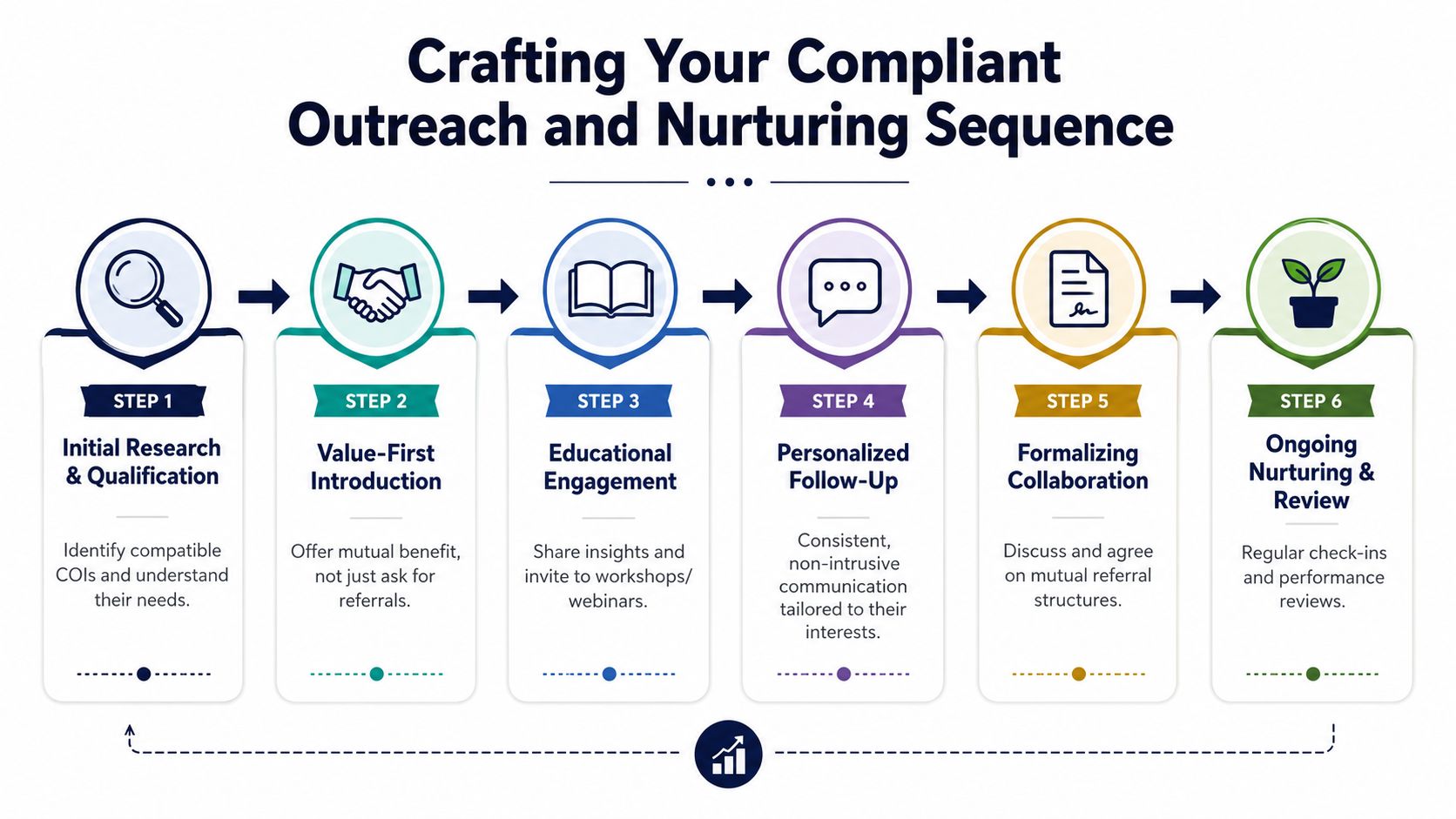
Crafting Your Compliant Outreach and Nurturing Sequence
A common failure point looks like this. An advisor has a good first meeting with an attorney or CPA, sends one follow-up email, then waits for referrals. Nothing happens. Six months later, the relationship is cold, there is no documentation of what was discussed, and compliance has no clear record of whether the interaction stayed educational or drifted into solicitation.
A COI sequence should prevent that outcome. It gives the firm a repeatable way to start conversations, maintain relevance, and document each touchpoint so outreach stays useful and reviewable.
Lead with relevance and keep the compliance file in mind
Early outreach works best when it is narrow, specific, and easy to defend if a regulator or examiner reviews it later. The message should explain why the firm is reaching out, what shared client issue creates legitimate overlap, and what low-pressure next step makes sense.
That standard improves conversion quality. It also improves supervision.
A good opening avoids three problems that create risk fast:
- vague claims about being a trusted expert
- implied expectations of reciprocal business
- language that sounds like endorsement before either side understands the other firm's process
The cleaner approach is straightforward:
- State the reason for contact based on real client overlap
- Identify a planning issue both professionals regularly see
- Suggest a limited next step such as a short call or coffee meeting
- Leave referrals out of the initial ask
For teams that want sharper conversation starters without sounding scripted, strategies for audience engagement and networking can help shape initial outreach language in a more natural way.
Build a sequence your firm can actually maintain
One meeting rarely tells you whether a COI relationship belongs in the program. What matters is whether the firm can maintain steady, relevant contact without slipping into generic check-ins or unsupported marketing claims.
A practical sequence usually looks like this:
- Touch one: Introductory email tied to a specific shared issue
- Touch two: Initial meeting focused on client overlap, service boundaries, and communication preferences
- Touch three: Follow-up note with one useful resource, meeting recap, or summary of agreed next steps
- Touch four: Invitation to an educational event, roundtable, or topic-specific discussion
- Touch five: Periodic check-in tied to a timely planning issue affecting the same client profile
- Touch six: Internal review of whether the relationship shows enough fit and conduct quality to continue
The timing matters less than the discipline. A firm that promises monthly touches and misses half of them creates more noise than value. In practice, quarterly contact with a clear reason is often easier to supervise and more credible to the COI.
Document each interaction the same way you would document any other business development activity subject to review. Keep the outreach copy, note what was discussed, record any materials shared, and flag anything that could raise questions about testimonials, endorsements, solicitor arrangements, or compensation. That recordkeeping habit turns COI marketing from an informal networking effort into a process the firm can defend.
Effective COI outreach gives the other professional enough clarity to assess fit carefully, without pressure and without compliance guesswork.
Sample outreach language that stays onside
The safest language is plain. It does not overstate expertise, imply results, or blur the line between education and promotion.
Initial email
Hello [Name],
The firm works with clients who often need coordinated input around [planning issue]. Your work with [client type or specialty] appears relevant to that same set of concerns. A brief conversation could help clarify where client needs overlap and whether staying in touch would be useful. If that would be worthwhile, the firm would welcome a short meeting.
Post-meeting follow-up
Thank you for the conversation. The discussion around [specific issue] was helpful. As mentioned, the firm is sending a short summary of the planning concerns that tend to come up in this area. If useful, a follow-up conversation later this quarter could focus on situations where earlier coordination between advisory and [the COI's profession] may help clients avoid delays or confusion.
There is a real trade-off here. Softer language usually produces fewer immediate introductions, but it also lowers the chance of creating misleading impressions or avoidable compliance problems. For RIAs, that is usually the better exchange.
Structuring Mutually Beneficial Referral Agreements
Many COI relationships break because both sides rely on assumptions. One side thinks the relationship is reciprocal. The other treats it as informal networking. Over time, the advisor sends introductions, follows up consistently, and invests in lunches or events, while receiving very little in return. That is not a relationship problem. It is a structure problem.

Why informal COI relationships break down
Capital Group highlights a problem many advisors recognize immediately. Many advisors refer more business than they receive because they lack formal guardrails, and practitioners need clear accountability metrics and mutual expectations early in the relationship to avoid one-sided partnerships, according to Capital Group's guidance on COI strategy.
That doesn't mean every COI needs a legal contract. It means the relationship needs explicit operating rules. Without them, each side measures success differently.
The most common failure points are easy to spot:
- Uneven referral expectations: One party expects active introductions, the other expects occasional goodwill
- No response standard: Referrals arrive, but follow-up is inconsistent or invisible
- Weak qualification: Names get exchanged without clarity on fit
- Overinvestment: The advisor keeps nurturing a low-yield relationship because the connection feels prestigious
The right guardrails don't make a relationship transactional. They prevent resentment from replacing trust.
What a workable agreement should cover
A practical COI agreement can be lightweight, but it should still address behavior. The goal isn't legal complexity. The goal is operational clarity.
A useful framework includes:
| Area | What to define |
|---|---|
| Purpose | Why the relationship exists and which client situations fit |
| Referral standards | What qualifies as a good introduction |
| Response expectations | How quickly each side acknowledges and handles an introduction |
| Communication limits | What can be said publicly, privately, and in co-marketing settings |
| Review cadence | When both sides assess whether the relationship is still productive |
Firms often benefit from using three possible structures, depending on maturity.
Reciprocal referral understanding works when both sides already know each other well and serve similar client profiles.
Educational collaboration works when trust is still forming. This might include joint workshops, closed-door roundtables, or shared client issue briefings, subject to the firm's compliance review.
Selective co-marketing works only when messaging, disclosures, and approvals are tightly managed. If the firm cannot review every public-facing asset in advance, this model should wait.
The key trade-off is discipline versus flexibility. Loose arrangements feel easier at the start, but they usually become expensive later. Firms that document expectations early tend to preserve both the relationship and the team's time.
Tracking Performance and Maintaining Compliance
A COI program should be measured like any other channel, but it should not be measured like paid lead generation. The first indicators aren't clicks or impressions. They are relationship quality, fit, responsiveness, and the quality of introductions.
That operational view matters because the compliance burden is real. If a firm can't document what was said, shared, approved, and followed up on, the program may create more regulatory exposure than growth.
Track relationship quality before pipeline volume
Most firms overvalue raw activity. Ten meetings with weak-fit professionals aren't better than two meetings with strong-fit COIs who understand the firm's client profile and communicate clearly.
A more useful scorecard tracks both relationship health and business outcomes. It should answer questions such as:
- Is the relationship active? Meetings, replies, and follow-through matter.
- Is the fit correct? Are introductions aligned with the firm's actual target client?
- Is the process reliable? Does each side handle introductions professionally and consistently?
- Is the relationship worth more investment? Some COIs deserve deeper collaboration. Others should move to low-maintenance status.
For firms building process discipline around these relationships, a strong client relationship management framework for financial services can help centralize owner assignment, follow-up records, and communication history.
Sample COI Performance Tracking Dashboard
| KPI | Metric | Target (Quarterly) | Notes |
|---|---|---|---|
| Active COIs | Number of COIs with documented touchpoints during the quarter | Firm-defined | Count only relationships with real interaction |
| Qualified introductions | Number of introductions that fit the firm's target client profile | Firm-defined | Separate from casual name drops |
| Intro-to-meeting conversion | Share of qualified introductions that become first meetings | Firm-defined | Use the same qualification standard every quarter |
| Meeting-to-opportunity progression | Number of meetings that advance into the firm's pipeline | Firm-defined | Track by COI source |
| Response timeliness | Time taken to acknowledge and route introductions | Firm-defined | Useful for service quality and reciprocity |
| Compliance completeness | Percentage of COI activities with required records retained | Firm-defined | Review emails, notes, event materials, and approvals |
That dashboard does more than measure output. It creates defensible oversight. A compliance officer or operations leader should be able to inspect the file for any active COI and understand who owns the relationship, what communications occurred, what materials were used, and whether any co-marketing was approved.
Apply SEC rules to every COI touchpoint
The SEC Marketing Rule, effective May 4, 2021, requires financial advisor communications to be fair, balanced, and complete, and it prohibits statements that are false, misleading, promissory, exaggerated, or unsubstantiated, as explained in C2P's summary of the SEC Marketing Rule.
In practical terms, that affects nearly every part of a COI program:
- Introductory emails: No exaggerated claims about outcomes, specialization, or expected results
- Joint events: No unsupported statements in slides, handouts, invitations, or follow-up summaries
- Referral discussions: No language that implies guaranteed client benefit or likely investment performance
- Co-branded content: Every asset should go through the same review discipline as any other advertisement
SEC books-and-records obligations matter just as much. Under SEC Rule 204-2, RIAs must maintain books and records for a minimum of five years, including client agreements, transaction records, advisory contracts, investment decision documentation, and all business communications such as email, text messages, and social media interactions, according to Smarsh's explanation of RIA communications recordkeeping.
That means COI communications cannot live in personal inboxes or undocumented text threads. The firm should retain:
- Approved outreach templates and any customized versions sent
- Meeting notes that describe the business purpose of each interaction
- Referral logs showing what was received, routed, and closed
- Event materials and co-marketing drafts with approval evidence
- Social and text communications if they relate to business activity
A firm also needs a web presence that supports the same discipline. A compliance-friendly adviser website should include the firm's name and contact information, Form CRS, any applicable performance advertising or testimonial disclosures, and a statement that the firm is a registered investment adviser permitted to conduct business only where registered or exempt, along with a note that materials are for educational purposes, as outlined in Comply's guide to a compliance-friendly adviser website.
The operating principle is straightforward. Every COI activity should be reviewable after the fact by someone who was not in the room. If the firm can't reconstruct the communication and the rationale, the process isn't mature enough.
From Connections to a Scalable Growth Engine
The firms that win with centers of influence don't treat them as a side project for rainmakers. They build a repeatable system around partner selection, outreach discipline, reciprocity standards, and recordkeeping. That turns referrals from occasional luck into managed business development.
This is also where many advisory firms separate strategy from habit. Casual networking feels productive because it is social and visible. A real COI program feels slower at first because it requires qualification, ownership, approvals, and follow-up. Over time, that slower model usually produces better relationships, cleaner handoffs, and fewer compliance surprises.
The strategic shift is important. Centers of influence are not just lead sources. They are external trust partners. When a firm respects that role, it stops asking broad questions like "Who can send business?" and starts building around narrower questions about fit, timing, client benefit, and communication controls.
A scalable COI engine usually shows five traits:
- Selective partner criteria instead of broad networking
- Value-first contact instead of referral-first outreach
- Defined guardrails instead of implied reciprocity
- Quarterly review habits instead of anecdotal judgment
- Integrated marketing discipline instead of disconnected business development activity
A COI program becomes scalable when the firm can hand it from one advisor or operator to another without losing quality, context, or compliance control.
That same discipline should carry into the firm's broader growth strategy. COI development works best when it supports the firm's digital presence, messaging standards, and overall digital marketing strategy for financial services. The strongest firms don't separate relationship marketing from brand governance. They run both together.
Advisory firms that want a more disciplined way to turn centers of influence into a compliant growth channel can work with Advisor Momentum. The team focuses on financial services marketing, compliance-aware content, websites, branding, coaching, and growth systems built for regulated firms that need credibility and control at the same time.
