

The most popular advice about client engagement software is also the least useful: choose the platform with the most features. A financial advisory firm can buy powerful automation, messaging, analytics, and artificial intelligence, then create new operational and compliance problems if permissions, records, integrations, and data handling aren't governed carefully.
A better evaluation starts with the client journey. Prospect follow-up requires different controls from digital onboarding. Planning engagement calls for different capabilities from ongoing service. A platform that excels at campaign automation may be a poor system for preserving advisory communications, while a strong CRM may still leave service teams without a practical case-management workflow.
This list evaluates client engagement software by the job it performs across an advisory firm's lifecycle. The comparison considers CRM depth, service management, planning experiences, sales engagement, workflow automation, integration effort, audit trails, data governance, and user adoption. It also treats implementation as part of the product decision, because a technically capable platform delivers little value when advisors won't use it consistently or compliance teams can't review its activity.
The market's expansion reinforces why this decision deserves discipline. One industry estimate valued customer engagement solutions at USD 24.36 billion in 2025 and projected USD 57.45 billion by 2034, a forecast of 10.10% compound annual growth. Fortune Business Insights' market estimate places the category well beyond a niche software segment. For RIAs, wealth managers, and bank teams, the practical question isn't whether engagement technology matters. It's which layer should be implemented first, and how safely it can support real client work.
Table of Contents
- 1. Salesforce Financial Services Cloud
- 2. HubSpot CRM for Financial Services
- 3. Redtail Technology CRM
- 4. Wealthbox CRM
- 5. Orion Advisor Services Platform
- 6. Tamarac by Morningstar
- 7. Salesforce Service Cloud for Advisory Client Support
- 8. Envestnet|MoneyGuide Engagement Tools
- 9. Outreach Sales Engagement Platform
- 10. HubSpot Service Hub for Advisory Client Retention
- Top 10 Client Engagement Software, Feature Comparison
- Build the Engagement Stack Around the Client Journey
1. Salesforce Financial Services Cloud
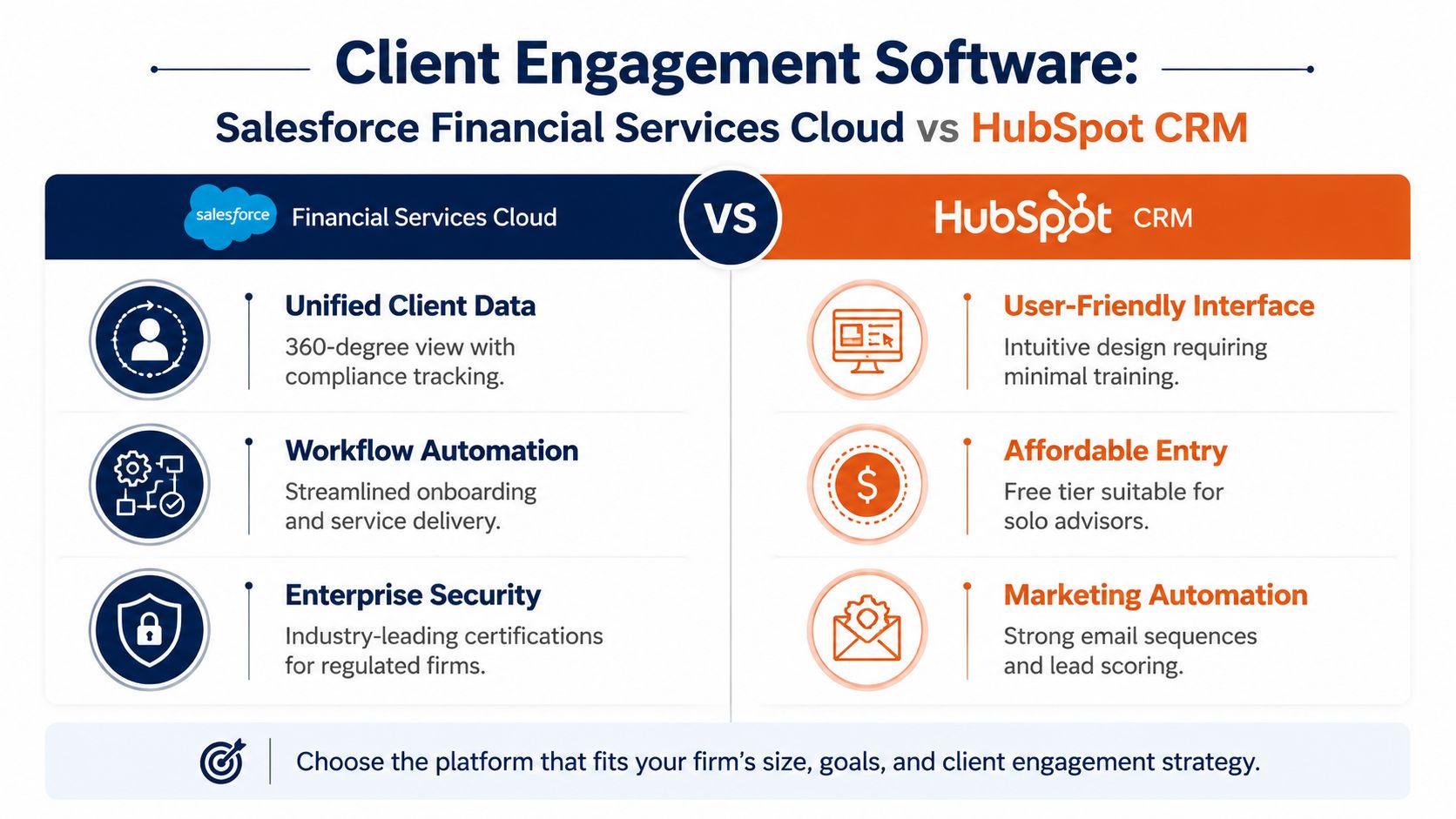
Salesforce Financial Services Cloud is the strongest fit on this list for a firm that needs a broad relationship system rather than a narrow messaging tool. It gives wealth management practices and RIAs a central place for household information, relationship history, opportunities, tasks, workflows, and service activity. That breadth can support a prospect from first inquiry through onboarding and ongoing planning conversations, provided the firm defines its operating model before configuration begins.
The platform's flexibility is also its main trade-off. A large advisory business can configure workflows for multiple advisors, complex service teams, and varied client segments, but configuration without process discipline can produce clutter, duplicate fields, and inconsistent records. Firms managing substantial assets may value the ability to standardize client lifecycle management across offices, while smaller practices may find the implementation effort disproportionate to their immediate needs.
Where it fits in the lifecycle
Salesforce works best when the firm wants one governed system for prospect follow-up, client data, advisor tasks, and engagement history. It can help teams route inquiries, assign onboarding responsibilities, trigger review reminders, and document interactions. The useful starting point is the core CRM, not every specialized module available.
A practical implementation sequence includes:
- Process mapping: Document how a lead becomes a qualified prospect, client, household, and service relationship before building fields or automations.
- Partner selection: Use an implementation partner familiar with advisory workflows, not only general sales operations.
- Compliance documentation: Configure review and recordkeeping procedures so the system supports regulatory documentation rather than merely storing contacts.
- Adoption measurement: Track whether advisors enter complete notes, close assigned tasks, and use the system during actual client work.
Practical rule: A sophisticated CRM should standardize the firm's service model before it automates that model.
Firms should also assess how Salesforce data connects to portfolio, planning, email, document, and archival systems. Integration quality matters more than the number of available connectors. A disconnected CRM can become another administrative screen instead of the operating layer leadership expects.
2. HubSpot CRM for Financial Services
HubSpot CRM suits independent advisors and small advisory teams that need usable contact management, marketing coordination, and follow-up without a heavy technical program. Its accessible interface can make it easier for a practice to capture inquiries, schedule meetings, assign tasks, and maintain a visible record of prospect communication. That simplicity is valuable when the alternative is a spreadsheet, personal inboxes, and reminders that only one employee can see.
The trade-off is governance depth. A financial-services firm must decide whether the system will hold sensitive client information, marketing permissions, advisory communications, or only early-stage prospect data. A free or lightweight setup may be appropriate for basic relationship tracking, but regulated teams shouldn't assume that ease of use automatically provides the retention, supervision, approval, and archival controls their policies require.
Practical uses for smaller practices
HubSpot can support a clear prospect-to-onboarding workflow. A new inquiry can enter a defined pipeline, receive an approved sequence, and trigger a task for a human follow-up. Lead scoring can help staff prioritize prospects who have completed a planning form or requested a meeting, although scoring should guide attention rather than make an unsupervised suitability judgment.
Annual financial-plan review reminders can also reduce reliance on individual calendars. Google Calendar integration can simplify scheduling, but the firm still needs a policy for what belongs in the CRM, what belongs in the official record, and how staff should document substantive communications.
A sensible setup focuses on a limited number of workflows:
- New inquiry routing: Assign every inquiry to an owner and a follow-up deadline.
- Onboarding communication: Use only approved templates, with compliance review and opt-out handling.
- Review reminders: Create recurring tasks for annual planning conversations and service milestones.
- Data boundaries: Separate marketing contacts from active client records when the platform isn't the official system of record.
A professional advisor can use a tablet-based interface to review contact lists and follow-up tasks, but the device doesn't solve process problems by itself. The practice should test whether staff can log an interaction quickly and accurately during a busy day. If they can't, the firm needs a simpler workflow before adding more automation.

3. Redtail Technology CRM
Redtail Technology CRM is designed around the working patterns of independent financial advisors and smaller RIA teams. Its value comes less from trying to serve every industry and more from fitting common advisory activities, including client communication, financial-planning coordination, business development, and service reminders. A solo advisor can use it as a relationship hub, while a team can use shared records and tasks to coordinate household service.
The platform becomes particularly useful when the firm's engagement problem is consistency. Anniversary reminders, referral tracking, email logging, and recurring tasks can help advisors replace memory-driven outreach with repeatable processes. Those features still need governance. A logged email isn't necessarily a complete regulatory record, and a reminder isn't a substitute for a documented service standard.
A practical core for independent advisors
Redtail should be connected to the firm's wealth-management and planning systems wherever reliable integrations exist. The purpose is to reduce duplicate entry and preserve a dependable flow of client information. Before activation, operations leaders should identify which system owns household data, account information, documents, and communications.
Referral tracking can help management understand where opportunities originate, while anniversary reminders can prompt personal outreach that feels relevant rather than automated. Email integration can automatically capture correspondence, but the firm should test whether attachments, replies, and shared mailboxes are handled as expected.
A small RIA team might configure workflows around:
- Referral ownership: Record the source, responsible advisor, next action, and outcome.
- Household milestones: Create approved reminders for anniversaries, reviews, and planning events.
- Communication capture: Log email and meeting activity without encouraging staff to place sensitive information in uncontrolled notes.
- Integration checks: Reconcile key client fields between Redtail and the portfolio or planning platform.
The CRM guide for financial advisors can help firms frame the selection around advisory workflows rather than generic sales terminology. That distinction matters because a CRM should support the firm's service promise, not force advisors into a pipeline model that doesn't reflect how relationships develop.
A CRM record earns trust when another authorized team member can understand the relationship without asking the original advisor.
Redtail is a practical candidate for firms that need industry-oriented CRM functionality and a manageable adoption path. It may be less suitable when leadership wants a highly customized enterprise architecture spanning many departments and systems.
4. Wealthbox CRM
Wealthbox CRM emphasizes an approachable experience for advisory practices that want client relationship management without making every advisor feel like a database administrator. Its workflow tools can support new-client welcome sequences, planning outreach, service reminders, and business-development activities. That focus on usability is important because engagement software only improves service when the people responsible for client relationships use it.
The platform's best use case is a growing practice that needs more structure than email and spreadsheets but doesn't yet need a highly complex enterprise configuration. A firm with several advisors can create shared workflows and segments for targeted outreach. The risk is that teams may automate communication before deciding which messages deserve personal attention and which can safely follow a standard pattern.
Turning routine activity into visible work
New-client welcome sequences can make onboarding feel coordinated. They can remind clients about documents, introduce service contacts, and signal the next step. The content should remain approved, accurate, and appropriate for the client's status. Automated reminders shouldn't imply that a review occurred when a human meeting hasn't taken place.
Client segmentation can support planning outreach, such as communications for retirement-income reviews or cash-flow conversations. Segments should be based on documented business rules, not informal assumptions. Access controls also deserve attention when a segment reveals sensitive financial circumstances.
Useful workflow patterns include:
- Welcome coordination: Assign document, meeting, and follow-up tasks to specific team members.
- Targeted planning outreach: Use clear segment definitions and approved message templates.
- Document exchange: Use a secure portal where appropriate instead of sending sensitive attachments through ordinary email.
- Routine task automation: Trigger reminders for repeatable internal work, then require human completion and verification.
The platform's simplicity can shorten training, but ease of adoption shouldn't lead to weak data discipline. Leadership should define mandatory fields, note standards, escalation rules, and ownership before opening access to the entire firm. A short pilot with one advisory team can reveal whether workflows match real practice.
Wealthbox is a sensible choice when the primary problem is inconsistent follow-up and fragmented task ownership. It isn't automatically the right first purchase for a firm that lacks a clear process or expects the CRM to replace portfolio management, planning, archival, and compliance systems at once.
5. Orion Advisor Services Platform
Orion Advisor Services Platform is suited to advisory teams that want engagement activity connected to wealth-management operations. Portfolio management, rebalancing, performance reporting, and relationship workflows can sit within a broader operating environment, which may reduce the friction created by moving between disconnected systems. For firms managing complex operations, that connection can make client service more informed and more consistent.
The benefit comes with implementation weight. An integrated platform touches data, reporting, trading, workflows, permissions, and client-facing experiences. A firm shouldn't treat deployment as a software switch. It needs dedicated implementation ownership, standardized service procedures, data mapping, user training, and a clear approach to exception handling.
Connecting service to portfolio reality
A client service team can respond more effectively when it can see the operational context behind a request. A performance-reporting question, onboarding task, or service issue may involve multiple accounts, advisors, and internal approvals. Orion's value increases when the firm maps those relationships and defines who owns each action.
Analytics can help management identify recurring service issues, delayed tasks, or communication patterns that deserve attention. Dashboards don't improve service by themselves. Leaders must connect them to decisions, such as changing a workflow, improving a client explanation, or allocating service capacity.
A disciplined rollout should cover:
- Data ownership: Define which system controls client, account, household, and reporting data.
- Workflow standardization: Agree on the approved service path before configuring automation.
- Permission design: Limit access according to role, need, and supervisory responsibility.
- Record controls: Confirm how notes, reports, messages, and changes are retained and retrieved.
- Pilot scope: Start with a contained client-service process before broad deployment.
The platform is most compelling for an RIA seeking consolidation and stronger operational visibility. Smaller firms with limited implementation resources may get better results from a narrower CRM until their processes and data practices are mature enough for an integrated environment.
6. Tamarac by Morningstar
Tamarac by Morningstar combines practice-management functions with portfolio management, planning, trading, compliance, reporting, and client relationship capabilities. That combination can appeal to multi-office RIAs and firms standardizing operations after growth or acquisition. Rather than treating engagement as a standalone marketing activity, the platform can connect client communication to the portfolio and planning work that gives advisory relationships their substance.
This breadth creates a familiar trade-off. A unified environment may reduce duplicate work, but it also increases the consequences of poor configuration. If offices use different service definitions, naming conventions, approval steps, or reporting practices, the platform can preserve inconsistency at scale instead of removing it.
Standardization before automation
Tamarac is most effective when the firm has already decided how advisors and service teams should work. Compliance workflow automation can reduce manual review effort, but the firm must define what gets reviewed, who approves it, what evidence is retained, and how exceptions are escalated. Automated reporting can improve operational efficiency only when the underlying data is complete and accurate.
Integrated planning can strengthen client conversations by linking recommendations to broader financial objectives. Performance analytics may also help identify service opportunities or support business-development discussions. Those uses should remain grounded in the firm's approved advisory process, with clear separation between analysis, communication, and advice.
Firms considering Tamarac should examine:
- Office consistency: Determine whether all locations follow the same client-service and reporting standards.
- Acquisition integration: Map legacy data and workflows before migrating acquired practices.
- Compliance review: Test approval, retention, retrieval, and supervisory controls using realistic records.
- Client reporting: Confirm that reports are understandable, timely, and aligned with the firm's communication policy.
- Training ownership: Assign internal champions who can reinforce usage after implementation.
A firm shouldn't select Tamarac solely because it offers many capabilities. The better reason is that its portfolio, planning, reporting, and engagement needs genuinely belong in a coordinated operating model. If the practice only needs prospect reminders, a full practice-management environment may add unnecessary complexity.
7. Salesforce Service Cloud for Advisory Client Support
Salesforce Service Cloud addresses the part of the client journey that begins after the relationship is established. Advisory teams can use case management to organize service requests, route inquiries, track ownership, and document resolution. A knowledge base and client portal can also reduce repetitive questions, although self-service should complement human support rather than replace it where clients need judgment or reassurance.
The platform's advantage is operational visibility. A phone call, portal request, document question, and follow-up task can become part of a shared service process instead of remaining in personal inboxes. That matters for growing wealth-management teams where clients expect continuity even when their usual advisor is unavailable.
Building a controlled service desk
A client portal can give clients access to approved information and routine resources outside office hours. The firm must define authentication, content approval, permissions, and escalation rules before promoting self-service. A knowledge base should answer common questions in plain language, but it shouldn't drift into unreviewed advice or outdated product explanations.
Service-level targets can help teams prioritize urgent matters and identify unresolved work. They should be realistic and tied to staffing. If a firm promises rapid responses without assigning capacity, the platform will expose the service gap rather than solve it.
Implementation priorities include:
- Case taxonomy: Categorize requests by topic, urgency, owner, and required expertise.
- Knowledge governance: Assign review responsibility and expiration dates to client-facing articles.
- Escalation paths: Route investment, operational, privacy, and complaint matters to the correct teams.
- Service reporting: Review open cases, recurring issues, response quality, and unresolved handoffs.
- Portal boundaries: Publish only information the client is authorized to access and the firm is prepared to maintain.
A firm building its operating model can also use advisor customer service guidance to connect service technology with staffing, communication standards, and client expectations. Service Cloud is a strong choice when the problem is inconsistent post-sale support, not when the firm still lacks a basic CRM record for prospects and clients.
8. Envestnet|MoneyGuide Engagement Tools
Envestnet|MoneyGuide Engagement Tools place the planning experience at the center of client engagement. Interactive planning tools, retirement calculators, engagement portals, and co-branded experiences can help advisors turn an abstract introductory conversation into a structured discussion about goals, trade-offs, and priorities. This makes the platform particularly relevant during prospect qualification and planning meetings.
The central trade-off is that interactive software can create the appearance of progress without producing a substantive advice process. A prospect may complete a tool, but the advisor still needs to validate inputs, explain assumptions, address uncertainty, and determine what belongs in the official planning record. Data captured through a digital experience should be treated as a starting point for professional discussion, not as self-executing advice.
Using planning as an engagement experience
Advisors can introduce planning tools during an initial meeting to demonstrate value before a prospect commits to a long relationship. Branded landing pages may help direct prospects into the experience, while an engagement portal can keep existing clients involved between meetings. During volatile markets, interactive planning can shift the conversation from short-term reactions toward goals and scenarios.
The workflow should define what happens after a client submits information. Staff need tasks for reviewing incomplete data, confirming assumptions, scheduling a conversation, and recording material decisions. Without that follow-through, the tool becomes another lead form.
A practical planning workflow includes:
- Prospect entry: Use an approved landing page and explain how submitted information will be used.
- Data review: Check inputs for completeness and plausibility before relying on them in a recommendation.
- Advisor discussion: Use the results to guide a human conversation about goals and trade-offs.
- Record preservation: Capture relevant outputs, disclosures, approvals, and subsequent changes.
- Ongoing engagement: Invite clients back for defined planning events, not indiscriminate reminders.
Client-facing planning software can deepen relationships when the advisor remains visible and accountable. It works less well when the firm treats a calculator, portal, or questionnaire as a replacement for discovery and professional judgment.
9. Outreach Sales Engagement Platform
Outreach Sales Engagement Platform focuses on prospecting discipline. It can organize email sequences, call logging, tasks, engagement activity, and management visibility for advisory teams that need a repeatable business-development process. That makes it useful for practices where advisors know they should follow up but lack a shared cadence, clear ownership, or reliable reporting.
Sales engagement automation carries a clear compliance risk in financial services. A sequence can make inappropriate or unapproved language easy to send at scale. It can also create excessive contact, confusing records, or messages that fail to reflect a prospect's actual status. The platform should therefore operate inside an approved communication framework, with human review for sensitive or substantive exchanges.
Scaling prospect follow-up responsibly
Management teams can create templates for common scenarios, such as a request for an introductory meeting, a referral follow-up, or a seminar attendee conversation. Templates should receive the appropriate review before use, and staff should understand when to stop an automated sequence. A reply, complaint, request to opt out, or indication of a personal financial situation should move the interaction into a human-managed process.
Analytics can show which sequences receive attention and where advisors abandon follow-up. Those signals are useful for coaching, but managers shouldn't reward activity volume alone. High message counts can hide poor relevance, weak personalization, or low-quality prospect conversations.
A controlled deployment should include:
- Approved scenarios: Limit sequences to documented business-development use cases.
- Stop conditions: Pause automation after replies, opt-outs, complaints, or sensitive disclosures.
- Activity standards: Evaluate the quality and outcome of engagement, not only completed tasks.
- Coaching integration: Pair analytics with role-play, feedback, and advisor support.
- Record policy: Decide how calls, emails, responses, and approvals are retained and retrieved.
Outreach is best for a firm with a defined prospecting motion and managers prepared to coach behavior. It isn't a substitute for positioning, trust, compliant content, or a compelling client experience after the first meeting.
10. HubSpot Service Hub for Advisory Client Retention
HubSpot Service Hub is aimed at post-sale support, client communication, and retention workflows. Ticketing can give a small advisory practice a structured way to manage questions, requests, and handoffs. Knowledge management can reduce repetitive explanations, while satisfaction follow-ups can reveal whether the firm's internal view of service matches the client's experience.
That feedback loop is especially important in financial services. One industry report found that 82% of financial-services companies believed their audiences were satisfied with messaging, while only 41% of consumers agreed, creating a 41-point perception gap. The State of Customer Engagement in Financial Services supports a practical conclusion: firms should test communication quality instead of assuming that sent messages were effective.
Retention needs more than ticket closure
A service ticket can show that a request was closed, but closure doesn't prove that the client understood the answer or felt supported. Health scoring can help staff identify clients needing proactive attention, but the score should be based on transparent signals and reviewed by a human. NPS surveys may provide directional feedback, though regulated firms should define how responses are stored, escalated, and used.
A knowledge base should address recurring operational questions, such as meeting preparation, document submission, account access, and planning-process explanations. Content should be approved and reviewed regularly. It shouldn't provide individualized recommendations without the appropriate advisor involvement.
Useful Service Hub practices include:
- Health review: Combine service activity, meeting history, unresolved requests, and advisor observations.
- Survey escalation: Route negative or concerning feedback to a named owner.
- Knowledge maintenance: Review client-facing answers for accuracy and relevance.
- Follow-up automation: Send approved satisfaction messages after service interactions.
- Expansion discipline: Treat additional needs as discovery opportunities, not automatic sales prompts.
HubSpot Service Hub can work well for smaller practices that need visible support workflows without a large service operation. It should be evaluated carefully when it will store regulated communications or sensitive client data, particularly if the firm's archival and supervisory systems sit elsewhere.
Top 10 Client Engagement Software, Feature Comparison
| Product | Core Capabilities | Ease of Use (★) | Compliance & Security (🏆) | Value & Pricing (💰) | Target Audience & USP (👥✨) |
|---|---|---|---|---|---|
| Salesforce Financial Services Cloud | 360° client CRM, workflow automation, rich integrations | ★★, powerful, steep learning curve | 🏆 Enterprise-grade audit trails & compliance tooling | 💰💰💰, high licensing & implementation costs | 👥 Large RIAs / enterprise; ✨ highly customizable for regulated workflows |
| HubSpot CRM for Financial Services | Contact management, email automation, lead scoring | ★★★★, very user-friendly, fast onboarding | 🏆 Moderate, compliant with add-ons and processes | 💰, free tier; paid tiers scale with growth | 👥 Solo advisors & small teams; ✨ easy marketing automation |
| Redtail Technology CRM | Advisor-centric client/prospect workflows, referral tracking | ★★★★, simple, advisor-focused UI | 🏆 Good, compliance-aware documentation features | 💰, affordable for independent advisors | 👥 Independent RIAs & small firms; ✨ built for advisory terminology |
| Wealthbox CRM | Intuitive dashboard, automation, document portal | ★★★★, clean modern interface | 🏆 Moderate, native integrations help compliance | 💰💰, cost-effective for growing firms | 👥 Growing RIAs (5–50 advisors); ✨ flexible automation + portal |
| Orion Advisor Services Platform | Unified portfolio + CRM, rebalancing, reporting | ★★★, feature-rich, moderate complexity | 🏆 Enterprise-level compliance & supervisory workflows | 💰💰💰, higher TCO for smaller practices | 👥 Mid–large RIAs; ✨ integrates portfolio + client data natively |
| Tamarac by Morningstar | Portfolio/trading, planning, compliance automation | ★★★, comprehensive, requires training | 🏆 Strong compliance automation & reporting | 💰💰💰, premium pricing for full deployment | 👥 Multi-office & growing firms; ✨ end-to-end back-office automation |
| Salesforce Service Cloud (Advisory) | Case management, client portal, omnichannel support | ★★, best with Salesforce ecosystem | 🏆 Enterprise compliance tracking & auditability | 💰💰💰, add-on licensing & implementation | 👥 Enterprise advisory teams; ✨ scalable client support platform |
| Envestnet | MoneyGuide Engagement Tools | Interactive planning, client portals, scenario tools | ★★★, advisor-facing & client-friendly UX | 🏆 Compliance-ready planning framework | 💰💰, licensed per firm/advisor | 👥 Planning-focused firms; ✨ co-branded engagement tools |
| Outreach Sales Engagement Platform | Multi-touch sequences, call logging, analytics | ★★★, needs adoption & coaching | 🏆 Captures compliant interaction records when integrated | 💰💰, per-user licensing scales | 👥 Teams focused on prospecting & BD; ✨ automation + coaching insights |
| HubSpot Service Hub for Advisory Retention | Ticketing, knowledge base, NPS, client health scoring | ★★★★, easy to use, fast setup | 🏆 Moderate, best when paired with HubSpot CRM | 💰💰, affordable, bundled options | 👥 Small–mid advisory teams; ✨ simple retention & satisfaction tools |
Build the Engagement Stack Around the Client Journey
The right client engagement software depends on the firm's workflow maturity, not a universal ranking. A solo advisor with scattered follow-up may need a simple CRM and clear task ownership. A growing RIA may need shared workflows, planning engagement, and integrations across portfolio and document systems. A multi-office wealth manager may need standardized permissions, reporting, service cases, and formal implementation governance.
The category itself has expanded from narrow customer-service systems into broader engagement infrastructure. One market report describes solutions spanning messaging, contact-center workflows, analytics, and automation. It reported that solutions represented 66.80% of market share in 2025, on-premise deployments held 69.90%, and cloud deployments were forecast to grow at a 12.28% compound annual growth rate. The same report stated that large enterprises captured 65.70% of revenue in 2025, while small and medium enterprises were expected to expand at an 11.88% compound annual growth rate. Mordor Intelligence's market analysis illustrates why buyers must distinguish legacy deployment needs from the more flexible operating model many firms now expect.
Financial advisors already rely heavily on digital workflow infrastructure. Schwab Advisor Services reported that 98% of registered investment advisors used digital money movement tools and 80% used digital client onboarding, while the 2023 T3 and Inside Information Advisory Software Survey found CRM adoption above 96% and financial planning software adoption above 83%. InvestmentNews' coverage of advisor technology adoption shows that the selection problem is no longer whether firms use technology. It is whether their systems connect into a coherent, adopted process.
Start with the workflow, not the vendor demo
Map the lead-to-onboard journey first. Identify where a prospect enters, who owns follow-up, what information is collected, when consent is captured, which communications require approval, and what becomes part of the permanent record. Then map ongoing service, including requests, complaints, document exchange, planning reviews, portfolio questions, and escalation paths.
The implementation plan should answer practical questions:
- System ownership: Which platform is authoritative for contacts, households, accounts, plans, documents, and communications?
- Integration behavior: What syncs automatically, what fails, and who reconciles discrepancies?
- Permission controls: Which employees can view, edit, export, approve, or delete information?
- Auditability: Can the firm retrieve the relevant communication, version, approval, and activity history?
- Adoption: Can advisors complete the required workflow during a normal client day without workarounds?
Compliance controls need specific testing. FINRA Rule 4511 requires firms to maintain records in a format that complies with SEC Rule 17a-4. That rule uses a write once, read many standard, meaning electronic records must be stored in a non-rewriteable and non-erasable format so they can't be altered or deleted. InvestmentNews' explanation of FINRA-compliant client management requirements provides a useful reference point for vendor questions about retention and record integrity.
Digital communications also require market-specific review. Singapore's Monetary Authority states that its Guidelines on Standards of Conduct for Digital Advertising Activities apply to financial institutions and their digital marketers advertising financial products and services through digital media. Firms operating across jurisdictions should document which rules apply to each channel, audience, message type, and approval process.
Treat AI as a governed workflow decision
The most important AI question isn't whether a platform can personalize communication. It is whether the firm can explain what the system is allowed to do, what data it can access, when a human must review the output, and how the firm will preserve evidence of consent and decision-making. Adobe reported that 62% of companies planned to use agentic AI for conversational customer engagement within the following 18 months, while also identifying privacy-led data governance, consent-based first-party data, and regulations including GDPR, CCPA/CPRA, LGPD, India's DPDP Act, and the EU AI Act as forces shaping product design. Adobe's customer engagement digital trends report makes the governance issue difficult to ignore.
A regulated firm should begin with bounded use cases. Drafting an internal task summary, suggesting a follow-up reminder, or routing a service request may be easier to supervise than generating individualized financial messaging or answering questions that could be interpreted as advice. The firm should define approved data sources, prohibited inputs, review thresholds, disclosure requirements, retention procedures, and a process for investigating errors.
Run a focused pilot
A pilot should test one meaningful workflow, such as prospect follow-up, digital onboarding, annual planning reviews, or service-request management. The firm should establish baseline process expectations qualitatively, then evaluate whether staff complete tasks, clients receive accurate communication, records remain retrievable, and handoffs work across systems.
Onboarding is a particularly useful pilot because it combines lead conversion, data capture, consent, document handling, advisor coordination, and compliance review. intelliflo's Advice Efficiency Survey 2025 reported that advice firms onboarded an average of 13 new clients per week, up from 6 in 2024, which it described as a 116% year-on-year rise, while firms had digitized 43% of their processes. Finextra's coverage of the survey shows why onboarding deserves measurement rather than vague claims about efficiency.
Client engagement software should make the desired behavior easier, safer, and more visible. If the pilot reveals duplicate entry, unclear ownership, missing records, low adoption, or uncontrolled messaging, the firm should fix the process before expanding the technology. Broader execution support can also matter. Advisor Momentum provides compliance-ready website development, content programs, digital marketing, coaching for onboarding and client service workflows, AI adoption guidance, and recruitment support for regulated financial organizations. Its Email Strategy Guide can help advisory teams connect email activity to a more deliberate communication process.
The final decision should be based on fit across four dimensions: firm size, workflow maturity, integration needs, and compliance oversight. Feature count comes last. A smaller firm may gain more from a system advisors use every day than from an enterprise suite that remains underused. A larger firm may accept implementation complexity when it produces consistent data, controlled access, stronger service visibility, and reliable records across offices.
The practical next step is clear. Map the client journey, document required controls, prepare vendor questions, select one workflow for a focused pilot, and involve compliance, operations, advisors, and service staff before signing a broad contract. That process turns client engagement software from another technology purchase into an accountable part of client service.
Advisor Momentum offers compliance-first website design, content, digital marketing, coaching, and onboarding support for financial advisors, planners, wealth managers, and banking teams. Visit Advisor Momentum to connect engagement technology with compliant marketing, client-service workflows, and practical growth execution.
