

More content isn't the answer to weak financial marketing. A firm can publish regularly, distribute across multiple channels, and still attract the wrong prospects, stall every useful asset in review, or offer nothing that helps a buyer choose. Content marketing in financial services succeeds when specificity, compliance, and decision-stage usefulness operate as one system.
That system matters because financial buyers don't make low-risk impulse purchases. They need evidence, clear explanations, relevant expertise, and a safe next step. The firms that win won't publish more educational articles. They'll build content that answers a defined audience's questions, survives regulatory scrutiny, and supports the path from search discovery to qualified conversation.
Table of Contents
- Why Most Financial Services Content Programs Stall
- The Economics of Content Marketing in Financial Services
- Building a Compliance-Integrated Content Workflow
- Content Formats That Build Trust in YMYL Environments
- SEO, AEO, and GEO Tactics for Financial Services Visibility
- Closing the Specificity Gap in Financial Content
- Measuring What Matters in Regulated Content Programs
- Where Financial Services Content Is Heading in 2026
Why Most Financial Services Content Programs Stall
Publishing consistently does not solve vague positioning or a slow approval process. A generic article about “market uncertainty” may be accurate, yet it gives a business owner little reason to contact one advisory firm instead of another. The operational failure usually sits between audience definition, content planning, and review.
The first gap is specificity. According to the 2026 fintech content marketing research from ContentRevOps, roughly seven in ten companies use generic messaging without a clear ideal customer profile, vertical, or use case. Only about one in five show moderate specificity, and barely one in ten show high specificity around industries, personas, or buyer contexts.
A wealth management firm publishing the same market commentary for high-net-worth prospects and small-business owners illustrates the problem. Both audiences may care about investment conditions, but their questions, constraints, and reasons to act differ. Without that distinction, content earns broad visibility while creating little commercial relevance.
Volume doesn't create commercial relevance
Educational content helps establish trust, especially when a prospect needs confidence before a sales conversation. A library filled only with introductory explainers, however, leaves buyers without answers to harder questions:
- Comparison questions: How does this service differ from the alternatives?
- Risk questions: What could go wrong, and how does the firm address it?
- Cost questions: What fees, minimums, or trade-offs should a prospect understand?
- Objection questions: Why should a buyer act now, change providers, or accept a particular approach?
A content audit should separate publishing activity from business usefulness. If traffic grows but qualified conversations do not, distribution may be working. The library may lack decision-stage content for buyers who are close to choosing.
Compliance can turn relevance into delay
The second gap is workflow friction. An independent industry report found that 67% of financial marketers said compliance concerns delayed time-to-market by at least two weeks per campaign according to the compliance workflow report. When review starts only after a polished draft exists, reviewers may identify unsupported claims, missing disclosures, unsuitable examples, or language that changes the asset's purpose. Writers then revise the work, and the cycle repeats.
Practical rule: Treat compliance as a design requirement in the brief, not as a final inspection after the creative work is finished.
A documented approach to building a content marketing strategy connects audience definition, editorial planning, distribution, and measurement. Each asset should have a named audience, a defensible purpose, a review path, and a compliant conversion action. Without those inputs, more publishing usually produces more material to review, not more qualified demand.
The Economics of Content Marketing in Financial Services
Financial services content rarely pays off through a single conversion. Its economic value comes from reducing repeated explanations, supporting research, and helping qualified prospects arrive with clearer questions. Articles, guides, videos, and market commentary can turn complex products into usable decision material, provided the content addresses a specific stage of the buying process.
The budget history shows how seriously large firms began funding that work. As of 2019, the most recent year Contently published this budget analysis, financial-services companies allocated an average of $23.3 million to content marketing budgets in its financial services content marketing report. That figure belongs to an older dataset, so it should not be read as a current spending benchmark. It does show the shift from occasional publishing to coordinated content operations.
The same 2019 report found that audiences spent 1 minute 26 seconds with financial-services content in 2018 and 1 minute 51 seconds in 2019, a 29% increase in attention time. Longer engagement does not establish a causal link to conversion. It does support the case for explaining high-stakes products instead of relying on product advertising alone.
Content works across multiple touches
A more recent finance-marketing benchmark places content within a wider digital mix. Social media marketing was used by 77% of financial marketers, digital display advertising by 62%, and video content by 53%. The benchmark also reported a 70% average engagement rate, a 52% average finish rate, and found that 47% of buyers view three to five pieces of content before contacting a sales representative. It further reported that 90% of loan and mortgage consumers, 85% of check-cashing consumers, and 76% of tax-preparation consumers begin with an online search, as summarized in financial content marketing benchmarks.
These figures describe a newer benchmark set, not an update to the 2019 Contently analysis. The channels still perform different jobs. Social distribution creates repeated exposure, video supports human explanation, and long-form pages help prospects research a decision. The operating challenge is connecting those assets to one journey, with enough specificity to move someone from general education toward a defensible next action.
The commercial case is trust plus qualification
Content earns its place in the budget when it helps a prospect make progress. An educational article may answer the first question, a comparison page may clarify alternatives, and an explanation or consultation form may support the eventual handoff. Without decision-stage material, those earlier touches can generate attention without creating sales-ready conversations.
Search therefore matters as an entry point, while workflow and content specificity determine whether that entry becomes useful demand. Measure the quality of the decision journey, not pageviews alone.
Building a Compliance-Integrated Content Workflow
Compliance review doesn't have to become the place where useful content goes to die. It becomes a bottleneck when teams ask reviewers to solve strategic, factual, editorial, and legal problems simultaneously at the end of production. A better workflow gives compliance a meaningful checkpoint before drafting and a focused review after the claims are known.
Start with a brief that exposes risk
The brief should identify the audience, search question, funnel stage, intended action, author, reviewer, source list, and claims that may require substantiation. It should also flag performance references, testimonials, comparisons, fees, tax language, product descriptions, and anything that could be interpreted as individualized advice.
The first checkpoint is a topic and claims review. Compliance doesn't need to approve every sentence at this stage, but the reviewer should reject unsafe premises, identify required disclosures, and confirm whether the proposed format is suitable. This prevents writers from developing an entire asset around a claim that won't survive review.
Use controlled production stages
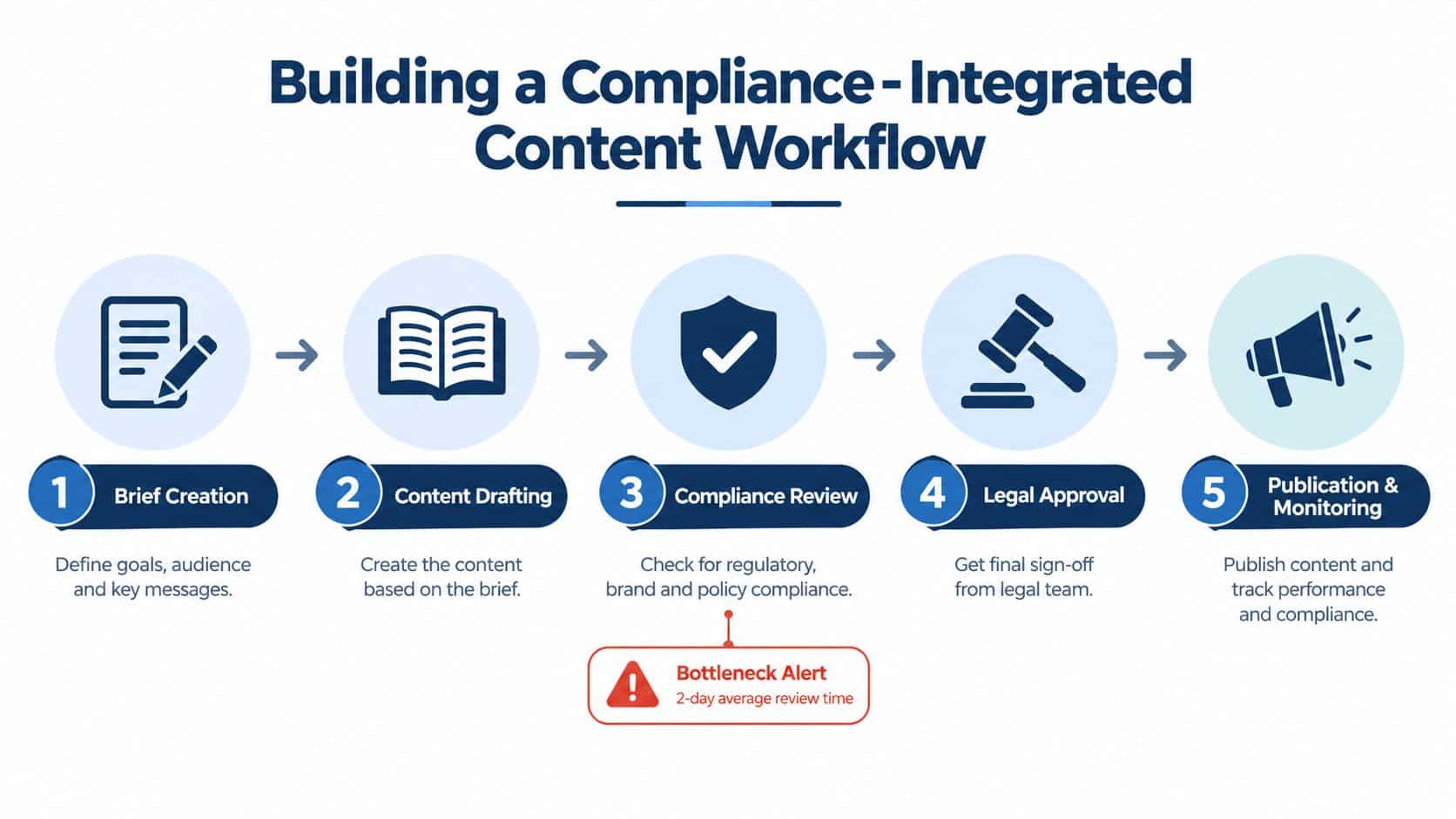
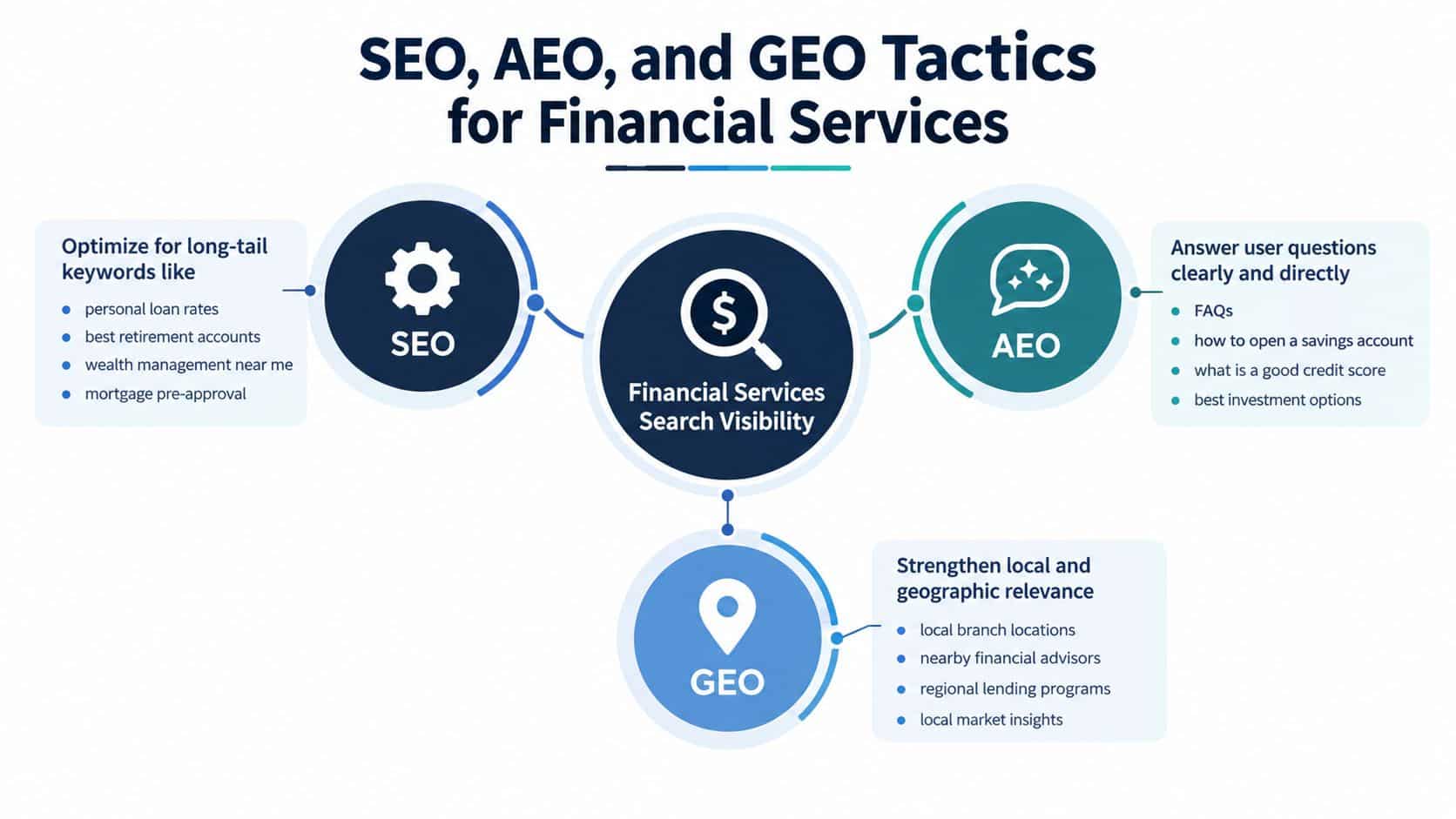
A workable sequence looks like this:
- Brief creation: Define audience, intent, claims, sources, disclosures, and owner.
- Drafting: Write within approved boundaries, using plain language and documented evidence.
- Compliance review: Check claims, omissions, disclosures, examples, and presentation.
- Final approval: Confirm that edits haven't introduced new risk and record the approved version.
- Publication and monitoring: Publish the approved asset, preserve the record, and schedule updates.
The workflow becomes faster when the firm maintains a compliance library containing approved disclosures, recurring explanations, prohibited phrasing, evidence standards, and reusable page structures. Question-led formats also help because they separate a prospect's actual question from the firm's promotional language.
Recent industry coverage found a mismatch between compliance leaders, who estimated that roughly 66% of firm-created content goes through review, and marketing leaders, who placed the figure closer to 59%, as described in coverage of financial-services content workflows. That mismatch matters because leadership can't improve a process it measures differently across departments.
The operational objective isn't fewer reviews. It's fewer avoidable review cycles.
A workflow should also define escalation rules. Routine educational content may follow a standard path, while performance claims, testimonials, and product-specific material need enhanced review. For investment advisers, the SEC marketing rule guidance applies broadly to advertisements disseminated directly or indirectly by an adviser registered or required to be registered under the Investment Advisers Act.
The SEC's rule became effective on May 4, 2021, and advisers had until November 4, 2022 to comply, an 18-month transition period, as explained in the SEC marketing compliance FAQ. After that compliance date, advisers could no longer rely on the prior advertising and cash solicitation rules for new advertisements.
Teams seeking a more detailed operating model can review compliance by design, particularly when marketing, operations, and compliance need one shared workflow.
Content Formats That Build Trust in YMYL Environments
Trust depends on more than choosing a polished format. In financial services, each asset must answer a specific question and fit the firm's ability to substantiate, review, maintain, and update it. A long guide can explain a complex decision, while a calculator or advisor profile may address a prospect's immediate concern more effectively.
Formats serve different jobs:
- Educational long-form guides build topical depth and clarify complex concepts, but require reliable sources, approval records, and regular maintenance.
- Interactive calculators turn abstract decisions into usable inputs and outputs. Every assumption, formula, limitation, and result needs review.
- Advisor profiles make expertise more tangible when credentials, responsibilities, and disclosures remain accurate.
- Expert interviews provide attributable experience and perspective, provided quoted material follows a defined approval path.
- Regulatory and market commentary supports timely relevance when analysis explains uncertainty rather than presenting unsupported predictions.
- Compliance-aware case studies and customer stories demonstrate application. They require consent, documentation, balanced context, and careful performance language.
- Original research gives a firm a defensible point of view when its methodology, limitations, and sources are transparent.
Match formats to the buyer's question
A person learning a basic concept needs plain-language explanation. A prospect comparing providers needs distinctions, fees, process information, and risk disclosures. A referral partner may need original research or market commentary that can support a professional conversation.
Decision-stage content is often the missing layer. Firms publish broad educational articles, then send interested prospects directly to a contact page. A decision checklist, service comparison, process walkthrough, or carefully bounded case study can answer the questions that delay a consultation.
Treating every asset as a blog post creates unnecessary production and review work. One approved subject can become a guide, question-led FAQ, advisor video with transcript, and decision checklist, as long as every derivative preserves the approved meaning, limitations, and disclosures.
| Format | Trust Building | Search Visibility | Compliance Complexity |
|---|---|---|---|
| Educational guide | High, when authored and sourced | High for broad informational questions | Moderate |
| Calculator | High for decision support | Strong when assumptions are indexable | High |
| Advisor profile | High through verifiable expertise | Useful for branded and local discovery | Moderate |
| Expert interview | High through attributable perspective | Strong for specific questions | Moderate to high |
| Regulatory commentary | High for timely authority | Strong for current questions | High |
| Case study | High when evidence is balanced | Strong for use-case searches | High |
| Original research | Very high when methodology is clear | Strong for citations and links | High |
Guidance on building trust in financial-services content emphasizes named authorship, reviewer attribution, structured data coverage, source citations, and an update cadence. These signals do not substitute for expertise. They help readers and search systems verify who stands behind the content, how it was reviewed, and whether it remains current.
SEO, AEO, and GEO Tactics for Financial Services Visibility
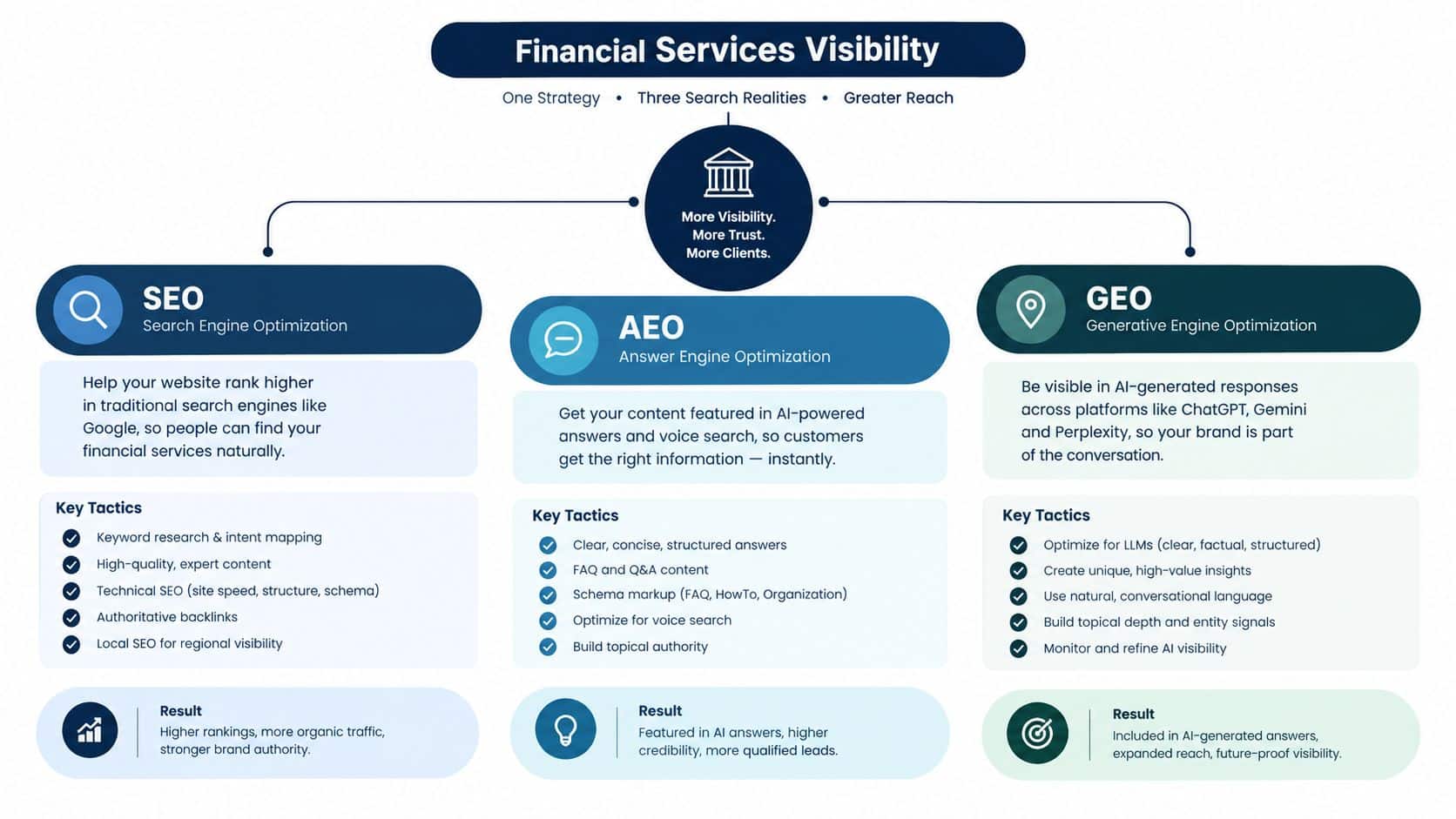
Search visibility in finance depends on more than placing a keyword in a title. SEO supports traditional organic discovery, answer engine optimization helps content provide extractable responses, and generative engine optimization increases the chance that a firm's expertise appears when systems synthesize answers from multiple sources.
All three depend on the same operating discipline: define the audience, isolate a specific question, verify the evidence, name the author and reviewer, and place the answer before the supporting detail. A weak compliance workflow slows publication. Vague positioning then gives search systems little useful material to interpret.
Build around questions and entities
Long-tail questions often reveal stronger intent than broad category terms. A wealth-management firm might organize content around retirement income, fee structures, portfolio transitions, tax-aware planning, or differences between service models. Each page should answer its primary question directly, define important terms, explain limitations, and point readers toward an appropriate next step.
Decision-stage questions deserve priority because many programs produce introductory education while leaving comparisons, fees, and implementation concerns thinly covered. Content teams should maintain a question inventory tied to client needs, approved services, and compliance review capacity. That inventory helps prevent repeated generalities and exposes gaps worth assigning to subject-matter experts.
For AEO and GEO, content should use:
- Question-led headings: Match prospect language, then answer immediately.
- Structured FAQs: Address related objections while keeping qualifications visible.
- Named expertise: Identify the writer and reviewer, including relevant credentials.
- Source discipline: Link or cite evidence for material claims.
- Consistent entities: Use the same firm, service, advisor, and regulatory terminology throughout the site.
- Structured data: Mark up articles, FAQs, financial services information, authors, and reviewers where appropriate.
Optimize for people before machines
Answer-style writing should preserve nuance. Put a concise answer first, then add definitions, examples, limitations, and disclosures. Visual content can aid comprehension, but important information also needs accessible text, including captions or transcripts where relevant.
A documented SEO roadmap strategy should connect technical improvements to commercial questions, not treat rankings as the final objective. A page may rank for a broad term yet attract people outside the firm's service area or ideal client profile, creating inquiries without useful pipeline. Review search intent, qualification criteria, and handoff ownership before investing in more visibility.
Generative visibility creates a governance requirement. If a model summarizes a firm's content inaccurately, the firm needs monitoring that checks important questions, records errors, and updates the source page. Content ownership and compliance should manage that process alongside search specialists.
Closing the Specificity Gap in Financial Content
Generic thought leadership feels safe because it avoids direct commercial claims. It also leaves decision-stage questions unanswered. A prospect evaluating a firm wants to understand its process, fit, fees, alternatives, limitations, and response to common objections.
The gap is operational as much as editorial. Teams often publish broad educational articles, then discover that the pages closest to a consultation do not explain how the firm works or what a prospect should evaluate. That leaves sales conversations to supply information the content program should have made clear.
Turn vague topics into decision assets
“Retirement planning considerations” is a broad educational topic. A decision page could instead use the heading “How Households Evaluate Retirement-Income Sources Before Choosing an Advisory Approach.” Its opening should explain what information an advisor needs, which trade-offs require discussion, and what the firm's process covers. The page remains educational while giving a qualified reader a clearer basis for deciding whether to speak with the firm.
The same standard applies across late-stage formats:
- A comparison page should define the alternatives fairly, identify the criteria, state limitations, and avoid implying that one option suits every reader.
- A fee-explanation page should state what the fee covers, what it excludes, when other costs may arise, and where a prospect can request clarification.
- An objection-based FAQ can address changing advisors, sharing account information, coordinating with tax professionals, and understanding the planning process.
These assets should answer a decision question, not merely repeat a service description. They also need a clear owner for updates when fees, processes, or approved claims change.
Give compliance something precise to approve
Specificity becomes easier to review when claims are bounded. The brief should separate factual service descriptions from opinions, projections, individualized recommendations, and performance statements. Attach approved evidence to each material claim before drafting begins, and identify disclosures or qualifiers at the same time.
For investment advisers, the SEC marketing rule prohibits an untrue statement of material fact or an omission of a material fact needed to make a statement not misleading. When gross performance is presented, it must be paired with net performance with at least equal prominence, as described in SEC marketing rule compliance guidance.
The practical standard is say exactly what can be supported, reviewed, and understood. A precise decision asset reduces uncertainty without manufacturing confidence, while a bounded brief gives compliance a defined claim set to approve.
Measuring What Matters in Regulated Content Programs
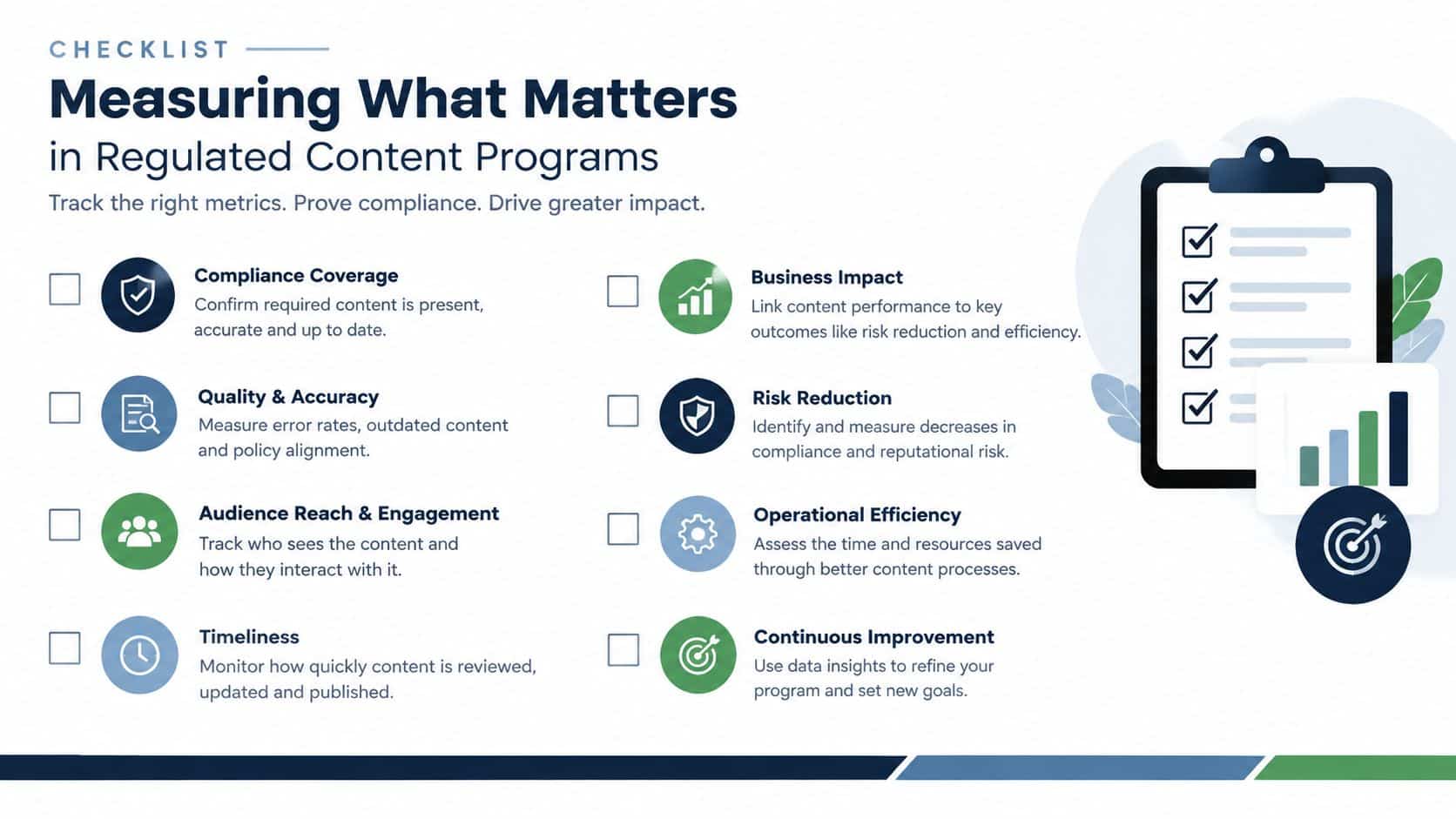
A regulated content dashboard must connect audience quality, commercial progress, evidence, and workflow efficiency. Reach alone cannot show whether content attracts prospects the firm can serve or whether compliance review is consuming avoidable capacity.
Track performance by decision stage
Measure early-stage assets through qualified organic discovery, relevant engagement, return visits, and movement into deeper resources. Decision-stage pages need a defined action, such as a consultation request, booked conversation, completed form, or another agreed conversion. Preserve content touches in the CRM so the team can identify assisted conversions instead of giving credit only to the final click.
Use different success thresholds for different formats and intent. A short FAQ should not be judged against the same completion expectation as a long planning guide. The NYT Licensing financial content benchmark provides context for engagement quality, but the useful question is whether attention leads to a relevant next action.
A dashboard should also expose the specificity gap. Track which pages attract qualified readers but fail to answer a decision question, then compare those pages with assets that generate consultation activity. This shows whether the program needs more comparison, objection, or process content rather than more traffic.
Add operational metrics
Publication results matter, but review friction can determine whether a program scales. Report:
- Review-cycle count: How often an asset returns for avoidable revisions.
- Time to approval: How long a compliant draft waits for a decision.
- Rework source: Whether changes involve unsupported claims, missing disclosures, editorial quality, or unclear ownership.
- Approval by format: Which formats create recurring review friction.
- Content-assisted progression: Whether readers move from education to a relevant decision asset.
- Content decay: Which pages lose relevance and need review or retirement.
Measurement principle: A page that generates modest traffic from qualified prospects may be more valuable than a popular page that attracts people the firm cannot serve.
Compliance officers need approval quality and risk controls. Marketing leaders need qualified progression and content-assisted pipeline. Both groups need shared definitions, named owners, and a consistent reporting rhythm. That shared view makes it easier to separate weak content from a slow workflow.
Where Financial Services Content Is Heading in 2026
Based on the compliance and search patterns documented above, financial-services content is moving toward structured answers, compliant visual storytelling, and assets designed for both search results and generative summaries. Long-form expertise still matters. Its packaging, evidence, and maintenance now determine whether audiences and reviewers can use it.
Adaptable firms will organize libraries around real questions rather than abstract themes. A practical example is a comparison page that answers suitability objections, identifies its intended audience, cites supporting evidence, and routes readers to a relevant decision-stage resource. Named authors, qualified reviewers, reusable disclosure language, and format-specific review checklists make that system easier to maintain without forcing every asset into one template.
The SEC's exam risk alert states that, from the November 4, 2022 compliance date, advertisements disseminated by advisers registered or required to be registered with the Commission became subject to the marketing rule, as explained in the SEC exam risk alert. That foundation matters as firms expand into video, social content, interactive tools, and AI-assisted production.
The next useful investment is a controlled content system, not another disconnected publishing sprint. It needs a defined audience, a clear decision path, evidence attached to claims, review checkpoints, and reporting that exposes commercial value alongside approval delays and rework. Advisor Momentum provides compliance-ready content programs, educational articles, market commentary, website content management, SEO/AEO/GEO advertising, and video production for financial advisors, wealth managers, and banking teams. Visit Advisor Momentum to discuss a workflow aligned with review requirements.
