

The retirement article is nearly ready, the email is queued, and someone has already shortened the headline for a social post. Compliance has approved the article, but nobody can confirm whether that approval covers the email's new claim or the social caption. Meanwhile, the spreadsheet shows the whole campaign as ready.
An editorial calendar template in Excel should expose that problem before publication. For an advisory firm, the calendar isn't a grid to fill every day. It's a working record of ownership, review, approved versions, and publication, with separate controls for each asset that leaves the firm.
Table of Contents
- Columns to Put in Your Editorial Calendar Template Excel
- How to Build the Workbook and Gate Each Row
- Parent Campaigns Child Assets and Performance Rows
- Tips for Cadence Capacity and Social Posts
- Customize Lists Filters and Weekly Views
- Start One Campaign and Staff the Review
Columns to Put in Your Editorial Calendar Template Excel
An editorial calendar records what will publish, when it appears, where it goes, who owns it, and which stage it has reached. The following table supplies the core headers and a hypothetical retirement-series article, with each sample value representing an entry in the same content row.
Editorial calendar template Excel columns
| Column | What it records | Sample value |
|---|---|---|
| Content ID | Unique key for the row | RET-BLOG-A |
| Publication date | Planned go-live date | April 2026, pending review |
| Content title | Working headline | Tax-loss harvesting myths |
| Audience | Who the piece is for | Pre-retirees ages 55 to 65 |
| Channel | Where it will appear | Blog |
| Format | Asset type | Article |
| Campaign | Parent theme | Q2 retirement series |
| Owner | Person responsible | Lead advisor |
| Compliance reviewer | Named approver | Chief compliance officer |
| Approval status | Workflow stage | In review |
| Asset URL | Final file or page | /insights/tax-loss-harvesting |
| Retention location | Where the record is stored | Compliance drive, Ads 2026 |
| Retention date | Keep-until date | Compliance-assigned date under the retention schedule |
The dates, audience range, and identifiers above are illustrative planning entries, not regulatory thresholds. The publication entry remains provisional because the article hasn't cleared review. In a working workbook, the marketing lead should replace the month with an actual date once review capacity is booked.
Planning itself usually isn't the missing ingredient. Researchscape's account of the 2024 WG Content survey reports that, among 168 respondents, only 2% used no content-planning method. The more useful question is whether the sheet supports publishing decisions or merely lists intentions.
Read the row as a handoff
The content ID stays with the article when its headline changes. The campaign connects it to the retirement series, while the audience tells the writer whose questions to answer. An article for pre-retirees should differ from material aimed at business owners or existing clients.
Channel and format belong in separate columns. Blog describes the destination; article describes the asset. An email and a LinkedIn post derived from the same idea need their own rows, rather than additional labels squeezed into the article's channel cell.
The owner is accountable for moving the asset forward. The compliance reviewer determines whether the submitted version can proceed under the firm's process. Role names make the example readable, but the operating sheet should identify actual people so an overdue review has a clear recipient.
Keep the starting sheet lean
Use a controlled approval-status list: Draft, In review, Approved, Scheduled, Published. Separate approval evidence from production status during workbook setup so scheduling doesn't erase the approval decision.
The asset reference should lead to the approved file or final page, not an abandoned draft. Retention location identifies the controlled archive, while retention date comes from the firm's applicable retention schedule. A blank or guessed keep-until date shouldn't pass unnoticed.
Narrareach's calendar fields for newsletter creators provides useful context when email becomes part of the publishing workflow. For an advisory firm, the practical test remains whether each field helps someone decide what can ship.
Risk category and draft date can wait until the workbook build. Adding every possible control to the opening row makes the sheet harder to adopt.
If a column doesn't change a decision about what ships, drop it.
How to Build the Workbook and Gate Each Row
Build the workbook around a visible exception: scheduled content without approval. Excel can flag that exception, but conditional formatting doesn't block publication or replace a reviewer's decision.
Set up the controlled workbook
Add a Calendar sheet and a Lists sheet. Calendar holds the production records. Lists holds the approved dropdown values, keeping spelling differences from breaking filters.
Paste the core column headers into row 1 and enter two sample rows, such as the retirement article and its supporting email. Use clearly marked test records rather than mixing unapproved examples with live work.
Convert the range to an Excel Table. Select the populated range and use Insert > Table, confirming that the range has headers. New records can then inherit the table's formatting and calculated-column behavior.
On Lists, store the permitted channels, workflow statuses, and risk values of Low, Medium, or High. Apply Data Validation lists to the corresponding Calendar columns, and use a stop-style error alert to discourage free-text substitutions.
Add draft date, compliance-review date, and version ID beside the core fields. Also separate Approval status from Production status. For the formula below, arrange Approval status in column G and Production status in column H; otherwise, adjust the references to match the actual workbook.
Apply the approval exception highlight. Select the table's data rows, open Conditional Formatting, and choose a formula-based rule using
=AND($H2="Scheduled",$G2<>"Approved"). Apply a conspicuous fill to the full row. This checks whether production says Scheduled while approval says anything other than Approved.Store the final approved asset link and version ID in the same row. An approval must refer to an identifiable file, not whichever document happens to occupy a shared folder later.
Preserve workbook history or export a monthly snapshot. The SEC's investment-adviser marketing guidance explains Rule 204-2 recordkeeping for advertisements, including performance, testimonials, endorsements, and third-party ratings, and the requirement for true, accurate, and current copies; applicable records must remain easily accessible for at least five years, with the first two years in an appropriate adviser office. The snapshot should point to the retained advertising records, not substitute for them.
Make the gate part of publishing
The diagram shows why campaign-level completion isn't enough.

A date and a reviewer name aren't the advertisement, the substantiation, or the performance file. Marketing needs an operating rule that highlighted exceptions stay out of publishing queues, with approval evidence stored in the controlled archive.
The social media approval workflow helps connect these spreadsheet checks to publishing responsibilities. For broader campaign coordination, Busylike's CMO guide to unified visibility strategy offers context for aligning distribution rather than managing each channel in isolation.
The final setup test should deliberately fail. A sample row should move to Scheduled while its approval remains In review; the highlight must appear before the workbook is accepted for use.
Parent Campaigns Child Assets and Performance Rows
Consider a retirement campaign that becomes a blog post, LinkedIn update, email, webinar, short video, and website edit. The article clears review, but the email writer adds a stronger tax claim and the video editor removes a qualifying sentence. A single campaign row marked Approved would hide both changes.
The parent campaign groups the work. Each child asset carries its own review and publication record. That distinction matters because the SEC's social-media risk alert explains that recordkeeping obligations don't depend on whether communications appear on paper or through electronic media; firms must determine which communications require retention, for how long, and with what accessibility.
Give each derivative an accountable record
Add the fields needed to connect the campaign without collapsing its assets:
| Field | Retirement campaign application |
|---|---|
| Parent campaign ID | RETIREMENT-Q |
| Child asset ID | RETIREMENT-EMAIL-A |
| Channel | |
| Audience | Pre-retiree prospects |
| Responsible adviser | Named retirement-planning specialist |
| Approval status | In review |
| Final URL or archive reference | Approved email archive record |
| Change log | Tax-language revision submitted for review |
The blog's approval doesn't become the email's approval merely because both explain tax-loss harvesting. Reviewers need the actual subject line, body copy, disclosures, links, and visual treatment that recipients will receive.
Separate planned, approved, scheduled, and published milestones. Planned describes an intention; approved identifies a cleared version; scheduled records a queue entry; published confirms distribution. A row can look finished in Excel while the website still displays an older revision.
Campaign planning should also distinguish publication from measurement. The firm's financial-advisor content marketing process can assign a purpose to each derivative, such as article visits, email responses, or webinar registrations, without treating all assets as interchangeable.
Put performance claims through a separate check
Performance content needs additional fields: period, calculation date, methodology, benchmark, net or gross designation, required accompanying periods, source file, and a second compliance check. These fields tell the reviewer what the presentation includes and where its calculations can be verified.
Under the SEC's final investment-adviser marketing rule, performance covering at least one year generally also requires one-, five-, and ten-year periods, subject to applicable exceptions, including shorter operating histories; the rule materials also describe the applicable seven-year-history case, with one-, five-, and seven-year results. The reviewer should determine the required presentation before a writer turns selected returns into a headline.
Capacity deserves the same discipline as version control.

Leave blank capacity for urgent regulatory or market-response content instead of booking every weekday. During the week after publication, the owner should reconcile each live URL against its archived version ID and record any discrepancy for correction.
Tips for Cadence Capacity and Social Posts
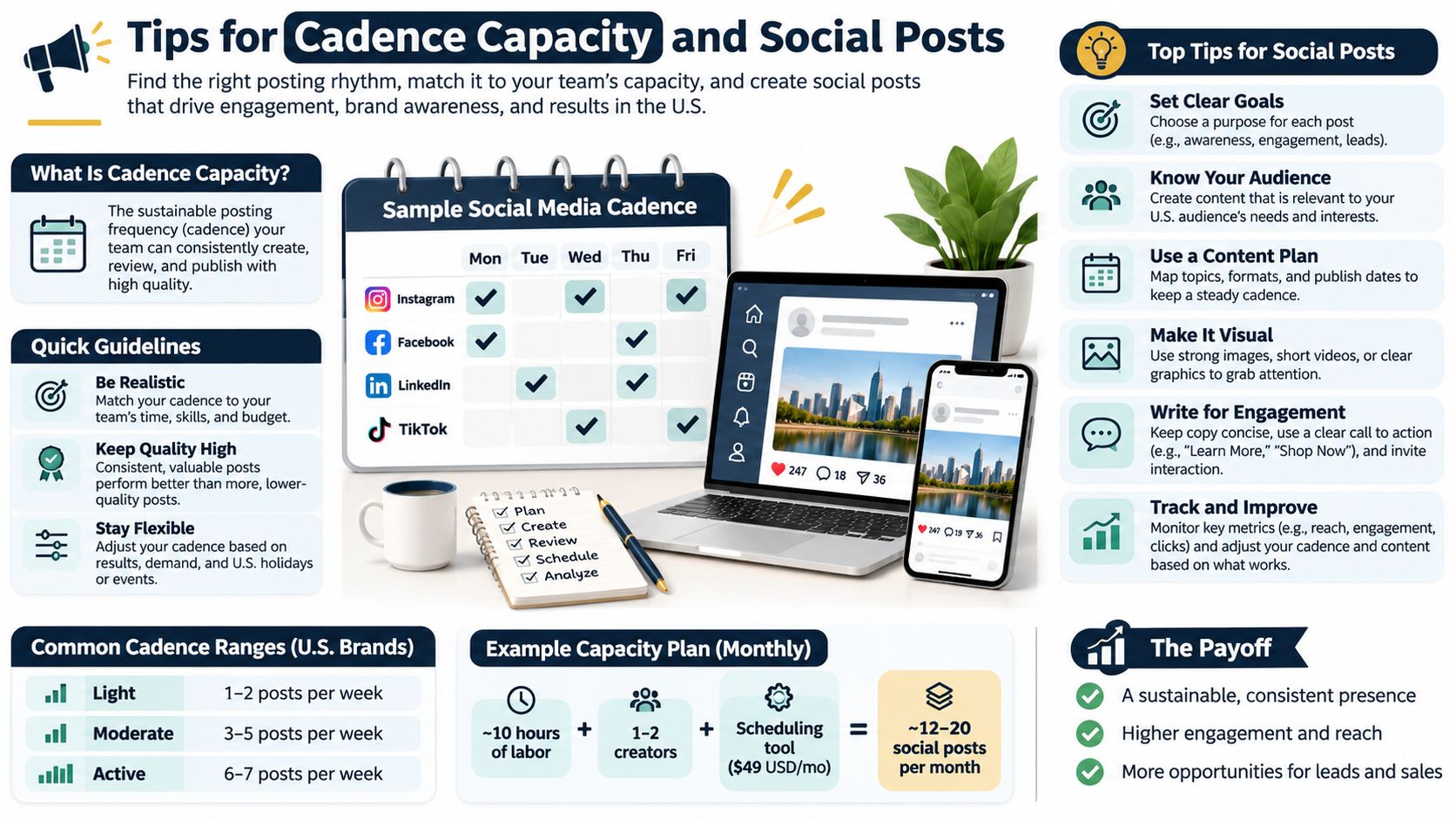
A quarterly anchor cadence gives research and compliance teams something concrete to staff. Wolf Financial's research-calendar guidance recommends four to six major research pieces annually for asset managers, or a model of four quarterly anchor reports plus eight to twelve monthly data briefs for many mid-sized firms, supported by shorter material and matched to research and review capacity.
Those are planning models, not quotas for every independent practice. A small advisory team should reduce output when subject-matter experts or reviewers can't support the proposed workload. Publishing more often isn't useful if the team starts cutting evidence checks to protect the schedule.
Reserve review time before distribution time
The anchor row should name the subject-matter expert and carry a compliance-review deadline before the publication date. Supporting posts should draw from the cleared source material, with enough time for reviewers to assess how the shorter format changes the message.
Capacity planning should account for more than writing:
- Evidence preparation: The adviser supplies the source material, assumptions, and supporting explanation before the draft reaches compliance.
- Review availability: The marketing lead checks whether the assigned reviewer can handle the work alongside other obligations.
- Revision time: The schedule leaves room to resolve comments rather than assuming every submission clears unchanged.
- Release preparation: The publisher checks links, formatting, disclosures, and the approved version before distribution.
A delayed anchor may require rescheduling the supporting material. Replacing it with improvised social commentary only moves the workload into a less controlled format.
Treat social supervision as a distinct responsibility
Business versus personal communication turns on the content, not the phone, application, or account name. For firms and representatives subject to its requirements, FINRA's social-media guidance states that business communications must be retained for at least three years and describes registered-principal review before a social site is used for business, subject to the permitted treatment of interactive communications.
When prior approval isn't required, written supervisory procedures still need training, surveillance, corrective action, and documented findings. A personal-looking account doesn't remove those responsibilities when the communication concerns the firm's business.
Add only the social fields that make the supervision process visible: account, business-purpose determination, pre-use approval, reviewer, surveillance method, issue status, corrective action, and retention date. The surveillance method should identify an actual review process, not a vague monitoring label.
An issue needs a named person and a recorded resolution. If a reviewer finds an unsupported claim after publication, the workbook should show the corrective action and the retained record of the communication, rather than replacing the original entry.
Capacity rule: Fewer governed campaigns beat a full grid.
Customize Lists Filters and Weekly Views
Customization should make the workbook easier to operate, not turn it into a collection of optional fields. Once the table and approval highlight work, the marketing lead can tailor lists and views around the firm's actual publishing process.
Keep dropdowns narrow
Replace sample channels on Lists with Blog, Email, LinkedIn, Webinar, and Website. Remove channels the firm doesn't use. Keep the core workflow vocabulary to Draft, In review, Approved, Scheduled, and Published, with approval evidence maintained separately from production progress.
Apply Low, Medium, or High risk categories to rows mentioning performance, a testimonial, an endorsement, or a third-party rating. These are internal routing labels, not legal determinations. The compliance officer should define the classifications; an ordinary educational article shouldn't receive an invented rating just to fill a cell.
Freeze row 1 and enable filters. The marketing lead can display the current month's compliance-review dates, while an adviser filters Owner to the relevant name. Review meetings become more useful when participants see the work requiring their action rather than the entire content inventory.
Add a pillar column only when the retirement series needs a meaningful thematic distinction, such as tax planning versus retirement income. Remove columns that nobody uses to change an assignment, review route, release decision, or follow-up.
Avoid near-duplicate labels. Client email and Email shouldn't coexist unless the distinction changes routing or supervision. Audience belongs in the audience field, not hidden inside a channel name.
Maintain views for review and release
Keep a compliance sort ordered by compliance-review date and a publishing sort ordered by publication date. Sort the entire table, never an isolated date column, so owners and asset references remain attached to the right records.
Each Monday, the marketing lead should filter Approval status to In review and check that the review date still precedes publication. An overdue review should trigger reassignment or a revised release date, not a hopeful status change.
A short weekly check can focus on practical decisions:
- Unassigned work: Resolve missing owners or reviewers before accepting a deadline.
- Stale dates: Replace dates that no longer reflect the production plan.
- Broken references: Repair archive and asset links before the publishing handoff.
- Unresolved comments: Confirm who will address the reviewer's outstanding concerns.
At quarter-end, copy the table into a new quarter tab instead of starting another tool. Preserve the headers, validation rules, and exception formatting, then remove sample content and verify that the copied rules still reference the intended columns.
Start One Campaign and Staff the Review
The firm's next step is a small operating test, not a fully populated annual calendar. This week, the marketing lead should build the core sheet, apply the approval highlight, and enter a parent campaign with child rows for a blog, an email, and a social post.
The compliance-review date should be booked before any publication date is treated as a commitment. That forces a useful conversation about who can review the material and what evidence must accompany it.
Test the handoffs with real work
The pilot should follow an actual educational topic through drafting, review, release, and archiving. The owner should submit the version identified in the workbook, the reviewer should record the decision against that version, and the publisher should use the cleared asset.
The acceptance check is practical:
- Ownership is explicit: Each participant knows which decision belongs to that role.
- Review has a place on the schedule: Compliance isn't an unnamed task squeezed between writing and publication.
- The archive is usable: The approved material and supporting records can be retrieved without searching private messages.
- Release is verified: After the first piece goes live, the owner reconciles its URL with the stored version.
Any failure in that pilot deserves attention before more campaigns enter production. A missing file reference is easier to fix in a small trial than across a crowded publishing schedule.
Separate writing capacity from review responsibility
A small RIA shouldn't treat writing and compliance review as the same person's spare-time job. WG Content reported in 2024 that 85% of surveyed organizations outsourced at least some content writing, while more than 40% outsourced all or almost all of it. Those findings describe the surveyed organizations, not advisory firms specifically, but they support treating writing as a resource decision rather than an incidental chore.
If producing scrubbed material across the planned channels is the bottleneck, Advisor Momentum offers SEC-compliant content creation that educates prospects and demonstrates advisors' expertise across all channels. Outside writing still needs a named internal owner, an assigned reviewer, and a controlled archive.
The workbook is the next step either way. A clear review process makes outside support usable; outsourcing alone doesn't establish approval authority or verify what ultimately goes live.
Advisor Momentum offers SEC-compliant content creation to support an editorial calendar built around accountable owners, review dates, and controlled publishing. Firms ready to staff that calendar can visit Advisor Momentum to schedule a consultation or call 801-640-5490.
