
Most advisory firms are sitting on the same problem right now. The website looks polished enough, the team is credentialed, the service model is solid, and referrals still bring in some opportunities. But online, the firm sounds like every other firm. The blog is sporadic, social posts are generic, compliance slows everything down, and the marketing team can't tell which pieces of content influenced new business.
That gap is where financial advisor content marketing either becomes a real growth system or turns into a pile of approved-but-unused assets. In a regulated industry, content only works when it does three jobs at once. It has to build trust, survive compliance review, and move a prospect closer to a conversation.
The firms that get traction stop treating content like a creative side project. They build a compliance-first publishing system that can keep running without creating risk or draining advisor time.
Table of Contents
- Why Content Marketing Is No Longer Optional for Advisors
- Building Your Compliance First Content Strategy
- Compliant Content Types That Build Trust and Authority
- Smart Distribution Tactics for a Regulated Industry
- Creating an Efficient Editorial and Approval Workflow
- Measuring What Matters for Business Growth
- Your First 90 Days A Starter Content Calendar
Why Content Marketing Is No Longer Optional for Advisors
Advisory firms don't lose attention because they lack expertise. They lose attention because prospects can't tell the difference between one firm and the next.
Most firms say some version of fiduciary, personalized guidance, retirement planning, and long-term relationships. None of that is wrong. None of it helps a prospect decide who understands their exact concerns. That creates a visibility problem first, then a trust problem second.
A clear visual makes the business case easier to grasp.
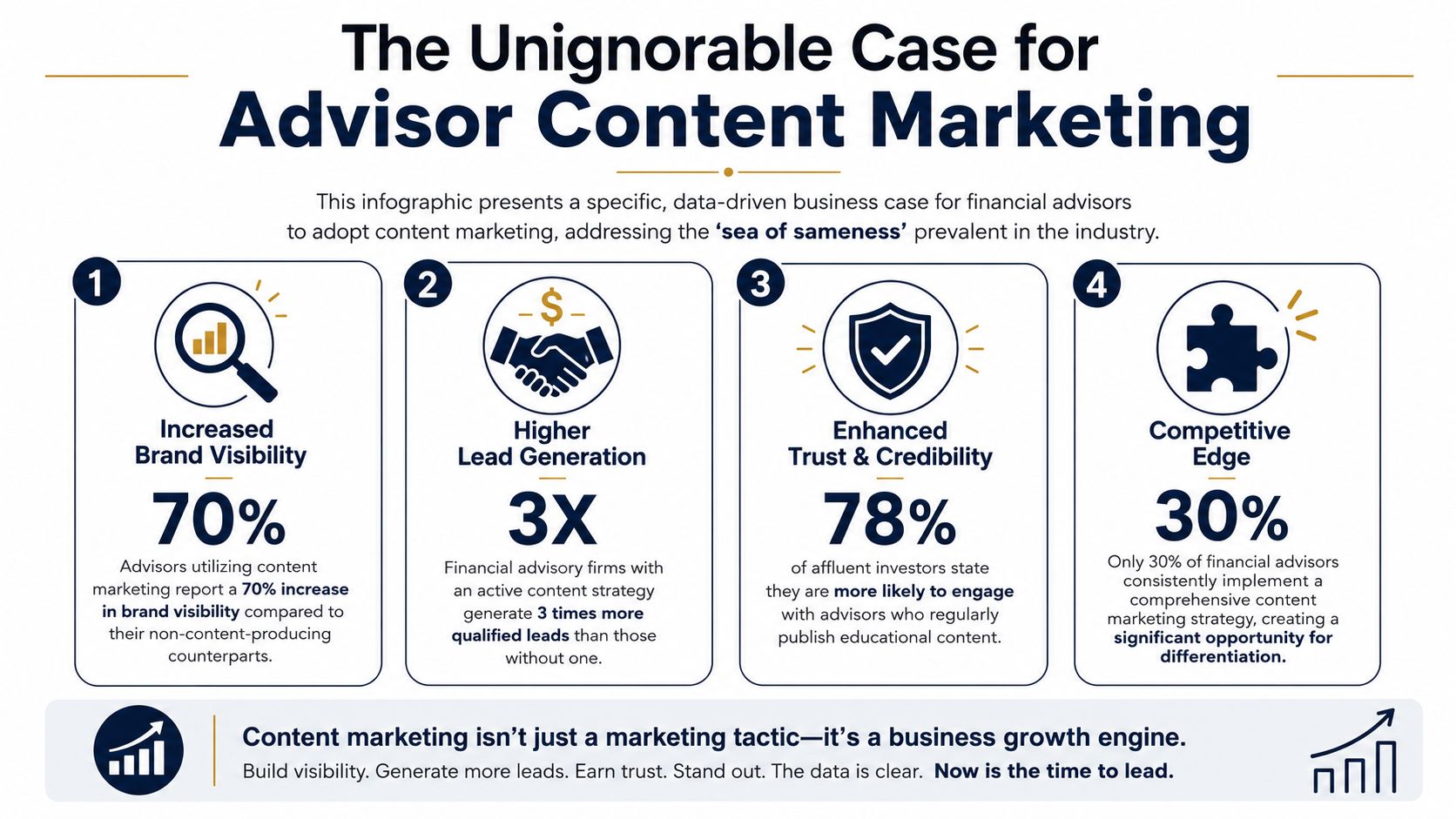
The market rewards clarity, not sameness
Content solves a basic sales problem before a prospect ever books a call. It answers, in public, what the firm knows, who it helps, and how it thinks. That matters more now because the first meeting often starts long before the calendar invite. A prospect reads a tax article, watches a short market commentary, or scans a retirement planning page and decides whether the firm sounds credible and relevant.
That is why a documented plan matters so much. Financial advisors who implement a defined marketing plan generate 168% more leads per month from their website compared to those without a plan, according to the Broadridge Financial Advisor Marketing Trends Report 2024.
The practical takeaway isn't that every firm needs to publish more for the sake of volume. It means planned content outperforms random activity because it compounds. A good article can support search, sales conversations, email nurture, and advisor follow-up. A random article usually does none of those jobs well.
Practical rule: If a content topic can't support both prospect education and a real business objective, it probably doesn't belong on the calendar.
A plan beats scattered activity
The firms that get value from financial advisor content marketing usually define a small set of outcomes and keep content tied to them. In practice, that often means choosing priorities such as:
- Niche authority: Become known for a specific audience or planning problem, not for serving everyone.
- Sales enablement: Publish content that answers recurring objections and shortens the path to a first meeting.
- Trust at scale: Give referred prospects something strong to find when they research the firm online.
- Defensible differentiation: Explain the firm's process, communication style, and planning philosophy in a way a robo offering can't copy.
A referral is still powerful. But referrals rarely close on trust alone anymore. People validate what they hear. They check the website, review content, and look for signs that the firm communicates clearly and understands their situation.
A content program becomes an asset when it does that work repeatedly. It creates a searchable library of expertise. It gives advisors better follow-up material. It reduces the pressure to explain everything from scratch in every first call.
That is why content is no longer optional. For most firms, it is the public proof layer sitting between reputation and revenue.
Building Your Compliance First Content Strategy
A lot of advisor content fails before anyone writes the first draft. The firm starts with topics and formats, not with guardrails. Then legal language gets added late, compliance reviews stretch out, and the team starts avoiding content that feels too hard to approve.
That cycle is avoidable when compliance is built into strategy instead of bolted on after the fact.
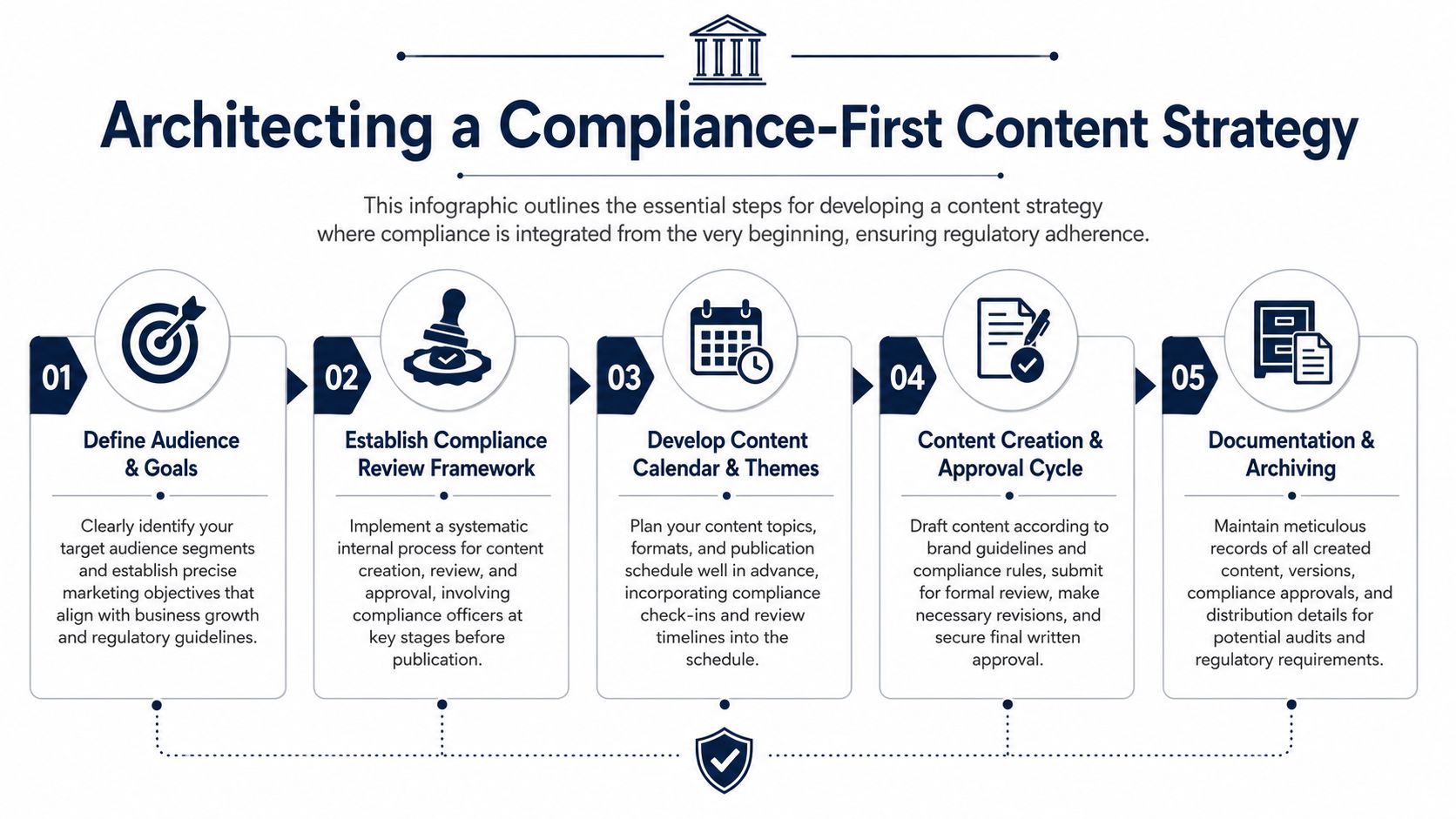
Start with boundaries before ideas
A compliance-first strategy starts with three working documents.
- Topic boundaries: A simple list of approved themes, sensitive subjects, and prohibited claim types.
- Language rules: Standard phrasing for disclosures, service descriptions, market commentary, and calls to action.
- Channel standards: What changes when the same core idea appears on the website, in email, on social, or in video.
Repurposing content often proves to be a major hurdle for many firms. Existing guidance for RIAs often ignores the operational friction involved in turning one approved asset into multiple compliant formats. A useful fix is building a shared repository of pre-approved, SEC-aware language for different channels, as discussed in this overview of advisor repurposing and compliance bottlenecks.
That repository should include short-form social captions, approved risk language, evergreen educational explanations, testimonial disclosure templates where relevant, and standard review notes. The goal isn't to sanitize every piece into the same voice. It's to stop rewriting the same careful wording every time a post gets adapted.
Compliance should act like a publishing system. It shouldn't act like a recurring surprise.
A strong strategy also maps topics to actual client concerns. Retirement distribution questions, estate planning coordination, market volatility, concentrated stock risk, and business owner liquidity events all make better editorial pillars than broad promises about wealth management. Specific concerns create specific content. Specific content is easier to approve because the scope is clear.
Build a reusable approval system
Most firms need a simple sequence that everyone understands:
- Brief the piece first with audience, intent, claim boundaries, and required disclosures.
- Draft from approved language instead of from a blank page.
- Route review by risk level, not by habit. A market commentary may need a different path than a basic educational article.
- Archive the final version with approval notes and distribution history.
Documentation matters because regulators care about what was published, how it was presented, and what disclosures appeared with it. The same discipline that supports marketing also supports recordkeeping.
For firms updating digital infrastructure at the same time, a compliance-ready website build often makes content execution easier because templates, disclaimers, forms, and author pages can be structured correctly from the start. A practical reference point is financial advisor web design, especially when marketing and compliance teams need the site architecture to support publishing rather than fight it.
The broader operating environment matters too. Content systems increasingly touch form submissions, email databases, analytics, and CRM workflows. Teams working through consent, retention, and data handling questions can benefit from a broader privacy framework such as mastering data privacy for growth teams, because content operations rarely stay limited to page copy alone.
One operational note makes this strategy work: assign ownership. Someone needs to own the calendar, someone needs to own compliance intake, and someone needs to own final publishing. When everyone "helps," nobody controls throughput.
Compliant Content Types That Build Trust and Authority
The best advisor content doesn't try to sound impressive. It tries to make the next decision easier for the prospect.
That changes how each format should be used. A blog post should clarify. A video should humanize expertise. A newsletter should maintain relevance. A social post should create familiarity without drifting into personalized advice.
Blog posts that educate without overpromising
A useful advisor blog post usually starts with a real client question, stripped of personal details and rewritten as a broad educational issue. For example, an article about retiring during a volatile market can explain trade-offs, planning variables, and common mistakes without implying guaranteed outcomes.
The strongest pieces tend to include:
- A defined audience: pre-retirees, business owners, widows, physicians, or another clear segment.
- A narrow problem: how to prepare for a first required withdrawal, what to review after a major inheritance, how stock compensation affects planning decisions.
- A restrained tone: no promises, no dramatic predictions, no language that sounds like a pitch deck.
That format works because it mirrors how trust is built in real conversations. The advisor shows judgment, not hype.
Video that compounds over time
Video often gives advisors the fastest credibility lift because prospects can evaluate tone, clarity, and presence immediately. It also has a different payoff curve than written content. For RIAs using YouTube, meaningful lead generation typically begins by month 4 to 6 of consistent weekly publishing, based on the Advisor Growth Lab reporting on YouTube's role in RIA acquisition.
That timeline matters because many firms quit too early. The first wave of advisor video content usually underperforms because the team is still learning pacing, scripting, thumbnails, intros, and topic selection. The library matters more than any single upload.
A compliant video approach usually works like this:
- Educational first: answer one focused question per video.
- Disclose clearly: include any required disclosures in a way viewers can see and understand.
- Avoid individualized recommendations: keep examples general and framed as education.
- Use the same approved core script across channels: the transcript can become a blog, email, and short-form clip after review.
A good advisor video doesn't try to close the viewer. It gives them enough clarity to take the next step confidently.
Newsletters and social posts that stay useful
Newsletters work best when they feel curated, not stuffed. A short market note, one educational article, and one action-oriented reminder often outperform a bloated monthly digest. The point is to stay present and useful.
Social content should be treated as distribution, not as the primary asset. A short post on retirement plan transitions, year-end planning habits, or what happens in an introductory meeting can create engagement. But the durable value usually lives on the website, where the full explanation and disclosures can sit in the right context.
A few content types deserve special caution:
| Content type | What works | What creates risk |
|---|---|---|
| Testimonials | Clear adjacent disclosure if used | Hiding disclosure in footnotes or separate pages |
| Performance content | Balanced presentation with required context | Showing gross performance without net performance alongside it |
| Hypothetical examples | Relevance to the intended audience and proper policies | Using broad hypothetical performance in public-facing promotion without guardrails |
If a firm uses testimonials, disclosure placement isn't optional. Under the SEC Marketing Rule, advisors must clearly disclose whether the person is a current client and whether compensation was provided, with those disclosures appearing adjacent to the testimonial, as outlined in this summary of testimonial disclosure requirements.
The common thread across formats is simple. Content should answer questions the prospect already has, in language compliance can support, using formats the firm can repeat consistently.
Smart Distribution Tactics for a Regulated Industry
A well-written article that nobody finds is just approved inventory. Distribution is what turns a content library into a lead channel.
For financial firms, distribution also has a higher standard than in lighter-regulated industries. Search visibility depends not just on relevance, but on whether the site sends enough trust signals for sensitive financial topics.
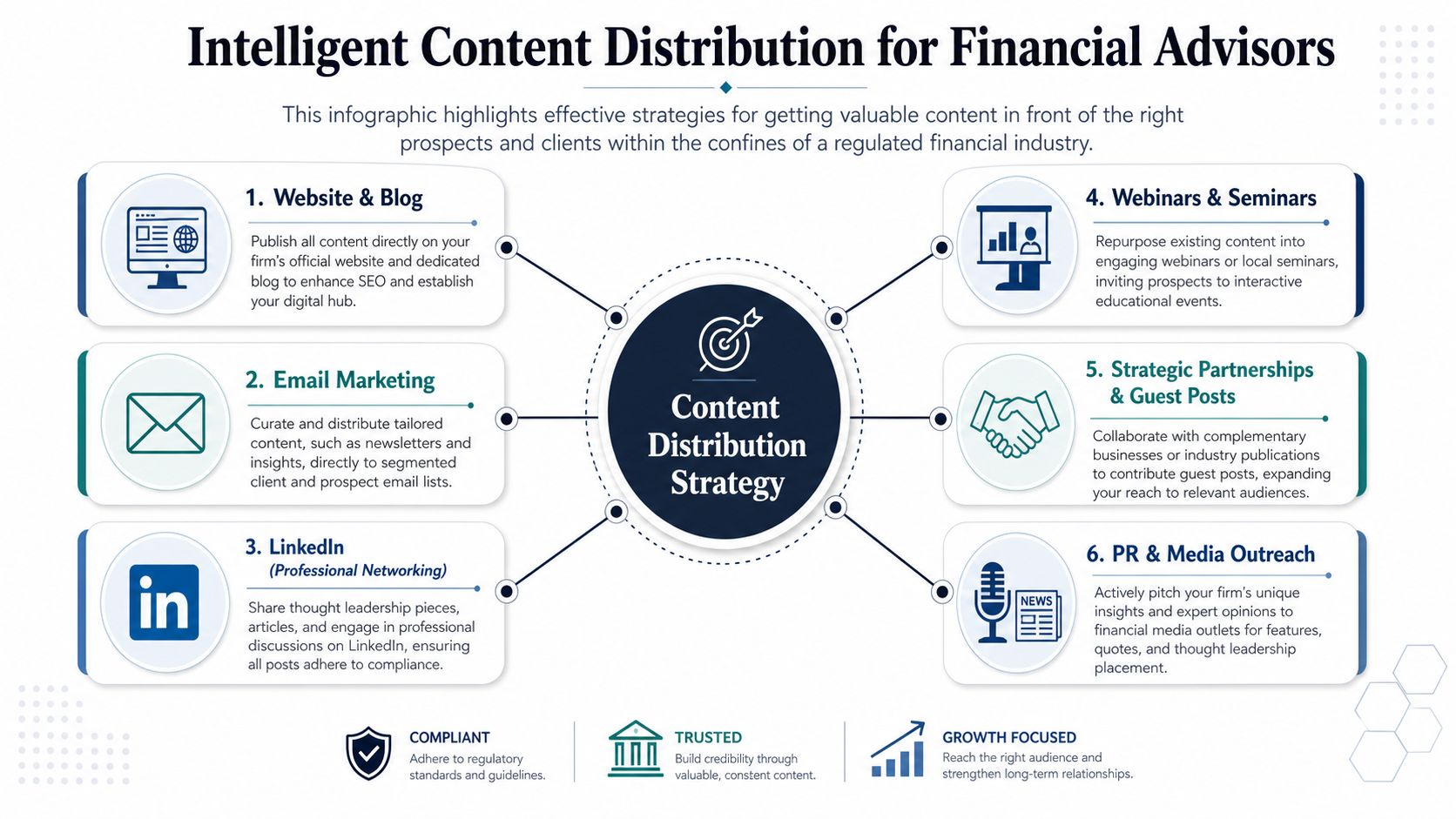
Authority signals matter more in financial search
For financial services content, Google's E-A-T framework, expertise, authoritativeness, and trustworthiness, is a critical technical SEO requirement, and firms need schema markup and related authority signals or they risk lower ranking potential, according to this analysis of SEO requirements for financial content.
In practice, that means advisor websites need more than target keywords. They need visible proof of who wrote the content, when it was published, why the author is qualified, and how the page fits into a credible site structure.
A practical distribution checklist usually includes:
- Author pages: show credentials, role, and relevant expertise.
- Publication detail: display dates and update content when guidance changes.
- Logical internal linking: connect pillar topics to narrower supporting pieces.
- Technical trust signals: secure forms, clean navigation, and solid page experience.
- Local relevance: align service areas, office information, and geographic cues for location-based searches.
Search is no longer only about blue links, either. Advisors also need to think about answer engines and local discovery. AEO rewards direct, concise answers to common questions. GEO improves visibility when prospects search for local financial guidance or location-specific advisor help.
Distribution works best from an owned hub
The website should be the publishing center. Everything else should point back to it.
That approach gives the firm one durable archive for articles, videos, transcripts, webinar recaps, and downloadable educational resources. Email can distribute that content to known audiences. LinkedIn can create professional reach. Local seminars and webinar invitations can convert educational themes into live conversations.
A practical model looks like this:
- Publish the full educational asset on the firm site.
- Send it to a segmented email list with a clear reason to read.
- Adapt one or two ideas into short social posts.
- Use follow-up conversations and advisor outreach to send the same asset where relevant.
A broader planning framework for this channel mix appears in digital marketing in financial services, especially for firms trying to connect search visibility, distribution, and conversion without splitting those efforts into disconnected campaigns.
Most firms don't need more channels. They need tighter coordination between the channels they already have.
Distribution gets easier when every asset has a primary role. One piece should rank. Another should nurture. Another should answer a pre-meeting question. When every asset tries to do all three, it usually does none of them well.
Creating an Efficient Editorial and Approval Workflow
Content production slows down for predictable reasons. Topics are vague. Drafts start from scratch. Compliance sees the piece too late. Advisors get asked to rewrite copy instead of reviewing substance.
An efficient workflow fixes those points before they become recurring delays.
A workflow that doesn't waste advisor time
The cleanest editorial process separates expertise from production. Advisors provide judgment, examples, and audience knowledge. Marketing or operations turns that raw material into a structured draft. Compliance reviews against pre-set standards, not against a moving target.
A workable workflow often looks like this:
- Collect source material: recurring client questions, meeting notes, planning themes, and FAQs from the advisory team.
- Create a brief: audience, search intent, approved angle, disclosures, and repurposing plan.
- Draft once for the core asset: usually the website article or primary script.
- Review in sequence: editorial first, compliance second, final owner approval last.
- Repurpose from the approved master version: newsletter excerpt, social copy, short video script, and advisor follow-up language.
That sequence prevents a common problem where five versions of the same idea all drift apart and each one needs separate corrections. One approved master version reduces rework.
For teams documenting responsibilities and release steps, a publishing reference like the MeshBase guide for content editors is useful because it forces clarity around status, ownership, and handoff points.
Use pre-discovery content to reduce friction
One of the most underused content assets in advisor marketing is the pre-discovery video. A major gap in many firms is the failure to create short videos that answer common prospect questions about the first meeting, as described in this write-up on pre-discovery videos for advisors.
That gap matters because prospects often feel uncertain before the first appointment. They wonder what documents to bring, whether they'll be judged, what the advisor will ask, and whether the conversation will turn into a sales pitch.
A simple workflow can turn those questions into content:
- Pull the top questions prospects ask before booking.
- Record a short answer for each one using approved language.
- Save each clip in a reusable library.
- Send the relevant clip in scheduling confirmations and reminder emails.
Examples of strong pre-discovery topics include:
- What happens in the first meeting
- Whether a spouse should attend
- What documents are helpful
- How the firm is compensated
- What happens after the conversation
Prospects don't need more suspense before a first meeting. They need clarity.
The same workflow can support broader editorial efficiency. If a firm already records internal explanations for client service or onboarding, those scripts can often be adapted into educational public-facing content after review. That lowers the burden on advisors and gives marketing a more reliable input stream.
One more operational rule helps: set service levels for review. If compliance review has no agreed turnaround expectations, the calendar is fiction.
Measuring What Matters for Business Growth
Many advisory firms still report content performance like a media company instead of a business development function. They count pageviews, open rates, and social engagement, then wonder why leadership isn't convinced.
Traffic has value. Engagement has value. But neither is the ultimate scorecard.
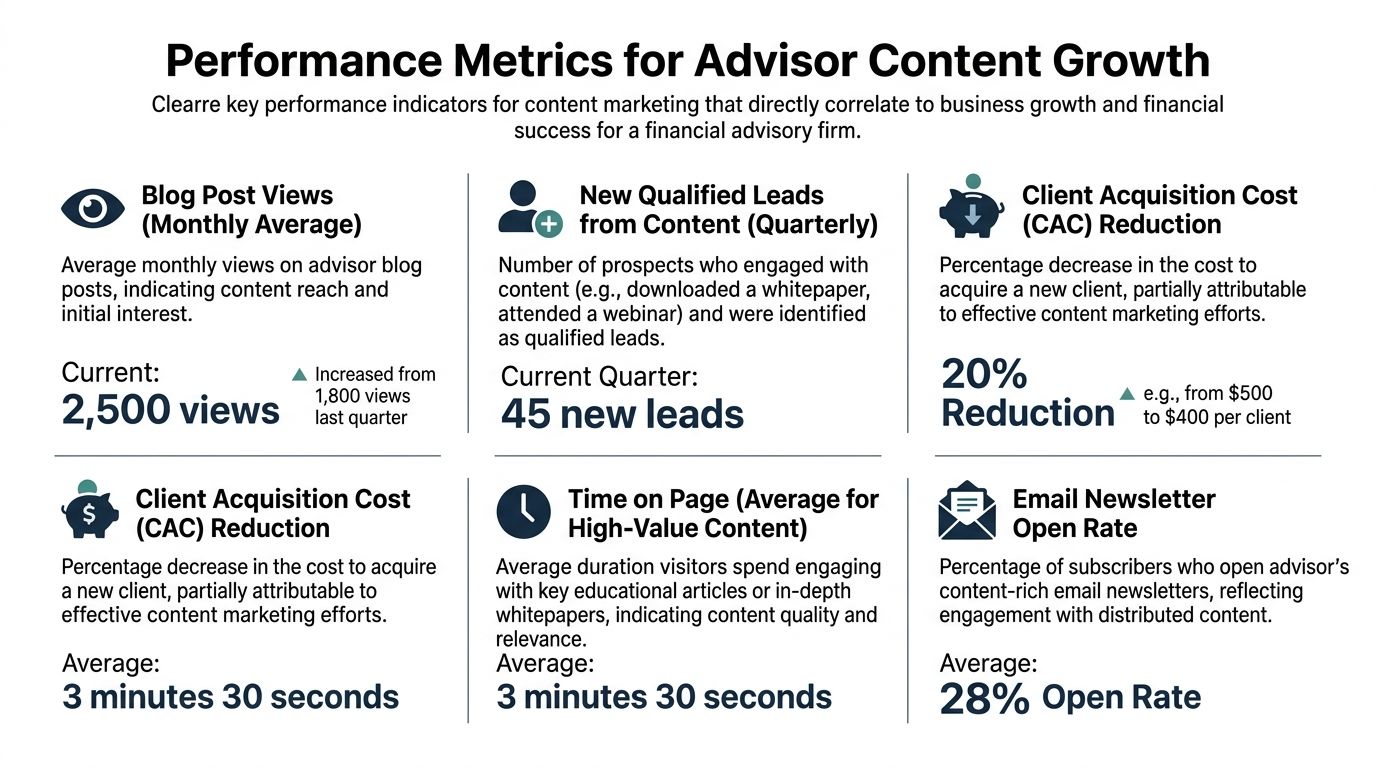
Stop reporting vanity metrics in isolation
The most actionable KPI for financial advisor content marketing is content-assisted pipeline value, which ties organic-sourced qualified leads to their influence on AUM and business outcomes, as explained in this KPI framework for financial services content.
That changes the reporting conversation. Instead of asking whether a post got attention, the firm asks whether content influenced a qualified opportunity, supported a meeting, or moved a prospect through the pipeline.
A better dashboard usually includes:
- Content-assisted pipeline value: which opportunities touched content before inquiry, meeting, or close.
- Organic-sourced qualified leads: not all form fills, only leads that match the firm's target profile.
- Topic-level performance: which planning themes produce the best sales conversations.
- Share of voice in priority keyword clusters: whether the firm is visible for the topics it wants to own.
Many reporting setups break down when website analytics live in one place, CRM stages live somewhere else, and compliance records live in a third system. Without connection between those layers, teams end up guessing.
A practical framework for leadership teams trying to understand your content's business impact is to separate awareness metrics from pipeline metrics and report them differently. Awareness tells the team whether content is being discovered. Pipeline tells the team whether it is influencing revenue.
Track business impact and workflow health
The internal metrics matter almost as much as the market-facing ones. If review cycles drag, publishing slows. If content sits in draft status for weeks, the issue isn't editorial quality alone. It is throughput.
Useful operational metrics include:
| Metric | Why it matters | What it often reveals |
|---|---|---|
| Average review and approval time | Shows whether production is sustainable | Bottlenecks in legal or unclear drafts |
| Number of compliance revisions per piece | Indicates briefing quality and template strength | Rework caused by inconsistent standards |
| Meetings generated from content usage | Connects assets to advisor activity | Which pieces actually help prospects convert |
| Content influence on retained or expanded relationships | Shows value beyond acquisition | Which educational assets support client confidence |
A strong reporting culture also changes editorial decisions. If retirement income content drives qualified conversations but broad market commentary doesn't, the calendar should shift. If certain social posts earn impressions but produce no visits or replies, the team should stop overvaluing them.
The point isn't to reduce content to a spreadsheet. It is to stop pretending that attention alone equals growth.
Your First 90 Days A Starter Content Calendar
Most firms don't need a giant content operation to start. They need a rhythm they can maintain, a review process they can trust, and a small set of topics tied to actual prospect questions.
The first ninety days should build assets that can be reused. That means one substantial article each month, one video each month, and a distribution plan that turns each core asset into supporting material without creating unnecessary review work.
Month one build the foundation
The first month is for structure, not speed. Pick one audience segment and one planning theme. Build the compliance brief template. Define approved language for service descriptions, risk statements, and calls to action. Then publish one strong asset that answers a high-frequency question.
A smart first topic is usually tied to a common concern the advisory team already hears in calls. That gives the content immediate sales value.
Month two publish and repurpose
By the second month, the firm should stop inventing from scratch. Use the approved framework from the first month to create the next article and one companion video. Then repurpose both into email and social distribution.
This is also the right time to create one pre-discovery asset for the sales process. It doesn't need to be polished. It needs to be clear.
Month three refine and expand
The third month is where patterns start to show. The team should review which topics sparked replies, which pages drew relevant visits, and which assets advisors used in follow-up. Keep what is practical. Cut what only looked good on the calendar.
A simple starter plan keeps the focus tight:
| Month | Focus Theme | Blog/Article (1x per month) | Video (1x per month) | Social Media & Distribution |
|---|---|---|---|---|
| Month 1 | Core audience and first high-intent topic | Publish one educational article answering a common prospect question such as how the first planning process works or what to prepare before retirement | Record one short introductory video explaining the firm's planning approach in broad educational terms | Share article in email, post one summary on LinkedIn, equip advisors with approved follow-up language |
| Month 2 | Trust-building and FAQ content | Publish an article tied to a recurring client pain point such as market volatility, retirement cash flow planning, or estate coordination basics | Record one FAQ-style video on a single topic drawn from actual prospect conversations | Send segmented email, create short social excerpts from approved copy, add the article to advisor nurture sequences |
| Month 3 | Conversion support and process clarity | Publish an article that addresses a late-stage decision question such as fees, onboarding, or how recommendations are implemented | Record one pre-discovery video covering what happens in the first meeting | Promote through email and social, add video to scheduling confirmations, review engagement and pipeline influence |
A few rules keep this starter calendar realistic:
- Keep themes narrow: broad monthly themes create vague drafts and messy approvals.
- Write for one audience at a time: content for retirees shouldn't sound like content for startup founders.
- Repurpose from the approved master asset: don't create new risk every time a format changes.
- Schedule review time before the month starts: publication dates only matter if review windows are already blocked.
This kind of calendar works because it matches how advisory firms operate. Advisors are busy. Compliance needs predictability. Marketing needs enough repetition to build momentum. A smaller system that ships on time beats an ambitious calendar that stalls in drafts.
The long-term advantage of financial advisor content marketing isn't just more visibility. It is operational clarity. The firm learns which questions deserve public answers, which assets help advisors close better conversations, and which workflows make compliant publishing repeatable.
Advisor Momentum helps financial advisors, RIAs, and banking teams build compliance-ready content systems that support branding, web strategy, video, SEO, and lead generation. Firms that need a coordinated approach can explore Advisor Momentum for support across content production, digital marketing, and operational execution.
