
A client asks for emerging markets exposure after a strong run in U.S. large caps, and the room gets vague fast. One person says EM is cheap, another warns it's a value trap, and the portfolio screen suddenly looks like a shortcut to an argument, not a decision. Advisors do better when they stop treating emerging markets stocks as a single macro bet and start treating them as a selective, bottom-up allocation where country, sector, and cap size matter more than the label.
Table of Contents
- What Emerging Markets Stocks Actually Are
- Why EM Returns Move The Way They Do
- The Cheapness Trap and Where the Real Opportunity Sits
- Choosing Between EM ETFs and Individual Stocks
- A Repeatable Due Diligence Checklist for EM Exposure
- Sizing EM as a Satellite Holding
- Compliance and Client Communication Considerations
- Advisor Decision Checklist for Emerging Markets Stocks
What Emerging Markets Stocks Actually Are
When a client says, “What about EM?”, the first job is not allocation. It's definition. If the advisor cannot explain what sits inside the sleeve, the discussion turns into a country guess, and that usually leads to the wrong product, the wrong expectation, or both.
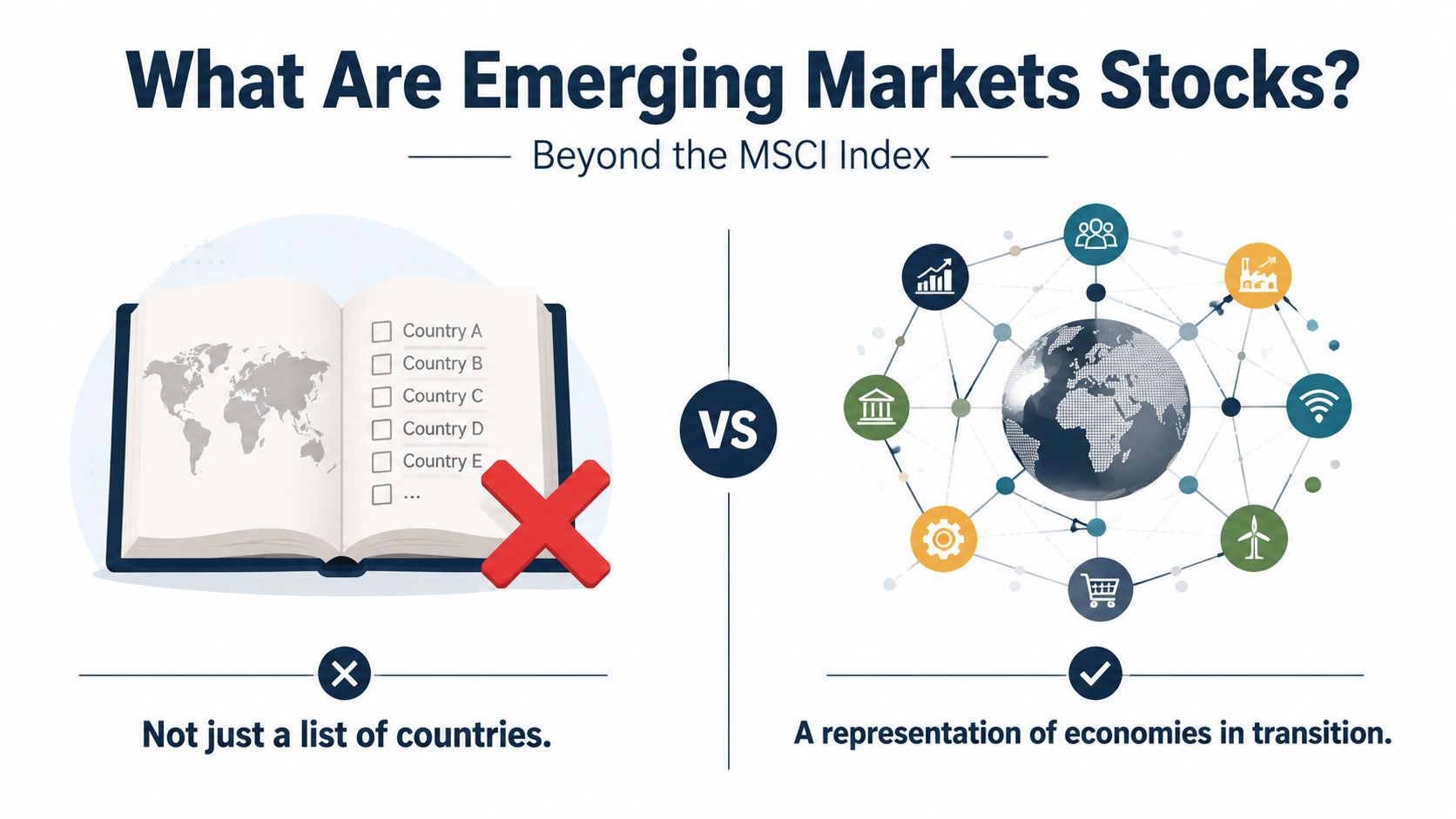
MSCI's framework is the cleanest place to start. Its Emerging Markets Index covers large and mid-cap companies across 24 emerging market countries and is designed to represent approximately 85% of the free float adjusted market capitalization in each country's equity universe, which gives the label a defined investable boundary instead of a vague growth story (MSCI methodology).
Why the index construction matters
That structure matters because clients rarely mean “all EM.” They usually mean a country, a theme, or a sector they've heard about. A client asking about India exposure is not asking for the same thing as a client who wants broad EM financials or exporters, and a portfolio that treats those as interchangeable is sloppy.
Practical rule: if the client names a country, the advisor should ask whether the thesis is really about that country's domestic demand, policy regime, or currency path. Those are different bets.
The index also helps with communication. Advisors can explain that the sleeve is not a random collection of frontier names, but a rules-based equity universe built from market-cap and float criteria. That is useful in review meetings because it keeps the conversation anchored to construction and risk, not just headlines.
For readers who need a plain-language starting point on market structure, a beginners guide to Indian stock market can be a useful adjunct when clients are specifically focused on India rather than the broader EM label.
| Characteristic | Developed Markets | Emerging Markets |
|---|---|---|
| Market definition | Mature, widely researched equity markets | Transitioning economies with different growth, governance, and liquidity profiles |
| Index role | Often used as a core allocation benchmark | Often better used as a selective satellite sleeve |
| Client framing | Broad regional or style exposure | Country, sector, and company-specific dispersion matters more |
| Research lens | Higher transparency and broader coverage | More uneven disclosure and greater mispricing potential |
The main takeaway is simple. Emerging markets stocks are not a country list. They are an investable equity segment defined by index rules, country inclusion, and capitalization coverage. Advisors who start there avoid most of the confusion that usually follows.
Why EM Returns Move The Way They Do
The easy story says EM rises with GDP and falls with politics. That's too crude. EM returns are driven by a mix of long-run growth, sentiment, currency swings, and cycle timing, which is why the same asset class can look brilliant one decade and frustrating the next.
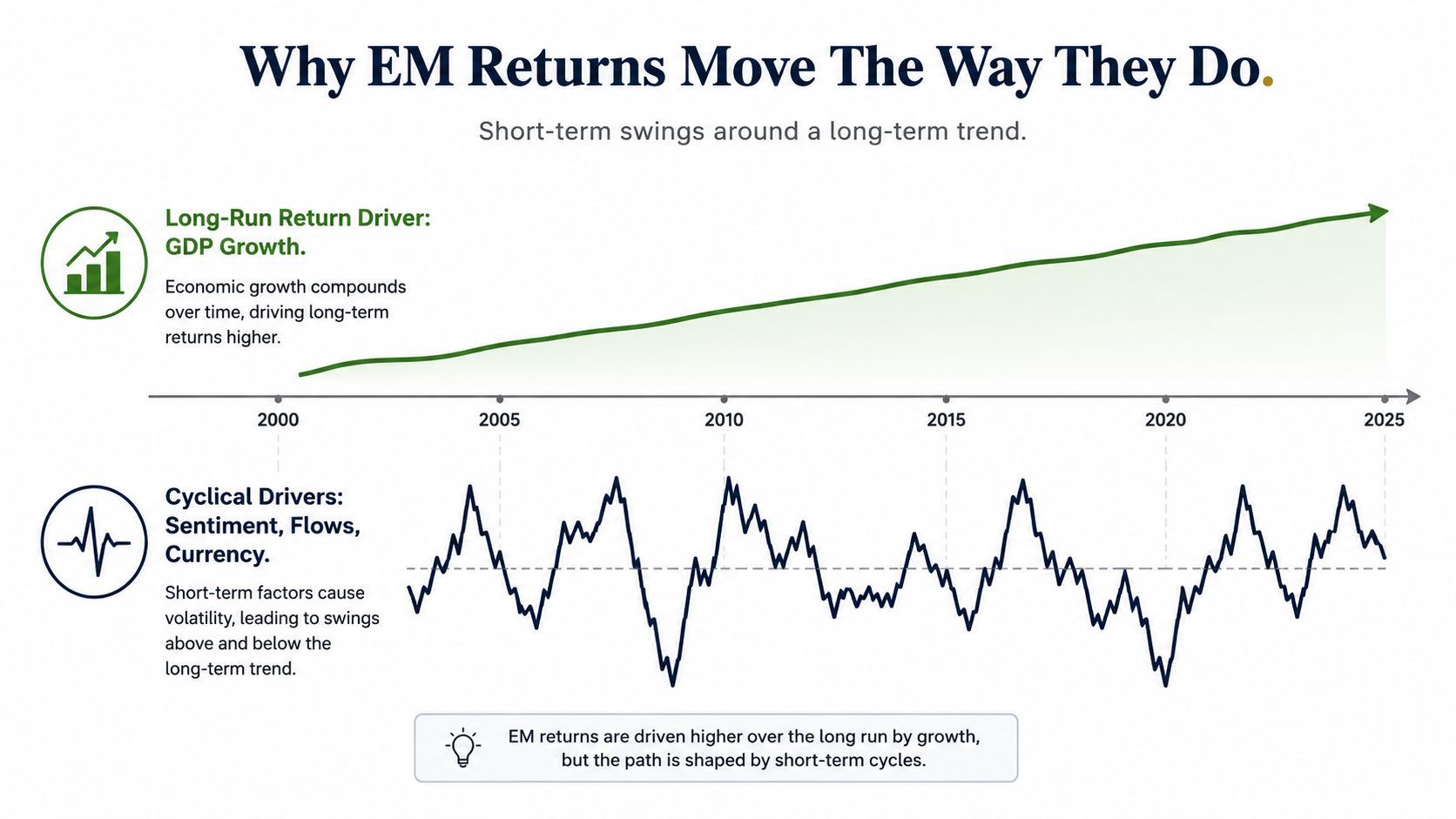
MSCI's June 30, 2026 factsheet shows the MSCI Emerging Markets Index has delivered a long-run annualized return of 7.67% in U.S. dollar terms since December 31, 1987, but that average hides a very uneven path, including 22.68% YTD, 40.90% over 1 year, 7.52% over 10 years, a -22.37% price return in 2022, and a +30.58% rebound in 2025 (MSCI factsheet). That is not a smooth compounding machine. It's a cyclical equity sleeve that can spend long periods rewarding patience and punishing impatience.
The cycle matters more than the average
Cambridge Associates' decades-long analysis shows why the average can mislead advisors. It found that EM outperformed developed equities by nearly 300% cumulative in two major outperformance cycles since 1987, with those cycles lasting roughly 7 years and 12 years, while since the post-GFC relative peak in September 2010 EM had underperformed developed markets by nearly 7% annualized (Cambridge Associates research).
That pattern should change how advisors talk. EM is not a steady diversifier that behaves itself. It is a high-variance asset class that tends to lead in bursts and lag for long stretches, and clients need to hear that before they buy, not after they're disappointed.
MSCI's long-term research also reports that emerging markets have averaged 5.9% annual economic growth over the last 20 years versus 4.9% for developed markets, with emerging markets' GDP per capita growth also reported at about 6% over the same period (MSCI long-term research). That growth gap helps explain why EM keeps returning to the strategic conversation, but it does not guarantee smooth equity gains.
The right client message is not “EM should compound faster because growth is higher.”
The right message is “EM has the growth base to matter, but the path is uneven enough that sizing and expectation-setting do most of the work.”
Advisors who frame EM this way protect the relationship. They're not promising a straight line. They're explaining why the sleeve belongs in a portfolio only if the client can tolerate the ride.
The Cheapness Trap and Where the Real Opportunity Sits
“EM is cheap” is one of the laziest phrases in portfolio management. It sounds intelligent, but it usually stops the analysis right before it gets useful. Broad valuation tells an advisor less than investors think, because the opportunity lives in the segments the market is mispricing, not in the headline index multiple.
The better question is where the discount sits
A recent perspective from Dodge & Cox argues that the long-term EM discount is not just a simple “cheap because risky” story, it is increasingly tied to profitability, governance, and index composition. That matters because a cheap multiple can reflect weak business quality just as easily as it can reflect neglect, and clients deserve the distinction (Dodge & Cox perspective).
Independent research on underfollowed stocks makes the same point from another angle. Smaller and less-covered EM companies can be overlooked because coverage is thinner than in developed markets, which creates a persistent information gap that broad EM commentary often misses (Acadian underfollowed-stocks insight). That's where a bottom-up process can matter, because the market is not pricing every sub-segment the same way.
The current opportunity set is also more specific than the old EM playbook suggested. Recent commentary highlights pockets such as India, Mexico, financials, and selected exporters rather than the index as a whole. That doesn't mean every name in those buckets works. It means the advisor should think in terms of mispriced sub-segments, not blanket allocation slogans.
Useful filter: if the investment case begins and ends with “EM is cheap,” it probably isn't a case yet.
The case gets stronger when the advisor can name the country, sector, or cap-size segment where fundamentals are improving faster than price implies.
For clients, this changes the conversation from passive belief to active selection. A broad EM ETF can still be the right answer, but only when the advisor wants market exposure without making a stronger claim. If the thesis is more selective, the work belongs in individual names or narrower sleeves.
Choosing Between EM ETFs and Individual Stocks
The right vehicle depends on what the advisor is trying to solve. Too many portfolios default to a broad EM ETF because it is easy, then act surprised when the result is mediocre in exactly the years when selective exposure would have mattered more.
Match the vehicle to the decision
A useful way to think about it is simple. Broad EM ETFs are for clients who want a diversified entry point and do not need the advisor to make a concentrated country or sector call. Country or regional ETFs fit clients with a specific thesis, such as domestic policy reform, exporter strength, or a desired underweight to a particular part of the index. Individual EM stocks are for situations where dispersion is wide enough to justify research and the advisor can defend the added work.
| Criterion | Broad EM ETF | Country/Regional ETF | Individual EM Stocks |
|---|---|---|---|
| Diversification | Highest | Moderate | Lowest unless built in a basket |
| Research effort | Low | Medium | Highest |
| Concentration risk | Lower at the fund level | Higher by design | Highest unless controlled |
| Client communication | Simple and broad | More thesis-driven | Most detailed and specific |
| Fit during stress | Usually easier to hold | Depends on country shock | Depends on name selection |
The stress-period question matters because broad EM vehicles often blur the sharp differences between countries and sectors when markets fall together. That can be useful for some clients and frustrating for others, especially when the investment case was never broad market beta in the first place.
For advisors comparing active and passive workflows, a useful companion discussion is the Futurecaps Stocks compares active vs passive piece, which can help frame the governance question around when a broad index is enough and when selection work deserves the effort.
Individual EM stocks make sense in a few specific cases. They can fit taxable accounts where the advisor wants to manage position-level realization more carefully, client portfolios with strong country convictions, or mandates where the client wants less index baggage and more exposure to a particular operating model. They do not make sense when the advisor lacks time for ongoing monitoring or when the thesis is too vague to survive a review meeting.
If the team cannot explain why a narrower sleeve should win, the broader ETF is probably the honest choice.
A Repeatable Due Diligence Checklist for EM Exposure
EM diligence works best when it is mechanical. Advisors do not need a 40-page memo to decide whether the sleeve belongs in the portfolio. They need a short process that surfaces whether the opportunity is broad, narrow, or illusory.
Start with the tape, then move to the file
The technical readout on the MSCI Emerging Markets complex is mixed, not euphoric. The 20-day, 50-day, 100-day, and 200-day moving averages are marked Buy, while the 5-day and 10-day simple averages are Sell, which usually signals a constructive longer-term trend with short-term momentum cooling or mean-reverting near resistance (technical readout). That matters because an advisor should never confuse a decent trend with a clean entry point.
The same readout shows RSI(14) at 33.452 and MACD(12,26) at -4.09, both flagged Sell, while ADX(14) at 42.654 points to a strong trend regime and ATR(14) at 2.3536 indicates higher volatility (technical readout). Read that as a caution flag, not a trading signal. Volatility is still high enough that sizing and timing discipline matter.
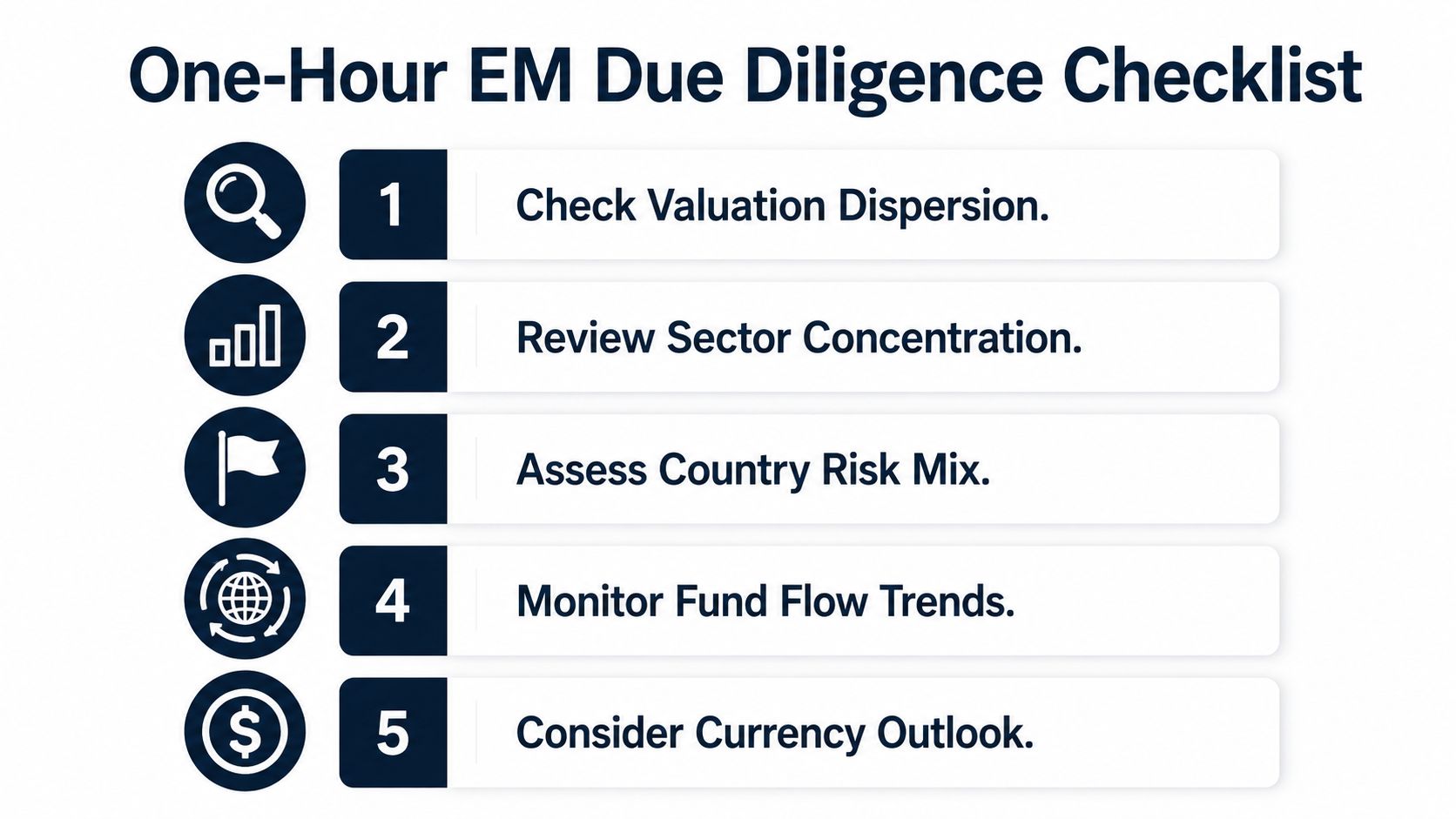
A practical diligence file should cover five things:
- Valuation dispersion: look for whether the opportunity is spread across countries or concentrated in a few names.
- Earnings revision breadth: ask whether improvements are broad or isolated.
- Currency exposure: separate equity selection from the currency you're implicitly buying.
- Governance and disclosure quality: confirm the names can survive basic client scrutiny.
- Liquidity under stress: make sure position size matches the market's ability to absorb it.
The point of the list is not to create false precision. It's to force an advisor to notice whether the thesis is supported by the actual investable universe or just by a narrative about cheapness.
For a deeper operational lens on risk-managed portfolio construction, the internal discussion around https://advisormomentum.com/long-short-equity-hedge-funds/ can be helpful when the team wants to think in terms of exposure control rather than simple long-only enthusiasm.
Compliance note: the written rationale should identify what was reviewed, what changed, and what would change the decision next quarter. That turns EM from a hunch into a documented process.
Sizing EM as a Satellite Holding
Most client portfolios do not need EM as a core holding. They need it as a satellite allocation, because that framing better matches the asset class's cycle-driven behavior and keeps the rest of the portfolio from being held hostage to EM's long flat stretches.
Keep the allocation modest and intentional
The right size depends on the client's time horizon, drawdown tolerance, and willingness to stay invested when EM underperforms developed equities for years. For many moderate portfolios, EM belongs in a smaller sleeve that complements the core, not in a size that forces the advisor to defend every drawdown as if it were the entire thesis. Growth-tilted accounts can justify more, but the logic should still be satellite-first, not core by default.
Rebalancing should be disciplined rather than emotional. When the sleeve runs hot, trim it back into policy range. When it lags but the underlying thesis is still intact, rebalance rather than chasing whatever is working elsewhere. That keeps the allocation tied to policy, not performance theater.
The satellite frame also helps during reviews. Clients hear that the sleeve is there for selective upside and diversification, not for uninterrupted leadership. That makes it easier to hold during inevitable lag periods, which is where a lot of EM allocations get abandoned.
A smaller sleeve is often the more aggressive choice, because it lets the portfolio stay invested through the ugly parts without forcing a wholesale sale.
Advisors who want a clean IPS line should be blunt. EM is not a core equity substitute for most households. It is a deliberate satellite exposure that earns its keep when dispersion widens and selection matters.
Compliance and Client Communication Considerations
The investment view is only half the job. The other half is making sure the written message matches the portfolio and can survive a compliance review without a rewrite marathon. That's especially true for EM, where advisors are tempted to describe the sleeve as either a guaranteed diversifier or a guaranteed bargain, and both claims create problems.
Write the claim you can defend
Under the SEC Marketing Rule environment, performance references, statements of belief, and forward-looking language need to be handled carefully. An advisor should document what the EM thesis is, what risks were considered, and why the allocation fits the client's objectives. If the sleeve is selective, the writing should say so. If the sleeve is broad, the writing should say that too.
Client commentary should avoid absolutes. EM should not be sold as a permanent outperformer, because the cycle data says otherwise. It also shouldn't be framed as structurally doomed, because the long-run data and the growth differential say otherwise. The defensible middle is selectivity, process, and client fit.
A strong file note usually includes:
- The thesis: what makes the opportunity worth considering now.
- The vehicle choice: why a broad ETF, regional ETF, or individual stock approach was selected.
- The risk view: what was done about currency, governance, and volatility.
- The review trigger: what evidence would justify adding, trimming, or exiting.
For advisor teams that produce public-facing content, a compliance-first workflow shortens the review loop because the argument, source support, and disclosure language are built in from the start. That is where Advisor Momentum fits naturally, since it provides compliance-ready content production and advisory marketing support for regulated firms without forcing the message into a generic template.
The linked process guide, how to become a fiduciary, is relevant here because fiduciary communication is not just about the recommendation, it's about the documentation and client-facing language that supports it.
Don't write EM as a promise. Write it as a documented allocation decision with specific risks, specific evidence, and a specific review cadence.
Advisor Decision Checklist for Emerging Markets Stocks
A good EM decision is usually a selective decision. If the sleeve only makes sense when the team can name the country, sector, or stock-level edge, then the process should say that plainly instead of hiding behind broad labels.
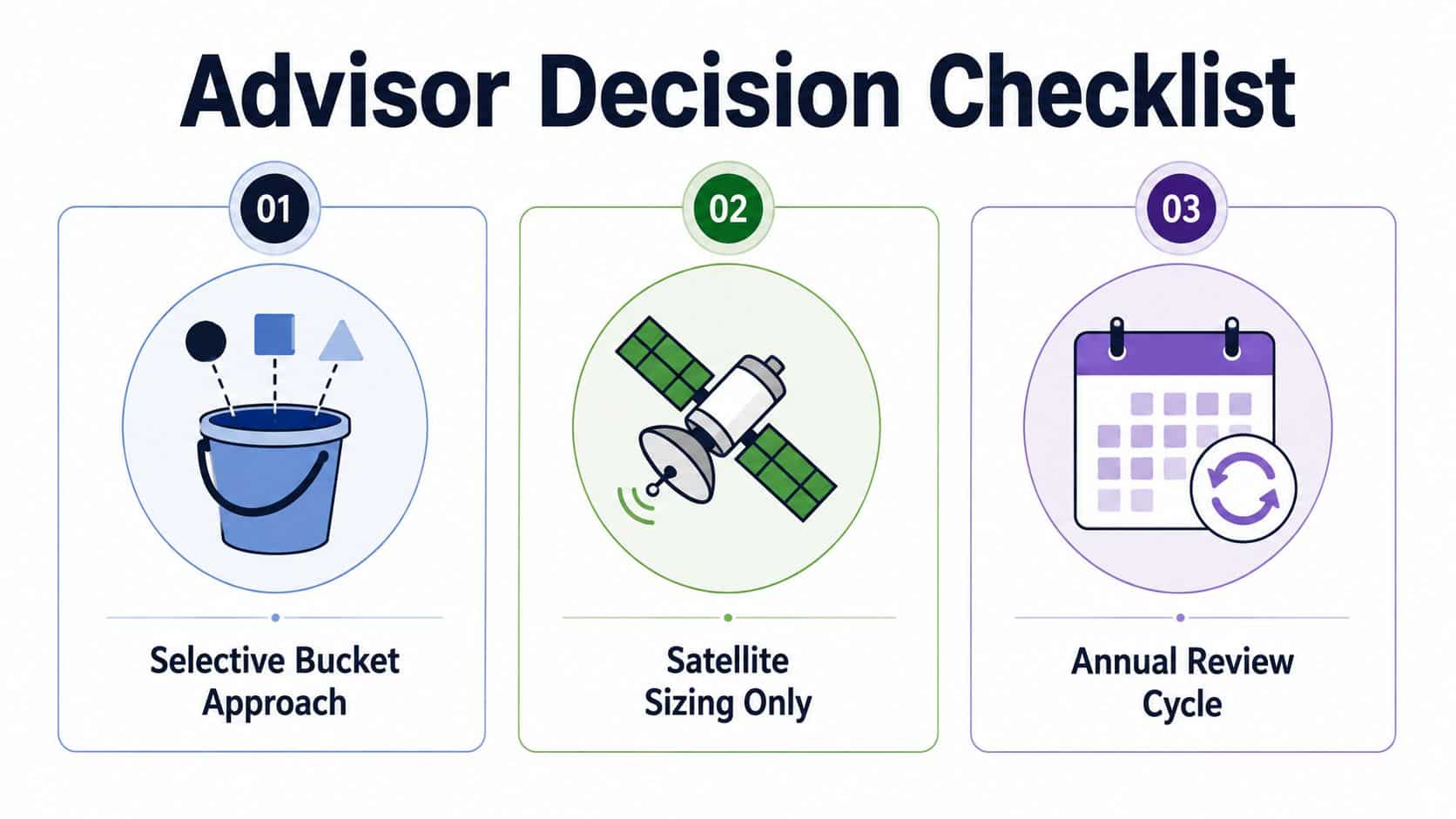
Keep three questions on file
- Selective bucket approach: Is the opportunity broad EM exposure, or is it really about a country, sector, or underfollowed segment?
- Satellite sizing only: Does the allocation fit as a smaller sleeve that the client can hold through long lag periods?
- Annual review cycle: Has the thesis, vehicle choice, or risk profile changed enough to justify a trim, add, or exit?
That checklist keeps the advisor out of the trap where EM becomes a vague macro opinion with no portfolio discipline behind it. It also protects the client conversation, because the discussion starts with the actual investable thesis rather than a slogan about growth.
A clean conclusion is better than a clever one. If the allocation cannot be defended in writing, it probably doesn't belong in the portfolio. If it can be defended, it should still stay small enough to survive the next cycle.
Advisor Momentum helps advisory teams turn market views into client-ready content that's written with compliance in mind from the start. For firms that want EM commentary, portfolio explainers, and review-ready web content handled with the same discipline, visit Advisor Momentum and see how its compliance-first content workflow supports regulated advisory marketing.
