

A solo advisor can spend an afternoon writing a thoughtful market note, send it to every contact in the database, and still get almost no meaningful response. The problem usually isn't the writing. It's that the email asks prospects, active clients, dormant clients, and professional contacts to treat the same message as if they have the same question.
A financial advisor newsletter performs better when it operates as a segmented service model. Each audience receives a different reason to pay attention, each issue has one measurable job, and each editorial choice has a clear compliance path. That approach turns email from a periodic broadcast into a controlled client and prospect touchpoint.
Table of Contents
- Why Most Financial Advisor Newsletters Stall Before They Earn Trust
- Choosing Your Audience, Cadence, and One Measurable Goal
- Content Pillars That Fit a Regulated Audience
- Writing the Newsletter So It Opens, Scans, and Converts
- Compliance Workflow That Protects Reach and Response
- Metrics, Testing, and the Quarterly Review Rhythm
- Your 90-Day Financial Advisor Newsletter Launch Plan
Why Most Financial Advisor Newsletters Stall Before They Earn Trust
A small RIA has a capable advisor, a polished brand, and a carefully researched quarterly market outlook. The firm sends it to the entire database because it has not decided whether the newsletter primarily serves prospects, clients, dormant relationships, or centers of influence.
The first issue receives little meaningful response. The second repeats the pattern. By the third, unsubscribes increase. The advisor concludes that email does not work, although the breakdown began earlier, with no defined audience stage, service promise, or review path.
A market outlook carries a different job for each group. An active client needs a concise explanation of how conditions affect an existing plan. A prospect needs evidence that the firm understands a specific planning problem. A dormant contact needs a useful reason to restart the conversation. A center-of-influence partner needs clarity about the clients the firm serves and the situations that warrant an introduction.
Practical rule: One newsletter can carry one brand, but it should not assume every reader has the same need.
Each audience stage also creates a different SEC review question. Client commentary may require support for statements about portfolio impact. Prospect content can trigger review of performance implications, testimonials, or calls to action. Re-engagement emails should avoid implying a current relationship, while center-of-influence material requires careful review of referral language and compensation claims. Segmenting the service model makes those checks visible before the issue reaches the approval queue.
The newsletter should therefore be judged as a performance channel, not only a branding exercise. advisor newsletter performance guidance reports that a steady-state list of 1,200 niche-aligned subscribers can produce 8 to 14 inbound discovery calls per quarter. It also reports higher average open and click rates for weekly newsletters than for monthly sends, while placing the median subscription-to-discovery-call period at 5 to 11 months. The practical implication is a long trust cycle, not an instant lead source.
The remedy is operational. Choose the audience stage before drafting, set a sustainable rhythm, define the response that matters, and assign the SEC review mechanic to each editorial choice. Trust grows when every issue has a clear reader, purpose, and approval path.
Choosing Your Audience, Cadence, and One Measurable Goal
A prospect opens an issue about retirement planning, while a current client needs context for an upcoming review. Sending both readers the same message forces one newsletter to carry two service promises. Decide who receives it, how often it arrives, and what action it should influence before drafting. Record those decisions so later performance comparisons remain meaningful.
Start with one primary audience stage. Active clients, prospects, dormant contacts, and centers of influence have different reasons to read and different next steps. A secondary segment can receive the issue when the subject serves both groups. A full-database send usually produces general copy, which leaves every reader with less relevance.
Each choice also creates an SEC review mechanic. Prospect education should be checked for implied performance expectations, testimonials, and calls to action. Client commentary may require support for statements about portfolio impact. Dormant-contact emails should not imply an active relationship, while center-of-influence material needs review of referral language, compensation, and disclosures.
Cadence creates a practical production trade-off. Monthly delivery supports regular visibility but adds a recurring writing and approval obligation. Every two months reduces pressure while maintaining a recognizable presence. Quarterly delivery suits substantial planning guidance, yet provides fewer opportunities to learn from reader behavior and remain present between conversations.
Survey findings cited in the original research indicate that newsletters remain a familiar format in financial advice. The same research reported strong readership for electronic newsletters, while later survey findings showed that some advisors included newsletters in their content plans and that investors varied between monthly and every-two-to-three-month communication preferences. The useful conclusion is qualitative: cadence should reflect both reader expectations and the firm's review capacity. newsletter strategy data for wealth managers
Set one measurable goal for the chosen segment. A prospect issue can seek booked discovery calls. A client issue can support retention touchpoints. A COI issue can seek referral introductions. Add one guardrail, such as unsubscribe rate or spam complaints, so response does not come at the expense of list health.
| Audience Segment | Cadence Option | Primary Goal | Main Tradeoff |
|---|---|---|---|
| Prospects | Monthly | Booked discovery calls | Requires consistently specific educational value |
| Active clients | Every two months | Retention touchpoints | Less frequent contact can reduce routine visibility |
| Dormant contacts | Quarterly | Re-engagement replies | A broad message may not overcome stale relevance |
| Center-of-influence contacts | Quarterly | Referral introductions | Referral language requires careful audience and disclosure review |
Use this financial advisor email marketing framework to document the segment, cadence, goal, guardrail, and review question before building the editorial calendar. A sustainable schedule usually survives principal review better than an ambitious one that produces rushed copy, uneven approvals, and inconsistent delivery.
Content Pillars That Fit a Regulated Audience
A financial advisor newsletter should use different editorial pillars for each audience stage, not one broadcast formula. Prospects need useful education, clients need continuity, dormant contacts need a relevant reason to respond, and centers of influence need material they can comfortably share. Each choice also determines the questions a principal or compliance reviewer will ask.
| Pillar | Best Audience Stage | Expected Outcome | Common Compliance Flags |
|---|---|---|---|
| Timely market context with educational framing | Clients and prospects | Clarifies decisions without turning the issue into a prediction | Performance implications, unsupported forecasts, missing risk context |
| Planning how-to tied to a life event | Prospects and clients | Encourages replies about a defined planning concern | Implied individualized advice, incomplete assumptions |
| Firm updates and team notes | Clients and COIs | Strengthens familiarity and relationship continuity | Promotional claims, awards, unsupported expertise statements |
| Anonymized client scenario with permission | Prospects | Shows the type of problem the firm handles | Testimonial treatment, privacy, outcome claims, missing consent |
| COI or referral partner spotlight | COIs and selected prospects | Creates a reason for a professional introduction | Endorsement disclosures, compensation, conflicts, written agreements |
Market context earns its place when it answers a planning question. “What happened in markets” is a weak assignment. “What a volatile quarter can and cannot tell a household reviewing its cash reserve” gives readers a practical frame and gives the reviewer a clear basis for assessing risk language, balance, and implied predictions.
Planning education should connect to a recognizable decision. Preparing for a business sale, reviewing beneficiary designations, or organizing retirement-income questions gives prospects and clients a defined problem to consider. Explain the decision framework, assumptions, and questions to raise with an adviser. Do not present one personal recommendation as if it fits every reader.
Firm updates work better as relationship information than self-congratulation. A new team member, community involvement, educational event, or service-process update can help clients and COIs understand how the firm operates. Claims about expertise, awards, or results need support and usually invite more review.
Client scenarios require the strongest documentation. An anonymized example can show the type of planning problem the firm handles while limiting personal information, but permission and records still matter. Performance claims, rankings, and testimonials often create more review work than educational explanations. A generalized planning scenario, decision checklist, or explanation of how alternatives are assessed usually gives the reader value with fewer claims to substantiate.
A COI spotlight can support a professional introduction, but it may trigger review of endorsement language, compensation, conflicts, disclosures, and written agreements. Keep the audience and relationship clear. The same item may be suitable for selected COIs and unsuitable for a broad prospect list.
The SEC Marketing Rule applies to SEC-registered or required-to-be-registered investment advisers that disseminate an advertisement, including newsletters that function as advertisements. The rule became effective on May 4, 2021, with a mandatory compliance date of November 4, 2022, as described in the SEC Investment Adviser Marketing Rule guide.
Editorial selection therefore sets the review route before drafting begins. A pillar is useful only when its audience, claim type, evidence, and approval path are clear.
Writing the Newsletter So It Opens, Scans, and Converts
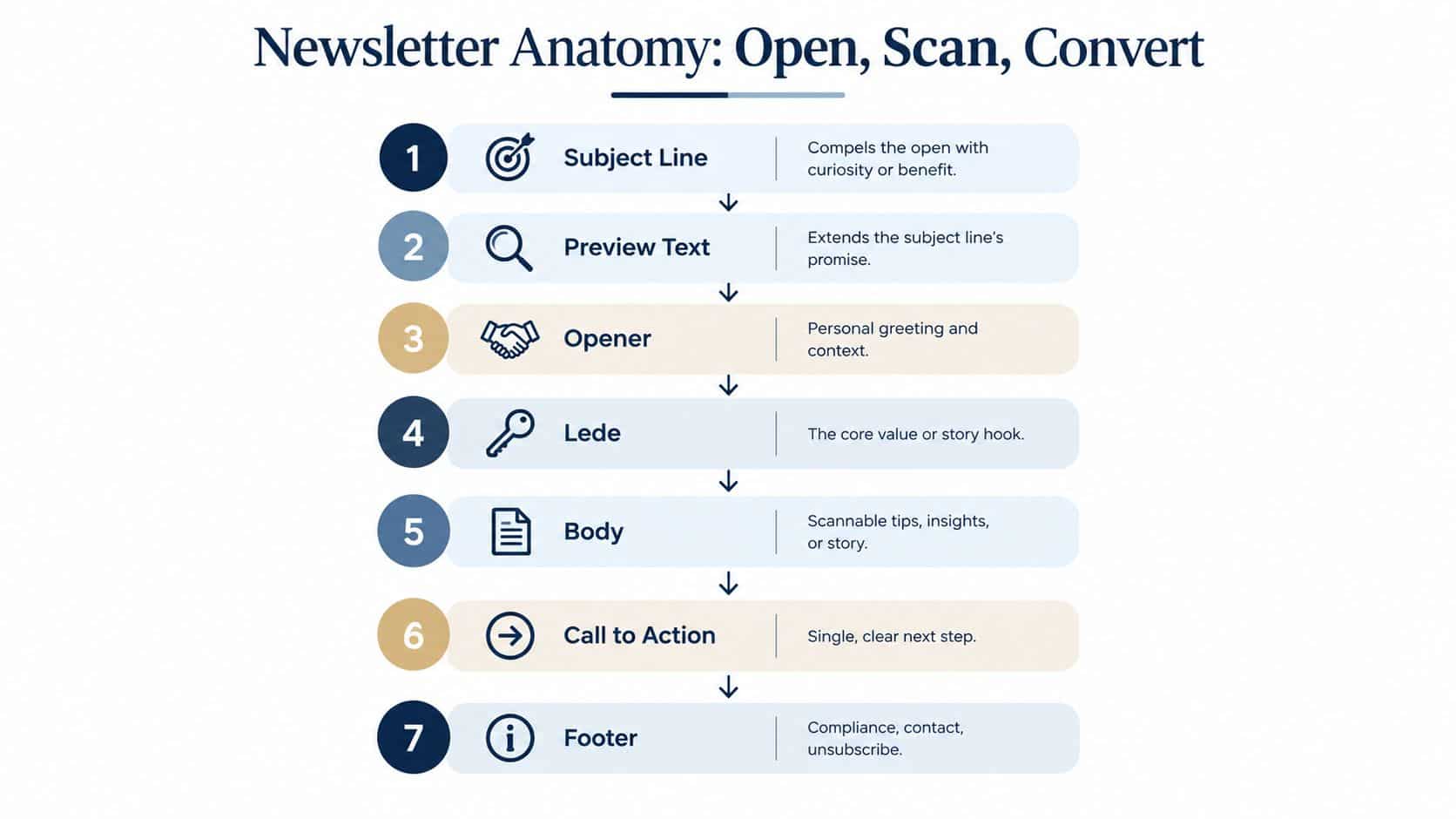
A newsletter should work as a segmented service, not one broadcast. A prospect needs orientation, a client needs useful follow-through, a dormant contact needs a reason to re-engage, and a center of influence needs context for an appropriate introduction. Each choice also sets the SEC review path, so draft for the audience and the claim type together.
Subject line and preview text
Test subject lines as controlled variables, while keeping every promise accurate and supportable. Curiosity creates an information gap. A specific number signals a bounded resource. Personal stake names the reader's planning concern. The appropriate choice depends on the segment. A prospect may respond to a question, while a client may prefer a direct reminder about an existing decision.
Preview text should extend the promise, not repeat the subject. If the subject raises a retirement-income question, the preview can state what the issue explains or which decision it helps organize. That wording is still part of the advertisement and should remain in the review record.
Open and click rates vary with list quality, audience, cadence, and segmentation. Use the financial advisor email marketing benchmarks as directional context, not as a promise of performance. A principal will still need to assess whether the subject, preview, and audience selection support the claims being made.
Opener, lede, and body
Open with the reader's problem in roughly 150 words, rather than the firm's credentials. The lede should state the central takeaway. Short paragraphs, descriptive subheads, and one clear visual hierarchy let readers scan without removing needed nuance.
A practical body sequence is:
- Problem: Name the planning question in ordinary language.
- Context: Explain why it matters to this audience.
- Framework: Give the reader a practical way to assess it.
- Boundary: State what the explanation cannot determine without personal facts.
- Action: Offer one next step that fits the segment.
For a prospect, the action might be an educational resource. For an active client, it might be a reply about a planning question. A dormant contact may need a low-pressure update, while a center of influence may need a clear description of whom the firm serves. Each version changes the audience controls and the evidence a reviewer expects. General education usually requires less substantiation than performance, ranking, testimonial, or outcome language.
A brochure talks about the firm. A useful newsletter helps the reader make sense of a decision.
CTA and footer
The CTA must match both audience stage and relationship. Prospects can be invited to schedule a discovery call. Active clients may be directed to the client portal. Dormant contacts can receive an invitation to reply or update their preferences. A COI contact may receive a carefully worded invitation to discuss whether the firm suits a particular introduction.
The footer should include the firm's physical address, contact information, required disclosures, and a clear unsubscribe mechanism. Teams seeking a technical review of subject lines and email engagement can consider consulting from Netco Design, provided recommendations are adapted to the firm's compliance process.
A copyable skeleton:
- Subject line: One accurate promise.
- Preview text: One consequence or benefit.
- Opener: The reader's current concern.
- Lede: The issue's main takeaway.
- Body: Three scannable points and one boundary.
- CTA: One audience-appropriate action.
- Footer: Contact details, disclosures, archive-ready copy, and unsubscribe path.
Compliance Workflow That Protects Reach and Response
A prospect newsletter, client update, dormant-contact reactivation, and center-of-influence communication should not enter review as the same campaign. Each audience stage creates a different compliance question. A prospect issue may support a discovery conversation. A client issue may explain a service decision. A dormant-contact issue must respect suppression and preference records. A COI issue may involve referral and conflict disclosures.
Start by identifying the editorial choice and the SEC review mechanic it triggers. Market commentary calls for fair balance, risk language, and review of any implied performance message. A client scenario requires documented permission, privacy controls, and careful wording around outcomes. A return, ranking, or comparison requires substantiation and a record of how the claim was calculated. A forward-to-a-friend feature needs a suppression path, so the firm does not create an uncontrolled marketing audience.
Testimonials and endorsements under the modernized Marketing Rule require prominent disclosure. The advertisement should make clear whether the promoter is a client and whether compensation is involved, including relevant compensation and conflict information. The adviser generally also needs oversight and a written agreement, except where the promoter is an affiliate or receives de minimis compensation of $1,000 or less, or equivalent noncash compensation, during the preceding twelve months. Keep the disclosure, permission, agreement, and compensation record with the campaign file. (SEC Marketing Rule testimonial and endorsement guidance)
| Content Type | Rule Triggered | Required Documentation | Typical Review Time |
|---|---|---|---|
| Educational market context | Advertising and fair-balance review | Source notes, draft, disclosures, reviewer comments | Set by the firm's approval calendar |
| Client scenario | Privacy, testimonial, or endorsement review | Written permission, anonymization record, final copy | Longer when outcomes or quotes appear |
| Performance or ranking claim | Substantiation and advertising review | Supporting evidence, calculation method, approval record | Longer than ordinary educational copy |
| Referral feature | Endorsement and conflict review | Disclosure language, agreement where required, compensation record | Depends on relationship complexity |
| Forwarding function | Consent and suppression review | Audience rules, opt-out record, send evidence | Requires operations and compliance coordination |
Use a versioned template. The marketing owner sends the chief compliance officer the draft, audience segment, intended send date, and a one-line change summary. Reviewer comments remain attached to the approved version. The campaign file should contain the sent version, audience list, proof of distribution, and unsubscribe record for the applicable books-and-records period.
Deliverability belongs inside the same workflow. Authentication, accessible unsubscribes, list hygiene, and complaint monitoring affect whether approved content reaches the intended audience. A spam word checker can flag language for review, but it cannot replace consent controls, principal approval, or an archive. Build these controls into production rather than adding them at the end with a compliance by design approach for advisory marketing.
A CCO-ready launch checklist should include:
- Version control: File names identify the issue, audience, date, and revision.
- Claim review: Every performance, ranking, or outcome statement has support.
- Permission review: Client scenarios, quotes, and endorsements have documented approval.
- Disclosure review: Required advertising, compensation, and conflict language is prominent.
- Audience review: The list reflects consent, suppression, and segment rules.
- Archive review: Final copy, reviewer notes, send proof, and unsubscribe evidence are stored.
The process earns trust when the approved copy, approved audience, and actual send all match. That alignment protects reach without asking compliance reviewers to approve language they cannot trace.
Metrics, Testing, and the Quarterly Review Rhythm
A prospect newsletter, a client update, a dormant-contact reactivation email, and a COI note should not share one dashboard. Their useful actions differ, so evaluate each segment against its service stage and intended next step. Opens show attention, not value. Track unique open rate by segment, click-to-open rate on the primary CTA, reply rate, and assisted meetings booked, then connect those measures to pipeline or service outcomes.
Reviewers also need a clear audit trail for the numbers. Record the audience, send version, CTA, and resulting action. A strong open rate can still hide weak response quality when the firm does not connect the issue to meetings, proposals, assets, or service conversations. The quarterly review should examine those connections rather than reward attention alone.
Use a short operating rhythm:
- Pull segmented results: Compare prospects, clients, dormant contacts, and COIs separately.
- Review the primary CTA: Identify clicks, replies, bookings, or no action.
- Inspect list health: Check unsubscribes, spam complaints, and delivery signals.
- Choose one change: Keep one effective element, remove one weak element, and test one new variable.
Testing also creates a compliance question. Change one meaningful variable per send. A subject-line test keeps the body and CTA unchanged. A CTA test keeps the subject line and editorial content unchanged. Archive both versions, the audience definition, and the reviewer's rationale so the principal can see what changed and why.
A quarterly meeting can stay practical. Ask:
- Which segment produced the most useful action?
- Which pillar generated replies instead of passive reading?
- Did the CTA fit that audience's stage?
- Did compliance comments expose a recurring drafting problem?
- Which single change belongs in the next test?
Keep the review focused on decisions. The newsletter then operates as four managed service tracks, with editorial choices, audience response, and SEC review evidence examined together.
Your 90-Day Financial Advisor Newsletter Launch Plan
A launch often stalls when one broadcast is expected to serve prospects, clients, dormant contacts, and COIs equally. Use four focused sprints to turn those groups into separate service tracks, each with a defined purpose, response, and review path.

Sprint one maps the audience and review risk
Confirm the prospect, client, dormant, and COI segments. Check consent and suppression records, then write one measurable goal for each group. A prospect issue may seek a reply or meeting, while a client issue may support an existing service conversation. Those different goals change the CTA and the SEC review questions around targeting, claims, and records.
Do not draft until the firm knows who receives the first issue and what useful action looks like.
Sprint two sets pillars and the template
Choose two or three pillars for the primary audience. Build the subject line, preview, opener, lede, body, CTA, footer, and disclosure blocks into a versioned template. Mark claims, performance references, testimonials, and individualized language that may require principal review. Test sample subject lines and claims before building the full editorial calendar.
The template should make review repeatable, not merely make production faster.
Sprint three runs a controlled soft launch
Run a 14-day pilot to 10% of each segment, then review replies, complaints, unsubscribes, and disclosure questions before sending to the remaining audience. Compare the response by audience stage. A confusing CTA may be appropriate for neither a prospect nor a dormant contact, while a service update may fit clients but waste attention among COIs. The pilot should expose tone, targeting, and operational problems while the audience remains limited.
Sprint four establishes the operating rhythm
Set the cadence, assign drafting and review owners, define the archive location, and schedule the 90-day performance meeting. Keep the segment map, goal sheet, pillar list, template, approved pilot, send record, and next-quarter testing decision together. That file shows what was sent, to whom, and why the reviewer approved it.
| Sprint | Owner | Deliverable | Completion signal |
|---|---|---|---|
| Audit and map | Advisor and operations | Segments, consent review, goals | Each audience has one defined purpose |
| Pillar and plan | Marketing and advisor | Pillars, template, editorial calendar | Reviewer can identify likely compliance triggers |
| Build and test | Marketing and compliance | Pilot issue and archive file | Replies and list-health signals are documented |
| Launch and learn | Advisor, marketing, and operations | Full cadence and review agenda | The next test is selected from actual results |
Advisor Momentum provides content planning, newsletter distribution, website content management, and related marketing support for financial advisors and wealth management firms. Visit Advisor Momentum to discuss a program that connects segmentation, compliant production, and measurable follow-up.
