

A client praises an advisor's retirement plan in a review meeting, then mentions a sibling who might need similar help. The advisor welcomes the introduction, but nobody records the source, confirms what the client told the prospect, or gives the prospect a clear next step. A week later, the opportunity has disappeared into an inbox.
That's the operational reality behind many referral efforts. The firm has satisfied clients and strong professional relationships, yet the financial advisor referral program exists mostly as informal goodwill. A workable program turns that goodwill into a controlled process, with compliant disclosures, defined ownership, prompt follow-up, and attribution that shows which relationships produce qualified business.
Table of Contents
- Why Most Financial Advisor Referral Programs Leak Revenue
- The Compliance Frame Every Program Must Fit Inside
- Designing the Program Structure That Survives Review
- Client and COI Outreach Scripts That Actually Get Introductions
- Onboarding Workflow From Introduction to First Meeting
- Measurement Dashboards That Separate Signal From Noise
- Launching the Program and Fixing What Breaks First
Why Most Financial Advisor Referral Programs Leak Revenue
The gap starts with a simple contradiction. A 2024 Kitces survey of nearly 1,000 firms found that roughly 9 in 10 financial advisors use client referrals, while about two-thirds of all clients arrive through referrals. The same research ranked referrals as both the highest-quality and highest-quantity lead source, making referral generation a foundational growth channel rather than an occasional supplement. The summarized Kitces referral data shows why firms can't afford to leave the channel unmanaged.
Yet willingness rarely becomes a documented introduction. One dataset reported that 50% of investors had referred an advisor, while fewer than 5% of advisors said they received referrals from clients. Another dataset found that roughly 83% of clients were comfortable giving a referral, but only 29% did. SEI's reporting on the referral opportunity points to the practical issue, satisfaction creates readiness, but it doesn't create action by itself.
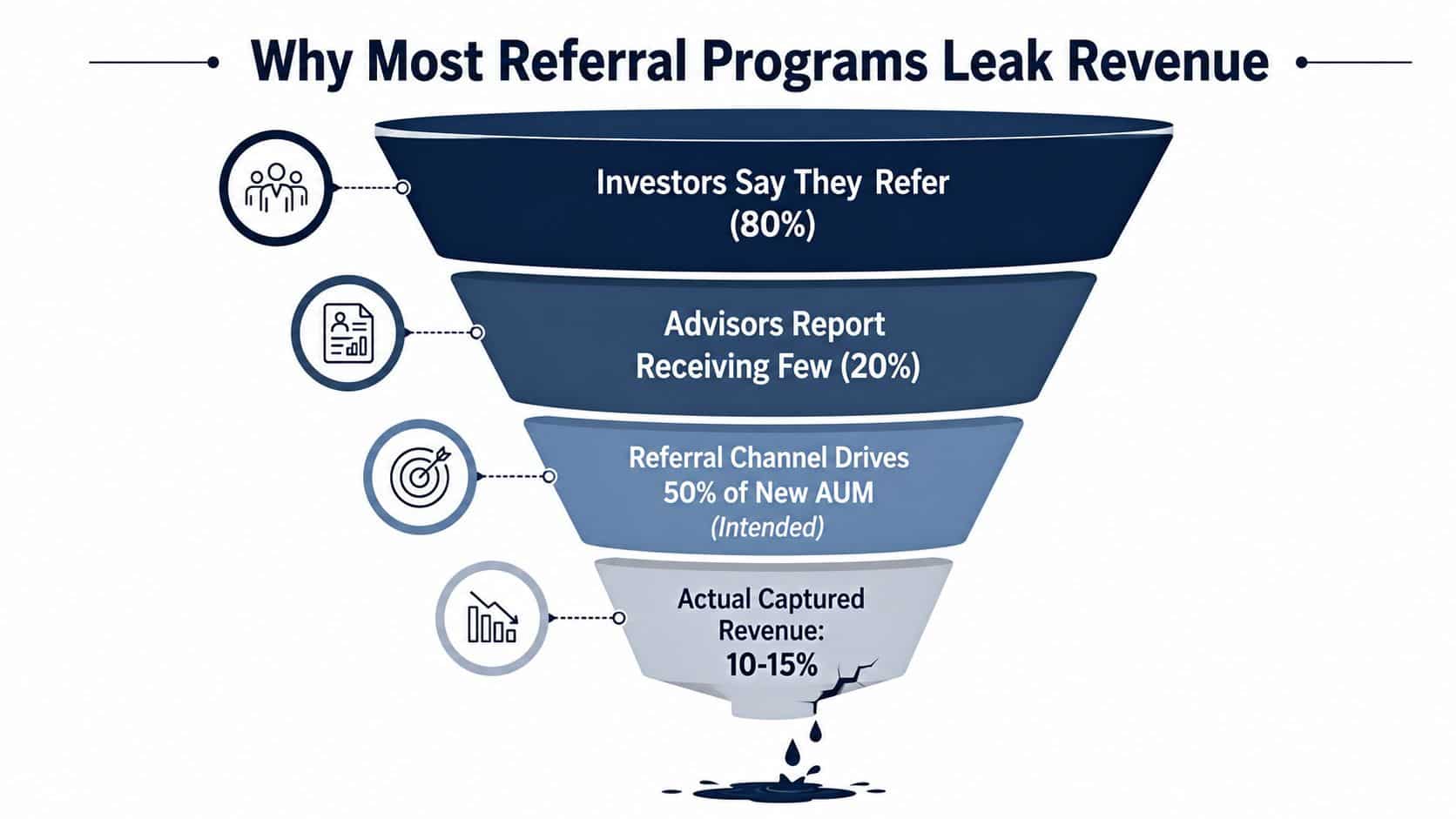
Treat the gap as a process defect
The common response is to tell advisors to ask more often. That's incomplete. A referral can fail because the advisor asks at the wrong time, the client doesn't know what kind of person fits, the introduction requires too much effort, or the team can't identify the source after the prospect arrives.
A stronger operating model has three parts:
- Segment the source: Separate current clients, friends and family networks, centers of influence, and any paid solicitor arrangement. Different sources require different outreach, documentation, and economics.
- Prompt the introduction: Ask after a visible service win, such as completing a retirement income plan or resolving a planning issue. The request should make the ideal introduction clear and give the client an easy path.
- Attribute the outcome: Record who introduced the prospect, the source category, the date, the stage reached, and the eventual disposition. Without attribution, the firm can't distinguish a productive relationship from a busy but low-quality source.
The economics support this discipline. Cerulli reported that 54.2% of new clients came from clients, friends, or family members, while 13.9% came from centers of influence such as CPAs and attorneys. Cerulli's referral and COI findings make the allocation problem clear. A firm that tracks only “referral” as one generic category loses the ability to see where its highest-value introductions originate.
Practical rule: A referral program shouldn't depend on an advisor remembering to ask. It should define the moment, language, owner, record, and next action before the conversation happens.
The Compliance Frame Every Program Must Fit Inside
Compliance needs to shape the program before marketing materials, incentives, or scripts are approved. The first question isn't “How can the firm generate more introductions?” It's “What kind of communication and compensation arrangement is being created?”
The SEC Marketing Rule distinguishes between testimonials and endorsements and places requirements around disclosures, oversight, and misleading statements. An advertisement using a testimonial or endorsement must clearly and prominently disclose whether the promoter is a client and whether the promoter is compensated. The SEC also generally requires a written agreement with promoters, subject to exceptions including affiliate relationships or de minimis compensation of $1,000 or less during the prior 12 months. The SEC's Marketing Rule announcement sets out those disclosure and agreement conditions.
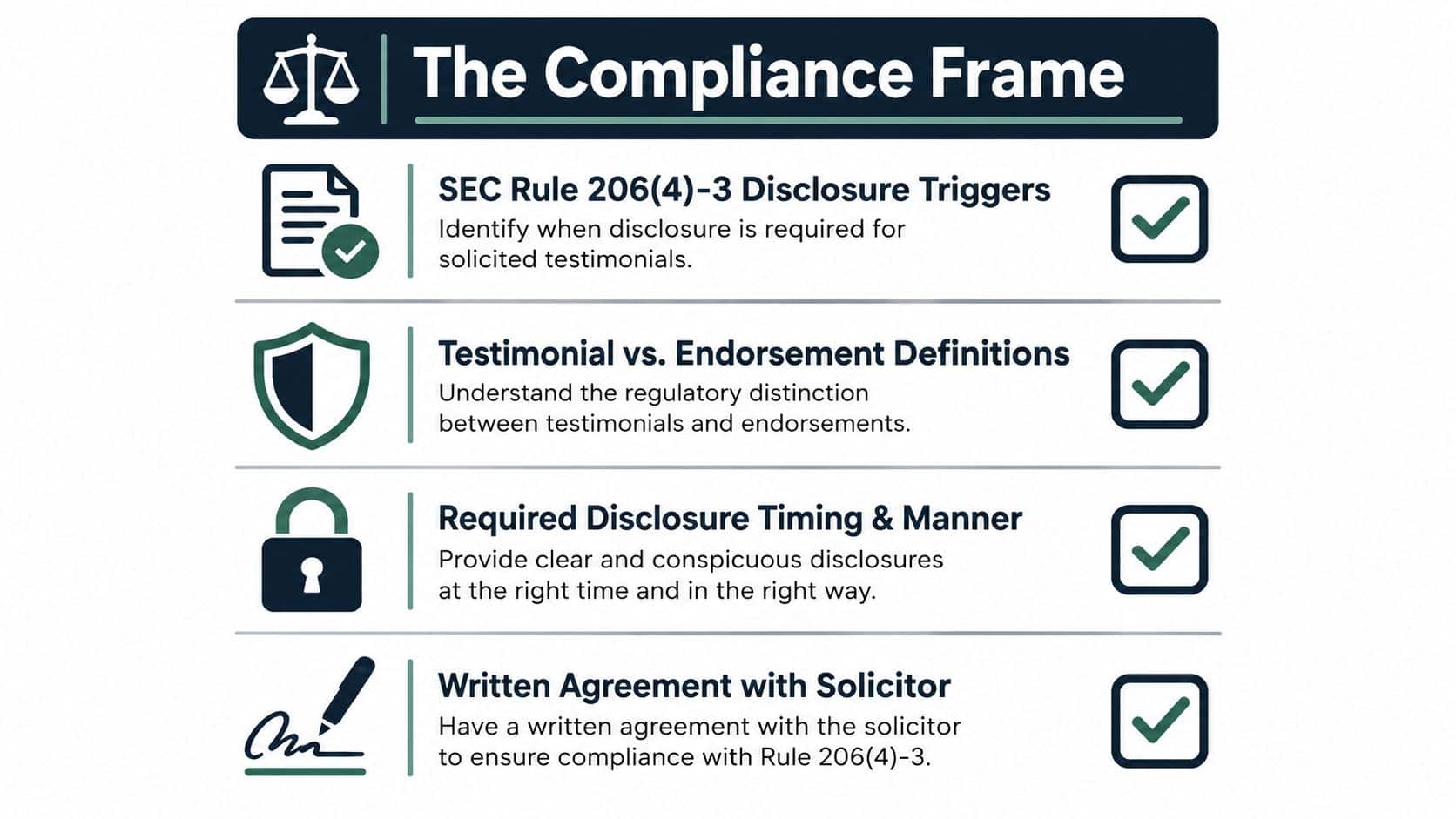
Match the arrangement to the rule
For SEC-registered investment advisers paying cash referral fees, Rule 206(4)-3 requires specific conditions, including a written agreement between the adviser and solicitor. The solicitor also can't be subject to statutory disqualification. The SEC's final rule materials treat the written contract as a condition of a lawful cash solicitation arrangement, not merely a useful administrative record.
That means a paid program should define:
- The parties: Identify the adviser, solicitor, and any supervising personnel.
- The compensation: State what is paid, when it's paid, and what event triggers payment.
- The disclosures: Specify what the solicitor must provide before or during the promotion.
- The conduct standard: Prohibit misleading statements, unsupported performance claims, and unauthorized promises.
- The records: Preserve approvals, communications, payments, and monitoring evidence.
Non-cash incentives create a separate issue for broker-dealers and associated persons. FINRA Rule 3220 limits gifts and non-cash compensation influencing employees of other firms to $100 per individual per year, unless an exemption applies. The referral-program compliance summary explains why a seemingly modest thank-you can still require review when the recipient is connected to another firm.
Keep brokerage recommendations inside the disclosure frame
A referred prospect may begin with an advisory conversation and later receive a brokerage recommendation. FINRA's Regulation Best Interest guidance requires broker-dealers to disclose the representative's capacity, material fees and costs, the type and scope of services, and material limitations. FINRA's guidance on Regulation Best Interest makes those elements part of the client-facing process when a referral leads into brokerage activity.
The practical checklist is straightforward. Compliance should approve the referrer category, the compensation method, the written agreement, the disclosure language, the timing of delivery, the approval owner, the record-retention process, and the escalation path for complaints or misleading statements.
Designing the Program Structure That Survives Review
A referral program survives review when its rules are clear enough to fit on one page and specific enough for operations to apply consistently. Before drafting outreach language, set the source categories, incentive rules, approval path, and record owner.
Decide who can refer
Client referrals are usually the simplest operating category. A client introduces someone from a personal network, but the firm still needs rules for acceptable language, follow-up, disclosures, and any compensation. An advisor should not publish an unapproved testimonial or offer an incentive outside the approved policy.
COI programs require a separate workflow. CPAs, attorneys, and other professionals may understand client needs and produce relevant introductions, yet the relationship should be managed as a professional channel rather than casual word of mouth. Earlier research found 13.9% of new clients coming from COIs, so the firm should track this source separately from client referrals rather than burying both under one field.
Paid solicitors require the most formal structure. If cash compensation is involved, plan for a written agreement, disclosure, eligibility review, payment record, and ongoing oversight unless compliance documents a specific exception. The agreement should define who may solicit, what the solicitor may say, which prospects qualify, and who can suspend the arrangement.
Choose the incentive carefully
The safest incentive may be no incentive. The firm can make introductions easy, thank the source appropriately, and avoid a payment arrangement that creates additional review work. If compensation is used, define the amount, trigger, timing, approval owner, and disclosure before launch.
A policy might state:
“The firm may accept introductions from approved sources. No source may promise services, returns, fee concessions, or outcomes. Any compensation or non-cash recognition requires prior compliance approval, documented eligibility, and delivery of required disclosures.”
Control the money flow
Operations should own the payment record, not the individual advisor. For every payment or benefit, retain the source identity, approval record, applicable agreement, calculation, delivery date, and confirmation that the arrangement remains within relevant rules.
Assign one owner to review exceptions and reconcile payments against approved agreements.
Finally, separate client-network referrals, COI referrals, and paid solicitor referrals in the CRM. Each category has different conversion rates, costs, compliance requirements, and relationship-management needs. One generic “referral” field can make activity look healthy while concealing where the process is failing.
Client and COI Outreach Scripts That Actually Get Introductions
Passive language leaves too much work to the client. “Send anyone my way” sounds friendly, but it doesn't tell the client who fits, when to act, or how to make the introduction. A structured ask is more useful because it connects the request to a service experience the client already recognizes.
Suppose an advisor has just completed a retirement income plan and the client says the process made the next phase feel clearer. The advisor could respond:
“That's helpful to hear. Many people in a similar transition have questions about turning savings into a sustainable income plan. If someone close to you is facing that decision, an email introduction is enough. The firm can start with a short conversation and determine whether the discussion is appropriate.”
The wording does three jobs. It identifies the situation, avoids promising an outcome, and lowers the effort required from the client. A similar request can follow a resolved planning issue:
“The tax decision is now documented and coordinated with the rest of the plan. If a family member or colleague is dealing with a related question, feel free to connect us. They don't need to prepare anything before the first conversation.”
The timing matters more than repetition. A post-value moment gives the client a concrete reason to believe the firm can help someone else.
Make COI outreach mutual
COIs need a professional proposition, not a request for names. A first conversation could sound like this:
“The firm works with households that need coordinated planning around retirement, liquidity, and investment decisions. When a client's needs extend beyond the firm's role, the team wants a reliable professional relationship for appropriate introductions. The same should be true in reverse, so the first step is to understand the clients and situations each practice serves well.”
The advisor should avoid implying that referrals will be exchanged automatically. The relationship needs clear boundaries, permission-based introductions, and a documented understanding of each party's role.
A practical cadence can remain light:
- First touch: Discuss client fit, service boundaries, and compliance requirements.
- Monthly touchpoint: Share one useful planning observation or invite the COI to a relevant educational event.
- After an introduction: Confirm receipt, explain the next step, and thank the professional without disclosing confidential client details.
- Periodic review: Discuss whether the relationship is producing appropriate introductions and whether the process needs adjustment.
Teams building this channel can use centers of influence guidance to refine partner selection and outreach. The central principle is simple, the relationship should create professional value even when no referral occurs.
Onboarding Workflow From Introduction to First Meeting
Most referral leakage happens after the introduction. The advisor receives a forwarded email, assumes someone else will respond, and loses the context that made the prospect warm. A defined intake workflow prevents that handoff failure.
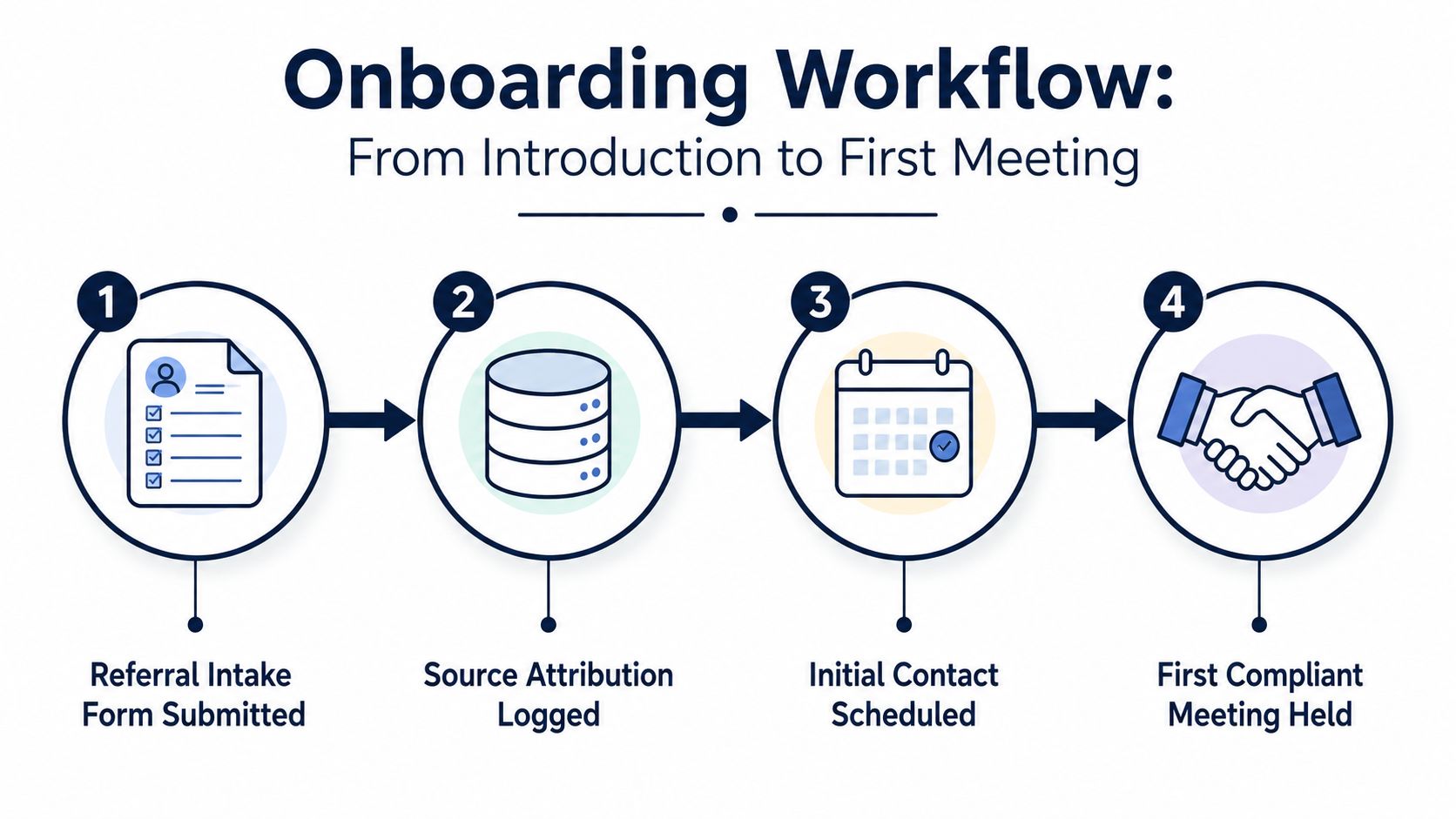
Capture the introduction correctly
The referring person should submit, or participate in, an approved intake process. The record should capture the prospect's name and contact information, the source category, the relationship between source and prospect, the reason for the introduction, consent for contact where required, and any compensation or disclosure flag.
The intake record should also preserve the original introduction message. That context helps the advisor understand what the prospect expects and prevents the team from overstating what the referrer said.
Log attribution before outreach
Operations should create the prospect record before the first contact. Required fields can include:
- Source owner: The client, COI, or approved solicitor connected to the introduction.
- Source type: Client network, professional relationship, or paid arrangement.
- Introduction date: The date the firm received the connection.
- Status: Received, contact attempted, scheduled, completed, not a fit, or converted.
- Compliance status: Required disclosure delivered, pending review, or not applicable.
- Next action: Named staff member and due date.
Client-sourced prospects may receive a warmer, more personal acknowledgment. COI-sourced prospects should receive language that clarifies the professional context and avoids implying that the COI has endorsed a specific investment recommendation.
Use a cleared first-meeting agenda
The initial meeting should have a compliance-approved agenda that explains the firm's role, services, fees and costs where applicable, conflicts, limitations, and the purpose of the discussion. The agenda should also identify what the meeting won't do, such as making an unsuitable recommendation before the necessary facts are gathered.
Each introduction should travel with the documentation needed to support the record, including the source identity, consent or permission evidence, applicable solicitor agreement, required promoter disclosure, approved script or message, and any compensation approval. This is far safer than trying to reconstruct the file after the meeting.
Measurement Dashboards That Separate Signal From Noise
A referral dashboard should answer operational questions, not reward activity for its own sake. “Referrals received” matters, but it doesn't show whether the firm is receiving appropriate introductions, following up promptly, or converting the right sources.
The minimum viable dashboard separates client, COI, and paid solicitor sources. For each segment, track referrals received, first meetings scheduled, first meetings completed, converted clients, declined or unqualified prospects, time between stages, and any approved acquisition cost.
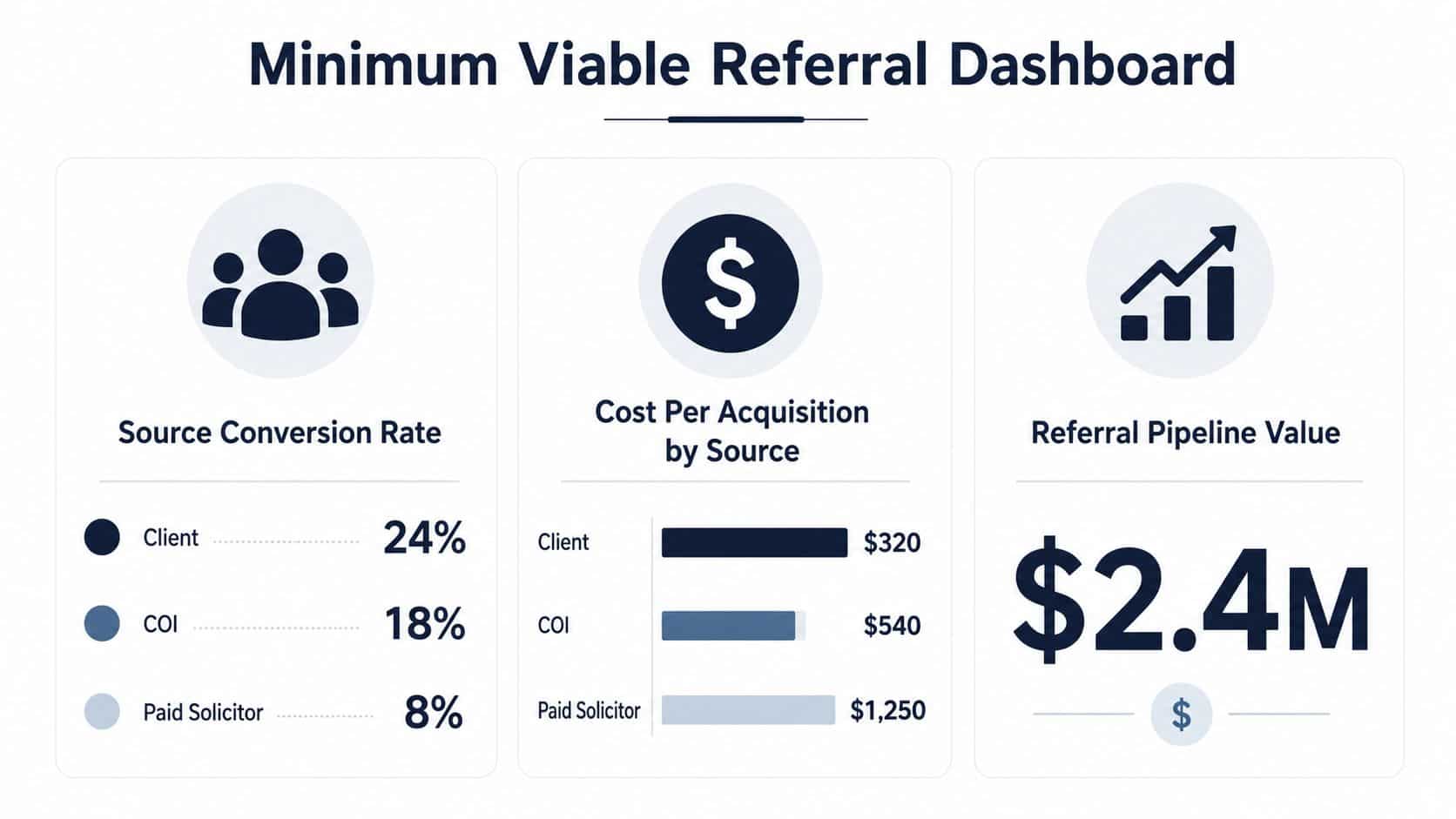
Put the right measures in the right rhythm
The weekly review should focus on exceptions:
- Unworked introductions: Prospects without an owner or next action.
- Stalled stages: Referrals waiting too long for contact or scheduling.
- Missing records: Introductions lacking source attribution or disclosure status.
- Relationship follow-up: Sources that need a thank-you or professional update.
The monthly review can examine conversion by source, yield per COI relationship, time-to-conversion, cost by paid arrangement, and pipeline value. The team should avoid treating every source equally. A COI who sends fewer but more suitable introductions may deserve more attention than a source who sends frequent, poorly matched names.
A CRM can support this structure, but a disciplined spreadsheet can work while the program is small. The required design is more important than the platform: controlled categories, required fields, consistent stage definitions, and an owner responsible for data quality. Firms reviewing broader workflow design can also consult this CRM guidance for financial advisors when deciding how referral records should connect to the wider prospect process.
Privacy needs restraint. Store only information necessary for follow-up, restrict access by role, avoid copying sensitive financial details into informal notes, and record the prospect's communication preferences. For teams refining measurement practices, the Square referral ROI guide offers broader context on connecting referral activity with acquisition economics. The firm's own compliance and privacy policies still control the implementation.
Launching the Program and Fixing What Breaks First
A controlled rollout is easier to review than a firm-wide launch. During the first phase, compliance and operations should approve the policy, source categories, scripts, intake form, disclosure process, and dashboard fields. The next phase should test the workflow with a small group of willing clients and professional relationships. The final phase should review records, identify bottlenecks, and expand only after the process works without founder intervention.
A usable policy can say:
“The firm welcomes client and professional introductions. Referrers may not make claims about performance, services, fees, or outcomes on the firm's behalf. The firm will record source attribution, deliver required disclosures, review compensation arrangements before payment, and follow up through approved communications.”
Three failure modes appear repeatedly:
- Compliant but underused: The policy is sound, but nobody asks. The fix is to add approved prompts to post-value meetings and assign follow-up ownership.
- Popular but noncompliant: Advisors and partners use improvised language or incentives. The fix is to stop unapproved activity, review every active arrangement, and replace improvisation with cleared scripts and agreements.
- Active but unmeasured: The firm receives introductions but records them inconsistently. The fix is to make source and stage fields mandatory before a prospect can move forward.
A broader guide to consultant lead generation can help place referrals within a wider acquisition plan, but referrals still need their own compliance controls and attribution logic. Advisor Momentum can support advisory firms with compliance-ready websites, content, lead-generation campaigns, onboarding workflows, coaching, and recruiting, including the operational connection between marketing activity and follow-up.
Advisor Momentum helps financial advisors build compliance-aware marketing systems that connect visibility, qualified introductions, and measurable follow-up. Visit Advisor Momentum to discuss a referral workflow, content program, or client acquisition process designed around the firm's regulatory and operational requirements.
