
A bond can look straightforward on the screen and still surprise a client the moment rates move. The coupon looks safe, the maturity date is clear, and then a portfolio statement lands with a loss that feels bigger than expected. That's usually the moment duration matters, because it tells the advisor how sensitive the bond is to interest-rate changes, not just when the money comes back.
The practical problem is that many investors stop at the first formula they learned. Macaulay duration gives a weighted-average time to cash flows, modified duration turns that into a price-sensitivity estimate, and effective duration is the better fit when cash flows can change. Used well, the three measures answer different questions. Used loosely, a single duration number can hide reinvestment risk, embedded options, and the way a bond's price response changes when yields move materially, which is exactly the limitation highlighted in standard fixed-income references on duration and key rate duration (bond duration reference).
That's why the right discussion starts with the client's objective, not the math. A planner trying to match liabilities needs a different answer than a trader managing a callable issue or a bond fund holding irregular cash flows. The broader planning frame matters too, because risk measurement only earns its place when it fits into the advisory process, not when it sits in isolation, as the planning sequence in the stages of financial planning makes clear.
For readers who want to connect duration with return attribution, there's also value in separating risk measures from performance measures, much like the distinction between beta and alpha in using alpha to find winning trades. Duration does not explain why a bond outperformed. It explains how much price movement to expect when rates shift.
Table of Contents
- Why Duration Matters Before the Math
- Calculating Macaulay Duration Step by Step
- From Macaulay to Modified Duration in Excel
- Effective Duration for Bonds With Embedded Options
- A Python Snippet for All Three Duration Measures
- From Duration to Convexity and Client Conversations
- Quick Checklist and Common Pitfalls to Avoid
Why Duration Matters Before the Math
A client sees a bond fund move sharply over a short stretch, and the first question is usually the wrong one. They ask whether the bond was “safe,” when the better question is how much of the price move came from rate sensitivity, how much came from coupon structure, and whether the bond's cash flows were fixed enough for a simple duration number to be useful. That distinction saves a lot of confusion later.
Three duration measures, three different jobs
Macaulay duration answers a timing question. It tells you the weighted-average time it takes to receive a bond's cash flows. Modified duration answers a sensitivity question. It tells you, in first-order terms, how much price may change for a small change in yield. Effective duration answers the option question. It fits bonds whose cash flows can change because the issuer can call the bond, the borrower can prepay, or the payment schedule is not fixed.
Practical rule: If the bond's cash flows can change when rates move, do not stop at Macaulay. The number can still be useful, but it is not the whole risk picture.
That is the core trade-off most basic guides miss. Standard explainers often cover the static Macaulay formula and briefly mention modified duration, but they do not spend enough time on reinvestment risk, convexity, or why a single duration number can misstate price sensitivity when rates shift materially. A neutral overview of Macaulay, modified, and key rate duration helps frame the point, since it shows why aggregate duration alone can be too simple for a real portfolio.
In practice, the mistake is usually not the math. It is the assumption set behind the math. If cash flows are fixed, the textbook measures do a good job of describing interest-rate exposure. If cash flows can change, or if the yield move is large, the clean answer from the formula can drift away from the price move a client experiences.
What a junior planner should walk away with
A planner should leave this part of the analysis able to do three things. First, build a cash-flow table and compute Macaulay duration by hand. Second, convert that result into modified duration and explain why it is still only an approximation. Third, recognize when embedded options or irregular cash flows push the analysis toward effective duration instead.
That is also where using alpha to find winning trades can become a distraction if it pulls attention away from fixed-income risk. For bond portfolios, the job is not to chase a single neat number. It is to state the assumption behind the number, decide whether the cash flows are stable enough for it to work, and tell the client plainly where the shortcut starts to fail.
Calculating Macaulay Duration Step by Step
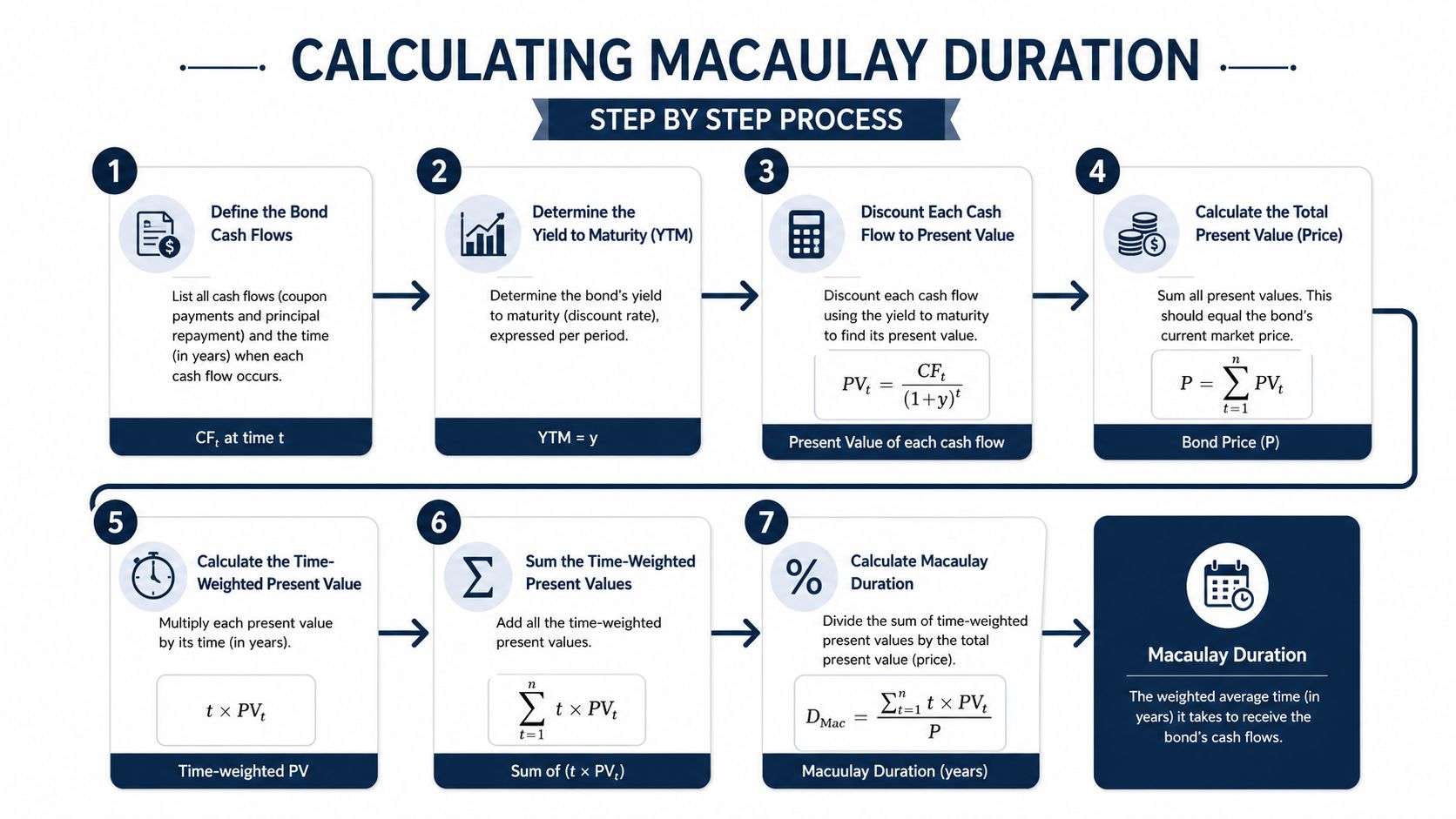
Macaulay duration is the weighted average time to receive a bond's cash flows, measured in years. The weights come from the present value of each cash flow, so the largest discounted payments matter more than the small ones. That's why coupon bonds always have a Macaulay duration shorter than maturity, while a zero-coupon bond lands exactly at maturity because there's only one cash flow to weight.
Start with the cash-flow table
Use the standard formula:
Macaulay duration = Σ[t × PV(CFₜ)] ÷ Bond price
Each piece does a specific job. t is the payment time, PV(CFₜ) is the present value of that payment, and the bond price is the sum of all discounted cash flows. The logic is simple. Earlier payments pull the weighted average left, later payments pull it right.
For a 5-year, 6% coupon bond priced at par, the process is clean because the price equals the present value of the promised cash flows. The bond pays regular coupons, and each coupon is discounted back to today at the yield to maturity. The weighted payments are then added together and divided by the price, producing a duration that sits below five years because some value arrives before the final maturity date. The important point is not the shortcut, it's the mechanism. Every coupon reduces the time you have to wait to recover present value.
The table below is the shape of the work, even when the math is done on paper rather than in software:
| Period | Cash flow | Present value | Weighted present value |
|---|---|---|---|
| 1 | Coupon | Discounted coupon | 1 × PV |
| 2 | Coupon | Discounted coupon | 2 × PV |
| 3 | Coupon | Discounted coupon | 3 × PV |
| 4 | Coupon | Discounted coupon | 4 × PV |
| 5 | Coupon plus principal | Discounted final payment | 5 × PV |
Why a longer bond shifts the weight later
A 10-year, 4% coupon bond behaves differently even before any software touches it. A lower coupon pushes more of the bond's total present value into the final principal repayment, so the weighted average time moves later. Higher yields do the same thing in practice, because they reduce the present value of distant cash flows more aggressively than near-term ones. The result is a duration profile that leans farther out the curve, which is exactly what a planner should expect when cash flows are back-loaded.
A quick way to sanity-check the number, if coupon payments are large and arrive often, duration should sit well below maturity. If most of the value sits in the principal repayment, duration should drift closer to maturity.
For a zero-coupon bond, the shortcut is immediate. There are no interim coupons, so Macaulay duration equals the time to maturity. That's the cleanest proof of what duration is really measuring, the timing of value, not just the stated maturity date.
From Macaulay to Modified Duration in Excel
Once Macaulay duration is in hand, the next step is converting it into a price-sensitivity estimate. Modified duration is the version meant when discussing how much a bond price should move for a small change in yield. The common shortcut is straightforward, modified duration equals Macaulay duration divided by one plus the yield per period.
The formula and why it works
In compact form:
Modified duration = Macaulay duration ÷ (1 + yield per period)
That adjustment matters because the Macaulay number is a timing measure, while modified duration is the one that connects more directly to approximate price change. For small yield moves, it gives a usable first-order estimate. For large moves, it starts to understate what convexity is doing, which is why the approximation has to be described carefully rather than quoted like a guarantee.
In Excel, the practical path is to verify the hand math with the built-in functions. DURATION returns Macaulay duration on an assumed par value of $100, while MDURATION returns modified duration. The key inputs are settlement date, maturity date, coupon rate, yield, frequency, and basis. That setup works well for plain-vanilla bonds with regular coupon schedules, but it gets awkward with odd first coupon periods, stub periods, or frequency mismatches because the worksheet logic expects clean periodic cash flows.
If the formula throws a #NUM! error, the usual culprit is a yield entered in the wrong format, or a date field that doesn't make economic sense. A quick sanity check catches most of those issues before the analyst spends time chasing a phantom problem.
A simple Excel workflow
- Set the bond terms: Enter settlement, maturity, coupon, yield, frequency, and basis.
- Compute Macaulay first: Use the duration function to confirm the timing measure.
- Convert to modified: Use the modified duration function or the formula shortcut.
- Compare the two: The modified number should be slightly lower because of the yield adjustment.
- Test the input conventions: Make sure yield and coupon are entered consistently with the payment frequency.
Practical rule: If the Excel result and the hand calculation disagree, check compounding convention before anything else. That mismatch causes more confusion than the bond math itself.
The main value of Excel here is not speed. It's consistency. A planner can calculate the bond by hand, then confirm the same structure in a worksheet and explain the sensitivity estimate without sounding hand-wavy.
Effective Duration for Bonds With Embedded Options
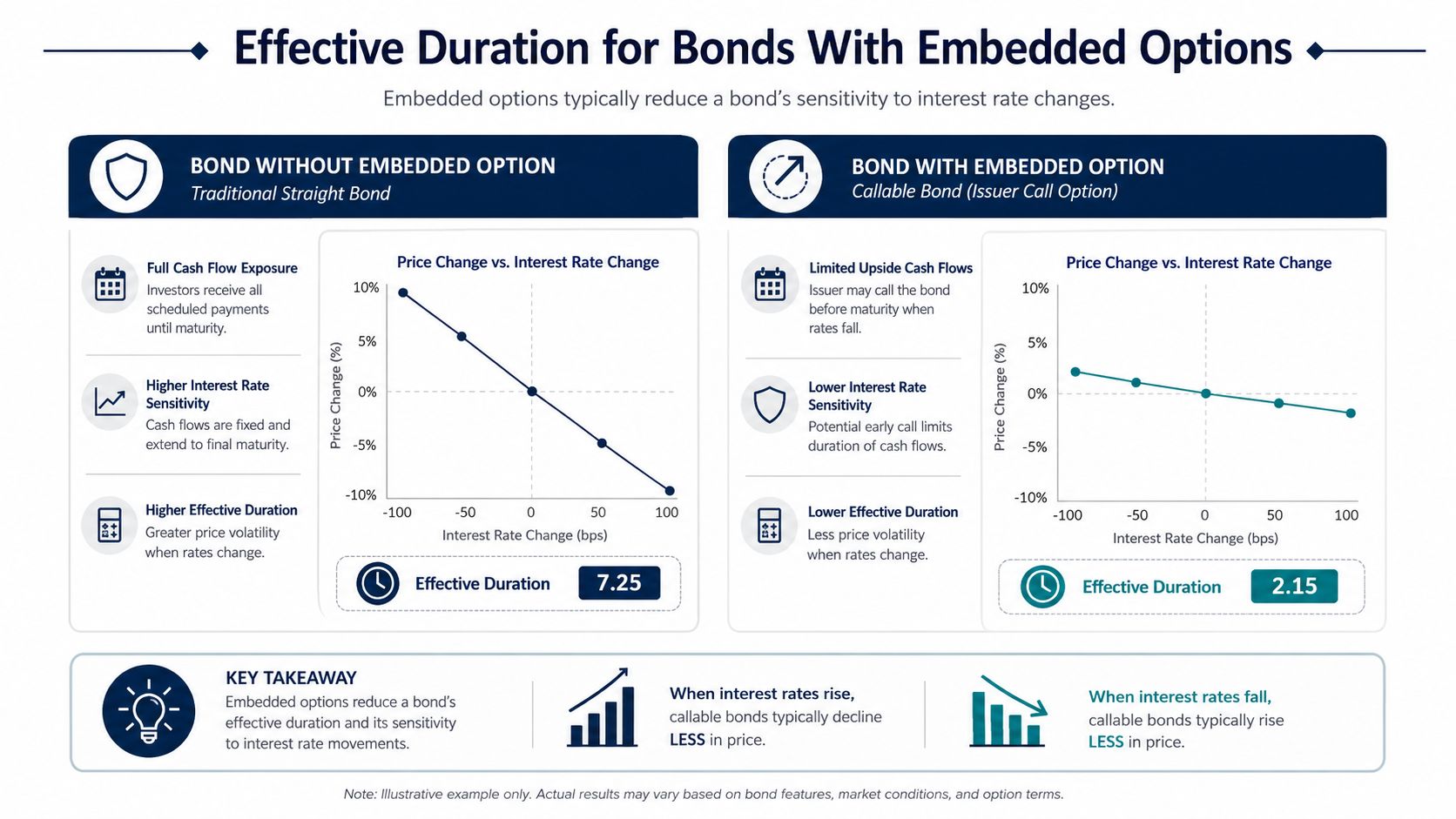
Plain Macaulay and modified duration assume the bond's cash flows are fixed. That assumption breaks as soon as the bond can be called, put, or prepaid. In those cases, the bond's future payments depend on what yields do, which means the right question is not just how long the cash flows last. It's how the price reacts when the cash flows themselves may change.
Why callable bonds need a different lens
A callable bond behaves one way when yields are stable and another way when yields fall enough to make redemption attractive for the issuer. As yields decline, the issuer is more likely to call the bond, which shortens the expected life. That is why effective duration often shrinks for callable structures. The bond starts to behave more like a shorter instrument near the call date, because the upside from falling rates gets capped by the call feature.
For a zero-coupon bond, duration stays tied to maturity because there are no optional cash flows to recast. For a callable bond, that fixed-cash-flow logic no longer holds. The bond's actual price path has to be estimated by revaluing it under rate shocks.
The standard effective duration formula is the average of the shocked prices on either side of the base price, divided by the base price and the yield shock. In practice, the analyst prices the bond once with yields moved down, once with yields moved up, then compares the two results against the starting price. That approach captures how the option changes the bond's response to rates better than a static duration number can.
Where effective duration still leaves risk on the table
Effective duration is stronger than modified duration for option-heavy bonds, but it still depends on the size of the shock used in the pricing exercise. A small shock can miss nonlinear behavior. A larger shock can overstate what happens in a milder market move. That's why the measure is best treated as a scenario tool, not as a permanent label on the bond.
For bonds where credit spreads or embedded options matter more than rate risk alone, an option-adjusted framework can be more honest than a single duration number. The practical lesson is simple. The more a bond's cash flows can change, the less useful it is to treat duration as a fixed property.
A Python Snippet for All Three Duration Measures
Analysts often want to test duration logic outside a spreadsheet before they trust it in portfolio work. Python is useful here because the cash-flow schedule is visible, the discounting is explicit, and the results can be reused across multiple bonds without rewriting formulas each time. The main job is to keep the assumptions visible.
A minimal calculation framework
import numpy as np
import pandas as pd

def macaulay_duration(face, coupon_rate, yield_rate, years, freq=1):
    periods = int(years * freq)
    c = face * coupon_rate / freq
    y = yield_rate / freq

    cash_flows = [c] * periods
    cash_flows[-1] += face

    t = np.arange(1, periods + 1)
    pv = np.array(cash_flows) / (1 + y) ** t
    price = pv.sum()
    weighted_time = (t / freq) * pv

    mac = weighted_time.sum() / price
    return price, mac

def modified_duration(mac, yield_rate, freq=1):
    return mac / (1 + yield_rate / freq)

def effective_duration(price_down, price_up, price_base, shock):
    return (price_down - price_up) / (2 * price_base * shock)

# Example bond
price, mac = macaulay_duration(face=100, coupon_rate=0.06, yield_rate=0.05, years=5, freq=1)
mod = modified_duration(mac, yield_rate=0.05, freq=1)

# Simple effective duration check
shock = 0.01
_, mac_down = macaulay_duration(face=100, coupon_rate=0.06, yield_rate=0.05 - shock, years=5, freq=1)
_, mac_up = macaulay_duration(face=100, coupon_rate=0.06, yield_rate=0.05 + shock, years=5, freq=1)
eff = effective_duration(price_down=mac_down, price_up=mac_up, price_base=price, shock=shock)
What the code assumes
This snippet uses annual compounding unless the frequency changes, and it does not handle day-count conventions or settlement-date edge cases. That makes it useful for learning, quick stress tests, and checking whether a worksheet result makes sense, but not for every institutional bond in a live book. For callable bonds, the cash flows should be recomputed under each yield scenario instead of held constant, because the optionality changes the schedule.
A clean way to use the snippet is to run it on one plain bond, compare the output with the spreadsheet, then adjust for frequency and call logic. That sequence is much safer than jumping straight into portfolio-wide estimates with untested assumptions.
Practical rule: The code is only as honest as the cash flows you feed it. If the bond can change its payment path, the schedule has to change with it.
That simple discipline makes the output useful for a junior planner and defensible in front of a senior reviewer.
From Duration to Convexity and Client Conversations
Duration gets the advisor close, but not all the way there. The reason is simple. Duration is a first-order estimate, while convexity adjusts for the fact that duration itself changes as yields move. When rates move more than a little, the curve of the price-yield relationship starts to matter, and the estimate from duration alone becomes too blunt.
Why convexity belongs in the discussion
A plain duration estimate tells the client the bond price is sensitive to rate changes. Convexity tells the client that the sensitivity is not constant. That matters in volatile markets, and it matters even more when the portfolio includes longer bonds or structures with uneven cash-flow behavior. The cleanest way to communicate that is to treat duration as an estimate and convexity as the adjustment that keeps the estimate from becoming misleading.
Portfolio immunization is where the practical value shows up fast. If a liability stream has a known pattern, matching the portfolio's duration to that liability profile helps keep value aligned within a narrower band. It is not magic, and it does not remove all risk. It does, however, reduce the chance that a rate move will knock the asset value far away from the obligation stream.
A useful way to talk to clients is to describe duration as the bond's interest-rate sensitivity and convexity as the reason the response is curved, not straight. That keeps the language clear without making promises. The right phrase is not “this bond will hold value.” The right phrase is “this model estimates how the bond may react under specified rate changes.”
The conversation language that holds up
- State the assumption: Explain whether the estimate uses fixed cash flows or rate-dependent cash flows.
- Qualify the range: Say the number is a model estimate, not a guarantee.
- Tie it to the objective: Connect the measure to income needs, liability matching, or risk control.
- Refresh it when structure changes: Re-run duration after coupon changes, call dates, or payment schedule changes.
For a broader portfolio context, the discussion usually belongs alongside portfolio management considerations, because duration alone is never the whole story. It is one input into a broader risk and allocation review.
The better client conversation sounds calm and precise. It acknowledges uncertainty, names the assumptions, and avoids promising that a duration number can predict the next statement line.
Quick Checklist and Common Pitfalls to Avoid
A fast review catches most duration errors before they turn into a bad recommendation. The biggest mistakes are usually mechanical, not conceptual, and they come from mixing conventions or quoting the wrong duration measure to the wrong audience.
| Measure | Formula | Best for | Key limitation |
|---|---|---|---|
| Macaulay duration | Weighted average time of discounted cash flows | Timing analysis and bond comparison | Does not directly estimate price change |
| Modified duration | Macaulay duration divided by one plus yield per period | Small-yield price sensitivity | First-order only, misses curvature |
| Effective duration | Shocked price comparison around the base price | Callable, putable, and irregular cash flows | Depends on the shock size and model assumptions |
Common pitfalls to avoid
- Mixing frequency conventions: Coupon frequency and yield periodicity have to match.
- Quoting Macaulay as price sensitivity: Macaulay is timing, not direct price impact.
- Using effective duration as a fixed label: The result changes with the shock size and assumptions.
- Ignoring convexity in volatile markets: The straight-line estimate gets less reliable as rate moves widen.
- Leaving assumptions undocumented: The next analyst, or the compliance reviewer, should be able to see exactly what was measured.
A useful operational habit is to refresh duration whenever the bond's structure changes, especially after a coupon date, a call date, or any change in the underlying cash-flow pattern. For teams that also track bank or advisory operations, it helps to use the same discipline that goes into calculating a bank's efficiency ratio, since both metrics depend on clean inputs and consistent definitions.
The plain-English takeaway is this. Duration is a powerful estimate, not a verdict. Document the assumption set, pair duration with convexity and key rate views when curve risk matters, and tell clients what the number does and doesn't cover.
A CTA for Advisor Momentum. If your firm wants bond, portfolio, and client education content that reads clearly and stays compliance-aware, connect with Advisor Momentum to build a content system that turns technical topics like duration into client-ready material.
