
The popular advice says a case study should read like a polished testimonial. That approach creates problems for financial advisors. A vague success story may sound warm, but it gives a compliance officer little evidence to verify and a prospect little reason to trust the claim.
How to create case studies for regulated advisory firms requires a different standard. The document must connect a defined problem to a documented intervention, measurable evidence, limitations, and an approved next step. Adobe's guidance recommends a standardized format supported by hard numbers and customer statements, while the CDC recommends plain language and sentences of 20 words or fewer to improve clarity and review quality. Adobe's case-study guidance supports the broader point: a credible case study is a repeatable proof document, not an improvised anecdote.
Table of Contents
- Why Most Advisor Case Studies Fail Before They Launch
- Selecting Clients and Securing Compliant Consent
- Interviewing Clients for Quantifiable Outcomes
- Structuring the Narrative and Presenting Data Defensibly
- Running the Internal Compliance Review Checklist
- Publishing and Measuring Case Study Performance
Why Most Advisor Case Studies Fail Before They Launch
Most advisor case studies fail because the draft starts with praise instead of evidence. “The team was professional,” “the advisor changed our financial lives,” and “we finally felt confident” may reflect genuine satisfaction, but these statements do not show what changed, how the change was measured, or whether the outcome can reasonably be connected to the advisor's work.
A compliance officer looks for the missing controls immediately. The draft may lack a defined baseline, source records, an explanation of market conditions, or a clear boundary around the advisor's role. That combination creates two problems: the story is too weak to persuade a prospect, yet broad enough to imply an unsupported result.

A testimonial is not an evidence file
The U.S. EPA describes case studies as detailed analyses of a limited set of events or conditions. Its overview identifies exploratory, descriptive, evaluative, and explanatory forms, each serving a different purpose. The EPA's case-study overview offers a useful standard for advisors: explain what happened in a specific context without implying that the same result will occur for everyone.
how to create case studies for regulated advisory firms requires a different standard from ordinary testimonial writing. The document should connect a defined problem with a documented intervention, measurable evidence, stated limitations, and an approved next step.
A defensible advisory case study follows a clear chain:
- Problem: What situation required attention?
- Scope: Which decisions, services, or workflows were included?
- Action: What did the advisory team do?
- Evidence: Which records, measurements, or client statements support the account?
- Limitations: Which factors remained outside the advisor's control?
- Next step: What can a similarly situated prospect do now?
This structure gives the writer a compliance-first workflow. The goal is not to make the client appear perfect. It is to document a bounded experience that a reviewer can inspect and a prospect can understand.
Practical rule: Explain constraints, trade-offs, and unresolved issues instead of hiding them.
That candor matters in regulated markets because polished certainty can resemble a promise. Delayed data, client decisions, review periods, and changing conditions may complicate the story, but acknowledging them usually makes the account more credible and easier to approve.
Production also requires control over every adaptation. Select an appropriate client or project, interview the relevant stakeholders, draft from source material, run a feedback round, and secure approval before publication. Teams turning the same evidence into video can consult this creator guide from TransClipper, then apply the same documentation, limitation, and approval controls to the adaptation.
Selecting Clients and Securing Compliant Consent
A strong case study can fail before drafting begins if the client, evidence, or permission creates an avoidable compliance problem. A recognizable name does not make a suitable subject. Select a client with a defined business or planning issue, a documented change, permission to discuss the engagement, and enough context to keep readers from drawing conclusions the evidence cannot support.
Begin with a private screening memo. Record the client category, service involved, engagement period, starting condition, proposed outcome metric, available records, and possible conflicts. Include any restrictions on confidentiality, publicity, or client approval. If the team cannot establish a baseline or explain what changed, pause the project. Publishing pressure should not determine whether the evidence is ready.
Use a narrow selection test
A narrowly defined case is easier to defend than a sweeping claim about a client population. Tie the subject to one service, decision, or operational challenge. A household's experience may illustrate how a planning process worked for that household, but it cannot support an implied promise for all retirees, business owners, physicians, or executives.
Use these screening questions before requesting approval:
- Outcome clarity: Can the result be described without suggesting that similarly situated prospects should expect the same outcome?
- Evidence access: Can the client and advisor identify records supporting both the starting point and the later condition?
- Attribution discipline: Can the draft separate advisor actions from market movement, client behavior, tax changes, timing, and other outside influences?
- Relationship safety: Would the client remain comfortable seeing the case beside the firm's name, disclosures, and contact information?
- Confidentiality control: Can personal, account, employer, and family details be removed without distorting the account?
- Review authority: Does the firm know who can approve factual accuracy, and does that approval remain subject to internal compliance review?
The goal shifts from making the client look perfect to documenting a bounded experience that a reviewer can inspect and a prospect can understand.
Write consent around facts, channels, and limitations
A signed general marketing release rarely provides enough operational detail. The consent file should identify the approved channels, information categories, publication formats, review rights, confidential details, and the possibility that the content may remain public after the relationship changes. It should also state that client review confirms factual accuracy, while the firm retains responsibility for compliance decisions and final wording.
The release should authorize a specific account of a specific engagement and its documented results. It should not imply that the experience represents every client or that the firm can reproduce the result. Avoid language such as “guaranteed,” “risk-free,” “always delivers,” “the advisor will achieve,” and “any investor can expect.” Client enthusiasm does not make a performance implication acceptable. Replace broad praise with a bounded statement tied to an identifiable experience and supporting records.
For example, “The advisor always delivers peace of mind” creates a broad promotional claim. “The client reported fewer unresolved planning questions after the review process” describes a personal observation, provided the firm can document the relevant process and define the review period.
Store the signed release with interview notes, source records, redaction decisions, disclosure language, and approval history. Advisors can review how to structure a testimonial page on a website before deciding whether the case study requires a separate format and disclosure treatment.
Identify outcome metrics at kickoff. Records may become unavailable, definitions may change, and later recollections may omit important context. The case-study methods guidance supports a narrow scope, precise numerical evidence, multiple data sources, and careful limits on generalization. Use those controls during client selection, before the marketing team starts drafting.
Interviewing Clients for Quantifiable Outcomes
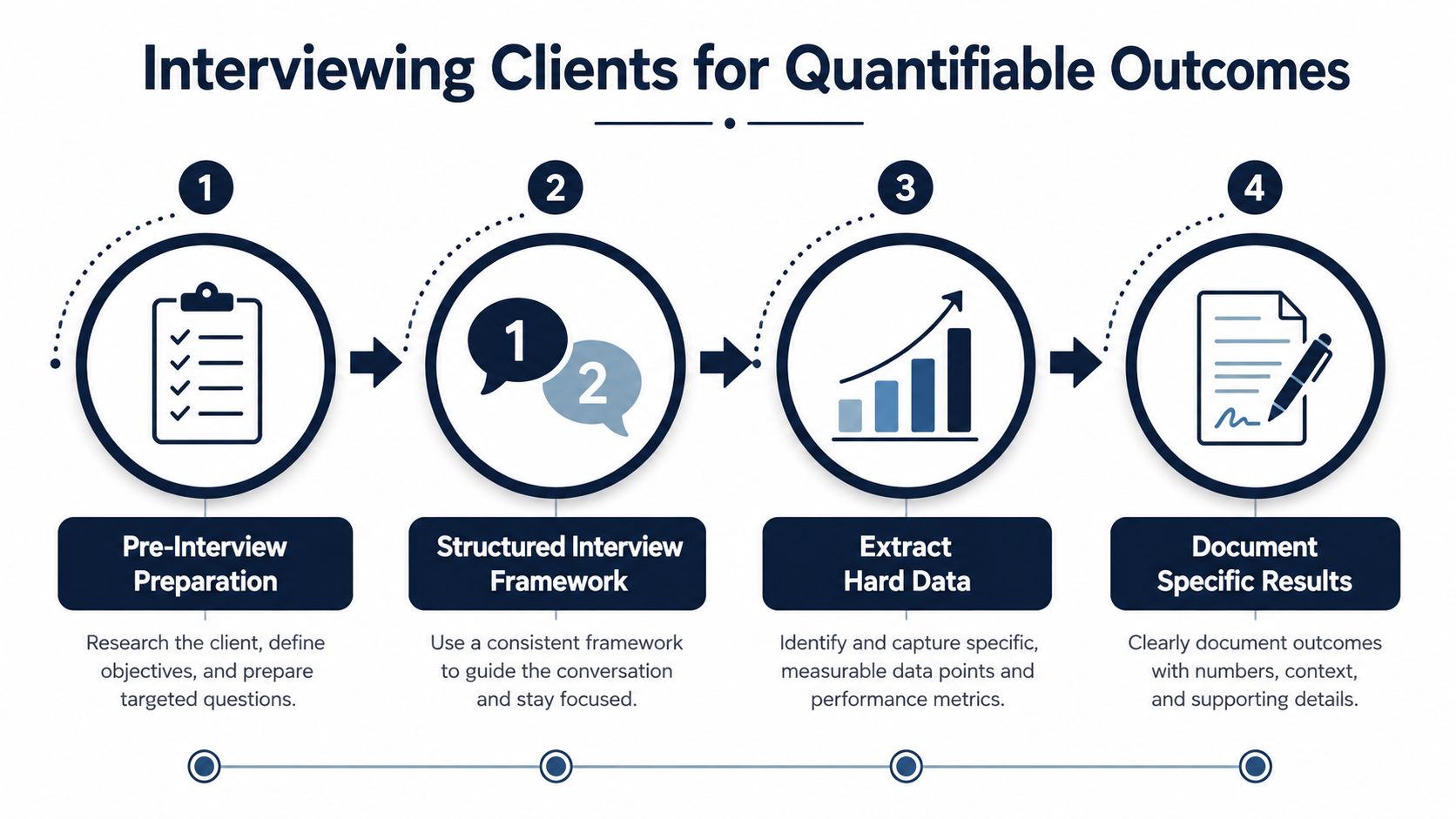
A useful interview doesn't ask, “How much better are things now?” That question invites a sweeping answer and can push the client toward a performance claim. A structured interview asks the client to describe the original condition, the decisions made, the observable changes, and the factors that influenced the result.
The interviewer should send a short preparation note before the meeting. It should explain the purpose, confirm the approved scope, identify records the client may want available, and state that the conversation doesn't guarantee publication. The client should understand that factual accuracy and compliance review control the final wording.
Ask questions that separate change from causation
A practical interview sequence starts with context:
- Establish the starting point. “What problem required attention when the engagement began?” “Which process, decision, or concern was creating the most friction?”
- Define the intervention. “Which actions did the advisory team take?” “What did the client decide, and what remained the client's responsibility?”
- Identify observable change. “What can be compared with the original condition?” “Which document, report, workflow record, or internal measure supports that comparison?”
- Test alternative explanations. “What else changed during the same period?” “Did market conditions, staffing, business activity, tax circumstances, or client behavior affect the outcome?”
- Capture practical value. “What became easier to manage?” “Which decision can the client make with greater clarity now?”
The interviewer should avoid leading prompts such as, “Did the advisor improve your returns?” or “Would you recommend this service to everyone?” Those questions create language that may be difficult to substantiate and may turn a specific experience into an implied universal claim.
Document the client's words carefully
Record the client's exact wording in working notes, but don't assume every memorable phrase belongs in the final draft. Confirm the meaning, remove unsupported superlatives, and ask the client to approve any quotation used for attribution.
A useful evidence grid has four columns: client statement, underlying fact, source record, and approved wording. For example, “I finally knew what to do next” might map to a documented planning decision, an agreed workflow, and a carefully limited quote. If hard numbers are delayed, the case study can state that limitation plainly and use verified process evidence instead of manufacturing precision.
Interview notes should also capture what didn't happen. A client may have received a recommendation but delayed implementation. That detail can make the account more credible and prevents the document from implying that every advised action produced an immediate result.
Structuring the Narrative and Presenting Data Defensibly
A case study can fail compliance review even when its results are genuine. The narrative must make the evidence easy to audit and the claims narrow enough to defend. Start with the client's situation, explain relevant context, describe the advisor's actions, present documented evidence, state limitations, and end with a measured call to action. Choose the example that fits the communication goal, then keep every sentence within the evidence collected.
Write the headline around the situation, not a promised result. “How a business owner organized a multi-year planning process” identifies a defined engagement. “How an advisor secured financial independence” implies a broad outcome and may invite questions the records cannot answer.
Build the document around proof
A common effective case-study range falls between 500 and 1,500 words, with subheads and a title or subtitle that may include an impact statistic. The Candu case-study benchmark reflects a practical balance, although a regulated advisory case may require less or more depending on the evidence and review obligations. The financial services content marketing workflow should place the case study within the firm's broader editorial process, while leaving evidence review specific to the document.
| Section | Word Count Target | Compliance Consideration |
|---|---|---|
| Situation and context | 80 to 180 words | Define the client and scope without unnecessary identifying details |
| Challenge | 80 to 180 words | Describe the starting condition without exaggeration |
| Advisory approach | 120 to 280 words | Separate advisor actions from client decisions |
| Evidence and outcome | 120 to 300 words | Identify dates, records, assumptions, and limitations |
| Client perspective | 60 to 160 words | Use approved, attributable language |
| Lessons and call to action | 60 to 140 words | Avoid promises or implied guarantees |
These ranges are editorial targets, not regulatory requirements. Proportion matters more than filling every section. An elaborate narrative with little evidence will read as promotional. A dense list of metrics without context will leave prospects unable to judge whether the result applies to them.
Present data in a reproducible order. Show the baseline, comparison period, calculation method, and source record. If several factors affected the result, write “the client reported” or “the records show a change during the engagement period.” Do not claim that the advisor caused the entire outcome unless the evidence supports that conclusion.
Redaction should protect privacy without destroying meaning. Remove names, account identifiers, employers, locations, and distinctive personal details when they are unnecessary. Retain the context needed to understand what was measured, how it was compared, and which limitations apply. A reviewer should be able to test the claim without identifying the client.
Running the Internal Compliance Review Checklist
A compliance review moves faster when the reviewer receives an evidence packet rather than a loose draft. The packet should include the approved client release, interview notes, source documents, calculation worksheets, redaction log, factual review comments, disclosure language, distribution plan, and version history.
The reviewer should be able to trace every material statement to a source. That chain of evidence matters because case-study methodology recommends a defined protocol, multiple sources of evidence, key-informant review, and a case-study database. The documented case-study reliability guidance treats those mechanics as reliability and validity controls, not optional administrative details.
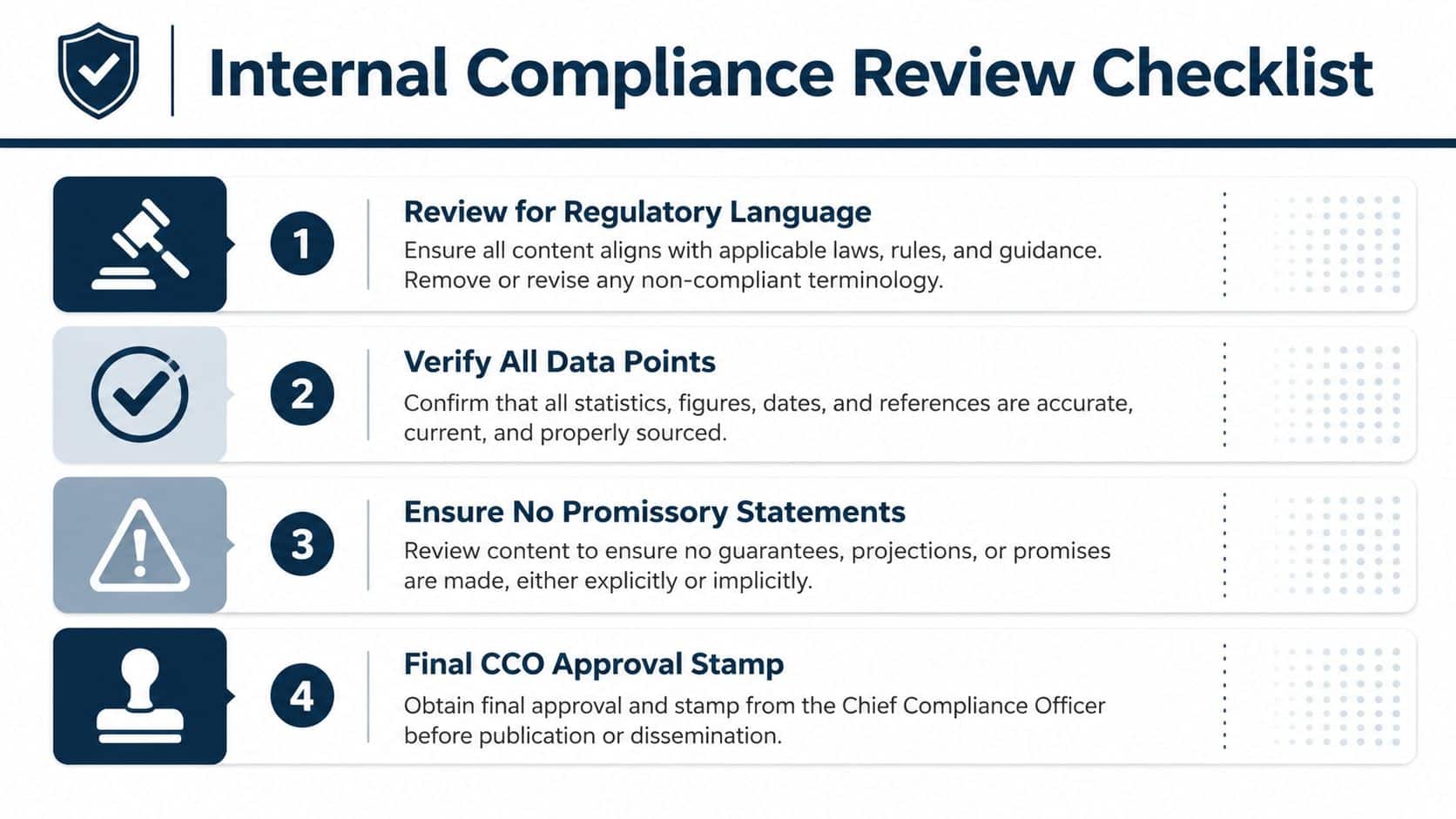
Apply the checklist in review order
1. Confirm the case boundary. The reviewer should identify the client type, engagement scope, relevant dates, service provided, and excluded factors. A broad headline paired with a narrow fact pattern should be revised before line editing begins.
2. Verify every data point. Check that each figure, date, comparison, and outcome matches a source record. The calculation should be reproducible, and the draft should distinguish client-reported information from firm-maintained records.
3. Remove promissory language. Search for guarantees, certainty, universal claims, predictive wording, and phrases that imply the prospect can expect the same outcome. Replace them with bounded descriptions of what occurred in this specific engagement.
4. Review attribution and consent. Confirm that every quotation is approved, every named party has authorized use, and anonymous descriptions don't reveal sensitive information through combination.
5. Test disclosures in context. A disclaimer cannot repair a headline that makes an unsupported promise. Review the headline, image, pull quote, chart, caption, landing page, email subject line, and call to action together.
6. Check distribution versions. The approved PDF may not be the same asset used in an email, social post, paid advertisement, or presentation. Each derivative must preserve the essential context and approved wording.
A compliance checklist should test the claim, the evidence, the audience, and the channel. Editing grammar alone won't control advertising risk.
Maintain a case-study database with the final version, approval date, authorized channels, expiration or review trigger, evidence location, and owner. State-specific requirements may differ, so the firm's compliance team should determine whether additional review applies to a particular jurisdiction or distribution method.
Publishing and Measuring Case Study Performance
Publication is part of the compliance control process. Place the case study where a relevant prospect can understand its context, such as a service page, consultation workflow, educational email, or advisor presentation. Preserve the approved version in every placement. A cropped testimonial, isolated metric, or altered headline can change the claim even when the underlying document was approved.
Choose measurement based on the intended business action. For consultation bookings, record qualified visits, document engagement, completed inquiry forms, booked conversations, and source channel. For sales enablement, record which prospects received the asset, whether advisors used it during the decision process, and which questions the evidence helped answer.
Measure evidence quality as well as reach
Views show distribution, not return. Review whether the content reached the intended buyer, whether that buyer understood the case, and whether the asset contributed to a compliant next step.
Keep a channel record:
- Website: Monitor the entry path, relevant page engagement, document interaction, and consultation actions.
- Email: Record the audience segment, delivery context, case-study interaction, and subsequent inquiry.
- Paid distribution: Preserve the approved creative, audience, landing page, and conversion path for review.
- Sales use: Ask advisors which claims prospects challenged and which evidence they requested.
Frame ROI as a documented relationship between the asset and a business action. Do not present it as a guaranteed marketing return. Advisory teams seeking a broader measurement discipline can adapt the same source-based thinking to their content workflows and review this guide on how to prove PR program ROI with data.
Set a review trigger for new evidence, an updated client-approved result, a material service change, or a new compliance requirement. Advisor Momentum offers content creation, website, branding, and regulated growth services for financial firms, including assets that support documented proof workflows. Firms building a compliance-first process for selecting clients, recording outcomes, and publishing approved case studies can visit Advisor Momentum to discuss the process.
