

A useful Google Ads target for financial advertisers is an average $5.42 cost per click paired with an 8.18% conversion rate, based on a 2026 benchmark covering more than 13,000 search campaigns across 23 industries. Those figures aren't promises for an advisory firm, but they provide a concrete starting point for deciding whether targeting, messaging, measurement, and compliance controls are working together.
Financial advisors shouldn't manage paid search as a simple traffic channel. A click from someone searching for retirement guidance, portfolio management, or a fiduciary advisor can begin a lengthy, highly regulated relationship. The campaign therefore has to satisfy two tests at once: it must attract qualified prospects, and it must preserve a defensible record of what the firm said, who approved it, how consent was handled, and what happened after the lead arrived.
The strongest workflow treats Google Ads as part of the firm's compliance and growth infrastructure. Keyword intent, ad relevance, landing-page experience, conversion definitions, consent signals, and human review all affect the outcome. Automation can help with reach and bidding, but it can't replace governance.
Table of Contents
- Navigating Financial Advertising Benchmarks
- Structuring Accounts for Compliance and Reach
- Writing SEC-Aware Ad Copy
- Measuring Conversions Under Privacy Rules
- Understanding Quality Score and Ad Rank
- Real-World Success in Wealth Management
- Future-Proofing Your Paid Search Strategy
Navigating Financial Advertising Benchmarks
Benchmark figures provide a reference for account review, not a target that every financial firm should pursue. A cross-campaign analysis of more than 13,000 search campaigns across 23 industries reported an average 6.64% CTR, $5.42 CPC, 8.18% conversion rate, and $66.69 cost per lead. The figures appear in Google Ads benchmarks covering search campaign performance. Use them to assess the full path from search query to qualified conversation, while documenting how consent and compliance review affect the result.
A separate framework reports typical search performance of 3% to 5% CTR, $2 to $4 CPC, 3% to 5% conversion rate, and $50 to $80 CPA. It also places top-performing search ads at 7% to 10% CTR. Display and shopping campaigns show lower click-through ranges in the same comparison. The implication is practical: an average only has meaning within the campaign type, audience, bidding approach, and conversion definition. The comparison is detailed in Google Ads benchmark guidance for different campaign types.
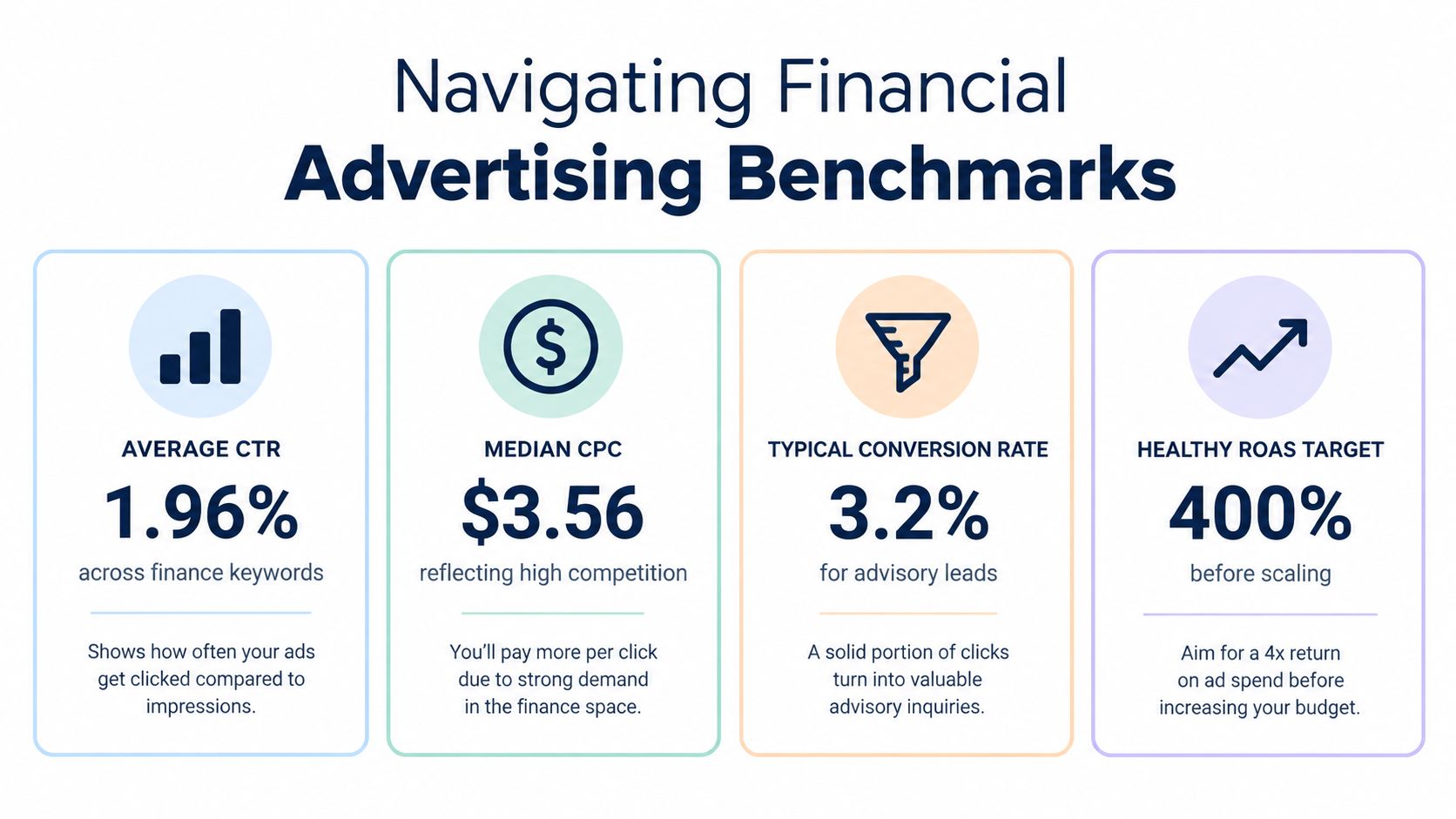
Why advisory averages need context
An advisory firm can waste money pursuing a low CPC if the inquiries are unqualified, outside its service area, or below its minimum relationship criteria. Financial services also involve greater scrutiny of claims, personal information, and follow-up records than many retail categories. A higher click cost can be acceptable when the searcher is a suitable prospect and the consultation meets the firm's standards. A cheap click has little value when intent is weak.
No single CPC represents every market. Results vary by advisory specialty, location, audience segment, and bidding system. The more useful internal measures are cost per qualified lead, booked consultation quality, accepted opportunities, and eventual client economics. Add consent status and approval records so performance decisions remain defensible under privacy and advertising requirements.
Practical rule: Use benchmarks to diagnose performance. Use margin, client fit, compliance exposure, and lead quality to decide what to change.
Before changing bids, a Registered Investment Advisor should establish a documented baseline. Record search terms, qualified-lead status, appointment outcomes, and review notes beside standard advertising metrics. If Consent Mode is configured, retain the relevant consent signals and account for modeled conversions when interpreting results. That record helps separate targeting problems from landing-page, sales-process, measurement, or review-control failures.
Structuring Accounts for Compliance and Reach
Account structure determines whether a financial firm can explain its targeting and control its exposure. Campaigns should separate meaningful business objectives, service lines, and geographic areas when those differences affect the message, budget, or compliance review. A retirement-planning campaign shouldn't share an ad group with a generic wealth-management query if the landing page and disclosures differ.
Build around intent
Tightly themed ad groups help align the keyword, headline, description, and landing page. Google identifies broad, phrase, and exact as the three main keyword match types. Broad match is the default when no match type is specified, phrase match reaches the same queries as exact match and more, and broad match reaches the same queries as phrase and exact match plus related searches, as explained in Google's keyword matching documentation.
A regulated account needs a deliberate decision rather than a blanket preference:
-
Use broad match selectively. Google recommends broad match when Smart Bidding is used because automation can pursue additional relevant searches within campaign goals. This approach can expand reach, but it requires search-term review, negative-keyword controls, and clear conversion definitions.
-
Use phrase match for controlled expansion. Phrase match can preserve more topical discipline while allowing the campaign to reach variations with the same meaning. It often suits service categories where the firm wants flexibility without opening every related interpretation.
-
Use exact match for sensitive intent. Exact match offers the tightest control and reaches fewer searches. It can be appropriate for tightly defined services, regulated claims, or campaigns where every query requires closer review.
Google's guidance also recommends phrase and exact match when advertisers need tighter controls, including in sensitive verticals, as described in its practical guide to keyword match types.
Document the controls
The search-terms review should become a recurring compliance task, not an occasional optimization. A reviewer can identify irrelevant financial queries, employment searches, free advice requests, educational research, and other traffic that doesn't fit the firm's approved audience. The firm should record additions to negative-keyword lists and retain the rationale for material targeting changes.
Keyword discovery should begin with real client language and first-party evidence. Teams can use a structured process to find keywords in Search Console, then classify terms by service, intent, location, and approval status. Geographic controls also deserve written treatment. A firm should define whether it targets people physically located in its service area, people regularly there, or people merely showing interest, then align those settings with its client acceptance policy. The broader principles of geo-targeting for advisory marketing can support that decision.
Writing SEC-Aware Ad Copy
Financial ad copy should persuade through clarity, not implication. A headline can state the audience served, the planning problem addressed, or the consultation offered. It shouldn't promise a specific investment outcome, imply certainty, or suggest that every prospect will receive the same result.
The drafting workflow should begin with an approved value proposition. That proposition needs a matching landing page, supporting evidence, and a reviewer who can assess whether the wording is fair, balanced, and consistent with the firm's policies. A claim that sounds harmless in a headline may become misleading when separated from the qualifications available on the page.

Make the promise reviewable
Effective copy can remain direct:
- Name the service: Describe financial planning, retirement planning, investment management, or another approved service accurately.
- Define the next step: Invite the prospect to schedule a consultation, request information, or review the firm's approach.
- Avoid outcome guarantees: Don't use language that suggests a certain return, risk-free result, or inevitable financial improvement.
- Match the destination: Send the click to a page that supports the ad's wording and presents required disclosures in a usable location.
- Preserve approval evidence: Keep the submitted copy, review comments, approver, date, and final destination together.
The call to action should clarify what happens next. “Schedule a consultation to discuss your goals” is more transparent than a vague promise to “achieve financial freedom.” It gives the prospect a reasonable expectation and gives the firm a cleaner basis for evaluating whether the landing experience matches the ad.
A compliance review should also consider context. A disclosure can't repair a misleading headline, and fine print shouldn't carry the entire burden of balancing an aggressive claim. Firms seeking a broader framework can review compliance for investment advisors and adapt the workflow to their own policies, regulatory obligations, and supervisory structure.
Measuring Conversions Under Privacy Rules
Measurement quality depends on more than placing a tag on a confirmation page. A financial firm needs a defined conversion model, a consent-aware collection process, and a way to connect an initial inquiry with the quality of the resulting opportunity. Otherwise, automated bidding may optimize toward inexpensive form completions rather than prospects who meet the firm's service criteria.
The core infrastructure should connect Google Ads with Analytics, then distinguish meaningful events. A form submission might be an early signal. A booked meeting, completed discovery call, or accepted prospect may be a more useful business outcome, provided the firm can collect and use that information lawfully and consistently. Teams responsible for implementation can use guidance on adding a site to Google Analytics as part of the broader measurement setup.
Consent belongs in the design
Consent Mode helps advertising and analytics systems adjust measurement behavior according to a visitor's consent choices. For regulated firms, this isn't merely a technical preference. It connects the firm's privacy notice, consent-management process, tagging configuration, analytics settings, and internal documentation.
A defensible process should answer several questions:
- What requires consent: Identify analytics, advertising, personalization, and other relevant categories before deployment.
- What happens without consent: Define which signals are unavailable, modeled, or excluded when a visitor declines.
- Who owns the configuration: Assign responsibility across marketing, compliance, operations, and the implementation team.
- How changes are tested: Check consent states, form behavior, attribution, and reporting after material site or tag changes.
- How records are retained: Preserve configuration notes and review evidence so the firm can explain its measurement choices.
Google Ads conversion windows can be set to 1, 30, 60, or 90 days, depending on the conversion source, and a selected window can report conversions up to 90 days after the click. Google also notes that conversion processing can take 24 to 48 hours, so very recent results may be incomplete, according to Google's conversion-window documentation.
A longer window can suit a wealth-management journey, but it can also delay decision-making and complicate comparisons between recent and mature cohorts. The firm should choose the window based on the sales process, document the choice, and avoid judging a campaign before the reporting period has had time to settle.
Understanding Quality Score and Ad Rank
Increasing bids is often the fastest response to weak visibility, but it isn't always the most rational response. Google reports Quality Score on a 1 to 10 scale as a diagnostic measure, and it identifies three primary areas for review: expected click-through rate, ad relevance, and landing-page experience. The framework is described in Google's Quality Score guidance.
A low-quality ad can push actual CPC close to the maximum CPC even when competition is limited. That means a firm may pay more because its message and destination fail to satisfy the query, not because another advertiser forced the price upward.

Diagnose before bidding higher
Ad Rank determines whether an ad is eligible to appear and where it appears. Google says it is influenced by the bid and auction-time quality signals, including expected CTR, ad relevance, and landing-page experience, as detailed in Google's Ad Rank explanation.
The audit should follow the signal rather than the symptom:
- Expected CTR: Compare the query's intent with the wording and usefulness of the ad. A generic headline often underperforms a specific statement that answers the search.
- Ad relevance: Check whether the keyword theme, ad language, and service page describe the same problem. Mixed ad groups make this alignment harder.
- Landing-page experience: Review speed, mobile usability, navigation, privacy information, disclosures, form friction, and whether the page fulfills the ad's promise.
Quality Score isn't the same as conversion quality, and reported conversions don't improve ad quality. A campaign can generate conversions while still needing better relevance, just as a high diagnostic score doesn't guarantee that prospects are suitable for the firm.
Bid more only after the account has earned the right to scale. A larger bid can't make an unclear promise compliant or a mismatched landing page persuasive.
The practical sequence is simple: correct the query-to-ad relationship, correct the ad-to-page relationship, verify the page experience, then reassess bidding. That approach protects budget and creates a clearer record of why an account changed.
Real-World Success in Wealth Management
A wealth-management practice attracts searches for retirement planning but sends every visitor to its general homepage. The campaign uses broad themes, the ads promise personalized guidance without defining the service, and the inquiry form requests information before explaining what happens next. Reviewers cannot easily approve revisions because the account lacks a documented connection between keyword, ad copy, destination, and approval record.
The practice separates retirement planning, investment management, and general financial planning. Each group receives approved language and a dedicated landing page. After reviewing search terms, the team adds negative keywords, shifts sensitive themes toward phrase and exact match, and reserves broad match for areas where automated bidding can optimize against a clearly defined qualified-lead conversion.
What changes in the workflow
The firm replaces outcome-oriented language with a specific consultation invitation. The landing page identifies the intended audience, explains the services and process, presents fees or relevant disclosures as applicable, describes privacy treatment, and states what information a prospect may provide. A reviewer records approval, and operations staff define which inquiries qualify for follow-up.
The practice evaluates performance against the benchmark context introduced earlier without treating it as a promised result. Cost per lead is only one input. The team compares cost per qualified consultation, appointment quality, client fit, sales-cycle progression, and documentation status with the firm's margins, client profile, and compliance requirements. This keeps optimization tied to business outcomes rather than a headline efficiency target.
The workflow also supports AI readiness. Consent signals and qualified-lead events must be defined before automated bidding or broader matching receives authority to optimize. If those inputs are incomplete, the system can favor inexpensive inquiries that do not meet the firm's standards. A compliance reviewer should be able to trace each conversion event to its consent basis, approved message, and operational outcome.
The important outcome is a cleaner operating model. The practice can identify which searches produced appropriate inquiries, which messages passed review, which pages supported the promise, and where prospects abandoned the process.
A compliance-first campaign does not hide weak performance. It makes weak performance easier to locate and correct.
That distinction matters in wealth management. A low cost per lead can conceal poor fit, while a higher cost can be acceptable when the firm receives qualified conversations and can trace the path from approved ad to documented outcome. This record gives marketing, compliance, and operations a shared basis for deciding what to change next.
Future-Proofing Your Paid Search Strategy
Google Ads is moving toward more automated targeting, broader search interpretation, and systems that use creative assets and first-party signals across more surfaces. Independent coverage has described AI Overviews and AI Mode as placing ads lower on the page, while zero-click behavior rose from 56% to nearly 69%, according to coverage of AI-driven changes reshaping Google Ads. Those developments make visibility less predictable, but they don't eliminate the need for disciplined paid search.
The strategic change is from manual control to governed automation. A financial firm may allow broader matching or automated bidding to find opportunities, but it should define the conversion events, approved claims, geographic boundaries, exclusions, budget limits, and review triggers before automation expands.
Build an AI-ready control layer
A practical governance cycle should include:
- Review data quality: Confirm that consent signals, conversion actions, Analytics connections, and lead-status imports reflect the firm's privacy and operational requirements.
- Audit search behavior: Examine search terms and placements for relevance, unsuitable audiences, and emerging queries that require exclusions or new approved content.
- Test creative responsibly: Maintain multiple compliant messages and landing-page variants, but record what changed and prevent unapproved claims from entering the account.
- Check financial efficiency: Compare CPC, conversion rate, cost per qualified lead, appointment quality, and downstream outcomes rather than clicks alone.
- Reapprove material changes: Route new services, claims, audiences, disclosures, and destinations through the firm's established supervisory process.
- Protect brand safety: Use available placement reporting and exclusion controls, then retain the decisions and rationale in the campaign record.
Google's 2025 highlights described expanded full placement reporting and third-party exclusion lists, which supports a governance approach that examines where ads appear as well as how often they convert. The same broader shift makes clean first-party data more important. Automation can distribute a message efficiently, but it can't decide whether the message reflects the firm's approved interpretation of risk, suitability, or disclosure.
The history of Google Ads also explains why the fundamentals remain durable. Google launched the platform as Google AdWords in October 2000, with early reports describing about 350 advertisers. CPC pricing followed in 2002, and Google Analytics, Quality Score, and Ad Rank arrived as major developments in 2005, as documented in the history of Google Ads and its move toward automation. The technology has changed, but intent, relevance, landing-page quality, and measurable outcomes still connect the search to the business result.

Advisor Momentum offers compliance-ready website development, content, Google Ads management, and related marketing support for financial advisors, planners, and banking teams. Firms evaluating how to use Google Ads effectively can visit Advisor Momentum to discuss campaign governance, conversion tracking, landing-page alignment, and lead-generation workflows built for regulated financial organizations.
