

The most popular advice about the Investment Adviser Marketing Rule is dangerously incomplete. Adding a disclosure and moving on doesn't create compliance. Examiners test governance, evidence, and consistency across every channel, not wording alone. A firm that can't show who approved content, who owns updates, and how third parties are monitored has a control problem, even when the fine print looks polished.
Table of Contents
- Why the Marketing Rule Matters Now
- The Seven Principles-Based Prohibitions
- Performance Advertising From Gross to Net
- Testimonials Endorsements and Third-Party Ratings
- Pre-Existing Client Relationships and Books and Records
- State-Specific Implications for Advisory Firms
- Compliance Checklist for Marketing Reviews
- Sample Disclosures You Can Adapt
Why the Marketing Rule Matters Now
A mid-sized RIA reviews its website and finds three problems at once. Clients' quotes were posted years ago without documentation, advisers made claims during podcast interviews that no one archived, and a performance deck still circulates with old presentations. Under the current framework, those aren't three separate legacy issues. They're one marketing-control failure.

One rule replaced two legacy regimes
The SEC adopted the modernized rule on December 22, 2020, it was published on March 5, 2021, at 86 Fed. Reg. 13,024, and it became effective on May 4, 2021, according to the SEC small business compliance guide for investment adviser marketing. That framework merged former Rule 206(4)-1 and cash solicitation Rule 206(4)-3 into a single, technology-neutral regime. Advisers generally had until November 4, 2022 to comply after the transition period described in that guide.
The scope reaches communications offering advisory services to prospective clients, current clients offered new services, and investors or prospective investors in private funds. Websites, social posts, paid ads, pitch decks, podcasts, referral arrangements, and ratings therefore need one review standard. Firms building a visible brand can also see how Legacy Builder helps advisors connect personal positioning with consistent public communications.
Why daily operations changed
- Approvals need owners: Marketing, compliance, and portfolio staff each own different facts, calculations, and disclosures.
- Archives need context: A saved screenshot without approval history, publication dates, and supporting records leaves major gaps.
- Channels need equal discipline: A short social post can create the same advertising issue as a formal deck.
- Legacy content needs remediation: Older material doesn't become safe because it predates current staff or vendors.
A compliant sentence inside an uncontrolled process is still a weak control.
The practical shift is straightforward. Firms shouldn't ask whether content merely looks professional. They should ask whether the claim is substantiated, balanced, documented, approved, and retrievable years later without reconstruction.
The Seven Principles-Based Prohibitions
Read the rule text once and the architecture surprises you. Rule 206(4)-1 replaces the old regime's short list of named bans with seven principles-based prohibitions that function like an antifraud standard applied to marketing copy. Firms gained flexibility and lost the comfort of a four-box checklist. Every claim now gets judged on wording, design, context, omissions, prominence, and the impression a reasonable audience takes away.

The seven, translated into what they catch in daily work:
- Untrue statements or material omissions. A fee page quoting the advisory fee while staying silent on costs clients also pay.
- Claims without a reasonable basis to substantiate on demand. "Fiduciary since day one" needs records behind it before publication, not after an exam letter arrives.
- Misleading implications or inferences. The catch-all. A LinkedIn post implying every client outperformed fails even if the featured client did.
- Benefits discussed without material risks or limitations. A podcast segment describing downside-protection strategies must carry the limitations in the same breath.
- Specific investment advice presented unfairly. Featuring three winning recommendations in a deck while burying the losing calls.
- Cherry-picked performance results or time periods. Private fund pitch decks live here: selecting only the vintages that flatter the track record.
- Anything else materially misleading. A residual clause covering whatever the first six missed, including formats the drafters never anticipated.
Two consequences deserve attention. The substantiation prohibition works as a timing rule: the reasonable basis must exist at the moment the ad runs, which means the file gets built before approval, not during remediation. And none of the seven carries a minimum-audience threshold. Teams regularly ask whether a LinkedIn post with a few hundred views or a firm-written reply to a Google review earns some de minimis pass. It doesn't.
Item three is the gray area worth fighting over. "Technically true" is the phrase I hear most from marketing teams, and it's the one that fails under this standard. Headline, image, caption, and disclosure read as one combined message, so a compliant footnote cannot rescue a misleading impression built above it. The staff FAQ updates issued in March 2025 reinforce that reading, and they deserve a spot in every reviewer's reference folder.
My standing instruction: stop softening weak copy with gentler adjectives. Demand the underlying fact. If marketing can't produce the record quickly, the claim leaves the ad.
Performance Advertising From Gross to Net
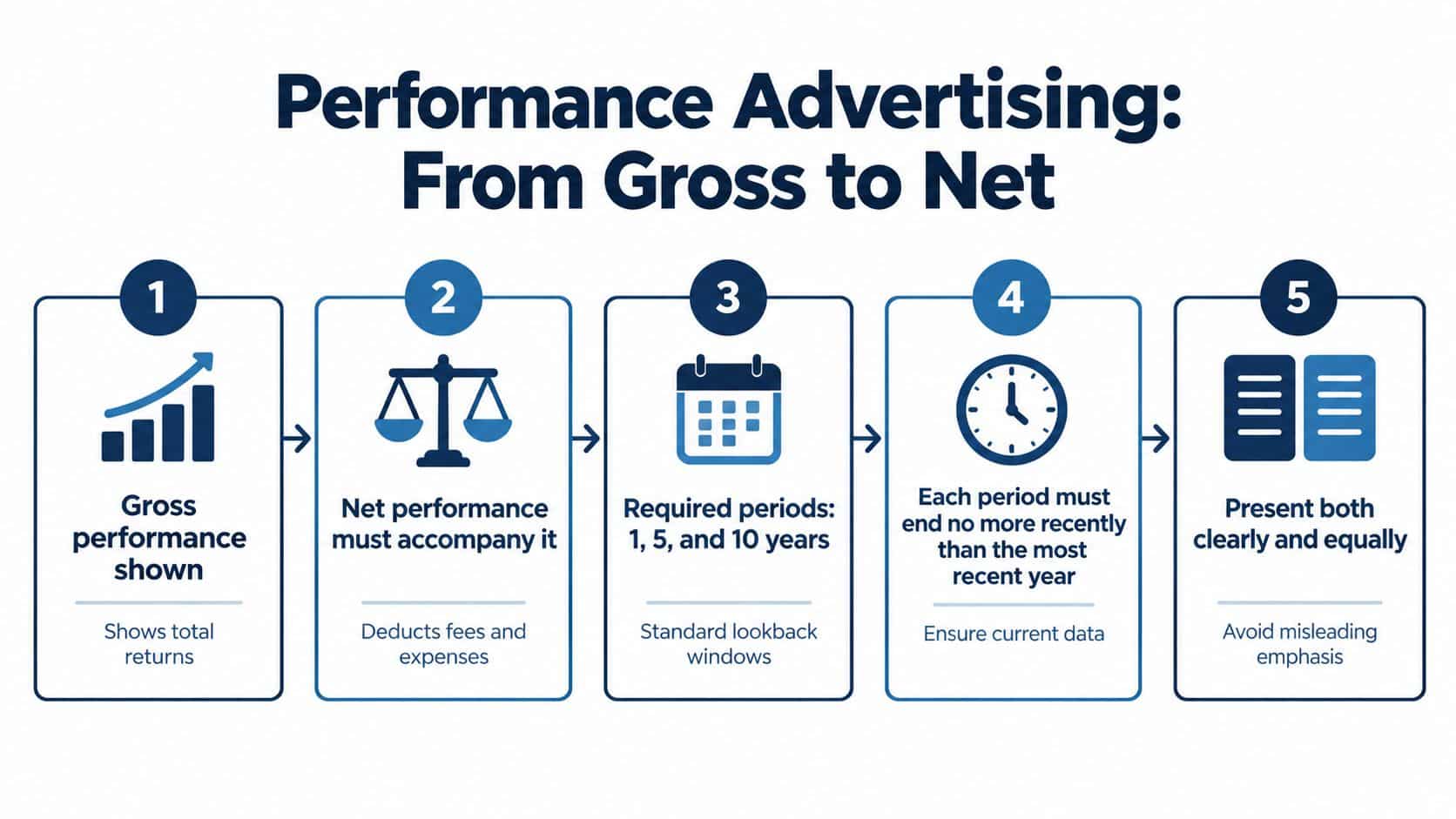
Performance is where attractive design most often collides with the Investment Adviser Marketing Rule. Net performance must accompany gross performance, subject to the rule's conditions, so prospects can see the effect of fees and expenses. A polished gross return without an equally visible net figure isn't a formatting preference. It's a substantive compliance failure.
Required periods and equal prominence
For non-private-fund advertisements showing total portfolio performance, results generally must cover one-year, five-year, and ten-year periods, receive equal prominence, and end no less recently than the most recent calendar year-end, as described in the SEC final rule release IA-5653. If a portfolio hasn't existed for a required period, the adviser uses its actual life rather than fabricating history. Firms evaluating whether advertising drives useful engagement can also consult the AdCrunch ad performance guide for broader measurement context.
Equal prominence needs testing in the final asset, not just the source spreadsheet. Font size, color, placement, chart scale, animation, and mobile cropping can all make net results functionally secondary. Reviewers should inspect the published experience exactly as prospects will encounter it.
The March 2025 extracted performance pathway
The March 2025 staff FAQs don't create a broad exemption. Gross extracted performance may appear without corresponding net extracted performance only when the extract is clearly labeled gross, the total portfolio's gross and net performance are shown, those figures receive at least equal prominence and facilitate comparison, and the total-portfolio period covers the entire extract period, according to Willkie's summary of the March 2025 SEC staff FAQs.
That pathway increases workflow discipline. Portfolio staff must define the extract, document calculations, confirm periods, and preserve the comparison. Designers must keep total portfolio results attached when a page becomes a slide, social graphic, or mobile advertisement.
- Use the pathway only when every condition fits: Unsupported extracts and isolated holdings shouldn't be forced into the framework.
- Lock the comparison: Total portfolio gross and net figures travel with the extract across every format.
- Document the calculation: Source data, period, extraction method, reviewer, and approval belong in the record.
- Treat private funds separately: Specific private fund requirements make retail templates unsafe for fund materials.
Fund pitch decks need their own templates and review path. Copying a separately managed account layout into a private fund presentation invites errors because audiences, required information, and calculations differ.
Testimonials Endorsements and Third-Party Ratings
A compliance officer usually learns about a LinkedIn recommendation by stumbling across it six months after a satisfied client posted it. No record of who approved it. No disclosure beside it. Nothing in the file. That scenario gets firms cited far more often than a missing disclaimer does.
Advisers running testimonial and endorsement programs must disclose whether the promoter is a client, disclose compensation and material conflicts, hold a reasonable basis for believing the promoter complies, use written agreements where required, and keep compensation away from ineligible promoters, according to the SEC's marketing rule examination risk alert. Examiners ask for evidence that oversight occurred. A firm preparing to publish client statements should review practical guidance on building a testimonial page on a website before anything goes live.
The $1,000 line is not a safe harbor
Under Rule 206(4)-1(b)(1), de minimis compensation means total compensation of $1,000 or less for providing a testimonial or endorsement, as stated in the SEC examinations risk alert on the marketing rule. Read that as total, not per installment. Cash and non-cash benefits both count, and indirect value still needs documentation.
Cross that threshold and disclosures, oversight duties, written agreement requirements, and disqualification conditions attach. Stay under it and the rest of the rule still applies anyway. Small payments don't cure misleading content or erase recordkeeping, and the March 2025 staff FAQ updates covered in the performance discussion changed none of this.
Each channel fails differently
The obligations are uniform. The way firms violate them is not.
| Channel | What compliance must capture |
|---|---|
| LinkedIn recommendations | Final wording, promoter status, date, approval decision, firm-requested edits |
| Google reviews | Solicitation method; no cherry-picking happy clients or republishing excerpts without balance and context |
| Podcast appearances | Host introductions, episode descriptions, paid placement terms, archived recordings |
| Referral partners and influencers | Compensation, conflicts, eligibility, required disclosures, scripts, monitoring |
| Third-party ratings | Methodology diligence, rating date, covered period, provider identity, compensation tied to use |
For paid creator arrangements, review compliance for finance influencer campaigns alongside your internal promoter procedures. Outside creators need clear instructions, approved boundaries, and monitored publication. A contract clause does nothing if nobody checks the live post.
Close the loop with a named owner for every promoter relationship. Someone has to know who requested the endorsement, who paid for it, who approved the wording, where it appears, and who watches for edits after publication. Miss one link in that chain and the firm cannot show reasonable oversight, whatever the disclosure says.
Pre-Existing Client Relationships and Books and Records
Communications with existing clients aren't automatically outside advertising analysis. A current client offered a new advisory service can fall within the rule's scope, while routine reporting and individualized communications require careful classification. Firms shouldn't rely on labels such as client update or educational email. Purpose, audience, content, and distribution control the analysis.
Classification starts before drafting
The first question is whether the communication offers services or promotes the adviser beyond the existing relationship. Cross-selling, new strategy introductions, referral requests, and broadly distributed performance claims deserve closer review. Hypothetical or targeted performance requires particular care because audience sophistication, relevance, and supporting information affect whether presentation is appropriate.
- Existing service reporting: Keep communications factual, client-specific, and separate from promotional claims.
- New service offers: Route through advertising review when the message seeks additional business.
- Broad client newsletters: Review performance, testimonials, ratings, and calls to action instead of assuming client status solves the issue.
- One-to-one materials: Document the intended recipient and why the information fits that relationship.
Records must reconstruct the decision
Books and records should allow an examiner to move from the published advertisement back to its facts. That chain includes final versions, approvals, disclosures, calculation support, testimonial agreements, promoter diligence, ratings diligence, distribution lists, and dates of use. Drafts alone do not prove what prospects saw.
An archive that stores files but can't connect them to approvals and supporting calculations isn't examination-ready.
A common failure occurs without notice. An email platform changes retention settings, social posts are captured without comments or linked pages, and podcast files sit under a producer's account. Months later, compliance owns fragments rather than a complete record.
Build a single evidence trail
Firms should assign each campaign an identifier connecting creative files, substantiation, approvals, agreements, and publication captures. Retention testing should sample old campaigns and confirm staff can retrieve every component. Broken links, missing attachments, inaccessible vendor accounts, and unnamed files should trigger remediation before an examination does.
Existing-client communications, promoter oversight, and archives form one governance picture. The firm knows the audience, controls the message, supervises third parties, and preserves proof. Any break in that chain weakens the entire program.
State-Specific Implications for Advisory Firms
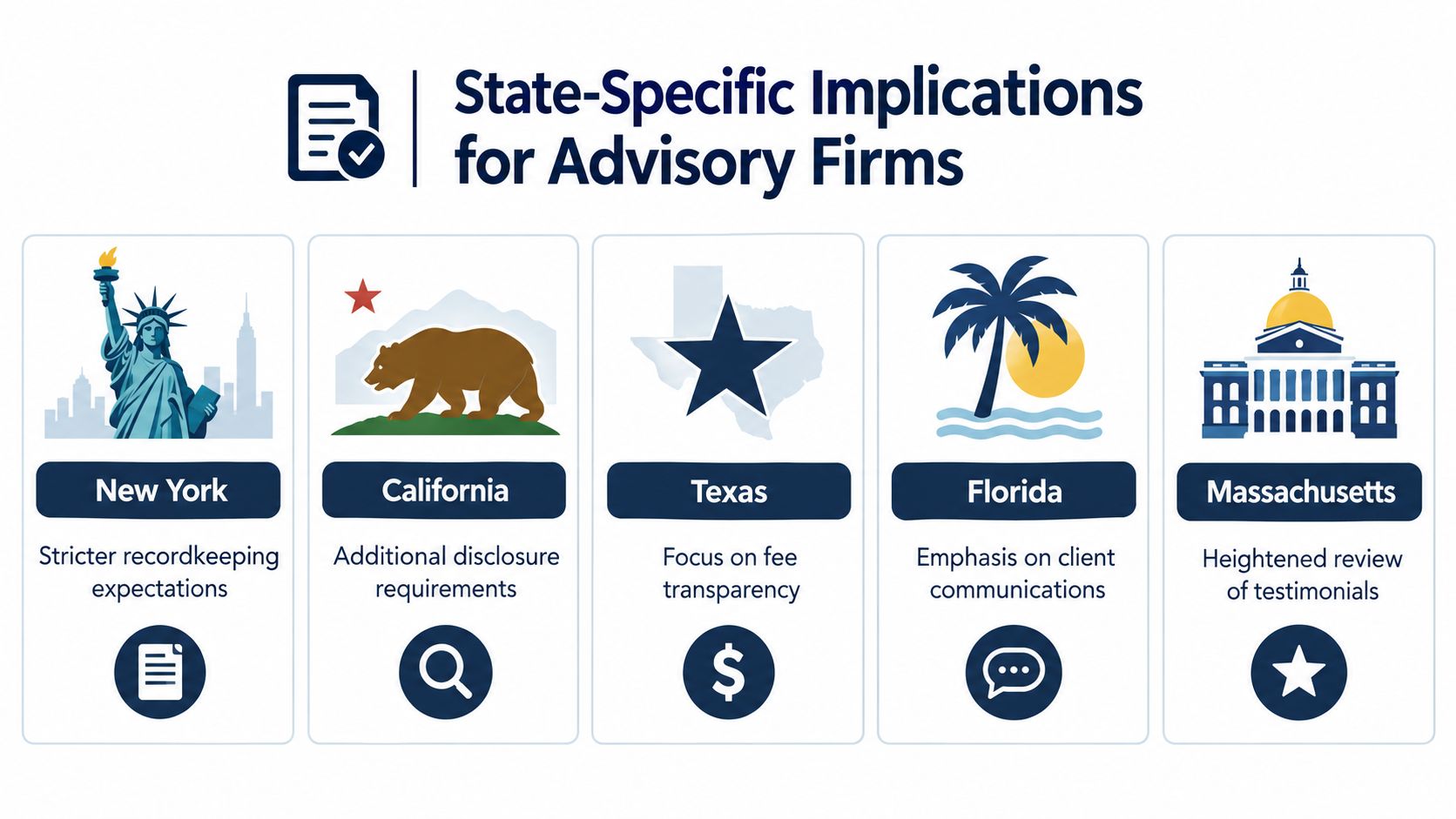
The Marketing Rule is federal, but the adviser in front of the client often isn't. State-registered advisers, investment adviser representatives, and multi-entity firms sit under regulators who never adopted the rule wholesale, and a campaign cleared for an SEC firm can still trip a state advertising, solicitor, or recordkeeping requirement. Nothing carries over automatically.
First question: who is actually advertising
Pin down the legal entity behind the ad before any state analysis begins. Which entity is registered where, which IARs appear on camera or by name, which entity pays the promoter, and where the audience sits. A firm in New York running LinkedIn ads into Texas and Florida has created a multi-jurisdiction review, whether the marketing team noticed or not.
Shared branding makes this worse. When a state-registered affiliate and an SEC-registered parent share a logo and a landing page, prospects can't tell which entity is offering services, and examiners won't guess charitably. Spell the relationship out in the ad itself.
Apply a state overlay, every time
The workflow I'd impose is short and repeatable:
- Map registration: advertising entity, IAR status, notice filings, target jurisdictions.
- Check each state's own advertising rules, solicitor provisions, and any testimonial or rating restrictions still on its books.
- Compare campaign claims against Form ADV and state filings for that entity.
- Ask whether a referral platform or CRM-driven lead source counts as a promoter under state definitions, which don't always track the federal de minimis thresholds.
- Document which states were considered and why each campaign version was approved.
Firms juggling these layers should fold federal and state regulatory compliance guidance into campaign planning rather than parking it with the legal department. Media buyers and local advisers need escalation triggers before they target a new state, not after the ads run.
Federal approval is one gate. State overlays are the rest of the fence.
Compliance Checklist for Marketing Reviews
A useful checklist forces decisions before publication. It should identify the deliverable, applicable Investment Adviser Marketing Rule issue, responsible owner, evidence location, and final verdict. Generic yes or no boxes without evidence links produce false confidence.
Review by deliverable
| Deliverable | Primary checks | Typical owner |
|---|---|---|
| Website pages | Claims, services, fees, testimonials, ratings, performance links, mobile disclosures | Marketing and compliance |
| Paid advertisements | Targeting, shortened claims, landing-page consistency, prominence, archive capture | Media owner and compliance |
| Social posts | Third-party comments, endorsements, edits, links, screenshots, publication dates | Social owner and compliance |
| Pitch decks | Gross and net performance, periods, extracts, private fund distinctions, calculations | Portfolio staff and compliance |
| Podcasts | Host statements, compensation, scripts, descriptions, recordings, transcripts | Communications and compliance |
| Email campaigns | Audience classification, new-service offers, performance, distribution lists, retention | Marketing operations and compliance |
Use a verdict that means something
- Approved: Facts are substantiated, disclosures are prominent, calculations are supported, and the final version is archived.
- Approved with edits: Required changes are specific, implemented, and rechecked in the publication format.
- Escalated: Promoter eligibility, extracted performance, hypothetical performance, state overlays, or private fund issues need senior review.
- Rejected: The claim can't be supported, balanced, monitored, or preserved adequately.
- Expired: Facts, periods, ratings, personnel, or arrangements changed, so prior approval no longer applies.
Every review should capture the claim owner. Portfolio staff verify calculations, operations verifies service and fee facts, compliance evaluates balance and disclosures, and marketing confirms the published asset matches the approved version. Divided ownership works only when each person signs off on a defined piece.
Quarterly self-audits should sample live content rather than approved drafts. Reviewers can follow public links, search adviser names, inspect rating badges, and compare social posts with archives. Discrepancies reveal whether controls operate after approval.
Firms without a dedicated marketing-compliance function need simpler campaigns, not weaker standards. Fewer promoters, fewer performance presentations, and standardized templates reduce surface area. Ambition should match supervision capacity.
Sample Disclosures You Can Adapt
Sample language helps reviewers start from a consistent structure, but samples aren't legal advice and shouldn't be pasted into every asset. Counsel and compliance must adapt wording to the audience, service, compensation, calculation, and distribution channel. Placement and prominence matter as much as the sentences themselves.
Performance and hypothetical performance
Sample structure: Gross performance does not reflect advisory fees or other expenses. Net performance reflects [describe deducted fees and expenses]. Performance covers [periods and ending date] for [portfolio or composite]. Past performance does not guarantee future results.
The bracketed fields force the firm to specify methodology rather than hide behind generic cautionary language. Hypothetical material needs additional attention to assumptions, audience relevance, limitations, and access to supporting information. A screenshot that crops those details for mobile can convert an acceptable deck page into a misleading advertisement.
Testimonials, endorsements, and referral compensation
[Name] is [a current client, former client, private fund investor, or non-client promoter]. [Name] [was or was not] compensated for this statement. [Describe material compensation terms and conflicts]. The statement reflects [Name]'s experience and may not represent another person's experience.
Common failures include omitting promoter status, describing compensation vaguely, and placing the disclosure away from the statement. Another frequent error is reusing the language after compensation or the relationship changes. Review dates should be attached to every testimonial record.
Third-party ratings and private funds
[Rating name] was provided by [provider] on [date] for [covered period]. [Describe compensation paid to obtain, use, or promote the rating]. [Brief methodology context or where methodology information is available].
Private fund advertisements require careful review rather than a retail testimonial or performance template with the fund name inserted. Audience, offering context, performance basis, risks, fees, and restrictions need asset-specific drafting. Generic growth language has no place in a fund deck.
Final adaptation checks
- Proximity: Required information appears close enough to the related claim to inform the reader's interpretation.
- Prominence: Type, contrast, timing, and audio delivery don't subordinate material limitations.
- Accuracy: Names, dates, compensation, conflicts, and methodology match current records.
- Format survival: Disclosures remain complete in print, mobile, social, video, and podcast versions.
- Change control: Material changes trigger reapproval instead of silent edits by marketing or a promoter.
Strong disclosures support a supervised process. They don't rescue unsupported claims, ineligible promoters, missing calculations, or unmonitored third-party content.
Advisor Momentum helps RIAs and advisory firms build compliance-ready websites, content, campaigns, and review workflows aligned with the Investment Adviser Marketing Rule. Firms ready to replace scattered approvals and legacy materials with a controlled marketing system can visit Advisor Momentum to start the conversation.
