

A 401(k) is a defined contribution plan, and the IRS treats it that way because the retirement benefit depends on contributions plus investment gains or losses, not on a guaranteed payout. For 2026, the employee deferral limit is $24,500, with an $8,000 catch-up amount for eligible participants, so the structure is built around annual contribution rules rather than a promised pension-style income stream.
If the answer is that simple, why do so many client conversations still go sideways when the topic turns to retirement income, market risk, and rollovers? The reason is that the label defined contribution sounds technical, but it changes almost every planning assumption an advisor makes, from investment choice to income planning to documentation.
Table of Contents
- The Short Answer and Why It Matters for Your Clients
- The Core Difference Defined Contribution vs Defined Benefit Plans
- How 401k Contribution Mechanics Work
- Key Implications for Investment Risk and Retirement Outcomes
- Advisory and Compliance Considerations for Financial Professionals
- Frequently Asked Questions About 401k Plan Types
The Short Answer and Why It Matters for Your Clients
Is a 401(k) a defined contribution plan? Yes. The account grows from employee deferrals, often employer contributions, and investment results inside an individual account, rather than from a promised retirement payout. That classification is not just a technical label. It shapes how advisors explain accumulation, risk, and the uncertainty around future income.
Why the classification changes the client conversation
A client hears “401(k)” and may group it with a pension because both are employer-sponsored retirement arrangements. That shortcut can lead to confusion. A defined contribution account can rise, fall, and change with market performance, while a defined benefit plan is built around a promised benefit.
Practical rule: When a client asks whether a 401(k) will “pay a pension,” the right answer is that it will not promise one. The account may support retirement income, but that income still depends on contributions, investment results, and distribution choices.
For advisors, the first job is often to reset expectations before discussing allocations. The client should understand that the plan is built on individual account ownership, not a guaranteed payment from the employer. That distinction affects suitability discussions, retirement income modeling, and risk tolerance reviews. It also matters for plan types such as a 403(b) arrangement, where the same defined contribution framework can appear under a different label.
Why advisors should care before discussing allocations
A defined contribution plan puts the participant at the center of the decision-making process. The advisor has to help the client see that each election, from deferral rate to fund selection to rollover timing, can change the eventual outcome. A defined benefit pension shifts far more of that burden to the sponsor. A 401(k) places it on the participant instead.
That is why the distinction is important before any discussion of portfolio choices. If the plan type is misunderstood, everything that follows becomes unclear, including how much risk the client is taking, whether the current contribution level is enough, and whether the eventual account balance can support lifetime spending. Advisors who lead with the plan type usually have cleaner retirement conversations and fewer surprises later.
The Core Difference Defined Contribution vs Defined Benefit Plans
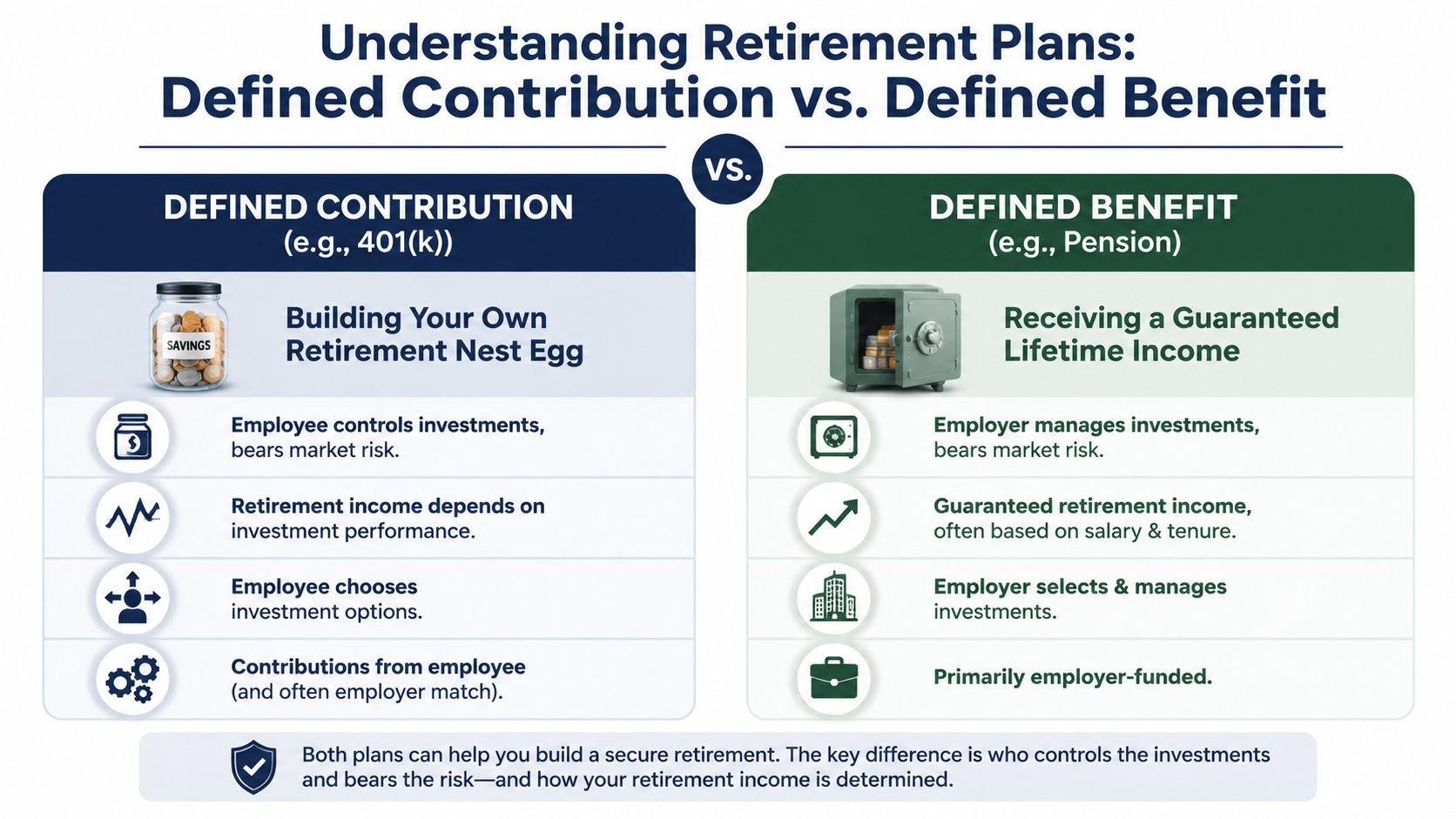
A defined contribution plan works like a personal retirement account built from ongoing contributions and investment results. A defined benefit plan operates on a promise, with the employer using a formula to determine the retirement benefit. For advisors, that difference changes nearly every client conversation, from risk disclosure to retirement income planning.
Side-by-side structure
A 401(k) is funded by employee deferrals and often employer contributions. The eventual retirement outcome depends on what goes in, how the assets are invested, and what remains available at distribution. A pension is built around a benefit formula, often tied to salary and service, with the employer responsible for delivering the promised amount.
| Feature | Defined Contribution Plan, e.g., 401(k) | Defined Benefit Plan, e.g., Pension |
|---|---|---|
| Funding | Employee contributions, often employer contributions | Employer-funded promise |
| Risk bearer | Participant bears investment and longevity risk | Employer bears funding and investment risk |
| Benefit form | Account balance that can rise or fall | Promised lifetime benefit under a formula |
| Planning focus | Contributions, allocation, and withdrawals | Plan formula and vesting |
| Advisor emphasis | Retirement income conversion | Benefit estimation and timing |
The IRS definition supports that distinction. In a defined contribution plan, the individual account grows from contributions plus gains or losses, rather than from a guaranteed benefit formula. That distinction matters in compliance reviews, especially when advisors are explaining how plan type affects participant expectations and retirement planning.
Why the distinction matters in practice
A pension question usually starts with the benefit formula. A 401(k) conversation starts with contributions, investment selection, and how withdrawals may be managed later. Those are different planning problems, and they call for different advisor judgments.
A participant in a defined contribution plan has an account to direct, while a participant in a defined benefit plan relies on a promised stream of income. That difference changes how risk is discussed, how adequacy is measured, and how retirement readiness is modeled.
The point becomes even more practical when the same framework shows up under another label, such as a 403(b) plan. The label may change, but the core question remains the same, who controls the accumulation process, and who bears the economic risk if markets move or contributions fall short.
For advisors, that is where compliance discipline matters most. A 401(k) should not be described as a guaranteed pension, because the plan does not work that way. Clear language helps clients understand what the plan can do, what it cannot promise, and why contribution limits, plan design, and investment risk all belong in the same discussion.
How 401k Contribution Mechanics Work
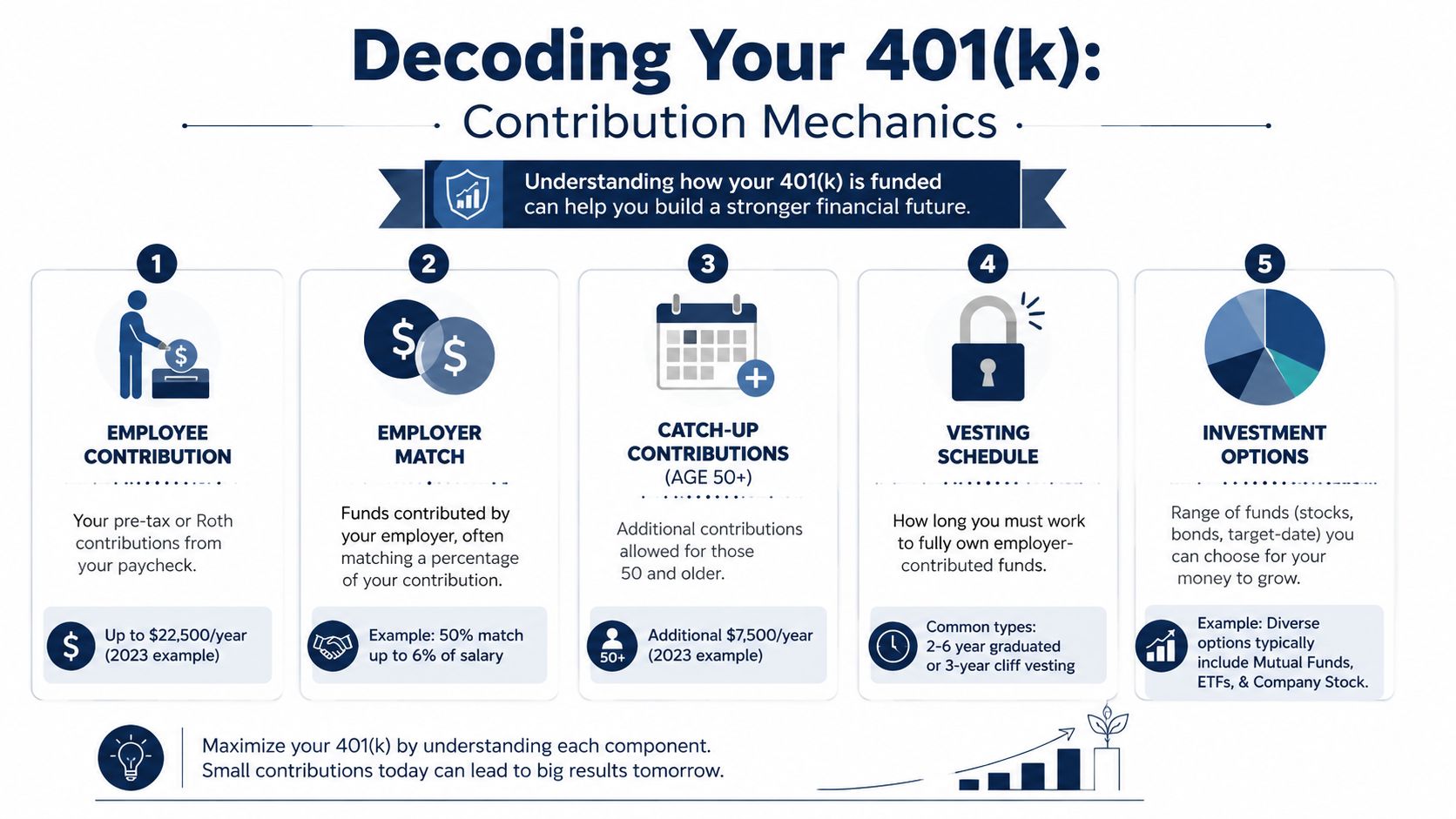
A 401(k) works because money enters the account in defined ways, under defined limits. The structure is not just “save more if you can.” It is a regulated system with annual caps, catch-up rules, and employer contribution designs that can change the actual pace of accumulation.
The employee side is the starting point
The most basic funding source is the employee elective deferral. In 2024, the employee elective deferral limit for defined contribution plans was $23,000, while the overall annual limit for employee plus employer contributions was $69,000 (Congressional Research Service report). That framework shows how the plan is controlled by contribution ceilings, not by a promised benefit formula.
For 2026, the elective deferral limit rises to $24,500, with an additional $8,000 catch-up amount for participants age 50 and older, and certain ages 60 to 63 can contribute an extra $11,250 under the enhanced catch-up rule (Columbia Threadneedle defined contribution plan guide). That is a plan-design issue as much as a tax issue, because the higher ceiling can materially change retirement savings behavior.
Employer money changes the calculation
Employer matching contributions and other employer contributions are central to client outcomes, but they are still part of a defined contribution structure. The employee does not receive a fixed pension promise just because an employer match exists. The employer contribution is another input into the account, not a guarantee of retirement income.
Advisory check: When reviewing a client's deferral rate, the first practical question is whether the client is capturing the full employer match. The second question is whether the rest of the contribution strategy supports the long-term income target.
A few details matter when advising on contribution mechanics:
- Elective deferrals: These are the employee's payroll contributions, typically pre-tax or Roth.
- Employer contributions: These may be matching, discretionary, or profit-sharing amounts, depending on the plan design.
- Catch-up contributions: These expand the participant's saving capacity later in career.
- Overall annual limit: This keeps total plan additions within the plan-year rule set.
- Age-based enhancements: Under current rules, older workers can have higher elective deferral capacity.
For a deeper look at how participants think about investment choices inside the account, an internal guide on how to invest in a 401(k) is a useful companion.
Key Implications for Investment Risk and Retirement Outcomes

A 401(k) being a defined contribution plan has one core consequence for clients, the participant takes the risk. Market risk sits with the account owner because investment values can move up or down. Longevity risk sits there too, because the account may need to fund spending over many retirement years.
Why a balance is not the same as income
A frequent source of confusion is treating a 401(k) like a pension once retirement begins. Defined contribution plans do not promise a fixed payout, and retirement income depends on contributions and investment performance rather than a guaranteed benefit (Tax Policy Center). A large balance helps, but it is only one piece of the retirement picture.
The primary planning question is how that balance turns into spendable income. A client can retire with a meaningful account value and still fall short if withdrawals are too aggressive, the portfolio is too concentrated, or distributions begin without a clear strategy. The account is a resource, not a promise.
What advisors should watch for
Investment strategy inside a 401(k) has to reflect the client's job, age, savings rate, and retirement horizon. The menu in the plan may be limited, but the allocation still drives outcomes. A participant who stays too concentrated in one asset class can see account volatility hit at exactly the wrong time.
Plan design changes also reinforce that the system is built around saving behavior, not guaranteed income. Under SECURE 2.0, workers ages 60 to 63 can make enhanced catch-up contributions, which shows how retirement readiness still depends on active contribution decisions. For advisors who want to keep the compliance side in view, SEC compliance for financial advisors is a useful reference point.
A practical advisory process should cover these points:
- Sequence risk awareness: Early retirement withdrawals can magnify the effect of weak market timing.
- Allocation drift monitoring: Portfolios change over time, especially when clients do not rebalance.
- Distribution planning: Retirement income requires a drawdown strategy, not just an accumulation strategy.
- Behavior coaching: Panic selling and overly cautious investing can both harm outcomes.
The goal is not to alarm clients. It is to make the tradeoff clear. A 401(k) can be a powerful retirement asset, but it works best when the advisor treats it as an income-conversion problem, not just an account-balance problem.
Advisory and Compliance Considerations for Financial Professionals

A 401(k) discussion becomes a compliance issue the moment advice turns into a recommendation. Advisors have to separate education, investment selection, and rollover guidance carefully, especially when the client is deciding whether to stay in plan or move assets elsewhere.
The advice standard changes with the task
Plan-level education is one thing. Personal investment advice is another. Once an advisor recommends a specific allocation, distribution approach, or rollover path, the recommendation needs to fit the relevant regulatory framework and be documented accordingly.
That is where clear records matter. A note that captures the client's objective, risk tolerance, available plan features, and the reason a recommendation was made can reduce confusion later. It also helps show that the advisor did not treat a 401(k) as if it were a guaranteed pension.
Rollover discussions need careful handling
Rollover conversations are where many firms need the most discipline. A client may be tempted to move money because the account feels old, large, or inconvenient. That instinct is not enough. The advisor should review fees, investment choices, services, and distribution needs before making any recommendation.
For firms building stronger review habits, SEC compliance for financial advisors is a useful reference point for understanding the broader compliance mindset around advisory documentation and client communications. The value of that type of resource is not marketing, it is the reminder that process discipline protects both the client and the firm.
Practical habits that reduce regulatory risk
- Document the reason for the recommendation: Client goals, constraints, and plan features should be visible in the file.
- Match language to the product type: A 401(k) should not be described as a pension substitute unless the analysis supports that framing.
- Review the employer match and vesting terms: Those details can change the economics of leaving assets in plan.
- Avoid generic rollover scripts: The client's actual plan menu and income need should drive the recommendation.
- Keep education separate from advice: Explaining a plan type is not the same as telling a client what to do with it.
Compliance gets easier when the advisor uses the plan's actual rules, not assumptions, as the starting point.
Frequently Asked Questions About 401k Plan Types
How is a 403(b) or 457 plan different from a 401(k)?
They are also defined contribution arrangements, but the sponsoring employer type and plan rules can differ. For advisors, the useful distinction is practical, not just technical. The account-based structure is similar, while eligibility, contribution features, and vendor arrangements may differ by plan design.
What is vesting, and why does it matter?
Vesting is the rule that determines when employer contributions become fully owned by the participant. If a client leaves a job before vesting is complete, some employer contributions may not be fully theirs yet. That matters because the value of staying in plan or rolling out can hinge on the vesting schedule.
Can a client have both a 401(k) and an IRA?
Yes, in many cases a person can hold both, but contribution eligibility, tax treatment, and income planning need to be reviewed separately. The presence of one account type does not eliminate the planning value of the other. It changes how the advisor coordinates them, especially when the client is trying to balance current deferrals, rollover choices, and future withdrawal planning.
Why do 401(k) limits keep changing?
The limits are adjusted over time, which is another sign that a 401(k) is governed by contribution rules rather than by a fixed benefit promise. The IRS publishes the current contribution limits and updates them as the rules change, so advisors should verify the applicable year before making a recommendation. For a government reference on the mechanics and limits, the IRS retirement plan overview is the better source to use than a commercial summary.
For advisors, the point is not whether a 401(k) is “good enough.” The better question is whether the client is using the plan's contribution capacity, employer features, and investment menu in a way that supports a realistic retirement income outcome. That includes checking whether elective deferrals are being maximized within the current limits, whether employer contributions are being captured, and whether plan design supports the client's broader tax and retirement objectives.
