
78% of financial advisors used LinkedIn in the widely cited survey, making it the most used social network among advisors, just ahead of Facebook at 75%. That is not a casual branding fact, it is a signal that LinkedIn for financial advisors has moved from optional networking to a core business channel, and every post, comment, message, and profile edit now sits inside a regulated communication environment that compliance teams can examine.
The practical takeaway is simple. If an advisor treats LinkedIn like a personal feed, the firm inherits exam risk. If the advisor treats it like a supervised growth system, LinkedIn can support visibility, conversations, and qualified introductions without creating avoidable headaches for the CCO.
Table of Contents
- Why LinkedIn Matters for Financial Advisors Right Now
- Building a Compliance-Safe LinkedIn Profile
- Designing a LinkedIn Content Engine Advisors Can Sustain
- Running Compliance Review Without Killing the Calendar
- Prospecting with Trigger Events and Signal-Based Outreach
- Turning Conversations into Qualified Advisory Clients
- Measuring LinkedIn ROI Without Inventing Numbers
Why LinkedIn Matters for Financial Advisors Right Now
A widely cited advisor survey found that 78% used LinkedIn, and among advisors who used at least one social network for business, 91% had used LinkedIn financial advisor LinkedIn survey. That matters because the channel is no longer just a place to post a thought piece and hope for visibility. It is where prospects, centers of influence, and peers already expect to find a credible professional presence.
LinkedIn is now both a prospecting channel and a record
The other reason LinkedIn matters is less glamorous and more important. Financial advisors using the platform for marketing must treat it as a regulated communication channel, because SEC and FINRA rules apply to posts, comments, messages, and profile information, and those communications generally need to be preserved for three years for regulatory examination recordkeeping and supervision overview. That puts LinkedIn inside the firm's books and records process, not outside it.
Practical rule: if the content would make a CCO uneasy in an exam binder, it should make the advisor uneasy before it is published.
The strategic shift from 2024 into 2026 is less about social media hype and more about professional credibility. LinkedIn's financial-services materials have long positioned it as a foundational business tool for advisors, with most advisors in the cited research using social networks for business and nearly all of them using LinkedIn specifically LinkedIn financial-services materials. That lines up with how major firms now think about digital presence, selective outreach, and documented supervision.
The playbook below focuses on what survives contact with compliance and what tends to fail. It covers the profile, the content system, review workflow, outreach, conversion, and measurement, so a firm can build a LinkedIn motion that produces conversations without turning marketing into a monthly fire drill.
Building a Compliance-Safe LinkedIn Profile
A LinkedIn profile is not a résumé when the audience includes prospects and regulators. It is advertising copy, even when the advisor wrote it in a personal tone. The headline, About section, featured links, experience descriptions, and skills all need to be reviewed as if they could be clipped into a supervision file.
Start with the headline and About section
The headline should say who the advisor helps and what problem gets solved, not just a job title. “Financial Advisor at XYZ Wealth Management” tells a visitor almost nothing. A better structure is client segment plus planning focus, because that gives the visitor an immediate reason to keep reading.
The About section should stay conversational, but it still needs compliance discipline. Avoid performance claims, promise language, and vague “trusted advisor” fluff that says nothing. A useful format is: who is served, what problem shows up repeatedly, how the process works, and what kind of conversations are welcome.
A practical disclosure block can sit at the end of the About section. It should identify that the profile is for informational purposes, that commentary is not individualized advice, and that firm communications are subject to review and retention. The exact wording should be pre-approved by the firm, but the point is consistent, a prospect should know this is a business profile, not a personal diary.

Treat featured content and experience as regulated marketing
The featured section often becomes a shortcut to conversion, which is exactly why it needs discipline. Link only to assets that have already cleared review, such as a profile page, a compliant article, or a firm-approved resource. If the asset includes a lead form, the form language should match the firm's approved outreach standards.
The experience section is another place where advisors accidentally drift into risky language. “Top producer,” “best-in-class results,” and similar claims can create unnecessary questions. Keep it factual, specific to role and scope, and aligned with the firm's approved positioning. A practical reference for broader digital governance is the financial services compliance guide, which is useful when a firm is mapping content to review and retention obligations.
Testimonials and endorsements deserve special caution. They can look harmless, but they often trigger a second review because they imply third-party validation. If the firm allows them at all, the policy should be explicit, not improvised on the fly.
For firms that want a clean workflow, the social media compliance framework for advisors should sit next to the profile checklist. That keeps the marketing team from reinventing review standards every time an advisor updates a job title or adds a new post.
What converts without creating friction
- Use a client-facing headline that names the audience and planning need.
- Write About copy in plain English with no performance promises.
- Keep featured links pre-approved and easy to review.
- Limit claims in experience descriptions to role, scope, and licensed activities.
- Audit testimonials and endorsements before they appear on the profile.
A profile that follows those rules can still feel human. It just won't create avoidable arguments between marketing and compliance every week.
Designing a LinkedIn Content Engine Advisors Can Sustain
A durable LinkedIn program needs repetition, not bursts of inspiration. The simplest usable rhythm in the advisor space is the 5-3-2 rule, meaning five pieces of useful curated content, three original posts, and two personal posts that show the human side of the advisor LinkedIn marketing framework. That mix keeps the feed from becoming a sales page while still giving the firm room to demonstrate expertise.
Build the calendar around a narrow cadence
Practical guidance for wealth management firms points to 2 to 4 posts per week, with long-form posts of about 800 to 1,200 characters, short videos of 1 to 3 minutes, and native documents or carousels because those formats tend to earn stronger distribution than external links wealth management LinkedIn strategy. The point is not to hit every format. The point is to select a small set the team can repeat without slipping into random acts of content.
A simple monthly calendar can assign one theme per week, then rotate formats inside that theme. One week might focus on retirement behavior, another on business-owner planning, another on caregiver transitions, and another on planning for women whose financial advice needs are often handled too generically. That last segment is a real content gap, because mainstream advisor posts often stay technical and broad, while women-specific concerns like caregiving, career interruptions, longevity risk, divorce, and confidence building rarely get translated into usable LinkedIn angles women's advice content gap.
Practical rule: if a post sounds interchangeable with every other advisor's feed, it probably won't earn trust or start a useful conversation.
Use a pre-approved library instead of a last-minute scramble
The highest-friction failure in advisor content is the Friday afternoon scramble. A central content library prevents that by storing pre-approved themes, boilerplate disclaimers, client-safe anecdotes, and reusable structures for FAQs or short case narratives. Batch review also helps, because compliance can examine a group of posts at once instead of handling each item as an emergency.
The best content families are usually the least flashy ones. Market insight, planning tips, anonymized client stories, and short thought leadership pieces are easier to supervise than clever hot takes. If the team wants a workflow reference for building that system, the content marketing playbook for financial advisors can be used as a planning anchor, then adjusted to the firm's own review standards.
A steady calendar works because it makes posting boring in the best possible way. The advisor knows what gets drafted, who reviews it, and when it goes out, and compliance knows nothing is sneaking through at the last minute.
Running Compliance Review Without Killing the Calendar
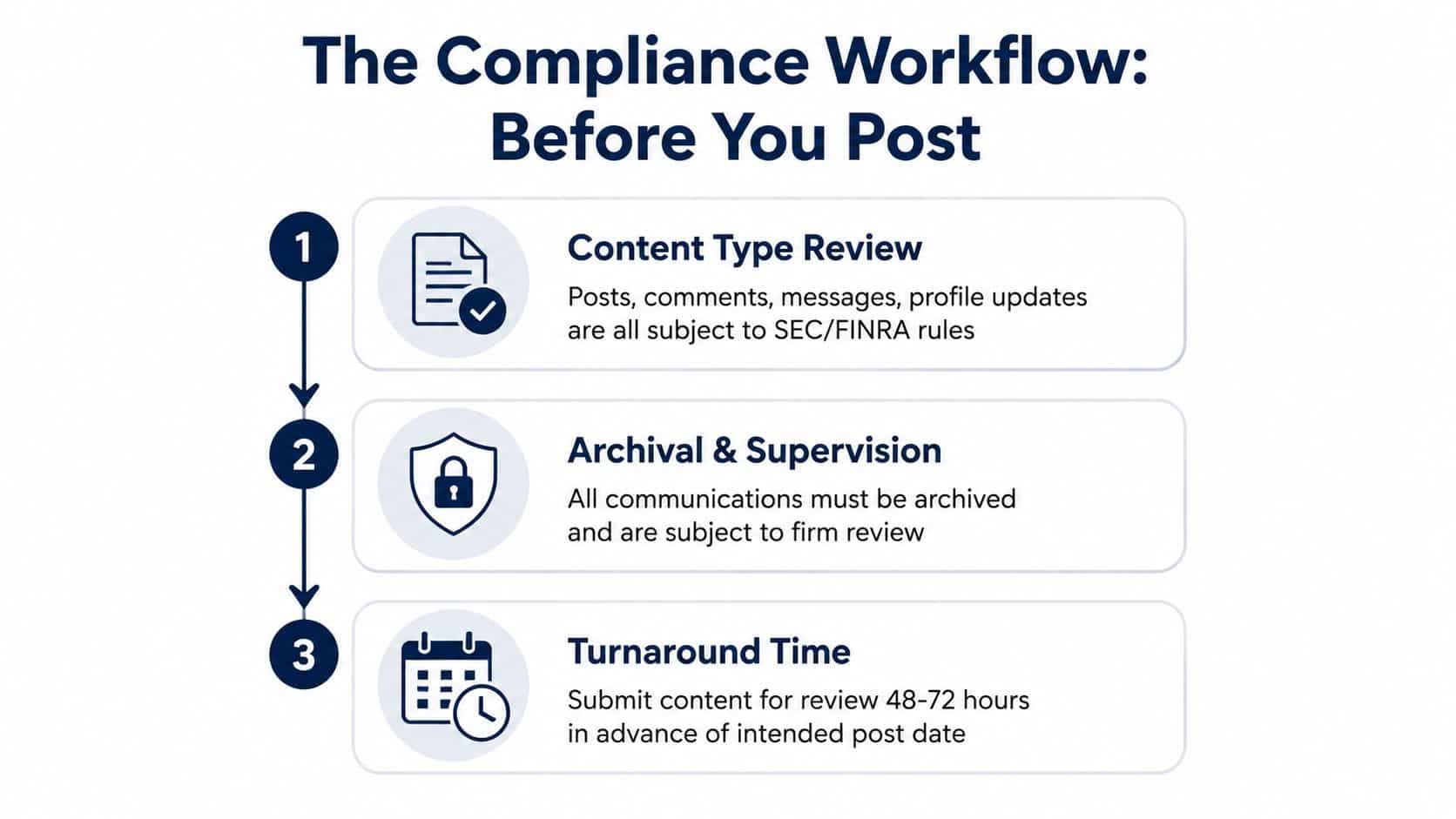
LinkedIn marketing only works when compliance review is treated like operations, not punishment. The key issue is simple, every LinkedIn post, comment, message, and profile update can fall inside the firm's communication controls, and those communications generally need to be preserved for three years for regulatory examination recordkeeping and supervision overview. That means the archive cannot be an afterthought.
Put the review queue in front of the content, not behind it
A lightweight review queue should do three things. First, it should capture draft content before publication. Second, it should route the draft to the right reviewer, usually compliance or a designated supervisor. Third, it should return either approval, requested edits, or a firm reason for rejection, so the marketing team can learn what will pass next time.
The fastest firms create clear disclosure controls up front. That includes profile language, post disclaimers when needed, and standards for what counts as testimonial, performance discussion, or product mention. Once those rules are documented, the advisor stops guessing and the CCO stops doing ad hoc triage.
Assign supervision and retention deliberately
The books-and-records burden is where sloppy LinkedIn programs get exposed. Posts and messages need to live in a retention workflow that can stand up in an exam, which usually means preserving the original content, the approval history, and the final published version. A supervisor should be able to explain who reviewed what, when it was cleared, and what changed before publication.
The practical side of this is not complicated, but it does require discipline. Use one intake path for drafts, one owner for approvals, and one archive location for the final record. If the firm also wants a broader guide to social compliance norms, the social media reporting guide is a helpful reference for thinking about documentation and oversight.
If the firm can't reconstruct who approved the post, it doesn't really have a control, it has a memory problem.
A productive conversation with compliance starts here
- Do define the review SLA so marketing knows when content comes back.
- Do keep disclosures standardized across profile and post templates.
- Do archive comments and direct messages when they are part of business activity.
- Don't publish first and ask later.
- Don't rely on informal text approvals that disappear from the record.
- Don't leave supervisory responsibility ambiguous between marketing and operations.
That structure keeps compliance from becoming the enemy of speed. It also keeps LinkedIn from becoming a shadow channel that nobody can explain six months later.
Prospecting with Trigger Events and Signal-Based Outreach
Generic cold outreach fails because it asks for attention before it earns relevance. The better LinkedIn motion starts with trigger events, such as a job change, a funding round, or a promotion, and reaches out while the signal is fresh. One workflow source says outreach within 24 hours of a trigger event is the highest-yield window, with timely, signal-based outreach producing 35 to 55% connection acceptance rates, while untargeted cold outreach can fall to 20 to 30% trigger-event outreach.
Keep the first message small and specific
The first message should not pitch a discovery meeting. It should recognize the trigger, offer relevance, and invite a response. That keeps the advisor from sounding like a stranger who scraped a name out of a list.
A usable opener looks like this, “Noticed the recent role change, congratulations. Advisors often see planning questions surface during transitions like that, so it seemed worth connecting.” A second version can reference a shared interest or connection, which matters because personalized messages tied to common ground can outperform pitch-first messages dramatically, while cold pitch messages can fall below 1% response in some outreach patterns response benchmark.
Use the same signal logic in content and outreach
The strongest outreach does not feel disconnected from the content engine. If the advisor has been posting planning insights around business transitions, career changes, or family dynamics, the first message should sound like a continuation of that expertise. That makes the relationship feel earned rather than opportunistic.
| Approach | Typical Acceptance Rate | Typical Response Rate | Best Use |
|---|---|---|---|
| Untargeted cold outreach | 20 to 30% | Low and inconsistent | Broad prospecting with weak fit |
| Trigger-based outreach within 24 hours | 35 to 55% | Higher when tied to relevance | Recent job change, funding, promotion |
| Pitch-first message | Not the right metric | Below 1% in some patterns | Avoid as a default motion |
| Personalized message with shared context | Not stated | 85% higher response than generic outreach in cited guidance | Warm introductions and relevant follow-up |
For firms wanting more tactical outreach structure, The Social Search's lead gen playbook is a useful reference point for mapping search intent to prospecting behavior.
A prospecting process built on triggers respects the prospect's timing. It also reduces the awkwardness that makes advisors overcompensate with long, sales-heavy notes that nobody wants to answer.
Turning Conversations into Qualified Advisory Clients
A LinkedIn conversation is not a client. It is a handoff point, and firms lose a lot of value by treating the chat thread as the finish line. The next step should be a soft call to action that moves the prospect toward a discovery conversation without promising outcomes or sounding like a sales script.
Use CTAs that sound like a next step, not a closing line
A compliant CTA usually asks whether the prospect would like a short conversation, a resource, or a clarification on a planning topic. It should never imply guaranteed results or pressure the prospect into urgency. “Happy to share how firms usually think through that issue” works better than “Book now so you don't miss out.”
Discovery questions should be simple and context-specific. Good examples include what changed recently, what the prospect is trying to solve, what information they already have, and what kind of support would be most useful. Those questions turn the LinkedIn thread into an actual qualification step.
Tag the lead before it gets lost
A common failure mode is the lead that leaves LinkedIn but never makes it into CRM. That's where attribution dies. Every prospect who comes from LinkedIn should get tagged with source, trigger, and initial interest area so the firm can see whether the channel is producing qualified conversations or just pleasant chatter.
The handoff also needs an intake path. If the prospect books a call, the scheduler, notes, and follow-up should all point back to the same source record. That makes onboarding smoother and gives the advisor a clean paper trail if the conversation later turns into a client file.
Useful standard: if a prospect can't be traced from first LinkedIn message to discovery call to intake record, the funnel is broken.
For firms that want help implementing a workflow around marketing and conversion, Advisor Momentum is one option that builds compliance-first content, websites, and lead-generation systems for advisors, so the social conversation doesn't die before it reaches the pipeline.
The goal is not to force every connection into a meeting. The goal is to move the right conversations into a repeatable process that the firm can measure and supervise.
Measuring LinkedIn ROI Without Inventing Numbers
LinkedIn ROI gets muddled when firms track only vanity metrics. Likes and impressions can be useful signals, but they don't answer the key question, which is whether LinkedIn is producing qualified conversations that survive into the pipeline. The measurement stack should start with leading indicators, move to pipeline indicators, and end with lagging business results.
Measure in tiers, not with one dashboard
Leading indicators include profile views, connection acceptance, post saves, comments, and meaningful direct replies. Pipeline indicators include booked meetings, discovery calls held, and follow-up conversations that stay active. Lagging indicators include new households, AUM, and revenue, though those belong in the broader firm review and should not be forced into a weekly social media dashboard.
A quarterly review is usually the right cadence for the firm's leadership team. That review should compare content themes, outreach patterns, and meeting conversion, then check whether compliance had to reject or rewrite a disproportionate amount of content. If the channel is generating engagement but no downstream activity, the strategy needs adjustment, not a celebration post.
Attribute cleanly and keep compliance in the loop
UTM-tagged links help when LinkedIn drives traffic to a resource or booking page, because they preserve source data that can be matched in analytics and CRM. CRM tagging is equally important for direct conversations, especially when the first touch happens in a comment thread or private message. Without that tagging, the advisor can't separate real channel ROI from casual familiarity.
A reporting template should summarize what was published, what was approved, which topics attracted qualified responses, and which outreach patterns converted to meetings. The goal is not to build a spreadsheet nobody reads. The goal is to give compliance, marketing, and leadership one shared view of what the channel is doing.
For firms that need a broader framework for reporting structure, the social media reporting guide is a practical companion when shaping the review pack and attribution summary.
A 90-day rollout that fits an advisory firm
The first 30 days should clean up the profile, define disclosures, and build the approval workflow. The next 30 should launch the content rhythm, start trigger-based outreach, and tag every inbound conversation in the CRM. The final 30 should review what produced qualified meetings, then remove the posts and messages that looked active but didn't move prospects forward.
High-risk mistakes stay consistent across firms. Treating LinkedIn as unregulated, ignoring the women's-advice content gap, posting without archive discipline, and measuring only vanity engagement will stall the program fast. The firms that keep moving are the ones that make LinkedIn boring, supervised, and repeatable.
FAQ
How long does it take to see pipeline impact? Usually long enough to require discipline, not luck. The first meaningful signal is usually better conversation quality, then booked meetings, then a visible pattern in the CRM.
Which tools help most? The most useful setup is the simplest one that supports drafting, approval, retention, tagging, and reporting. Fancy software won't fix a weak workflow.
How often should advisors post? A sustainable 2 to 4 posts per week is a practical target for many firms wealth management LinkedIn strategy.
What if compliance pushes back? Bring them a draft workflow, a disclosure template, and an archive plan. That changes the conversation from “Can marketing post this?” to “How does the firm supervise it?”
Advisor Momentum helps advisory firms build compliance-first LinkedIn marketing, from content planning and profile messaging to lead-generation workflows that can stand up in supervision. If the goal is to turn LinkedIn into a regulated growth channel instead of a noisy feed, visit Advisor Momentum and see how the agency supports advisors, planners, and bank teams with execution that's built for review, retention, and conversion.
