

In 2020, only 23% of financial advisors had a defined marketing strategy, while 77% did not. The same Broadridge survey found that 91% considered developing a digital marketing strategy challenging, 86% struggled to find time for marketing, and 34% generated no website leads at all. These figures, reported in Broadridge's advisor marketing research, reframe the problem. Advisor marketing usually doesn't fail because firms lack ideas. It fails because strategy, execution, measurement, and compliance operate as separate systems.
Effective marketing plans for financial advisors treat compliance as a strategic input. The audience, positioning, claims, channels, review process, and reporting model should fit together before a campaign goes live. That approach creates a growth system a firm can explain to partners, improve over time, and defend during regulatory review.
Table of Contents
- Why Most Advisor Marketing Plans Fail Before They Start
- Defining Your Ideal Client and Defensible Niche
- Building a Compliance-Ready Advisor Website
- Choosing the Right Organic and Paid Channel Mix
- Setting Funnel Math and KPIs That Actually Matter
- Plugging Content Into Your Compliance Workflow
- Your 90-Day Rollout Plan and Quick-Start Checklist
Why Most Advisor Marketing Plans Fail Before They Start
A plan that adds compliance only after the copy, campaign, and creative are finished isn't a plan. It's a queue of work waiting to be rejected, rewritten, or delayed.
Three patterns that stall growth
Channel-first thinking starts with a platform. A firm chooses LinkedIn, search advertising, or a newsletter before defining which households it wants to attract. The result is activity without a clear commercial purpose. A channel should answer a specific audience question, not become the strategy itself.
Message-first thinking creates polished language before the firm has tested whether the promise is defensible. Copy such as “beat the market,” “retire early,” or “guaranteed financial confidence” may sound persuasive, but it creates avoidable review friction and can imply outcomes the firm can't substantiate.
Activity-first thinking measures posts published, impressions earned, or followers added instead of qualified meetings, proposals, and clients. Those metrics can help diagnose reach, but they don't tell partners whether marketing is producing an acceptable pipeline.
What a working plan produces
A useful plan gives the firm four operating decisions:
- A defined client profile: The firm knows which households, professions, situations, and service needs deserve attention.
- Documented positioning: Advisors can explain who they serve, what problems they address, and how their service model differs.
- A channel mix tied to resources: Each channel has an owner, budget, review path, publishing rhythm, and expected role in the funnel.
- Defensible pipeline math: The firm can connect traffic and inquiries to booked meetings, proposals, and new relationships.
A 2024 Broadridge survey summarized by SmartAsset's financial advisor marketing budget analysis found that advisors with a defined marketing strategy added 21 new clients annually versus 14 for those without one, and that 31% planned to increase marketing budgets in the following 12 months. The useful lesson isn't that every firm should spend more. It's that documented strategy gives spending a purpose.
Practical rule: Compliance review should shape the campaign brief before a writer drafts the headline. It shouldn't be the final obstacle between finished copy and publication.
Defining Your Ideal Client and Defensible Niche
A niche is useful only when it is specific enough to guide decisions and broad enough to support a sustainable practice. "Financial planning that covers every aspect of a client's finances" describes a service category, not a reason for a particular prospect to contact one firm instead of another.
Start with evidence from the practice
The first step is to study the firm's strongest existing relationships. Review the households that fit the service model, communicate effectively, value the planning process, and produce healthy economics. The goal isn't to copy an aspirational persona. It's to identify patterns the firm has already served successfully.
Useful patterns include:
- Life or career situation: Business ownership, executive compensation, a liquidity event, succession, or a transition into retirement.
- Recurring financial complexity: Concentrated stock, multi-generational planning, charitable giving, equity compensation, or cash-flow uncertainty.
- Decision style: A preference for collaborative planning, delegated investment management, technical analysis, or ongoing education.
- Service fit: The minimum relationship scope, fee model, planning cadence, and geographic reach the firm can support consistently.
The second step pressure-tests reachability. LinkedIn searches, public demographic information, local business directories, and competitor analysis can show whether the audience is identifiable and accessible. A niche that exists only in a partner's imagination won't produce a workable media plan.
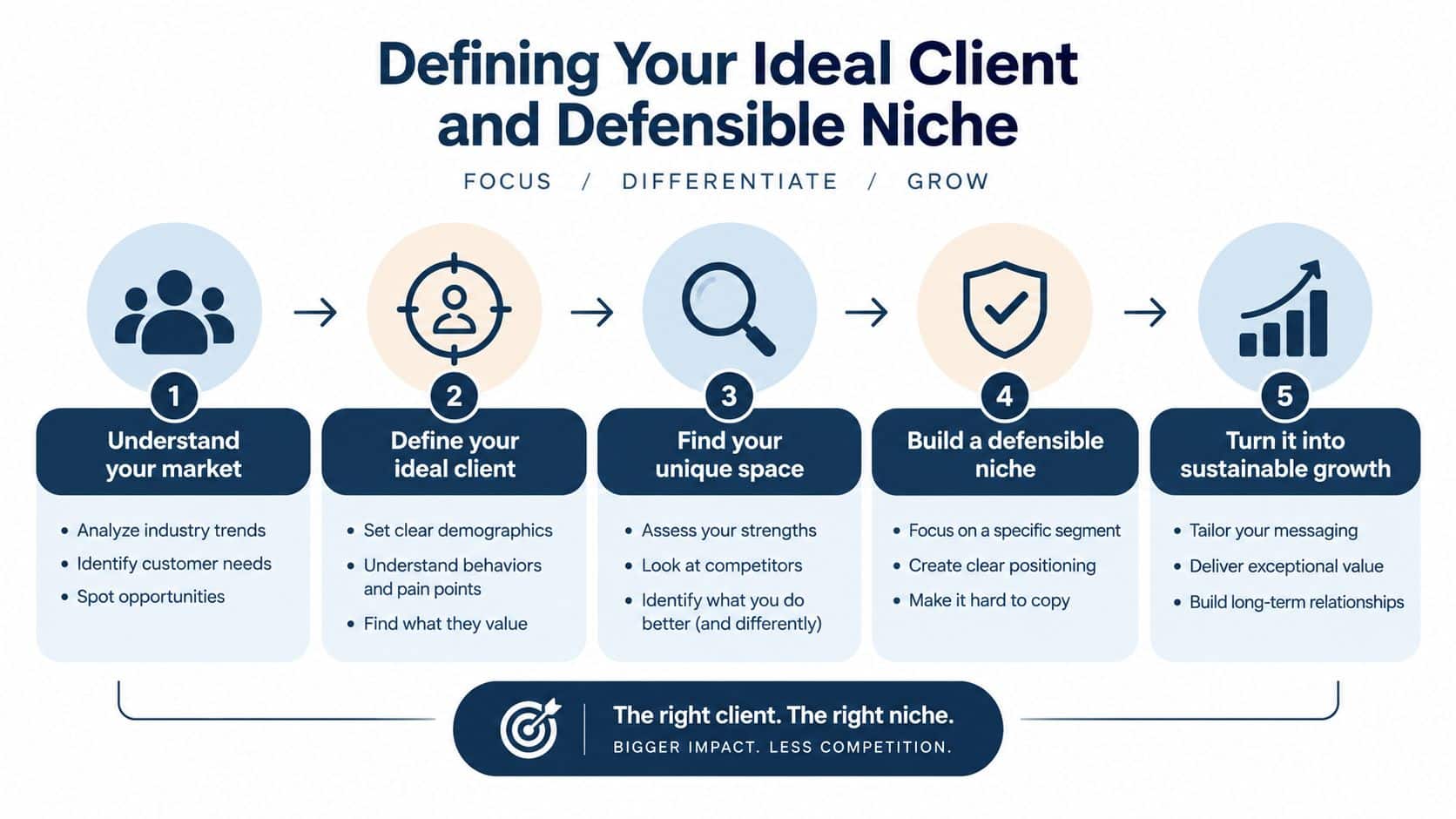
Turn the niche into approved language
A practical positioning structure is:
I work with [audience] in [situation] to help them [planning outcome], with [fee structure].
The wording should describe the firm's process and scope, not promise an uncontrollable result. “The firm works with physicians navigating practice ownership and personal wealth decisions through coordinated planning and investment management” is more defensible than “The firm helps physicians retire early.”
The final step is pre-testing claims with compliance before building headlines, landing pages, or campaigns. The WaveGen.ai advisor strategy guide can provide additional perspective on connecting brand positioning with a defined audience, but the firm's own review process must determine which language is usable.
A defensible niche doesn't eliminate review. It reduces ambiguous language, clarifies the intended audience, and gives reviewers enough context to assess claims quickly.
Building a Compliance-Ready Advisor Website
An advisor website should function as the firm's primary conversion asset, not as an online brochure that lists credentials and a phone number. Every page should help a suitable prospect answer three questions: Is this firm for someone like me? Does its process fit my needs? What should happen next?
Build the conversion path first
The homepage should state the audience, situation, and service value near the top of the page. A niche-specific hero section gives the visitor a reason to continue, while a single primary call to action, such as scheduling a discovery conversation, prevents competing options from diluting intent.
The core architecture should normally include:
- Who We Serve: Audience-specific pages that explain common circumstances and planning needs.
- How We Work: A plain-language description of onboarding, planning, investment management, communication, and fees.
- Insights: Educational articles that answer real prospect questions and create a durable search foundation.
- Contact or discovery page: A short, accessible form with an alternative scheduling path and clear expectations.
Case studies can demonstrate process more effectively than a wall of logos, but they need careful treatment. A firm should use anonymized scenarios or approved client examples, define the context, avoid implying typical results, and preserve the disclosures required for the format.
The financial advisor website design resource offers a useful reference point for connecting structure, branding, and conversion design. The final build still needs approval against the firm's specific regulatory obligations and supervisory procedures.
Embed compliance into the information architecture
The SEC marketing rule applies to investment advisers registered or required to be registered under section 203 of the Advisers Act when they directly or indirectly disseminate an advertisement. Its requirements affect testimonials, endorsements, compensation disclosures, and performance presentation, so these issues belong in the website architecture rather than in a last-minute footer exercise. The SEC small business compliance guide for investment adviser marketing explains the applicable conditions, including restrictions on presenting gross performance without net performance.
| Compliance element | Placement |
|---|---|
| Form ADV Part 2A | A clearly labeled disclosure or regulatory information area |
| CRD number | Footer or firm information page, where applicable |
| Jurisdiction language | Footer, contact pages, and location-specific pages |
| SEC and firm disclosures | Global footer and relevant service pages |
| Testimonial policy | Internal approval records, with required disclosures on published material |
| Performance disclosures | Adjacent to the relevant presentation, not hidden in a general policy page |
| Privacy and communications notices | Forms, email capture points, and contact workflows |
Technical quality still matters. The development checklist should include advisor schema markup, mobile performance testing, keyboard-accessible forms, descriptive labels, analytics consent where required, and lead-source capture. A specific speed promise shouldn't be used without measured evidence. The standard is simple: the site should load efficiently, work on mobile devices, and make attribution possible without compromising privacy.
Choosing the Right Organic and Paid Channel Mix
No channel is universally efficient for an advisory firm. Search captures active demand, professional social channels build authority and relationships, email develops known contacts, and partner marketing can transfer trust. The right mix depends on the niche, geography, sales capacity, approval resources, and tolerance for delayed results. Compliance belongs in that decision from the start. A channel that generates attention but creates excessive review work may be less productive than a slower channel with reusable, approved formats.
Match channels to the funnel
Awareness usually benefits from educational search content, professional thought leadership, referral partner activity, and selected sponsorships. These channels help prospects recognize a problem and connect the firm with a useful explanation. Claims, examples, audience descriptions, and sponsorship language still need a review path consistent with the firm's SEC and FINRA obligations.
Consideration requires material that addresses real objections. A strong article, webinar, email sequence, planning checklist, or niche-specific video can explain the firm's approach more effectively than a short social post. Organic content compounds slowly. Paid distribution can create faster exposure, but attention stops when spending stops. Each format should have an owner, an approval record, and a clear process for updating claims that become outdated.
Booked-meeting conversion depends on intent and friction. Campaigns built around specific service queries can reach prospects already looking for help. Retargeting can bring previous visitors back, but it cannot replace a clear offer, credible disclosures, and a straightforward scheduling experience. Landing-page copy and audience settings should be reviewed together, since the promise in an advertisement must match the destination and the firm's approved communications.
Professional social platforms can provide stronger context for high-net-worth or professional audiences because job role, industry, and career situation may inform targeting. Search generally captures broader demand and may produce more inquiries, but volume is not the same as fit. Judge both channels by qualified meetings, follow-up capacity, and eventual client quality, not by clicks alone.
Treat compliance time as a channel cost
A channel's cost includes drafting, media spend, review, revisions, recordkeeping, monitoring, and advisor follow-up. Short social posts may be easier to review than a long article containing multiple factual claims. A podcast sponsorship may require review of scripts, host language, disclosures, audience fit, and placement context. Under SEC and FINRA expectations, those controls are part of production capacity, not an administrative task added after launch.
| Channel | Cost driver | Lead quality | Compliance review time | Best funnel stage |
|---|---|---|---|---|
| SEO articles | Production depth, research, and review cycles | Strong when aligned with specific intent | Often longer because claims and sources require review | Awareness and consideration |
| Professional social posts | Publishing frequency, creative effort, and approval workflow | Useful for niche authority and warm audiences | Usually shorter with repeatable approved formats | Awareness and consideration |
| Email newsletters | List hygiene, editorial workflow, and recurring review | Strong for known prospects and referrals | Moderate, especially when claims are repeated | Consideration and nurture |
| Intent-based search campaigns | Keyword competition, media spend, and landing-page quality | High intent, with fit requiring qualification | Moderate, including claims and destination review | Consideration and conversion |
| Retargeting | Audience size, media buying, and creative controls | Familiarity is higher, intent is mixed | Moderate, with audience and creative review | Conversion support |
| Partner or podcast sponsorships | Audience alignment, placement, and production requirements | Depends heavily on audience fit | Can be high because scripts and endorsements need review | Awareness and consideration |
Solo firms should usually choose one primary organic channel and one supporting conversion channel. Mid-size firms can sustain a paid test alongside a content and email program. Enterprise teams can separate brand, demand generation, partner marketing, and local campaigns, provided ownership, archiving, and review rules are explicit.
A scheduling workflow can support consistent recurring social content, but automation does not approve communications. Teams considering process support can review this LinkedIn post scheduler as an example of a publishing workflow that should remain behind documented approval controls.
Setting Funnel Math and KPIs That Actually Matter
Marketing becomes manageable when the firm can translate attention into pipeline. The basic equation is:
Website visitors × visitor-to-lead rate × lead-to-meeting rate × meeting-to-client rate × average client value = potential revenue.
The equation isn't a promise. It's a planning model that exposes the stage creating the constraint. A firm with strong traffic but weak forms has a conversion problem. A firm with many inquiries but few meetings may have a qualification or follow-up problem. A firm with meetings but few clients may have a positioning, service-fit, or sales-process problem.
Use benchmark ranges carefully
Industry reporting cited by AdvisorStream's financial advisor marketing trends report places full-funnel lead-to-client conversion at approximately 5% to 12%, with structured-process benchmarks of 15% to 35% for landing-page conversion, 20% to 40% from lead to call, and 25% to 40% from call to client. The same source gives an illustrative path where 20% of visitors become leads, 30% of leads become calls, and 33% of calls become clients, requiring about 152 landing-page visitors for one new client.
Those figures should establish a testable starting model, not a target that every firm must claim. A separate financial advisor marketing benchmark reports that advisors with a defined marketing plan generated 168% more website leads per month than those without one, while 20% of U.S. advisors reported a defined strategy in 2023. The practical implication is to document the funnel before increasing traffic.
The firm should report:
- Monthly: Qualified inquiries, booked meetings, attendance rate, lead source, response time, and content or campaign status.
- Quarterly: Proposals, new clients, assets converted where appropriate, acquisition cost, channel contribution, and compliance-related delays.
- By channel: Landing-page conversion, form completion, meeting rate, meeting quality, and downstream client outcomes.
Make attribution useful, not theatrical
Most prospects encounter more than one touchpoint. A CRM should preserve the first known source, the converting source, and the meaningful assisted interactions. A monthly report can use simple rules, such as first-touch and last-touch attribution, while a quarterly review examines the sequence qualitatively.
Measurement rule: Traffic explains reach. Qualified appointments explain commercial traction. New client outcomes explain whether the system deserves more investment.
The reporting cadence should align with review windows. Marketing can identify which questions generated qualified conversations, compliance can flag recurring claims or disclosure issues, and the next content cycle can address both findings without restarting the process.
For firms trying to connect search visibility to action, a practical guide to how to convert traffic with SEO can help frame the transition from visits to measurable conversion events.
Plugging Content Into Your Compliance Workflow
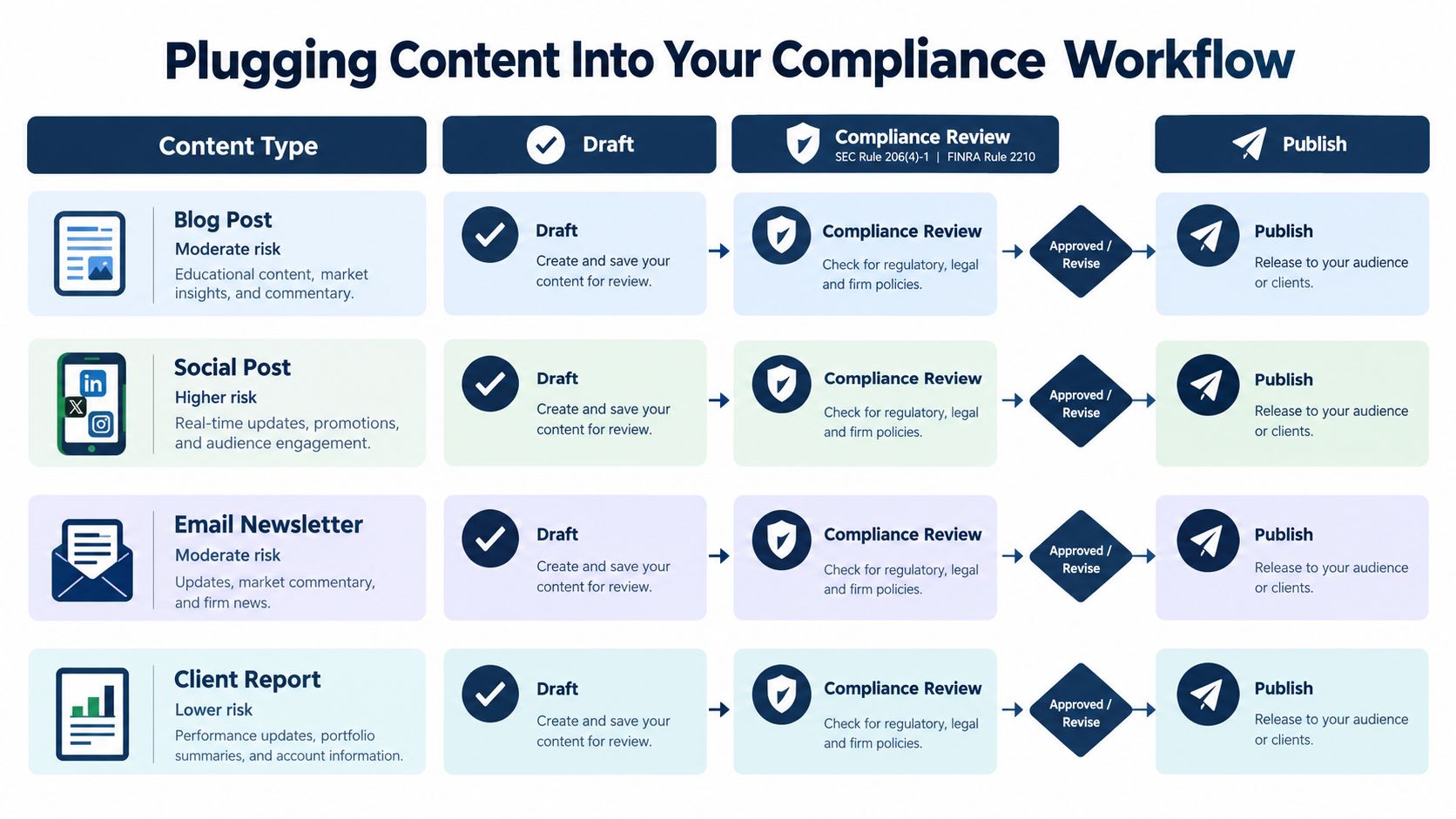
A compliance-ready content operation starts with classification. Marketing staff should not route every asset through the same process, and reviewers should not have to reconstruct its audience, distribution plan, or supporting evidence before assessing risk.
Create review tiers
A practical workflow assigns each asset a review tier, as explained in our compliance marketing workflow guidance:
- Routine educational content: Blog posts and newsletters built from approved topics, language, and disclosures receive a standard review.
- Public opinion and social content: Posts and short videos require checks for recommendations, performance implications, testimonials, and missing context.
- Promotional campaigns: Ads, landing pages, lead magnets, and event invitations receive closer review because both the call to action and audience targeting are explicit.
- Higher-risk material: Testimonials, endorsements, performance information, hypothetical illustrations, and personalized recommendations go to the designated compliance reviewer or supervising principal.
Under SEC Rule 206(4)-1-1), testimonials and endorsements require specified disclosures and oversight conditions. Published material should identify whether the provider is a current client or investor, or whether the endorsement came from another person. It should also disclose cash or non-cash compensation when applicable.
The review package should include the draft, intended audience, distribution channel, landing-page destination, sources supporting factual or performance claims, disclosure footer, and any previously approved language. A reviewer can then evaluate the communication without requesting basic context.
Build repeatability and evidence
A language library can hold approved descriptions of services, fee arrangements, planning processes, risk statements, and recurring educational explanations. Each entry should identify its approved context, review or expiration date, prohibited variations, and responsible owner.
Records should preserve the submitted version, reviewer comments, final version, approval date, approver identity, distribution details, and later edits. The firm's retention policy and applicable regulatory requirements determine how long those records remain available. The operating requirement is straightforward: approval evidence must be retrievable when an examiner or supervisor asks how a communication reached the public.
The SEC staff also states that an adviser must not compensate a testimonial or endorsement provider when the adviser knows, or should know through reasonable care, that the person had a disqualifying event within the prior 10 years. That SEC staff marketing compliance guidance makes screening and due diligence part of campaign planning.
Firms that want to operationalize these review tiers without building every template in-house can work with a compliance-aware partner such as Advisor Momentum, which supports content, website, and advertising production under documented approval workflows. The adviser, marketing team, and compliance function still need clearly assigned responsibilities.
Run a predictable weekly cadence
A workable cadence might assign Monday to topic selection and evidence gathering, Tuesday to drafting, Wednesday to compliance review, Thursday to revisions and scheduling, and Friday to publication checks and performance logging. Unresolved items should move to a named escalation owner rather than remain in an anonymous queue.
FINRA Rule 2210 requires retail communications or correspondence containing testimonials about investment advice or performance to disclose prominently that the testimonial may not represent other customers' experiences and is not a guarantee of future performance or success. FINRA Rule 2210 also requires communications to be fair and balanced and prohibits false, misleading, promissory, exaggerated, or performance-projecting statements.
Standardization protects speed. It gives reviewers known evidence, approved language, and clear escalation paths without weakening oversight.
Your 90-Day Rollout Plan and Quick-Start Checklist
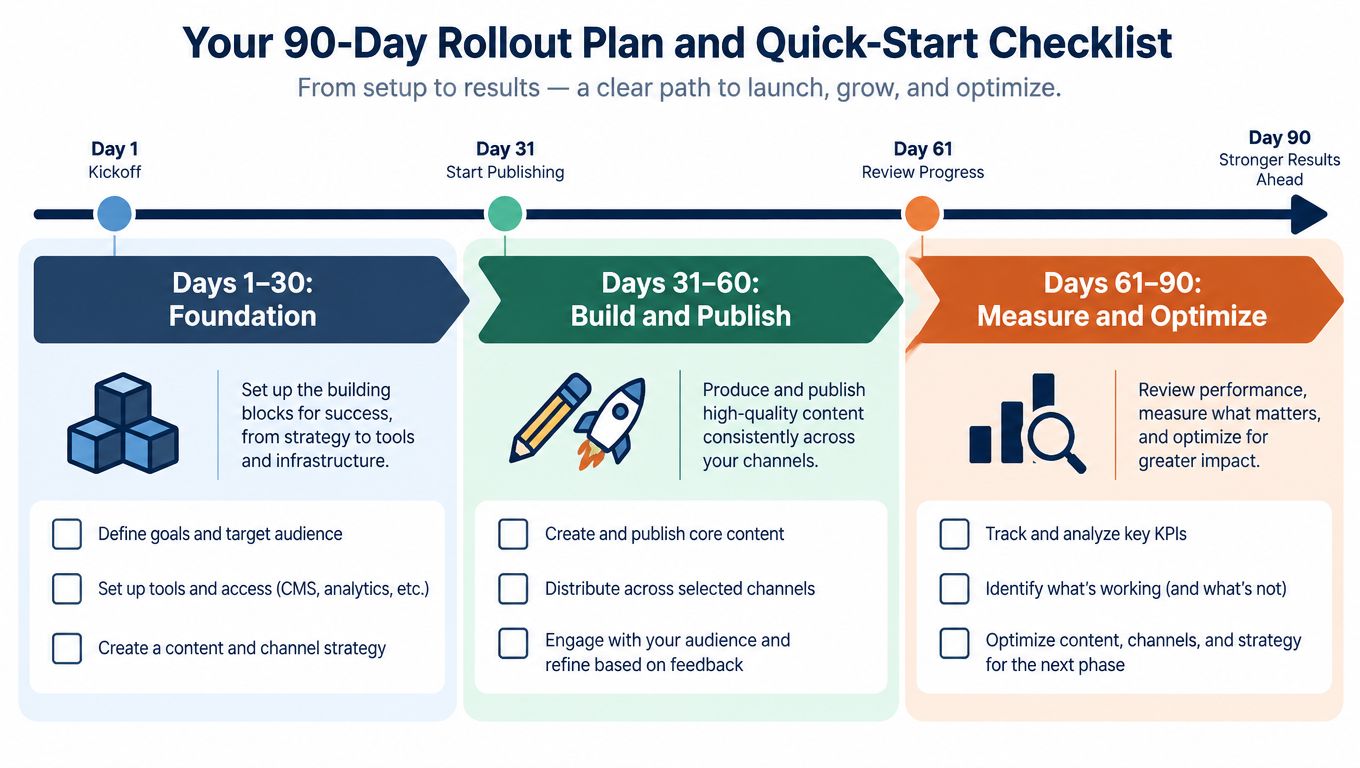
A 90-day launch sequence gives an advisory firm enough time to establish the foundation, publish meaningful assets, and inspect early funnel evidence without trying to perfect the entire marketing operation at once.
Days 1 to 30 build the foundation
The firm defines its ideal client, reviews existing households, selects a defensible niche, and approves a positioning statement. Marketing and compliance then document review tiers, owners, required evidence, disclosure language, storage locations, and escalation rules.
The website inventory follows. The team identifies missing service pages, disclosure pages, forms, analytics events, and cornerstone topics. Paid channels should remain limited until the destination page, qualification process, and review workflow are ready.
Days 31 to 60 build and publish
The firm publishes the core website pages, launches its Insights hub, and creates a small set of niche-specific educational assets. Each asset should have a clear audience, search intent, call to action, source record, and approval status.
Initial paid campaigns can begin with controlled budgets and narrow audiences. The objective is not to maximize reach immediately. It's to learn which messages produce suitable inquiries and whether the firm can respond and review material without creating operational strain.
Days 61 to 90 measure and optimize
The team reviews lead sources, qualified meetings, attendance, follow-up, proposals, and early client outcomes. Underperforming channels should be revised or paused rather than protected because of sunk effort. Strong topics can be expanded into email, social, video, or partner formats after their claims and disclosures are approved for those contexts.
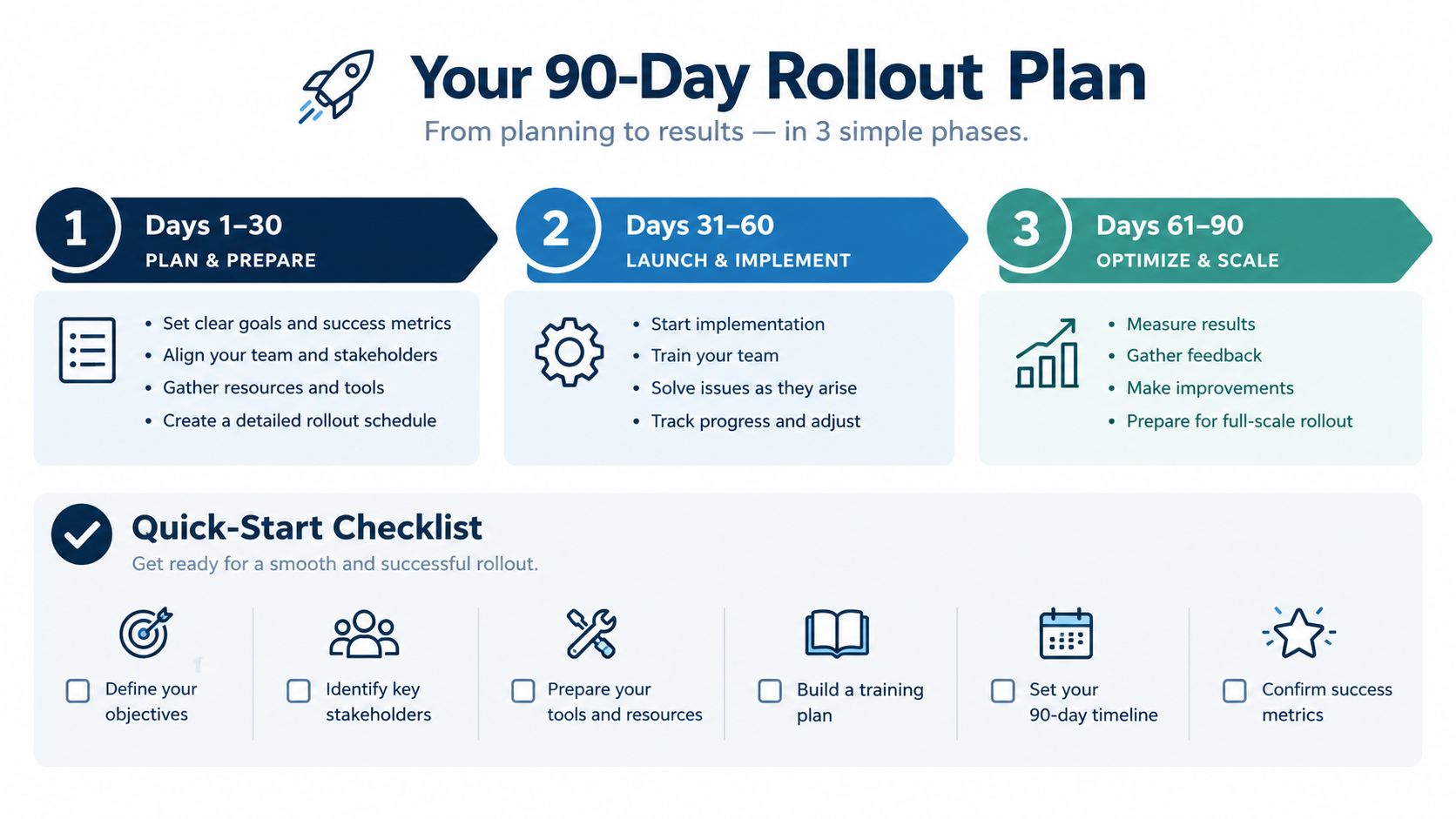
The launch-morning checklist
- Disclosure pages: Confirm regulatory, privacy, and jurisdiction information is live.
- Form ADV Part 2A: Test the link and verify the current document is available.
- CRD information: Check the required firm and advisor identifiers.
- Positioning: Confirm every primary page names the intended audience and service context.
- Primary CTA: Test the discovery-call path from desktop and mobile.
- CRM connection: Confirm forms create records and assign ownership.
- Lead source tracking: Verify source, campaign, and landing-page fields.
- Review archive: Store final approvals and supporting claim evidence.
- Social profiles: Update bios, links, disclosures, and service descriptions.
- Email process: Confirm consent, footer language, segmentation, and unsubscribe handling.
- Cornerstone content: Publish one approved, audience-specific educational asset.
- Reporting view: Confirm the dashboard shows inquiries, meetings, and source data.
The first quarter usually exposes five avoidable mistakes: skipping the niche, ignoring compliance timing, over-investing in one channel, failing to score leads, and refusing to stop tactics that produce activity without suitable meetings. A disciplined firm treats those findings as operating data, not as evidence that marketing itself doesn't work.
Advisor Momentum provides compliance-ready website development, branding, content, advertising, coaching, and recruiting services for financial advisors and related financial organizations. Firms building a regulated growth system can visit Advisor Momentum to review services that connect marketing execution with compliance-aware planning and lead conversion.
