
A bank marketer has a client thank-you ready to share. An advisor has recorded a short market video, and a paid creator has sent a clip for the next campaign. Each item looks informal enough to publish quickly. The uncomfortable question is whether anyone can later prove what was approved, what appeared, and what changed afterward.
That's the operational challenge behind social media compliance for financial institutions. A disclosure matters, but it's only part of the job. Marketing and compliance teams also need an auditable way to manage creators, publication, edits, disappearing content, and the claims that reach prospective clients.
Table of Contents
- Why a Social Post Can Become an Advertisement
- How the Marketing Rule Governs Social Content
- Building Supervision and Record Retention Controls
- Governing Finfluencers and Third-Party Creators
- What Enforcement Shows About Performance Claims
- Choosing a Compliance-First Social Operating Model
- Start a Practical Social Review Workflow
Why a Social Post Can Become an Advertisement
Consider a hypothetical advisor who receives a grateful client message. The marketing team turns it into a graphic, adds the firm's logo, and schedules it alongside educational posts. What began as a private expression of appreciation is now something the firm is using to promote its services.
The same issue can arise when a creator publishes a firm-sponsored video or an employee shares a campaign through a personal account. For investment advisers, the SEC's Marketing Rule addresses advertisements disseminated directly or indirectly, so third-party publication doesn't necessarily place content outside the adviser's responsibilities. The SEC's investment adviser marketing compliance guide explains the framework, including oversight and advertisement retention.
The message and the firm's involvement matter more than the informal appearance of the app.
Recognizing the review trigger
Generic wealth language can make competing firms sound interchangeable. But replacing bland copy with an unreviewed promise isn't a useful solution. A sentence suggesting dependable investment results creates a different problem from a vague statement about attentive service.
The practical distinction is between improving the message and changing the claim. Marketing teams should flag everyday actions such as:
- Repurposing praise: Turning a client's comment into campaign material.
- Adding a result: Inserting a return, projection, or implied outcome into educational content.
- Extending distribution: Asking an employee or creator to publish material for the firm.
- Changing context: Pairing an approved caption with a different video, headline, or destination page.

The right starting question isn't whether the post feels like advertising. It's what the firm is communicating, whose business it promotes, and how the firm participates in its distribution. Bank teams should also distinguish investment-related activity from other business lines rather than assume a single regulatory framework covers every post.
For teams organizing that operational evidence, Sift AI's resource on how to build audit trails for social operations provides a useful planning reference. Waiting for a complaint leaves the firm reconstructing decisions instead of consulting a record created when those decisions occurred.
How the Marketing Rule Governs Social Content
A client records a video praising an adviser, and the marketing team wants to share it. Before publication, the team needs to establish whether the video is an advertisement, what relationship and compensation disclosures it requires, and who will check the final version. A disclosure alone does not create a reliable control system: the firm must also be able to show how the content was reviewed and what it published.
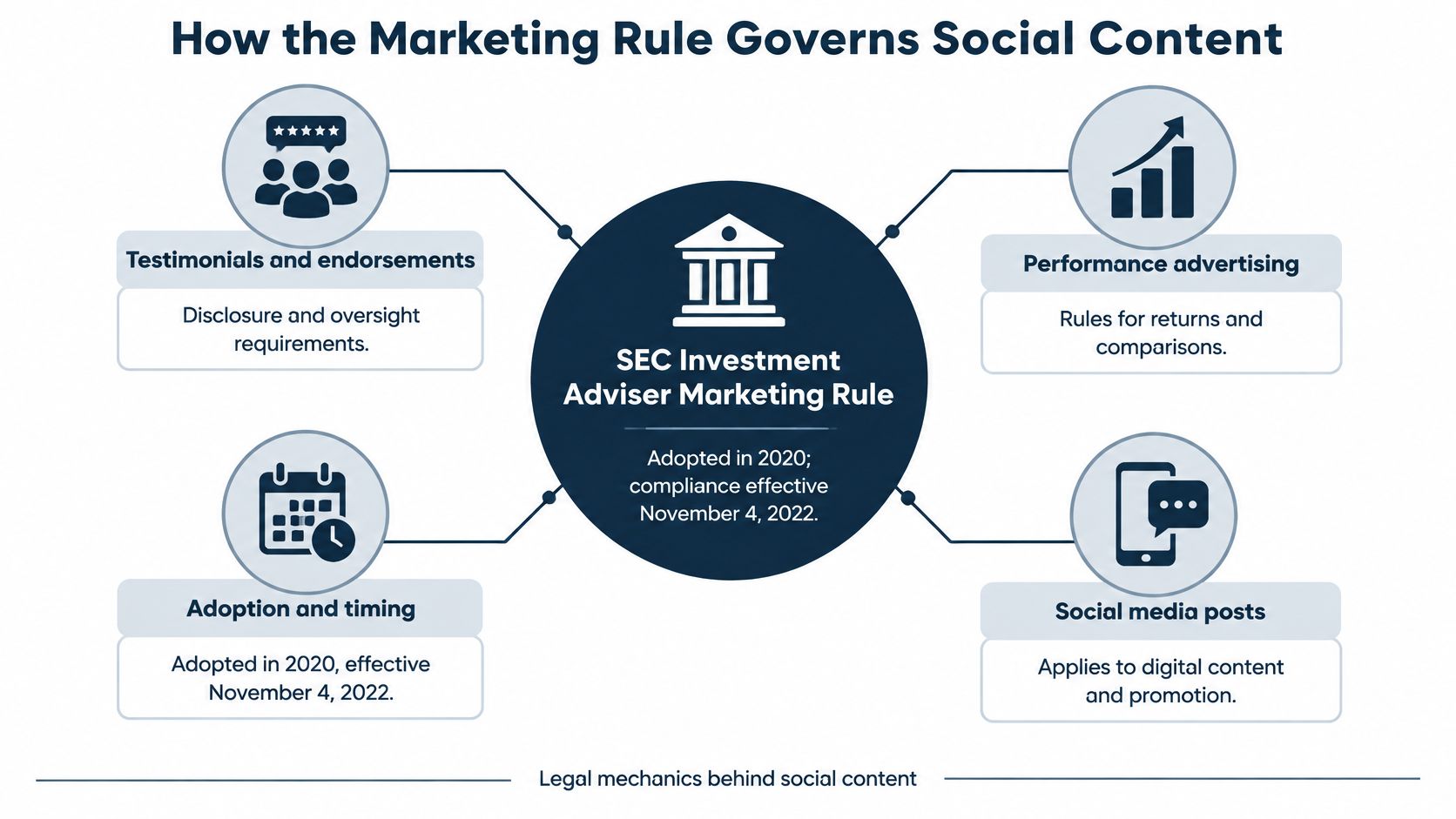
The SEC's Investment Adviser Marketing Rule was adopted in 2020, with compliance required on November 4, 2022. It replaced the earlier advertising and cash-solicitation framework with principles-based requirements covering testimonials, endorsements, third-party ratings, and performance information, as described in the SEC's Marketing Rule adoption announcement. These categories can arise in client videos, reviews, promotional clips, or campaigns that connect social posts to landing pages.
The rule concerns investment adviser advertising, not every bank product or communication. A practical investment adviser Marketing Rule overview can help marketing staff spot when specialist review is needed. They do not need to make the final legal classification themselves.
What a promoted recommendation needs
When an adviser uses a testimonial or endorsement in advertising, a friendly tone and a disclosure tucked beneath the creative are not enough. Required disclosures must clearly and prominently state whether the promoter is a client and whether compensation is involved. The firm also needs to consider other compensation and conflict-of-interest disclosures, adviser oversight, and usually a written agreement with the promoter.
Under the SEC adoption announcement, the written-agreement requirement has a limited exception for an adviser affiliate or promoter receiving $1,000 or less, including equivalent noncash compensation, during the preceding 12 months. This exception applies to the agreement requirement only. It does not remove the other applicable conditions.
For a client video, review each part of the advertisement as it will appear to viewers:
- Relationship: Confirm whether the speaker is a client and how the advertisement describes that relationship.
- Compensation: Check for cash and noncash benefits, not just invoice payments.
- Presentation: Review the disclosure in the finished video. A script alone cannot show whether it is clear and prominent on screen.
- Oversight: Assign responsibility for checking the promoter's compliance and preserving the version distributed.
Organic praise versus firm-used advertising
An unsolicited mention and a client comment selected for a campaign call for different review questions. The firm should assess its role before reposting, promoting, or arranging distribution. Once staff edit or reuse a comment, the team should be able to trace the creator, the changes, the review, and the version that went live.
Reviews and third-party ratings also need deliberate classification, rather than automatic placement in a testimonial template. Give compliance a record of the content, the relationship, any compensation, and the intended distribution. That lets reviewers assess the relevant conditions against the actual campaign, not a caption separated from its context.
Building Supervision and Record Retention Controls
A useful analogy is a security camera system that records every entrance, not just the front door the marketing team prefers. A social archive that captures the firm's main feed but misses business conversations elsewhere has the same design weakness.
For broker-dealers and registered representatives, the substance of a business communication matters, not the platform, device, or technology. Securities-business communications must be retained for at least three years, and firms must maintain supervisory capability, according to FINRA's social media guidance.
Design around activity rather than account names
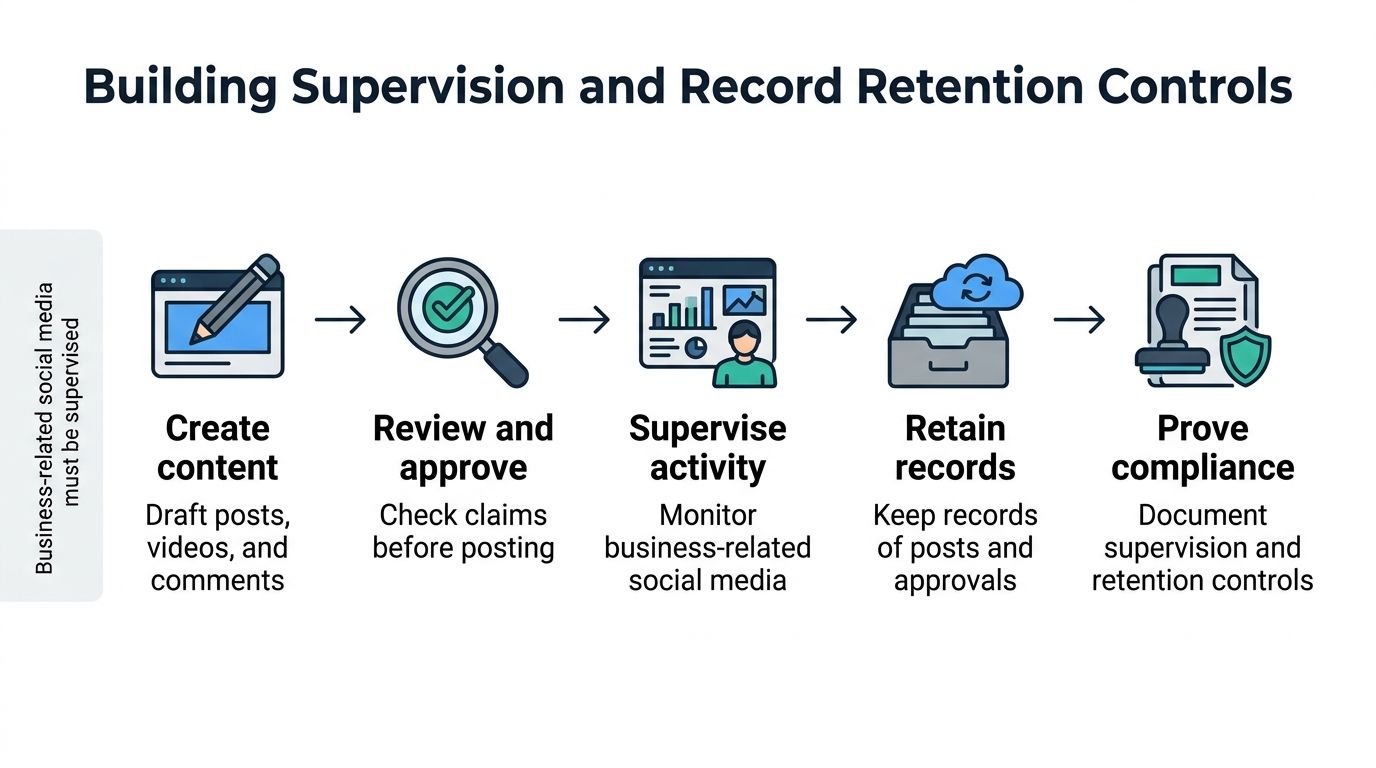
Start with the activities employees are permitted to perform. Publishing a post, replying to a prospect, editing a caption, and sending a direct message require different capture tests. The firm should identify which business-related posts, comments, direct messages, edits, reactions, and associated metadata its records process preserves.
A practical implementation sequence is:
- Map permitted activity: Identify authorized accounts, users, features, and business purposes.
- Test capture: Publish controlled test content and confirm that the archive preserves the expected material.
- Assign supervision: Name the reviewer and define what requires escalation.
- Test retrieval: Ask someone outside the campaign team to reconstruct a publication and its review history.
- Resolve exceptions: Restrict unsupported activity until the firm can supervise and retain it appropriately.
Separate approval from continuing supervision
Not every permitted interaction necessarily follows an identical approval path. Firms allowing interactive communications before principal approval need written supervisory procedures addressing training, surveillance methods, escalation, and corrective action under the FINRA guidance cited above.
For example, a representative might be permitted to answer a routine business question under an established supervisory process. A response that introduces a product recommendation or performance assertion should trigger the firm's defined escalation route. Employees need examples that explain where that boundary sits.
Retention and supervision are connected, but they aren't interchangeable. Saving content doesn't prove anyone reviewed it, and recording an approval doesn't prove the published version was preserved.
The practical failure can therefore occur even when the words are unobjectionable. An exception for a messaging feature may leave supervisors unable to review qualifying business communications and operations staff unable to retrieve them. A sound process tests both capabilities before permitting the activity, rather than accepting a general assurance that the account is archived.
Governing Finfluencers and Third-Party Creators
A creator can follow an approved disclosure and still publish content the firm never reviewed. For example, a creator might change a caption, add an unscripted performance claim during a livestream, or delete a video before the firm saves it. A signed agreement and a disclosure do not, on their own, create an auditable control system.
FINRA's 2025 Annual Regulatory Oversight Report identified inadequate influencer supervision, including failures to review influencer videos before publication and retain them afterward. The practical lesson is to track what the firm approved, what appeared publicly, and what changed, rather than relying on a compliant-looking final frame.
Classify the relationship before commissioning content
Start by identifying the creator's relationship with the firm. The categories below help shape intake questions, but do not replace legal classification.
| Relationship | Intake question |
|---|---|
| Paid endorsement | What cash or noncash benefit supports the promotion? |
| Client testimonial | How will the client's experience be presented? |
| Referral arrangement | What activity triggers payment or another benefit? |
| Affiliate arrangement | How are incentives, attribution, and relationships documented? |
| Unpaid employee advocacy | What business content may the employee share or change? |
Then assign a script approver and define which edits require another review. Approval should cover the complete post: spoken words, visuals, caption, disclosure, and linked destination. A creator who receives approval for an educational explanation might later add a personal claim about expected results. The contract should allow the firm to request a correction or removal, and the workflow should say who detects the change and who decides how to respond.
Control test: A reviewer should be able to connect the approved version to the published version without relying on the creator's memory.
Keep an evidence register through takedown
An evidence register should link the agreement and compensation checks to approvals, disclosure decisions, published versions, later edits, complaints, and takedown decisions. Assign an owner and a retrieval location to each record so the firm can trace the campaign after publication.
Comments, livestreams, and disappearing formats need a decision before they are used. If the firm cannot reliably supervise and preserve a feature, exclude it until the control gap is resolved. That choice can limit a campaign's format, but it avoids relying on a creator to provide evidence after a concern arises.
A creator's informal style may help a message feel natural. The evidence process still needs clear steps. A tidy disclosure cannot cure missing supervision or missing records. The firm should be able to show who approved the content, what was published, how changes were handled, and whether the final record was retained.
What Enforcement Shows About Performance Claims
Performance advertising deserves a separate review because a polished graphic can make an unsupported proposition look authoritative. A chart may appear precise even when the firm hasn't established whether its assumptions and distribution are appropriate.
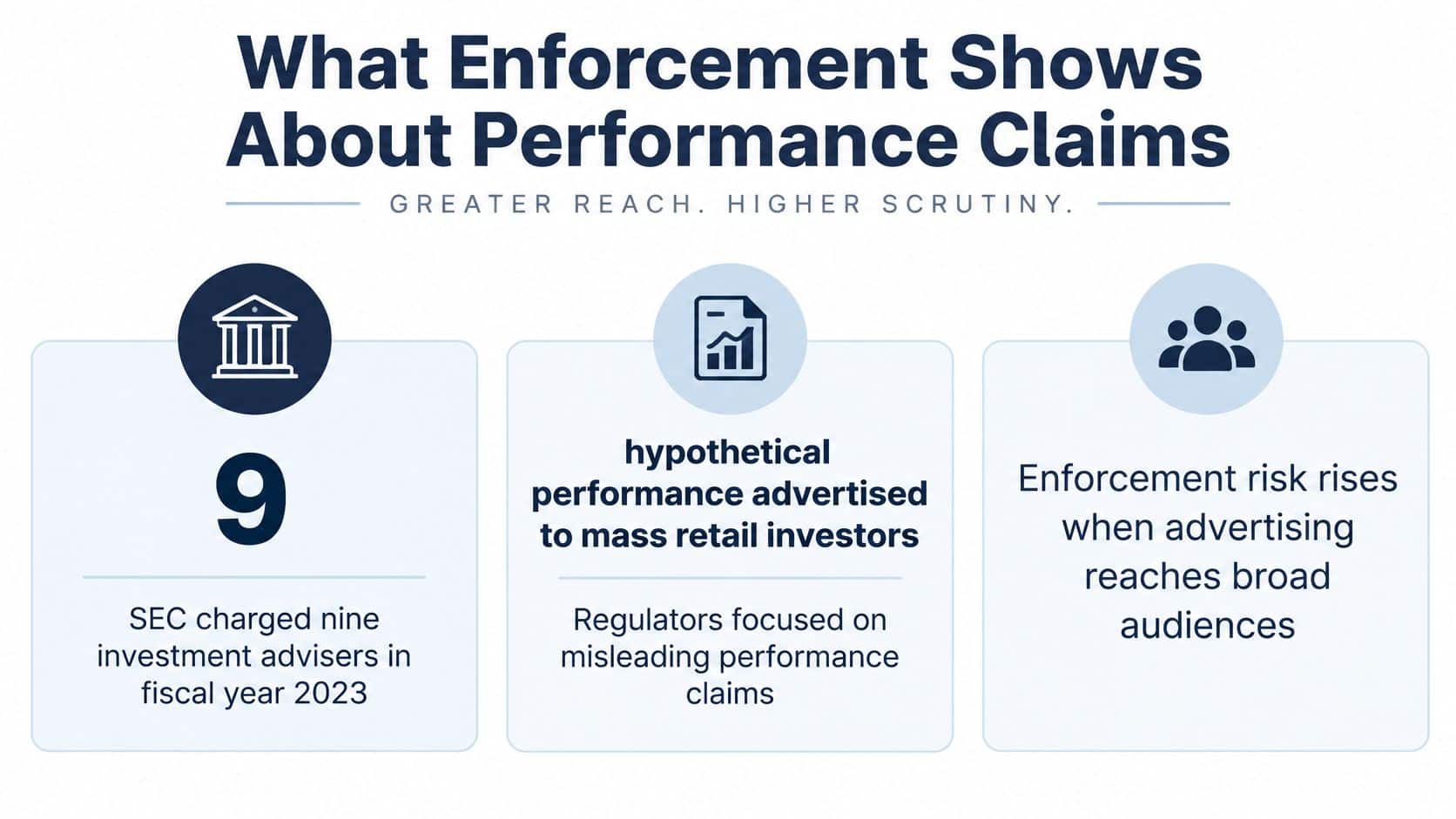
In fiscal year 2023, the SEC charged nine investment advisers over hypothetical performance advertised to mass audiences on public websites without required policies and procedures; they collectively paid $850,000 in civil penalties, approximately $94,444 per firm, while Titan Global Capital Management USA agreed in a related case to pay more than $1 million in civil penalty, disgorgement, and prejudgment interest, according to the SEC's fiscal-year enforcement results.
Test the claim before polishing the creative
Those were website cases, not a finding that every performance-related social post is prohibited. The relevant connection is public distribution: a social campaign can also put material in front of an audience the firm hasn't individually assessed.
A proposed return, projection, or hypothetical result should pass a documented pre-publication test:
- Identify the result: Establish whether it reflects actual experience, a model, or a hypothetical scenario.
- Substantiate the presentation: Preserve the underlying calculation, assumptions, and support for comparisons.
- Evaluate the audience: Determine whether public distribution is appropriate under the applicable requirements.
- Read the complete impression: Examine the headline, chart, qualifications, caption, and destination together.
- Resolve missing support: Hold publication when the reviewer can't establish the basis for the claim.
FINRA's standard, addressed in its earlier-cited social media guidance, is that communications must be fair, balanced, and complete across social media, email, and print. False, misleading, exaggerated, promissory, or unwarranted claims are prohibited.
Challenge the implied promise
Consider a hypothetical graphic showing an attractive modeled outcome beside a reassuring headline. The arithmetic might be reproducible while the overall presentation still implies more certainty than the supporting material warrants.
The reviewer's job is therefore broader than checking a calculation. The review should examine what a prospective client would reasonably take away and whether important limitations are understandable in the actual format.
This is a supervisory decision, not merely a copy edit. When the answer depends on missing assumptions or an undefined audience, shortening the disclaimer won't resolve the underlying issue.
Choosing a Compliance-First Social Operating Model
A post can pass review and still leave a weak audit trail. If a creator changes the approved wording, a video disappears, or the firm cannot retrieve the published version, a disclosure alone will not show who approved what or when. Choose an operating model that makes those steps traceable, while matching the firm's staff, channels, and production needs.
The key question is who performs each control and who remains accountable when work passes between people or organizations. An internal review desk may suit a firm with experienced writers and enough compliance capacity. An archive provider addresses a narrower need: preserving captured communications. A marketing partner can prepare content and coordinate revisions, while the firm retains clear approval authority and ownership of its records.
Social Compliance Operating Models
| Control need | In-house review desk | Archive vendor only | Compliance-first marketing partner |
|---|---|---|---|
| Review speed | Depends on internal staffing and draft quality | Doesn't resolve drafting or approval delays | Can prepare review-ready drafts and coordinate revisions |
| Disclosure control | Internal team manages wording and placement | Captures supported published material | Can integrate disclosure checkpoints into production |
| Influencer evidence | Firm builds and maintains the register | May preserve supported content, not the full relationship file | Can coordinate contracts, versions, and approval evidence within an agreed scope |
| Final record ownership | Firm defines storage and access | Firm must verify capture, retrieval, and export arrangements | Firm should specify its authoritative record and access rights |
| Production responsibility | Internal marketers and specialists | Remains elsewhere | Shared according to the engagement |
Where specialized marketing support fits
Advisor Momentum provides social and blog content, compliance-ready websites, paid social for advisory audiences, and workflows informed by leadership experience described as a former chief compliance officer for more than eight years with the SEC. Its compliance-focused marketing services are an option for firms seeking outside production support, not a replacement for supervisory judgment.
The trade-off depends on the team's workload. A well-staffed firm may keep production in-house and improve a particular capture or handoff process. A smaller team that repeatedly rewrites posts may benefit from prepared drafts, clear submission requirements, and coordinated revision handling. In either case, approval records should connect the submitted draft to the version ultimately published, including later edits where applicable.
Before choosing a model, decision-makers should examine:
- Staff capacity: Whether employees can consistently draft, review, publish, monitor, and retrieve evidence.
- Channel complexity: Whether the program includes creators, interactive features, video, or paid distribution.
- Handoff clarity: Whether each provider understands its responsibilities and what remains with the firm.
- Exit readiness: Whether the firm can retrieve its records and continue operations when a relationship ends.
Speed alone is a poor test. The stronger model gives marketing a workable production process and lets compliance verify the content's path, from creator and edits through publication and retention.
Start a Practical Social Review Workflow
A campaign draft reaches an employee advocate, gets edited for tone, then appears as a disappearing story. A disclosure may be present, yet the firm still needs to show who approved the content, what changed, and what was published. Start with one campaign pilot, so marketing and compliance can test the handoffs before applying the workflow across accounts.
Inventory firm accounts, employee advocates, and paid creators. Assign each a named owner, a review path before or after use, and a location for retained records. Resolve unowned accounts and unclear exceptions before launch.
Put the campaign evidence in one place
A reviewer should be able to reconstruct a campaign without searching personal inboxes. A controlled register can hold the core evidence:
- Submission details: Campaign purpose, channel, content owner, and planned publication date.
- Decision evidence: Script approval, disclosure review, compensation check, and open conditions.
- Publication evidence: The version released and how it matches the approved material.
- Change history: Later edits, complaints, corrective steps, and takedown decisions.
Keep disappearing content in view, too. The workflow needs to capture and retain the material and its revisions in a form that can be retrieved later. A disclosure alone cannot show whether an editor changed a claim after approval or whether the final post matched the reviewed version.
Run the pilot on one channel for a defined period. A month-long test can be a planning choice, not a regulatory requirement. Record where drafts stall, where ownership is unclear, and whether someone outside the campaign team can retrieve the complete record.
A successful pilot produces a usable decision record, not just a calendar of published posts.
Give the test an owner and a date
Before the planning meeting ends, name the operational owner, choose the first channel, and set launch and review dates. Those decisions make the workflow testable. The review should check whether approvals, edits, disappearing content, and performance claims can all be traced to retained evidence.
For firms seeking outside help, an Advisor Momentum working session on compliance by design can align content production, supervisory review, and lead follow-up. The goal is a defined pilot, with assigned responsibilities and an agreed evidence location.
Advisor Momentum offers compliance-aware social content, website development, and marketing workflows for advisory and banking teams. Firms ready to connect production with review, retained evidence, and lead follow-up can visit Advisor Momentum to discuss a focused social workflow pilot.
