
93% of surveyed hiring managers report difficulty finding skilled candidates for finance, risk, technology, and compliance roles. More than 57,000 U.S. financial advisors exited the profession in 2025, while fewer than 53,000 entered it, making staffing strategy more important than ever.
The popular advice is to fill open seats as quickly as possible. That advice works for routine, low-risk hiring. It breaks down in an advisory firm, bank, or wealth-management practice where a poor hire can disrupt client relationships, weaken supervisory controls, and leave critical knowledge with the departing employee.
Staffing support solutions should therefore be judged by more than speed. The meaningful questions are whether a candidate can operate within documented procedures, whether the role supports succession, whether the firm can retain the hire, and whether the staffing model gives managers enough control over compliance-sensitive decisions.
Table of Contents
- The Staffing Challenge Facing Advisory Firms Today
- Comparing Staffing Support Models for Financial Firms
- In-House Recruiting Teams and Their Trade-offs
- Outsourced Recruiting Agencies for Advisory Talent
- Contract and Temporary Talent for Seasonal Needs
- Hiring Timelines and Recruitment Processes
- Compliance and Regulatory Hiring Requirements
- Specialized Recruiters Versus Generalist Agencies
- Building a Workforce Continuity Strategy
- Evaluating and Selecting Staffing Partners
- When to Engage a Specialized Recruiting Firm
- Staffing Support Solutions Frequently Asked Questions
The Staffing Challenge Facing Advisory Firms Today
A vacant advisor role is rarely just a vacant seat. Clients may face disrupted communication, slower decisions, or a relationship handoff that was never properly documented. If the departing professional carries institutional knowledge or key accounts, sending a résumé quickly leaves the underlying exposure in place.
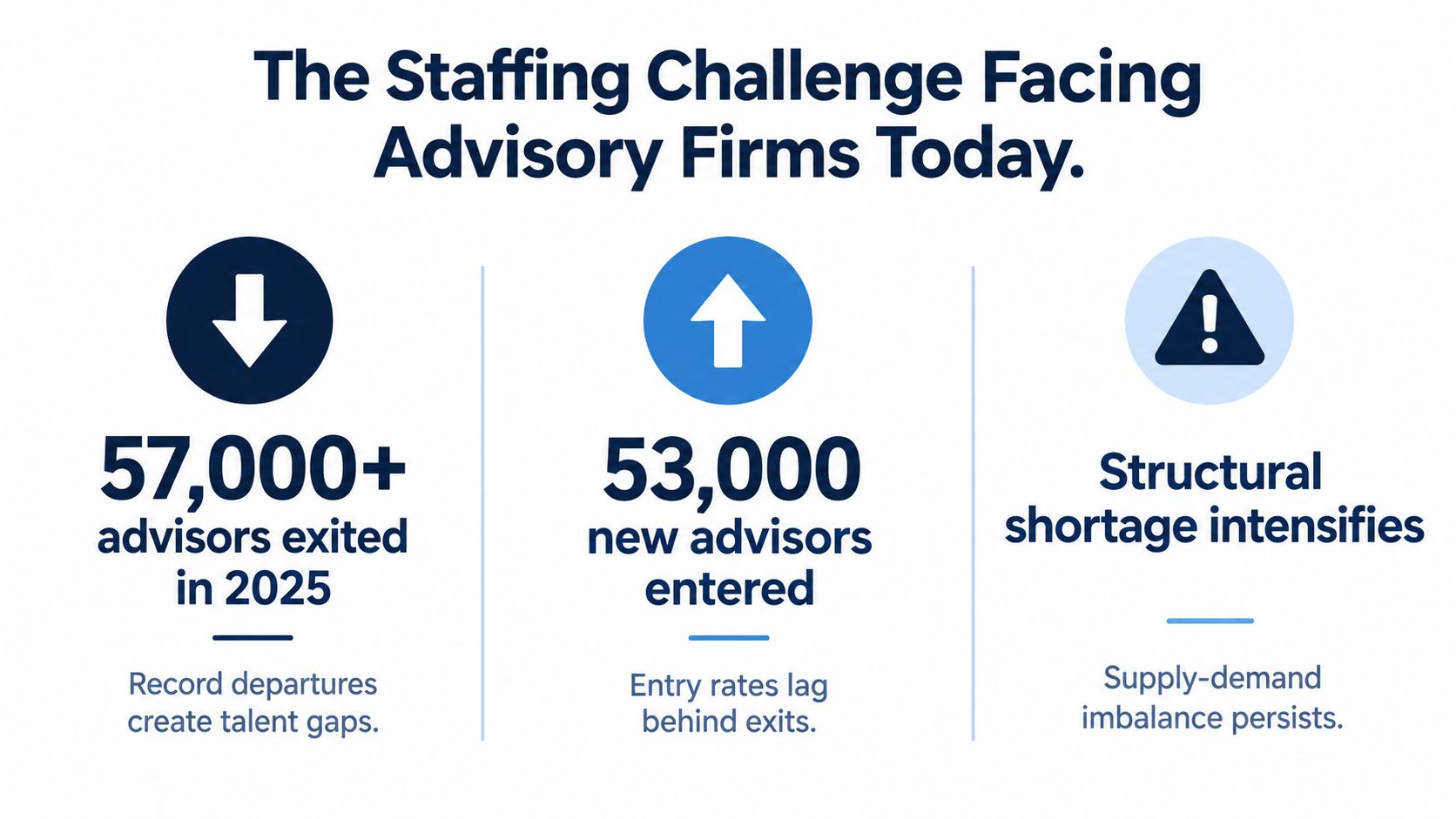
More than 57,000 U.S. financial advisors exited the profession in 2025, while fewer than 53,000 entered it, according to a recent analysis of advisor talent trends. The analysis also reports that 93% of surveyed hiring managers struggled to find skilled candidates across finance, risk, technology, and compliance. For a smaller firm, one departure can reduce a significant share of client-service capacity, making reactive hiring a weak continuity plan.
Why traditional hiring fails
A job advertisement can attract someone who matches the title but not the firm's operating requirements. An advisor may bring sales experience without the judgment needed for a particular client segment. An operations candidate may understand workflows but not supervisory procedures. A technology hire may know automation yet lack experience with privacy, records, or escalation controls.
Effective staffing starts with a defined role. Separate growth positions from backfills, document the workflows each hire will own, and identify evidence of readiness before interviews begin. That process also exposes succession gaps while there is still time to address them.
Practical rule: A qualified shortlist is more valuable than a fast first candidate.
Staffing support solutions become business infrastructure when they protect client continuity, create a credible succession path, and make compliance expectations clear before the hiring decision.
Comparing Staffing Support Models for Financial Firms
No single staffing model serves every advisory firm. The right choice depends on hiring volume, role sensitivity, internal expertise, and the management responsibility the firm can absorb. The decision should also protect workforce continuity, not merely fill the next vacancy.
Financial-services employers face replacement and expansion demand. 93% of surveyed hiring managers reported difficulty finding skilled candidates in finance, risk, technology, and compliance, while 68% said they were hiring for both newly created and vacated roles, according to financial-services employment research. Those demands require separate plans for growth hiring, backfills, and succession coverage.
A practical comparison
| Staffing Model | Best For | Control Level | Time to Hire | Compliance Oversight |
|---|---|---|---|---|
| In-house recruiting team | Sustained hiring across practices or offices | High | Depends on internal capacity | Directly managed by the firm |
| Specialized recruiting agency | Hard-to-fill regulated and specialist roles | Shared | Usually faster than building a new pipeline internally | Requires clear screening standards and firm review |
| Contract or temporary talent | Seasonal work, defined projects, leave coverage, and trial arrangements | Moderate | Flexible and often faster for urgent capacity | Firm remains responsible for supervision and access controls |
An internal team offers the strongest cultural knowledge and direct control over candidate communication. That control requires recruiting expertise, systems, training, and enough recurring hiring to justify fixed overhead. It can also support succession planning because recruiters remain close to managers, role changes, and future capability needs.
A specialized agency provides market access and targeted sourcing without a permanent recruiting department. The trade-off is oversight. The firm must test the agency's understanding of registration, supervision, confidentiality, access restrictions, and candidate ownership terms. Firms hiring for technology or operational roles can also hire tech talent with GENTY recruitment, while retaining responsibility for internal approval and regulated-role assessment.
Contract talent adds capacity for defined projects, seasonal workloads, leave coverage, and trial arrangements. It is less suitable for client-facing positions built on long-term trust unless supervision, system access, handover duties, and client communication are clearly assigned. The firm remains accountable for how temporary personnel operate within its controls.
In-House Recruiting Teams and Their Trade-offs
An internal recruiting team makes sense when a firm hires regularly across several functions and can maintain clear ownership of the process. Recruiters develop working knowledge of how the organization serves clients, how managers make decisions, and which requirements matter in practice. That context improves hiring decisions, but it comes with fixed cost and operating responsibility.
Internal knowledge strengthens intake meetings and candidate evaluation. A recruiter who understands the difference between an associate advisor, lead advisor, service specialist, and compliance analyst can challenge vague job descriptions before they attract unsuitable applicants. The team can also record why roles changed, which capabilities are scarce, and where future coverage gaps may emerge.

Where internal control helps
Internal recruiters can work directly with compliance, operations, and hiring managers. They can maintain approved interview guides, document selection criteria, restrict access to candidate information, and preserve records needed for consistent decisions.
That control also supports workforce continuity. Recruiters who stay close to managers can identify potential successors, track changing role requirements, and keep relationships active before a departure creates pressure. Candidates receive direct answers about decision rights, advancement, technology, supervision, and client responsibilities.
Where internal teams struggle
The commitment is substantial. The firm funds recruiter capacity, applicant-tracking infrastructure, sourcing activity, process documentation, and ongoing compliance education. A small team can become overloaded when several roles open together or a specialist search requires market access it has not built.
Internal teams may also repeat established assumptions, favoring the same credentials, employers, or career histories after the role has changed. Under deadline pressure, vacancy closure can displace succession planning and careful assessment of regulated-role risk.
A hybrid model addresses both constraints. Internal leaders keep authority over role design, interviews, approvals, and final selection. A specialist partner adds sourcing reach during difficult searches or concentrated demand, while the firm retains control of compliance decisions, candidate records, and long-term workforce planning.
Outsourced Recruiting Agencies for Advisory Talent
An outsourced recruiting agency earns its place when an advisory firm needs access to candidates beyond its existing network or lacks the capacity to run a sensitive search properly. A capable partner does more than forward résumés. It clarifies the role, tests the judgment required in practice, and shows how the candidate would operate within the firm's governance, service, and reporting structure.
The assignment should reflect the business risk behind the vacancy. Replacing a departing advisor may require relationship transfer, knowledge capture, and a succession plan that protects client continuity. Hiring for a new service line calls for a different review of market-development ability, operational support, and supervisory capacity. Using one brief and assessment method for both searches can leave material gaps.
What a specialist should understand
A credible partner should be able to examine:
- Registration alignment: Whether the candidate's registration and oversight history fit the firm's regulatory structure.
- Workflow relevance: Whether the candidate has worked within documented procedures, not just held a similar title.
- Client-service judgment: How the candidate handles escalation, suitability concerns, sensitive information, and difficult conversations.
- Retention conditions: Whether the firm can provide mentorship, authority, development, and a credible long-term path.
The agency's commercial model affects the work it can support. Contingency terms may suit a clearly defined search with an available candidate pool. Retained or phased arrangements may be more appropriate for confidential senior hiring, difficult markets, or succession-sensitive appointments. Compare fees with vacancy cost, manager time, compliance exposure, and the consequences of a failed placement.
Technology capability now belongs in any serious assessment of advisory talent. A global survey of finance leaders identified AI and automation as the leading required skill, followed by data analysis and technology integration. Recruiters should therefore test both regulated-finance competence and the candidate's ability to use technology responsibly within approved controls.
The partner creates measurable value by improving shortlist quality, reducing avoidable hiring risk, and supporting continuity, not by increasing the number of résumés delivered.
Contract and Temporary Talent for Seasonal Needs
Temporary staffing is not a shortcut around workforce planning. It works when the assignment has a defined scope, an accountable manager, and a documented end point. Leave coverage, operational backlogs, service-line launches, technology implementation support, and seasonal client onboarding can all justify contract talent when the firm protects continuity from the start.
Temporary workers are a meaningful part of the labor market. Federal labor data on temporary help services reports that temporary workers represented approximately 2% of total U.S. nonfarm employment in 2018, up from 1.7% in 2008. Temporary employment also increased by about 75%, or roughly 1.3 million jobs, during that period.

How to control temporary-workforce risk
Before work begins, assign a named supervisor, specify permitted system access, document confidentiality obligations, and define the exit process. Provide training and oversight appropriate to the assignment. Temporary status does not reduce the firm's duty to protect client information, maintain records, or enforce supervisory procedures.
The handoff also needs a plan. Require documented processes, status notes, and identified owners for unresolved work so a contractor's departure does not interrupt client service or leave a control gap.
Contract-to-hire arrangements let managers assess performance and working style before extending a permanent offer. Written conversion terms, performance criteria, and knowledge-transfer requirements should govern the arrangement.
Firms considering external capacity for contract assignments can review Synopsix on contract recruiters. The relevant test is whether temporary talent adds controlled capacity without unmanaged access, fragmented accountability, or knowledge loss. That standard supports continuity and succession planning, not merely faster hiring.
Hiring Timelines and Recruitment Processes
Hiring timelines vary by role, candidate scarcity, approval requirements, and intake quality. A permanent advisor or compliance professional may require a deliberate search, multiple interviews, registration review, references, and offer negotiation. A defined operations assignment can move faster when the firm has documented the work and approval path.
Measure the process by time-to-qualified-shortlist, not time-to-first-candidate. A candidate who lacks regulatory familiarity or sound client-service judgment adds work without reducing risk. Clear hiring stages also protect workforce continuity and give leaders better information for succession planning.
A disciplined hiring sequence
- Define the business reason. State whether the position supports growth, replaces a departing employee, protects a critical workflow, or tests a new capability.
- Set evidence requirements. Identify practical exercises, scenario questions, work samples, or registration checks that demonstrate readiness.
- Screen for operating judgment. Test how candidates handle escalation, confidential information, documentation, and competing client priorities.
- Coordinate decision-makers early. Compliance, operations, and the hiring manager should agree on approval gates before final interviews.
- Measure post-hire outcomes. Track retention, onboarding performance, work quality, and integration into supervisory procedures.
The financial advisor recruiting resource can help firms frame recruiting around role fit and operating requirements rather than vacancy speed alone.
Demand for advisory talent remains sustained. Federal projections cited in financial advisor job outlook data indicate 10% projected employment growth from 2024 through 2034 and about 24,100 openings annually, including new positions and worker replacements. Firms that wait until a departure becomes urgent will compete under less favorable conditions, with fewer options for orderly handover and succession coverage.
Compliance and Regulatory Hiring Requirements
Hiring capacity does not automatically produce growth. In a regulated firm, the wrong appointment can create supervisory gaps, access risks, and a weak handover. Role fit must account for the firm's registration model, reporting lines, permitted activities, and succession needs.
Industry snapshot data reported 309,405 registered representatives in 2023, while separate categories identify investment adviser representatives registered only as IARs and overseen by federal or state regulators, as shown in the industry snapshot. These categories are not interchangeable. Registration history and prior oversight should match the authority the position carries.
The screening process should leave an auditable record:
- Verify registration status: Confirm current and historical registrations, relevant jurisdictions, and supervision arrangements.
- Review employment history: Examine unexplained gaps, disciplinary matters, conflicts, and duties that differed materially from the job title.
- Test procedural judgment: Use scenarios involving privacy, suitability, recordkeeping, complaints, escalation, and marketing review.
- Document selection criteria: Keep approved requirements, interview notes, assessment results, and the reasons for the decision.
- Control access at onboarding: Provide only the systems and data required for the role, then expand access through documented approval.
- Schedule continuing training: Include contract personnel when their duties expose them to client information, regulated activity, or firm procedures.
A technically impressive candidate may still fail the operating test. The practical question is whether the person can follow documented supervisory procedures consistently, raise concerns promptly, and support an orderly transfer of responsibility.
Firms reviewing role fit and hiring requirements can consult this financial advisor hiring guidance. Compliance should participate before interviews reach the final stage, not act as a late approval point after business leaders have committed to a preferred candidate. That timing protects continuity and keeps compliance risk from being treated as an administrative afterthought.
Specialized Recruiters Versus Generalist Agencies
A generalist recruiter can source candidates effectively and still misread what a financial-services role requires. An RIA, bank, and wealth-management platform may use the same title for positions with different authority, registration, supervision, and client responsibilities. That mismatch can create hiring risk long after the vacancy is filled.
Specialized recruiters bring operating context to the intake process. They clarify whether the role will generate business, manage relationships, support producers, govern operations, or protect a control process. They can also challenge requirements that exclude capable candidates without improving performance. The best partners assess whether a hire will support workforce continuity, preserve institutional knowledge, and fit the firm's future succession needs.
Questions that reveal real expertise
A firm should ask a prospective partner:
- Which regulated roles are most familiar to the team? The answer should identify specific functions and responsibilities, not rely on broad industry labels.
- How are candidates assessed? Look for structured interviews, evidence-based screening, registration review, and documented selection criteria.
- What happens after placement? Clarify communication expectations, performance follow-up, escalation routes, and how the partner handles an unsuitable hire.
- How is quality defined? A strong partner tracks retention, performance, acceptance, and role fit rather than résumé volume alone.
Technology raises the value of specialist judgment. Only 16% of organizations were considered well equipped for generative AI, while 61% were actively hiring to close that gap, according to financial-services technology workforce reporting. For an AI-enabled compliance or operations role, the recruiter should test whether candidates can document AI-assisted work, protect confidential information, validate outputs, and escalate uncertainty.
Credentials open the conversation. Evidence of safe, effective performance earns the offer.
Building a Workforce Continuity Strategy
A staffing plan should identify roles with succession value before a departure creates pressure. That gives the firm time to develop internal candidates, document operating knowledge, and recruit for future responsibilities instead of replacing a title after the fact.
The risk is measurable. An estimate indicates that roughly 37.4% of advisors, or about 105,887 people, may retire within a decade, while more than one-quarter reportedly lack a succession plan, according to the advisor talent analysis. Those figures describe a continuity problem, not merely an open requisition.

The continuity framework
Map succession value. Identify roles connected to client relationships, revenue knowledge, institutional processes, and ownership transition. A departing producer and an operations specialist may both need replacements, but the client, regulatory, and knowledge-transfer risks will differ.
Create visible career paths. A documented route from client-service associate to lead advisor gives junior employees a reason to stay and gives senior professionals a structure for transferring responsibility.
Pair knowledge with people. Junior hires should work alongside retiring producers or experienced operators. During that overlap, document client history, decision logic, service standards, and relationship practices rather than relying on informal conversations.
Measure continuity outcomes. Track 12-month, 24-month, and 36-month retention, time to revenue contribution, client-transfer completion, and handoff quality. These measures show whether staffing support is strengthening resilience or merely closing requisitions.
Adding headcount without mentorship, authority, and a credible path to partnership can increase risk rather than reduce it.
A smaller practice may not need a large internal recruiting function. It still needs continuity discipline, documented ownership, and a plan for knowledge transfer. A staffing partner should distinguish between filling a seat and preparing the firm to operate when a key professional reduces responsibilities, retires, or leaves unexpectedly. That distinction is where transactional recruiting ends and strategic staffing support begins.
Evaluating and Selecting Staffing Partners
A low fee is irrelevant if a vacancy stays open, a candidate fails compliance review, or a new hire leaves after discovering that the role was misrepresented. Evaluate staffing partners against operating risk, role fit, and continuity requirements before comparing fees.
Start with the position, then set the weighting. A technology implementation role calls for technical screening. A client-facing advisor role requires relationship judgment and succession awareness. A compliance appointment demands evidence of documentation discipline, escalation judgment, and respect for supervisory controls.
Use these questions during partner selection:
- Financial-services specialization: Can the partner discuss RIA, banking, advisory, operations, and compliance roles in practical terms?
- Screening depth: Does its process test competencies, registration fit, judgment, and communication rather than relying on titles or credentials?
- Quality evidence: Can it explain how it reviews interview-to-offer performance, acceptance, retention, and post-hire productivity?
- Continuity support: Does it separate a backfill from a growth hire and help define knowledge-transfer responsibilities?
- Operating reach: Can it handle the firm's locations, hiring volume, and role complexity while maintaining consistent standards?
- Commercial protection: Are replacement terms, candidate ownership, confidentiality, and communication duties documented clearly?
Require evidence, not assurances. Ask for anonymized examples of difficult searches, failed placements, compliance-sensitive roles, and post-hire follow-up. A partner that only reports requisitions closed may be optimizing speed rather than workforce stability.
Skills-based recruitment is becoming a material operating requirement. A 2025 sector report states that 75% of financial-services firms were already using AI in 2024, with another 10% planning adoption within three years, according to sector skills research in the Future Skills Report. Partners should assess practical capability instead of relying mainly on degrees, job titles, or prestige.
For distributed or cross-border capacity, Latam staffing may enter the research process. Validate confidentiality, jurisdiction, supervision, access controls, and handoff ownership separately.
When to Engage a Specialized Recruiting Firm
Engage external recruiting support when the internal process cannot maintain hiring quality without slowing growth or consuming managers' time. The decision usually follows a practical trigger: simultaneous openings, scarce technical and regulatory skills, a confidential succession search, or a role involving AI-enabled compliance or advanced analytics. In regulated firms, speed matters, but continuity and controlled risk matter more.
Demand is likely to remain strong. Federal industry projections show the U.S. finance and insurance sector growing 3.4% between 2024 and 2034, while securities, commodity contracts, and related financial investment activities grow 6.0%, according to federal industry projections. Recruiting capacity therefore belongs in growth planning. A firm that waits until a senior employee resigns may lose client knowledge before a replacement can be assessed, approved, and brought into the role.
Look for these operating signals:
- Managers are sourcing after hours: the vacancy is consuming leadership capacity and delaying existing work.
- Candidate quality is inconsistent: interviews take time but produce few viable finalists.
- The role is highly specialized: internal contacts do not reach candidates with the required technical and regulatory combination.
- Several roles compete for attention: a small team cannot apply equal rigor to every search.
- Succession is sensitive: discreet outreach, documented handoffs, and continuity planning are required.
- The hiring process lacks measurement: the firm cannot identify which screening stage improves quality or where candidates withdraw.
Internal recruiting remains suitable for repeatable, high-volume hiring with standardized qualifications and active manager participation. A specialized partner earns its place when the role is unusual, an error carries compliance or client-service consequences, or the firm needs a durable talent pipeline rather than a quick placement.
Staffing Support Solutions Frequently Asked Questions
What should a firm pay for specialized recruiting?
Fees reflect role complexity, search structure, seniority, and commercial model. Compare them with vacancy costs, manager time, compliance exposure, and the consequences of a poor hire. A lower fee offers little value if candidates are weak or the firm must handle each screening stage itself.
How long does regulated hiring take?
Timing depends on sourcing difficulty, interview availability, registration review, references, and internal approvals. Set expectations around a qualified shortlist and completed compliance review, rather than a résumé delivery date.
Do contract workers need compliance screening?
Yes, if duties involve client information, regulated activity, firm systems, or supervised workflows. Temporary status does not remove background checks, confidentiality controls, training, access limits, or documented oversight.
How should partner performance be measured?
Measure shortlist quality, interview-to-offer conversion, offer acceptance, retention, onboarding performance, and integration into supervisory procedures. For succession-sensitive roles, track knowledge transfer and client-transition completion.
What signals a weak partner?
Generic screening, weak registration knowledge, pressure to accept the first candidate, an undocumented selection process, and no clear post-placement support indicate risk. A partner should explain how its work protects continuity, compliance, and succession, not only how quickly it fills a vacancy.
Advisor Momentum provides recruitment support for advisory, operations, and compliance functions. Its approach aligns candidates with firm culture, operating needs, and long-term retention. Firms planning a regulated hire or workforce continuity program can visit Advisor Momentum to discuss a practical staffing approach.
