
A familiar client call usually starts this way. There's extra cash in a bank account, year end is approaching, and the client wants a quick answer on whether it should go into an IRA. The problem is that a quick answer is often the wrong answer.
For advisors, traditional IRA rules aren't difficult because the headline limits are hard to memorize. They're difficult because the correct recommendation depends on earned income, workplace plan coverage, filing status, deductibility, timing, and how today's decision affects future distributions. A contribution can be allowed but not deductible. A delayed RMD can be legal but tax-inefficient. A well-meant withdrawal can solve a family need while still creating an avoidable reporting problem.
That's why the best client conversations don't stop at “yes, you can contribute.” They move to “here's why this works, here's where the trap is, and here's how to document it correctly.”
Table of Contents
- Navigating the Foundation of Retirement Planning
- Who Can Contribute and How Much
- Understanding Contribution Deductions and Phaseouts
- Managing Withdrawals Penalties and Exceptions
- Mastering Required Minimum Distribution Rules
- Advanced Strategies for Rollovers and Roth Conversions
- Your Compliance and Client Conversation Checklist
Navigating the Foundation of Retirement Planning
A client in peak earning years asks whether an IRA contribution makes sense. The account balance is healthy, cash flow is strong, and the client already participates in an employer plan. On the surface, that sounds easy. In practice, it opens several compliance questions at once.
The advisor has to determine whether the client has enough taxable compensation, whether a contribution will be deductible, whether the spouse's plan coverage changes the outcome, and whether the client is using the IRA as a savings tool, a tax tool, or both. Those aren't academic distinctions. They change what gets recommended, how it gets reported, and whether the client later faces avoidable tax friction.

Some clients are really asking a broader allocation question. If they're weighing hard assets against tax-deferred retirement savings, a useful framework is comparing Gold and Traditional IRAs, especially when the conversation turns to volatility tolerance, liquidity expectations, and retirement account structure rather than just contribution mechanics.
Practical rule: The advisor's first job isn't to quote a limit. It's to identify what problem the client is trying to solve.
Traditional IRA rules matter because they force discipline around that distinction. They separate eligibility from deductibility, tax deferral from tax elimination, and legal timing from smart timing. Advisors who treat the IRA as a simple annual checkbox often miss planning opportunities. Advisors who treat it as a compliance workflow tend to give better advice.
That workflow starts with contribution eligibility, then moves to deduction analysis, then to downstream consequences. Every step has a purpose. The rules exist to tie tax benefits to earned income, prevent duplicate tax advantages, and ensure deferred tax eventually returns to the tax system through distributions.
Who Can Contribute and How Much
The most reliable way to handle traditional IRA rules is to stop thinking about the annual limit first. Start with whether the client is eligible to contribute at all, then test the amount.
Under the IRS rules for 2026, the maximum annual contribution to a traditional IRA is $7,500 for individuals under age 50 and $8,600 for those age 50 or older, reflecting a $500 increase from the 2025 limit of $7,000. The same IRS guidance also states that the contribution can't exceed the taxpayer's taxable compensation for the year, and the combined total across traditional and Roth IRAs is capped at those amounts per person. It also confirms that the old age limit is gone because the SECURE Act eliminated the prior rule that blocked contributions after age 70½. See the IRS explanation of traditional and Roth IRA contribution rules for 2026.
Start with compensation, not the limit
That taxable compensation rule is where many preventable errors begin. Advisors often hear “the client has the cash,” but cash on hand doesn't establish contribution room. Compensation does.
If a college student earns wages from a part-time job, that student may be eligible to contribute, even if the earnings are modest. If a semi-retired client has consulting income, that client may still contribute, even at an advanced age. If a client's income is primarily from investments, though, the presence of account assets doesn't create IRA contribution eligibility.
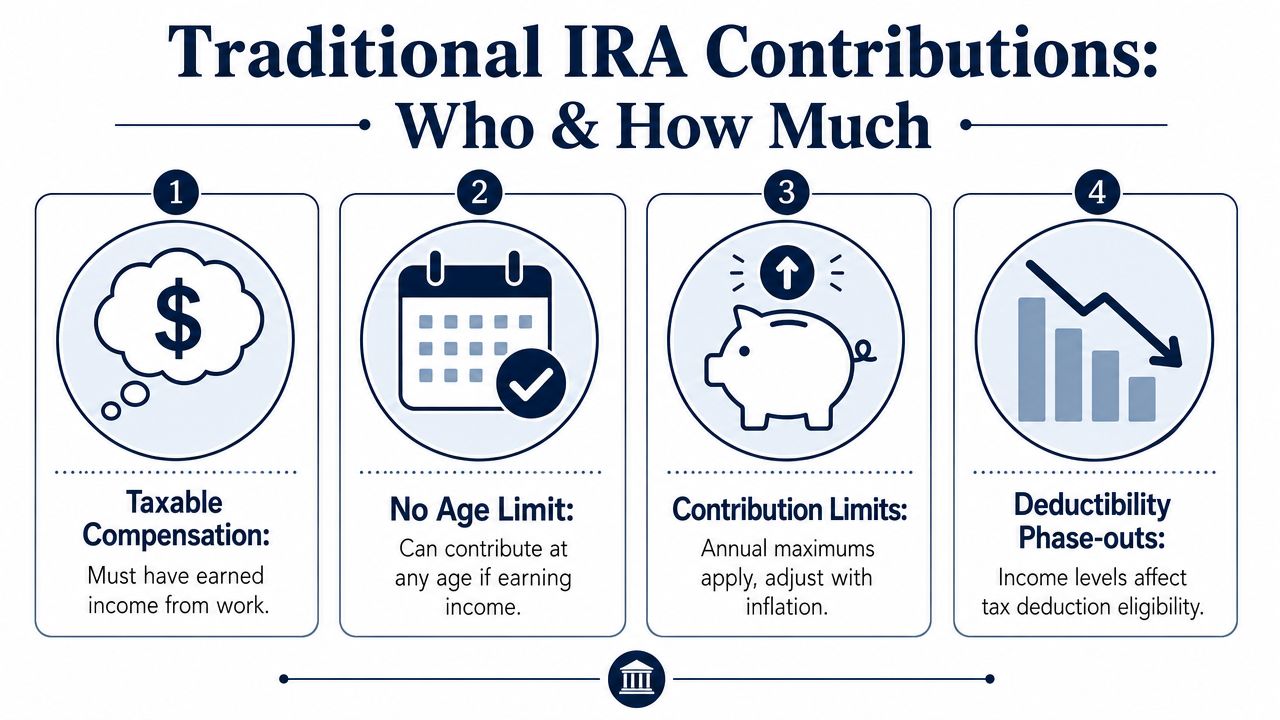
A clean advisor workflow usually looks like this:
- Confirm taxable compensation: Review whether the client has compensation that qualifies for IRA purposes.
- Apply the age-based limit: Use the correct 2026 threshold for under age 50 or age 50 and older.
- Aggregate across IRAs: Verify that the client isn't exceeding the combined annual cap across traditional and Roth IRAs.
- Document the basis for the recommendation: Keep support in the file for income, account type, and timing.
For clients balancing an IRA decision against salary deferrals, it's often useful to place the IRA discussion alongside broader retirement plan funding choices, such as this guide on how to invest in a 401(k).
Common fact patterns that create errors
The highest-risk scenarios usually aren't exotic. They're routine.
- Young earners with low wages: A client may want to contribute the full statutory maximum, but if compensation is below that amount, the contribution is capped by earnings.
- Older working clients: Some advisors still carry forward the outdated assumption that age blocks eligibility. It doesn't, as long as there's earned income.
- Households using both IRA types: The client may say “one traditional, one Roth,” but the annual cap applies across both, not separately.
- Cash-rich, income-light clients: Brokerage income, dividends, and capital gains may create liquidity, but they don't substitute for taxable compensation for contribution purposes.
A contribution recommendation should be supported by payroll facts, not by available cash or account preference.
The reason behind these rules is straightforward. Congress permits the tax advantage because the account is tied to work-related compensation and retirement savings behavior. That's why a client with wages can contribute at any age, while a client with substantial investment income but no qualifying compensation may have no contribution room at all.
From a compliance standpoint, this is one of the easiest areas to operationalize. The advisor should verify income first, record the amount used, confirm aggregate IRA contributions, and only then process funding. That sequence avoids over-contribution problems before they happen.
Understanding Contribution Deductions and Phaseouts
Contribution eligibility answers one question. Deductibility answers a different one. Many clients don't separate the two, which is why this part of the conversation needs precision.
A client may be fully eligible to contribute to a traditional IRA and still receive only a partial deduction or no deduction at all. The trigger is often workplace retirement plan coverage combined with modified adjusted gross income. That's where many advisors either oversimplify or move too fast.
Why deductibility creates confusion
Clients tend to hear “traditional IRA” and assume “tax deduction.” That isn't always true. Deductibility phases out for certain taxpayers who are covered by a workplace plan, and there's a separate rule for a spouse who isn't covered but is married to someone who is.
For 2026, the deduction for traditional IRA contributions is phased out for single taxpayers covered by a workplace retirement plan when MAGI is between $81,000 and $91,000. For married filing jointly where the IRA contributor is covered by a workplace plan, the phase-out range is $129,000 to $149,000. For a spouse not covered by a workplace plan but married to someone who is, the range is $242,000 to $252,000. Those 2026 ranges are summarized by J.R. Martin CPA based on the annual retirement plan limits update.
The practical issue isn't just whether a deduction exists. It's whether the client understands the downstream implications if the contribution is non-deductible. A non-deductible traditional IRA contribution can still make sense, but only if basis tracking is handled correctly.
2026 Traditional IRA Deduction Phase-Out Ranges MAGI
| Filing Status | Covered by a Workplace Plan? | 2026 Phase-Out Range |
|---|---|---|
| Single | Yes | $81,000 to $91,000 |
| Married filing jointly | IRA contributor is covered | $129,000 to $149,000 |
| Married filing jointly | IRA contributor is not covered, spouse is covered | $242,000 to $252,000 |
A useful advisor framework is to sort each client into one of three buckets:
- Fully deductible: Income falls below the applicable phase-out range.
- Partially deductible: Income lands inside the range and requires calculation.
- Non-deductible: Income exceeds the top of the applicable range.
That framing works because it matches how clients think. They want to know whether they get the tax benefit now, later, or not at all.
What advisors should document
The compliance trap here is poor basis reporting. If a client makes a non-deductible contribution and the advisor doesn't flag the recordkeeping requirement, future distributions can be taxed more heavily than they should be.
Advisors should document:
- Plan coverage status: Confirm whether the taxpayer is covered by a workplace retirement plan.
- Filing status and spouse status: The spouse's plan coverage can materially change the deduction outcome.
- MAGI analysis: Keep the calculation support in the file.
- Basis reporting reminder: Non-deductible contributions generally require careful reporting on Form 8606 to prevent double taxation later.
The technical error isn't making a non-deductible contribution. The error is making one without preserving the tax basis trail.
That's also where strategic judgment matters. A non-deductible contribution may still fit when the client wants tax-deferred growth and has no better retirement account option available. It may fit less well when the client assumes an immediate deduction that won't materialize. The advisor's role is to close that expectation gap before the contribution is made, not after the tax preparer raises the issue.
Managing Withdrawals Penalties and Exceptions
A client calls on Tuesday. Closing is Friday, cash is short, and the question is whether the traditional IRA can cover the gap. In that moment, the rule set matters because the wrong answer creates a tax problem, a reporting problem, or both.
Traditional IRA distributions are generally includible in income to the extent they have not already been taxed. For many clients, that means ordinary income treatment on the amount withdrawn. The separate question is whether an additional tax applies because the client took the money before age 59½.
The default rule and the client's primary concern
Early distributions before age 59½ generally face a 10% additional tax unless an exception applies, as described in IRS Publication 590-B on distributions from IRAs. Advisors should treat that rule as the starting point, not the conclusion.
The client's primary concern is usually access to cash. The advisor's concern should be broader. Does an exception apply, what records support it, how will it be reported, and is the IRA the least damaging source of funds?
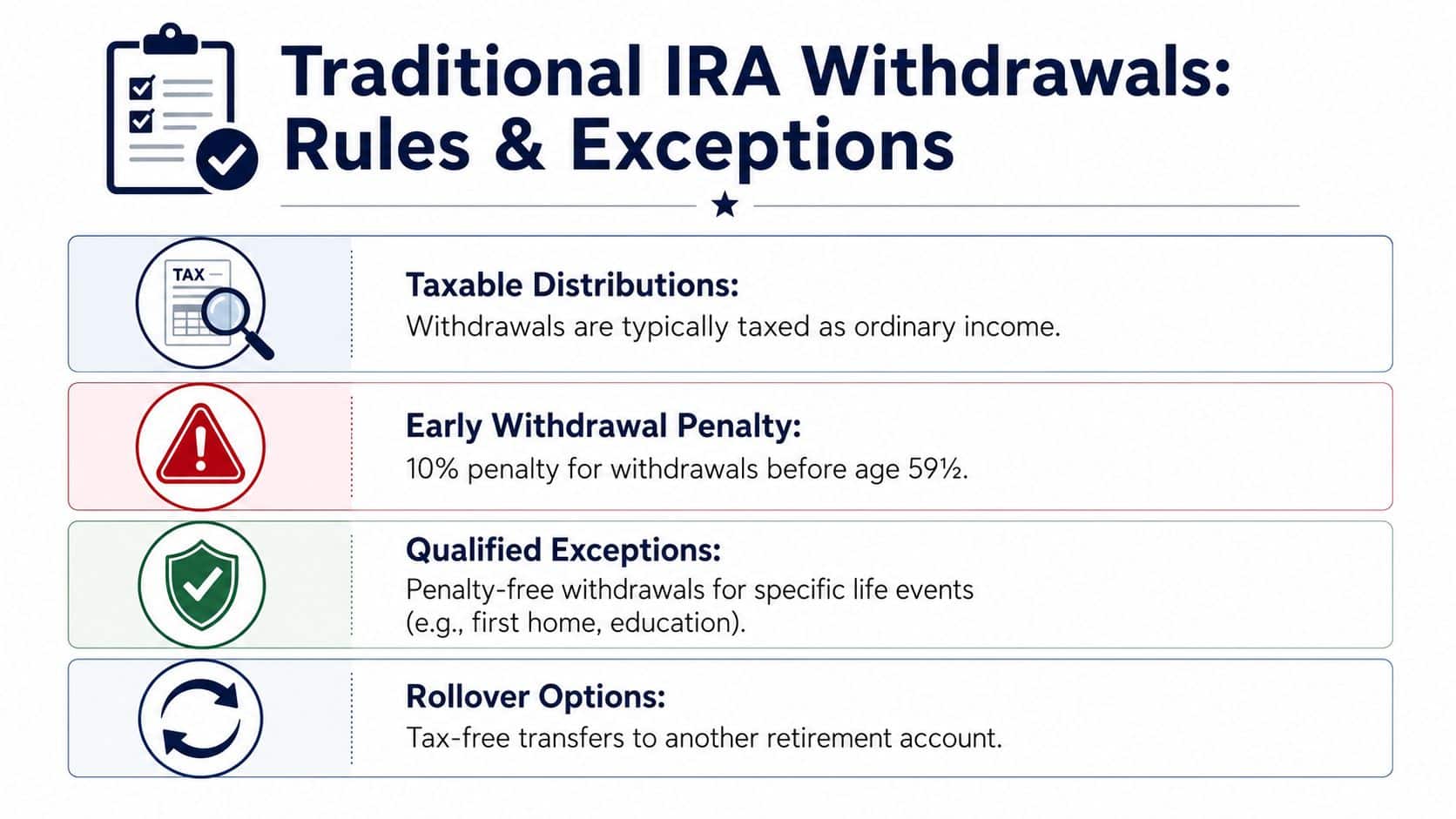
A few exceptions come up repeatedly in practice. A client may avoid the additional tax for a qualified first-time home purchase, subject to the lifetime limit. Certain birth or adoption distributions can qualify. Unreimbursed medical expenses can also matter, but that analysis depends on the client's adjusted gross income and the portion of expenses that clears the threshold.
Those exceptions exist for policy reasons. Congress allowed limited access for major life events and hardship situations, but it did not convert the traditional IRA into a general-purpose emergency account. That is the point many clients miss.
Penalty-free does not mean tax-free.
That sentence belongs in the client file and often in the client email.
Where the exception analysis breaks down
Timing creates many of the mistakes. A home purchase has a closing date. A family dealing with adoption expenses has invoices due now. A client with large medical bills is often making decisions before the tax return is complete. Urgency tends to compress review, and compressed review is where advisors skip the details that matter.
Consider how the analysis changes by fact pattern:
- First home purchase: The exception can reduce the early distribution cost, but only within the permitted amount and only if the facts fit the rule. The distribution is still generally taxable.
- Birth or adoption expenses: The exception may help with immediate liquidity, but the advisor should confirm the distribution timing, the qualifying event, and how the client's tax preparer will report it.
- Medical expenses: Advisors should not approve this exception by instinct. The calculation depends on unreimbursed expenses and AGI, so a rough estimate can produce the wrong answer.
The planning question is often about source of funds, not just eligibility. If taxable assets are available, preserving IRA dollars may be the better long-term choice. If the IRA is the only practical source, the advice should include the income tax cost, the possible additional tax, and the recordkeeping needed to support any exception claimed.
Operational mistakes to prevent
Advisors usually know the broad exceptions. The failures are usually administrative.
- Vague file notes: Document the stated purpose of the withdrawal, the exception being considered, and what support the client has provided.
- Poor tax-return coordination: A valid exception still has to be reflected properly on the return. If the advisor and preparer are not aligned, the client may receive a notice even when the position is correct.
- Assuming hardship equals exception: Many legitimate financial pressures do not fit a statutory exception.
- Ignoring basis issues: If the client has after-tax amounts in any traditional IRA, the distribution may require Form 8606 analysis. That affects how much of the withdrawal is taxable.
One more trap deserves attention. Custodial forms and distribution coding do not replace substantive review. The custodian processes the transaction. The taxpayer still bears the burden of supporting the exception.
A practical review usually comes down to three questions: Is the distribution necessary, does a specific exception apply under the facts, and what does the client need to keep in the file to defend that position later? Advisors who answer all three reduce cleanup work for everyone involved.
Mastering Required Minimum Distribution Rules
A client turns 73, assumes the custodian will handle the distribution automatically, and calls in January after nothing went out. That is a common RMD file, and it is why this part of the traditional IRA rule set causes so much preventable cleanup. The rule itself is not hard. The risk comes from timing, account aggregation, and poor first-year planning.
RMDs deserve a compliance process, not a year-end reminder.
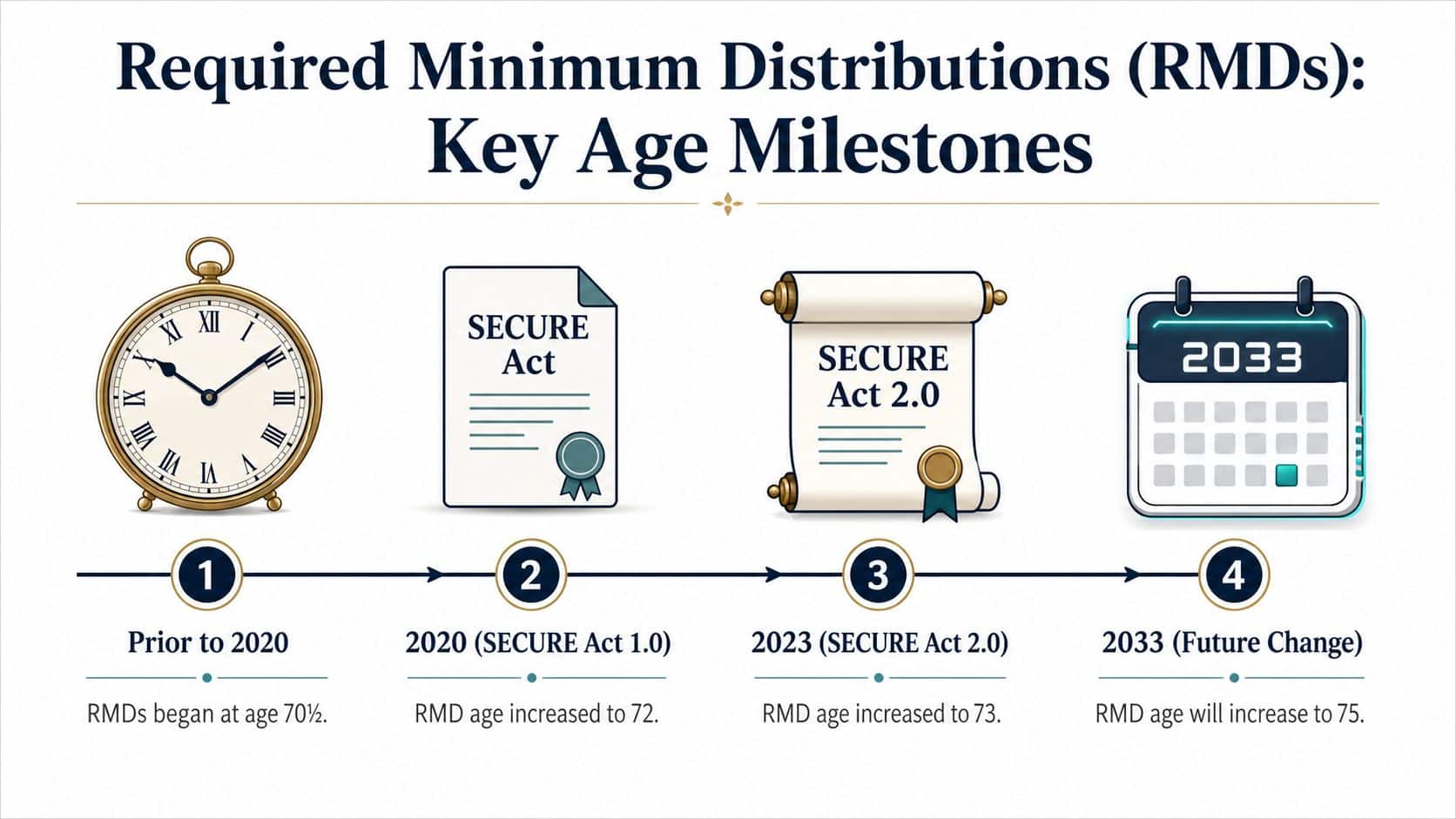
Current law does not use one universal starting age. The SECURE 2.0 changes made birth date review a control point. For traditional IRAs, the required beginning age depends on when the client was born, and the IRS explains the current framework in its retirement topics guidance on required minimum distributions. Advisors who still work from the old age-70 1/2 or age-72 assumptions create avoidable failures.
The practical question is why the rule matters so much operationally. Unlike many IRA errors, an RMD mistake is usually visible after the deadline has passed. At that point, the advisor is no longer planning. The advisor is documenting a correction, coordinating with the tax preparer, and helping the client explain why the shortfall occurred.
How the calculation works in practice
The calculation starts with the prior December 31 account balance and the applicable life expectancy factor from IRS Publication 590-B. The compliance trap is rarely the formula by itself. The trap is using the wrong valuation, pulling the wrong table, or assuming one account's distribution satisfies another account's obligation without checking the aggregation rules.
The IRS explains the tables, aggregation rules, and distribution mechanics in Publication 590-B. That source is the one to keep in the file if a staff member or client asks why the amount looks the way it does.
Three review points catch many of the mistakes I see:
- Confirm the prior year-end balance used for each IRA. Year-end valuation errors carry directly into the RMD amount.
- Use the correct life expectancy table. A wrong factor can understate the withdrawal even when the account balance is right.
- Verify completion, not intent. A requested distribution that settles after the deadline is still a problem.
One more issue deserves attention. Clients often hold both IRAs and employer plan assets, and they assume all retirement accounts follow one RMD method. They do not. Accounts such as 403(b) plans have their own operational rules and plan-level procedures, so advisors should separate the conversation early. A quick refresher on how a 403(b) plan works can help frame that distinction before distribution season starts.
If the full RMD is missed, the excise tax is tied to the shortfall. The IRS instructions for Form 5329 are the right source for reporting that additional tax and requesting relief when the facts support it. That is where process matters. A corrected miss still requires documentation.
The first year trap
The first distribution year creates the planning decision that causes the most confusion. A client can delay the first RMD until April 1 of the following year, but that delay does not move the second year's deadline. The second RMD is still due by December 31 of that same year, as the IRS states in its RMD FAQ guidance.
That means two taxable distributions can land in one calendar year.
The reason this rule exists is administrative, but the planning effect is real. The IRS allows a short first-year delay. It does not give the client a free year. Advisors should explain that clearly because many clients hear “delay” and assume “avoid.”
For some households, the delay is acceptable. For others, it is a poor trade. Two distributions in one year can affect marginal rate exposure, withholding needs, Medicare premium planning, and taxation of Social Security benefits. The right answer depends on the full tax picture, not on whether waiting feels better.
A solid first-year review should cover:
- Birth date and required beginning date: Confirm the client is entering the correct first RMD year.
- Projected taxable income across both years: Test whether doubling up distributions creates avoidable tax friction.
- Cash need versus tax cost: Some clients do not need the funds and still should take the first RMD in the earlier year.
- Withholding and estimated payments: A delayed first distribution can create underpayment issues if no one adjusts the tax plan.
- Account-level execution: Confirm which IRA will fund the total amount and when the cash will leave the account.
The broader point is the "why" behind the rule. RMDs force deferred money back into the tax system on a schedule the client does not control. Good advice starts with compliance, then moves to damage control. The advisor's job is to make sure the required amount goes out on time and to decide whether the permitted timing choice improves the client's tax result or merely creates a larger problem next year.
Advanced Strategies for Rollovers and Roth Conversions
Traditional IRAs aren't only annual contribution accounts. In practice, they also function as consolidation vehicles and staging points for tax planning. That's where rollovers and Roth conversions become useful, but only if the advisor treats them as coordinated decisions rather than isolated transactions.
Rollovers as an operational decision
A rollover often starts as a housekeeping move. The client leaves an employer, has retirement assets in a former plan, and wants one place to manage investments and distributions. That simplification can be valuable, but the advisor still needs to test what the move changes.
Once assets are in a traditional IRA, they sit under the traditional IRA rule set for future distributions, deductions, and planning conversations. For older working clients, one rule that matters is that there's no age limit for contributing to a traditional IRA starting in 2020, provided the client has eligible compensation, and the contribution can't exceed taxable compensation for the year. The Ascensus explanation gives a simple example: if a person earns $6,000 in 2026, the maximum contribution is $6,000 even though the statutory limit is $7,500. That summary appears in Ascensus guidance on traditional IRA eligibility for 2026.
That matters because many clients assume rollover status and contribution eligibility are the same issue. They aren't. A client may roll over assets and still need separate analysis before making a new annual contribution.
For advisors working with education and nonprofit professionals who compare different employer-plan pathways before rolling assets out, this overview of 403(b) basics and planning considerations can help frame the transition discussion.
Roth conversions as a tax management conversation
A Roth conversion changes the tax character of retirement assets. Pre-tax amounts move from a traditional IRA to a Roth IRA, and the conversion amount is generally taxable in the year of conversion. The planning question isn't whether conversions are good or bad in the abstract. It's whether paying tax now is preferable to paying tax later.
That discussion usually becomes more compelling in years when taxable income is temporarily lower, when future RMD pressure looks likely, or when the client wants to reduce future reliance on pre-tax accounts. The traditional IRA becomes the source account, and the advisor uses tax bracket management, cash flow planning, and timing discipline to shape the move.
The main compliance trap is casual execution. A conversion recommendation should account for the client's current tax profile, expected future income, withholding approach, and whether existing IRA basis complicates the tax result. The best conversion conversations are narrow and specific. Broad enthusiasm is less helpful than measured arithmetic.
Your Compliance and Client Conversation Checklist
The best use of traditional IRA rules in practice is to turn them into a repeatable client workflow. Advisors don't need more memorized trivia. They need a defensible process.
A workable checklist usually includes the following:
- Verify compensation before contribution approval: Don't rely on liquidity, account balances, or client assumptions.
- Test deductibility separately from eligibility: A valid contribution isn't automatically deductible.
- Preserve basis records: If a contribution is non-deductible, make sure the tax reporting trail is clear.
- Review withdrawals for both tax and penalty effects: Clients often hear only the part they want to hear.
- Track RMDs by birth date and deadline: Date control is the core compliance function.
- Model first-year RMD timing carefully: Delaying can be lawful and still produce a poor tax result.
- Document rollover and conversion rationale: A clean file should show why the transaction fit the client's facts.
Client conversations also improve when the advisor uses plain language. Instead of reciting rules, explain the reason behind them. The contribution limit exists to tie the benefit to compensation. The phase-out exists to limit deductions for certain higher-income taxpayers with workplace coverage. The RMD rule exists because tax deferral was never meant to last forever.
Strong IRA advice sounds calm because the process behind it is organized.
Operations matter here. Firms that standardize intake, deadline tracking, and document flow usually produce fewer IRA errors. Teams exploring better back-office discipline may find useful ideas in this perspective on revolutionizing financial operations, especially when retirement account workflows are still too dependent on memory and email chains.
One final point belongs on every checklist. Federal IRA treatment is only part of the picture. State tax treatment can differ, and that difference can change how a recommendation should be framed.
Advisor Momentum helps financial advisors, RIAs, and banking teams turn technical topics like traditional IRA rules into compliant, client-ready marketing and educational content. Firms that need SEC-aware website content, branding, SEO, coaching, or recruiting support can learn more at Advisor Momentum.
