
In 2026, 91% of businesses use video as a marketing tool, and 93% say it's important to their overall strategy. Social video is the most common use case, with 69% of video marketers creating it, while about 5.3 billion people use social media worldwide and spend roughly 2 hours and 24 minutes per day on those platforms. (Sprout Social's social video statistics) For financial advisors, that makes video production for social media an operating requirement, not a branding experiment.
The firms that win won't be the ones with the most cinematic footage. They'll be the ones that can turn one approved shoot into platform-native assets without reopening the same compliance questions every time. That requires a documented workflow connecting planning, scripting, filming, editing, review, publishing, and measurement.
Table of Contents
- Why Social Video Is Now a Core Channel for Advisors
- Planning a Video That Survives Compliance and the Algorithm
- Scripting and Storyboarding for Regulated Content
- Shooting Setup That Works for a Lean Team
- Editing, Captions, and Platform-Native Cutdowns
- Running a Compliance Review That Does Not Stall Production
- Distributing, Measuring, and Iterating the Whole System
Why Social Video Is Now a Core Channel for Advisors
The market has moved past the question of whether advisors should use video. Between 2016 and 2026, the share of businesses using video marketing rose from 61% to 91%, a 30-point increase over one decade. In 2026, 69% of video marketers reported creating social media videos, while YouTube remained the most widely used video platform among marketers at 82%. (Siege Media's video marketing statistics)
That shift changes the advisor's distribution problem. Static posts can support a brand, but video gives an advisor room to explain tax planning, retirement income, portfolio risk, estate considerations, or a market event with voice, expression, diagrams, and context. A short clip can create awareness, while a longer explanation can help a prospect decide whether a conversation is worth scheduling.
The operational burden rises with the opportunity. Each published video may require review of disclosures, supporting documentation, testimonial language, performance references, fair presentation, recordkeeping, and supervisory approval. An advisor who shoots first and asks compliance questions later creates avoidable rework. A producer who starts with an approved message map can create several usable assets from the same source material.
Build the channel around reusable approvals
A practical workflow starts with a master concept and a controlled set of derivatives:
- One approved subject: The central claim stays consistent across every cut.
- Several native versions: Each platform receives its own opening, pacing, framing, caption treatment, and call to action.
- One evidence trail: Sources, disclosures, reviewer notes, and final files remain connected.
- One publishing record: The firm logs where each approved version appeared and when.
That structure supports organic distribution, paid retargeting, and ongoing education without treating every export as a brand-new creative project. A useful overview of the broader discipline is this guide to video marketing for social media, particularly for teams building repeatable publishing systems.
The table below should be treated as a planning prompt, not a universal benchmark. Reliable platform-specific static-post comparisons aren't available in the verified data, so any team using it should replace the qualitative entries with its own reviewed account data.
Social Video Reach vs. Static Posts for Advisor Accounts
| Platform | Avg. video engagement | Avg. static post engagement | Share of feed |
|---|---|---|---|
| Track by qualified reactions, comments, and clicks | Track by qualified reactions, comments, and clicks | Platform-specific | |
| YouTube | Track by watch quality and inquiries | Not a primary static-post comparison | Platform-specific |
| Track by retention, saves, shares, and profile actions | Track by saves, shares, and profile actions | Platform-specific | |
| TikTok | Track by retention, shares, and qualified profile actions | Not a primary static-post comparison | Platform-specific |
| Track by retention, comments, shares, and clicks | Track by comments, shares, and clicks | Platform-specific |
The firm's real objective isn't maximum reach alone. It's qualified attention that can move into a compliant next step, such as a direct message, a gated resource visit, or a booked call.
Planning a Video That Survives Compliance and the Algorithm
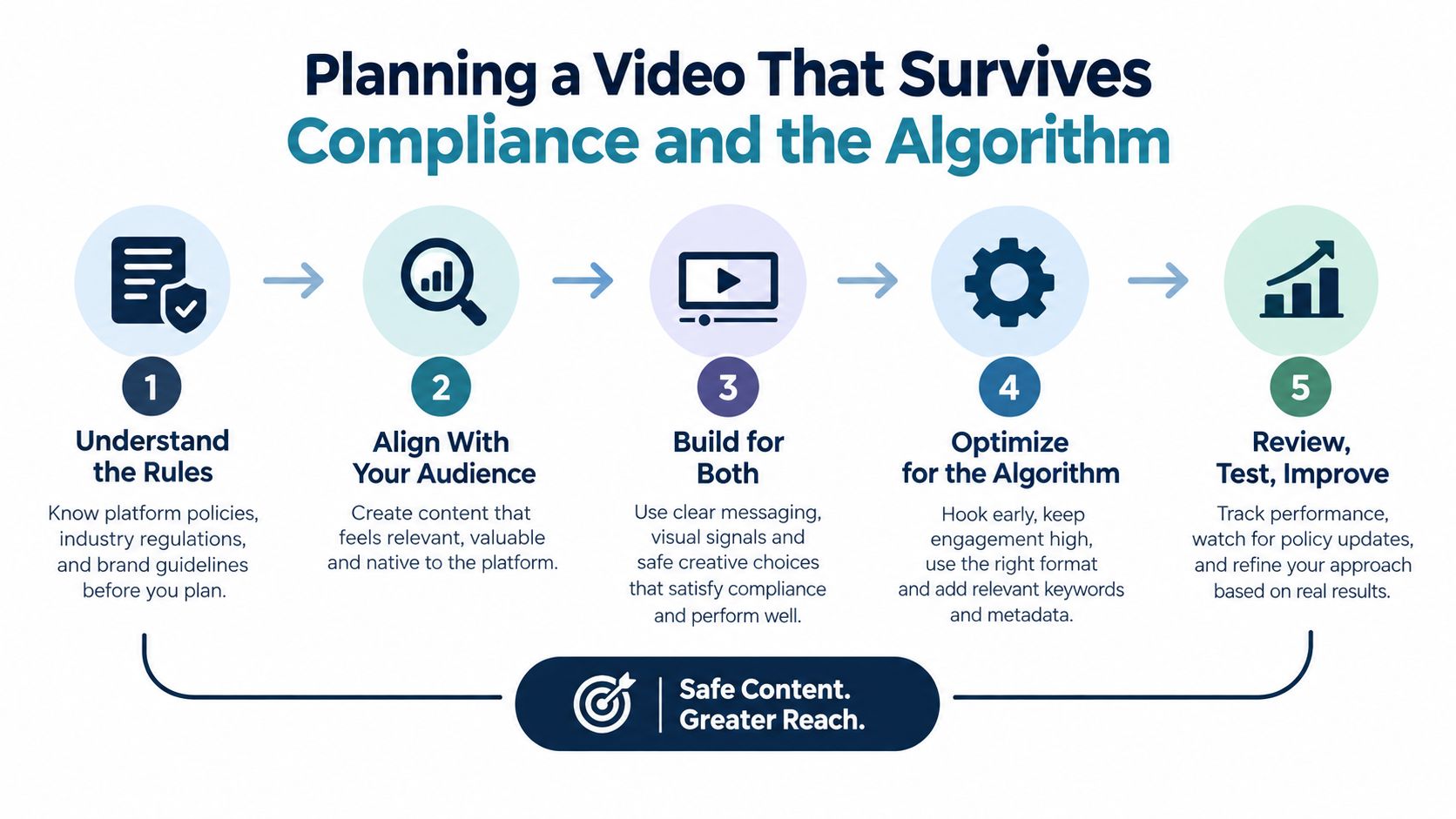
Pre-production should look less like a brainstorm and more like an intake form with consequences. Before anyone turns on a camera, the producer should know the single claim, intended audience, target platform, required disclosure, evidence source, and reviewer.
A working title such as “What rising rates can mean for cash management” is still too broad. The approved concept should narrow the message to one useful point, identify whether the viewer is a retiree, business owner, young professional, or existing client, and specify what the video must not imply. If the idea needs several unrelated claims to feel complete, it's probably several videos.
Use one planning document as the shared source of truth
The document should contain:
- Working title and core claim: One sentence that survives without supporting decoration.
- Approved talking points: The statements the advisor may make on camera.
- Prohibited claims: Guarantees, unsupported comparisons, urgency language, or unapproved tax conclusions.
- Platform targets: Intended channels, aspect ratios, runtime versions, and audience context.
- Disclosure needs: Required language, placement, duration, and any source material.
- Named reviewer: A specific person or committee, not a vague compliance queue.
- Derivative plan: The cutdowns that can be created without changing the approved meaning.
Each field should answer a later review question. The platform field controls framing and captions. The audience field controls suitability context. The evidence field allows a reviewer to verify a claim without searching through an inbox. The derivative plan prevents an editor from improvising new language while creating shorter versions.
Reject weak concepts before the shoot
A concept should be rejected when its value depends on a promise the firm can't substantiate, a disclaimer that would overwhelm the message, or a dramatic hook that changes the meaning once qualified. “This strategy protects every portfolio” fails immediately. “Three questions to ask before changing a portfolio allocation” gives the advisor a useful educational structure without promising an outcome.
The approved plan should then generate the master script, alternate hooks, platform-specific introductions, caption text, and disclosure placements. That's the only sustainable way to publish frequently. Reviewers assess one controlled message, while the production team gets enough material for several native edits.
Scripting and Storyboarding for Regulated Content
The first 3 seconds deserve more attention than the opening logo. Facebook research cited in 2026 benchmarking coverage found that 65% of viewers who watch the first 3 seconds continue to at least 10 seconds, and 45% reach 30 seconds or more. (Retensis audience retention benchmarks)
That makes the opening a retention and compliance decision at the same time. The hook should state a useful problem, show immediate movement, and place readable context on screen before branding or a long introduction. “Before changing a retirement allocation, check this assumption” creates a clear reason to continue without promising a financial result.
Use a five-part script structure
A compliance-ready script can follow this sequence:
- Pattern interrupt: A visual change, direct question, or unexpected but supportable observation.
- Single promise: State what the viewer will understand by the end.
- Supporting proof: Use an approved example, source, chart, or explanation. Avoid unsupported performance language.
- Qualified conclusion: Explain what the point does and doesn't establish.
- Persistent disclosure: Keep required language visible or audible for the duration specified by the reviewer.
The storyboard must show more than camera angles. It should identify the exact frame where performance data, testimonials, risk language, names, credentials, charts, and disclosures appear. If the editor can't locate the claim in the timeline, the reviewer will have to hunt for it. That slows every derivative.
A simple production grid works well:
| Script line | Visual frame | On-screen element | Required review item |
|---|---|---|---|
| Opening question | Advisor in medium shot | Large readable hook | Confirm wording |
| Core explanation | Advisor plus chart | Defined term or label | Verify source |
| Qualification | Advisor returns to camera | Limitation or risk statement | Confirm fair balance |
| Next step | Clean closing frame | Approved CTA and disclosure | Confirm suitability context |
Scripts should avoid hypothetical return promises, celebrity endorsements, and urgency language that can't survive reasonable-basis and fair-balance review. The writing should educate first and sell only through an approved next step.
Teams that need help adapting structure by channel can review these format-specific YouTube scripts, then apply the same approval logic to every platform version.
Shooting Setup That Works for a Lean Team
A lean advisor shoot doesn't need a gear warehouse. It needs consistent inputs. A practical baseline is one mirrorless camera, a 24-70mm equivalent lens, a small LED panel with a diffuser, a lavalier microphone feeding a portable recorder, and a phone used as a monitor.
The camera should capture the widest useful horizontal frame first, with the vertical crop planned inside it. The advisor's face, hands, charts, and essential text must remain inside the 9:16 safe area so later vertical edits don't require a reshoot. This approach preserves flexibility while keeping the master footage visually coherent.
Make lighting repeatable
A home office can support a professional-looking setup when the team controls direction and contrast:
- Key light: Place the LED panel slightly above eye level and off to one side.
- Fill option: Bounce the key off a whiteboard when no second light is available.
- Window control: Flag direct window light with a curtain, foam board, or other opaque surface.
- Background: Remove reflective surfaces, distracting papers, and visible private information.
The background should support credibility without displaying client materials, account screens, documents, or handwritten notes. A clean, repeatable room is more valuable than a complicated set that changes from shoot to shoot.

Treat audio as a compliance asset
Poor audio makes even accurate advice feel unreliable. Place the lav mic under a tie or collar without letting fabric rub against it, capture room tone, and record a 10-second clap for sync. Soft furnishings reduce reflections, while a closed door and temporarily switched-off HVAC remove common background noise.
The pre-shoot check should take 15 minutes:
- Wardrobe: Remove wrinkles, reflective accessories, and distracting patterns.
- Documents: Clear client materials, account details, and confidential notes from view.
- Frame: Confirm horizontal composition and vertical crop safety.
- Audio: Check mic placement, recorder levels, room tone, and backup recording.
- Lighting: Confirm the advisor's face remains consistent through the full take.
- Continuity: Record the same approved opening several times for cutdown options.
This preparation prevents the two problems that most often stall advisor shoots, wrinkled wardrobe and visible client materials.
Editing, Captions, and Platform-Native Cutdowns
The edit should assemble approved material, not reinvent the message. The producer should ingest footage into organized bins by shoot date, speaker, subject, and platform intent, then build one master timeline that preserves the approved script and disclosure structure.
A practical sequence uses a 60 to 90 second master for YouTube and LinkedIn, then derives a 30-second Instagram Reel, a 20-second TikTok, and a 6 to 9 second Shorts teaser from the same timeline. These runtimes are production recommendations, not universal performance rules. The important control is that each shorter version keeps the same approved meaning and doesn't introduce a new claim.
Keep captions inside the reviewed asset
Open, burned-in captions serve viewers who watch without sound and make the video usable in feed environments. A production team can use a 32 to 40px equivalent caption size as a starting point, then verify readability on an actual phone. An SRT upload can support accessibility and indexing, but it shouldn't replace the burned-in treatment when the firm requires captions to remain visible.
Required disclosures belong in the caption stream when the reviewer requires them on screen. Putting a qualification only in the post description creates a mismatch between the spoken message and the viewed asset. Captions must also be proofread, because auto-generated text can distort financial terms, product names, and risk language. An accessibility standard from Oakland specifically requires captions and prefers open captions because auto captions can be inconsistent. (Oakland accessibility guidance for social media)
Reframe, don't recut the approved meaning
Vertical exports require deliberate repositioning. Keep faces, charts, lower thirds, disclosures, and calls to action away from interface overlays. Meta Reels ad creative guidance recommends protecting the top 14%, bottom 35%, and 6% on each side of the frame from important text, logos, and calls to action. (Meta Reels safe-area guidance)
| Platform | Length | Aspect | Safe zone | Export bitrate | Caption type |
|---|---|---|---|---|---|
| YouTube master | 60 to 90 seconds | 16:9 | Center-weighted | 12 Mbps | Open captions plus SRT |
| LinkedIn master | 60 to 90 seconds | 16:9 | Center-weighted | 12 Mbps | Open captions plus SRT |
| Instagram Reel | 30 seconds | 9:16 | Protected center | 9 Mbps | Open captions plus SRT |
| TikTok cutdown | 20 seconds | 9:16 | Protected center | 9 Mbps | Open captions plus SRT |
| YouTube Shorts teaser | 6 to 9 seconds | 9:16 | Protected center | 9 Mbps | Open captions plus SRT |
Vertical video is the standard technical format across major short-form placements, generally using 9:16 at 1080 by 1920 pixels, while platform runtime ceilings vary. (Social media video specifications) Teams can use a reference covering 2026 social media video dimensions when maintaining export presets.
Running a Compliance Review That Does Not Stall Production
Speed in regulated video comes from structure, not shortcuts. A reviewer should receive a complete package that can be checked quickly, while the editor should work only from controlled language and approved assets.
Separate review by risk
A tiered workflow keeps routine education from competing with higher-risk content:
- Tier 1, evergreen education: Use pre-approved language banks for introductions, standard market disclaimers, and recurring calls to action.
- Tier 2, topical commentary: Route current market or legislative discussion through a defined review service level, such as a 48-hour SLA.
- Tier 3, performance and testimonials: Require full committee review for performance data, testimonials, endorsements, comparative claims, and related evidence.
The submission package should contain one review link, time-coded comments tied to script line numbers, and a one-page summary listing every claim, source, and disclosure. When recycling an approved video, include a side-by-side comparison with the prior version. Reviewers shouldn't have to determine whether a change is cosmetic or substantive.
Practical rule: If a reviewer has to search for the source, disclosure, or changed frame, the production system has already failed.
Lock language and version control
A disclosure library lets editors insert pre-approved supers, disclaimers, and CTA language without requesting fresh wording for each cut. The library needs ownership, expiration rules, usage notes, and a clear record of which versions remain active.
Once the final file passes review, lock its final file hash and prohibit last-minute tweaks. A new export with changed captions, timing, b-roll, or wording should return to review rather than replace the approved asset. A shared decision log should record reviewer comments and resolutions, so writers learn which patterns create rework.
Automatic red lines include performance guarantees, unsupported tax positions, cherry-picked returns, and missing suitability context. Advisor Momentum's financial advisor social media compliance guidance can sit alongside the firm's internal policy as a reference point for organizing that process.

Distributing, Measuring, and Iterating the Whole System
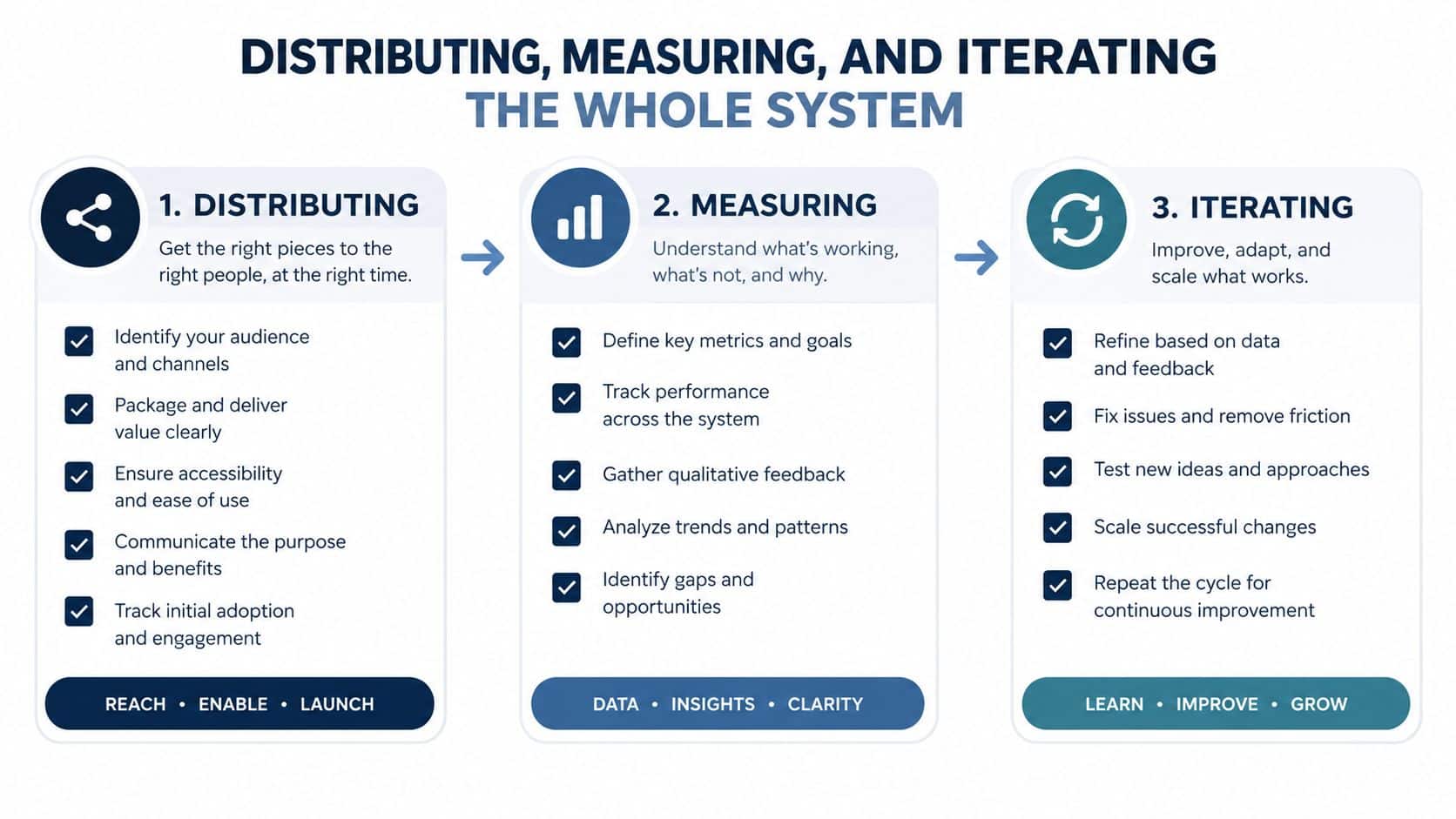
Distribution begins with the approved master file, not with a fresh upload decision. Each derivative should carry a consistent asset name, subject tag, approval date, reviewer record, intended platform, and version identifier. Platform-specific captions can then come from the same approved script instead of being rewritten by whoever schedules the post.
Short-form activity is expanding quickly. Metricool reported a 71% year-over-year rise in published short-form videos and a 51% rise in accounts using the format, with TikTok video posts rising 156% and Instagram volume rising 34.43%. (Metricool short-form video report coverage) The operational implication is straightforward: a firm needs a queue and naming system, not just more ideas.
Measure commercial intent
Views and follower counts can help diagnose distribution, but they don't prove that an advisor reached a valuable prospect. The core KPI set should include:
- Qualified direct messages: Conversations from people who fit the firm's intended audience.
- Booked calls: Appointments attributed to a specific video or campaign.
- Gated-page clicks: Visits that show enough intent to exchange contact information for a useful resource.
- Retention signals: Drop-off points that indicate where the explanation loses clarity.
- Compliance rework: Review comments and rejection reasons that raise future production cost.
The team should review performance on a seven-day cadence and feed the findings into the next script approval. A weak opening may require a new hook, while strong retention paired with poor inquiry quality may indicate an audience or CTA problem. The producer should re-shoot only when the data points to a message, delivery, or framing issue that the existing footage can't fix.
This week's checklist is practical:
- Tag every approved master and derivative by topic, platform, reviewer, and version.
- Schedule the same approved concept across LinkedIn, YouTube, Instagram Reels, and TikTok with native captions.
- Add UTM tracking to destination links and record the associated asset ID.
- Define the platform signal that triggers iteration, such as early retention loss, qualified-message quality, or gated-page clicks.
- Review the results after seven days and send only evidence-backed changes into the next approval package.
Advisor Momentum's financial advisor video marketing services fit this operating model by connecting professional video production with financial education and trust-building content for advisory firms.
Advisor Momentum helps financial advisors, planners, and banking teams produce compliance-aware video, social content, websites, and campaigns built around qualified growth. Visit Advisor Momentum to discuss a repeatable video production workflow that turns one approved shoot into platform-native assets without unnecessary review cycles.
