

A compliance officer has just flagged the finished advisor video. The production team has already booked the studio, approved the edit, and built a campaign around the launch date. Now the script needs changes, the disclosure appears too late, and a client logo in the background may not be cleared for use. The video looks polished, but it isn't ready for distribution.
That situation is avoidable. For advisors, banks, and wealth management firms, video production services should operate as a compliance-aware pipeline, not as a creative project that gets sent to compliance after the final export. Each decision, from the first claim in the brief to the last caption in the master file, affects review, retention, and release.
Table of Contents
- Why Video Production Needs Compliance From Day One
- The Core Stages of a Regulated Video Workflow
- Common Deliverables for Advisors and Banks
- Technical Specs Worth Pinning Down Early
- Pricing Models and What They Mean for Your Budget
- Choosing a Vendor for Financial Video Production
- Compliance Touchpoints Across the Production Timeline
- A Practical Kickoff Checklist for Your Next Video
Why Video Production Needs Compliance From Day One
A finished video can fail review for reasons that have little to do with lighting, sound, or editing quality. A script may imply a performance guarantee. An added interview scene may turn ordinary brand content into a testimonial or endorsement. A client logo may appear on a monitor, presentation, or office wall without documented authorization.
The expensive mistake is treating those issues as final-stage cleanup. Rewriting a script before filming costs less than re-recording an executive. Replacing a storyboard frame costs less than rebuilding a scene. Removing an unsupported claim from a rough cut is simpler than explaining why a campaign launch must move across LinkedIn, YouTube, and email.
The SEC describes advertisement broadly enough to include written or oral communications offering advisory services to more than one person, which makes promotional video part of the marketing review conversation. SEC marketing guidance reinforces the practical point: scripts, on-screen claims, visuals, and disclosures all need a planned review path.
Build a parallel review lane
A regulated workflow should run two tracks at the same time:
- Creative development: The production team creates the brief, script, storyboard, shot list, and edit.
- Compliance review: The designated reviewers examine claims, disclosures, testimonials, endorsements, data references, client permissions, and intended distribution.
- Evidence capture: The vendor preserves approved drafts, comments, releases, source files, and final exports.
- Release control: The firm confirms that the exact approved version is the version scheduled for publication.
That structure reflects a broader compliance by design approach, where regulatory requirements shape the asset before production rather than interrupting it afterward. Firms can review Advisor Momentum's compliance by design resource for a related framework.
Practical rule: If compliance can't approve the message in a written outline, the camera shouldn't roll.
Early review also improves the marketing itself. Compliance questions force the team to replace broad promises with specific explanations, separate education from promotion, and make the intended audience clearer. The result is usually a sharper video because the production team knows what the firm can say, what it must qualify, and what it should leave out.
A specialized hire NJ video production studio can support the creative side, but the financial firm still needs ownership of its review chain, approvals, and records. The vendor should make compliance easier, not create a second system that the firm can't audit.
The Core Stages of a Regulated Video Workflow
A reliable pipeline has four interlocking phases: pre-production, production, post-production, and mastering. Each phase should produce a reviewable handoff, not just internal progress that disappears into a project management system.
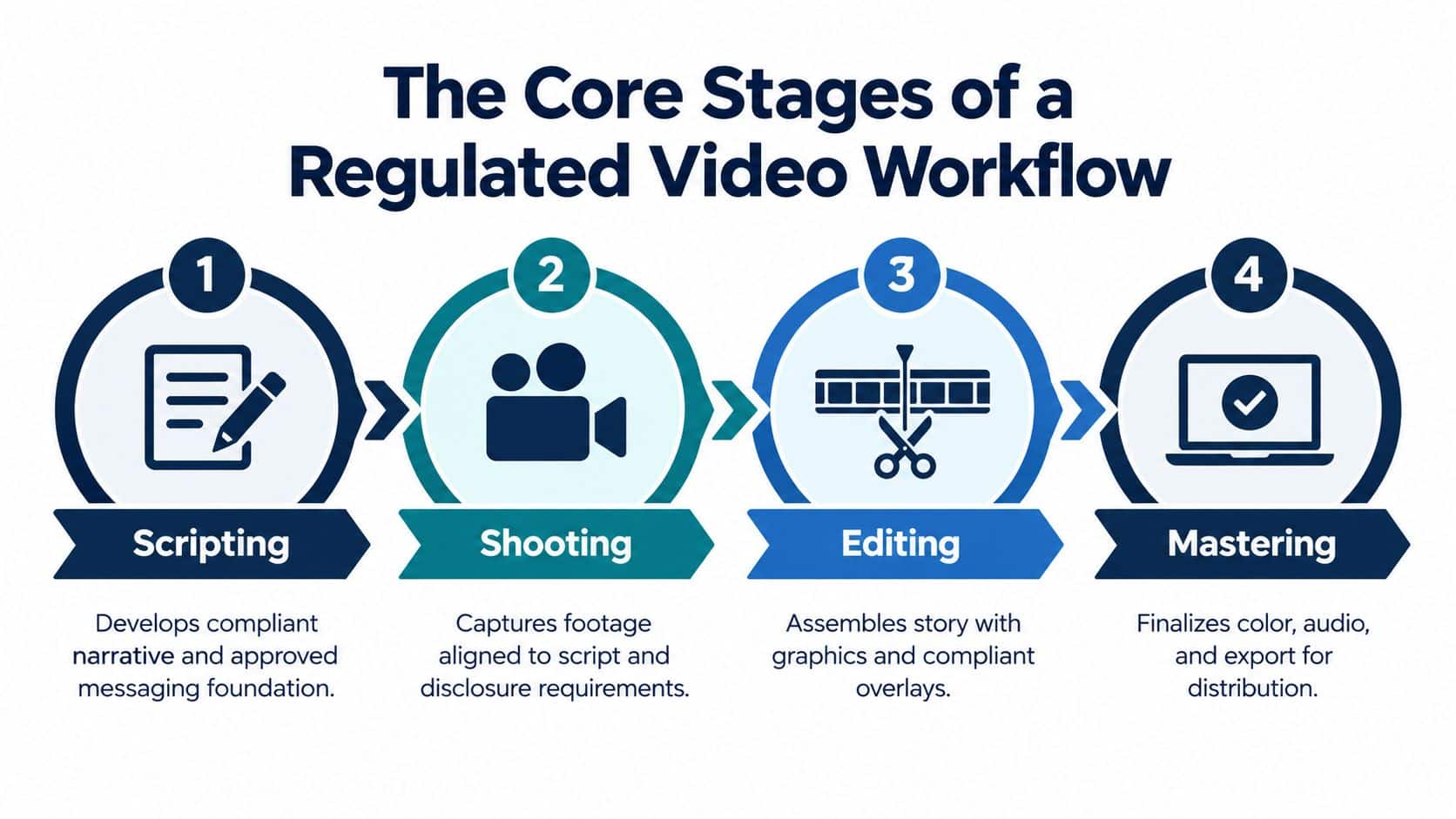
Pre-production creates the approved foundation
The brief defines the product, audience, objective, call to action, distribution channels, and tone. The script then translates that brief into spoken words, on-screen text, visual direction, and disclosure language. A storyboard shows how claims will appear visually, while the shot list identifies locations, talent, graphics, logos, and supporting footage.
Compliance reviewers should receive the brief, script, storyboard, claim sources, disclosure copy, talent plan, and permission status. The vendor should also identify open decisions, such as whether a scene could be interpreted as a testimonial or whether a performance reference needs additional context.
Production captures evidence, not just footage
The shoot should follow the approved script and storyboard. That means the director, producer, and on-set representative need access to the latest approved version. The crew should capture interviews, B-roll, lighting, audio, and backup recordings in a way that lets editors remove or replace individual elements without changing the approved meaning.
Filming without approved disclosure cards is a common shortcut that backfires. So is recording unscripted answers and hoping the edit can make them compliant. A controlled interview structure gives the firm a better record of what was said and lets reviewers compare the final statements with the approved narrative.
Post-production assembles the claim and context
The rough cut establishes structure. The fine cut locks timing, graphics, captions, music, color, and audio. Reviewers should receive versions with timecoded comments, visible version names, and a change log that identifies what moved between drafts.
A vendor should provide the review link, transcript, caption file, graphics list, music license documentation, talent releases, and source references. Those materials help compliance review the video in hours rather than forcing staff to reconstruct production decisions weeks later.
Mastering locks the release version
Mastering is more than exporting a file. The team confirms frame rate, resolution, aspect ratio, codec, captions, audio, thumbnail, filename, and archive package. Mastering should happen after legal and compliance sign-off, not before it.
For practical production guidance beyond regulated workflows, the LesFM guide for filmmakers offers useful context on planning and execution. The financial firm's own release checklist must then add the compliance artifacts required for its records.
Common Deliverables for Advisors and Banks
A regulated firm doesn't need every video format for every campaign. The right mix depends on the message, review burden, distribution plan, and how long the footage can remain useful.
An explainer video usually combines motion graphics and voiceover to clarify a strategy, market theme, service, or onboarding concept. Its value comes from simplifying a topic that advisors repeatedly explain in meetings, presentations, or introductory calls. It works best when the message has a stable educational core and the graphics can carry context without making unsupported visual implications.
A compliance edit repurposes an approved master into short vertical or square versions for advisor-specific social posts. The cutdown should preserve the approved script, required disclosures, and intended meaning. Personalization belongs in controlled elements, such as an approved introduction or clearly defined end card, not in improvised claims recorded after the master has been approved.
B-roll has a different role. Office scenes, whiteboards, market monitors, planning conversations, team interactions, and lifestyle footage create a reusable visual library. B-roll earns its budget when future edits can use it without repeating the baseline shoot or reopening questions about ordinary brand footage.
Comparing Common Video Deliverables for Regulated Firms
| Deliverable | Best Use Case | Typical Cost Band | Compliance Review Effort | Shelf Life |
|---|---|---|---|---|
| Explainer video | Education, service introductions, onboarding | Depends on script, animation, talent, and production scope | High at the first approval | Often durable when the subject remains stable |
| Compliance edit | Social cutdowns from an approved master | Scales with the number of versions and revisions | Moderate when the master and disclosures remain intact | Shorter when platform formats or campaigns change |
| B-roll library | Future campaigns, advisor introductions, recruiting, and brand content | Front-loaded during the shoot | Lower after permissions and baseline use are approved | Durable when footage avoids dated claims and events |
A shoot that produces only one finished video leaves value on the table. Pairing an explainer with controlled cutdowns and a properly documented B-roll library turns one approved production into a broader content system. That doesn't eliminate review. It makes review more repeatable because later assets inherit an approved foundation.
The on-camera performance still matters. Advisors and executives can use practical executive body language tips to improve posture, eye line, gestures, and presence before the shoot. Better performance reduces the need for excessive editing and keeps the final piece natural.
Technical Specs Worth Pinning Down Early
Technical decisions should be made before filming because they affect capture, editing, review, storage, and distribution. A neutral production benchmark recommends 23.98 fps as a native frame rate for general brand video, 60 fps for slow motion, 3840×2160 UHD for high-resolution capture, H.264 for standard web delivery, and ProRes 422 HQ when a high-quality mezzanine file is needed for postproduction or archival workflows. The benchmark's video specifications provide a useful starting point.
The right specification is the one that matches the channel. A firm shouldn't capture or export at a higher standard because the setting exists. It should preserve a clean master, create distribution versions deliberately, and avoid unnecessary conversions that introduce motion artifacts or increase editing overhead.
Recommended Technical Specs for Regulated Video Deliverables
| Spec | Recommended Setting | Why It Matters |
|---|---|---|
| Frame rate | Keep the native frame rate consistent, with 23.98 fps for general brand video and 60 fps for slow motion | Prevents motion issues, sync problems, and avoidable conforming work |
| Resolution | 3840×2160 UHD capture when a high-resolution master is required, with channel-specific deliverables | Preserves flexibility for reframing and future exports |
| Web codec | H.264 for compatibility-first distribution | Supports broad playback and standard delivery workflows |
| High-quality master | ProRes 422 HQ for postproduction or archival workflows | Preserves a robust mezzanine file for future work |
| Aspect ratio | Plan separate 16:9, 1:1, and 9:16 compositions when required | Prevents captions, faces, and disclosures from being cropped |
| Captions | Maintain a caption file and a burned-in version when the channel requires it | Keeps accessibility and disclosure visibility under control |
| File naming | Use project, subject, version, date, channel, and approval status | Makes the approved asset traceable during review and retention |
Codec selection affects delivery cost. A 4K/30fps export typically targets about 35 to 45 Mbps in H.264, compared with 15 to 25 Mbps in H.265, and 4K H.265 can reduce bitrate by roughly 35 to 50% compared with H.264. The 4K bitrate reference explains the trade-off between lower bandwidth demand and greater encoding complexity.
Vimeo's compression guidance also recommends maintaining the native frame rate and using a constant frame rate for smoother playback and fewer synchronization issues. Firms should document the chosen settings in the kickoff brief, then make the vendor match every export to that record. A practical guide to video production for social media can help teams connect channel planning with the technical delivery plan.
Pricing Models and What They Mean for Your Budget
Pricing structure determines where uncertainty sits. A low headline quote can look attractive until the firm discovers that scripting, compliance revisions, captioning, music licensing, talent releases, alternate aspect ratios, or archive preparation are priced separately.
Per-project pricing
A per-project quote bundles a defined scope from scripting through mastering. This model gives the firm a clear budget for a tightly controlled production, especially when the script, number of shoot days, deliverables, and revision rounds are settled early.
The trade-off is flexibility. If compliance changes the message after filming, the original scope may no longer apply. A firm should ask whether the quote includes script revisions, reshoots, cutdowns, captions, graphics changes, and final approval exports.
Retainer pricing
A retainer exchanges a recurring fee for priority access, predictable planning, and a vendor familiar with the firm's brand and review posture. It works well when the firm has an ongoing stream of advisor interviews, educational videos, recruiting content, webinar edits, or social versions.
The risk is unused capacity. A retainer should define production hours, included deliverables, rollover rules, revision boundaries, response expectations, and ownership of unused footage. Without those terms, the firm may pay for access instead of completed assets.
Per-asset pricing
Per-asset pricing suits firms that already have approved footage and need multiple short versions. The cost follows output, which can make the model practical for social cutdowns and advisor-personalized edits.
It can become inefficient when every asset requires a new compliance interpretation. The vendor should distinguish a straightforward format conversion from a substantive editorial revision.
Video Production Pricing Models Compared
| Pricing Model | Best Fit For | Risk Sits With |
|---|---|---|
| Per-project | Defined campaigns with stable scope | The firm carries more change-order risk after scope shifts |
| Retainer | Ongoing production and recurring content needs | The firm carries utilization risk |
| Per-asset | High-volume cutdowns from approved footage | The vendor carries less project risk, while the firm pays as output grows |
The contract should also address ownership, raw footage access, release documentation, caption files, archive copies, and the exact meaning of an included revision. Those details matter more than a low initial estimate.
Choosing a Vendor for Financial Video Production
Industry experience is the first filter, but it isn't enough. A vendor may understand cameras and editing while still lacking a workable process for SEC and FINRA review. The selection conversation should test the workflow, not just the reel.
Ask for evidence of work that passed a regulated firm's internal review, including the type of review performed and the materials delivered with the final asset. A vendor that can't explain how it handles claims, disclosures, testimonials, releases, captions, and version control will create avoidable work for the firm's compliance team.
Questions that expose process quality
- Review packet: Does the vendor provide the script, storyboard, transcript, claim references, disclosure copy, graphics list, and version history in one review packet?
- Approval discipline: Will the vendor script against a compliance-approved outline and lock the script before production?
- Revision control: Can reviewers leave timecoded comments, and can the editor respond to each comment without losing the prior approved version?
- Caption handling: Are captions, transcripts, and burned-in versions part of the base scope?
- Permission records: Does the vendor collect talent releases, logo permissions, music licenses, and location approvals before delivery?
- Final handoff: Does the firm receive the approved master, platform exports, caption files, source materials, and archive documentation?
A vendor should also explain what happens when an executive improvises during an interview. The answer shouldn't be “the editor will make it work.” The production team needs a defined escalation path for unscripted claims, changed disclosures, and footage that creates a misleading implication.
Disqualifiers deserve attention
Unsigned confidentiality agreements, missing insurance certificates, unclear subcontractor arrangements, and talent releases obtained without the firm's knowledge are operational risks. So is a vendor that refuses to identify who owns the raw footage or who controls the final project files.
The best selection test is a small planning exercise. Give the vendor a hypothetical product, audience, claim library, distribution plan, and approval chain. Ask for the proposed brief, review milestones, deliverables, and archive package. The response will reveal more than a polished portfolio.
Compliance Touchpoints Across the Production Timeline
The SEC adopted the updated Investment Adviser Marketing Rule on April 28, 2021, and set a compliance date of November 4, 2022, giving advisers 18 months to comply with the amended rule and related books and records requirements. The SEC compliance guide establishes why video belongs inside the firm's formal marketing workflow.
FINRA Rule 2210 requires broker-dealer communications to be fair, balanced, and not misleading, with review and approval obligations extending to customer-facing content such as video and creator content. The FINRA-focused production guidance connects that standard to practical requirements for pre-publication review, documentation, retention, and preservation of the approved version.

Assign an artifact to every milestone
Script approval should include the final spoken copy, on-screen claims, disclosure language, and supporting sources. Reviewers should confirm that the script doesn't promise outcomes or use language the firm can't substantiate.
Storyboard approval should address visual meaning. A rising chart, celebratory client scene, prominent logo, or before-and-after sequence can imply something the narration never states. Compliance needs to see the intended visual context before the shoot.
Production review should confirm that on-camera statements match the approved script or have been escalated for review. The producer should preserve the relevant take, release, and any approved deviation.
Rough-cut review catches structure, context, and sequencing problems. A disclosure that technically exists may still appear too late, or the first few seconds of a cutdown introduce a claim that wasn't cleared.
Fine-cut and post-production review should cover color, audio, graphics, captions, thumbnails, end cards, and platform-specific versions. The final archive should contain the approved file and the supporting materials needed to understand what was reviewed.
Paid endorsements require additional controls. Advisers must use a written agreement, clearly and prominently disclose compensation, verify that the promoter isn't disqualified, and supervise the promoter's content. Guidance on influencer marketing for financial advisors explains why the disclosure belongs on screen when the endorsement is made, not only in a description box.
Release gate: The final export, thumbnail, caption file, and archive record should be reviewed as one package.
A Practical Kickoff Checklist for Your Next Video
The first production call should end with written decisions, not general enthusiasm. A vendor-ready checklist keeps the firm, production team, marketing lead, and compliance reviewers aligned before anyone books a location.

Scope
- Featured subject: Identify the product, service, strategy, or educational topic.
- Objective: State whether the video supports education, awareness, lead generation, onboarding, recruiting, or client communication.
- Call to action: Approve the exact next step the viewer should take.
- Distribution: List every intended channel before the script is finalized.
Audience
- Viewer profile: Identify the audience segment and its level of financial knowledge.
- Context: State whether the viewer will encounter the video in a feed, email, website, presentation, webinar, or advisor conversation.
- Tone: Define the appropriate level of technical detail and formality.
Compliance
- Claim library: Identify approved claims, supporting sources, prohibited language, and required qualifiers.
- Reviewer chain: Name the business owner, compliance reviewer, legal reviewer if applicable, and final approver.
- Disclosure plan: Decide what appears in narration, on screen, in captions, in the description, and in the archive.
- Recordkeeping: Confirm how the firm will retain the final approved asset and supporting materials.
Deliverables
- Versions: List master, cutdowns, aspect ratios, thumbnails, captions, transcript, and advisor-specific edits.
- Revisions: Define included review rounds and the approval point that locks the script and edit.
- Permissions: Assign responsibility for talent releases, logos, locations, music, and third-party footage.
Specs
- Technical settings: Confirm resolution, frame rate, codec, aspect ratio, audio requirements, and file naming.
- Caption scope: Request both caption files and burned-in versions where distribution requires them.
- Milestones: Set deadlines for brief approval, script lock, shoot, rough cut, fine cut, compliance sign-off, mastering, and publication.
Advisor Momentum offers compliance-ready content, branding, professional video production, and digital marketing services for financial advisors and banking professionals, including explainers, interviews, onboarding content, webinars, and short-form video. Firms planning a regulated video pipeline can visit Advisor Momentum to discuss a production approach that connects creative execution with compliance-aware review.
