

The most popular advice about the 60/40 portfolio is also the least useful: “It's dead.” That conclusion usually follows a difficult market year, then disappears when the allocation produces a strong recovery. Advisors need a better explanation for clients than a slogan.
The 60/40 portfolio isn't obsolete. It's being misread. Its purpose was never to eliminate losses, and its bond sleeve was never a guarantee that equities would be hedged in every market. In the higher-rate era, the model makes more sense as an income-plus-resilience framework, provided the advisor defines the risks clearly and builds each sleeve intentionally.
The practical questions are straightforward. What has the allocation delivered across long periods? Why did diversification fail when stocks and bonds fell together? How should duration, taxes, drift, and rebalancing be handled? And what language can an advisor use without promising certainty?
Table of Contents
- Why the 60 40 Portfolio Still Belongs in Your Client Conversations
- What a 60 40 Portfolio Actually Means
- Long Run Performance Across Markets and Regimes
- Why 60 40 Broke in 2022 and What Correlation Really Means
- Implementing 60 40 in a Real Client Portfolio
- Common Variations Worth Considering for Specific Clients
- A Compliance-Ready Playbook for Talking to Clients About 60 40
- Reframing the Right Question About the 60 40 Portfolio
Why the 60 40 Portfolio Still Belongs in Your Client Conversations
A client calls after a bad year and asks whether the 60/40 portfolio is broken. Another prospect says bonds no longer work because both sides of the allocation lost value at the same time. Neither client needs a defensive history lesson. Both need a precise explanation of what the portfolio is designed to do, what it cannot do, and how the implementation should adapt.
The contrarian premise is simple: 60/40 isn't dead, but it is being sold for the wrong reason. Advisors should stop presenting it as a permanent shield against equity losses. The allocation is better understood as a long-term structure that combines equity participation, bond income, and disciplined rebalancing. Its defensive value depends on inflation, interest rates, duration, and the relationship between stocks and bonds.
The model has a substantial record behind it. A CFA Institute report on the long-run 60/40 record analyzes balanced portfolio performance across major markets from 1901 to 2022, providing a much stronger basis for client discussions than a single recent return. That history supports the model's persistence, but it also shows that outcomes vary sharply by regime.
The conversation advisors should lead
A useful client discussion separates three questions:
- What is the portfolio for? Growth, income, resilience, or some combination?
- Which risks does the bond sleeve carry? Interest-rate, credit, inflation, and reinvestment risk all matter.
- What happens when the target drifts? Rebalancing turns market movement into a planned portfolio action rather than an emotional decision.
The higher-rate environment also changes the tone. Fixed income can contribute meaningful income again, rather than being treated only as a low-return safety asset. That doesn't make every bond allocation appropriate, and it doesn't restore a permanently negative stock-bond correlation. It does give advisors a more credible way to describe the portfolio.
Advisor position: The 60/40 portfolio remains useful when it is matched to the client's objective, monitored through the current risk regime, and explained without guarantees.
What a 60 40 Portfolio Actually Means
A balanced diet works because different foods serve different purposes. Stocks are the growth-producing portion, while bonds provide income and a potentially steadier source of capital. The analogy helps, but it has limits. A bond allocation isn't automatically safe, just as a food category doesn't guarantee a healthy outcome without attention to quality and quantity.
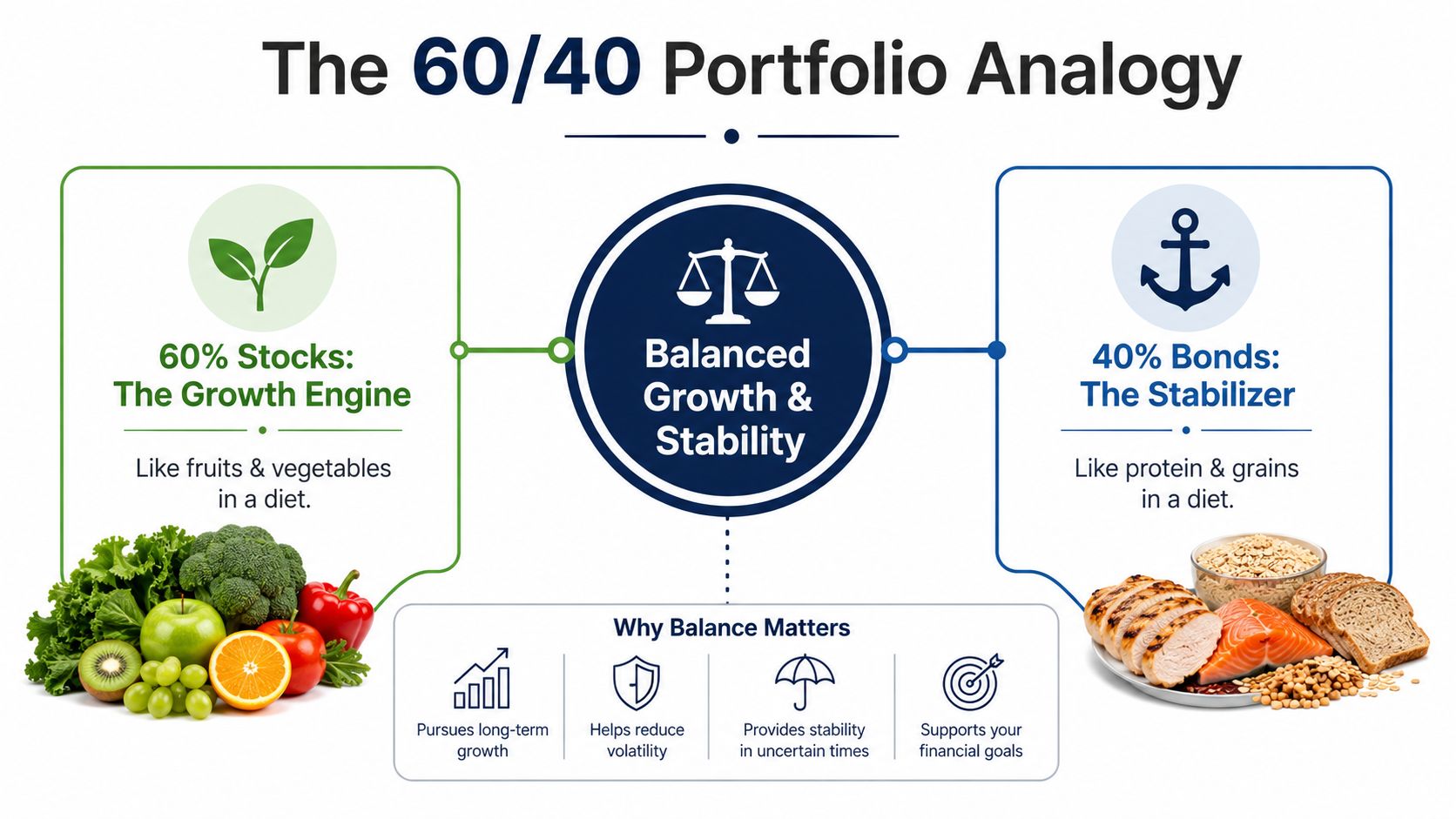
A 60/40 portfolio means 60% in equities and 40% in fixed income. The equity sleeve seeks long-term capital growth. The fixed-income sleeve contributes income and can reduce portfolio sensitivity to equity risk when rates and correlations cooperate. Capital Group's explanation of the 60/40 structure also identifies rebalancing back to the target as a standard portfolio mechanic when market movements create drift.
The allocation is a system, not a slogan
Suppose equities rise and become a larger share of the household portfolio. A rebalance sells part of the overweight sleeve and directs the proceeds toward the underweight sleeve. If equities fall, the same discipline can require buying them back toward target. The process creates a repeatable risk-control mechanism, although it doesn't guarantee a profit or prevent losses.
The 40% bond allocation also deserves closer inspection. It represents exposure to interest rates and duration, not “stability.” Longer-duration bonds generally respond more sharply to changes in yields. Falling rates can support their prices and improve their defensive contribution, while rising rates can pressure prices and weaken the expected shock absorption.
That distinction should appear in the investment policy statement. “Bonds for safety” is too vague. A stronger description identifies the intended role, maturity profile, credit quality, income objective, and circumstances that could cause the sleeve to behave differently.
A client-ready explanation
“The 60% is designed to provide the portfolio's primary growth engine. The 40% is designed to provide income, liquidity, and resilience, but its value depends on interest rates, inflation, and the types of bonds selected.”
That language keeps the benefit without making a promise. It also creates room for a deeper discussion about whether the fixed-income sleeve is being used for spending needs, volatility management, capital preservation, or a combination of objectives.
Long Run Performance Across Markets and Regimes
The strongest case for the 60/40 portfolio comes from its long record, not from a claim that every period was comfortable. The CFA Institute's historical research examines the allocation across major markets from 1901 to 2022. That length matters because it includes very different inflation, growth, and interest-rate environments.
A hypothetical 60/40 portfolio produced a 5.0% annual return since 1925, according to the CFA Institute research summarized by Strategic Investor's long-horizon review. GMO's analysis found that a U.S. stock and U.S. bond mix delivered about 4.7% real annual return since 1900, but the path included six separate periods averaging 11 years each when the portfolio merely kept pace with inflation or lost real purchasing power. Those figures support a balanced allocation, but they don't support selling it as a smooth wealth-building machine.
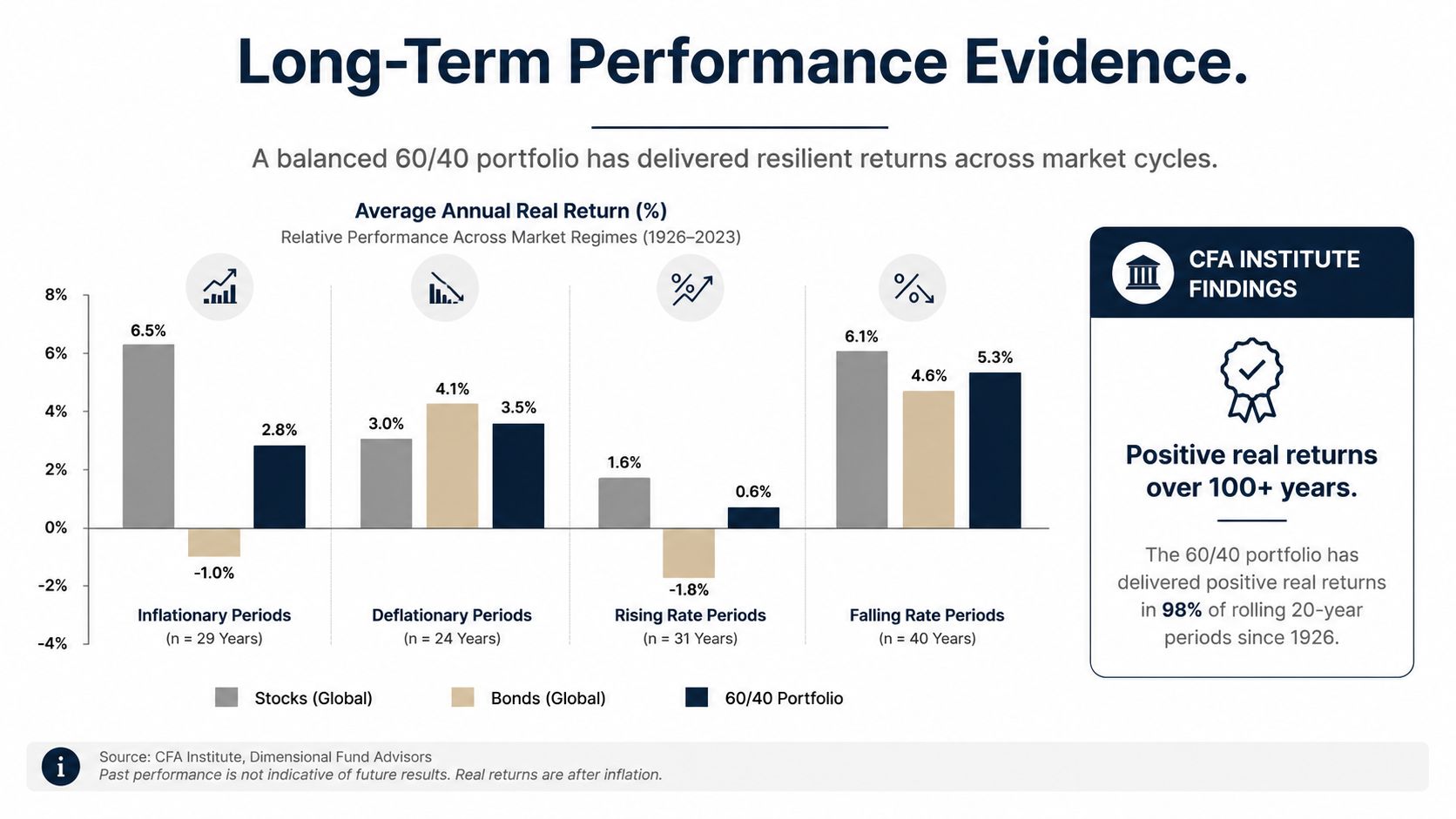
Average return is only one part of the record
Modern global data provides a useful second lens. Vanguard's reported global portfolio figures show a 6.9% trailing annualized return over 10 years, close to a 6.8% long-term average, with the interquartile range of 10-year annualized returns since 1997 between 5.6% and 7.6%. This is a reasonable historical baseline for setting expectations, but the range also shows why a single average can't describe every client experience.
Capital Group found that a hypothetical 60/40 portfolio produced positive returns in 15 of the 20 calendar years from 2005 through 2024. Only two of the five negative years were double-digit declines, specifically 2008 and 2022, as reported in the same historical portfolio summary.
The advisor's job is to present both sides:
- Long-term usefulness: Equity growth, bond income, and rebalancing have supported the model across long datasets.
- Uneven experience: Inflationary and rate-shock periods can create extended stretches of weak real purchasing power.
- Client suitability: The allocation must fit the household's spending horizon, loss tolerance, and need for dependable liquidity.
The defensible message isn't that 60/40 always works. It's that the model has historically offered a durable framework, while its results depend on the regime and the construction of its sleeves.
Why 60 40 Broke in 2022 and What Correlation Really Means
The 2022 experience exposed the flaw in the phrase “bonds always hedge stocks.” They don't. Morningstar reported that the 60/40 portfolio declined 25.1% in 2022, demonstrating that the structure can suffer substantial losses when equities and fixed income decline together.
Correlation measures how two assets move relative to each other. Negative correlation can help a bond allocation offset part of an equity decline. Positive correlation means both sleeves may move in the same direction, reducing the diversification benefit even when the portfolio still contains two different asset classes.
Institutional research reported an average stock-bond correlation of -0.37 during 2011 to 2021 and +0.41 after 2022, as summarized by State Street Global Advisors' correlation analysis. The same allocation can therefore look defensive in one regime and much more equity-like in another.
| Regime | Typical stock-bond correlation | Implied behavior |
|---|---|---|
| Diversifying regime | -0.37 during 2011 to 2021 | Bonds may cushion equity weakness |
| Joint-loss regime | +0.41 after 2022 | Both sleeves may fall together |
| Shifting regime | Correlation changes over time | Portfolio behavior requires monitoring |
The practical lesson is that weights don't tell the whole risk story. Advisors should review rolling correlation, duration, yield exposure, and inflation sensitivity rather than assuming the 40% sleeve will always provide ballast. A client who asks why bonds failed deserves an answer tied to the economic mechanism, not a dismissal of the outcome.
Duration belongs in that conversation. Advisors can use this guide to calculate bond duration when assessing how strongly a bond allocation may respond to changes in yields. The purpose isn't to predict the next rate move. It is to understand the exposure already embedded in the portfolio.
Client language: “The bond allocation reduced risk in some historical environments, but diversification is conditional. When inflation and rates pressure stocks and bonds at the same time, both sleeves can lose value.”
Implementing 60 40 in a Real Client Portfolio
Implementation should begin with the household's objective, not with a preselected fund or a rigid account template. A client seeking current income may need a different bond structure from a household focused on long-term accumulation. Taxable and tax-deferred accounts may also call for different asset locations.
The workflow becomes clearer when each decision answers a client-specific question.
Account location comes first
Tax treatment can change the value of income-producing assets. Advisors should evaluate whether the bond sleeve belongs in a tax-deferred account when possible, while considering withdrawal rules, required liquidity, and the household's broader tax plan. Taxable accounts may still hold fixed income for liquidity or other planning reasons, but the choice should be deliberate.
The equity sleeve requires its own review. Geographic diversification, market-cap exposure, concentration, and the client's existing workplace or business exposure all affect the actual risk behind the headline 60%. A household heavily exposed to one employer may need a different equity design even if the policy target remains 60/40.
Bond construction requires judgment
The fixed-income sleeve should be selected by intended function:
- Income focus: Emphasize the role of yield and cash-flow reliability, while acknowledging credit and reinvestment risks.
- Resilience focus: Evaluate duration and quality for the type of shock the portfolio is expected to absorb.
- Liquidity focus: Match maturities and instruments to known spending needs instead of reaching for yield indiscriminately.
Then define the drift policy. The IPS should state whether the firm rebalances on a calendar review, a threshold breach, or a combination of both. Cash flows, withdrawals, dividends, and tax-loss activity can often move the portfolio toward target without creating unnecessary taxable sales.
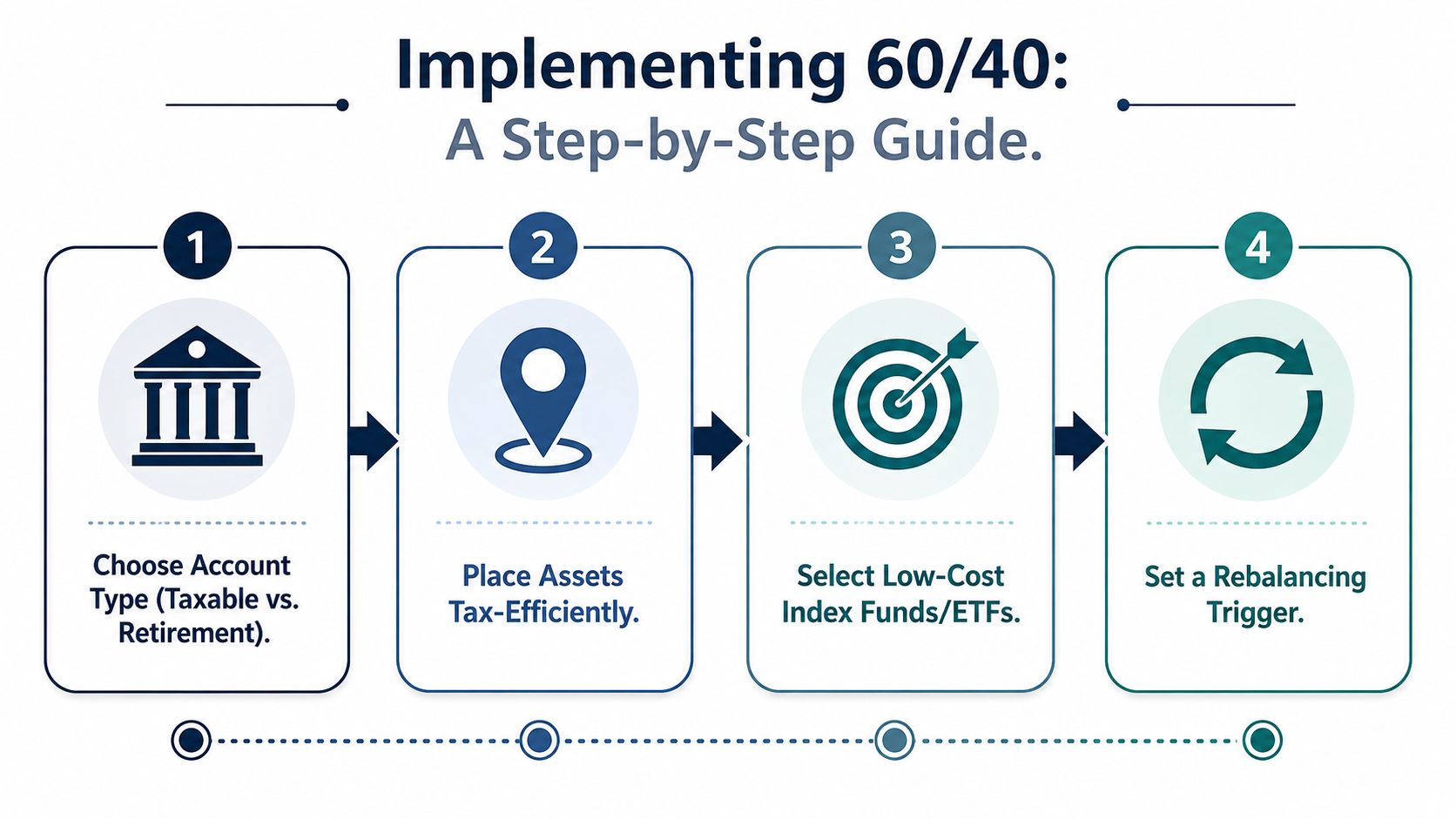
A disciplined process prevents rebalancing from becoming a market-timing exercise. It also gives the advisor a clear record of why trades occurred, which matters for client communication, supervision, and future review.
Common Variations Worth Considering for Specific Clients
The classic 60/40 allocation is a starting framework, not a universal prescription. The right variation depends on the client's goal, time horizon, income requirement, tax position, and ability to tolerate a drawdown. Complexity should earn its place in the portfolio.
| Allocation approach | Suitable client profile | Trade-off |
|---|---|---|
| 70/30 | Longer horizon and stronger tolerance for equity volatility | Greater growth exposure and less bond-based resilience |
| 60/40 | Balanced growth and income objectives | Outcomes remain sensitive to rates and correlation |
| 50/50 | More conservative spending or loss tolerance | Lower equity participation and potentially slower growth |
| 60/40 with inflation-sensitive assets | Client focused on purchasing-power risk | More moving parts and additional implementation decisions |
A 70/30 portfolio can fit a younger accumulator or a household with substantial nonportfolio income. The added equity exposure may support long-term growth, but it also raises the client's reliance on the equity sleeve during market stress. The advisor should not describe the change as a free return enhancement.
A 50/50 portfolio can make sense when spending stability matters more than maximizing growth. It still carries bond risk, and a higher bond weight doesn't eliminate the possibility of simultaneous losses. It does, however, reduce the portfolio's direct dependence on equities.
Additions should solve a defined problem
TIPS or other inflation-sensitive exposures may help address a client's concern about purchasing power. Alternatives or real assets may diversify risks that traditional stocks and bonds don't address, but they introduce liquidity, valuation, fee, and due-diligence questions. The portfolio shouldn't add complexity because the classic allocation has become unfashionable.
The equity sleeve also deserves geographic scrutiny. Advisors evaluating broader stock exposure can use emerging-markets stocks as a portfolio research topic, but the decision should connect to diversification, risk capacity, and the client's existing exposures.
A variation is additive when it improves alignment with a stated objective. It is over-engineering when neither the client nor the advisor can explain what problem the added sleeve solves.
A Compliance-Ready Playbook for Talking to Clients About 60 40
Compliance-ready communication starts with accurate framing. The advisor should describe the allocation as a long-term framework, not a forecast, guarantee, or insurance policy. Historical returns can provide context, but they cannot promise the next outcome.
A client meeting needs plain language that survives scrutiny:
“This allocation combines growth assets with income-producing assets. The bond sleeve can reduce risk in some environments, but stocks and bonds can also decline together.”
Rebalancing explanation: “Rebalancing is routine maintenance. It brings the portfolio back toward its agreed risk target when market movements cause the allocation to drift.”
The message should also explain why the current bond environment may differ from the low-rate period. Higher yields can make fixed income more relevant as an income source, but higher rates can still create price declines, particularly in longer-duration holdings. That distinction keeps the discussion useful without turning a rate view into a promise.
Claims to remove before publication
- Guaranteed protection: Avoid saying bonds will always offset stock losses.
- Single-period promotion: Don't use one favorable return to imply a permanent expected outcome.
- Dead-or-alive slogans: “The 60/40 portfolio is dead” is as weak as “60/40 always works.”
- Unqualified safety language: Identify the bond risks instead of calling the entire sleeve safe.
- Unclear process claims: State when and why rebalancing occurs.
Marketing teams also need a consistent visual and editorial process. A LinkedIn content creation platform can help organize educational material into clear advisor talking points, but every performance reference, risk statement, and visual claim still requires the firm's normal review.
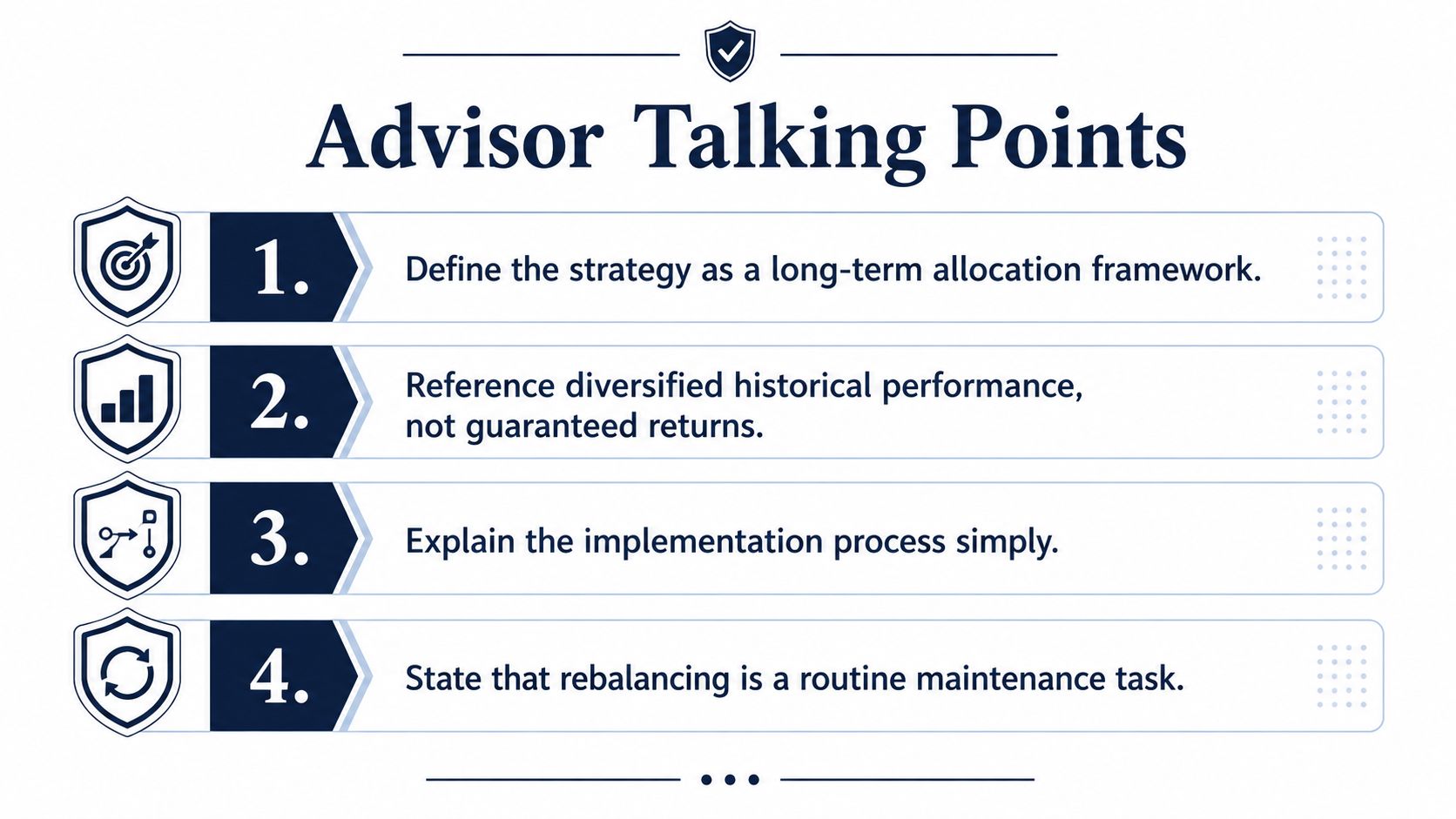
The strongest compliance posture comes from matching the portfolio's written rationale to the client-facing language. If the IPS says the bond sleeve provides income and liquidity, the website shouldn't call it a guaranteed hedge.
Reframing the Right Question About the 60 40 Portfolio
The right question in 2026 isn't whether the 60/40 portfolio is dead. It's what the allocation is supposed to accomplish for a particular household in the current rate and inflation environment.
For many clients, the answer is income plus resilience. The equity sleeve remains responsible for much of the portfolio's long-term growth potential. The bond sleeve can provide income, liquidity, and a possible source of resilience, but its effectiveness depends on duration, credit exposure, inflation, and stock-bond correlation.
The annual review should focus on decisions, not slogans:
- Goal alignment: Does the equity allocation still match the client's growth requirement and loss capacity?
- Bond function: Is the fixed-income sleeve built for income, liquidity, resilience, or a clearly defined combination?
- Regime awareness: Have correlation, inflation sensitivity, and rate exposure changed the portfolio's behavior?
- Rebalancing discipline: Does the process fit the household's tax sensitivity, cash flows, and spending needs?
- Communication quality: Could the client explain what the allocation can and cannot do?
A diversified portfolio produced about 9.4% in 2025, according to J.P. Morgan's long-term investing materials. That result is useful context, not a forecast. The same source also reports that a yearly rebalanced 60/40 portfolio generated a 7.2% annualized total return since 1794, reinforcing how much the strategy's long-run mechanics depend on rebalancing and the specific stock and bond sleeves selected.
Practical takeaway: Keep 60/40 when it fits the client's objective. Modify it when a defined risk, income, inflation, or liquidity problem requires a different design. Never keep it merely because it is familiar.
The advisor who can explain those trade-offs has a stronger client conversation than the advisor repeating that the model is either timeless or finished.
Advisor Momentum helps financial advisors build compliance-ready content, websites, branding, coaching systems, and lead-generation programs around the realities of regulated advice. Visit Advisor Momentum to turn this 60/40 framework into clearer client education, stronger marketing, and a more consistent growth process.
