

Client demand often rises before the firm is ready for it. An advisor may start the week thinking about planning work and client conversations, then spend the next three days chasing signatures, correcting CRM records, checking billing, and answering compliance questions that should already have a clear process behind them.
That tension is where many firms get stuck. Growth looks healthy from the outside, but inside the office, every new household adds more handoffs, more exceptions, and more risk. The result isn't only stress. It is slower onboarding, uneven client service, and less time for the work that deepens relationships.
Financial advisor practice management is what turns that chaos into an operating system. It connects people, workflows, compliance routines, and technology so the firm can serve clients consistently without overloading advisors or staff. When those pieces work together, the business gains capacity, protects margins, and creates room to scale.
Table of Contents
- Introduction to Financial Advisor Practice Management
- Understanding the Key Concepts of Practice Management
- Key Aspects of Effective Practice Management
- Examples of Financial Advisor Practice Management in Action
- Common Practice Management Challenges and Solutions
- Implementation Playbook and Quick Wins
- Conclusion and Next Steps
Introduction to Financial Advisor Practice Management
A busy advisory firm rarely breaks all at once. It slows down in small, expensive ways. One new client waits too long for paperwork. A review meeting gets prepared from three different systems. A staff member answers the same service question in a different way than a colleague. Compliance tasks pile up because nobody owns the calendar end to end.
That is why practice management matters. It gives a firm a consistent way to run the business behind the advice. Instead of relying on memory, heroics, or informal habits, the team uses defined processes for onboarding, service delivery, billing, documentation, technology use, and oversight.
In simple terms, financial advisor practice management answers five operating questions:
- Who does the work
- When it gets done
- How it gets done
- Where it gets documented
- How leadership knows it worked
A firm that can't answer those questions clearly usually feels busier than it is productive. A firm that can answer them tends to serve clients more consistently and use advisor time more carefully.
Practical rule: If a recurring task depends on one person's memory, it isn't a process yet.
Good practice management also keeps growth sustainable. More clients should not automatically mean more confusion. The strongest firms build a framework that joins service standards, workflows, compliance routines, and technology into one system. That is the thread running through this guide. Capacity and profitability improve when the firm stops treating operations, compliance, and technology as separate projects.
Understanding the Key Concepts of Practice Management
Practice management is often misunderstood as back-office administration. That definition is too small. A better way to think about it is as the coordination layer for the entire firm.
An advisory practice works a lot like an orchestra. The advisor may be the lead performer clients notice first, but the quality of the outcome depends on how well every section comes in on time. Onboarding, planning, portfolio administration, billing, service requests, records, and compliance reviews all have to follow the same score. If one section is off tempo, clients feel the friction immediately.
Practice management as firmwide coordination
Practice management organizes three main things:
- People: advisors, associates, operations staff, and compliance owners
- Processes: the repeatable steps behind client service and internal control
- Technology: the systems that hold data, trigger tasks, and document activity
That scope is broader than many firms expect. It includes service tiers, meeting preparation, follow-up tasks, fee processing, account paperwork, document storage, and escalation rules. It also includes less visible work such as permissions, training, and who approves exceptions.
A firm doesn't need complexity for its own sake. It needs predictability. Clients should receive the same standard of care whether the founder handles the relationship or a newer team member supports it.
Why compliance belongs inside practice management
Many firms separate compliance from operations. That creates gaps. If compliance sits in a binder while the actual workflow lives elsewhere, the team eventually follows the workflow and ignores the binder.
That is one reason formal review matters. SEC Rule 206(4)-7 mandates that RIAs formally review their compliance policies and procedures at least once per year, documenting findings and aligning updates with business changes to manage risk effectively, as outlined in this summary of the annual review requirement for RIAs.
That requirement is not just a legal checkbox. It is a management discipline. If the firm hires staff, adds services, changes systems, or introduces new technology, the compliance program has to match how the business operates.
Good practice management means the documented policy and the daily workflow say the same thing.
When that alignment exists, the firm gains more than compliance confidence. It reduces rework, shortens handoffs, and gives advisors more time for planning and relationship work.
Key Aspects of Effective Practice Management
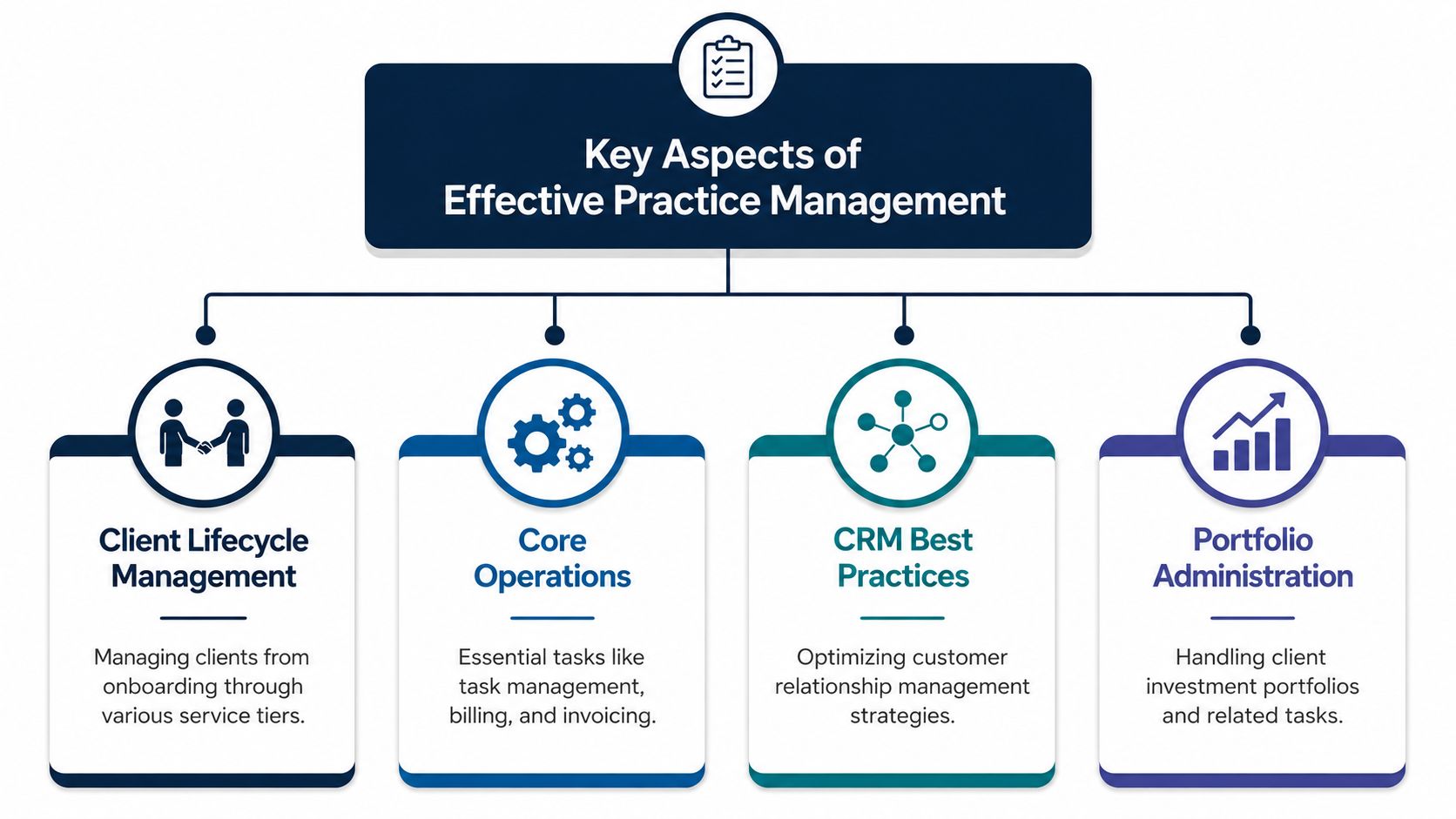
Strong practice management is easier to build when the firm breaks it into a few operating pillars. The mistake many teams make is improving one area in isolation. They clean up onboarding but ignore records. They buy better software but leave service tiers vague. They tighten compliance language but never fix the workflow that created the issue.
The better approach is to treat each area as connected to the others.
A firm can see the financial stakes in the numbers. The median operating profit margin for RIA firms is 20–25%, with top-quartile firms achieving 33–40%. Key benchmarks include keeping overhead under 35% of revenue and allocating 35–40% to advisor compensation, according to this discussion of RIA financial benchmarks. Practice management affects those margins because every manual touch, duplicate entry, and unclear handoff adds overhead.
Client lifecycle management
The client lifecycle starts before the first account is opened and continues through every review, service request, and referral opportunity after that. Firms often think about this as onboarding alone, but that misses the full picture.
A sound lifecycle model answers questions such as:
- Qualification: Which prospects fit the firm and which do not
- Onboarding: What paperwork, disclosures, and introductions happen in sequence
- Service tiers: Which clients receive which meeting cadence and response standards
- Review process: How planning updates, account reviews, and follow-ups are prepared and recorded
- Offboarding: What happens when a relationship ends
Without a clear lifecycle, staff create custom processes for each household. That feels personalized, but it usually means the team is reinventing the same work.
A simple example helps. If a firm serves both complex wealth clients and emerging accumulators, each segment shouldn't flow through the identical service path. One may need a deeper annual planning cycle. The other may benefit from a more simplified, education-focused process. Practice management makes those differences intentional instead of accidental.
Core operations and billing discipline
Operations are the hidden machinery of the firm. When they work, clients barely notice them. When they fail, trust erodes quickly.
Core operations usually include task routing, account setup support, billing workflows, invoice review where applicable, document collection, and exception handling. These activities should follow written instructions with ownership assigned at each step.
A helpful way to test operational strength is to pick one recurring event, such as a quarterly fee cycle or a new account opening, and ask three questions:
| Question | Why it matters |
|---|---|
| Who owns each step | Prevents dropped tasks and duplicate work |
| What triggers the next action | Reduces waiting and manual chasing |
| Where is proof stored | Supports both service continuity and oversight |
If the team can't answer those cleanly, the process is still too dependent on individuals.
CRM best practices and relationship continuity
A CRM should function as the firm's shared memory. In many practices, it becomes a partial contact list plus scattered notes. That weakens continuity when someone is out, when a client calls unexpectedly, or when the firm needs to review a relationship history.
Strong CRM use starts with standards, not software. Every firm needs rules for required fields, activity logging, task creation, meeting note structure, and follow-up deadlines. Without those rules, different team members enter data in different ways, and the system loses value.
For firms refining this area, this guide to CRM strategy for financial services teams is a useful companion to broader practice management work.
A CRM should answer, in one place, what happened, what is pending, and who owns the next step.
Client trust is shaped by those details. When a client hears, "Let the office check and call back," confidence drops. When the team can see history and act immediately, the experience feels coordinated.
Portfolio administration and compliance-ready records
Portfolio administration sits close to the client promise. It covers account maintenance, review preparation, data reconciliation, document handling, and records tied to recommendations or changes. Because it touches both investment activity and client communication, it needs especially clean controls.
Many firms discover that service quality and compliance quality are not separate outcomes. If review packets are prepared inconsistently, if account changes are documented in one system but not another, or if meeting notes don't explain what happened, the problem is operational first and regulatory second.
Recordkeeping discipline should cover:
- Client interactions: notes, requests, and follow-up actions
- Risk information: updates that affect recommendations or service approach
- Training and supervision: evidence that staff know the process they are expected to follow
- Internal checks: routine reviews that verify the documented process matches actual activity
When those records are complete and easy to retrieve, the firm is less likely to scramble during exams or internal reviews.
Technology integration and team structure
Technology delivers significant benefit only when systems exchange information cleanly and the team knows how to use them. Otherwise, software moves manual work from one screen to another.
Documented SOPs and end-to-end workflow mapping matter here. When firms codify service tiers, meeting frequencies, and response-time standards, then automate onboarding, proposals, and e-signatures, they can increase revenue-generating hours by 15–25%, according to this blueprint for financial firm practice management. The same analysis emphasizes mapping data flows between the CRM, planning tools, portfolio systems, and reporting platforms so staff aren't reconciling records by hand.
A practical staffing model usually includes clear role boundaries:
- Advisors focus on advice, judgment, and relationship leadership
- Operations staff manage workflows, records, and service execution
- Compliance owners maintain calendars, reviews, and policy alignment
- Leadership monitors performance and resolves bottlenecks
Even branding and public-facing details can support better operations when they are standardized. For example, teams that need professional imagery for bios, directories, and client-facing materials may find Secta Labs AI portrait studio helpful as part of a broader effort to keep outward presentation consistent across the firm.
Examples of Financial Advisor Practice Management in Action
Examples make the framework clearer because they show what changes when a firm stops managing by improvisation.

Example one from fragmented onboarding to a repeatable process
A boutique RIA had a familiar problem. New clients were saying yes, but the team handled each onboarding differently. One associate emailed forms manually. Another kept a personal checklist. Advisors answered status questions themselves because nobody trusted the process to move without intervention.
Leadership responded by documenting a single onboarding workflow from signed agreement through account funding and first review scheduling. Each step had an owner, a trigger, and a required record. Data fields were standardized so information entered once could move through the rest of the workflow without repeated manual updates.
The result wasn't magic. It was consistency. Onboarding no longer depended on which staff member happened to touch the file first. The team cut unnecessary back-and-forth, reduced missed follow-ups, and created more space for advisors to focus on planning conversations instead of status chasing.
The first sign that a process is working is simple. Staff stop asking who owns the next step.
Example two from audit anxiety to audit readiness
A mid-sized advisory firm had a different issue. Client service looked fine on the surface, but compliance preparation was reactive. Filing dates lived on separate calendars. Policy review notes were hard to track. Documentation existed, but retrieving it took too much time.
The firm tightened its operating rhythm by assigning ownership for each filing and review task, then linking those responsibilities to one compliance calendar. That matters because SEC-registered advisers must update Form ADV at least annually and map all filing deadlines to specific owners, as explained in this overview of compliance calendar and filing obligations. Once responsibilities were explicit, audit preparation became part of normal operations instead of an emergency project.
The measurable outcome in this kind of situation isn't only cleaner documentation. It is calmer decision-making. Staff know where records live, leadership can confirm tasks were completed, and the firm is far less likely to lose time to preventable surprises.
Common Practice Management Challenges and Solutions
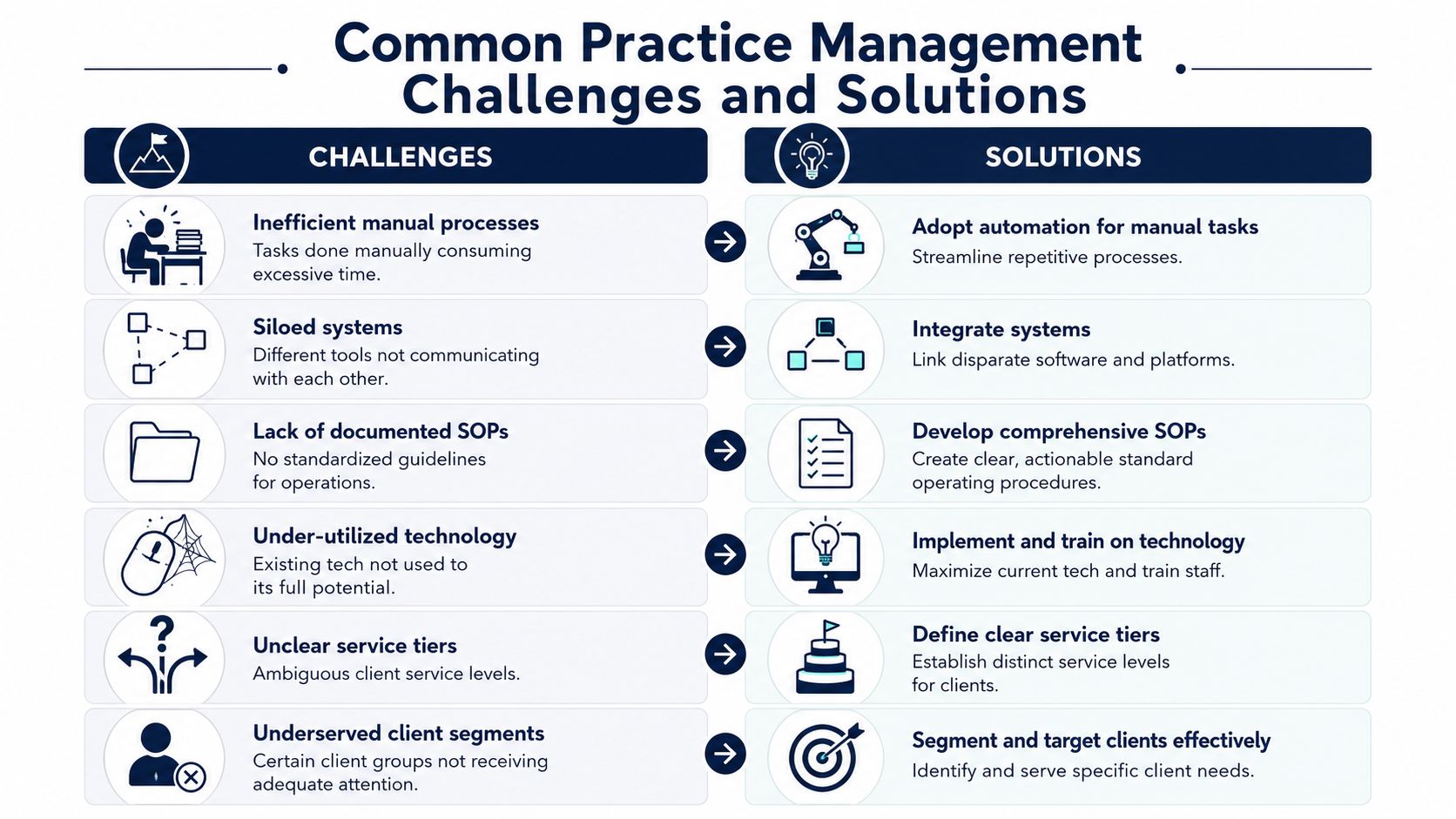
Most practice management problems look unique from inside the firm. In reality, they tend to come from a short list of recurring issues.
Where firms usually get stuck
Manual work is the first trap. Staff re-enter the same information in multiple places, build emails from scratch, and rely on memory for follow-up. That slows service and creates avoidable errors.
Siloed systems come next. Client details sit in one platform, tasks in another, and documents in a third. Nothing is necessarily wrong with each system on its own. The problem is the lack of connection between them.
Then there is the SOP gap. A firm may believe it has a process because experienced staff know what to do. But if that process isn't documented, trained, and reviewed, the firm doesn't have a repeatable system.
Unclear service tiers create another common bottleneck. When clients are not clearly segmented, everyone gets handled as an exception. Advisors over-serve some relationships, under-define others, and make staffing harder than it needs to be.
How to solve the problem without adding chaos
The fix starts with simplification, not more complexity.
- For manual processes: identify recurring tasks that follow the same pattern and convert them into checklists, templates, and automated handoffs where appropriate.
- For siloed systems: map where data begins, where it should flow next, and where the final record belongs. Integration decisions become easier once the workflow is visible.
- For undocumented work: write SOPs in plain language. A good SOP should let a trained team member complete the task without guessing.
- For weak technology adoption: train staff on the expected use of each system, then audit whether the system is being used that way.
- For vague service levels: define clear client tiers with explicit meeting cadence, deliverables, and response standards.
One challenge deserves special attention. Many firms struggle to serve middle-income households profitably because traditional pricing models don't fit that segment well. Some industry guidance notes that many practice management resources overlook this gap, while advisors can use hourly or subscription fees averaging 2–2.5% of client income to broaden access and remain viable, as discussed in this conversation on serving underserved client segments.
That doesn't mean every firm should change its model. It means practice management should include service design. If the firm wants to reach a broader market, it needs a delivery model that matches that market.
Underserved segments usually do not require lower standards. They require a different operating model.
Implementation Playbook and Quick Wins
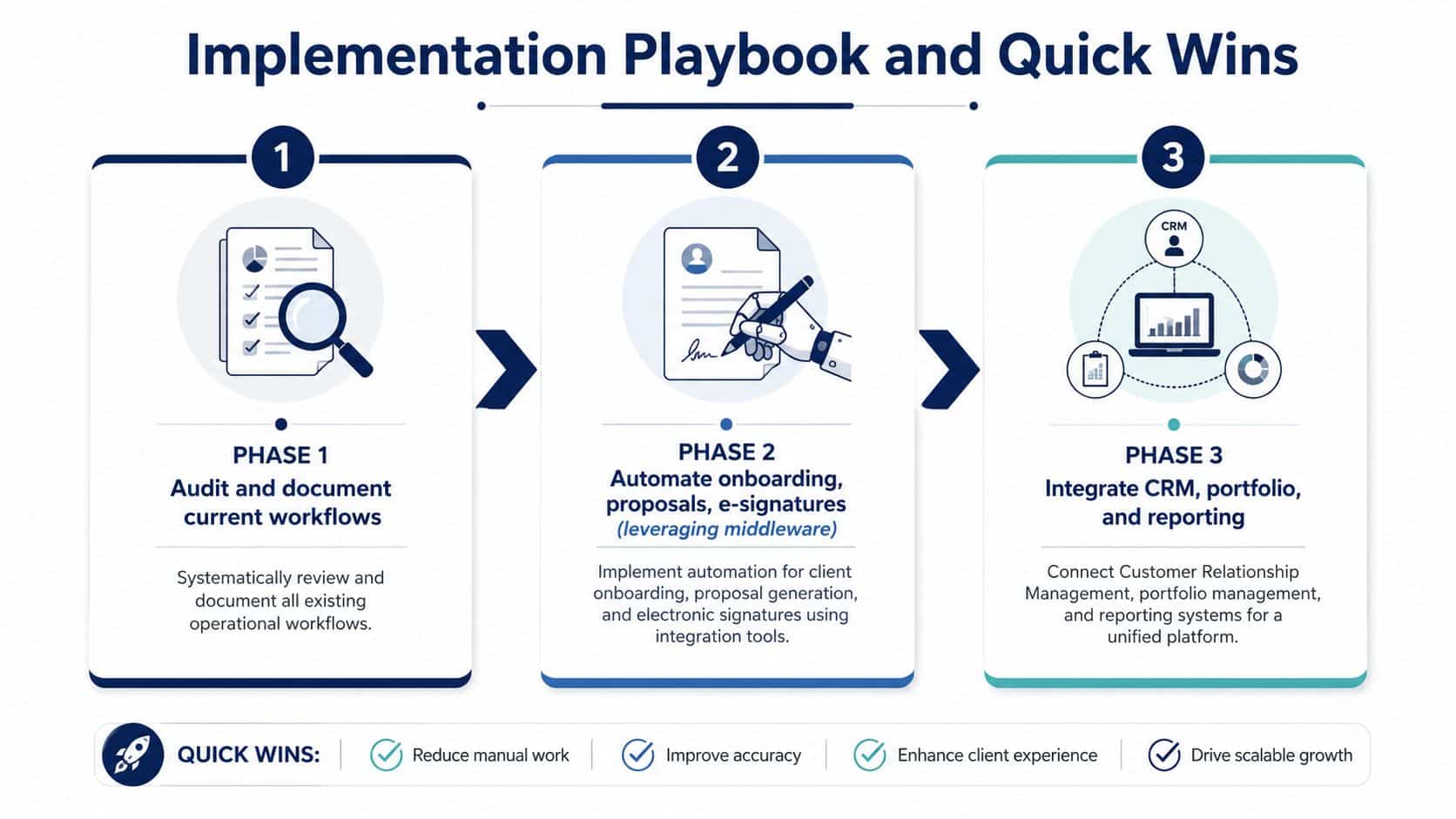
A workable rollout needs structure. Firms often try to improve everything at once, then lose momentum when daily work takes over. A phased plan works better because each step creates a cleaner foundation for the next one.
Phase one and phase two
Phase 1 is audit and documentation. Start by mapping how the firm currently handles onboarding, service requests, reviews, billing support, compliance checks, and exception handling. The point is not to judge the team. The point is to uncover where work is performed versus where leadership assumes it happens.
Quick wins in this phase:
- Pick one recurring workflow: document it from start to finish and assign ownership to each handoff.
- Create one source of truth: decide where final records must live so staff stop storing critical information in personal folders or inboxes.
Phase 2 is automation of routine workflows. Once the steps are clear, repetitive actions such as onboarding tasks, proposal preparation, and e-signature routing can be standardized and automated. Firms should automate only after the process itself makes sense. Otherwise, automation speeds up confusion.
One emerging area sits here as well. While 70% of advisors explore AI for automation, fewer than 15% have SEC-compliant AI governance frameworks; implementing reviewed AI workflows and training can free up 15–25% more revenue-generating hours, according to this analysis of AI adoption and governance for independent advisors. The operational lesson is straightforward. AI use needs documented review, approved use cases, and staff training before it belongs in a regulated workflow.
Phase three through phase five
Phase 3 is integration. Connect the systems that support client records, portfolio administration, and reporting so the team isn't reconciling the same information manually. At this stage, many firms also benefit from reviewing their broader advisor customer service framework so the service promise matches the operational design.
Phase 4 is measurement and calendar discipline. Build simple dashboards around workflow health, then maintain a compliance calendar with named owners. The best metrics are the ones that guide action, such as delayed onboarding items, pending service tasks, and incomplete documentation.
Phase 5 is training and refinement. A process isn't finished when it is written. Staff need to practice it, leadership needs to check adoption, and the firm needs a way to improve it when reality changes.
Quick wins for the later phases:
- Hold a short weekly operations review: focus on stuck items, not generic status updates.
- Review one SOP each month: compare the written process to actual behavior and update whichever one is out of date.
- Train for exceptions: many service failures happen not in routine work, but in unusual cases nobody defined in advance.
A good implementation plan feels modest at first. That is a strength. Firms improve faster when they build a process people will follow.
Conclusion and Next Steps
Financial advisor practice management works best when it is treated as one connected system. Client service, workflow design, technology use, documentation, team roles, and compliance oversight all shape the same outcome. A firm that improves only one of those areas usually finds the others pulling performance back down.
The firms that scale more smoothly tend to share a few habits. They document SOPs. They assign ownership clearly. They integrate systems where handoffs matter most. They review policies and workflows when the business changes, not only when a deadline forces attention. Most of all, they protect advisor time for advice instead of letting administrative drag consume it.
A stronger practice does not require endless complexity. It requires clarity. The team should know what happens, who owns it, how it is recorded, and how leadership verifies that the process worked.
A firm that wants a cleaner, compliance-ready growth model can get outside support before small inefficiencies become structural problems. Advisor Momentum helps financial firms strengthen branding, marketing, client service workflows, and operational execution in ways that fit regulated environments. A practical next step is to request a compliance-ready practice assessment or use a structured checklist to identify the biggest workflow gaps first.
