
He had a polished website, a steady stream of market commentary, and a growing list of prospects asking smart questions in the comments. Then compliance asked to see every post, every reply, and every direct message tied to the business account, and the whole social strategy suddenly felt risky instead of useful. That's the point where many advisors freeze, lower their activity, or publish bland posts that never earn attention. Financial advisor social media compliance shouldn't push a firm into silence. It should give the team a clear operating system for posting with confidence, protecting records, and building trust in public.
Table of Contents
- Introduction
- Understanding the Regulatory Maze for Social Media
- Crafting Your Firm's Social Media Policy
- Implementing a Bulletproof Approval Workflow
- Mastering Supervision and Archiving Requirements
- Navigating Platform Rules and Testimonials
- Your Final Compliance Checklist and Next Steps
Introduction
The usual pattern is easy to recognize. An advisor writes a strong market update, pauses at the last minute, and deletes half of it because the language feels too promotional. Another advisor posts nothing at all, even though prospects are already searching for credibility online. The result is the same in both cases, lost momentum and a social presence that feels timid instead of authoritative.
That hesitation is understandable, because social media is not casual once it becomes a business channel. The good news is that the rules are workable when they're translated into a repeatable process. Compliance is not the enemy of visibility, it's the structure that makes visibility safe enough to scale.
A firm that gets this right doesn't rely on luck or memory. It runs a disciplined system for drafting, reviewing, approving, archiving, and supervising content. That kind of process turns social media from a source of anxiety into a credible extension of the advisory brand.
Understanding the Regulatory Maze for Social Media
Start with the regulator that governs the account
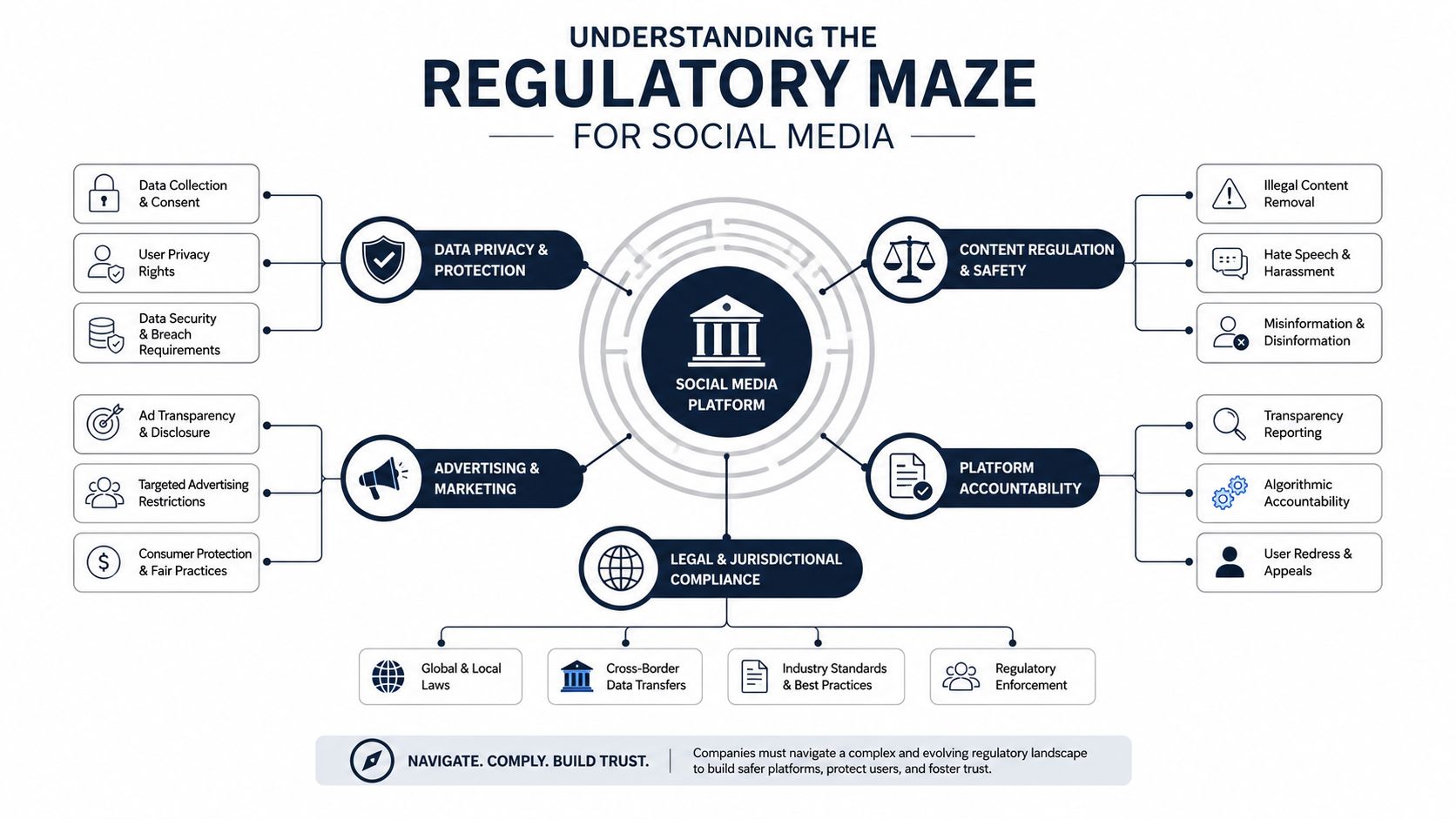
A firm that gets social media wrong usually starts with a bad assumption, it treats every profile as if it sits under the same rule set. A business-associated account is not a personal feed, and a casual-looking post can still count as a regulated communication. The right starting point is simple. Identify whether the account is tied to advisory business, client communication, or public marketing, then apply the controls that fit that use.
The SEC's Marketing Rule became effective on May 4, 2021 and changed how advisors can use testimonials and endorsements. Those materials are allowed when the rule's disclosure, oversight, and disqualification requirements are met. The disclosures also need to state whether the testimonial or endorsement was solicited or compensated, and they need to be readily accessible on the profile or a linked page. Social posts are short. Disclosure obligations are not. SEC Marketing Rule background for financial advisors
Practical rule: If a post is meant to attract, influence, or reassure a prospect, compliance should assume it needs review before it goes live.
Treat posts, comments, and shares as business communication
Social media compliance reaches far beyond the original post. Comments, reposts, replies, and direct messages can all become part of the business record if they relate to advisory activity. A supervisor who only checks the main feed misses a large part of the risk surface.
Firms should not organize their controls around “marketing content” alone. They need to treat the channel as regulated business communication that includes public-facing and one-to-one interactions. The operational question is straightforward. If the account is used for business, the firm needs a process for what gets reviewed, what gets retained, and what gets escalated.
The public and the informal often blur together on social media, but compliance cares about function. A comment that answers a product question, confirms services, or invites a consultation belongs in the review workflow. A like or share can also matter when it signals endorsement, amplifies promotional content, or appears under a business identity.
Know why FINRA and SEC expectations diverge in practice
For many advisory firms, the operational question is not which regulator exists in theory. It is which rule set drives day-to-day supervision. FINRA-oriented guidance says firms must archive social media communications for at least 3 years, while SEC-related guidance for RIAs says communications records should be kept for 5 years under Rule 204-2. Many firms choose the longer retention standard so one process covers the whole business. FINRA and SEC-oriented recordkeeping guidance for advisors
That choice affects more than storage. It shapes supervision, retrieval, and exam readiness. A firm that cannot produce records quickly creates a bigger problem than a firm that posts less. The better approach is to define the account type first, then align the review and retention process to the stricter expectation that applies to the firm. A practical playbook for content planning can help here, especially when the firm wants a repeatable process instead of ad hoc decisions, as outlined in this advisor content marketing framework and the guide for enterprise social ops.
Crafting Your Firm's Social Media Policy
A policy that works in practice answers the questions an advisor faces right before posting. What can be posted, who reviews it, which disclosures belong on the final version, and what happens when someone wants to share client feedback. Without that detail, every post turns into a one-off judgment call, and that is where firms start to drift into inconsistency.
Build the policy around control points
Start with the approved platforms and the approved account types. The policy should also say whether personal accounts can be used for business activity, and if so, what limits apply. That matters because business content stays business content even when it comes from a personal profile.
The policy also has to define what cannot appear in a post. Promissory language, performance guarantees, and statements that could mislead a reader about future outcomes belong in the prohibited category. The review standard should be written in plain language so the advisor, marketer, and principal can apply it the same way.
Good policies remove judgment calls. They make the line between acceptable and unacceptable content visible before anyone hits publish.
Make disclosures and ownership rules explicit
Every policy needs a section on testimonials and endorsements. SmartAsset notes that firms should disclose whether a testimonial or endorsement came from a client and whether that person was compensated, should use a written agreement for promoters except in limited cases, and should prohibit certain bad actors from serving as promoters. It also says all business-associated social media content should go through compliance review before it goes live. SmartAsset's overview of advisor social media compliance
Translate that guidance into firm-specific rules. If an advisor wants to highlight a client remark, the policy should say where the disclosure goes, who signs off, and what supporting documentation must be saved. If the firm has multiple advisers or branch offices, the policy should explain whether each location follows the same standard or has an added review layer.
For teams building the content system around those controls, the content marketing guide for advisors gives a useful operational frame, and the guide for enterprise social ops shows how larger organizations document ownership, approvals, and accountability.
Write for day-to-day use, not audit shelf life
The strongest policies are readable under pressure. They define responsibilities, list the approval path, and explain escalation. They also separate business use from personal expression in a way that employees can follow.
A policy that nobody can use becomes a liability. A policy that names the content types, the reviewers, the disclosure rules, and the recordkeeping obligations becomes a training tool, a supervision tool, and an exam defense document at the same time.
Implementing a Bulletproof Approval Workflow
A policy without an operational workflow is just a document. The firm needs a repeatable sequence that moves each post from idea to publication without bypassing review. That sequence should be simple enough for advisors to follow and rigid enough that shortcuts don't slip through when the team gets busy.
Run content through a four-stage control loop
The cleanest workflow starts before anything is scheduled. Content is drafted in advance, then the team performs an internal self-review against a checklist. After that, the post is submitted with supporting documentation for compliance approval, and only then is it archived in its approved form before publication. Social media marketing workflow for financial advisors
That sequence works because it separates creative work from control work. The marketer can focus on clarity and tone during drafting. Compliance can focus on disclosures, claims, and suitability for public distribution during review. The principal or designated reviewer then gives the formal go-ahead based on the documented version, not an informal verbal summary.
A post should never move from draft to live status unless someone can later show what was reviewed, who approved it, and when that approval happened.
Use the right approval mechanics for the firm size
Small firms often try to manage review through email threads, which works until the first exam request or content dispute. Larger teams often need a formal queue, a reviewer assignment, and a visible approval status so nothing gets lost. The right software matters less than the presence of a clear intake path.
That's where firms usually benefit from choosing the right approval software that can preserve the draft, the approved version, and the reviewer trail in one place. The goal is not automation for its own sake. The goal is removing ambiguity about what was approved and what was not.
A strong workflow also reduces the temptation to “just post it now and fix it later.” In social media compliance, later is usually too late because the record already exists and the audience already saw the content.
Build supervision into the post-publication stage
Publication is not the end of the process. Comments and direct responses can add new compliance issues after the post goes live, especially when a prospect asks for specifics or a client adds a testimonial-style reply. The team needs a way to monitor reactions and capture significant interactions for supervision and recordkeeping.
That monitoring responsibility should be assigned, not assumed. Someone must own the review cadence, decide when a conversation needs escalation, and make sure the archived record reflects what happened. A good workflow doesn't just stop bad posts, it preserves the full context around the posts that do go out.
Mastering Supervision and Archiving Requirements
A post that goes live is not the end of the compliance process. Regulators treat social media as firm communication, so the firm has to supervise what was published, what was said in response, and what remained visible afterward. That oversight is what turns social media from a casual marketing habit into a defensible operating process.
Define the record, then capture it in full
The record should include more than the final post. It needs the post itself, the associated comments, the timestamps, the public replies, and any material edits that changed the message after publication. A screenshot alone usually falls short because it can miss the thread structure, the metadata, and the back-and-forth that gives the interaction its compliance context.
The same logic applies across channels. LinkedIn can create long comment chains and private follow-up messages that are easy to lose if the archive only captures the surface post. X, formerly Twitter, compresses exchange into shorter bursts, which makes it easy to miss the full story unless the archive preserves the complete thread and the surrounding response. The platform changes, the supervision problem does not.
A firm also needs a clear rule for what counts as a recordable interaction after publication. If a prospect asks for more detail, if a client corrects something publicly, or if a representative answers a question that changes the impression of the post, that exchange belongs in the archive. The review should cover the full business conversation, not just the headline content.
Build an archive that can survive an exam
A defensible archive has to do three things well. It has to preserve the content, make the record searchable, and keep the material retrievable without manual reconstruction. If a reviewer cannot pull a post and its related replies quickly, the archive is not doing enough work.
That is where automated content flagging systems can help. They do not replace human review, but they do give a compliance team a way to catch risky language, surface posts that need a closer look, and create a cleaner supervisory trail before an exam request lands.
The archive process should also be tested the way an examiner would test it. Pull a sample of posts, comments, direct responses, and edited versions, then confirm that the system can produce a complete record without piecing it together by hand. The test should cover routine content and higher-risk items, because the archive has to handle both.
Give supervisors a practical retrieval checklist
Supervision works better when the reviewer knows exactly what to look for. A simple exam-prep checklist should confirm that the archive shows the original publication date, the full thread, any edits, the reviewer history, and the final approved version of the content. If the firm uses multiple account types, the reviewer should also verify that business communications are being captured from each one, not just the main profile.
The other question is whether the archive reflects what the public saw. A compliant record is not just a storage file, it is proof of what the firm published and how it responded after the post went live. That becomes especially important when a comment thread is later deleted, edited, or turned into a private conversation. The supervisor should still be able to show the original public record and the firm's response to it.
Firms also need a backup plan for records that live in fast-moving channels or in account settings that can change without warning. A written retention policy should say where the archive lives, who can retrieve it, and what happens if a platform deletes or alters content. If the firm cannot explain that chain clearly, the supervision program will look improvised when someone asks for proof.
Navigating Platform Rules and Testimonials
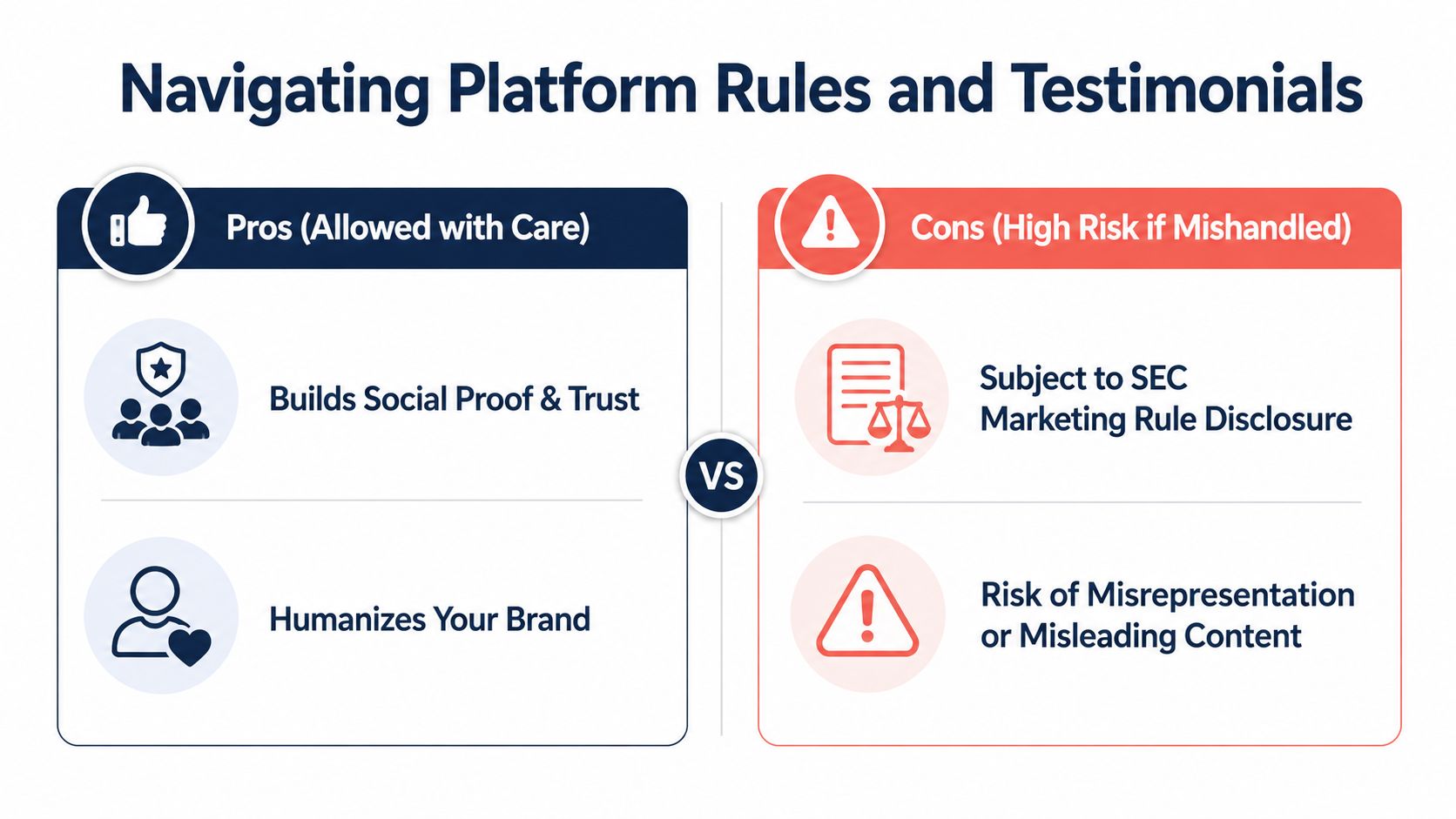
The SEC Marketing Rule didn't ban testimonials. It made them conditional. That distinction matters, because many firms still treat client praise as either forbidden or free-for-all material. The better view is that testimonials can be useful if the firm controls the language, the context, and the disclosures.
Disclose the relationship before you disclose the praise
A compliant testimonial post starts by telling the reader who the promoter is and how the testimonial or endorsement was obtained. The SEC marketing rule requires disclosures about whether the promoter is a current client or another person, how the testimonial or endorsement was solicited, and whether compensation was paid. If a current client receives more than $1,000 in non-cash compensation over 12 months, a written agreement is required. Copies of advertisements, including social-media posts and comments, must be retained for no less than five years. SEC testimonial and endorsement disclosure requirements for advisors
That is why the disclosure should not be buried in a forgotten profile page. It needs to be readily accessible, and it needs to match the way the content is published. If the testimonial lives in a short post, the disclosure must still be visible enough to inform the reader at the moment they engage with it.
Use examples that are accurate, not flashy
A compliant post might say that a current client shared a positive experience, that the statement was solicited by the firm, and that the person received compensation in line with the firm's policy. A non-compliant version skips those details and makes the praise sound spontaneous, universal, or results-based.
The difference is not style, it's substance. If the language suggests that one client's experience is typical or guaranteed, the post starts to imply a result the firm cannot control. If the wording hides the compensation arrangement, it creates an incomplete picture even when the praise itself is genuine.
The same caution applies across platforms. A LinkedIn post, a Facebook update, and a pinned profile comment all need the same discipline if they're being used to advertise advisory services. The format changes, but the disclosure standard doesn't.
Automate review, but don't automate judgment
Automation can help flag questionable language before publication, especially when a firm publishes regularly. A policy-violation detection workflow can surface missing disclosures or risky phrasing faster than a human reviewer scanning a crowded queue. For firms evaluating that layer of control, automated content flagging systems are worth studying as part of the broader supervision design.
Still, automation should support the reviewer, not replace the reviewer. The final call has to rest with a person who understands the firm's policy, the disclosure rules, and the context behind the post. That human judgment is what keeps a testimonial from becoming an unintentional misrepresentation.
For firms that want to make client praise part of the content strategy, a practical companion resource is the testimonial page on the website, because social proof should be governed consistently across the entire digital presence.
Your Final Compliance Checklist and Next Steps
A strong social media program comes down to four things, a written policy, a consistent approval workflow, reliable archiving, and disciplined handling of testimonials. If any one of those pieces is missing, the rest of the system carries more risk than it should. When they work together, the firm can post with confidence instead of caution fatigue.
Use this final check as a quick audit. Does the policy define what can be posted? Does every business post receive review before publication? Are comments and direct interactions captured in an archive that can be produced later? Are testimonial disclosures visible, documented, and approved?
That framework does more than reduce exam risk. It gives the firm a credible public voice, which is often the key business advantage. Advisors who can speak clearly online without creating avoidable compliance problems tend to earn more trust, not less.
Advisor Momentum helps financial firms build social, content, and web systems that respect the realities of regulation while still supporting growth. If social media compliance feels like a bottleneck, visit Advisor Momentum to see how a compliance-first marketing partner can turn that process into something the team can sustain.
